Hybrid E-Assessment in Higher Education: Semi-Automated Grading of Paper-Based Written Examinations
Pith reviewed 2026-06-27 18:04 UTC · model grok-4.3
The pith
Vision LLMs with two-pass validation and solution key checks reduce misclassifications in handwritten exam grading.
A machine-rendered reading of the paper's core claim, the machinery that carries it, and where it could break.
Core claim
The central claim is that recent vision-capable large language models, combined with a two-pass validation principle and comparison against a solution key, can reduce misclassifications and thereby improve the validity, fairness, and scalability of summative assessment.
What carries the argument
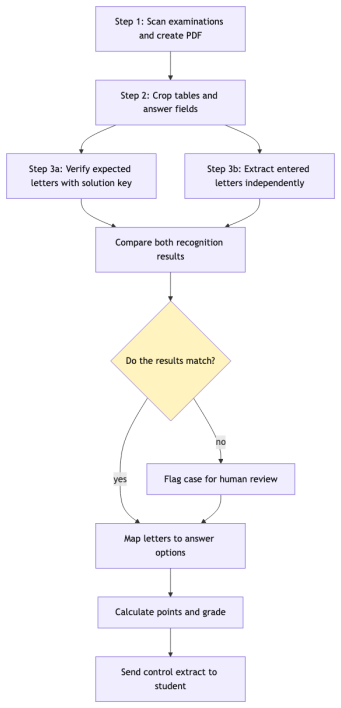
Two-pass validation principle with solution key comparison, used to improve accuracy of vision LLMs on structured handwritten answer fields.
If this is right
- Paper-based problem-oriented examination tasks can be retained while grading becomes semi-automated.
- Misclassifications in recognition of handwritten answers decrease.
- Validity and fairness of summative assessments increase.
- Scalability of assessments improves for large student cohorts without full digitization.
Where Pith is reading between the lines
- The approach could be adapted to process other structured handwritten inputs outside university exams.
- It suggests a pathway for universities to maintain traditional exam formats while gaining automation benefits.
- Similar validation steps might apply to other document processing tasks that mix handwriting and structured layouts.
Load-bearing premise
Vision LLMs can achieve reliable handwritten character recognition under realistic exam conditions when the two-pass validation and solution key comparison are applied.
What would settle it
A collection of real student exam papers processed by the system where the rate of character misclassifications remains high even after two-pass validation and solution key comparison.
Figures
read the original abstract
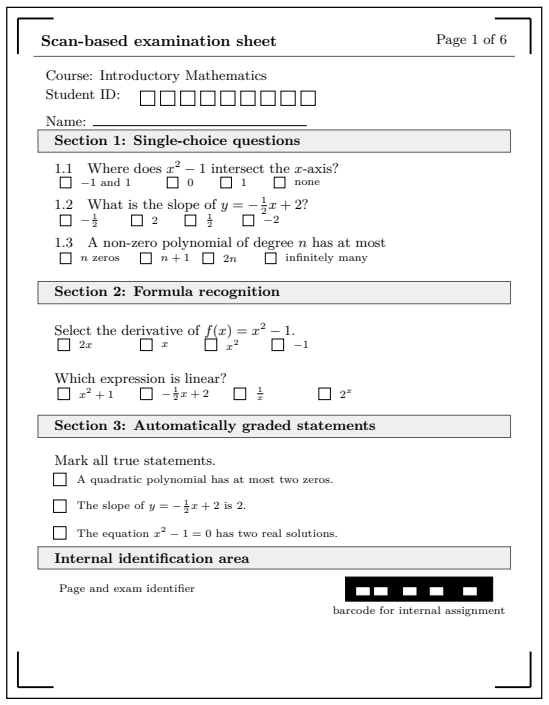
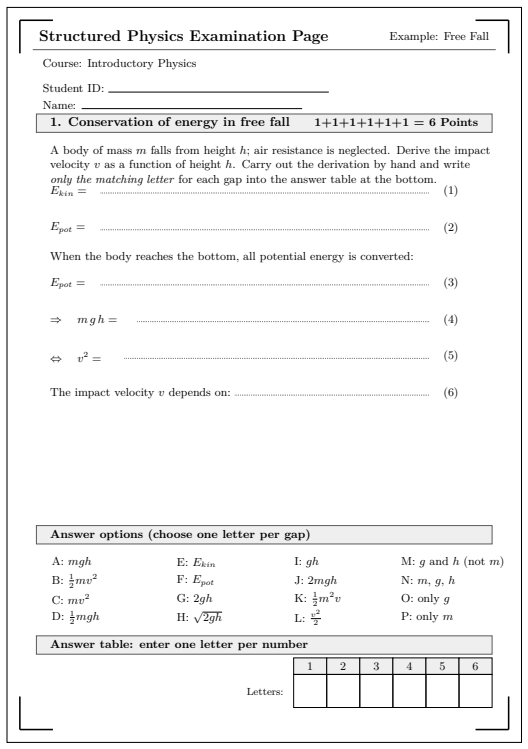
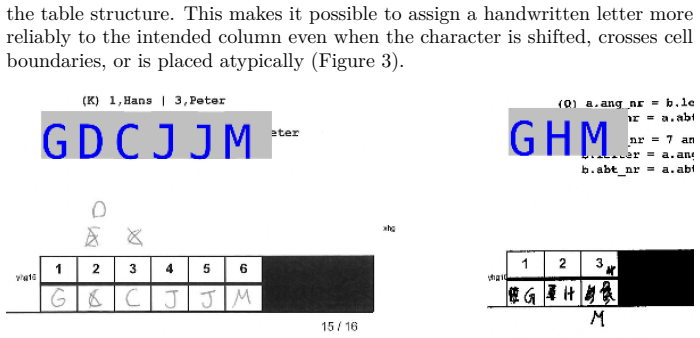
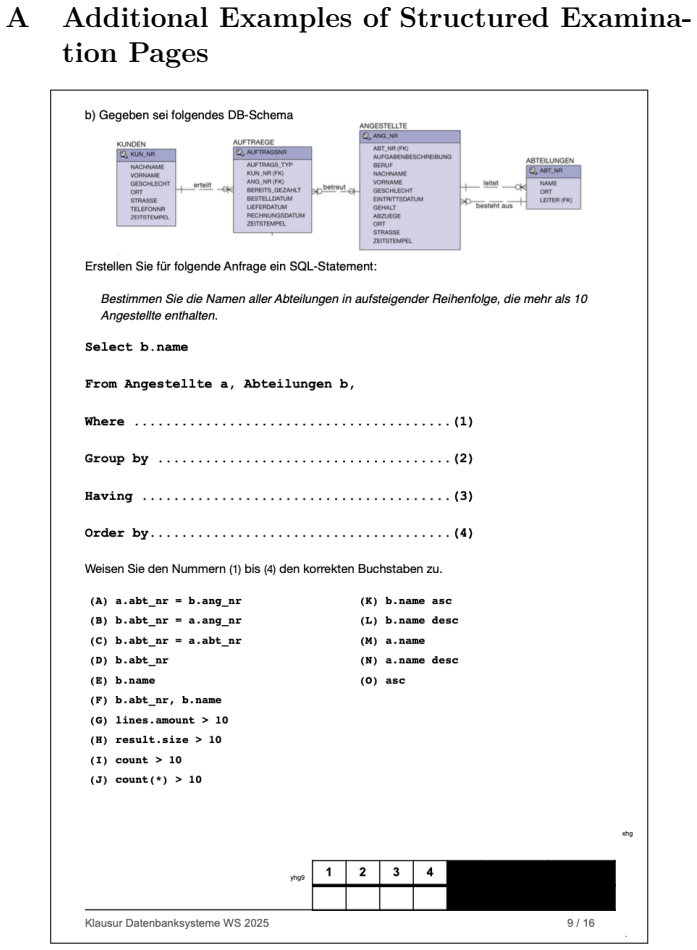
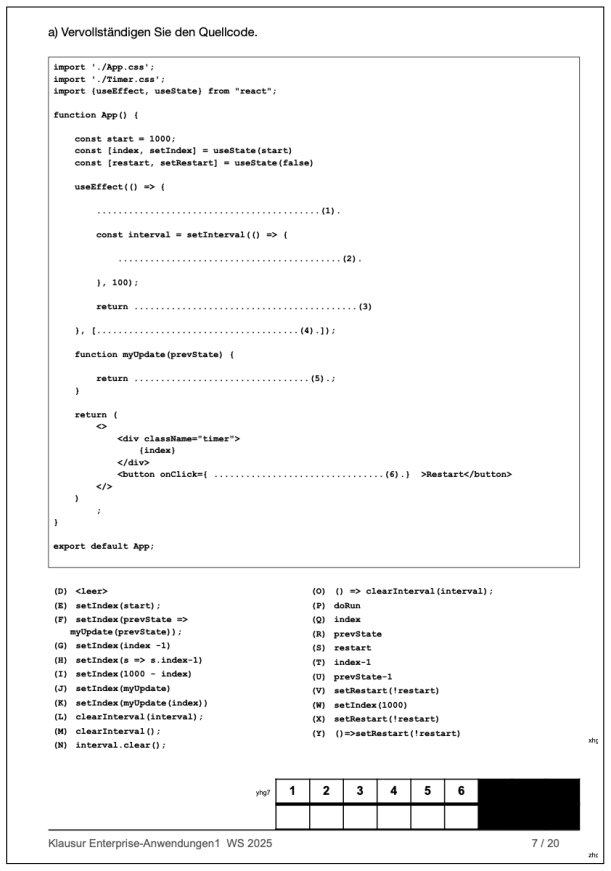
This paper examines the limitations of fully digital and partially digital e-assessment approaches in summative examinations in higher education. The analysis focuses on the didactic narrowing caused by closed question formats and on organizational, technical, and legal constraints that become particularly relevant in large student cohorts. As an alternative, the paper proposes a hybrid e-assessment approach that retains paper-based, problem-oriented examination tasks while enabling semi-automated grading. Assessment-relevant intermediate results are encoded in a structured answer format, entered by students by hand, and subsequently captured from table fields. The central technical bottleneck is reliable recognition of handwritten characters under realistic examination conditions. Recent vision-capable large language models, combined with a two-pass validation principle and comparison against a solution key, can reduce misclassifications and thereby improve the validity, fairness, and scalability of summative assessment.
Editorial analysis
A structured set of objections, weighed in public.
Referee Report
Summary. The paper proposes a hybrid e-assessment approach for higher education summative examinations that retains paper-based, problem-oriented tasks while enabling semi-automated grading. Students handwrite structured intermediate results in table fields; these are captured and processed by vision-capable large language models using a two-pass validation principle and comparison against a solution key. The central claim is that this combination can overcome the recognition bottleneck, reduce misclassifications, and thereby improve validity, fairness, and scalability compared to fully digital or partially digital alternatives.
Significance. If the proposed recognition method proves reliable under realistic exam conditions, the hybrid workflow could meaningfully address didactic narrowing and scalability issues in large-cohort assessments while preserving authentic problem-solving formats. The paper correctly identifies practical constraints (organizational, technical, legal) that current e-assessment systems face. However, because the manuscript contains no empirical results, the significance remains prospective rather than demonstrated.
major comments (1)
- [Abstract] Abstract and proposed workflow: The assertion that vision LLMs plus two-pass validation and solution-key comparison 'can reduce misclassifications' is presented as the solution to the central technical bottleneck, yet the manuscript supplies no quantitative evidence—no error rates, no test sets of real student handwriting, no comparison against human graders, and no evaluation under realistic scanning or answer-density conditions. This untested assumption is load-bearing for the entire proposal.
Simulated Author's Rebuttal
We thank the referee for the detailed and constructive review. We agree that the manuscript presents a conceptual proposal rather than an empirical study, and that the abstract's phrasing requires clarification to avoid implying demonstrated performance. We will revise accordingly.
read point-by-point responses
-
Referee: [Abstract] Abstract and proposed workflow: The assertion that vision LLMs plus two-pass validation and solution-key comparison 'can reduce misclassifications' is presented as the solution to the central technical bottleneck, yet the manuscript supplies no quantitative evidence—no error rates, no test sets of real student handwriting, no comparison against human graders, and no evaluation under realistic scanning or answer-density conditions. This untested assumption is load-bearing for the entire proposal.
Authors: We acknowledge that the manuscript is a design proposal without empirical evaluation of the recognition accuracy. The statement in the abstract describes the intended mechanism of the two-pass validation and solution-key comparison rather than a validated outcome. We will revise the abstract and introduction to explicitly frame the reduction in misclassifications as a hypothesis to be tested in subsequent empirical work, and to clarify that the current contribution lies in the overall hybrid workflow design and its potential to address didactic and scalability constraints. revision: yes
Circularity Check
No circularity; conceptual proposal without derivations or self-referential claims
full rationale
The manuscript is a high-level conceptual proposal for hybrid e-assessment. It identifies limitations of existing approaches and suggests a workflow using vision LLMs with two-pass validation and solution-key comparison. No equations, fitted parameters, derivations, or load-bearing self-citations appear in the provided text. The central claim is stated as a hypothesis rather than derived from internal inputs, making the paper self-contained as a non-mathematical proposal.
Axiom & Free-Parameter Ledger
axioms (1)
- domain assumption Vision-capable LLMs can achieve reliable handwritten character recognition in realistic exam conditions when combined with two-pass validation against a solution key
Reference graph
Works this paper leans on
-
[1]
Biggs, J. (1996). Enhancing teaching through constructive alignment.Higher Education, 32(3), 347–364. https://doi.org/10.1007/BF00138871 Black, P. & Wiliam, D. (1998). Assessment and classroom learn- ing.Assessment in Education: Principles, Policy & Practice, 5(1), 7–74. https://doi.org/10.1080/0969595980050102 Bommasani, R., et al. (2021). On the opportu...
work page internal anchor Pith review Pith/arXiv arXiv doi:10.1007/bf00138871 1996
-
[2]
https://doi.org/10.1111/j.1467-9280.2006.01693.x Schmees, M., Krüger, M. & Schaper, E. (2013). E-Assessments an Hochschulen: Ein vielschichtiges Thema. InE-Assessments in der Hochschullehre. Einführung, Positionen & Einsatzbeispiele: Psychologie und Gesellschaft(No. 13, pp. 19–32). PL Academic Research: Frankfurt, M. https://doi.org/10.25656/01:12879 Schm...
discussion (0)
Sign in with ORCID, Apple, or X to comment. Anyone can read and Pith papers without signing in.