Building Social World Models with Large Language Models
Pith reviewed 2026-06-27 10:32 UTC · model grok-4.3
The pith
Large language models can learn how social beliefs shift after events by mining temporal patterns in data alone.
A machine-rendered reading of the paper's core claim, the machinery that carries it, and where it could break.
Core claim
Social World Models built from LLMs can learn state-transition functions for social beliefs by mining temporal patterns in social data and optimizing the evidence lower bound, producing accurate forecasts of belief evolution on real prediction-market data without explicit human annotations or census statistics.
What carries the argument
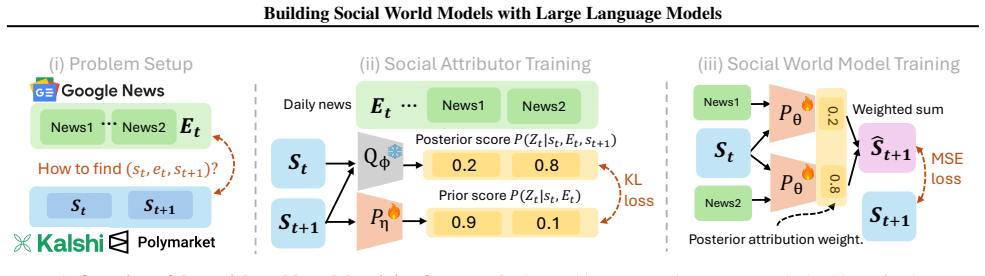
The Social World Model (SWM), an LLM-based framework that extracts state-transition functions for social beliefs from temporal social data by optimizing the evidence lower bound.
If this is right
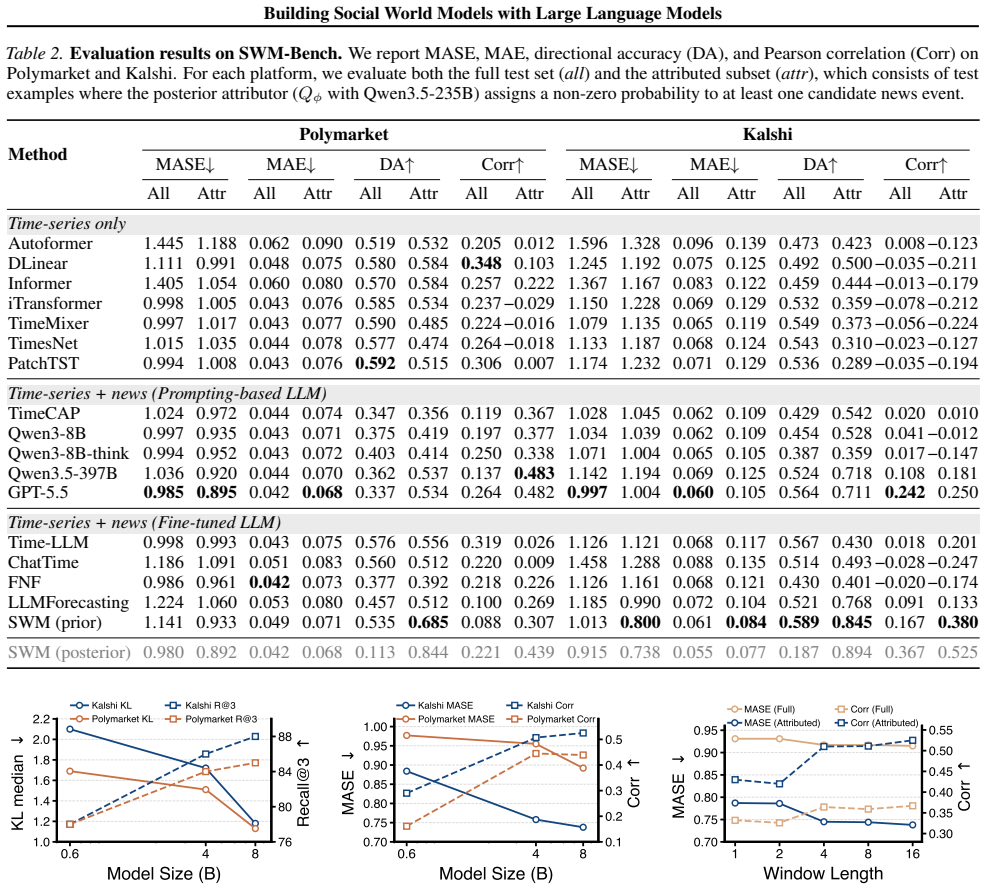
- SWM achieves state-of-the-art accuracy on Kalshi social-belief prediction tasks.
- SWM remains competitive with specialized time-series models on Polymarket data.
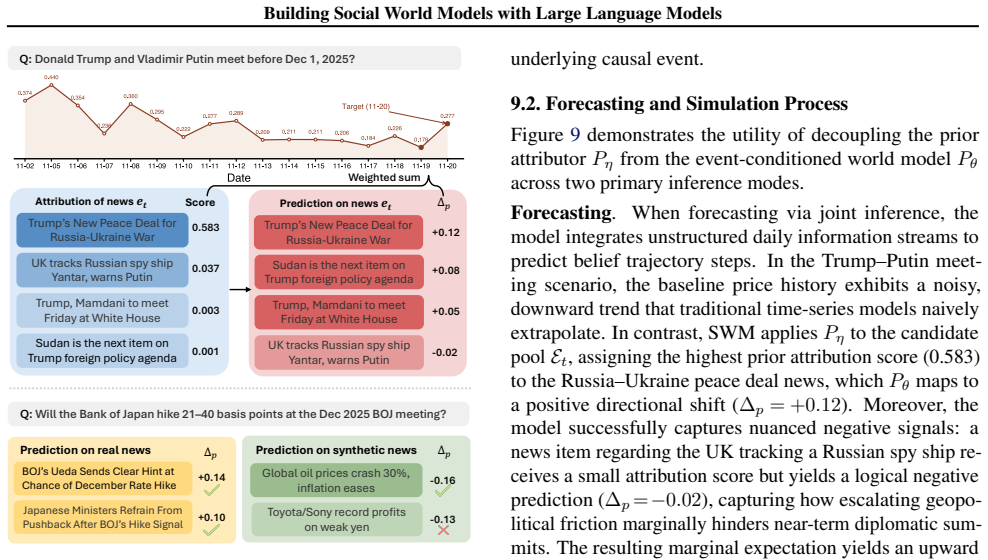
- SWM supplies human-readable accounts of the mechanisms driving belief changes.
- The approach works across politics, finance, and cryptocurrency domains using only unlabeled temporal sequences.
Where Pith is reading between the lines
- If the learned transitions generalize, the same models could simulate public response to entirely hypothetical future events before they occur.
- The framework could lower the cost of tracking opinion dynamics by replacing repeated large-scale surveys with model rollouts on public data streams.
- Extensions might link belief transitions to downstream behaviors such as voting or market trades to test causal pathways in social systems.
Load-bearing premise
That LLMs can reliably extract and model state-transition functions for social beliefs solely by mining temporal patterns in social data and optimizing the evidence lower bound, without explicit human annotations linking events to belief shifts or expensive census data.
What would settle it
Collect independent survey measurements or fresh market prices for a set of recent events not seen during training and test whether SWM-predicted belief trajectories match the observed shifts more closely than baseline time-series models.
Figures

read the original abstract
Understanding and predicting how social beliefs evolve in response to events -- from policy changes to scientific breakthroughs -- remains a fundamental challenge in social science. Given LLMs' commonsense knowledge and social intelligence, we ask: Can LLMs model the dynamics of social beliefs following social events? In this work, we introduce the concept of the Social World Model (SWM), a general framework designed to capture how social beliefs evolve in response to major events. SWM learns state-transition functions for social beliefs by mining temporal patterns in social data and optimizing the evidence lower bound, without the need for explicit human annotations linking events to belief shifts, or for expensive census data. To evaluate SWM, we introduce a benchmark, SWM-bench, derived from real-world prediction markets, specifically Kalshi and Polymarket. SWM-bench includes over 12k data points for social belief prediction tasks spanning diverse domains such as politics, finance, and cryptocurrency. Our experimental results show that SWM significantly outperforms time-series foundation models, achieving state-of-the-art results on Kalshi data and demonstrating competitive performance on Polymarket data, while offering interpretable insights into the underlying mechanisms of social belief dynamics.
Editorial analysis
A structured set of objections, weighed in public.
Referee Report
Summary. The paper introduces the Social World Model (SWM), a framework using large language models to model the dynamics of social beliefs in response to events. SWM learns state-transition functions by mining temporal patterns in social data and optimizing the evidence lower bound (ELBO), without requiring explicit human annotations or census data. It presents SWM-bench, a benchmark with over 12k data points from Kalshi and Polymarket prediction markets across politics, finance, and cryptocurrency. The paper claims that SWM achieves state-of-the-art performance on Kalshi data, competitive results on Polymarket, outperforming time-series foundation models, and provides interpretable insights into social belief dynamics.
Significance. If the results are robust and the market price proxy validly represents belief states, this could represent a significant advance in computational social science by enabling scalable modeling of belief evolution using LLMs and readily available market data. The annotation-free approach and interpretability are potential strengths. However, the reliance on prediction market data as ground truth for beliefs introduces a key assumption that requires careful validation for the findings to have broad impact.
major comments (3)
- [Abstract] The abstract asserts SOTA performance on Kalshi data and competitive performance on Polymarket without providing any quantitative metrics, baseline details, statistical tests, or error analysis. This makes it impossible to assess whether the data support the claim that SWM significantly outperforms time-series foundation models.
- [SWM-bench and Evaluation (experiments section)] The benchmark derives ground-truth transitions from prediction market prices. Market prices embed not only beliefs but also liquidity, risk premia, and betting incentives. The described method of temporal pattern mining and ELBO optimization on social data does not disentangle these confounds from the belief component. If the model is fitting market equilibrium dynamics rather than belief state transitions, the outperformance and mechanistic insights are likely artifacts of the proxy rather than evidence for a social world model.
- [Method (state-transition function learning)] The claim that the approach works 'without the need for explicit human annotations linking events to belief shifts' is load-bearing, but the evaluation uses market data which implicitly assumes that price changes reflect belief shifts. Additional validation, such as comparison to independent belief measures or ablation on incentive-free data, is needed to support this.
minor comments (2)
- [Notation] Clarify the exact formulation of the ELBO used for optimizing the state-transition functions, including any assumptions about the latent belief states.
- [Figure clarity] Ensure that any figures showing interpretable insights into belief dynamics include clear labels and legends to allow readers to verify the claimed interpretability.
Simulated Author's Rebuttal
We thank the referee for their constructive feedback on our manuscript. We address each of the major comments below, proposing revisions to improve clarity and address concerns about the evaluation proxy.
read point-by-point responses
-
Referee: [Abstract] The abstract asserts SOTA performance on Kalshi data and competitive performance on Polymarket without providing any quantitative metrics, baseline details, statistical tests, or error analysis. This makes it impossible to assess whether the data support the claim that SWM significantly outperforms time-series foundation models.
Authors: We concur that including quantitative details in the abstract would strengthen the presentation. In the revised version, we will incorporate specific metrics from our experiments, including performance improvements over time-series foundation models on both Kalshi and Polymarket datasets, along with references to statistical tests performed. revision: yes
-
Referee: [SWM-bench and Evaluation (experiments section)] The benchmark derives ground-truth transitions from prediction market prices. Market prices embed not only beliefs but also liquidity, risk premia, and betting incentives. The described method of temporal pattern mining and ELBO optimization on social data does not disentangle these confounds from the belief component. If the model is fitting market equilibrium dynamics rather than belief state transitions, the outperformance and mechanistic insights are likely artifacts of the proxy rather than evidence for a social world model.
Authors: We appreciate this critical observation on the use of prediction market data. Prediction markets are commonly employed as proxies for belief aggregation in social science research, but we recognize the presence of additional factors. We will revise the manuscript to include an expanded discussion in the evaluation and limitations sections on the assumptions underlying the use of market prices and potential confounds. This will help contextualize the results appropriately. revision: partial
-
Referee: [Method (state-transition function learning)] The claim that the approach works 'without the need for explicit human annotations linking events to belief shifts' is load-bearing, but the evaluation uses market data which implicitly assumes that price changes reflect belief shifts. Additional validation, such as comparison to independent belief measures or ablation on incentive-free data, is needed to support this.
Authors: The 'annotation-free' claim pertains specifically to the learning of the state-transition function from social data via temporal pattern mining and ELBO optimization, without requiring labeled pairs. The evaluation benchmark does rely on the assumption that market price changes serve as a proxy for belief shifts, which is standard but merits explicit acknowledgment. We will update the method and evaluation sections to clarify this assumption and discuss its implications. Additional independent validations represent valuable directions for future research. revision: partial
Circularity Check
No significant circularity identified
full rationale
The provided abstract describes SWM as learning state-transition functions via temporal pattern mining in social data plus ELBO optimization, then evaluating on a distinct SWM-bench derived from prediction-market data. No equations, self-citations, or load-bearing steps are quoted that reduce any claimed prediction to a fitted input or prior self-result by construction. The training and evaluation sources are presented as separate, so the derivation remains self-contained against external benchmarks.
Axiom & Free-Parameter Ledger
Reference graph
Works this paper leans on
-
[1]
T. M. Mitchell. The Need for Biases in Learning Generalizations. 1980
1980
-
[2]
2024 , eprint=
From News to Forecast: Integrating Event Analysis in LLM-Based Time Series Forecasting with Reflection , author=. 2024 , eprint=
2024
-
[3]
Proceedings of the AAAI Conference on Artificial Intelligence , volume=
Timecap: Learning to contextualize, augment, and predict time series events with large language model agents , author=. Proceedings of the AAAI Conference on Artificial Intelligence , volume=
-
[4]
arXiv preprint arXiv:2210.02186 , year=
Timesnet: Temporal 2d-variation modeling for general time series analysis , author=. arXiv preprint arXiv:2210.02186 , year=
-
[5]
Proceedings of the AAAI conference on artificial intelligence , volume=
Informer: Beyond efficient transformer for long sequence time-series forecasting , author=. Proceedings of the AAAI conference on artificial intelligence , volume=
-
[6]
International conference on learning representations , volume=
Timemixer: Decomposable multiscale mixing for time series forecasting , author=. International conference on learning representations , volume=
-
[7]
arXiv preprint arXiv:2211.14730 , year=
A time series is worth 64 words: Long-term forecasting with transformers , author=. arXiv preprint arXiv:2211.14730 , year=
-
[8]
International conference on learning representations , volume=
itransformer: Inverted transformers are effective for time series forecasting , author=. International conference on learning representations , volume=
-
[9]
Proceedings of the AAAI conference on artificial intelligence , volume=
Are transformers effective for time series forecasting? , author=. Proceedings of the AAAI conference on artificial intelligence , volume=
-
[10]
M. J. Kearns , title =
-
[11]
Machine Learning: An Artificial Intelligence Approach, Vol. I. 1983
1983
-
[12]
R. O. Duda and P. E. Hart and D. G. Stork. Pattern Classification. 2000
2000
-
[13]
Suppressed for Anonymity , author=
-
[14]
Newell and P
A. Newell and P. S. Rosenbloom. Mechanisms of Skill Acquisition and the Law of Practice. Cognitive Skills and Their Acquisition. 1981
1981
-
[15]
A. L. Samuel. Some Studies in Machine Learning Using the Game of Checkers. IBM Journal of Research and Development. 1959
1959
-
[16]
Aho and Jeffrey D
Alfred V. Aho and Jeffrey D. Ullman , title =. 1972
1972
-
[17]
Publications Manual , year = "1983", publisher =
1983
-
[18]
Ashok K. Chandra and Dexter C. Kozen and Larry J. Stockmeyer , year = "1981", title =. doi:10.1145/322234.322243
-
[19]
Scalable training of
Andrew, Galen and Gao, Jianfeng , booktitle=. Scalable training of
-
[20]
Dan Gusfield , title =. 1997
1997
-
[21]
Tetreault , title =
Mohammad Sadegh Rasooli and Joel R. Tetreault , title =. Computing Research Repository , volume =. 2015 , url =
2015
-
[22]
A Framework for Learning Predictive Structures from Multiple Tasks and Unlabeled Data , Volume =
Ando, Rie Kubota and Zhang, Tong , Issn =. A Framework for Learning Predictive Structures from Multiple Tasks and Unlabeled Data , Volume =. Journal of Machine Learning Research , Month = dec, Numpages =
-
[23]
Langley , title =
P. Langley , title =. Proceedings of the 17th International Conference on Machine Learning (ICML 2000) , address =. 2000 , pages =
2000
-
[24]
Climate research , volume=
Advantages of the mean absolute error (MAE) over the root mean square error (RMSE) in assessing average model performance , author=. Climate research , volume=
-
[25]
Advances in Neural Information Processing Systems , year=
Attention is all you need , author=. Advances in Neural Information Processing Systems , year=
-
[26]
Neural Computation MIT-Press , year=
Long Short-term Memory , author=. Neural Computation MIT-Press , year=
-
[27]
Ebook, Revised and , year=
Predictably irrational: the hidden forces that shape our decisions , author=. Ebook, Revised and , year=
-
[28]
Institute for Security and Development Policy [issue brief] , year=
Issues and Trends in US Presidential Election 2024 , author=. Institute for Security and Development Policy [issue brief] , year=
2024
-
[29]
2023 , publisher=
Preparing for a Longer War: Is a Ceasefire between Ukraine and Russia possible by 2024? , author=. 2023 , publisher=
2024
-
[30]
arXiv preprint arXiv:2404.04841 , year=
Unveiling Decentralization: A Comprehensive Review of Technologies, Comparison, Challenges in Bitcoin, Ethereum, and Solana Blockchain , author=. arXiv preprint arXiv:2404.04841 , year=
-
[31]
, author=
Culture as common sense: perceived consensus versus personal beliefs as mechanisms of cultural influence. , author=. Journal of personality and social psychology , volume=. 2009 , publisher=
2009
-
[32]
Journal of political economy , volume=
Cultural beliefs and the organization of society: A historical and theoretical reflection on collectivist and individualist societies , author=. Journal of political economy , volume=. 1994 , publisher=
1994
-
[33]
2000 , publisher=
Shared beliefs in a society: Social psychological analysis , author=. 2000 , publisher=
2000
-
[34]
, author=
Neurocommunication and the public: Trump's announcement to run for the 2024 US presidential election. , author=. Journal of Competitiveness , volume=
2024
-
[35]
Transactions on Machine Learning Research , year=
How Far Are We From AGI: Are LLMs All We Need? , author=. Transactions on Machine Learning Research , year=
-
[36]
Proceedings of the 58th Annual Meeting of the Association for Computational Linguistics: Tutorial Abstracts , pages=
Commonsense reasoning for natural language processing , author=. Proceedings of the 58th Annual Meeting of the Association for Computational Linguistics: Tutorial Abstracts , pages=
-
[37]
arXiv preprint arXiv:1909.01066 , year=
Language models as knowledge bases? , author=. arXiv preprint arXiv:1909.01066 , year=
Pith/arXiv arXiv 1909
-
[38]
arXiv preprint arXiv:1905.06316 , year=
What do you learn from context? probing for sentence structure in contextualized word representations , author=. arXiv preprint arXiv:1905.06316 , year=
Pith/arXiv arXiv 1905
-
[39]
Natural Language Processing and Chinese Computing: 8th CCF International Conference, NLPCC 2019, Dunhuang, China, October 9--14, 2019, Proceedings, Part I 8 , pages=
Improving question answering by commonsense-based pre-training , author=. Natural Language Processing and Chinese Computing: 8th CCF International Conference, NLPCC 2019, Dunhuang, China, October 9--14, 2019, Proceedings, Part I 8 , pages=. 2019 , organization=
2019
-
[40]
arXiv preprint arXiv:1904.09728 , year=
Socialiqa: Commonsense reasoning about social interactions , author=. arXiv preprint arXiv:1904.09728 , year=
Pith/arXiv arXiv 1904
-
[41]
arXiv preprint arXiv:1805.06533 , year=
Modeling naive psychology of characters in simple commonsense stories , author=. arXiv preprint arXiv:1805.06533 , year=
-
[42]
large language models: Judgmental forecasting in an era of advanced ai , author=
Humans vs. large language models: Judgmental forecasting in an era of advanced ai , author=. International Journal of Forecasting , year=
-
[43]
arXiv preprint arXiv:2402.02592 , year=
Unified training of universal time series forecasting transformers , author=. arXiv preprint arXiv:2402.02592 , year=
-
[44]
arXiv preprint arXiv:2109.13916 , year=
Unsolved problems in ml safety , author=. arXiv preprint arXiv:2109.13916 , year=
-
[45]
arXiv preprint arXiv:2310.13014 , year=
Large language model prediction capabilities: Evidence from a real-world forecasting tournament , author=. arXiv preprint arXiv:2310.13014 , year=
-
[46]
arXiv preprint arXiv:2005.00792 , year=
Forecastqa: A question answering challenge for event forecasting with temporal text data , author=. arXiv preprint arXiv:2005.00792 , year=
arXiv 2005
-
[47]
arXiv preprint arXiv:2505.09388 , year=
Qwen3 technical report , author=. arXiv preprint arXiv:2505.09388 , year=
-
[48]
2025 , url=
Introducing GPT-5.2 , author=. 2025 , url=
2025
-
[49]
ArXiv , year=
Can Lessons From Human Teams Be Applied to Multi-Agent Systems? The Role of Structure, Diversity, and Interaction Dynamics , author=. ArXiv , year=
-
[50]
arXiv preprint arXiv:2310.01728 , year=
Time-llm: Time series forecasting by reprogramming large language models , author=. arXiv preprint arXiv:2310.01728 , year=
-
[51]
ERN: Financial Crises (Econometric) (Topic) , year=
The Invisible Hand and the Rational Agent are Behind Bubbles and Crashes , author=. ERN: Financial Crises (Econometric) (Topic) , year=
-
[52]
International Journal of Advanced Computer Science and Applications , year=
Normalization of Unstructured and Informal Text in Sentiment Analysis , author=. International Journal of Advanced Computer Science and Applications , year=
-
[53]
IEEE Access , year=
AI Techniques and Applications for Online Social Networks and Media: Insights From BERTopic Modeling , author=. IEEE Access , year=
-
[54]
Agent-Based Social Simulation of the Covid-19 Pandemic: A Systematic Review , author=. J. Artif. Soc. Soc. Simul. , year=
-
[55]
ArXiv , year=
SocioVerse: A World Model for Social Simulation Powered by LLM Agents and A Pool of 10 Million Real-World Users , author=. ArXiv , year=
-
[56]
ArXiv , year=
S3: Social-network Simulation System with Large Language Model-Empowered Agents , author=. ArXiv , year=
-
[57]
ArXiv , year=
Neuro-symbolic Commonsense Social Reasoning , author=. ArXiv , year=
-
[58]
arXiv preprint arXiv:2510.19270 , year=
Social world model-augmented mechanism design policy learning , author=. arXiv preprint arXiv:2510.19270 , year=
-
[59]
ArXiv , year=
Social World Models , author=. ArXiv , year=
-
[60]
ArXiv , year=
mSCoRe: a Multilingual and Scalable Benchmark for Skill-based Commonsense Reasoning , author=. ArXiv , year=
-
[61]
Open Mind : Discoveries in Cognitive Science , year=
Agenda Setting and The Emperor’s New Clothes: People Diagnose Information Cascades During Sequential Testimony by Reasoning About Informants’ Speaking Order and Social Status , author=. Open Mind : Discoveries in Cognitive Science , year=
-
[62]
Environmental Innovation and Societal Transitions , year=
An interdisciplinary perspective on scaling in transitions: Connecting actors and space , author=. Environmental Innovation and Societal Transitions , year=
-
[63]
2024 , eprint=
Approaching Human-Level Forecasting with Language Models , author=. 2024 , eprint=
2024
-
[64]
unknown , year=
Large Language Models as Interpolated and Extrapolated Event Predictors , author=. unknown , year=
-
[65]
2025 , eprint=
DecisionFlow: Advancing Large Language Model as Principled Decision Maker , author=. 2025 , eprint=
2025
-
[66]
2026 , month = apr, day =
Introducing GPT-5.5 , author =. 2026 , month = apr, day =
2026
-
[67]
AAAI Conference on Artificial Intelligence , year=
Attentive Neural Point Processes for Event Forecasting , author=. AAAI Conference on Artificial Intelligence , year=
-
[68]
Proceedings of the 26th ACM SIGKDD International Conference on Knowledge Discovery & Data Mining , year=
Dynamic Knowledge Graph based Multi-Event Forecasting , author=. Proceedings of the 26th ACM SIGKDD International Conference on Knowledge Discovery & Data Mining , year=
-
[69]
ArXiv , year=
Addressing the alignment problem in transportation policy making: an LLM approach , author=. ArXiv , year=
-
[70]
Proceedings of the 36th Annual ACM Symposium on User Interface Software and Technology , year=
Generative Agents: Interactive Simulacra of Human Behavior , author=. Proceedings of the 36th Annual ACM Symposium on User Interface Software and Technology , year=
-
[71]
ArXiv , year=
Back to the Features: DINO as a Foundation for Video World Models , author=. ArXiv , year=
-
[72]
ArXiv , year=
Owl-1: Omni World Model for Consistent Long Video Generation , author=. ArXiv , year=
-
[73]
ArXiv , year=
Genie: Generative Interactive Environments , author=. ArXiv , year=
-
[74]
ArXiv , year=
Emergent Social Dynamics of LLM Agents in the El Farol Bar Problem , author=. ArXiv , year=
-
[75]
, author=
Attitude networks as intergroup realities: Using network-modelling to research attitude-identity relationships in polarized political contexts. , author=. The British journal of social psychology , year=
-
[76]
Philosophical Transactions of the Royal Society B: Biological Sciences , year=
Modelling social norms: an integration of the norm-utility approach with beliefs dynamics , author=. Philosophical Transactions of the Royal Society B: Biological Sciences , year=
-
[77]
Frontiers in Psychiatry , year=
A cultural-ecosocial systems view for psychiatry , author=. Frontiers in Psychiatry , year=
-
[78]
Humanities and Social Sciences Communications , year=
Large language models empowered agent-based modeling and simulation: a survey and perspectives , author=. Humanities and Social Sciences Communications , year=
-
[79]
Frontiers in Artificial Intelligence , year=
LLM services in the management of social communications , author=. Frontiers in Artificial Intelligence , year=
-
[80]
Psychological Review , year=
A Social Inference Model of Idealization and Devaluation , author=. Psychological Review , year=
discussion (0)
Sign in with ORCID, Apple, or X to comment. Anyone can read and Pith papers without signing in.