Semiparametric Bayesian inference for causal mediation in cluster randomized trials
Pith reviewed 2026-06-27 05:59 UTC · model grok-4.3
The pith
Parametric Bayesian models paired with a similarity-weighted Bayesian bootstrap enable accurate estimation of natural direct and indirect effects in cluster randomized trials even with few clusters.
A machine-rendered reading of the paper's core claim, the machinery that carries it, and where it could break.
Core claim
The central claim is that specifying parametric Bayesian models for the outcome and mediator together with a similarity-weighted Bayesian bootstrap that employs a distance metric between clusters avoids the need for restrictive parametric assumptions on uncertainty quantification and thereby accurately estimates natural direct and indirect effects in cluster randomized trials even when the number of clusters is small.
What carries the argument
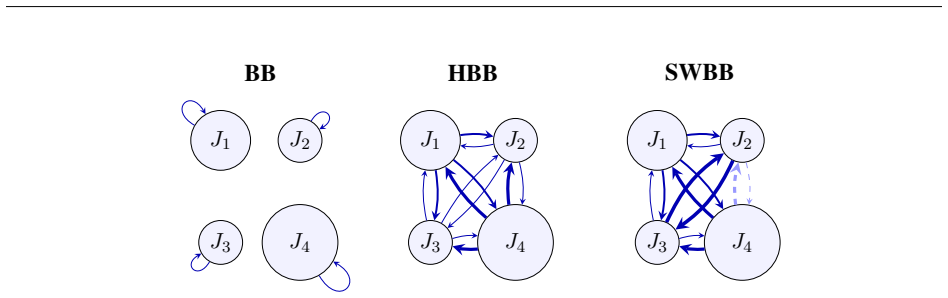
The similarity-weighted Bayesian bootstrap (SWBB) with a distance metric between clusters, which quantifies uncertainty by resampling while borrowing more information from closer clusters.
If this is right
- The method achieves nominal coverage probability across diverse simulation scenarios.
- The approach can be applied to real cluster randomized trials to assess mediation, as illustrated with data from a trial in Kenya.
- Natural direct and indirect effect estimates remain accurate when the number of clusters is limited.
- The framework combines observed-data models with causal assumptions to support inference without relying on large-sample asymptotics.
Where Pith is reading between the lines
- If suitable distance metrics can be defined, the resampling strategy could be adapted to other hierarchical data structures that require information borrowing across groups.
- The separation of parametric modeling from the bootstrap step suggests that non-parametric or semiparametric alternatives for the outcome and mediator could be substituted while retaining the uncertainty quantification procedure.
- The method's performance with small numbers of clusters implies it may reduce the sample-size requirements for mediation studies in settings where randomization occurs at the cluster level.
Load-bearing premise
The distance metric between clusters correctly identifies similarity for appropriate information borrowing in the similarity-weighted Bayesian bootstrap.
What would settle it
A simulation study in which the distance metric is misspecified relative to the true cluster similarity structure and the resulting coverage probabilities fall below nominal levels would falsify the claim.
Figures

read the original abstract
Cluster randomized trials (CRTs) are frequently used to evaluate interventions, yet conducting causal mediation analysis in these settings remains challenging, particularly when the mediator is measured at the cluster level and the number of clusters is small. Standard inference methods often rely on asymptotic assumptions that fail in finite-sample settings, leading to biased variance estimation and invalid confidence intervals. In this paper, we propose a robust inference framework for causal mediation analysis in CRTs. We utilize parametric Bayesian models for the outcome and mediator to ensure computational efficiency and interpretability. Crucially, to quantify uncertainty, we specify a novel similarity-weighted Bayesian bootstrap (SWBB) with a `distance' metric between clusters; this avoids the need for restrictive parametric assumptions and allows the model to borrow more information from `closer' clusters. By combining observed data models with causal assumptions, our approach accurately estimates natural direct and indirect effects even with limited clusters. Simulation studies demonstrate that our method achieves nominal coverage probability across diverse scenarios. We illustrate the practical utility of our approach by assessing mediation in a CRT in Kenya.
Editorial analysis
A structured set of objections, weighed in public.
Referee Report
Summary. The manuscript proposes a semiparametric Bayesian framework for causal mediation analysis in cluster randomized trials (CRTs) with small numbers of clusters. Parametric Bayesian models are specified for the outcome and mediator, combined with a novel similarity-weighted Bayesian bootstrap (SWBB) that employs a distance metric between clusters to borrow strength and quantify uncertainty without relying on asymptotic approximations. The central claim is that this yields accurate estimates of natural direct and indirect effects, with simulations demonstrating nominal coverage across scenarios and an application to a Kenyan CRT.
Significance. If the SWBB construction and distance metric perform as described, the approach would address a genuine practical gap in CRT mediation analysis, where standard methods suffer from poor finite-sample performance. The use of parametric models for computational tractability paired with a data-driven bootstrap for robustness is a reasonable strategy, and reproducible simulation results supporting nominal coverage would constitute a concrete contribution to the field.
major comments (2)
- [§4.2] §4.2 (SWBB construction): The distance metric and its associated parameters are presented as central to the weighting scheme, yet the manuscript provides no formal justification or data-driven procedure for their selection; because the SWBB is the device that relaxes asymptotic requirements, the lack of sensitivity analyses to metric misspecification directly weakens the claim that the method achieves nominal coverage 'even with limited clusters.'
- [Table 3] Table 3 (simulation results): Coverage probabilities are reported only under correctly specified distance metrics; without additional rows or scenarios that perturb the metric (e.g., using Euclidean distance when the true similarity is based on a different covariate), it is impossible to verify that the reported nominal coverage is robust rather than an artifact of the simulation design.
minor comments (2)
- [Abstract] Abstract and §2: The title uses 'semiparametric' while the text repeatedly describes 'parametric Bayesian models'; a brief clarification of which components are nonparametric would resolve the apparent tension.
- [§3.1] §3.1: Notation for the cluster-level mediator and the individual-level outcome is introduced without an explicit diagram or table linking the observed-data likelihood to the causal estimands; adding such a table would improve readability.
Simulated Author's Rebuttal
We thank the referee for their thoughtful and constructive comments, which highlight important aspects of the SWBB method and its evaluation. We address each major comment below and agree that revisions are needed to strengthen the manuscript.
read point-by-point responses
-
Referee: [§4.2] §4.2 (SWBB construction): The distance metric and its associated parameters are presented as central to the weighting scheme, yet the manuscript provides no formal justification or data-driven procedure for their selection; because the SWBB is the device that relaxes asymptotic requirements, the lack of sensitivity analyses to metric misspecification directly weakens the claim that the method achieves nominal coverage 'even with limited clusters.'
Authors: We agree that the manuscript lacks a formal data-driven procedure for selecting the distance metric and its parameters, as well as sensitivity analyses under misspecification. In the revised version, we will add a dedicated subsection describing a cross-validation-based procedure for parameter selection and include sensitivity analyses that vary the metric (including misspecification cases) to demonstrate that coverage remains close to nominal. This directly addresses the concern regarding robustness. revision: yes
-
Referee: [Table 3] Table 3 (simulation results): Coverage probabilities are reported only under correctly specified distance metrics; without additional rows or scenarios that perturb the metric (e.g., using Euclidean distance when the true similarity is based on a different covariate), it is impossible to verify that the reported nominal coverage is robust rather than an artifact of the simulation design.
Authors: The referee is correct that the current Table 3 reports coverage only under correctly specified metrics. In the revision, we will augment the simulation study with additional scenarios that deliberately perturb the distance metric (e.g., using Euclidean distance when the true similarity depends on a different covariate set) and report the resulting coverage probabilities. These results will be added to support the claim that performance is not an artifact of the simulation design. revision: yes
Circularity Check
No significant circularity detected
full rationale
The derivation combines standard parametric Bayesian models for the outcome and mediator with causal mediation assumptions and introduces a similarity-weighted Bayesian bootstrap using a distance metric between clusters. No quoted equations or steps reduce a claimed prediction or result to its own fitted inputs by construction, nor do self-citations load-bear the central identification; the approach is presented as self-contained against finite-sample issues via simulation validation rather than tautological re-derivation of inputs.
Axiom & Free-Parameter Ledger
free parameters (1)
- distance metric parameters
axioms (1)
- domain assumption Standard causal assumptions required for identification of natural direct and indirect effects
invented entities (1)
-
similarity-weighted Bayesian bootstrap (SWBB)
no independent evidence
Reference graph
Works this paper leans on
-
[1]
Bae, W., M. J. Daniels, and M. G. Perri, A bayesian nonparametric approach for causal mediation with a post-treatment confounder,Biometrics,80(3), ujae099, doi:10.1093/biomtc/ujae099,
-
[2]
Balzer, L. B., W. Zheng, M. J. V . D. Laan, and M. L. Petersen, A new approach to hierarchical data analysis: Targeted maximum likelihood estimation for the causal effect of a cluster-level exposure, Statistical Methods in Medical Research,28(6), 1761–1780, doi:10.1177/0962280218774936, pMID: 29921160,
-
[3]
Benitez, A., et al., Defining and estimating effects in cluster randomized trials: A methods compari- son,Statistics in Medicine,42(19), 3443–3466, doi:https://doi.org/10.1002/sim.9813,
-
[4]
Hayes, R. J., and L. H. Moulton,Cluster randomised trials, second edition, CRC Press, doi: 10.4324/9781315370286,
-
[5]
Kim, C., M. J. Daniels, J. W. Hogan, C. Choirat, and C. M. Zigler, Bayesian methods for multiple mediators: Relating principal stratification and causal mediation in the analysis of power plant emission controls,The annals of applied statistics,13(3), 1927–1956,
1927
-
[6]
Liang, K.-Y ., and S. L. Zeger, Longitudinal data analysis using generalized linear models, Biometrika,73(1), 13–22, doi:10.1093/biomet/73.1.13,
-
[7]
Page 31 of 37 Oganisian, A., N. Mitra, and J. A. Roy, Hierarchical bayesian bootstrap for heterogeneous treatment effect estimation,The International Journal of Biostatistics, doi:doi:10.1515/ijb-2022-0051,
-
[8]
Ohnishi, Y ., and F. Li, A bayesian nonparametric approach to mediation and spillover effects with multiple mediators in cluster-randomized trials,Journal of the American Statistical Association, 0(ja), 1–20, doi:10.1080/01621459.2025.2544366,
-
[9]
Pearl, J., Direct and indirect effects,CoRR,abs/1301.2300,
-
[10]
Roy, S., M. J. Daniels, and J. Roy, A Bayesian nonparametric approach for multiple mediators with applications in mental health studies,Biostatistics, p. kxad038, doi:10.1093/biostatistics/kxad038,
-
[11]
J., Ignorability and stability assumptions in neighborhood effects research,Statistics in medicine,27(11), 1934–1943,
VanderWeele, T. J., Ignorability and stability assumptions in neighborhood effects research,Statistics in medicine,27(11), 1934–1943,
1934
-
[12]
Vedanthan, R., et al., Group medical visit and microfinance intervention for patients with diabetes or hypertension in kenya,Journal of the American College of Cardiology,77(16), 2007–2018, doi:https://doi.org/10.1016/j.jacc.2021.03.002,
-
[13]
Wang, B., C. Park, D. S. Small, and F. Li, Model-robust and efficient covariate adjustment for cluster-randomized experiments,Journal of the American Statistical Association,119(548), 2959–2971, doi:10.1080/01621459.2023.2289693, pMID: 39911293,
-
[14]
Page 33 of 37 A Identification of causal mediation effects The structural assumptions introduced in Section 2.2 of the main text are used to nonparametrically identify the nested potential outcome ErYpz, Mpz 1qq |C“c,V“v s from the observed data distribution. Before detailing the sequential derivation, we note that the no-interference component of the Clu...
2010
-
[15]
Because our generalized linear model for the outcome incorporates a cluster-level random intercept ψ to account for within-cluster correlation, the expectation must be further marginalized over the distribution of this random effect. Thus, the final identification formula expands to: ErYpz, Mpz 1qq |C“c,V“v s “ ż ErY|M“m 1, Z“z,C“c,V“v sdF M|Z“z 1,C“c,V“v...
2022
discussion (0)
Sign in with ORCID, Apple, or X to comment. Anyone can read and Pith papers without signing in.