Galaxy clusters in the VIDEO fields: detection and characterisation in the context of MOONRISE
Pith reviewed 2026-06-27 06:35 UTC · model grok-4.3
The pith
Galaxy clusters at z up to 3 in VIDEO fields have red sequences consistent with passive evolution already in place at z=1.5-2.0
A machine-rendered reading of the paper's core claim, the machinery that carries it, and where it could break.
Core claim
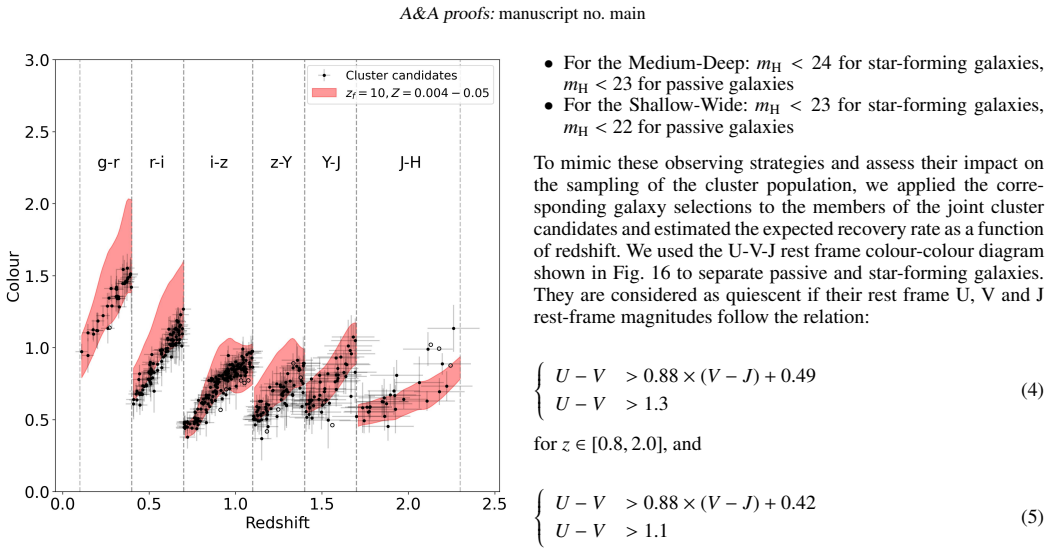
A sample of 519 cluster candidates is constructed from overlapping detections by AMICO and WaZP in the redshift range 0.1 to 3, with 74 at z>1.5. The red-sequence component of their color-magnitude diagrams is consistent with passive evolution models formed at high redshift and already in place at z=1.5-2.0. Cluster spectroscopic confirmation is feasible up to z~1.7 with MOONRISE even using the shallowest strategy.
What carries the argument
Overlap between independent photometric cluster finders AMICO and WaZP to select reliable candidates, together with analysis of the red sequence in apparent colour-magnitude diagrams.
If this is right
- Candidates with radio-loud members are efficiently recovered by the prior-based finder PPM.
- The galaxy population supports passive evolution with formation at high redshift.
- Cluster confirmation and characterization up to z~1.7 is possible with shallow MOONRISE survey strategies.
- This provides insight into physical properties of high-redshift clusters and galaxy formation in dense environments.
Where Pith is reading between the lines
- Similar overlap methods could be applied to other multi-finder cluster searches to reduce false positives.
- Extending the analysis to deeper data might reveal evolution beyond z=2.
- Connection to radio-loud AGN could inform models of cluster assembly.
Load-bearing premise
The overlap of detections from AMICO and WaZP reliably identifies real physical clusters instead of projection effects or spurious overdensities.
What would settle it
Spectroscopic observations of a significant fraction of the z>1.5 candidates showing no coherent velocity structure or member galaxies would indicate many are not real clusters.
Figures






read the original abstract
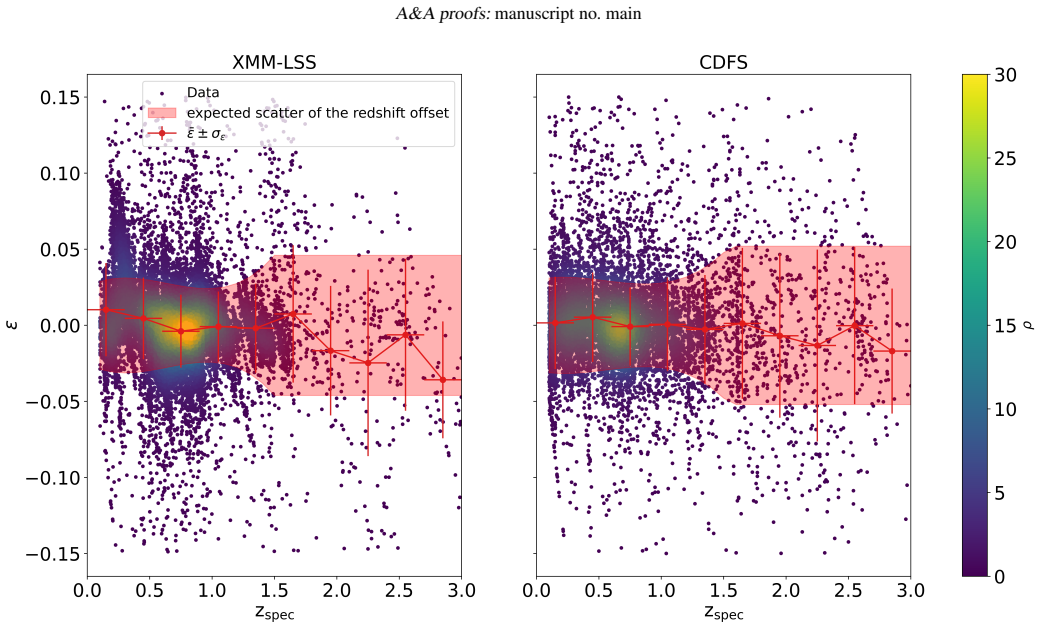
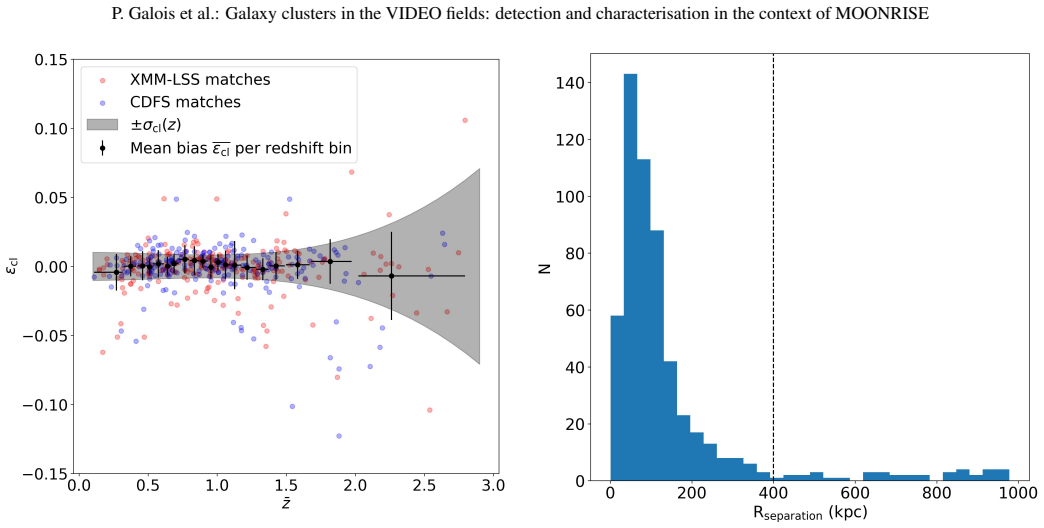
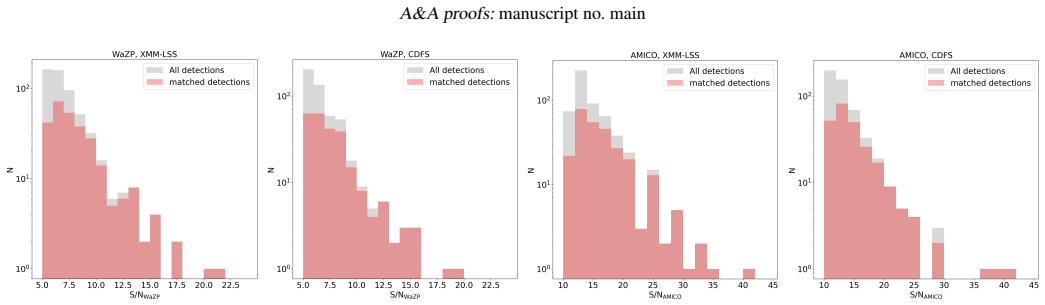
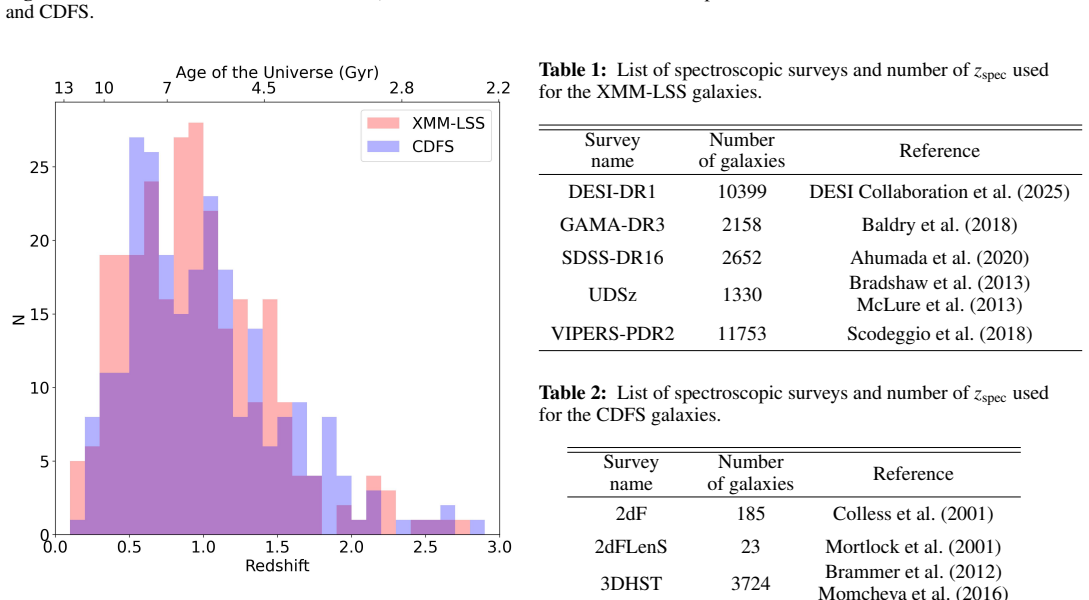
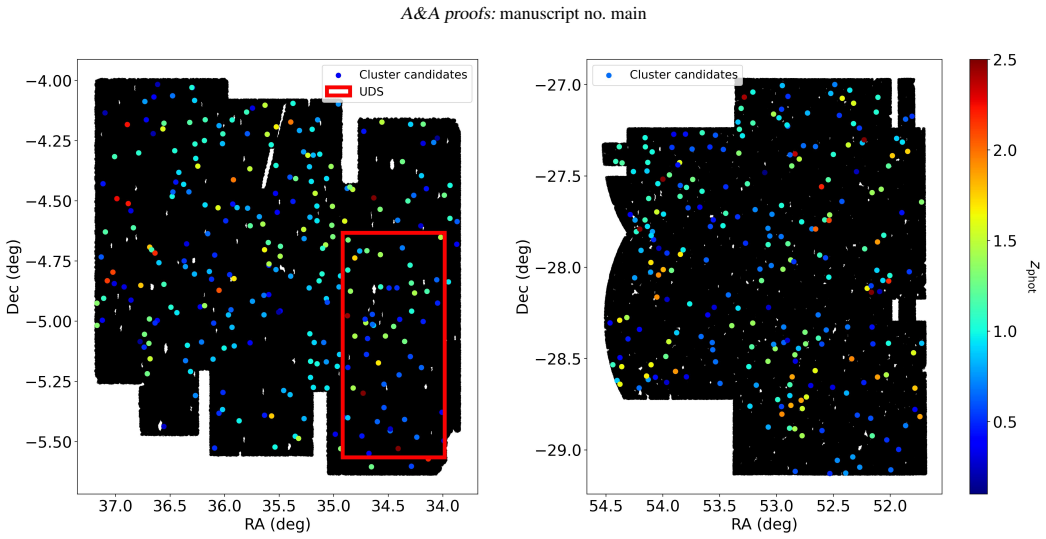
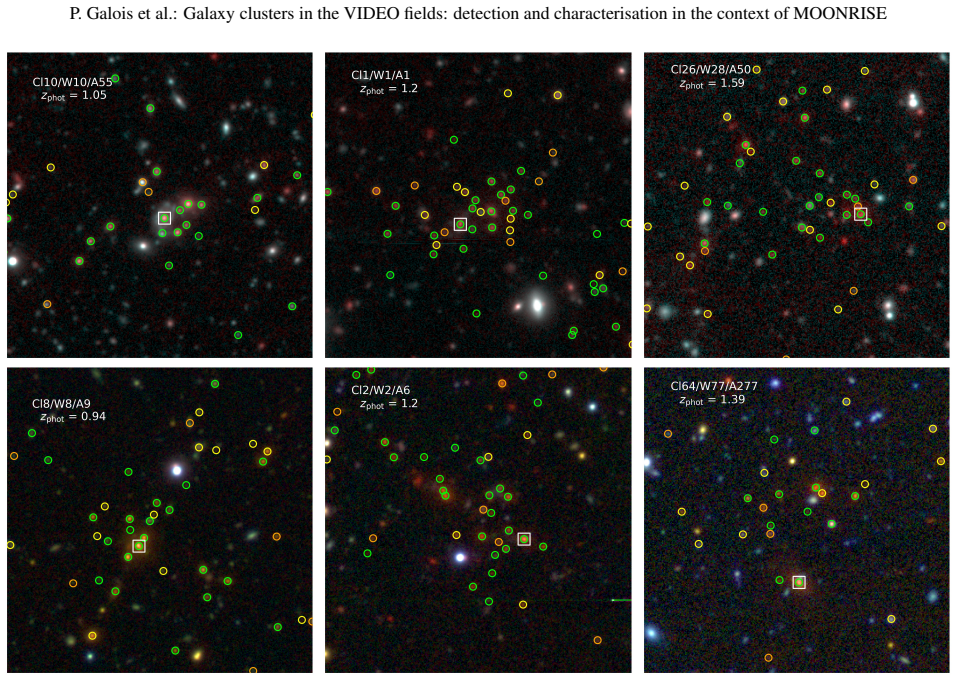
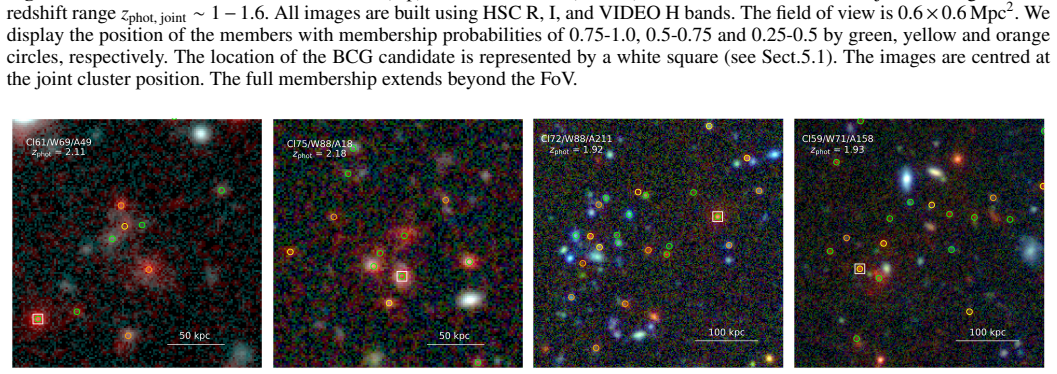
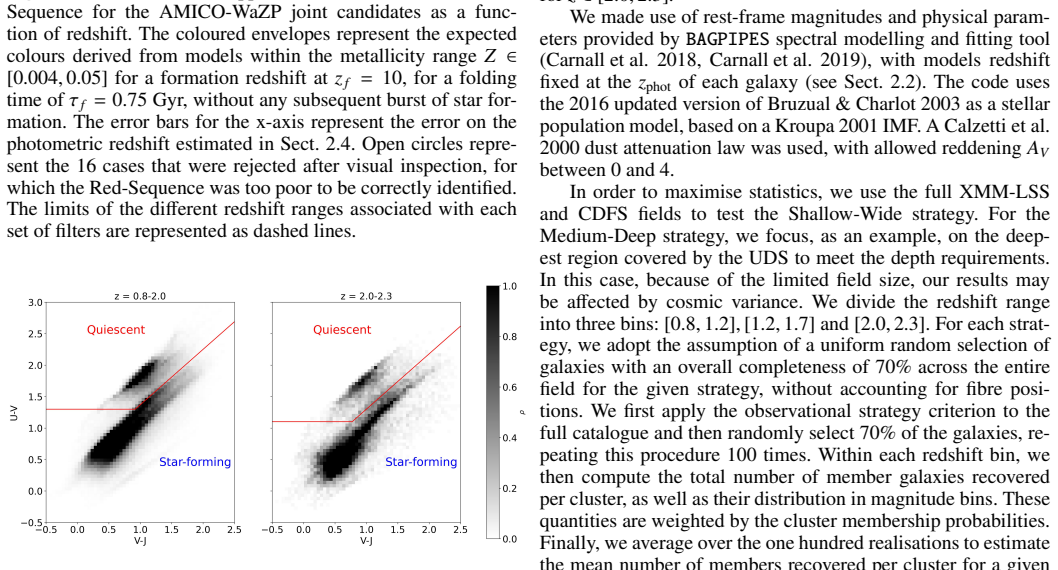
We analyse the cluster content of the $\sim 4.5 \text{ deg}^{2}$ XMM-LSS and CDFS VIDEO fields which are expected to be partially covered by the upcoming MOONRISE survey. Using AMICO and WaZP photometric redshift-based cluster finders, we construct a sample of $519$ cluster candidates detected by both finders in the redshift range $z = 0.1-3$, including $74$ detections at $z > 1.5$. For all detections, we identify the Brightest Central Galaxy (BCG) and compute a list of probabilistic cluster memberships. Our photometric redshift measurements of the clusters agree well with spectroscopic redshifts from the literature, when available. From ancillary spectroscopic data, we assign $z_\text{spec}$ measurements to $116$ cluster candidates based on their spectroscopic members and to $204$ based on their likely BCGs. We also show that candidates containing Radio-Loud members are efficiently recovered using the prior-based cluster finder PPM. We perform a preliminary analysis of the galaxy content of these candidates, focusing on the Red-Sequence components of their apparent Colour-Magnitude Diagram. By comparing with models of galaxy evolution, we show that this population is consistent with a model of passive evolution with a formation at high redshift, and is already in place at $z = 1.5-2.0$. Finally, our cluster sample is used to evaluate how these clusters would be detected and characterised, according to various MOONRISE strategies. We show that cluster spectroscopic confirmation and characterisation could be efficiently achieved up to $z\sim1.7$ even with the shallowest survey strategy. This open unprecedented insight into the physical properties of high-redshift galaxy clusters and into galaxy formation in dense environments.
Editorial analysis
A structured set of objections, weighed in public.
Referee Report
Summary. The paper analyzes ~4.5 deg² VIDEO fields (XMM-LSS and CDFS) using AMICO and WaZP photometric-redshift cluster finders to identify 519 cluster candidates (including 74 at z>1.5) detected by both algorithms. It assigns BCGs and probabilistic memberships, compares photometric redshifts to available spectroscopic data (116 candidates via members, 204 via BCGs), demonstrates efficient recovery of radio-loud clusters with PPM, analyzes red-sequence galaxies in color-magnitude diagrams, concludes consistency with passive evolution models formed at high redshift and already in place at z=1.5-2.0, and evaluates detection/characterization prospects under various MOONRISE survey strategies, claiming efficient spectroscopic confirmation up to z~1.7 even with the shallowest strategy.
Significance. If the high-redshift sample is robust, the work supplies a sizable catalog of z>1.5 cluster candidates in well-studied fields, enabling studies of galaxy evolution in dense environments and providing practical input for MOONRISE observing strategies. Strengths include the dual-finder overlap approach, direct comparison to spectroscopic redshifts, and the ancillary radio-loud and red-sequence analyses. The central evolutionary and MOONRISE claims, however, rest on the purity of the overlap-selected sample at z>1.5.
major comments (3)
- [Abstract (sample construction)] Abstract (sample construction paragraph): The 74 z>1.5 candidates are selected solely via common detections in AMICO and WaZP; no purity estimate, mock-catalog validation, or multi-wavelength (X-ray/SZ) cross-check is reported for this overlap subsample. This is load-bearing for the passive-evolution conclusion and the MOONRISE strategy assessment.
- [Abstract (red-sequence analysis)] Abstract (red-sequence paragraph): The claim that the red-sequence population 'is already in place at z=1.5-2.0' and 'consistent with a model of passive evolution' is presented without quantitative metrics (e.g., number of red-sequence members per cluster, membership probability thresholds, or goodness-of-fit statistics) for the 74 high-z candidates.
- [Abstract (MOONRISE evaluation)] Abstract (MOONRISE evaluation paragraph): The assertion that 'cluster spectroscopic confirmation and characterisation could be efficiently achieved up to z∼1.7 even with the shallowest survey strategy' lacks the specific survey-depth parameters, simulation setup, or success-rate metrics used to reach this conclusion.
minor comments (2)
- [Abstract] The abstract states photometric redshifts 'agree well' with spectroscopic redshifts but provides neither the number of comparisons, the typical offset, nor the scatter.
- [Abstract] No explicit statement of the membership probability threshold or post-detection cleaning cuts applied to the final catalog of 519 candidates.
Simulated Author's Rebuttal
We thank the referee for their constructive and detailed review. We address each major comment below and will revise the manuscript to strengthen the presentation of our results, particularly in the abstract and supporting sections.
read point-by-point responses
-
Referee: Abstract (sample construction paragraph): The 74 z>1.5 candidates are selected solely via common detections in AMICO and WaZP; no purity estimate, mock-catalog validation, or multi-wavelength (X-ray/SZ) cross-check is reported for this overlap subsample. This is load-bearing for the passive-evolution conclusion and the MOONRISE strategy assessment.
Authors: The overlap between AMICO and WaZP is explicitly chosen to improve sample reliability, and the manuscript validates the overall catalog via direct comparison to spectroscopic redshifts (116 candidates via members, 204 via BCGs). We agree the abstract does not quote a numerical purity for the z>1.5 overlap subsample alone. We will revise the abstract to note the dual-finder validation and add a short paragraph in the main text discussing the expected purity gain from the intersection method together with any available ancillary checks. If new mock runs are not feasible we will state this limitation explicitly. revision: partial
-
Referee: Abstract (red-sequence analysis paragraph): The claim that the red-sequence population 'is already in place at z=1.5-2.0' and 'consistent with a model of passive evolution' is presented without quantitative metrics (e.g., number of red-sequence members per cluster, membership probability thresholds, or goodness-of-fit statistics) for the 74 high-z candidates.
Authors: The red-sequence analysis is labelled preliminary and relies on visual comparison of colour-magnitude diagrams against passive-evolution tracks. Quantitative details (member counts, probability thresholds, model fits) appear in the main text for the full sample; the high-redshift subset has lower statistics and is not broken out separately. We will revise the abstract wording to reflect the preliminary character and ensure the main text supplies explicit metrics or thresholds for the z>1.5 objects where possible. revision: yes
-
Referee: Abstract (MOONRISE evaluation paragraph): The assertion that 'cluster spectroscopic confirmation and characterisation could be efficiently achieved up to z∼1.7 even with the shallowest survey strategy' lacks the specific survey-depth parameters, simulation setup, or success-rate metrics used to reach this conclusion.
Authors: The MOONRISE assessment applies the observed cluster sample to a set of survey strategies whose depth parameters and success-rate calculations are described in the dedicated section of the manuscript. We will expand the abstract to include the key depth values and the derived confirmation efficiencies so the claim is self-contained. revision: yes
Circularity Check
No circularity in derivation chain
full rationale
The paper constructs a cluster candidate sample via overlap of two independent photometric-redshift finders (AMICO and WaZP) and performs a preliminary comparison of the red-sequence population against external galaxy evolution models. No equations, fitted parameters, or self-citations are presented that reduce the reported detections, membership probabilities, or evolutionary conclusions to the inputs by construction. The analysis relies on ancillary spectroscopic data and standard model comparisons without self-definitional steps or load-bearing self-citations.
Axiom & Free-Parameter Ledger
Reference graph
Works this paper leans on
-
[2]
The 16th Data Release of the Sloan Digital Sky Surveys: First Release from the APOGEE-2 Southern Survey and Full Release of eBOSS Spectra. , keywords =. doi:10.3847/1538-4365/ab929e , archivePrefix =. 1912.02905 , primaryClass =
-
[3]
Galaxy And Mass Assembly (GAMA): the G02 field, Herschel-ATLAS target selection and Data Release 3
Galaxy And Mass Assembly: the G02 field, Herschel-ATLAS target selection and data release 3. , keywords =. doi:10.1093/mnras/stx3042 , archivePrefix =. 1711.09139 , primaryClass =
work page internal anchor Pith review Pith/arXiv arXiv doi:10.1093/mnras/stx3042
-
[4]
The VIMOS Public Extragalactic Redshift Survey (VIPERS). Full spectroscopic data and auxiliary information release (PDR-2). , keywords =. doi:10.1051/0004-6361/201630114 , archivePrefix =. 1611.07048 , primaryClass =
work page internal anchor Pith review Pith/arXiv arXiv doi:10.1051/0004-6361/201630114
-
[5]
The WaZP galaxy cluster sample of the dark energy survey year 1 , volume=
Aguena, M and Benoist, C and da Costa, L N and Ogando, R L C and Gschwend, J and Sampaio-Santos, H B and Lima, M and Maia, M A G and Allam, S and Avila, S and Bacon, D and Bertin, E and Bhargava, S and Brooks, D and Carnero Rosell, A and Carrasco Kind, M and Carretero, J and Costanzi, M and De Vicente, J and Desai, S and Diehl, H T and Doel, P and Everett...
-
[6]
Maiolino, Roberto and Cirasuolo, Michele and Afonso, José and Bauer, Franz E. and Bowler, Rebecca and Cucciati, Olga and Daddi, Emanuele and De Lucia, Gabriella and Evans, Chris and Flores, Hector and Gargiulo, Adriana and Garilli, Bianca and Jablonka, Pascale and Jarvis, Matt and Kneib, Jean-Paul and Lilly, Simon and Looser, Tobias and Magliocchetti, Man...
-
[7]
Galactic Stellar and Substellar Initial Mass Function
Chabrier, Gilles , year=. Galactic Stellar and Substellar Initial Mass Function , volume=. Publications of the Astronomical Society of the Pacific , publisher=. doi:10.1086/376392 , number=
work page internal anchor Pith review doi:10.1086/376392
-
[8]
The XXL Survey. XX. The 365 cluster catalogue. , keywords =. doi:10.1051/0004-6361/201731606 , archivePrefix =. 1810.03849 , primaryClass =
work page internal anchor Pith review Pith/arXiv arXiv doi:10.1051/0004-6361/201731606
-
[9]
The XXL Survey. XLII. Detection and characterisation of the galaxy population of distant galaxy clusters in the XXL-N/VIDEO field: A tale of variety. , keywords =. doi:10.1051/0004-6361/202038982 , adsurl =
-
[10]
The GOGREEN and GCLASS surveys: first data release , volume=
Balogh, Michael L and van der Burg, Remco F J and Muzzin, Adam and Rudnick, Gregory and Wilson, Gillian and Webb, Kristi and Biviano, Andrea and Boak, Kevin and Cerulo, Pierluigi and Chan, Jeffrey and Cooper, M C and Gilbank, David G and Gwyn, Stephen and Lidman, Chris and Matharu, Jasleen and McGee, Sean L and Old, Lyndsay and Pintos-Castro, Irene and Re...
-
[11]
Evolution since z = 0.5 of the Morphology-Density relation for Clusters of Galaxies
Evolution since z = 0.5 of the Morphology-Density Relation for Clusters of Galaxies. , keywords =. doi:10.1086/304890 , archivePrefix =. astro-ph/9707232 , primaryClass =
work page internal anchor Pith review Pith/arXiv arXiv doi:10.1086/304890
-
[12]
Ultra-deep catalog of X-ray groups in the Extended Chandra Deep Field South
Ultra-deep catalog of X-ray groups in the Extended Chandra Deep Field South. , keywords =. doi:10.1051/0004-6361/201323053 , archivePrefix =. 1501.03506 , primaryClass =
work page internal anchor Pith review Pith/arXiv arXiv doi:10.1051/0004-6361/201323053
-
[13]
Papovich, C. and Momcheva, I. and Willmer, C. N. A. and Finkelstein, K. D. and Finkelstein, S. L. and Tran, K.-V. and Brodwin, M. and Dunlop, J. S. and Farrah, D. and Khan, S. A. and Lotz, J. and McCarthy, P. and McLure, R. J. and Rieke, M. and Rudnick, G. and Sivanandam, S. and Pacaud, F. and Pierre, M. , year=. ASPITZER-SELECTED GALAXY CLUSTER ATz= 1.62...
-
[14]
The VISTA Deep Extragalactic Observations (VIDEO) Survey
The VISTA Deep Extragalactic Observations (VIDEO) survey. , keywords =. doi:10.1093/mnras/sts118 , archivePrefix =. 1206.4263 , primaryClass =
work page internal anchor Pith review Pith/arXiv arXiv doi:10.1093/mnras/sts118
-
[15]
The evolution of galaxies in clusters. I. ISIT photometry of Cl 0024+1654 and 3C 295. , keywords =. doi:10.1086/155751 , adsurl =
-
[16]
Kellermann, K. I. and Fomalont, E. B. and Mainieri, V. and Padovani, P. and Rosati, P. and Shaver, P. and Tozzi, P. and Miller, N. , title =. The Astrophysical Journal Supplement Series , abstract =. 2008 , month =. doi:10.1086/591055 , url =
-
[17]
The FIRST Survey: Faint Images of the Radio Sky at Twenty Centimeters. , keywords =. doi:10.1086/176166 , adsurl =
-
[18]
Accurate photometric redshifts for the CFHT Legacy Survey calibrated using the VIMOS VLT Deep Survey
Accurate photometric redshifts for the CFHT legacy survey calibrated using the VIMOS VLT deep survey. , keywords =. doi:10.1051/0004-6361:20065138 , archivePrefix =. astro-ph/0603217 , primaryClass =
work page internal anchor Pith review Pith/arXiv arXiv doi:10.1051/0004-6361:20065138
-
[19]
The sizes, masses and specific star formation rates of massive galaxies at 1.3 < z < 1.5: strong evidence in favour of evolution via minor mergers. , keywords =. doi:10.1093/mnras/sts092 , archivePrefix =. 1205.4058 , primaryClass =
work page internal anchor Pith review Pith/arXiv arXiv doi:10.1093/mnras/sts092
-
[20]
Bradshaw, E. J. and Almaini, O. and Hartley, W. G. and Smith, K. T. and Conselice, C. J. and Dunlop, J. S. and Simpson, C. and Chuter, R. W. and Cirasuolo, M. and Foucaud, S. and McLure, R. J. and Mortlock, A. and Pearce, H. , year=. High-velocity outflows from young star-forming galaxies in the UKIDSS Ultra-Deep Survey , volume=. Monthly Notices of the R...
-
[21]
Second data release of the Hyper Suprime-Cam Subaru Strategic Program , volume=
Aihara, Hiroaki and AlSayyad, Yusra and Ando, Makoto and Armstrong, Robert and Bosch, James and Egami, Eiichi and Furusawa, Hisanori and Furusawa, Junko and Goulding, Andy and Harikane, Yuichi and Hikage, Chiaki and Ho, Paul T P and Hsieh, Bau-Ching and Huang, Song and Ikeda, Hiroyuki and Imanishi, Masatoshi and Ito, Kei and Iwata, Ikuru and Jaelani, Anto...
-
[22]
Panoramic Views of Galaxy Formation and Evolution , year = 2008, editor =
Subaru/XMM-Newton Deep Survey (SXDS) - Optical Imaging Survey and Photometric Catalogs. Panoramic Views of Galaxy Formation and Evolution , year = 2008, editor =
2008
-
[23]
A New Constraint on the Ly$\alpha$ Fraction of UV Very Bright Galaxies at Redshift 7
A New Constraint on the Ly Fraction of UV Very Bright Galaxies at Redshift 7. , keywords =. doi:10.3847/0004-637X/822/1/46 , archivePrefix =. 1604.02214 , primaryClass =
work page internal anchor Pith review Pith/arXiv arXiv doi:10.3847/0004-637x/822/1/46
-
[24]
Gaia DR3 Lite Cone Search , author=
-
[25]
MUSUBI (MegaCam Ultra-deep Survey: u*-band Imaging) Data for the COSMOS and SXDS Fields. , keywords =. doi:10.3847/1538-4365/ac729e , archivePrefix =. 2205.11546 , primaryClass =
-
[26]
SPLASH-SXDF Multi-wavelength Photometric Catalog
SPLASH-SXDF Multi-wavelength Photometric Catalog. , keywords =. doi:10.3847/1538-4365/aab60c , archivePrefix =. 1711.05280 , primaryClass =
work page internal anchor Pith review Pith/arXiv arXiv doi:10.3847/1538-4365/aab60c
-
[27]
VizieR Online Data Catalog: The CFHTLS Survey (T0007 release) (Hudelot+ 2012)
2012
-
[28]
The VOICE Survey : VST Optical Imaging of the CDFS and ES1 Fields
The VOICE Survey : VST Optical Imaging of the CDFS and ES1 Fields. The 4th Annual Conference on High Energy Astrophysics in Southern Africa (HEASA 2016) , year = 2016, month = jan, eid =. doi:10.22323/1.275.0026 , archivePrefix =. 1704.01495 , primaryClass =
work page internal anchor Pith review Pith/arXiv arXiv doi:10.22323/1.275.0026 2016
-
[29]
Deep Hyper Suprime-Cam Images and a Forced Photometry Catalog in W-CDF-S
Deep Hyper Suprime-Cam Images and a Forced Photometry Catalog in W-CDF-S. Research Notes of the American Astronomical Society , keywords =. doi:10.3847/2515-5172/aaf8af , archivePrefix =. 1812.07565 , primaryClass =
work page internal anchor Pith review Pith/arXiv arXiv doi:10.3847/2515-5172/aaf8af
-
[30]
doi:10.26093/cds/vizier.22560021 , adsurl =
VizieR Online Data Catalog: XMM-SERVS survey: X-ray sources for W-CDF-S & ELAIS-S1 (Ni+, 2021). doi:10.26093/cds/vizier.22560021 , adsurl =
-
[31]
The Spitzer Extragalactic Representative Volume Survey (SERVS): survey definition and goals
The Spitzer Extragalactic Representative Volume Survey (SERVS): Survey Definition and Goals. , keywords =. doi:10.1086/666945 , archivePrefix =. 1206.4060 , primaryClass =
work page internal anchor Pith review Pith/arXiv arXiv doi:10.1086/666945
-
[32]
T-PHOT: A new code for PSF-matched, prior-based, multiwavelength extragalactic deconfusion photometry. , keywords =. doi:10.1051/0004-6361/201526471 , archivePrefix =. 1505.02516 , primaryClass =
work page internal anchor Pith review Pith/arXiv arXiv doi:10.1051/0004-6361/201526471
-
[33]
Rykoff, E. S. and Rozo, E. and Busha, M. T. and Cunha, C. E. and Finoguenov, A. and Evrard, A. and Hao, J. and Koester, B. P. and Leauthaud, A. and Nord, B. and Pierre, M. and Reddick, R. and Sadibekova, T. and Sheldon, E. S. and Wechsler, R. H. , year=. redMaPPer. I. ALGORITHM AND SDSS DR8 CATALOG , volume=. The Astrophysical Journal , publisher=. doi:10...
-
[34]
The XXL Survey. II. The bright cluster sample: catalogue and luminosity function. , keywords =. doi:10.1051/0004-6361/201526891 , archivePrefix =. 1512.04264 , primaryClass =
work page internal anchor Pith review Pith/arXiv arXiv doi:10.1051/0004-6361/201526891
-
[35]
The first catalog of galaxy clusters and groups in the Western Galactic Hemisphere
The SRG/eROSITA All-Sky Survey. The first catalog of galaxy clusters and groups in the Western Galactic Hemisphere. , keywords =. doi:10.1051/0004-6361/202348264 , archivePrefix =. 2402.08452 , primaryClass =
-
[36]
Bleem, L. E. and Stalder, B. and de Haan, T. and Aird, K. A. and Allen, S. W. and Applegate, D. E. and Ashby, M. L. N. and Bautz, M. and Bayliss, M. and Benson, B. A. and Bocquet, S. and Brodwin, M. and Carlstrom, J. E. and Chang, C. L. and Chiu, I. and Cho, H. M. and Clocchiatti, A. and Crawford, T. M. and Crites, A. T. and Desai, S. and Dietrich, J. P. ...
-
[37]
Galaxy morphology in rich clusters: implications for the formation and evolution of galaxies. , keywords =. doi:10.1086/157753 , adsurl =
-
[38]
Balogh, Michael L. and Morris, Simon L. and Yee, H. K. C. and Carlberg, R. G. and Ellingson, Erica , title =. The Astrophysical Journal , abstract =. 1999 , month =. doi:10.1086/308056 , url =
-
[39]
Monthly Notices of the Royal Astronomical Society , volume =
Noordeh, E and Canning, R E A and Willis, J P and Allen, S W and Mantz, A and Stanford, S A and Brammer, G , title =. Monthly Notices of the Royal Astronomical Society , volume =. 2021 , month =. doi:10.1093/mnras/stab2459 , url =
-
[40]
A Massive Quiescent Galaxy Confirmed in a Protocluster at z = 3.09. , keywords =. doi:10.3847/1538-4357/ac0cf8 , archivePrefix =. 2106.10798 , primaryClass =
-
[41]
2023 , eprint=
The Emergence of Brightest Cluster Galaxy in a Protocluster Core at z=2.24 , author=. 2023 , eprint=
2023
-
[42]
Physical properties of brightest cluster galaxies up to redshift 1.80 based on HST data. , keywords =. doi:10.1051/0004-6361/202040245 , archivePrefix =. 2102.01557 , primaryClass =
-
[43]
Gunn, J E and Gott, III, J R , title =. Astrophys. J. 176: No. 1, 1-19(15 Aug 1972). , place =. 1972 , month =. doi:10.1086/151605 , url =
-
[44]
Moore, Ben and Katz, Neal and Lake, George and Dressler, Alan and Oemler, Augustus , year=. Galaxy harassment and the evolution of clusters of galaxies , volume=. Nature , publisher=. doi:10.1038/379613a0 , number=
-
[45]
Measuring and modelling the redshift evolution of clustering: the Hubble Deep Field North. , keywords =. doi:10.1046/j.1365-8711.1999.02978.x , archivePrefix =. astro-ph/9902290 , primaryClass =
-
[46]
EAZY: A Fast, Public Photometric Redshift Code
EAZY: A Fast, Public Photometric Redshift Code. , keywords =. doi:10.1086/591786 , archivePrefix =. 0807.1533 , primaryClass =
work page internal anchor Pith review Pith/arXiv arXiv doi:10.1086/591786
-
[47]
A new method to search for high redshift clusters using photometric redshifts
A New Method to Search for High-redshift Clusters Using Photometric Redshifts. , keywords =. doi:10.1088/0004-637X/792/2/113 , archivePrefix =. 1405.7973 , primaryClass =
work page internal anchor Pith review Pith/arXiv arXiv doi:10.1088/0004-637x/792/2/113
-
[48]
Cluster candidates around low power radio-galaxies at z~1-2 in COSMOS
Cluster Candidates around Low-power Radio Galaxies at z -0.5ex 1-2 in COSMOS. , keywords =. doi:10.1088/0004-637X/792/2/114 , archivePrefix =. 1406.5255 , primaryClass =
work page internal anchor Pith review Pith/arXiv arXiv doi:10.1088/0004-637x/792/2/114
-
[49]
Molecular gas in radio galaxies in dense Mpc-scale environments at $z=0.4-2.6$
Molecular gas in radio galaxies in dense megaparsec-scale environments at z = 0.4-2.6. , keywords =. doi:10.1051/0004-6361/201834066 , archivePrefix =. 1812.09997 , primaryClass =
work page internal anchor Pith review Pith/arXiv arXiv doi:10.1051/0004-6361/201834066
-
[50]
Bright submillimeter galaxies do trace galaxy protoclusters. , keywords =. doi:10.1051/0004-6361/202346200 , archivePrefix =. 2302.10323 , primaryClass =
-
[51]
Cerulo, P. and Couch, W. J. and Lidman, C. and Demarco, R. and Huertas-Company, M. and Mei, S. and Sánchez-Janssen, R. and Barrientos, L. F. and Muñoz, R. P. , title =. Monthly Notices of the Royal Astronomical Society , volume =. 2016 , month =. doi:10.1093/mnras/stw080 , url =
-
[52]
The GOGREEN Survey: A deep stellar mass function of cluster galaxies at 1.0 < z < 1.4 and the complex nature of satellite quenching , DOI= "10.1051/0004-6361/202037754", url= "https://doi.org/10.1051/0004-6361/202037754", journal =
-
[53]
Carnall, A C and McLure, R J and Dunlop, J S and Davé, R , year=. Inferring the star formation histories of massive quiescent galaxies with bagpipes: evidence for multiple quenching mechanisms , volume=. Monthly Notices of the Royal Astronomical Society , publisher=. doi:10.1093/mnras/sty2169 , number=
work page internal anchor Pith review doi:10.1093/mnras/sty2169
-
[54]
Carnall, A C and McLure, R J and Dunlop, J S and Cullen, F and McLeod, D J and Wild, V and Johnson, B D and Appleby, S and Davé, R and Amorin, R and Bolzonella, M and Castellano, M and Cimatti, A and Cucciati, O and Gargiulo, A and Garilli, B and Marchi, F and Pentericci, L and Pozzetti, L and Schreiber, C and Talia, M and Zamorani, G , year=. The VANDELS...
-
[55]
AMICO: optimised detection of galaxy clusters in photometric surveys
AMICO: optimized detection of galaxy clusters in photometric surveys. , keywords =. doi:10.1093/mnras/stx2701 , archivePrefix =. 1705.03029 , primaryClass =
work page internal anchor Pith review Pith/arXiv arXiv doi:10.1093/mnras/stx2701
-
[56]
AMICO-COSMOS galaxy cluster and group catalogue up to z = 2: Sample properties and X-ray counterparts. , keywords =. doi:10.1051/0004-6361/202348832 , archivePrefix =. 2312.12501 , primaryClass =
-
[57]
The COSMOS-Web deep galaxy group catalog up to z = 3.7. , keywords =. doi:10.1051/0004-6361/202553759 , archivePrefix =. 2501.09060 , primaryClass =
-
[58]
COSMOS-Web galaxy groups: Evolution of red sequence and quiescent galaxy fraction
COSMOS-Web galaxy groups: Evolution of red sequence and quiescent galaxy fraction. arXiv e-prints , keywords =. doi:10.48550/arXiv.2509.08040 , archivePrefix =. 2509.08040 , primaryClass =
work page internal anchor Pith review Pith/arXiv arXiv doi:10.48550/arxiv.2509.08040
-
[59]
MAGIC: MUSE gAlaxy Groups In COSMOS - A survey to probe the impact of environment on galaxy evolution over the last 8 Gyr. , keywords =. doi:10.1051/0004-6361/202348038 , archivePrefix =. 2312.00924 , primaryClass =
-
[60]
The XMM-Newton Wide-Field Survey in the COSMOS Field: Statistical Properties of Clusters of Galaxies. , keywords =. doi:10.1086/516577 , archivePrefix =. astro-ph/0612360 , primaryClass =
work page internal anchor Pith review Pith/arXiv arXiv doi:10.1086/516577
-
[61]
Planck 2015 results. XXVII. The second Planck catalogue of Sunyaev-Zeldovich sources. , keywords =. doi:10.1051/0004-6361/201525823 , archivePrefix =. 1502.01598 , primaryClass =
work page internal anchor Pith review Pith/arXiv arXiv doi:10.1051/0004-6361/201525823 2015
-
[62]
Measures of Location and Scale for Velocities in Clusters of Galaxies---A Robust Approach. , keywords =. doi:10.1086/115487 , adsurl =
-
[63]
Groups and clusters of galaxies in the SDSS DR8. Value-added catalogues
Groups and clusters of galaxies in the SDSS DR8. Value-added catalogues. , keywords =. doi:10.1051/0004-6361/201118687 , archivePrefix =. 1112.4648 , primaryClass =
work page internal anchor Pith review Pith/arXiv arXiv doi:10.1051/0004-6361/201118687
-
[64]
Optical detection of galaxy clusters with PZWav
The miniJPAS survey. Optical detection of galaxy clusters with PZWav. , keywords =. doi:10.1051/0004-6361/202349019 , archivePrefix =. 2312.12197 , primaryClass =
-
[65]
A High Merger Fraction in the Rich Cluster MS 1054-03 at Z = 0.83: Direct Evidence for Hierarchical Formation of Massive Galaxies. , keywords =. doi:10.1086/312154 , archivePrefix =. astro-ph/9905394 , primaryClass =
work page internal anchor Pith review Pith/arXiv arXiv doi:10.1086/312154
-
[66]
The 2dF Galaxy Redshift Survey: spectra and redshifts. , keywords =. doi:10.1046/j.1365-8711.2001.04902.x , archivePrefix =. astro-ph/0106498 , primaryClass =
-
[67]
Publications of the Astronomical Society of Australia , author=
The 2dF Gravitational Lens Survey , volume=. Publications of the Astronomical Society of Australia , author=. 2001 , pages=. doi:10.1071/AS01021 , number=
-
[68]
Momcheva, Ivelina G. and Brammer, Gabriel B. and van Dokkum, Pieter G. and Skelton, Rosalind E. and Whitaker, Katherine E. and Nelson, Erica J. and Fumagalli, Mattia and Maseda, Michael V. and Leja, Joel and Franx, Marijn and Rix, Hans-Walter and Bezanson, Rachel and Cunha, Elisabete Da and Dickey, Claire and Schreiber, Natascha M. Förster and Illingworth...
-
[69]
, archivePrefix = "arXiv", eprint =
Brammer, Gabriel B. and van Dokkum, Pieter G. and Franx, Marijn and Fumagalli, Mattia and Patel, Shannon and Rix, Hans-Walter and Skelton, Rosalind E. and Kriek, Mariska and Nelson, Erica and Schmidt, Kasper B. and Bezanson, Rachel and da Cunha, Elisabete and Erb, Dawn K. and Fan, Xiaohui and Förster Schreiber, Natascha and Illingworth, Garth D. and Labbé...
-
[70]
The Arizona CDFS Environment Survey (ACES): A Magellan/IMACS Spectroscopic Survey of the Chandra Deep Field-South. , keywords =. doi:10.1111/j.1365-2966.2012.21524.x , archivePrefix =. 1112.0312 , primaryClass =
-
[71]
Childress, M. J. and Lidman, C. and Davis, T. M. and Tucker, B. E. and Asorey, J. and Yuan, F. and Abbott, T. M. C. and Abdalla, F. B. and Allam, S. and Annis, J. and Banerji, M. and Benoit-Lévy, A. and Bernard, S. R. and Bertin, E. and Brooks, D. and Buckley-Geer, E. and Burke, D. L. and Carnero Rosell, A. and Carollo, D. and Carrasco Kind, M. and Carret...
-
[72]
The VANDELS ESO public spectroscopic survey: observations and first data release
The VANDELS ESO public spectroscopic survey: Observations and first data release. , keywords =. doi:10.1051/0004-6361/201833047 , archivePrefix =. 1803.07373 , primaryClass =
work page internal anchor Pith review Pith/arXiv arXiv doi:10.1051/0004-6361/201833047
-
[73]
The VIMOS Ultra Deep Survey first data release: Spectra and spectroscopic redshifts of 698 objects up to z _ spec 6 in CANDELS. , keywords =. doi:10.1051/0004-6361/201527963 , archivePrefix =. 1602.01842 , primaryClass =
work page internal anchor Pith review Pith/arXiv arXiv doi:10.1051/0004-6361/201527963
-
[74]
The VIMOS VLT deep survey. First epoch VVDS-deep survey: 11 564 spectra with 17.5 IAB 24, and the redshift distribution over 0 z 5. , keywords =. doi:10.1051/0004-6361:20041960 , archivePrefix =. astro-ph/0409133 , primaryClass =
work page internal anchor Pith review Pith/arXiv arXiv doi:10.1051/0004-6361:20041960
-
[75]
A Catalog of Emission-line Galaxies from the Faint Infrared Grism Survey: Studying Environmental Influence on Star Formation. , keywords =. doi:10.3847/1538-4357/ab5f5c , archivePrefix =. 1912.02261 , primaryClass =
-
[76]
The Australia Telescope Large Area Survey: spectroscopic catalogue and radio luminosity functions. , keywords =. doi:10.1111/j.1365-2966.2012.21913.x , archivePrefix =. 1208.2722 , primaryClass =
-
[77]
The MUSE-Wide Survey: Survey Description and First Data Release
The MUSE-Wide Survey: survey description and first data release. , keywords =. doi:10.1051/0004-6361/201834656 , archivePrefix =. 1811.06549 , primaryClass =
work page internal anchor Pith review Pith/arXiv arXiv doi:10.1051/0004-6361/201834656
-
[78]
Evolution of Group Galaxies from the First Red-Sequence Cluster Survey
Evolution of Group Galaxies from the First Red-Sequence Cluster Survey. , keywords =. doi:10.1088/0004-637X/749/2/150 , archivePrefix =. 1202.4767 , primaryClass =
work page internal anchor Pith review Pith/arXiv arXiv doi:10.1088/0004-637x/749/2/150
-
[79]
Galaxy Clusters around radio-loud AGN at 1.3 < z < 3.2 as seen by Spitzer
Galaxy Clusters around Radio-loud Active Galactic Nuclei at 1.3 < z < 3.2 as Seen by Spitzer. , keywords =. doi:10.1088/0004-637X/769/1/79 , archivePrefix =. 1304.0770 , primaryClass =
work page internal anchor Pith review Pith/arXiv arXiv doi:10.1088/0004-637x/769/1/79
-
[80]
Hilton, M. and Sifón, C. and Naess, S. and Madhavacheril, M. and Oguri, M. and Rozo, E. and Rykoff, E. and Abbott, T. M. C. and Adhikari, S. and Aguena, M. and Aiola, S. and Allam, S. and Amodeo, S. and Amon, A. and Annis, J. and Ansarinejad, B. and Aros-Bunster, C. and Austermann, J. E. and Avila, S. and Bacon, D. and Battaglia, N. and Beall, J. A. and B...
-
[81]
An optimal filter for the detection of galaxy clusters through weak lensing
An optimal filter for the detection of galaxy clusters through weak lensing. , keywords =. doi:10.1051/0004-6361:20042600 , archivePrefix =. astro-ph/0412604 , primaryClass =
work page internal anchor Pith review Pith/arXiv arXiv doi:10.1051/0004-6361:20042600
discussion (0)
Sign in with ORCID, Apple, or X to comment. Anyone can read and Pith papers without signing in.