Designing Recommendation Exposure and Favorite Lists: A Field Experiment in a Spot-Work Platform
Pith reviewed 2026-06-26 22:15 UTC · model grok-4.3
The pith
Thresholded eligibility control reallocates exposure to job templates based on unfilled capacity and raises matching rates on a spot-work platform.
A machine-rendered reading of the paper's core claim, the machinery that carries it, and where it could break.
Core claim
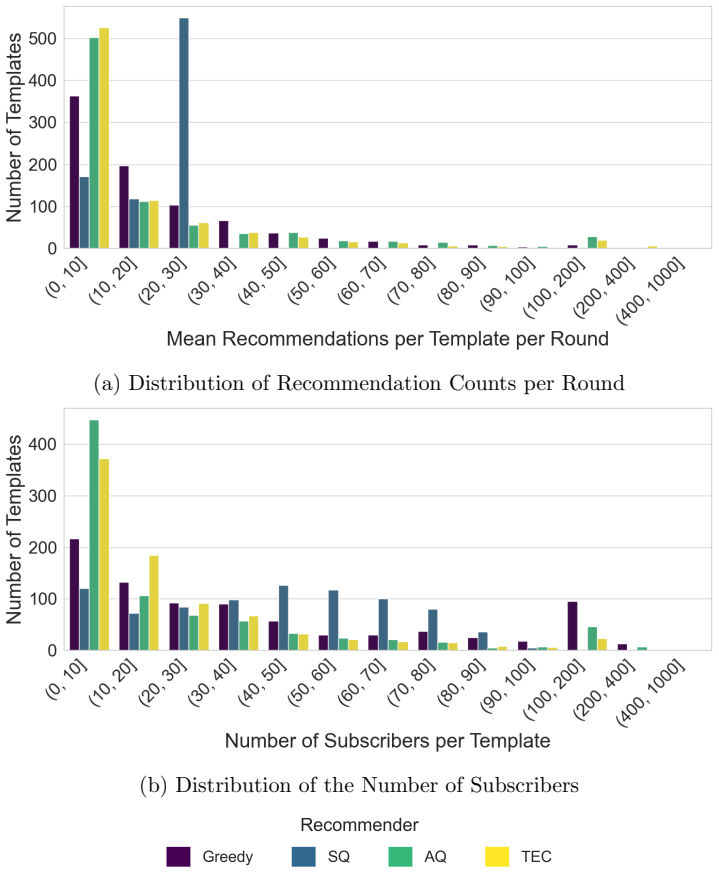
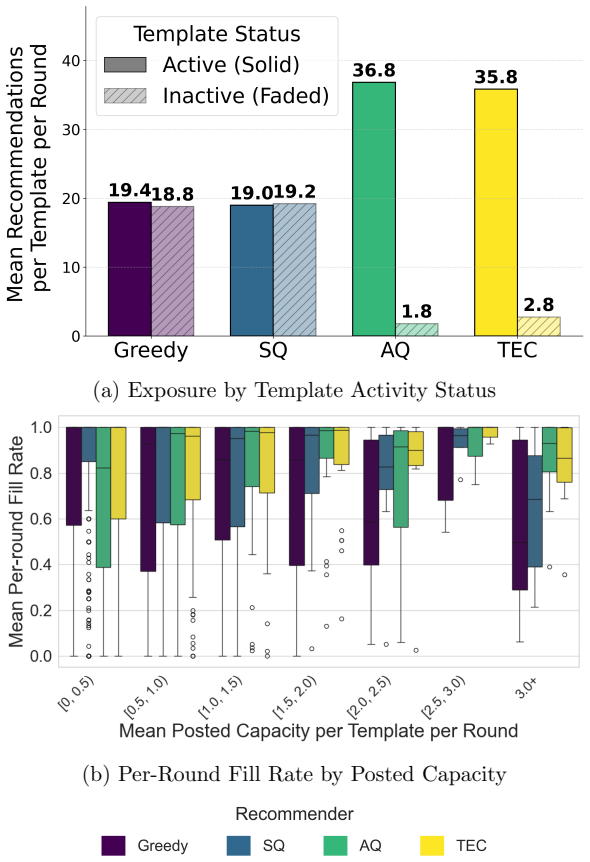
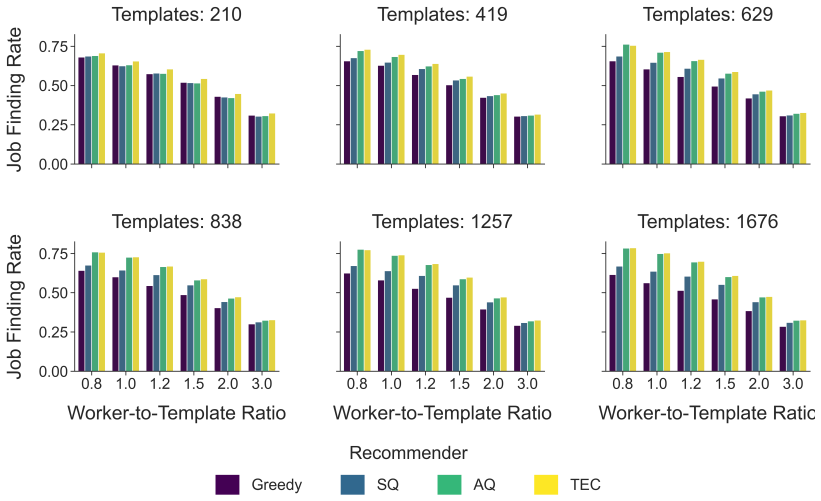
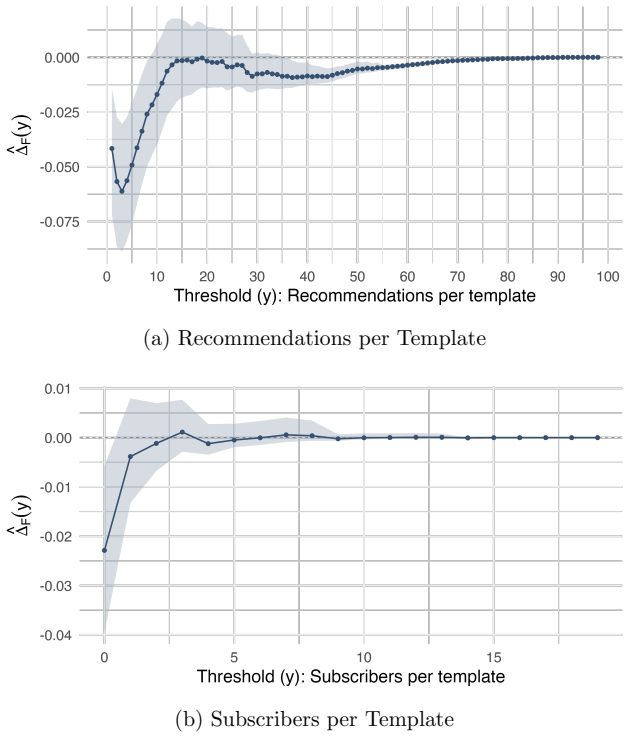
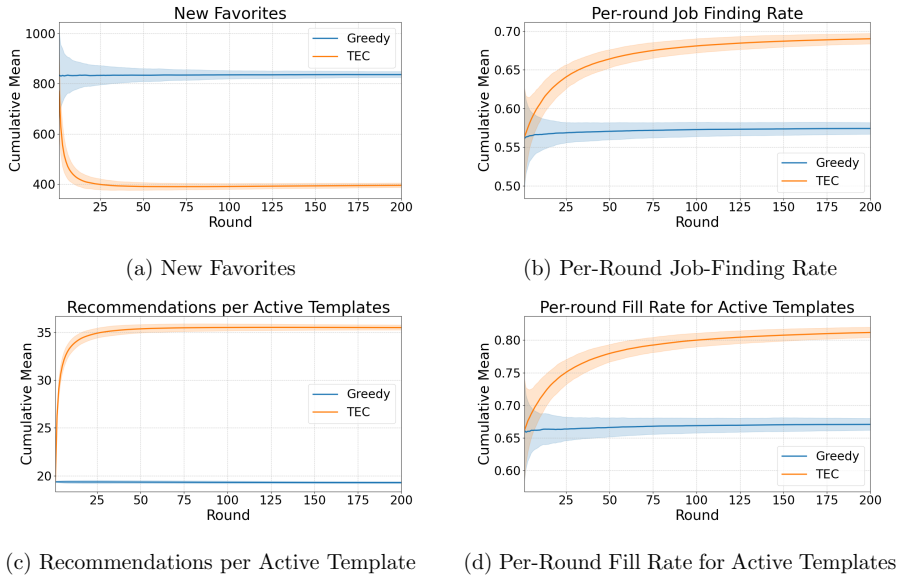
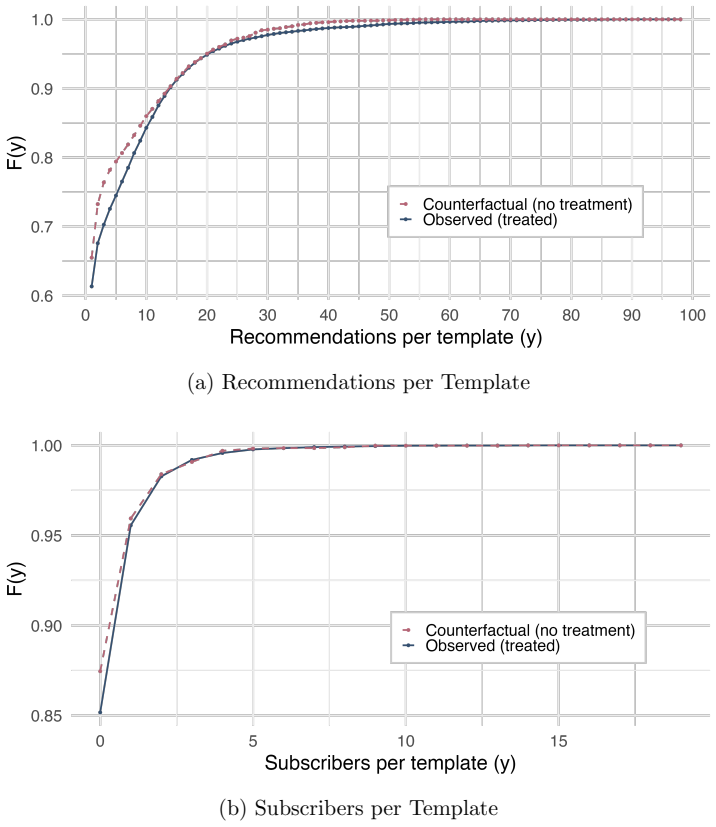
Thresholded eligibility control (TEC) is a parallelizable mechanism that reallocates template exposure based on posting activity and unfilled capacity; when applied to Timee data it raises the per-round job-finding rate from 57.6 percent to 70.0 percent in simulation and, in a randomized field experiment, increases realized matches, exposure per template, and favoriting while reducing the share of low-exposure templates.
What carries the argument
thresholded eligibility control (TEC), a mechanism that reallocates template exposure based on recent posting activity and unfilled capacity to balance recommendations with actual labor demand.
If this is right
- Increases realized matches and exposure per active template.
- Reduces the share of low-exposure templates.
- Improves impression-level favoriting and downstream matching.
Where Pith is reading between the lines
- The same exposure-control logic could be tested on other gig platforms where recommendations shape access to time-sensitive tasks.
- Dynamic updates to the eligibility thresholds could be compared against static rules in follow-on experiments to measure robustness to demand shifts.
- Longer-run data would reveal whether firms adjust their posting behavior in response to changed worker visibility.
Load-bearing premise
Reallocating exposure solely on the basis of recent posting activity and unfilled capacity will not create new bottlenecks or reduce overall platform participation.
What would settle it
A measurable drop in total platform participation or an increase in unfilled jobs after rollout would falsify the claim that the mechanism improves matching without side effects.
Figures

read the original abstract
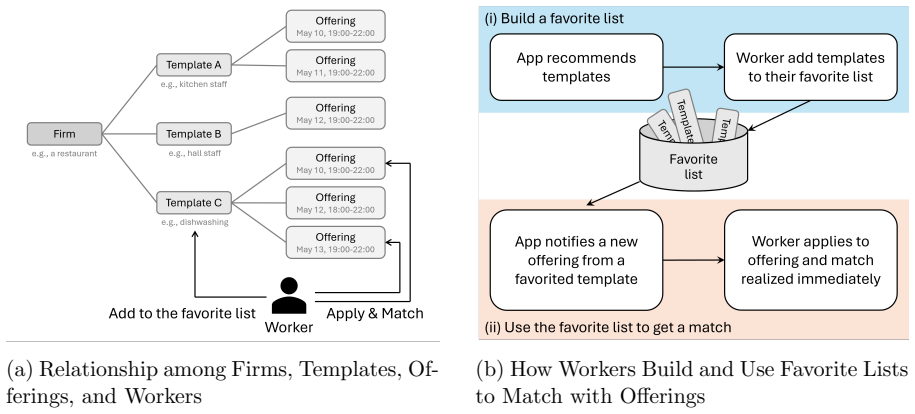
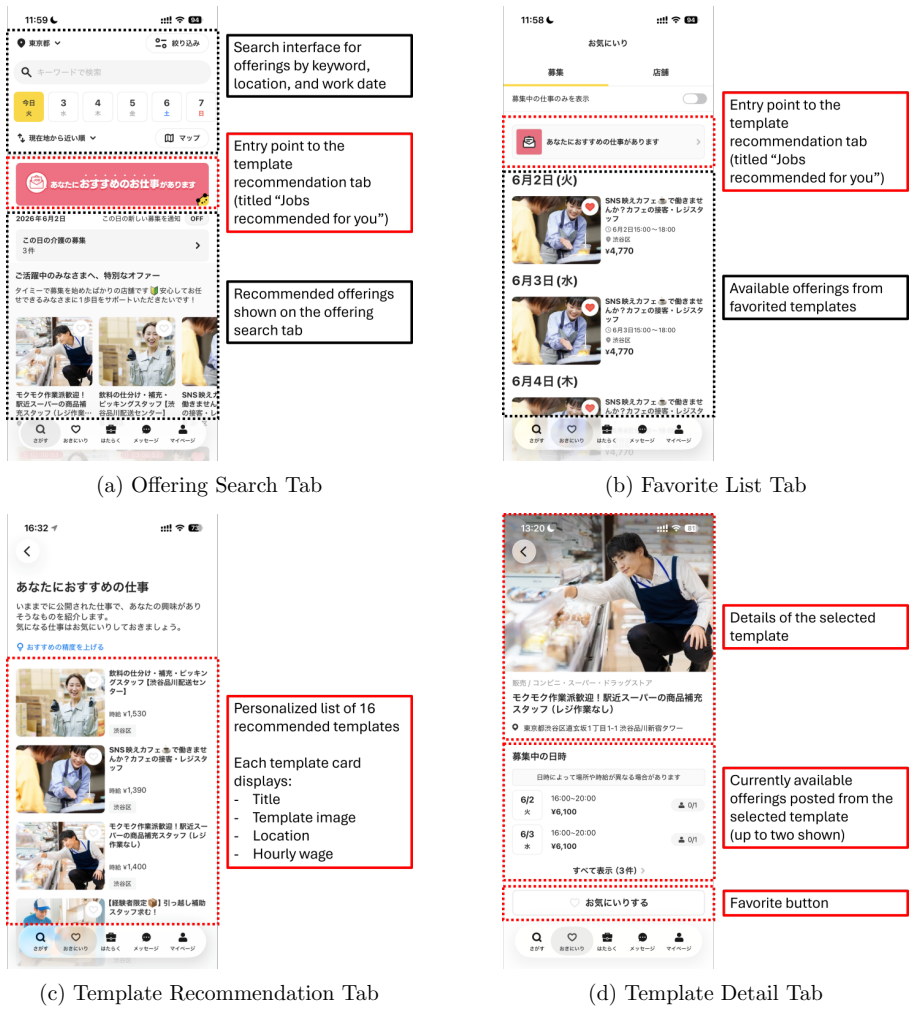
How should recommender systems be designed when recommendations shape access to scarce, short-lived opportunities? We study this question in a production setting: Timee, Japan's largest platform for spot work, where workers favorite job templates and receive notifications when firms post shifts from those templates. Maximizing predicted favoriting can generate misdirected concentration: recommendations accumulate on popular templates that create few viable job openings, while templates with unmet labor demand receive too little exposure. We design exposure-control mechanisms for favorite-list management, reallocating template exposure based on posting activity and unfilled capacity. The proposed recommender, thresholded eligibility control (TEC), is fully parallelizable and suitable for large-scale digital platforms. In simulations calibrated to Timee data, TEC raises the per-round job-finding rate from 57.6% to 70.0%. A prefecture-level randomized field experiment increases realized matches and exposure per active template, reduces the share of low-exposure templates, and improves impression-level favoriting and downstream matching.
Editorial analysis
A structured set of objections, weighed in public.
Referee Report
Summary. The paper proposes thresholded eligibility control (TEC), a parallelizable exposure-reallocation mechanism for recommender systems on spot-work platforms. It reallocates template exposure according to recent posting activity and unfilled capacity to reduce misdirected concentration on popular but low-opportunity templates. Simulations calibrated to Timee data report an increase in per-round job-finding rate from 57.6% to 70.0%. A prefecture-level randomized field experiment is reported to increase realized matches and per-template exposure, reduce the share of low-exposure templates, and improve impression-level favoriting and downstream matching.
Significance. If the quantitative claims hold, the work contributes a practical, scalable mechanism for managing exposure in matching platforms where recommendations affect access to scarce, time-sensitive opportunities. The combination of a field experiment with calibrated simulations provides direct evidence on both realized and counterfactual performance, which is rare in this domain. The mechanism's emphasis on observable posting activity and capacity makes it implementable without requiring new data collection.
major comments (2)
- [Abstract] Abstract: The simulation reports a rise from 57.6% to 70.0% in the per-round job-finding rate, but provides no information on how the 57.6% baseline is computed from the same Timee data used for calibration. This creates a circularity that directly affects the magnitude of the reported improvement and must be clarified with explicit out-of-sample checks or hold-out validation.
- [Abstract] Abstract: The prefecture-level randomized field experiment is described only at a high level; the randomization procedure, number of prefectures or templates assigned, sample size, and whether a pre-analysis plan was registered are not stated. These details are load-bearing for interpreting the reported increases in realized matches, exposure per active template, and downstream matching.
Simulated Author's Rebuttal
We thank the referee for these constructive comments on the abstract. We respond to each point below and indicate planned revisions.
read point-by-point responses
-
Referee: [Abstract] Abstract: The simulation reports a rise from 57.6% to 70.0% in the per-round job-finding rate, but provides no information on how the 57.6% baseline is computed from the same Timee data used for calibration. This creates a circularity that directly affects the magnitude of the reported improvement and must be clarified with explicit out-of-sample checks or hold-out validation.
Authors: We agree the abstract omits this detail. The 57.6% baseline reflects the observed per-round job-finding rate under the platform's existing recommendation policy in the calibration sample. To eliminate any appearance of circularity, we will revise the abstract to briefly state the baseline construction and add an explicit description of the hold-out validation procedure (including the temporal split used) in the simulation section of the main text. revision: yes
-
Referee: [Abstract] Abstract: The prefecture-level randomized field experiment is described only at a high level; the randomization procedure, number of prefectures or templates assigned, sample size, and whether a pre-analysis plan was registered are not stated. These details are load-bearing for interpreting the reported increases in realized matches, exposure per active template, and downstream matching.
Authors: We agree the abstract is high-level. The full manuscript details the prefecture-level randomization, the number of treated and control prefectures, template and worker sample sizes, and the exact outcome measures. We will expand the abstract to report the number of prefectures and overall sample size. A pre-analysis plan was not registered for this platform-partnered experiment; we will add an explicit statement to that effect in both the abstract and the experimental design section. revision: yes
Circularity Check
No significant circularity identified
full rationale
The paper's central results derive from a prefecture-level randomized field experiment measuring realized matches, exposure, and favoriting under the TEC mechanism, plus standard counterfactual simulations calibrated to observed Timee data. No quoted equations, self-citations, or steps reduce the reported improvements to fitted inputs by construction; the baseline job-finding rate and intervention effects are distinct empirical quantities. The design reallocates exposure using observable posting activity and capacity without redefining outcomes via the same parameters. This is a self-contained empirical evaluation with no load-bearing self-definitional or renaming patterns.
Axiom & Free-Parameter Ledger
Reference graph
Works this paper leans on
-
[1]
Wiring the labor market,
Working Paper. Autor, David H, “Wiring the labor market,”Journal of Economic Perspectives, 2001, 15(1), 25–40. Behaghel, Luc, Sofia Dromundo, Marc Gurgand, Yagan Hazard, and Thomas Zuber, “The potential of recommender systems for directing job search: A large scale experiment,”
2001
-
[2]
Providing advice to jobseekers at low cost: An experimental study on online advice,
Working Paper. Belot, Michele, Philipp Kircher, and Paul Muller, “Providing advice to jobseekers at low cost: An experimental study on online advice,”The Review of Economic Studies, 2019,86(4), 1411–1447. Belot, Mich` ele, Philipp Kircher, and Paul Muller, “Do the Long-term Unemployed Benefit from Automated Occupational Advice during Online Job Search?,”E...
2019
-
[3]
Disclosing Product Availabil- ity in Online Retail,
Working Paper. 45 Calvo, Eduard, Ruomeng Cui, and Laura Wagner, “Disclosing Product Availabil- ity in Online Retail,”Manufacturing & Service Operations Management, 2023,25(2), 427–447. Chen, Kuan-Ming, Yu-Wei Hsieh, and Ming-Jen Lin, “Reducing recommendation inequality via two-sided matching: A field experiment of online dating,”International Economic Rev...
2023
-
[4]
Dis- tribution regression difference-in-differences,
Fern´ andez-Val, Iv´ an, Jonas Meier, Aico van Vuuren, and Francis Vella, “Dis- tribution regression difference-in-differences,”arXiv preprint arXiv:2409.02311,
-
[5]
Competition Avoidance vs. Herding in Job Search: Evidence from Large-Scale Field Experiments on an Online Job Board,
Fradkin, Andrey, Monica Bhole, and John J. Horton, “Competition Avoidance vs. Herding in Job Search: Evidence from Large-Scale Field Experiments on an Online Job Board,”Management Science, 2026,72(2), 1305–1323. Gautier, Pieter, Paul Muller, Bas Van der Klaauw, Michael Rosholm, and Michael Svarer, “Estimating equilibrium effects of job search assistance,”...
2026
-
[6]
Kanayama, Hayato and Suguru Otani, “Nonparametric Estimation of Matching Efficiency and Elasticity in a Spot Gig Work Platform: 2019-2023,”arXiv preprint arXiv:2412.19024,
Pith/arXiv arXiv 2019
-
[7]
Just After Minimum Wage Hikes: Short-Run Labor-Demand Response and Reallocation,
, Sho Miyaji, and Suguru Otani, “Just After Minimum Wage Hikes: Short-Run Labor-Demand Response and Reallocation,”arXiv preprint arXiv:2505.04555,
-
[8]
Online labour index: Measuring the online gig economy for policy and research,
K¨ assi, Otto and Vili Lehdonvirta, “Online labour index: Measuring the online gig economy for policy and research,”Technological forecasting and social change, 2018, 137, 241–248. 46 Knight, Benjamin and Dmitry Mitrofanov, “Disclosing Low Product Availability: An Online Platform’s Strategy for Mitigating Stockout Risk,”Management Science, 2026,72(2), 156...
2018
-
[9]
Push It Across the Finish Line—Designing Online Interfaces to Induce Choice Closure at the Postdecision Prepurchase Stage,
Working Paper. Lee, Younghwa, Andrew N. K. Chen, and Weiquan Wang, “Push It Across the Finish Line—Designing Online Interfaces to Induce Choice Closure at the Postdecision Prepurchase Stage,”Information Systems Research, 2025,36(3), 1821–1845. Luo, Xueming, Xianghua Lu, and Jing Li, “When and How to Leverage E-commerce Cart Targeting: The Relative and Mod...
2025
-
[10]
Modeling Online Browsing and Path Analysis Using Clickstream Data,
Management Science, forthcoming. Montgomery, Alan L., Shibo Li, Kannan Srinivasan, and John C. Liechty, “Modeling Online Browsing and Path Analysis Using Clickstream Data,”Marketing Science, 2004,23(4), 579–595. Naya, Victor Alfonso, Guillaume Bied, Philippe Caillou, Bruno Cr´ epon, Christophe Gaillac, Elia P´ erennes, and Mich` ele Sebag, “Designing labo...
2004
-
[11]
Nonparametric estimation of matching efficiency and elasticity on a private on-the-job search platform: Evidence from Japan, 2014-2024,
Working Paper. Otani, Suguru, “Nonparametric estimation of matching efficiency and elasticity on a private on-the-job search platform: Evidence from Japan, 2014-2024,”Journal of the Japanese and International Economies, 2025, p. 101394. Reusens, Michael, Wilfried Lemahieu, Bart Baesens, and Luc Sels, “Evaluating recommendation and search in the labor mark...
2014
-
[12]
Integrating Predictive Models into Two-Sided Recommendations: A Matching-Theoretic Approach,
Sekiya, Kazuki, Suguru Otani, Yuki Komatsu, Sachio Ohkawa, and Shunya Noda, “Integrating Predictive Models into Two-Sided Recommendations: A Matching-Theoretic Approach,”arXiv preprint arXiv:2602.19689,
-
[13]
Matching Theory-based Recommender Systems in Online Dating,
Tomita, Yoji, Riku Togashi, and Daisuke Moriwaki, “Matching Theory-based Recommender Systems in Online Dating,” in “Proceedings of the 16th ACM Conference on Recommender Systems” 2022, p. 538–541. , , Yuriko Hashizume, and Naoto Ohsaka, “Fast and examination-agnostic reciprocal recommendation in matching markets,” in “Proceedings of the 17th ACM Conferenc...
2022
discussion (0)
Sign in with ORCID, Apple, or X to comment. Anyone can read and Pith papers without signing in.