Multi-Orientation Edge-Minimum Repair for Non-Redundant Fault-Tolerant Broadcasting in Dense Gaussian Networks
Pith reviewed 2026-06-26 23:26 UTC · model grok-4.3
The pith
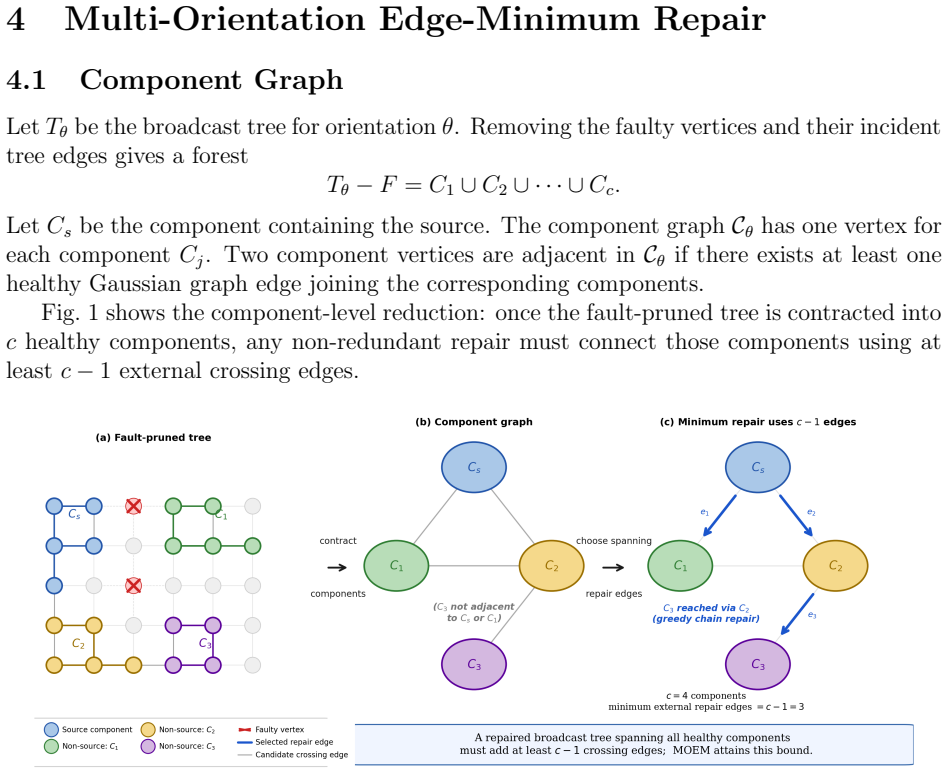
MOEM selects from a constant-size family of orientations to repair broadcasts in dense Gaussian networks using exactly c-1 edges for c fault-pruned components.
A machine-rendered reading of the paper's core claim, the machinery that carries it, and where it could break.
Core claim
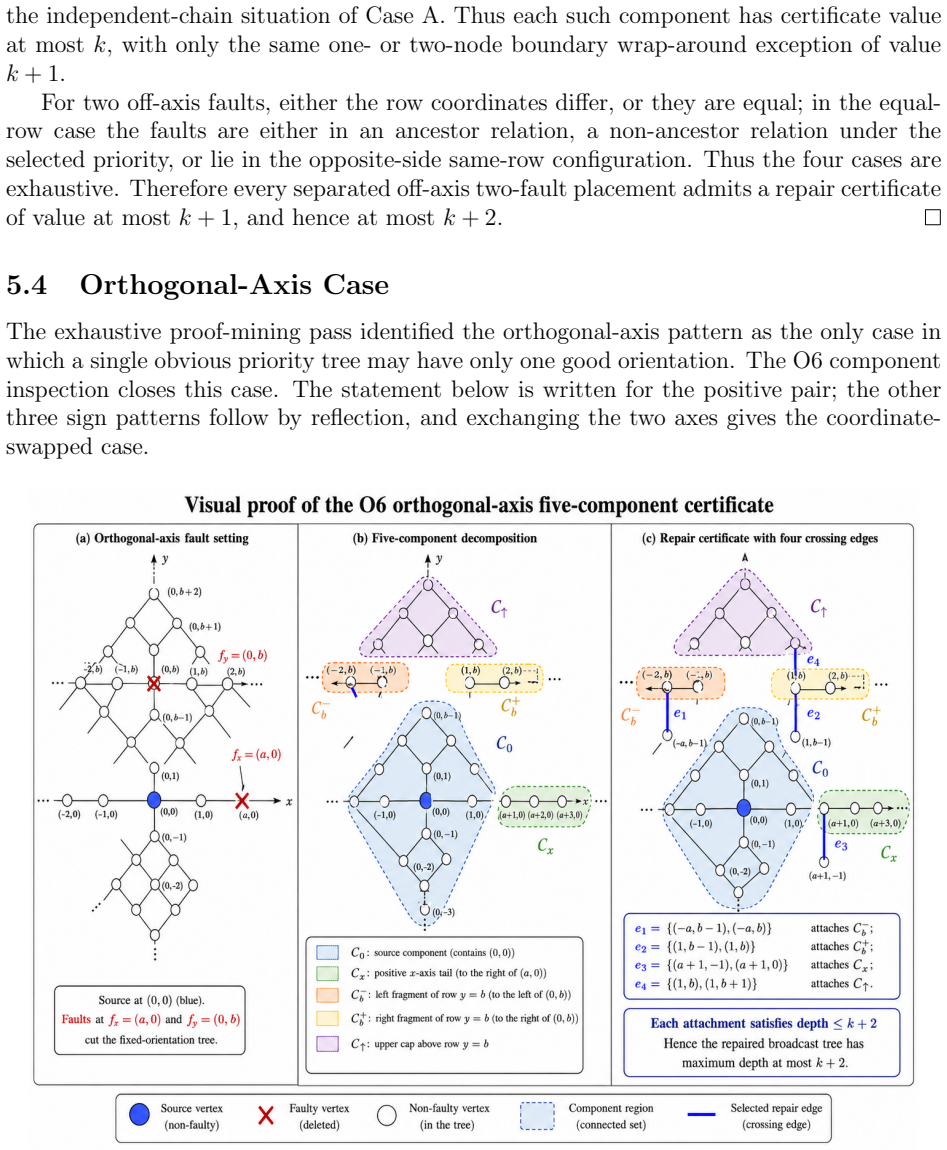
For a chosen orientation with c fault-pruned components and a connected healthy component graph, the repair step is non-redundant and uses the minimum possible number c-1 of external component-repair edges. For every one- or two-fault placement, the MOEM orientation family contains a repair with depth at most k+2. The depth proof combines a certificate framework, an explicit four-case off-axis analysis, and a five-component orthogonal-axis certificate.
What carries the argument
Multi-orientation edge-minimum repair (MOEM), which evaluates a constant-size family of Gaussian broadcast-tree orientations, contracts the fault-pruned tree into healthy components, and reconnects those components using external component-crossing repair edges.
If this is right
- The resulting structure is a rooted spanning tree of the healthy subgraph so each healthy node receives the message exactly once.
- For every one- or two-fault placement the MOEM family contains a repair with depth at most k+2.
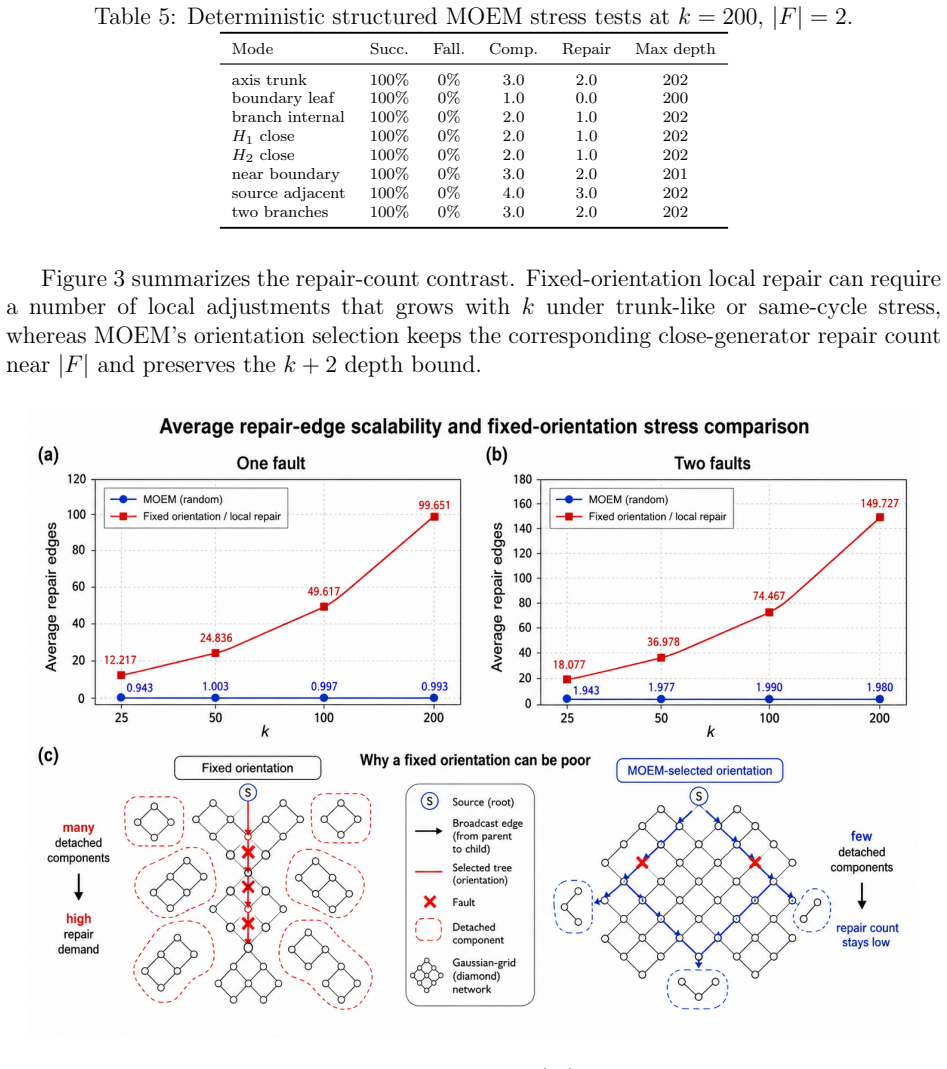
- Exhaustive validation for k from 5 to 10 and large-scale validation through k=200 confirm that random two-fault repairs use approximately two external repair edges.
Where Pith is reading between the lines
- The non-redundant property means broadcast time equals the depth of the repaired tree rather than the depth plus extra transmissions.
- The constant family size implies the selection step can be performed locally if each node stores the small set of precomputed orientations.
Load-bearing premise
The MOEM family always contains an orientation for which the healthy component graph remains connected after pruning faulty nodes.
What would settle it
A concrete one- or two-fault placement where every orientation in the family either disconnects the healthy component graph or yields a repair tree deeper than k+2.
Figures
read the original abstract
Dense Gaussian networks are degree-four algebraic interconnection networks with compact diameter and simple modular routing. This paper studies non-redundant one-to-all broadcast repair in the dense Gaussian network generated by $\alpha=k+(k+1)i$. We propose multi-orientation edge-minimum repair (MOEM), which evaluates a constant-size family of Gaussian broadcast-tree orientations, selects a fault-aware orientation, contracts the fault-pruned tree into healthy components, and reconnects those components using external component-crossing repair edges. The resulting structure is a rooted spanning tree of the healthy subgraph, so each healthy node receives the message exactly once and no faulty node is used. We prove that, for a chosen orientation with $c$ fault-pruned components and a connected healthy component graph, the repair step is non-redundant and uses the minimum possible number $c-1$ of external component-repair edges. We also prove that, for every one- or two-fault placement, the MOEM orientation family contains a repair with depth at most $k+2$. The depth proof combines a certificate framework, an explicit four-case off-axis analysis, and a five-component orthogonal-axis certificate. Exhaustive validation for $k=5,\ldots,10$ and large-scale validation through $k=200$ confirm the implementation and show that random two-fault repairs use approximately two external repair edges.
Editorial analysis
A structured set of objections, weighed in public.
Referee Report
Summary. The manuscript proposes Multi-Orientation Edge-Minimum Repair (MOEM) for non-redundant one-to-all broadcast repair in the dense Gaussian network generated by α = k + (k+1)i. It evaluates a constant-size family of Gaussian broadcast-tree orientations, selects a fault-aware orientation, contracts the fault-pruned tree into healthy components, and reconnects those components using external component-crossing repair edges to form a rooted spanning tree of the healthy subgraph. The paper proves that, for a chosen orientation with c fault-pruned components and a connected healthy component graph, the repair uses exactly c-1 edges and is non-redundant. It also proves that for every one- or two-fault placement the MOEM family contains a repair of depth at most k+2, via a certificate framework, four-case off-axis analysis, and five-component orthogonal-axis certificate. Exhaustive validation for k=5..10 and large-scale validation to k=200 are reported, showing random two-fault repairs use approximately two external edges.
Significance. If the existence of a suitable orientation (ensuring connected healthy component graph) is established for all 1- and 2-fault placements, the work supplies a non-redundant, minimum-edge repair construction with a provable depth bound of k+2 together with extensive validation; this would be a concrete contribution to fault-tolerant broadcasting in algebraic degree-4 networks. The explicit conditional statement of the c-1 bound and the combination of certificate-based proof with large-scale empirical checks are strengths.
major comments (1)
- [Depth proof (certificate framework, four-case off-axis analysis, and five-component orthogonal-axis certificate)] The depth-at-most-k+2 claim (and by extension the applicability of the c-1 edge bound) requires that the constant-size MOEM orientation family always contains at least one orientation for which the healthy component graph remains connected after any 1- or 2-fault pruning. The abstract states the conditional c-1 proof and the depth result but supplies no separate argument establishing this existence precondition for every fault placement; if the certificate framework, off-axis analysis, or orthogonal-axis certificate do not explicitly address connectivity of the healthy component graph, both central guarantees remain conditional on an unverified assumption.
minor comments (1)
- [Abstract] The abstract reports 'approximately two external repair edges' for random two-fault repairs but does not state the precise distribution, maximum, or number of trials; adding these details would strengthen the validation claim.
Simulated Author's Rebuttal
We thank the referee for the detailed reading and for identifying a point that merits clarification. We respond to the major comment below.
read point-by-point responses
-
Referee: The depth-at-most-k+2 claim (and by extension the applicability of the c-1 edge bound) requires that the constant-size MOEM orientation family always contains at least one orientation for which the healthy component graph remains connected after any 1- or 2-fault pruning. The abstract states the conditional c-1 proof and the depth result but supplies no separate argument establishing this existence precondition for every fault placement; if the certificate framework, off-axis analysis, or orthogonal-axis certificate do not explicitly address connectivity of the healthy component graph, both central guarantees remain conditional on an unverified assumption.
Authors: The certificate framework is constructed to establish exactly the required existence: for every 1- or 2-fault placement it certifies the presence of an orientation in the constant-size MOEM family such that the healthy-component graph is connected and the resulting repair tree has depth at most k+2. The four-case off-axis analysis and the five-component orthogonal-axis certificate enumerate the relative positions of the faults with respect to each orientation; in each case they simultaneously verify connectivity of the contracted component graph and the depth bound. Consequently the existence precondition is not left unverified but is an explicit outcome of the case analysis. No separate lemma is needed because the connectivity guarantee is obtained inside the same certificate that yields the depth bound. revision: no
Circularity Check
No significant circularity; claims rest on explicit conditional proofs and case analysis.
full rationale
The paper defines MOEM as a construction that selects from a constant-size family of orientations, contracts fault-pruned trees, and reconnects components. It then states two explicit theorems: (1) non-redundancy and c-1 edge minimality hold only under the precondition that the healthy component graph is connected, and (2) for every 1- or 2-fault placement the family contains an orientation yielding depth at most k+2, proved via a certificate framework plus four-case off-axis and five-component orthogonal-axis analysis. These are presented as mathematical derivations, not as quantities fitted to data or renamed by definition. Exhaustive validation for small k and large-scale checks to k=200 are reported separately as implementation confirmation. No self-citations, ansatzes, or uniqueness theorems imported from prior author work appear as load-bearing steps in the abstract or described proof structure. The derivation chain therefore remains self-contained against external benchmarks.
Axiom & Free-Parameter Ledger
axioms (1)
- domain assumption The network is the dense Gaussian network generated by α = k + (k+1)i
Reference graph
Works this paper leans on
-
[1]
A group-theoretic model for symmetric intercon- nection networks,
S. B. Akers and B. Krishnamurthy, “A group-theoretic model for symmetric intercon- nection networks,”IEEE Transactions on Computers, vol. 38, no. 4, pp. 555–566, Apr. 1989
1989
-
[2]
F. T. Leighton,Introduction to Parallel Algorithms and Architectures: Arrays, Trees, Hypercubes. San Mateo, CA, USA: Morgan Kaufmann, 1992
1992
-
[3]
W. J. Dally and B. Towles,Principles and Practices of Interconnection Networks. San Francisco, CA, USA: Morgan Kaufmann, 2004
2004
-
[4]
Fault-tolerant communication algorithms in toroidal networks,
B. F. A. AlMohammad and B. Bose, “Fault-tolerant communication algorithms in toroidal networks,”IEEE Transactions on Parallel and Distributed Systems, vol. 10, no. 10, pp. 976–983, Oct. 1999
1999
-
[5]
Modeling toroidal networks with the Gaussian integers,
C. Martinez, R. Beivide, E. Stafford, M. Moreto, and E. M. Gabidulin, “Modeling toroidal networks with the Gaussian integers,”IEEE Transactions on Computers, vol. 57, no. 8, pp. 1046–1056, Aug. 2008. 18
2008
-
[6]
Dense Gaussian networks: Suitable topologies for on-chip multiprocessors,
C. Martinez, E. Vallejo, R. Beivide, C. Izu, and M. Moreto, “Dense Gaussian networks: Suitable topologies for on-chip multiprocessors,”International Journal of Parallel Pro- gramming, vol. 34, no. 3, pp. 193–211, 2006
2006
-
[7]
Hierarchical Gaussian topologies,
M. Moreto, C. Martinez, R. Beivide, E. Vallejo, and M. Valero, “Hierarchical Gaussian topologies,” inAdvanced Computer Architecture and Compilation for Embedded Systems (ACACES), 2006
2006
-
[8]
Modeling hexagonal con- stellations with Eisenstein–Jacobi graphs,
C. Martinez, E. Stafford, R. Beivide, and E. M. Gabidulin, “Modeling hexagonal con- stellations with Eisenstein–Jacobi graphs,”Problems of Information Transmission, vol. 44, no. 1, pp. 1–11, 2008
2008
-
[9]
Symmetric interconnection networks from cubic crystal lattices,
C. Camarero, C. Martinez, and R. Beivide, “Symmetric interconnection networks from cubic crystal lattices,” arXiv:1311.2019, 2013
Pith/arXiv arXiv 2019
-
[10]
Projective networks: Topologies for large parallel computer systems,
C. Camarero, C. Martinez, E. Vallejo, and R. Beivide, “Projective networks: Topologies for large parallel computer systems,” arXiv:1512.07574, 2015
Pith/arXiv arXiv 2015
-
[11]
The topology of Gaussian and Eisenstein–Jacobi interconnec- tion networks,
M. Flahive and B. Bose, “The topology of Gaussian and Eisenstein–Jacobi interconnec- tion networks,”IEEE Transactions on Parallel and Distributed Systems, vol. 21, no. 8, pp. 1132–1142, Aug. 2010
2010
-
[12]
Efficient communication algorithms in hexag- onal mesh interconnection networks,
B. A. Albader, B. Bose, and M. Flahive, “Efficient communication algorithms in hexag- onal mesh interconnection networks,”IEEE Transactions on Parallel and Distributed Systems, vol. 23, no. 1, pp. 69–77, Jan. 2012
2012
-
[13]
On resource placements in Gaussian and EJ networks,
M. Flahive and B. Bose, “On resource placements in Gaussian and EJ networks,”IEEE Transactions on Computers, vol. 62, no. 3, pp. 623–626, Mar. 2013
2013
-
[14]
One-to-many node-disjoint paths routing in dense Gaussian networks,
O. Alsaleh, B. Bose, and B. Hamdaoui, “One-to-many node-disjoint paths routing in dense Gaussian networks,”The Computer Journal, 2013, doi: 10.1093/comjnl/bxt142
-
[15]
Edge disjoint Hamiltonian cycles in Gaussian networks,
B. A. Albader and B. Bose, “Edge disjoint Hamiltonian cycles in Gaussian networks,” IEEE Transactions on Computers, vol. 65, no. 1, pp. 315–321, Jan. 2016
2016
-
[16]
A survey of fault-tolerant network-on- chip architectures,
D. Kliazovich, F. Granelli, and D. Miorandi, “A survey of fault-tolerant network-on- chip architectures,”IEEE Communications Surveys and Tutorials, vol. 15, no. 4, pp. 1676–1690, 2013
2013
-
[17]
Pasricha and N
S. Pasricha and N. Dutt,On-Chip Communication Architectures: System on Chip In- terconnect. San Francisco, CA, USA: Morgan Kaufmann, 2008
2008
-
[18]
Routing algorithms for optimal degree-four circulant networks based on relative addressing,
E. A. Monakhova, O. G. Monakhov, and A. Y. Romanov, “Routing algorithms for optimal degree-four circulant networks based on relative addressing,”IEEE Access, vol. 8, pp. 215010–215019, 2020
2020
-
[19]
Gaussian-based optical networks-on-chip: Perfor- mance evaluation and analysis,
T. Song, X. Jiang, and Y. Yang, “Gaussian-based optical networks-on-chip: Perfor- mance evaluation and analysis,”Sustainable Computing: Informatics and Systems, vol. 28, 2020. 19
2020
discussion (0)
Sign in with ORCID, Apple, or X to comment. Anyone can read and Pith papers without signing in.