Safe, Real-Time Active Model Discrimination and Fault Diagnosis for Nonlinear Systems via Differentiable Reachability
Pith reviewed 2026-06-26 20:26 UTC · model grok-4.3
The pith
A differentiable reachability approach finds safe policies that separate up to 11 fault models in nonlinear robots within 50 ms.
A machine-rendered reading of the paper's core claim, the machinery that carries it, and where it could break.
Core claim
The central claim is that an output-feedback policy optimization problem, approximated via interval over-approximations of reachable state and output sets and solved with a differentiable overlap penalty, produces time-varying policies that robustly enforce safety constraints and drive sampled measurements to be consistent with at most one model from a finite candidate set, enabling deterministic diagnosis in real time.
What carries the argument
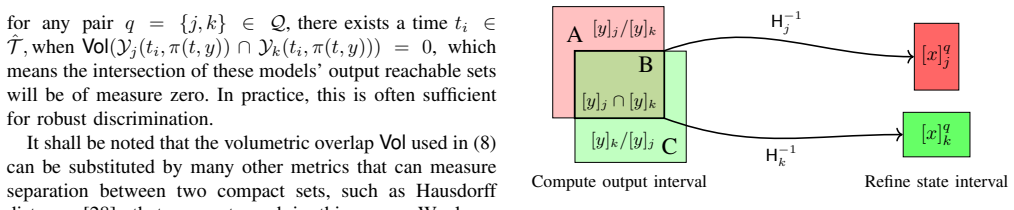
Interval over-approximations of reachable output sets combined with a differentiable penalty on their pairwise overlaps, embedded inside a gradient-based policy optimization that also enforces safety.
If this is right
- Diagnosis completes reliably in under 50 ms across high-dimensional nonlinear robotic examples.
- Formal safety guarantees hold during the active diagnosis process for both sensor and actuator faults.
- Performance exceeds baseline methods in both discrimination success rate and computation speed for up to 11 modes.
- The same formulation applies to simulated and hardware platforms including quadrotors and quadrupedal navigation.
Where Pith is reading between the lines
- The method could be combined with receding-horizon replanning so that diagnosis triggers immediate mode-specific recovery controllers.
- Tighter set representations or adaptive interval refinement might further reduce conservatism while preserving real-time speed.
- The same overlap-penalty structure could apply to active identification of unknown parameters rather than discrete fault modes.
- Hardware validation under larger disturbances would test whether the differentiability advantage survives model mismatch.
Load-bearing premise
The interval over-approximations of reachable output sets must stay tight enough that minimizing their overlap actually produces a policy separating the models in finite time without violating the encoded safety constraints.
What would settle it
Running the optimized policy on a system and finding that the actual output trajectories for two different models still produce overlapping reachable sets at the sampled times, or that a safety constraint on state or input is violated.
Figures



read the original abstract
We present a safe, real-time algorithm for active fault diagnosis and model discrimination for uncertain continuous-time nonlinear systems with process and measurement disturbances. Given a finite set of candidate models representing nominal and faulty modes, including actuator and sensor faults, we formulate an output-feedback, time-varying policy optimization problem that (i) robustly enforces state-input safety constraints over a finite horizon and (ii) drives the system to produce sampled measurements consistent with at most one model, enabling deterministic diagnosis. To solve this problem in real time, we develop a tractable approximation using interval over-approximations of reachable state and output sets, and encode diagnosability via a differentiable objective that penalizes overlap between the reachable output sets of possible models. The resulting optimization is solved efficiently online with gradient-based methods using JAX and differentiable reachability primitives. We evaluate our method on sensor and actuator fault diagnosis (up to 11 fault modes) in several high-dimensional nonlinear robotic systems, including a simulated quadrotor and fighter-jet model, a hardware differential-drive robot, and quadrupedal navigation. Across these case studies, our approach achieves reliable model discrimination in under 50 ms, outperforming baselines in discrimination success rate and speed while providing formal safety guarantees.
Editorial analysis
A structured set of objections, weighed in public.
Referee Report
Summary. The paper claims to present a safe real-time algorithm for active model discrimination and fault diagnosis in uncertain continuous-time nonlinear systems. It formulates an output-feedback policy optimization that enforces safety constraints over a finite horizon using interval over-approximations of reachable sets and drives sampled measurements to be consistent with at most one model via a differentiable overlap penalty on reachable output sets. The optimization is solved online with gradient-based methods in JAX; evaluations on robotic systems (quadrotor, fighter-jet, differential-drive robot, quadruped) with up to 11 fault modes report reliable discrimination in under 50 ms while outperforming baselines and providing formal safety guarantees.
Significance. If the interval over-approximations prove sufficiently tight to make the overlap penalty effective without rendering the safety-constrained program infeasible, the approach would offer a practical, formally grounded method for real-time active diagnosis in high-dimensional nonlinear robotic systems, bridging differentiable programming with reachability-based safety.
major comments (2)
- [Abstract and reachable-set approximation section] The central claim that the method provides formal safety guarantees while achieving deterministic diagnosis rests on the interval over-approximations of reachable output sets remaining tight enough for the differentiable overlap penalty to drive the sets disjoint under admissible controls. In continuous-time nonlinear dynamics with process/measurement disturbances, standard interval methods are subject to the wrapping effect; the manuscript provides no quantitative bounds, tightness metrics, or empirical over-approximation error analysis to confirm that the surrogate objective actually separates the models (up to 11) rather than merely satisfying a relaxed penalty.
- [Evaluation section] The reported performance (reliable discrimination in under 50 ms, outperforming baselines) lacks evidence on how the results depend on post-hoc choices such as optimization horizon length or penalty weights. Without ablations or sensitivity analysis, it is unclear whether the claimed speed and success rates are robust or artifacts of tuning that could affect constraint satisfaction or diagnosability.
minor comments (1)
- [Introduction] Notation for the finite set of candidate models and the time-varying policy could be introduced more explicitly to improve readability.
Simulated Author's Rebuttal
We thank the referee for the constructive feedback. We address each major comment below, clarifying the formal guarantees provided by over-approximations and committing to additional analyses in revision.
read point-by-point responses
-
Referee: [Abstract and reachable-set approximation section] The central claim that the method provides formal safety guarantees while achieving deterministic diagnosis rests on the interval over-approximations of reachable output sets remaining tight enough for the differentiable overlap penalty to drive the sets disjoint under admissible controls. In continuous-time nonlinear dynamics with process/measurement disturbances, standard interval methods are subject to the wrapping effect; the manuscript provides no quantitative bounds, tightness metrics, or empirical over-approximation error analysis to confirm that the surrogate objective actually separates the models (up to 11) rather than merely satisfying a relaxed penalty.
Authors: Safety is formally guaranteed because constraints are enforced on the interval over-approximations: satisfaction for the over-approximations implies satisfaction for the true (contained) reachable sets. For diagnosis, the overlap penalty acts on over-approximated output sets; driving the penalty to zero makes the over-approximations disjoint, which implies the actual sets are disjoint and enables deterministic diagnosis. We agree the manuscript lacks quantitative tightness metrics or error analysis. We will add an empirical over-approximation error study (e.g., interval bounds vs. Monte Carlo samples) to the evaluation section in revision. revision: yes
-
Referee: [Evaluation section] The reported performance (reliable discrimination in under 50 ms, outperforming baselines) lacks evidence on how the results depend on post-hoc choices such as optimization horizon length or penalty weights. Without ablations or sensitivity analysis, it is unclear whether the claimed speed and success rates are robust or artifacts of tuning that could affect constraint satisfaction or diagnosability.
Authors: We agree that robustness to horizon length and penalty weights should be demonstrated. In the revised manuscript we will add ablation and sensitivity studies varying these parameters, reporting effects on success rate, runtime, and constraint satisfaction for the robotic examples. revision: yes
Circularity Check
No circularity: derivation relies on external differentiable reachability primitives and interval methods without self-referential reduction
full rationale
The paper formulates an optimization using interval over-approximations of reachable sets and a differentiable overlap penalty, solved via JAX. No equations or claims reduce a reported performance metric or diagnosability guarantee to a fitted parameter or self-citation by construction. The central approach is presented as depending on standard interval methods and external primitives rather than redefining its inputs. The reader's assessment of score 1.0 aligns with the absence of any load-bearing self-definition, fitted-input prediction, or uniqueness theorem imported from the authors' prior work. The skeptic concern addresses assumption tightness (a correctness issue) rather than circularity in the derivation chain.
Axiom & Free-Parameter Ledger
axioms (1)
- standard math Interval arithmetic yields valid over-approximations of reachable state and output sets for the considered class of nonlinear systems with bounded disturbances.
Reference graph
Works this paper leans on
-
[1]
Statistical methods in model discrimination,
P. Reilly, “Statistical methods in model discrimination,”The Canadian journal of chemical engineering, vol. 48, no. 2, pp. 168–173, 1970
1970
-
[2]
Model (in) validation and fault detection for systems with polynomial state-space models,
F. Harirchi, Z. Luo, and N. Ozay, “Model (in) validation and fault detection for systems with polynomial state-space models,” in2016 American Control Conference (ACC). IEEE, 2016, pp. 1017–1023
2016
-
[3]
Input design for nonlin- ear model discrimination via affine abstraction,
K. Singh, Y . Ding, N. Ozay, and S. Z. Yong, “Input design for nonlin- ear model discrimination via affine abstraction,”IFAC-PapersOnLine, vol. 51, no. 16, pp. 175–180, 2018
2018
-
[4]
Obtaining fault trees through sysml diagrams: A mbse approach for reliability analysis,
A. H. de Andrade Melani and G. F. M. de Souza, “Obtaining fault trees through sysml diagrams: A mbse approach for reliability analysis,” in 2020 Annual reliability and maintainability symposium. IEEE, 2020
2020
-
[5]
Observer-based asymptotic active fault diagnosis: Separate and joint design of observer gain and input,
F. Xu, Y . Wan, Y . Wang, and V . Puig, “Observer-based asymptotic active fault diagnosis: Separate and joint design of observer gain and input,”Automatica, vol. 183, p. 112548, 2026
2026
-
[6]
Robust augmented state extended kalman filter for actuator/sensor fault detection and isolation in quadrotor un- manned aerial vehicles,
M. G. Patan and I. Ustoglu, “Robust augmented state extended kalman filter for actuator/sensor fault detection and isolation in quadrotor un- manned aerial vehicles,”Journal of Dynamic Systems, Measurement, and Control, vol. 148, no. 1, p. 011001, 2026
2026
-
[7]
A sensor-based approach for fault detection and diagnosis for robotic systems,
E. Khalastchi and M. Kalech, “A sensor-based approach for fault detection and diagnosis for robotic systems,”Autonomous Robots, vol. 42, no. 6, pp. 1231–1248, 2018
2018
-
[8]
Online data-driven fault detection for robotic systems,
R. Golombek, S. Wrede, M. Hanheide, and M. Heckmann, “Online data-driven fault detection for robotic systems,” inIEEE/RSJ Interna- tional Conference on Intelligent Robots and Systems (IROS), 2011
2011
-
[9]
Op- timal experimental design for probabilistic model discrimination using polynomial chaos,
S. Streif, F. Petzke, A. Mesbah, R. Findeisen, and R. D. Braatz, “Op- timal experimental design for probabilistic model discrimination using polynomial chaos,”IFAC Proceedings Volumes, vol. 47, no. 3, 2014
2014
-
[10]
Model-free neural fault detection and isolation for safe control,
K. Garg, C. Dawson, K. Xu, M. Ornik, and C. Fan, “Model-free neural fault detection and isolation for safe control,”IEEE Control Systems Letters, vol. 7, pp. 3169–3174, 2023
2023
-
[11]
Data-driven fault detection and isolation of system with only state measurements and control inputs using neural networks,
J.-H. Park and D. E. Chang, “Data-driven fault detection and isolation of system with only state measurements and control inputs using neural networks,” in2021 21st International Conference on Control, Automation and Systems (ICCAS). IEEE, 2021, pp. 108–112
2021
-
[12]
Active fault-tolerant control for a quadrotor helicopter against actuator faults and model uncertainties,
B. Wang, Y . Shen, and Y . Zhang, “Active fault-tolerant control for a quadrotor helicopter against actuator faults and model uncertainties,” Aerospace Science and Technology, vol. 99, p. 105745, 2020
2020
-
[13]
Fault detection and isolation of lpv systems using set-valued observers: An application to a fixed-wing aircraft,
P. Rosa and C. Silvestre, “Fault detection and isolation of lpv systems using set-valued observers: An application to a fixed-wing aircraft,” Control Engineering Practice, vol. 21, no. 3, pp. 242–252, 2013
2013
-
[14]
Input design for guaranteed fault diagnosis using zonotopes,
J. K. Scott, R. Findeisen, R. D. Braatz, and D. M. Raimondo, “Input design for guaranteed fault diagnosis using zonotopes,”Automatica, vol. 50, no. 6, pp. 1580–1589, 2014
2014
-
[15]
Guaranteed model-based fault detection in cyber–physical systems: A model invalidation approach,
F. Harirchi and N. Ozay, “Guaranteed model-based fault detection in cyber–physical systems: A model invalidation approach,”Automatica, vol. 93, pp. 476–488, 2018
2018
-
[16]
Active fault diagnosis: A multi-parametric approach,
G. R. Marseglia and D. M. Raimondo, “Active fault diagnosis: A multi-parametric approach,”Automatica, vol. 79, pp. 223–230, 2017
2017
-
[17]
Set-based fault diagnosis for uncertain nonlinear systems,
B. Mu and J. Scott, “Set-based fault diagnosis for uncertain nonlinear systems,”Computers & Chemical Engineering, vol. 180, 2024
2024
-
[18]
Zeta: a library for zonotope-based estimation and fault diagnosis of discrete- time systems,
B. Rego, J. Scott, D. Raimondo, M. Terra, and G. Raffo, “Zeta: a library for zonotope-based estimation and fault diagnosis of discrete- time systems,” inIEEE Conference on Decision and Control, 2025
2025
-
[19]
Fault detection via output-based barrier functions,
L. Ballotta, A. Peruffo, R. Ferrari, and M. Mazo Jr, “Fault detection via output-based barrier functions,”European Journal of Control, 2025
2025
-
[20]
Safe control for nonlinear systems under faults and attacks via control barrier functions,
H. Zhang, Z. Li, and A. Clark, “Safe control for nonlinear systems under faults and attacks via control barrier functions,”IEEE Transactions on Automatic Control, 2025
2025
-
[21]
Set-based experiment design for model discrimination using bilevel optimization,
N. Rudolph, S. Streif, and R. Findeisen, “Set-based experiment design for model discrimination using bilevel optimization,”IFAC- PapersOnLine, vol. 49, no. 26, pp. 295–299, 2016
2016
-
[22]
Guaranteeing safety of learned perception modules via measurement-robust control barrier functions,
S. Dean, A. Taylor, R. Cosner, B. Recht, and A. Ames, “Guaranteeing safety of learned perception modules via measurement-robust control barrier functions,” inConference on Robot Learning, 2021
2021
-
[23]
Synthesizing stable reduced-order visuomo- tor policies for nonlinear systems via sums-of-squares optimization,
G. Chou and R. Tedrake, “Synthesizing stable reduced-order visuomo- tor policies for nonlinear systems via sums-of-squares optimization,” in2023 62nd IEEE Conference on Decision and Control (CDC), 2023
2023
-
[24]
Safe output feedback motion planning from images via learned perception modules and contraction theory,
G. Chou, N. Ozay, and D. Berenson, “Safe output feedback motion planning from images via learned perception modules and contraction theory,” inInternational Workshop on the Algorithmic Foundations of Robotics. Springer, 2022, pp. 349–367
2022
-
[25]
A. P. Leeman, S. Zhan, M. N. Zeilinger, and G. Chou, “Vision-sls: Safe perception-based control from learned visual representations via system level synthesis,”arXiv preprint arXiv:2604.24894, 2026
work page internal anchor Pith review Pith/arXiv arXiv 2026
-
[26]
immrax: A paralleliz- able and differentiable toolbox for interval analysis and mixed mono- tone reachability in jax,
A. Harapanahalli, S. Jafarpour, and S. Coogan, “immrax: A paralleliz- able and differentiable toolbox for interval analysis and mixed mono- tone reachability in jax,”IFAC-PapersOnLine, vol. 58, no. 11, 2024
2024
-
[27]
Mixed monotonicity for reachability and safety in dynamical systems,
S. Coogan, “Mixed monotonicity for reachability and safety in dynamical systems,” in2020 59th IEEE Conference on Decision and Control (CDC). IEEE, 2020, pp. 5074–5085
2020
-
[28]
Set inversion via interval analysis for nonlinear bounded-error estimation,
L. Jaulin and E. Walter, “Set inversion via interval analysis for nonlinear bounded-error estimation,”Automatica, vol. 29, no. 4, 1993
1993
-
[29]
Applied interval analysis,
O. Didrit, L. Jaulin, M. Kieffer, and E. Walter, “Applied interval analysis,”Springer-Verlag, 2001
2001
-
[30]
Computing robustly forward invariant sets for mixed-monotone systems,
M. Abate and S. Coogan, “Computing robustly forward invariant sets for mixed-monotone systems,” inConf. on Dec. Ctrl. (CDC), 2020
2020
-
[31]
LaValle,Planning algorithms
S. LaValle,Planning algorithms. Cambridge university press, 2006
2006
-
[32]
Forssell and U
L. Forssell and U. Nilsson,ADMIRE the aero-data model in a research environment version 4.0, model description, 2005
2005
-
[33]
Resilience of linear systems to partial loss of control authority,
J.-B. Bouvier and M. Ornik, “Resilience of linear systems to partial loss of control authority,”Automatica, vol. 152, p. 110985, 2023
2023
discussion (0)
Sign in with ORCID, Apple, or X to comment. Anyone can read and Pith papers without signing in.