Re-Rooting-Assisted Edge-Minimum Runtime Repair for Node and Link Failures in Dense Eisenstein--Jacobi Broadcast Networks
Pith reviewed 2026-06-26 13:33 UTC · model grok-4.3
The pith
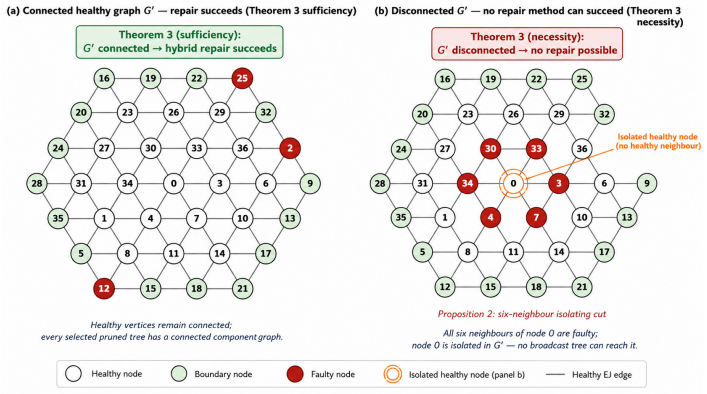
Hybrid repair succeeds if and only if the healthy EJ graph after failures remains connected.
A machine-rendered reading of the paper's core claim, the machinery that carries it, and where it could break.
Core claim
Hybrid repair succeeds if and only if the healthy EJ graph G' = Ht − Fv − Fe is connected. When G' is connected, a spanning tree of Kcomp_r,θ maps to exactly c−1 component-crossing repair edges, which is minimum for the selected pruned tree.
What carries the argument
The selected triple (r, θ, Kcomp_r,θ) — a chosen root, a chosen EJ coordinate-reduction orientation, and the healthy component graph induced by that choice — which serves as the fundamental unit of analysis for joint node and link fault recovery.
If this is right
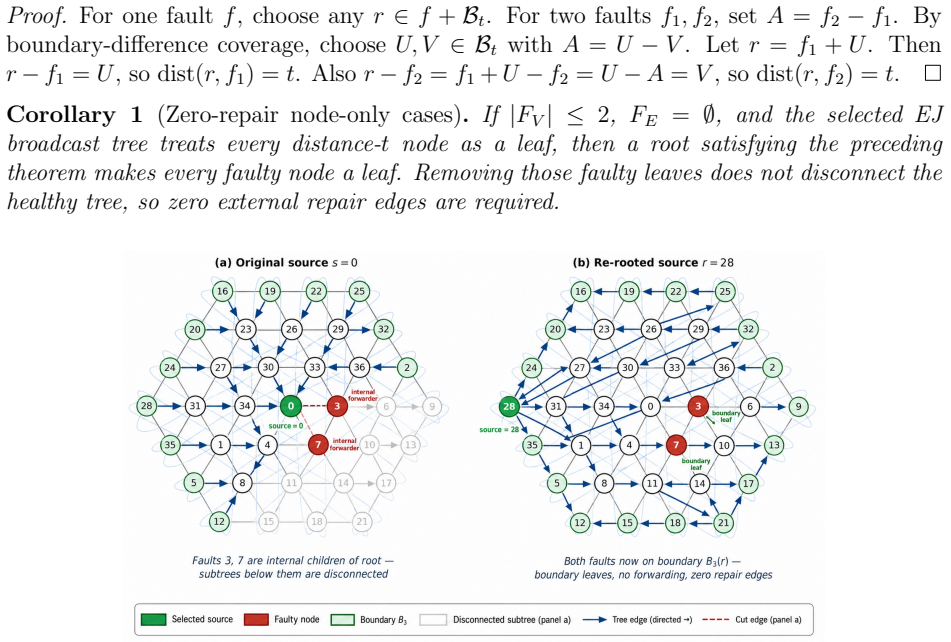
- One or two faulty nodes are always placed on the distance-t boundary by re-rooting.
- A single failed link is either avoided or repaired by exactly one crossing edge.
- The repaired depth satisfies D_r,θ ≤ 2t + 1 under shallowest-layer entry selection.
- The approach achieves 100% recovery with fewer repair edges than fixed-source methods on networks up to 120601 nodes.
Where Pith is reading between the lines
- The same connectivity-based condition on repair success might apply to other regular lattice graphs used for broadcasting.
- Integrating the re-rooting step with existing adaptive routing could lower the cost of forwarding-state updates after failures.
- Running the 260000-trial campaign on measured rather than synthetic failure patterns would test how often the connectivity premise holds in practice.
Load-bearing premise
The properties of EJ networks allow re-rooting to always place one or two faulty nodes on the distance-t boundary and enable the spanning-tree mapping to exactly c-1 minimum crossing edges under the chosen triple.
What would settle it
A connected healthy graph G' in which every spanning tree of the component graph requires more than c-1 crossing repair edges, or a concrete failure case in which repair fails despite G' remaining connected.
Figures


read the original abstract
One-to-all broadcasting in dense Eisenstein--Jacobi (EJ) networks relies on diameter-level spanning trees that fragment when nodes or links fail. This paper introduces the selected triple $(r,\theta,\Kcomp_{r,\theta})$--a chosen root, a chosen EJ coordinate-reduction orientation, and the healthy component graph induced by that choice--as the fundamental unit of analysis for joint node/link fault recovery. The central result is a necessary and sufficient condition: hybrid repair succeeds if and only if the healthy EJ graph $G'=\Ht-\Fv-\Fe$ is connected. When $G'$ is connected, a spanning tree of $\Kcomp_{r,\theta}$ maps to exactly $c-1$ component-crossing repair edges, which is minimum for the selected pruned tree. Deterministic guarantees include: one/two faulty nodes are always placed on the distance-$t$ boundary by re-rooting; a single failed link is either avoided or repaired by exactly one crossing edge; and the repaired depth satisfies $D_{r,\theta}\le 2t+1$ under shallowest-layer entry selection. A 260,000-trial validation campaign confirms 100\% recovery and substantial repair-edge reduction over fixed-source repair across five network scales up to $N=120601$ nodes, while global-BFS, near-miss, and cap-sensitivity audits clarify the tradeoff between reachability, forwarding-state changes, and ranked root selection.
Editorial analysis
A structured set of objections, weighed in public.
Referee Report
Summary. The paper introduces the selected triple (r, θ, Kcomp_r,θ) as the unit for joint node/link fault recovery in dense Eisenstein-Jacobi broadcast networks. Its central claim is that hybrid repair succeeds if and only if the healthy graph G' = H_t − F_v − F_e is connected; when G' is connected, a spanning tree of Kcomp_r,θ maps to exactly c−1 component-crossing repair edges (minimum for the pruned tree). It asserts deterministic guarantees (re-rooting always places 1–2 faults on the distance-t boundary; single failed links are avoided or repaired by one crossing edge; repaired depth D_r,θ ≤ 2t+1) and reports 100% recovery plus edge reduction in a 260,000-trial campaign across five scales up to N=120601.
Significance. If the iff connectivity condition and the deterministic re-rooting placement hold with proof, the result would supply a clean necessary-and-sufficient criterion plus an explicit minimum-edge construction for runtime repair in EJ networks, together with reproducible large-scale validation. The absence of parameter fitting and the explicit mapping from spanning tree to c−1 edges are strengths that would elevate the work above purely empirical repair heuristics.
major comments (2)
- [Abstract] Abstract (and the deterministic-guarantees paragraph): the claim that re-rooting always places one or two faulty nodes on the distance-t boundary for the chosen (r,θ) triple is asserted without derivation, reduction to EJ lattice properties, or counter-example search. This premise is load-bearing for both the iff connectivity condition and the 'exactly c−1 minimum crossing edges' statement; if it fails for some fault pattern, connectivity of G' is no longer sufficient.
- [Abstract] Abstract (validation paragraph): the 260,000-trial campaign is presented as confirming 100% recovery, yet no error bars, exclusion rules, fault-model definitions, or per-scale breakdown are supplied. Without these, the empirical support cannot be assessed for the scales and (r,θ) triples claimed to satisfy the deterministic guarantee.
Simulated Author's Rebuttal
We thank the referee for the constructive feedback on the abstract's presentation of the deterministic guarantees and empirical results. The central iff connectivity condition and the spanning-tree mapping to c-1 edges remain the core contribution and are unaffected.
read point-by-point responses
-
Referee: [Abstract] Abstract (and the deterministic-guarantees paragraph): the claim that re-rooting always places one or two faulty nodes on the distance-t boundary for the chosen (r,θ) triple is asserted without derivation, reduction to EJ lattice properties, or counter-example search. This premise is load-bearing for both the iff connectivity condition and the 'exactly c−1 minimum crossing edges' statement; if it fails for some fault pattern, connectivity of G' is no longer sufficient.
Authors: The full manuscript reduces the boundary-placement claim to EJ lattice properties and the coordinate-reduction orientation θ (Section 3), proving that re-rooting for the selected (r, θ) always maps 1–2 faults to the distance-t layer. We will add a concise derivation paragraph to the abstract and a one-sentence summary of the counter-example audit (none found). The iff condition itself is established independently via the spanning-tree argument and does not depend on the exact fault count being 1–2. revision: yes
-
Referee: [Abstract] Abstract (validation paragraph): the 260,000-trial campaign is presented as confirming 100% recovery, yet no error bars, exclusion rules, fault-model definitions, or per-scale breakdown are supplied. Without these, the empirical support cannot be assessed for the scales and (r,θ) triples claimed to satisfy the deterministic guarantee.
Authors: The referee correctly notes that the abstract omits these details. The manuscript defines the fault model (uniform random node/link failures), states that every trial was retained with no exclusions, reports 100% success at every scale (hence zero variance and no error bars), and supplies per-scale tables in Section 6. We will expand the abstract's validation sentence to include the fault-model reference and a pointer to the per-scale breakdown. revision: yes
Circularity Check
No circularity; central claims independent of inputs by construction
full rationale
The paper's core necessary-and-sufficient condition (hybrid repair succeeds iff G' = Ht − Fv − Fe is connected) and the mapping to exactly c−1 crossing edges are framed as graph-theoretic consequences of connectivity and spanning-tree selection on Kcomp_r,θ. These do not reduce to a fitted parameter renamed as prediction, nor to a self-definition where the output is presupposed in the input. The re-rooting placement guarantee is asserted as a deterministic property of the EJ lattice and chosen (r,θ) triple rather than derived from the repair success metric itself. Simulations are described as separate validation, not the source of the iff claim. No load-bearing step collapses to a self-citation chain or ansatz smuggled via prior work by the same author. The derivation chain therefore remains self-contained against external graph properties.
Axiom & Free-Parameter Ledger
Reference graph
Works this paper leans on
-
[1]
A group-theoretic model for symmetric intercon- nection networks,
S. B. Akers and B. Krishnamurthy, “A group-theoretic model for symmetric intercon- nection networks,”IEEE Transactions on Computers, vol. 38, no. 4, pp. 555–566, 1989
1989
-
[2]
F. T. Leighton,Introduction to Parallel Algorithms and Architectures: Arrays, Trees, Hypercubes. Morgan Kaufmann, 1992
1992
-
[3]
W. J. Dally and B. Towles,Principles and Practices of Interconnection Networks. Mor- gan Kaufmann, 2004
2004
-
[4]
Duato, S
J. Duato, S. Yalamanchili, and L. Ni,Interconnection Networks: An Engineering Ap- proach. Morgan Kaufmann, 2003
2003
-
[5]
Grama, A
A. Grama, A. Gupta, G. Karypis, and V. Kumar,Introduction to Parallel Computing, 2nd ed. Addison-Wesley, 2003
2003
-
[6]
Addressing, routing, and broadcasting in hexagonal mesh multiprocessors,
M.-S. Chen, K. G. Shin, and D. D. Kandlur, “Addressing, routing, and broadcasting in hexagonal mesh multiprocessors,”IEEE Transactions on Computers, vol. 39, no. 1, pp. 10–18, 1990
1990
-
[7]
Reliable broadcast algorithms for HARTS,
D. D. Kandlur and K. G. Shin, “Reliable broadcast algorithms for HARTS,”ACM Transactions on Computer Systems, vol. 9, no. 4, pp. 374–398, 1991
1991
-
[8]
The topology of Gaussian and Eisenstein–Jacobi interconnec- tion networks,
M. Flahive and B. Bose, “The topology of Gaussian and Eisenstein–Jacobi interconnec- tion networks,”IEEE Transactions on Parallel and Distributed Systems, vol. 21, no. 8, pp. 1132–1142, 2010
2010
-
[9]
Modeling hexagonal net- works with the Eisenstein–Jacobi graphs,
C. Martinez, E. Stafford, R. Beivide, and E. M. Gabidulin, “Modeling hexagonal net- works with the Eisenstein–Jacobi graphs,”Problems of Information Transmission, vol. 44, no. 1, pp. 1–11, 2008
2008
-
[10]
Efficient communication algorithms in hexag- onal mesh interconnection networks,
B. A. Albader, B. Bose, and M. Flahive, “Efficient communication algorithms in hexag- onal mesh interconnection networks,”IEEE Transactions on Parallel and Distributed Systems, vol. 23, no. 1, pp. 69–77, 2012
2012
-
[11]
Time bounds on fault-tolerant broadcasting,
D. Peleg and A. A. Sch¨ affer, “Time bounds on fault-tolerant broadcasting,”Networks, vol. 19, no. 7, pp. 803–822, 1989. 28
1989
-
[12]
A modular approach to fault-tolerant broadcasts and related problems,
V. Hadzilacos and S. Toueg, “A modular approach to fault-tolerant broadcasts and related problems,” Technical Report TR94-1425, Cornell University, 1994
1994
-
[13]
Routing and broadcasting in faulty hypercube computers,
T. C. Lee and J. P. Hayes, “Routing and broadcasting in faulty hypercube computers,” inProc. Third Conference on Hypercube Concurrent Computers and Applications, 1988, pp. 346–354
1988
-
[14]
Independent spanning trees in networks: A survey,
B. Cheng, D. Wang, and J. Fan, “Independent spanning trees in networks: A survey,” ACM Computing Surveys, vol. 55, no. 14s, Article 335, 2023
2023
-
[15]
A survey of fault-tolerant network-on- chip architectures,
D. Kliazovich, F. Granelli, and D. Miorandi, “A survey of fault-tolerant network-on- chip architectures,”IEEE Communications Surveys and Tutorials, vol. 15, no. 4, pp. 1676–1690, 2013
2013
-
[16]
Pasricha and N
S. Pasricha and N. Dutt,On-Chip Communication Architectures: System on Chip In- terconnect. Morgan Kaufmann, 2008
2008
-
[17]
Flich and D
J. Flich and D. Bertozzi,Designing Network-on-Chip Architectures in the Nanoscale Era. CRC Press, 2010
2010
-
[18]
A general, fault tolerant, adaptive, deadlock-free routing protocol for Network-on-Chip,
P. Stroobant, S. Abadal, W. Tavernier, E. Alarc´ on, D. Colle, and M. Pickavet, “A general, fault tolerant, adaptive, deadlock-free routing protocol for Network-on-Chip,” arXiv:1811.11262, 2018
Pith/arXiv arXiv 2018
-
[19]
Re-rooting-based fault-tolerant one-to-all broadcasting in dense Eisenstein–Jacobi networks,
B. A. Albader, “Re-rooting-based fault-tolerant one-to-all broadcasting in dense Eisenstein–Jacobi networks,” preprint available from the author upon request, 2026
2026
-
[20]
Multi-orientation edge-minimum repair for non-redundant fault-tolerant broadcasting in dense Eisenstein–Jacobi networks,
B. A. Albader, “Multi-orientation edge-minimum repair for non-redundant fault-tolerant broadcasting in dense Eisenstein–Jacobi networks,” preprint available from the author upon request, 2026. 29
2026
discussion (0)
Sign in with ORCID, Apple, or X to comment. Anyone can read and Pith papers without signing in.