Denoising Iterative Self-Correction: Structured Verification Loops for Reliable LLM Reasoning
Pith reviewed 2026-06-26 13:57 UTC · model grok-4.3
The pith
DISC treats verification outputs as noisy measurements of error locations and uses repeated verify-judge-correct passes with a binary gate to repair LLM reasoning without degrading correct answers.
A machine-rendered reading of the paper's core claim, the machinery that carries it, and where it could break.
Core claim
DISC progressively reduces errors across multiple verify-judge-correct passes by treating verification question outputs as noisy measurements of where a solution may be corrupted; a binary judgment gate blocks rewrites that would damage already-correct answers while the verifier and corrector repair errors, yielding superior precision-recall trade-offs compared with Chain-of-Verification and Self-Refine on the evaluated benchmarks.
What carries the argument
The verify-judge-correct loop that treats verification outputs as noisy measurements of corruption locations and applies a binary judgment gate to decide whether a correction is applied.
If this is right
- DISC reaches 81.6 percent accuracy on BIG-Bench Mistake while delivering 13 times more improvements per degradation than Chain-of-Verification.
- It achieves five times the improvement-to-degradation ratio of Self-Refine on the same benchmark.
- Assigning verification and judgment roles to a model different from the generator reduces self-confirmation bias.
- On GPQA Diamond a capability floor appears where judges recognize contradictions yet cannot translate that into corrections.
Where Pith is reading between the lines
- The denoising analogy implies that additional iterations or stronger verifiers could further raise accuracy once the capability floor is addressed.
- Separating generation from verification roles across models may extend to other bias-reduction techniques in multi-agent LLM systems.
- The precision-recall framing could be used to compare self-correction methods on tasks outside the three benchmarks tested.
Load-bearing premise
Verification outputs function as usable noisy measurements of solution corruption locations and the binary judgment gate can reliably block rewrites that would damage correct answers.
What would settle it
Running DISC on BIG-Bench Mistake and observing either fewer improvements than degradations or lower final accuracy than Chain-of-Verification or Self-Refine.
Figures



read the original abstract
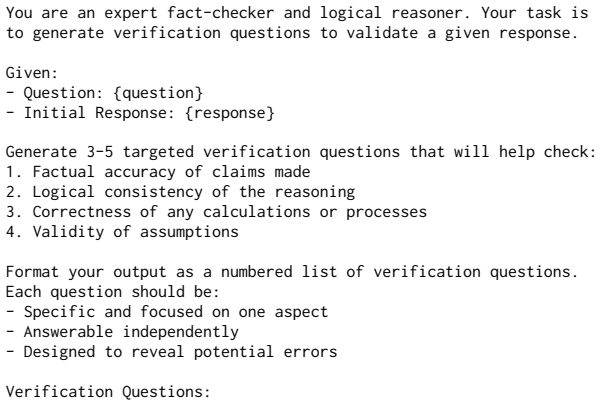
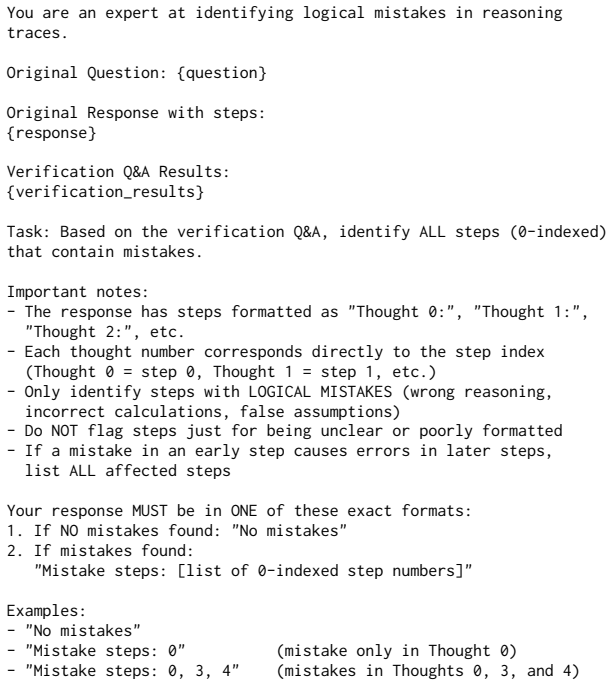
Large language models produce fluent but often incorrect multi-step reasoning, and naive correction methods risk degrading already-correct answers. We introduce Denoising Iterative Self-Correction (DISC), a test-time procedure that treats verification question outputs as noisy measurements of where a solution may be corrupted. Using these signals, DISC progressively reduces errors across multiple verify-judge-correct passes, analogous to traditional iterative denoising. A binary judgment gate controls correction precision by blocking rewrites that would damage already-correct answers while the verifier and corrector together repair errors. We evaluate this trade-off using two paired diagnostics: an improvement-to-degradation ratio (precision) and a repair rate (recall). Across three benchmarks (BIG-Bench Mistake, HotpotQA, GPQA Diamond) and four models, DISC dominates Chain-of-Verification and Self-Refine on the precision-recall trade-off, reaching 81.6% accuracy with 13x more improvements per degradation than Chain-of-Verification and 5x more than Self-Refine on BIG-Bench Mistake (Sonnet~4.5). On GPQA Diamond, we identify a capability floor below which judges acknowledge contradictions in evidence but cannot translate that recognition into a correction. We further show that cross-model role allocation -- assigning verification and judgment to a model different from the generator -- mitigates self-confirmation bias.
Editorial analysis
A structured set of objections, weighed in public.
Referee Report
Summary. The paper introduces Denoising Iterative Self-Correction (DISC), a test-time iterative procedure for LLM multi-step reasoning that treats verification-question outputs as noisy measurements of potential corruption locations. A binary judgment gate is used to block rewrites that would degrade already-correct answers, while the verifier-corrector pair repairs errors across multiple passes. The method is evaluated on BIG-Bench Mistake, HotpotQA, and GPQA Diamond using improvement-to-degradation ratio (precision) and repair rate (recall), claiming dominance over Chain-of-Verification and Self-Refine (e.g., 81.6% accuracy and 13x ratio vs. CoVe on BIG-Bench Mistake with Sonnet~4.5). Additional results address cross-model role allocation to reduce self-confirmation bias and a capability floor on GPQA Diamond.
Significance. If the core mechanisms are validated, DISC provides a structured, training-free approach to balancing error correction with preservation of correct answers in LLM reasoning, which is a practical concern for reliable deployment. The paired precision-recall diagnostics (improvement-to-degradation ratio and repair rate) offer a useful, falsifiable framework for comparing iterative self-correction methods and could be adopted more broadly. The observation of a capability floor on GPQA and the mitigation via cross-model allocation are concrete contributions. The paper does not include machine-checked proofs or released code, but the benchmark comparisons are direct and the diagnostics are a strength.
major comments (1)
- [Evaluation] Evaluation (implicit in abstract and results): The central claim that verification outputs serve as usable noisy measurements of corruption locations and that the binary judgment gate reliably blocks damaging rewrites is load-bearing for the denoising interpretation and the reported precision-recall dominance (81.6% accuracy, 13x ratio vs. CoVe on BIG-Bench Mistake). No ablations are described that isolate gate accuracy (e.g., false-positive rate on correct answers) or measure correlation between verifier outputs and actual error locations. Aggregate benchmark wins alone do not rule out that gains arise from additional inference steps rather than the proposed mechanism.
minor comments (3)
- The manuscript lacks implementation details such as exact prompts for the verifier, judge, and corrector, as well as the precise definition and computation of the improvement-to-degradation ratio; these should be provided to support reproducibility.
- No statistical tests, confidence intervals, or controls for prompt sensitivity are mentioned for the accuracy and ratio results, which would strengthen the comparisons across models and benchmarks.
- The four models used are referenced but not named in the provided abstract; the experimental setup section should list them explicitly along with any hyperparameter choices.
Simulated Author's Rebuttal
We thank the referee for the constructive feedback emphasizing the need for stronger validation of DISC's core mechanisms. We address the major comment below and will revise the manuscript to incorporate additional evidence.
read point-by-point responses
-
Referee: [Evaluation] Evaluation (implicit in abstract and results): The central claim that verification outputs serve as usable noisy measurements of corruption locations and that the binary judgment gate reliably blocks damaging rewrites is load-bearing for the denoising interpretation and the reported precision-recall dominance (81.6% accuracy, 13x ratio vs. CoVe on BIG-Bench Mistake). No ablations are described that isolate gate accuracy (e.g., false-positive rate on correct answers) or measure correlation between verifier outputs and actual error locations. Aggregate benchmark wins alone do not rule out that gains arise from additional inference steps rather than the proposed mechanism.
Authors: We agree that the manuscript would be strengthened by explicit ablations isolating gate accuracy (such as false-positive rate on already-correct answers) and direct correlation between verifier outputs and ground-truth error locations. The improvement-to-degradation ratio is intended to capture the gate's net contribution to blocking degradations, and the fact that DISC outperforms other multi-step baselines (CoVe, Self-Refine) on this paired diagnostic across models and benchmarks provides indirect support that gains are not solely from extra inference steps. However, these comparisons do not fully isolate the proposed denoising signals. We will therefore add the requested ablations in the revision, including gate false-positive measurements and verifier-error correlation analysis on subsets of BIG-Bench Mistake and HotpotQA. revision: yes
Circularity Check
No circularity: empirical procedure evaluated on external benchmarks
full rationale
The paper introduces DISC as a test-time procedure that applies verification, judgment, and correction passes, evaluated via accuracy, improvement-to-degradation ratios, and repair rates on three public benchmarks (BIG-Bench Mistake, HotpotQA, GPQA Diamond) against named baselines (Chain-of-Verification, Self-Refine). No equations, fitted parameters, or derivations are present that reduce reported outcomes to self-defined inputs by construction. Claims rest on direct empirical comparisons rather than self-citation chains or ansatzes imported from prior author work. The method description uses analogy to denoising but does not define its metrics or results in terms of themselves.
Axiom & Free-Parameter Ledger
Reference graph
Works this paper leans on
-
[1]
arXiv preprint arXiv:2309.11495 , year =
Chain-of-Verification Reduces Hallucination in Large Language Models , author =. arXiv preprint arXiv:2309.11495 , year =
-
[2]
The Twelfth International Conference on Learning Representations (ICLR) , year =
Large Language Models Cannot Self-Correct Reasoning Yet , author =. The Twelfth International Conference on Learning Representations (ICLR) , year =
-
[3]
Advances in Neural Information Processing Systems (NeurIPS) , year =
Chain-of-Thought Prompting Elicits Reasoning in Large Language Models , author =. Advances in Neural Information Processing Systems (NeurIPS) , year =
-
[4]
The Eleventh International Conference on Learning Representations (ICLR) , year =
Self-Consistency Improves Chain of Thought Reasoning in Language Models , author =. The Eleventh International Conference on Learning Representations (ICLR) , year =
-
[5]
Yang, Zhe and Zhang, Yichang and Wang, Yudong and Xu, Ziyao and Lin, Junyang and Sui, Zhifang. Confidence v.s. Critique: A Decomposition of Self-Correction Capability for LLM s. Proceedings of the 63rd Annual Meeting of the Association for Computational Linguistics (Volume 1: Long Papers). 2025. doi:10.18653/v1/2025.acl-long.203
-
[6]
arXiv preprint arXiv:2404.17140 , year =
Small Language Models Need Strong Verifiers to Self-Correct Reasoning , author =. arXiv preprint arXiv:2404.17140 , year =
-
[7]
CorrectBench: A Benchmark of Self-Correction in
Guiyao Tie and Zenghui Yuan and Zeli Zhao and Chaoran Hu and Tianhe Gu and Ruihang Zhang and Sizhe Zhang and Junran Wu and Xiaoyue Tu and Ming Jin and Qingsong Wen and Lixing Chen and Pan Zhou and Lichao Sun , booktitle =. CorrectBench: A Benchmark of Self-Correction in
-
[8]
arXiv preprint arXiv:2409.12917 , year =
Training Language Models to Self-Correct via Reinforcement Learning , author =. arXiv preprint arXiv:2409.12917 , year =
-
[9]
Advances in Neural Information Processing Systems (NeurIPS) , year =
Self-Refine: Iterative Refinement with Self-Feedback , author =. Advances in Neural Information Processing Systems (NeurIPS) , year =
-
[10]
Advances in Neural Information Processing Systems (NeurIPS) , year =
Reflexion: Language Agents with Verbal Reinforcement Learning , author =. Advances in Neural Information Processing Systems (NeurIPS) , year =
-
[11]
2024 , url =
Gou, Zhibin and Shao, Zhihong and Gong, Yeyun and Shen, Yelong and Yang, Yujiu and Duan, Nan and Chen, Weizhu , booktitle =. 2024 , url =
2024
-
[12]
When Can
Kamoi, Ryo and Zhang, Yusen and Zhang, Nan and Han, Jiawei and Zhang, Rui , journal =. When Can. 2024 , doi =
2024
-
[13]
Findings of the Association for Computational Linguistics: ACL 2024 , pages =
Tyen, Gladys and Mansoor, Hassan and C. Findings of the Association for Computational Linguistics: ACL 2024 , pages =. 2024 , address =
2024
-
[14]
Proceedings of the 2024 Conference on Empirical Methods in Natural Language Processing , pages =
Large Language Models Can Self-Correct with Key Condition Verification , author =. Proceedings of the 2024 Conference on Empirical Methods in Natural Language Processing , pages =. 2024 , address =
2024
-
[15]
arXiv preprint arXiv:2110.14168 , year =
Training Verifiers to Solve Math Word Problems , author =. arXiv preprint arXiv:2110.14168 , year =
-
[16]
Measuring Mathematical Problem Solving with the
Hendrycks, Dan and Burns, Collin and Kadavath, Saurav and Arora, Akul and Basart, Steven and Tang, Eric and Song, Dawn and Steinhardt, Jacob , booktitle =. Measuring Mathematical Problem Solving with the. 2021 , url =
2021
-
[17]
Advances in Neural Information Processing Systems , volume =
Training language models to follow instructions with human feedback , author =. Advances in Neural Information Processing Systems , volume =
-
[18]
Advances in Neural Information Processing Systems , volume =
Denoising Diffusion Probabilistic Models , author =. Advances in Neural Information Processing Systems , volume =
-
[19]
Advances in Neural Information Processing Systems , volume =
Generative Modeling by Estimating Gradients of the Data Distribution , author =. Advances in Neural Information Processing Systems , volume =
-
[20]
, journal =
Rein, David and Hou, Betty Li and Stickland, Asa Cooper and Petty, Jackson and Pang, Richard Yuanzhe and Dirani, Julien and Michael, Julian and Bowman, Samuel R. , journal =. 2023 , url =
2023
-
[21]
2023 , url =
Gao, Luyu and Madaan, Aman and Zhou, Shuyan and Alon, Uri and Liu, Pengfei and Yang, Yiming and Callan, Jamie and Neubig, Graham , booktitle =. 2023 , url =
2023
-
[22]
Multiple Classifier Systems , series =
Ensemble Methods in Machine Learning , author =. Multiple Classifier Systems , series =. 2000 , publisher =
2000
-
[23]
Aho and Jeffrey D
Alfred V. Aho and Jeffrey D. Ullman , title =. 1972
1972
-
[24]
Publications Manual , year = "1983", publisher =
1983
-
[25]
Ashok K. Chandra and Dexter C. Kozen and Larry J. Stockmeyer , year = "1981", title =. doi:10.1145/322234.322243
-
[26]
Scalable training of
Andrew, Galen and Gao, Jianfeng , booktitle =. Scalable training of
-
[27]
Dan Gusfield , title =. 1997
1997
-
[28]
Tetreault , title =
Mohammad Sadegh Rasooli and Joel R. Tetreault , title =. Computing Research Repository , volume =. 2015 , url =
2015
-
[29]
A Framework for Learning Predictive Structures from Multiple Tasks and Unlabeled Data , Volume =
Ando, Rie Kubota and Zhang, Tong , Issn =. A Framework for Learning Predictive Structures from Multiple Tasks and Unlabeled Data , Volume =. Journal of Machine Learning Research , Month = dec, Numpages =
-
[30]
Advances in Neural Information Processing Systems , volume =
Direct Preference Optimization: Your Language Model is Secretly a Reward Model , author =. Advances in Neural Information Processing Systems , volume =
discussion (0)
Sign in with ORCID, Apple, or X to comment. Anyone can read and Pith papers without signing in.