Cross-National Information Attacks: A Two-Decade Analysis of Troll Behavior in Korea
Pith reviewed 2026-06-26 06:38 UTC · model grok-4.3
The pith
Hierarchical model identifies 23,998 Korean accounts using moral condemnation to target domestic politicians in suspected influence operations.
A machine-rendered reading of the paper's core claim, the machinery that carries it, and where it could break.
Core claim
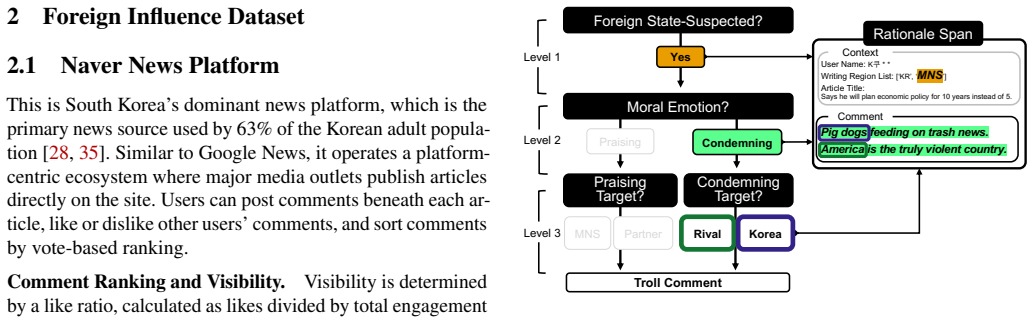
The hierarchical model classifies comments along three dimensions central to influence campaigns: foreign origin, moral-emotional framing, and target country. It also extracts brief span-level textual evidence. Applied to 112M South Korean news comments, the model identifies 23,998 accounts exhibiting behavior consistent with coordinated manipulation. These accounts predominantly rely on morally condemning rhetoric that receives significantly higher user engagement, with the highest-engagement comments most frequently targeting domestic political figures on both the left and the right.
What carries the argument
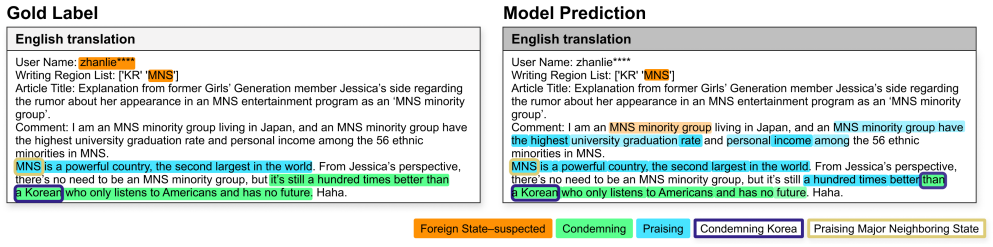
The hierarchical classifier that assigns comments to foreign origin, moral-emotional framing, and target country while returning span-level textual evidence for interpretability.
Load-bearing premise
The classifier can accurately identify foreign origin and coordinated manipulation behavior from comment text alone.
What would settle it
Independent verification of account origins or coordination signals, such as through IP logs or external records, for a sample of the 23,998 flagged accounts.
Figures



read the original abstract
Coordinated foreign influence operations pose a growing threat to online platforms, but detecting state-linked troll activity and tracking its evolution remain challenging. This paper presents an explainable machine learning framework for theory-guided detection and longitudinal analysis of suspected trolling within Korean online news comment sections. Our hierarchical model classifies comments along three dimensions central to influence campaigns: foreign origin, moral-emotional framing, and target country. To support explainability, it also extracts brief span-level textual evidence that provides human-interpretable rationales. We apply the approach to 112M South Korean news comments authored by 4M users over nearly 20 years, identifying 23,998 accounts exhibiting behavior consistent with coordinated manipulation. Analyzing these accounts, we find that they predominantly rely on morally condemning rhetoric rather than direct promotion of foreign-aligned narratives; this rhetoric receives significantly higher user engagement. Among the highest-engagement comments, the moral condemnation most frequently targets domestic political figures (e.g., presidents or party leaders) on both the left and the right, potentially amplifying polarization. Our framework supports transparent platform governance through explainable, evidence-based moderation. These observed rhetorical and engagement patterns can inform how platforms and observatories prioritize defenses and intervene before harmful narrative-target combinations achieve widespread reach.
Editorial analysis
A structured set of objections, weighed in public.
Referee Report
Summary. The paper claims to develop an explainable hierarchical machine learning framework that classifies Korean news comments along three dimensions (foreign origin, moral-emotional framing, and target country) while extracting span-level textual evidence. Applied to 112M comments by 4M users over nearly 20 years, the approach identifies 23,998 accounts exhibiting behavior consistent with coordinated manipulation. Analysis of these accounts finds predominant use of morally condemning rhetoric (rather than direct foreign promotion) that receives higher engagement, with highest-engagement comments most often targeting domestic political figures on both left and right, potentially amplifying polarization.
Significance. If the classifications hold after proper validation, the work would offer a notable contribution through its scale (two-decade longitudinal dataset), emphasis on explainability via span-level rationales, and theory-guided dimensions tailored to influence campaigns. These elements could support more transparent platform moderation and provide falsifiable patterns for future studies on rhetorical strategies in cross-national operations.
major comments (2)
- [Abstract] Abstract: The identification of 23,998 accounts as consistent with coordinated manipulation rests entirely on the hierarchical model's first-stage classification of foreign origin from comment text alone. No training details, validation metrics, baseline comparisons, ground-truth sources (e.g., account metadata, known actor lists, or non-text signals), or error analysis are supplied, preventing assessment of whether the classifications support the reported patterns on engagement and polarization.
- [Abstract] Abstract: The downstream claims about moral condemnation being the dominant strategy and its higher engagement rest on the same unvalidated foreign-origin stage; if that stage primarily captures domestic stylistic markers correlated with moral-emotional language, the counts and polarization inferences become unreliable.
minor comments (1)
- [Abstract] Abstract: The hedging terms ('suspected', 'consistent with') are appropriate but should be paired with an explicit limitations discussion in the methods regarding text-only inference of foreign origin and coordination.
Simulated Author's Rebuttal
We thank the referee for their careful review and for identifying areas where the abstract requires greater transparency regarding model validation. We address each major comment below with point-by-point responses and indicate the revisions we will make.
read point-by-point responses
-
Referee: [Abstract] Abstract: The identification of 23,998 accounts as consistent with coordinated manipulation rests entirely on the hierarchical model's first-stage classification of foreign origin from comment text alone. No training details, validation metrics, baseline comparisons, ground-truth sources (e.g., account metadata, known actor lists, or non-text signals), or error analysis are supplied, preventing assessment of whether the classifications support the reported patterns on engagement and polarization.
Authors: The referee is correct that the abstract does not supply these details. The full manuscript provides them in the Methods section, including the construction of the training set via expert annotation of comment text for foreign-origin indicators drawn from prior studies of Korean influence operations, cross-validation performance, baseline comparisons against standard text classifiers, and error analysis. Ground truth relies on text-based expert labeling rather than account metadata or non-text signals, which were unavailable from the platform. We will revise the abstract to include a concise summary of the first-stage validation metrics and ground-truth approach so readers can assess reliability without consulting the full methods. revision: yes
-
Referee: [Abstract] Abstract: The downstream claims about moral condemnation being the dominant strategy and its higher engagement rest on the same unvalidated foreign-origin stage; if that stage primarily captures domestic stylistic markers correlated with moral-emotional language, the counts and polarization inferences become unreliable.
Authors: We acknowledge the risk of stylistic confounding between stages. The model employs theory-guided, stage-specific features: the foreign-origin classifier targets documented non-native phrasing and trolling markers distinct from moral-emotional language, while the second stage operates conditionally but with independent feature extraction. The manuscript reports that moral-condemnation patterns and engagement differences remain consistent in robustness checks. We will add an explicit discussion of this potential confound plus a new robustness analysis comparing moral-emotional distributions in the foreign-origin subset versus a matched domestic sample, thereby strengthening the claim that the observed patterns are not artifacts of the first stage. revision: partial
Circularity Check
No circularity; derivation applies external model to independent data
full rationale
The paper describes a hierarchical ML classifier trained on theory-guided dimensions (foreign origin, moral-emotional framing, target country) and applies it to an independent corpus of 112M comments to count accounts and analyze engagement patterns. No equations, self-citations, fitted parameters presented as predictions, or self-definitional steps appear in the provided text that would reduce the account counts or rhetorical findings to the classifier inputs by construction. The central claims are empirical outputs from data application rather than tautological renamings or load-bearing self-citations.
Axiom & Free-Parameter Ledger
Reference graph
Works this paper leans on
-
[1]
GPT-4 technical report, 2023
Josh Achiam, Steven Adler, Sandhini Agarwal, et al. GPT-4 technical report, 2023
2023
-
[2]
Content-based features predict social media influence operations.Science Advances, 2020
Meysam Alizadeh, Jacob N Shapiro, Cody Buntain, and Joshua A Tucker. Content-based features predict social media influence operations.Science Advances, 2020
2020
-
[3]
Acting the part: Examining information operations within# BlackLivesMatter discourse.Proceedings of the ACM on Human-Computer Interaction, 2018
Ahmer Arif, Leo Graiden Stewart, and Kate Starbird. Acting the part: Examining information operations within# BlackLivesMatter discourse.Proceedings of the ACM on Human-Computer Interaction, 2018
2018
-
[4]
Bernal, C
A. Bernal, C. Carter, I. Singh, K. Cao, and O. Madreperla. Cognitive warfare: An attack on truth and thought. Technical report, NATO Innovation Hub and Johns Hopkins University Applied Physics Laboratory, 2020
2020
-
[5]
JSTOR, 2024
Jude Blanchette, Ryan Hass, and Lily McElwee.Build- ing International Support for Taiwan. JSTOR, 2024
2024
-
[6]
The MAD model of moral contagion: The role of moti- vation, attention, and design in the spread of moralized content online.Perspectives on Psychological Science, 2020
William J Brady, Molly J Crockett, and Jay J Van Bavel. The MAD model of moral contagion: The role of moti- vation, attention, and design in the spread of moralized content online.Perspectives on Psychological Science, 2020
2020
-
[7]
Emotion shapes the diffu- sion of moralized content in social networks.Proceed- ings of the National Academy of Sciences, 2017
William J Brady, Julian A Wills, John T Jost, Joshua A Tucker, and Jay J Van Bavel. Emotion shapes the diffu- sion of moralized content in social networks.Proceed- ings of the National Academy of Sciences, 2017
2017
-
[8]
Weaponized health commu- nication: Twitter bots and Russian trolls amplify the vaccine debate.American Journal of Public Health, 2018
David A Broniatowski, Amelia M Jamison, SiHua Qi, Lulwah AlKulaib, Tao Chen, Adrian Benton, Sandra C Quinn, and Mark Dredze. Weaponized health commu- nication: Twitter bots and Russian trolls amplify the vaccine debate.American Journal of Public Health, 2018
2018
-
[9]
Lan- guage models are few-shot learners
Tom Brown, Benjamin Mann, Nick Ryder, et al. Lan- guage models are few-shot learners. InProceedings of the 34th International Conference on Neural Informa- tion Processing Systems, 2020
2020
-
[10]
cognitive warfare
Bernard Claverie and François Du Cluzel. “cognitive warfare”: The advent of the concept of “cognitics” in the field of warfare. InCognitive Warfare: The Future of Cognitive Dominance. NATO Collaboration Support Office, 2022
2022
-
[11]
GoE- motions: A dataset of fine-grained emotions
Dorottya Demszky, Dana Movshovitz-Attias, Jeongwoo Ko, Alan Cowen, Gaurav Nemade, and Sujith Ravi. GoE- motions: A dataset of fine-grained emotions. InPro- ceedings of the 58th Annual Meeting of the Association for Computational Linguistics, 2020
2020
-
[12]
Span- oriented information extraction: A unified framework
Yifan Ding, Michael Yankoski, and Tim Weninger. Span- oriented information extraction: A unified framework. ACM SIGKDD Explorations Newsletter, 2025
2025
-
[13]
An anal- ysis of emotions and the prominence of positivity in# BlackLivesMatter tweets.Proceedings of the National Academy of Sciences, 2022
Anjalie Field, Chan Young Park, Antonio Theophilo, Jamelle Watson-Daniels, and Yulia Tsvetkov. An anal- ysis of emotions and the prominence of positivity in# BlackLivesMatter tweets.Proceedings of the National Academy of Sciences, 2022
2022
-
[14]
‘fake news’ is the invention of a liar: How false information circulates within the hybrid news sys- tem.Current Sociology, 2019
Fabio Giglietto, Laura Iannelli, Augusto Valeriani, and Luca Rossi. ‘fake news’ is the invention of a liar: How false information circulates within the hybrid news sys- tem.Current Sociology, 2019
2019
-
[15]
The moral emotions
Jonathan Haidt. The moral emotions. InHandbook of Affective Sciences. Oxford University Press, 2003
2003
-
[16]
Commenters and lurkers: Navigating the two-step flow of communication in online news dis- course.New Media & Society, 2025
Jiyoung Han. Commenters and lurkers: Navigating the two-step flow of communication in online news dis- course.New Media & Society, 2025
2025
-
[17]
Hans W. A. Hanley, Deepak Kumar, and Zakir Du- rumeric. Specious sites: Tracking the spread and sway of spurious news stories at scale. InIEEE Symposium on Security and Privacy, 2024
2024
-
[18]
Large language models for propaganda span annota- tion
Maram Hasanain, Fatema Ahmad, and Firoj Alam. Large language models for propaganda span annota- tion. InFindings of the Association for Computational Linguistics: EMNLP, 2024
2024
-
[19]
The IRA, social me- dia and political polarization in the united states, 2012–
Philip N Howard, Bharath Ganesh, Dimitra Liotsiou, John Kelly, and Camille François. The IRA, social me- dia and political polarization in the united states, 2012–
2012
-
[20]
Technical report, Project on Computational Pro- paganda, University of Oxford, 2018
2018
-
[21]
How China’s cog- nitive warfare works: a frontline perspective of Taiwan’s anti-disinformation wars.Journal of Global Security Studies, 2022
Tzu-Chieh Hung and Tzu-Wei Hung. How China’s cog- nitive warfare works: a frontline perspective of Taiwan’s anti-disinformation wars.Journal of Global Security Studies, 2022
2022
-
[22]
Current state of foreign influence operations: Examples of internet and media misuse
Institute for National Security Strategy (INSS). Current state of foreign influence operations: Examples of internet and media misuse. https://www.inss.re.kr/ en/News/bbs/news_en_view.do?nttId=41037284, 2024
2024
-
[23]
Identi- fying and quantifying coordinated manipulation of up- votes and downvotes in Naver News comments
Jiwan Jeong, Jeong-han Kang, and Sue Moon. Identi- fying and quantifying coordinated manipulation of up- votes and downvotes in Naver News comments. In Proceedings of the International AAAI Conference on Web and Social Media, 2020
2020
-
[24]
KOLD: Korean offensive language dataset
Younghoon Jeong, Juhyun Oh, Jongwon Lee, Jaimeen Ahn, Jihyung Moon, Sungjoon Park, and Alice Oh. KOLD: Korean offensive language dataset. InCon- ference on Empirical Methods in Natural Language Processing, 2022
2022
-
[25]
Does transparency in moderation really matter? user behavior after content removal explanations on Reddit.Proceed- ings of the ACM on Human-Computer Interaction, 2019
Shagun Jhaver, Amy Bruckman, and Eric Gilbert. Does transparency in moderation really matter? user behavior after content removal explanations on Reddit.Proceed- ings of the ACM on Human-Computer Interaction, 2019
2019
-
[26]
Australia, the utility of force and the society-centric battlespace.International Affairs, 2019
Maryanne Kelton, Michael Sullivan, Emily Bienvenue, and Zac Rogers. Australia, the utility of force and the society-centric battlespace.International Affairs, 2019
2019
-
[27]
How do moral emotions shape political participation? a cross-cultural analysis of online petitions using language models
Jaehong Kim, Chaeyoon Jeong, Seongchan Park, Meey- oung Cha, and Wonjae Lee. How do moral emotions shape political participation? a cross-cultural analysis of online petitions using language models. InFindings of the Association for Computational Linguistics, 2024
2024
-
[28]
Characterizing and detecting propaganda-spreading accounts on Telegram
Klim Kireev, Yevhen Mykhno, Carmela Troncoso, and Rebekah Overdorf. Characterizing and detecting propaganda-spreading accounts on Telegram. InPro- ceedings of the 34th USENIX Conference on Security Symposium, 2025
2025
-
[29]
2025 Media Users in Ko- rea (2025 언론수용자조사 )
Korea Press Foundation. 2025 Media Users in Ko- rea (2025 언론수용자조사 ). Technical report, Ko- rea Press Foundation, Seoul, South Korea, December
2025
-
[30]
Available at https://www.kpf.or.kr/front/ research/consumerDetail.do?seq=600224
-
[31]
KcBERT: Korean comments BERT
Junbum Lee. KcBERT: Korean comments BERT. In Proceedings of the 32nd Annual Conference on Human and Cognitive Language Technology, 2020
2020
-
[32]
KcELECTRA: Korean comments ELEC- TRA
Junbum Lee. KcELECTRA: Korean comments ELEC- TRA. https://github.com/Beomi/KcELECTRA, 2021
2021
-
[33]
Decoupled weight decay regularization
Ilya Loshchilov and Frank Hutter. Decoupled weight decay regularization. InInternational Conference on Learning Representations, 2019
2019
-
[34]
Lundberg and Su-In Lee
Scott M. Lundberg and Su-In Lee. A unified approach to interpreting model predictions. InProceedings of the 31st International Conference on Neural Information Processing Systems, 2017
2017
-
[35]
Tactics, threats & targets: Modeling disinformation and its mitigation
Muhammad Shujaat Mirza, Labeeba Begum, Liang Niu, Sarah Pardo, Azza Abouzied, Paolo Papotti, and Christina Pöpper. Tactics, threats & targets: Modeling disinformation and its mitigation. InNetwork and Dis- tributed System Security Symposium, 2023
2023
-
[36]
Censored, suspended, shadow- banned: User interpretations of content moderation on social media platforms.New Media & Society, 2018
Sarah Myers West. Censored, suspended, shadow- banned: User interpretations of content moderation on social media platforms.New Media & Society, 2018
2018
-
[37]
Reuters Institute for the Study of Journalism, 2025
Nic Newman, Arguedas Ross Arguedas, Craig T Robert- son, Rasmus Kleis Nielsen, and Richard Fletcher.Digi- tal news report 2025. Reuters Institute for the Study of Journalism, 2025
2025
-
[38]
Econometric methods for fractional response variables with an appli- cation to 401 (k) plan participation rates.Journal of Applied Econometrics, 1996
Leslie E Papke and Jeffrey M Wooldridge. Econometric methods for fractional response variables with an appli- cation to 401 (k) plan participation rates.Journal of Applied Econometrics, 1996
1996
-
[39]
Moral outrage shapes commitments beyond attention: Multimodal moral emotions on YouTube in Korea and the US
Seongchan Park, Jaehong Kim, Hyeonseung Kim, Hee- jin Bin, Sue Moon, and Wonjae Lee. Moral outrage shapes commitments beyond attention: Multimodal moral emotions on YouTube in Korea and the US. In Proceedings of the ACM Web Conference, 2026
2026
-
[40]
KLUE: Korean language understanding evaluation
Sungjoon Park, Jihyung Moon, Sungdong Kim, et al. KLUE: Korean language understanding evaluation. In 35th Conference on Neural Information Processing Sys- tems Track on Datasets and Benchmark, 2021
2021
-
[41]
Strategies and vulnerabili- ties of participants in Venezuelan influence operations
Ruben Recabarren, Bogdan Carbunar, Nestor Hernan- dez, and Ashfaq Ali Shafin. Strategies and vulnerabili- ties of participants in Venezuelan influence operations. In32nd USENIX Security Symposium, 2023
2023
-
[42]
Trollmagnifier: Detecting state- sponsored troll accounts on Reddit
Mohammad Hammas Saeed, Shiza Ali, Jeremy Black- burn, Emiliano De Cristofaro, Savvas Zannettou, and Gianluca Stringhini. Trollmagnifier: Detecting state- sponsored troll accounts on Reddit. InIEEE symposium on security and privacy, 2022
2022
-
[43]
How malicious AI swarms can threaten democracy.Science, 2026
Daniel Thilo Schroeder, Meeyoung Cha, Andrea Baronchelli, Nick Bostrom, Nicholas A Christakis, David Garcia, Amit Goldenberg, Yara Kyrychenko, Kevin Leyton-Brown, Nina Lutz, et al. How malicious AI swarms can threaten democracy.Science, 2026
2026
-
[44]
Troll and divide: the language of online polarization
Almog Simchon, William J Brady, and Jay J Van Bavel. Troll and divide: the language of online polarization. PNAS Nexus, 2022
2022
-
[45]
Disinformation’s spread: bots, trolls and all of us.Nature, 2019
Kate Starbird. Disinformation’s spread: bots, trolls and all of us.Nature, 2019
2019
-
[46]
How China fights in large-scale combat operations
Ian Sullivan. How China fights in large-scale combat operations. Technical report, U.S. Army Training and Doctrine Command (TRADOC G-2), 2025
2025
-
[47]
Label Studio: Data labeling software
Maxim Tkachenko, Mikhail Malyuk, Andrey Hol- manyuk, and Nikolai Liubimov. Label Studio: Data labeling software. https://github.com/ HumanSignal/label-studio, 2020–2025
2020
-
[48]
Senate Select Committee on Intelligence
U.S. Senate Select Committee on Intelligence. Report on Russian active measures campaigns and interference in the 2016 U.S. election, volume 2: Russia’s use of social media, with additional views. Technical report, United States Senate, 2019
2016
-
[49]
So- cial media and morality.Annual Review of Psychology, 2024
Jay J Van Bavel, Claire E Robertson, Kareena Del Rosario, Jesper Rasmussen, and Steve Rathje. So- cial media and morality.Annual Review of Psychology, 2024
2024
-
[50]
Council of Europe, 2017
Claire Wardle and Hossein Derakhshan.Information disorder: Toward an interdisciplinary framework for research and policymaking. Council of Europe, 2017
2017
-
[51]
The comparison of regression vari- ables.Journal of the Royal Statistical Society: Series B (Methodological), 1959
Evan J Williams. The comparison of regression vari- ables.Journal of the Royal Statistical Society: Series B (Methodological), 1959
1959
-
[52]
SoK: Machine learning for misinformation detection
Madelyne Xiao and Jonathan Mayer. SoK: Machine learning for misinformation detection. In34th USENIX Security Symposium, 2025
2025
-
[53]
Predicting the type and target of offensive posts in social media
Marcos Zampieri, Shervin Malmasi, Preslav Nakov, Sara Rosenthal, Noura Farra, and Ritesh Kumar. Predicting the type and target of offensive posts in social media. InProceedings of the 2019 Conference of the North American Chapter of the Association for Computational Linguistics: Human Language Technologies, 2019. A Troll Dataset Summary We define the 70 a...
2019
discussion (0)
Sign in with ORCID, Apple, or X to comment. Anyone can read and Pith papers without signing in.