Evaluating LLM Usage for Efficient and Explainable Numerical and Classified Implicit Sentiment Analysis of Product Desirability
Pith reviewed 2026-06-28 01:12 UTC · model grok-4.3
The pith
Large language models can generate numerical and classified implicit sentiment scores from qualitative product feedback that closely match expert human annotations.
A machine-rendered reading of the paper's core claim, the machinery that carries it, and where it could break.
Core claim
Zero-shot LLMs can directly produce numerical sentiment scores and categorical classifications from qualitative PDT term groupings that align closely with gold-standard human expert annotations, while also generating confidence estimates and human-readable explanations, outperforming lexicon and transformer baselines on the tested datasets.
What carries the argument
Zero-shot prompting of LLMs to output numerical sentiment scores, categorical labels, confidence ratings, and explanatory rationales from qualitative term groupings.
If this is right
- LLM outputs remain consistent when the same qualitative data is presented in different formats.
- Smaller models such as GPT-4o-mini deliver performance comparable to larger models at 94 percent lower cost.
- The method supplies both numerical sentiment values and high-level user impressions usable for product improvement and marketing ideas.
- Inclusion of model confidence and rationale text increases transparency for practical deployment in satisfaction assessment.
- The approach works without explicit review scores or task-specific fine-tuning.
Where Pith is reading between the lines
- The same zero-shot workflow could be tested on qualitative feedback from domains other than product desirability to check transferability.
- Combining PDT surveys with LLM analysis might allow organizations to scale sentiment tracking without proportional increases in human annotation effort.
- If the LLM rationales prove reliable, they could serve as starting points for qualitative coding in mixed-methods studies.
Load-bearing premise
Human expert annotations on the term groupings accurately represent the implicit sentiment present in the responses, allowing direct comparison to uncalibrated zero-shot LLM outputs.
What would settle it
A fresh set of PDT-style qualitative responses where newly collected expert annotations show Pearson correlation below 0.7 with the LLM numerical scores would undermine the central performance claim.
Figures
read the original abstract
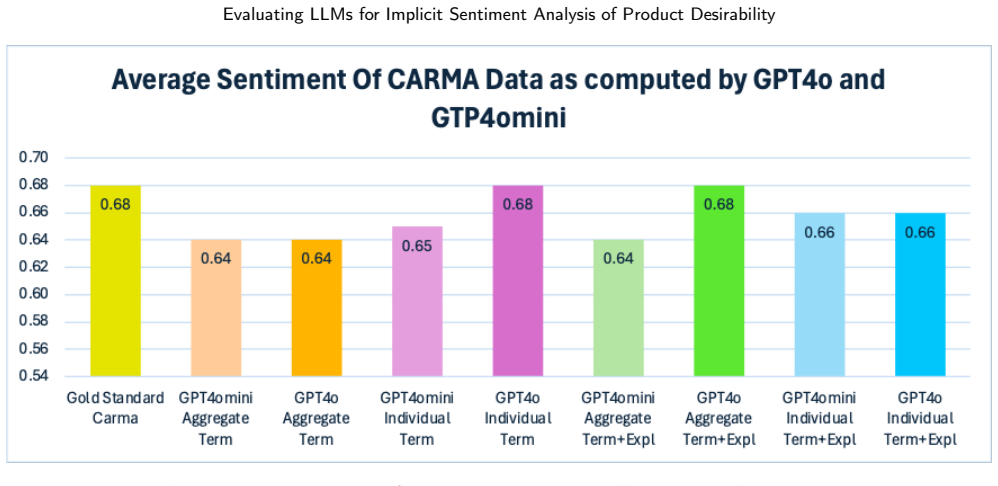
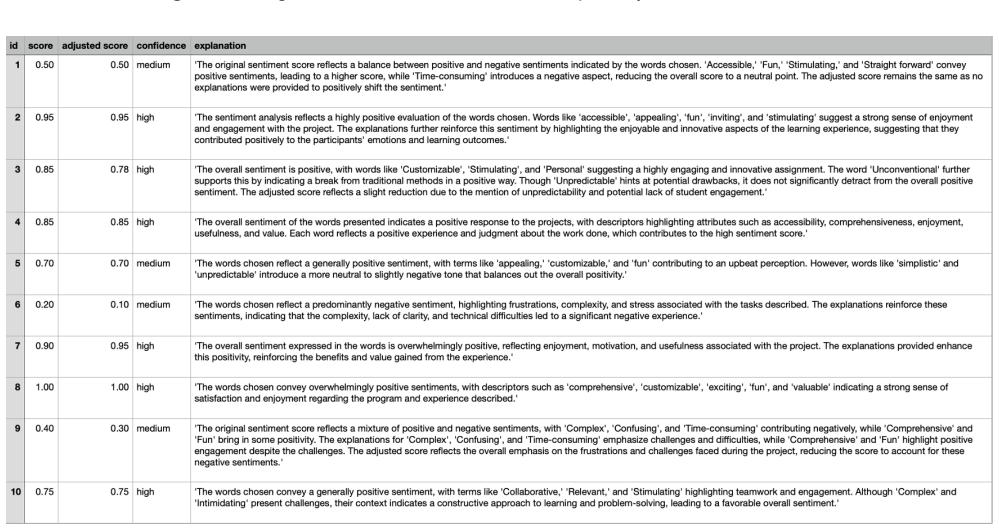
Qualitative product feedback can reveal nuanced user experiences, but its implicit sentiment is difficult to measure. This paper presents a scalable and interpretable framework that uses large language models (LLMs) to quantify product desirability from such data. Using two Product Desirability Toolkit (PDT) datasets from ZORQ and CARMA comprising 106 respondent term groupings with gold-standard human annotation, zero-shot continuous numerical sentiment scoring and categorical sentiment classification are evaluated without relying on explicit review scores. Across the datasets, LLMs generated numerical sentiment scores directly from qualitative responses and closely matched expert labels, achieving Pearson correlations up to 0.97 and classification accuracy up to 94%. LLMs maintained robustness even when handling data presented in multiple forms and consistently expressed high confidence. In contrast, lexicon-based and transformer baselines did not produce statistically significant results. Among the models tested, GPT-4o-mini achieved performance comparable to larger models at 94% lower cost, supporting scalable deployment. The framework also incorporates model confidence ratings and human-readable rationale explanations (xAI), improving interpretability, transparency, and trust while supporting practical use in product satisfaction assessment. In general, using the PDT tool as a survey method along with a cost efficient LLM for sentiment analysis has the potential to provide for product evaluation with results that are rich in terms of sentiment scores (both numerical and classified sentiment) and in terms of the high-level user impressions of the product that can be used to identify ideas for product development and improvement, as well as marketing ideas for target audiences.
Editorial analysis
A structured set of objections, weighed in public.
Referee Report
Summary. The paper proposes a zero-shot LLM framework for numerical scoring and categorical classification of implicit sentiment in qualitative product feedback from two PDT datasets (ZORQ and CARMA, 106 term groupings total). It reports that LLMs achieve Pearson correlations up to 0.97 and classification accuracy up to 94% against human gold-standard labels, outperforming lexicon-based and transformer baselines, while also providing model confidence scores and human-readable rationales; GPT-4o-mini is highlighted for comparable performance at lower cost.
Significance. If the empirical comparisons are shown to be fair and the human labels are reliable, the work could demonstrate a practical, scalable route to extracting quantifiable desirability signals from open-ended PDT responses without explicit rating scales, with added interpretability from xAI outputs. The cost-efficiency finding for smaller models is a concrete deployment advantage.
major comments (3)
- [Abstract and methods (implied)] The manuscript provides no description of the gold-standard annotation process for the 106 term groupings (number of annotators, annotation protocol, instructions given to experts, or any inter-rater reliability metric such as Cohen’s kappa or ICC). Because the headline Pearson r ≤ 0.97 and 94% accuracy claims treat these labels as fixed ground truth, the absence of reliability data makes it impossible to assess whether the reported LLM–human agreement exceeds typical annotator variance on implicit-sentiment tasks.
- [Methods (implied)] No prompt templates, few-shot examples, output parsing rules, or temperature settings are supplied for the zero-shot LLM evaluations. Without these, it is not possible to determine whether the high correlations and accuracies are reproducible or whether they reflect task-specific prompt engineering that was not applied to the baselines.
- [Results (implied)] The claim that lexicon-based and transformer baselines “did not produce statistically significant results” lacks detail on baseline implementations, feature extraction, hyper-parameter tuning, and the exact statistical tests used. This prevents evaluation of whether the LLM advantage is due to model capability or to unequal experimental conditions.
minor comments (1)
- [Abstract] The abstract states “Pearson correlations up to 0.97” and “classification accuracy up to 94%” but does not indicate which dataset or model produced each figure; a table or explicit mapping would improve clarity.
Simulated Author's Rebuttal
We thank the referee for the constructive feedback. We address each major comment below and will revise the manuscript accordingly to improve clarity, reproducibility, and fairness of comparisons.
read point-by-point responses
-
Referee: The manuscript provides no description of the gold-standard annotation process for the 106 term groupings (number of annotators, annotation protocol, instructions given to experts, or any inter-rater reliability metric such as Cohen’s kappa or ICC). Because the headline Pearson r ≤ 0.97 and 94% accuracy claims treat these labels as fixed ground truth, the absence of reliability data makes it impossible to assess whether the reported LLM–human agreement exceeds typical annotator variance on implicit-sentiment tasks.
Authors: We agree this information is missing from the manuscript. The gold-standard labels originate from the original ZORQ and CARMA PDT dataset publications, where expert annotators (product design researchers) grouped and labeled terms according to desirability constructs. We will add a dedicated subsection in Methods detailing the source annotation protocol, number of annotators where reported in the source papers, instructions, and any available reliability metrics. If inter-rater statistics were not originally computed, we will explicitly note this as a limitation and discuss implications for interpreting LLM agreement. revision: yes
-
Referee: No prompt templates, few-shot examples, output parsing rules, or temperature settings are supplied for the zero-shot LLM evaluations. Without these, it is not possible to determine whether the high correlations and accuracies are reproducible or whether they reflect task-specific prompt engineering that was not applied to the baselines.
Authors: We acknowledge the omission. All evaluations used zero-shot prompts with temperature set to 0 for determinism; no few-shot examples were used. We will include the full prompt templates (for both numerical scoring and categorical classification), exact output parsing logic (regex-based extraction of scores and rationales), and model parameters in a new Appendix. Baselines received no equivalent prompt engineering as they rely on different paradigms (lexicon lookup or fine-tuned classification heads). revision: yes
-
Referee: The claim that lexicon-based and transformer baselines “did not produce statistically significant results” lacks detail on baseline implementations, feature extraction, hyper-parameter tuning, and the exact statistical tests used. This prevents evaluation of whether the LLM advantage is due to model capability or to unequal experimental conditions.
Authors: We agree additional detail is required. The lexicon baselines used VADER and TextBlob with default parameters; transformer baselines used standard pre-trained models (e.g., BERT) with default settings and no task-specific tuning. Statistical significance was evaluated using p-values from Pearson correlations and accuracy metrics. We will expand the Methods and Results sections with full implementation details, feature extraction steps, hyper-parameter information, and exact tests applied uniformly. This will allow readers to assess the fairness of comparisons. revision: yes
Circularity Check
No circularity: purely empirical comparison with no derivation or fitted predictions
full rationale
The paper reports measured Pearson correlations and classification accuracies between zero-shot LLM outputs and fixed human annotations on 106 term groupings. No equations, parameter fitting, self-citation chains, or predictions that reduce to inputs by construction appear in the provided text. The central results are direct empirical matches to external labels, making the study self-contained against benchmarks. The reader's circularity score of 1.0 is consistent with this assessment.
Axiom & Free-Parameter Ledger
axioms (1)
- domain assumption Human annotations on term groupings constitute a reliable gold standard for implicit sentiment.
Reference graph
Works this paper leans on
-
[1]
, booktitle=
Alroobaea, Roobaea and Mayhew, Pam J. , booktitle=. How many participants are really enough for usability studies? , year=
-
[2]
Design Convergence Study , volume=
Lim, Dokshin , title=. Design Convergence Study , volume=
-
[3]
Imler and K.R
B.B. Imler and K.R. Garcia and N. Clements , year=. Are reference pop-up widgets welcome or annoying? A usability study , journal=
-
[4]
2024 , journal=
Guangyu Hou, Qin Lian , title=. 2024 , journal=
2024
-
[5]
Capturing Sensory Experiences Through Semi-Structured Elicitation Questions , booktitle =
Chapter 8. Capturing Sensory Experiences Through Semi-Structured Elicitation Questions , booktitle =. Consumer and Managerial Perspectives , author =. doi:doi:10.21832/9781845411503-011 , isbn =
-
[6]
Volo, S. , year=. Conceptualizing experience: A tourist based approach , journal=
-
[7]
and De Holan, P
Salvador, F. and De Holan, P. M. and Piller, F. T. , year=. Cracking the code of mass customization , url=
-
[8]
Hastings, K
J. Hastings, K. Branting and J. Lockwood , title=. AI Magazine , volume=
-
[9]
Jia, Wenlong and Shan, Jing and Wang, Jiaying and Mengyang, Zhang , title =. ACM Comput. Surv. , month = apr, articleno =. 2026 , issue_date =. doi:10.1145/3799234 , abstract =
-
[10]
Huiting Liu and Yao Quan and Zirui Wang and Haiping Ma and Xindong Wu , keywords =. DRUM: Distributionally robust optimization for LLM-based user model in interactive recommendation , journal =. 2026 , issn =. doi:https://doi.org/10.1016/j.ipm.2026.104746 , url =
-
[11]
Interpretable zero-shot stance detection with proactive content intervention , journal =
Apoorva Upadhyaya and Wolfgang Nejdl and Marco Fisichella , keywords =. Interpretable zero-shot stance detection with proactive content intervention , journal =. 2025 , issn =. doi:https://doi.org/10.1016/j.ipm.2025.104223 , url =
-
[12]
Exploring Implicit Sentiment Analysis Through Progressive Prompting Strategies , year=
Liu, Chang and Gao, Chen and Li, Yong and Wang, Meng , journal=. Exploring Implicit Sentiment Analysis Through Progressive Prompting Strategies , year=
-
[13]
Detecting Implicit Aspects and Sentiment in Hotel Reviews via Hybrid Embedding Methods , year=
Polpinij, Jantima and Khamket, Thananchai and Chan, Chunpong and Uttha, Theeraya and Chothanom, Anirut and Juanchaiyaphum, Jatuphum , booktitle=. Detecting Implicit Aspects and Sentiment in Hotel Reviews via Hybrid Embedding Methods , year=
-
[14]
Implicit Sentiment Analysis Methods and Applications Based on Machine Learning , year=
Hu, Xiande and Abisado, Mideth , booktitle=. Implicit Sentiment Analysis Methods and Applications Based on Machine Learning , year=
-
[15]
Revealing Hidden Sentiments: Implicit Aspectbased Sentiment Analysis Using Bert on Amazon Reviews , year=
Rahim, Leena Ardini Abdul and Samah, Khyrina Airin Fariza Abu and Dzulkalnine, Mohamad Faiz , booktitle=. Revealing Hidden Sentiments: Implicit Aspectbased Sentiment Analysis Using Bert on Amazon Reviews , year=
-
[16]
Lai and H
W. Lai and H. Xie and G. Xu and Q. Li , title=. IEEE Trans. Affective Comput. , volume=
-
[17]
Ouyang and Z
J. Ouyang and Z. Yang and S. Liang and B. Wang and Y. Wang and X. Li , title =. Proc. AAAI Conf. Artif. Intell , year =
-
[18]
Fei and B
H. Fei and B. Li and Q. Liu and L. Bing and F. Li and T.S. Chua , title =. Proc. 61st Annu. Meeting Assoc. Comput. Linguistics , year =
-
[19]
Causal Prompting for Implicit Sentiment Analysis With Large Language Models , year=
Ren, Jing and Zhou, Wenhao and Li, Bowen and Liu, Mujie and Le, Nguyen Linh Dan and Cen, Jiade and Chen, Liping and Xu, Ziqi and Xu, Xiwei and Li, Xiaodong , journal=. Causal Prompting for Implicit Sentiment Analysis With Large Language Models , year=
-
[20]
Kepu Zhang and Weijie Yu and Zhongxiang Sun and Weicong Qin and Jun Xu and Ji-Rong Wen , keywords =. Empowering open-domain LLMs for legal document correction via legal knowledge integration and decoding constraints , journal =. 2026 , issn =. doi:https://doi.org/10.1016/j.ipm.2026.104703 , url =
-
[21]
and Kaneko, H
Hamdhana, D. and Kaneko, H. and Victorino, J. N. and Inoue, S. , year=. Improved Evaluation Metrics for Sentence Suggestions in Nursing and Elderly Care Record Applications , journal=
-
[22]
Robert and Zhang, Xuejie , journal=
Yu, Liang-Chih and Wang, Jin and Lai, K. Robert and Zhang, Xuejie , journal=. Pipelined Neural Networks for Phrase-Level Sentiment Intensity Prediction , year=
-
[23]
doi:10.14569/IJACSA.2022.0131052 , year =
BiLSTM and Multiple Linear Regression based Sentiment Analysis Model using Polarity and Subjectivity of a Text , journal =. doi:10.14569/IJACSA.2022.0131052 , year =
-
[24]
Liapis and Aikaterini Karanikola and Sotiris Kotsiantis , keywords =
Charalampos M. Liapis and Aikaterini Karanikola and Sotiris Kotsiantis , keywords =. Enhancing sentiment analysis with distributional emotion embeddings , journal =. 2025 , issn =. doi:https://doi.org/10.1016/j.neucom.2025.129822 , url =
-
[25]
Zhang, Kai and Han, Yupeng , title =. Proceedings of the 34th ACM International Conference on Information and Knowledge Management , pages =. 2025 , isbn =. doi:10.1145/3746252.3761223 , abstract =
-
[26]
Dwivedi, Rudresh and Dave, Devam and Naik, Het and Singhal, Smiti and Omer, Rana and Patel, Pankesh and Qian, Bin and Wen, Zhenyu and Shah, Tejal and Morgan, Graham and Ranjan, Rajiv , title =. ACM Comput. Surv. , month = jan, articleno =. 2023 , issue_date =. doi:10.1145/3561048 , abstract =
-
[27]
2017 , eprint=
A Unified Approach to Interpreting Model Predictions , author=. 2017 , eprint=
2017
-
[28]
T weet E val: Unified Benchmark and Comparative Evaluation for Tweet Classification
Barbieri, Francesco and Camacho-Collados, Jose and Espinosa Anke, Luis and Neves, Leonardo. T weet E val: Unified Benchmark and Comparative Evaluation for Tweet Classification. Findings of the Association for Computational Linguistics: EMNLP 2020. 2020. doi:10.18653/v1/2020.findings-emnlp.148
-
[29]
Using LoRA for Efficient Stable Diffusion Fine-Tuning , howpublished=
Pedro Cuenca, Sayak Paul , year=. Using LoRA for Efficient Stable Diffusion Fine-Tuning , howpublished=
-
[30]
Expert Systems with Applications , author =
A review on sentiment analysis from social media platforms , volume =. Expert Systems with Applications , author =. 2023 , pages =. doi:10.1016/j.eswa.2023.119862 , language =
-
[31]
Provenance-. Proc. ACM Manag. Data , author =. 2024 , note =. doi:10.1145/3698826 , abstract =
-
[32]
Riello, Pasquale and Quille, Keith and Jaiswal, Rajesh and Sansone, Carlo , title =. Proceedings of the 2024 Conference on Human Centred Artificial Intelligence - Education and Practice , pages =. 2024 , isbn =. doi:10.1145/3701268.3701274 , abstract =
-
[34]
Model-Based Trust Analysis of LLM Conversations , year =
G\". Model-Based Trust Analysis of LLM Conversations , year =. Proceedings of the ACM/IEEE 27th International Conference on Model Driven Engineering Languages and Systems , pages =. doi:10.1145/3652620.3687809 , abstract =
-
[35]
2025 , url=
Gemini Flash Pricing , author=. 2025 , url=
2025
-
[36]
2016 , eprint=
LSUN: Construction of a Large-scale Image Dataset using Deep Learning with Humans in the Loop , author=. 2016 , eprint=
2016
-
[37]
AI Energy Usage Climate Footprint Big Tech , author=
-
[38]
Ma and Ruofan Wu and Oh Jun Kweon and Yuxuan Xia and Zhiyu Wu and Mosharaf Chowdhury , url =
Jae-Won Chung and Jiachen Liu and Jeff J. Ma and Ruofan Wu and Oh Jun Kweon and Yuxuan Xia and Zhiyu Wu and Mosharaf Chowdhury , url =. The. 2025 , journal=
2025
-
[39]
Zeus: Understanding and Optimizing
Jie You and Jae-Won Chung and Mosharaf Chowdhury , booktitle=. Zeus: Understanding and Optimizing
-
[40]
Assessing User Experiences with
Sherri Weitl. Assessing User Experiences with. 56th Hawaii International Conference on System Sciences,. 2023 , url =
2023
-
[41]
Comparative Analysis of LLM-based Market Prediction and Human Expertise with Sentiment Analysis and Machine Learning Integration , year=
Abdelsamie, Mohamed and Wang, Hua , booktitle=. Comparative Analysis of LLM-based Market Prediction and Human Expertise with Sentiment Analysis and Machine Learning Integration , year=
-
[42]
Comparative Analysis of Fine-Tuned LLM, BERT and DL Models for Customer Sentiment Analysis , year=
Chinnalagu, Anandan , booktitle=. Comparative Analysis of Fine-Tuned LLM, BERT and DL Models for Customer Sentiment Analysis , year=
-
[43]
Hastings and Jonah Lum , booktitle=
Sherri Weitl-Harms and John D. Hastings and Jonah Lum , booktitle=. Using. 2024 , month=
2024
-
[44]
Proceedings of the 2024 Workshop on Quantum Search and Information Retrieval , pages =
Buonaiuto, Giuseppe and Guarasci, Raffaele and Esposito, Massimo , title =. Proceedings of the 2024 Workshop on Quantum Search and Information Retrieval , pages =. 2024 , isbn =. doi:10.1145/3660318.3660325 , abstract =
-
[45]
Deng, Xiang and Bashlovkina, Vasilisa and Han, Feng and Baumgartner, Simon and Bendersky, Michael , title =. Companion Proceedings of the ACM Web Conference 2023 , pages =. 2023 , isbn =. doi:10.1145/3543873.3587324 , abstract =
-
[46]
Proceedings of the 30th International Conference on Intelligent User Interfaces , pages =
Zeng, Xiyin and Zhou, Qianyi and Liu, Shouqiang , title =. Proceedings of the 30th International Conference on Intelligent User Interfaces , pages =. 2025 , isbn =. doi:10.1145/3708359.3712106 , abstract =
-
[47]
Qiao, Jun and Wang, Jingyi and Wang, Yuxuan and Jiang, Yong and Li, Shentie , title =. Proceedings of the 2024 7th International Conference on Signal Processing and Machine Learning , pages =. 2024 , isbn =. doi:10.1145/3686490.3686498 , abstract =
-
[48]
Xiao, Weizhen , title =. Proceedings of the International Conference on Modeling, Natural Language Processing and Machine Learning , pages =. 2024 , isbn =. doi:10.1145/3677779.3677791 , abstract =
-
[49]
Proceedings of the 25th Annual International Conference on Digital Government Research , pages =
Tsai, Chun-Hua and Nandy, Gargi and House, Deanna and Carroll, John , title =. Proceedings of the 25th Annual International Conference on Digital Government Research , pages =. 2024 , isbn =. doi:10.1145/3657054.3657128 , abstract =
-
[50]
Liu, Zhiwei and Yang, Kailai and Xie, Qianqian and Zhang, Tianlin and Ananiadou, Sophia , title =. Proceedings of the 30th ACM SIGKDD Conference on Knowledge Discovery and Data Mining , pages =. 2024 , isbn =. doi:10.1145/3637528.3671552 , abstract =
-
[51]
Fazzi, Gino Franco and Skoven Hinge, Julie and Heinrich, Stefan and Burelli, Paolo , title =. Proceedings of the Extended Abstracts of the CHI Conference on Human Factors in Computing Systems , articleno =. 2025 , isbn =. doi:10.1145/3706599.3720191 , abstract =
-
[52]
Saffat and Tarin, Ishika and Nurain, Novia and Islam, A
Tahmidul Karim, Farhan and Zabin, Sardar Md. Saffat and Tarin, Ishika and Nurain, Novia and Islam, A. B. M. Alim Al , title =. Proceedings of the Extended Abstracts of the CHI Conference on Human Factors in Computing Systems , articleno =. 2025 , isbn =. doi:10.1145/3706599.3719895 , abstract =
-
[53]
Wang, Yulong and Li, Hong and Wei, Ni , title =. 2025 , isbn =. doi:10.1145/3696410.3714644 , booktitle =
-
[54]
Zengzhi Wang and Qiming Xie and Yi Feng and Zixiang Ding and Zinong Yang and Rui Xia , year=. Is
-
[55]
Zengzhi Wang and Qiming Xie and Yi Feng and Zixiang Ding and Zinong Yang and Rui Xia , year=. Is. 2304.04339 , archivePrefix=
-
[56]
2018 , publisher =
Ergonomics of human-system interaction -- Part 11: Usability: Definitions and concepts , author =. 2018 , publisher =
2018
-
[57]
CIRP Annals , volume =
Mapping customer needs to design parameters in the front end of product design by applying deep learning , author =. CIRP Annals , volume =. 2018 , issn =
2018
-
[58]
Energy and Policy Considerations for Deep Learning in NLP
Energy and Policy Considerations for Deep Learning in NLP , author =. Proceedings of the 57th Annual Meeting of the Association for Computational Linguistics , month =. doi:10.18653/v1/P19-1355 , pages=
work page internal anchor Pith review doi:10.18653/v1/p19-1355
-
[59]
2025 , note=
OpenAI API Pricing , author=. 2025 , note=
2025
-
[60]
2024 , eprint=
GPT-4 Technical Report , author=. 2024 , eprint=
2024
-
[61]
2024 , note=
GPT-4o mini: advancing cost-efficient intelligence , author=. 2024 , note=
2024
-
[62]
OpenAI , year=. Hello
-
[63]
Nature Climate Change , volume=
Aligning artificial intelligence with climate change mitigation , author=. Nature Climate Change , volume=. 2022 , publisher=
2022
-
[64]
Green. Communications of the ACM , author =. 2020 , issue_date =. doi:10.1145/3381831 , abstract =
-
[65]
Generative
Kate Crawford , volume=. Generative. Nature , doi=
-
[66]
PeerJ Comput Sci , year=
Zhu, L and Xu, M and Bao, Y and Xu, Y and Kong, X , title=. PeerJ Comput Sci , year=
-
[67]
Mohammad Tubishat and Norisma Idris and Mohammad A.M. Abushariah , keywords =. Implicit aspect extraction in sentiment analysis: Review, taxonomy, oppportunities, and open challenges , journal =. 2018 , issn =. doi:https://doi.org/10.1016/j.ipm.2018.03.008 , url =
-
[68]
Deep learning for Aspect-based Sentiment Analysis , year=
Wang, Jie and Xu, Bingxin and Zu, Yujie , booktitle=. Deep learning for Aspect-based Sentiment Analysis , year=
-
[69]
Deep Learning for Aspect-Based Sentiment Analysis: A Comparative Review , journal =. 2019 , issn =. doi:doi.org/10.1016/j.eswa.2018.10.003 , author =
-
[70]
Macías , title =
Marina Martín and José A. Macías , title =. International Journal of Human–Computer Interaction , volume =. 2023 , publisher =
2023
-
[71]
Clustering to categorize desirability in software: Exploring cluster analysis of Product Reaction Cards in a stereoscopic retail application , year=
González-Zúñiga, Diego and Carrabina, Jordi , booktitle=. Clustering to categorize desirability in software: Exploring cluster analysis of Product Reaction Cards in a stereoscopic retail application , year=
-
[72]
Dimensions of User Experience and Reaction Cards , booktitle =
Mer. Dimensions of User Experience and Reaction Cards , booktitle =
-
[73]
Conference: International Conference of Design, User Experience, and Usability , year =
Camila Maia and Elizabeth Furtado , title =. Conference: International Conference of Design, User Experience, and Usability , year =
-
[74]
Mer. Evaluation of information visualization techniques: analysing user experience with reaction cards , year =. Proceedings of the Fifth Workshop on Beyond Time and Errors: Novel Evaluation Methods for Visualization , pages =. doi:10.1145/2669557.2669565 , abstract =
-
[75]
Analysis of sentiment expressions for user-centered design , journal =. 2021 , issn =. doi:10.1016/j.eswa.2021.114604 , author =
-
[76]
2013 , publisher=
Tom Tullis and Bill Albert , title=. 2013 , publisher=
2013
-
[77]
Problem-based gaming via an augmented reality mobile game and a printed game in foreign language education , volume =
Lee, Juhee , address =. Problem-based gaming via an augmented reality mobile game and a printed game in foreign language education , volume =. Education and information technologies , keywords =. 2022 , abstract =
2022
-
[78]
Developing an Instrument to Capture Multifaceted Visitor Experiences: The DoVE Adjective Checklist
Packer, Jan and Ballantyne, Roy and Bond, Nigel , ISSN =. Developing an Instrument to Capture Multifaceted Visitor Experiences: The DoVE Adjective Checklist. , Volume =. Visitor Studies , Keywords =
-
[79]
User brain-driven evaluation of an educational 3D virtual environment , year=
Carofiglio, Valeria and Ricci, Giuseppe and Abbattista, Fabio , booktitle=. User brain-driven evaluation of an educational 3D virtual environment , year=
-
[80]
Evaluation of the Usability of a Serious Game: Through Emotions and Satisfaction , year =
Talavera Mendoza, Fabiola and Gonzales Diaz, Maria Luz and Rojas G\'. Evaluation of the Usability of a Serious Game: Through Emotions and Satisfaction , year =. Proceedings of the 2021 5th International Conference on E-Education, E-Business and E-Technology , pages =. doi:10.1145/3474880.3474889 , abstract =
-
[81]
Research on product formal design based on style description , year=
Kai Wang , booktitle=. Research on product formal design based on style description , year=
discussion (0)
Sign in with ORCID, Apple, or X to comment. Anyone can read and Pith papers without signing in.