Modern tidal interaction models for rapid binary population synthesis: II. Binary black hole formation, mergers, and spins
Pith reviewed 2026-06-26 07:10 UTC · model grok-4.3
The pith
Isolated binary evolution with updated tides produces mostly low effective spin black hole mergers for current detectors.
A machine-rendered reading of the paper's core claim, the machinery that carries it, and where it could break.
Core claim
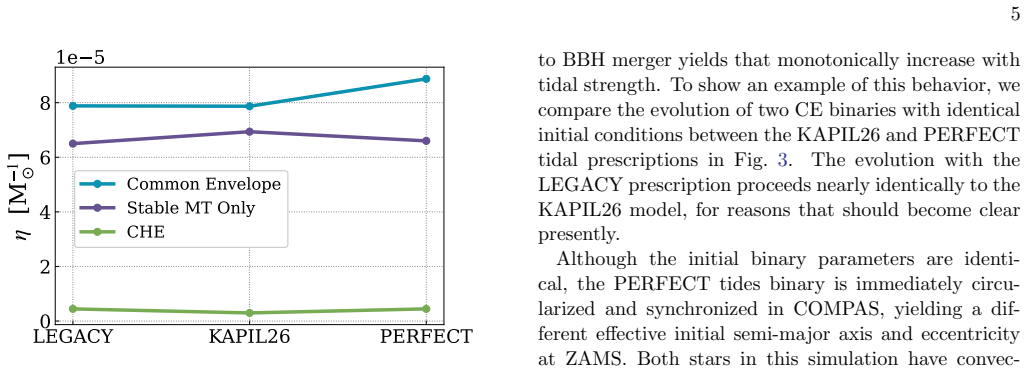
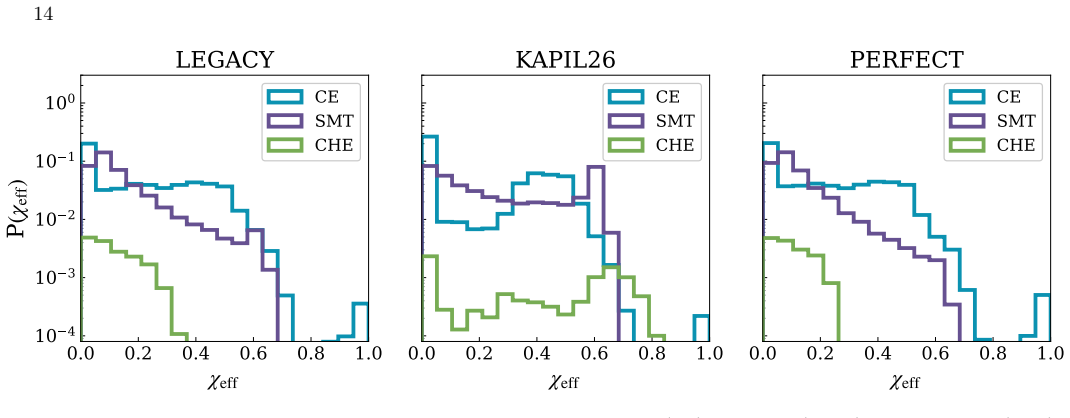
Using the updated tidal model in COMPAS, the intrinsic χ_eff distribution of merging binary black holes from isolated evolution is strongly biased low for present-day detectors, with roughly one third of systems below 0.05 and only about three percent above 0.5; high χ_eff binaries merge at higher redshifts due to smaller separations at black hole formation and shorter coalescence times, so the fraction above 0.5 rises to about fifteen percent once detectors reach those earlier epochs.
What carries the argument
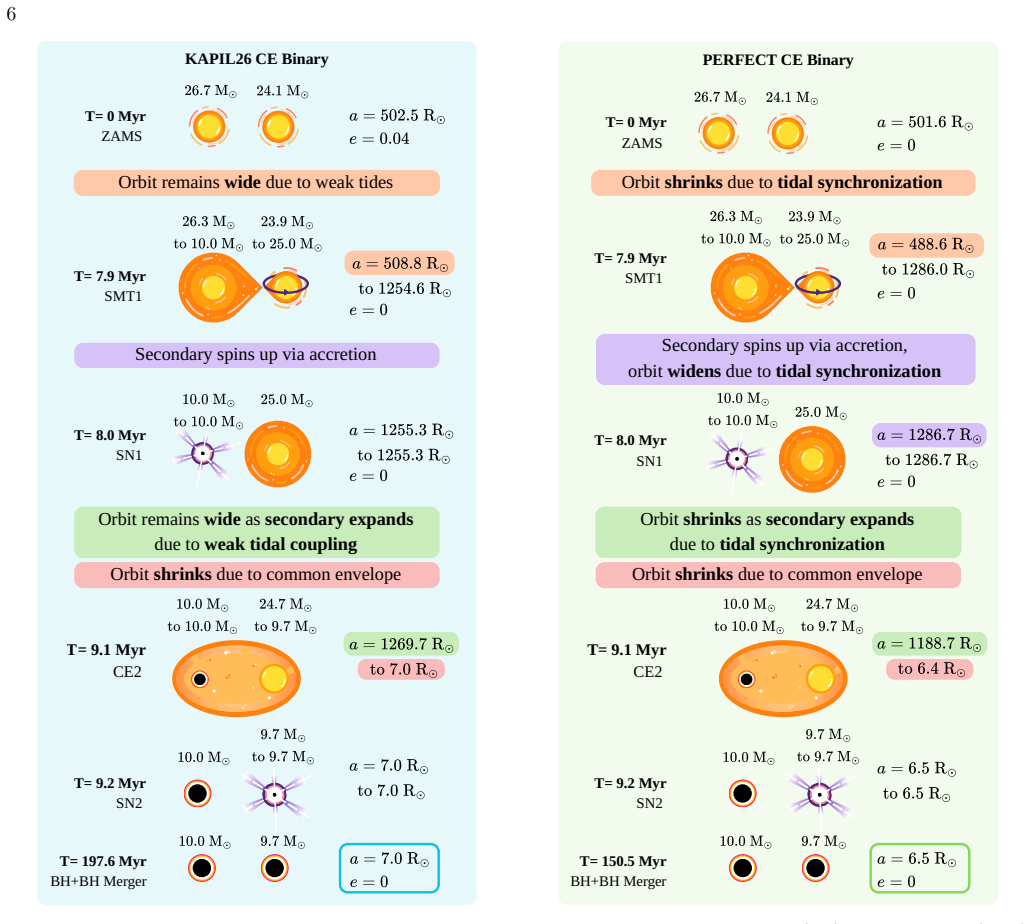
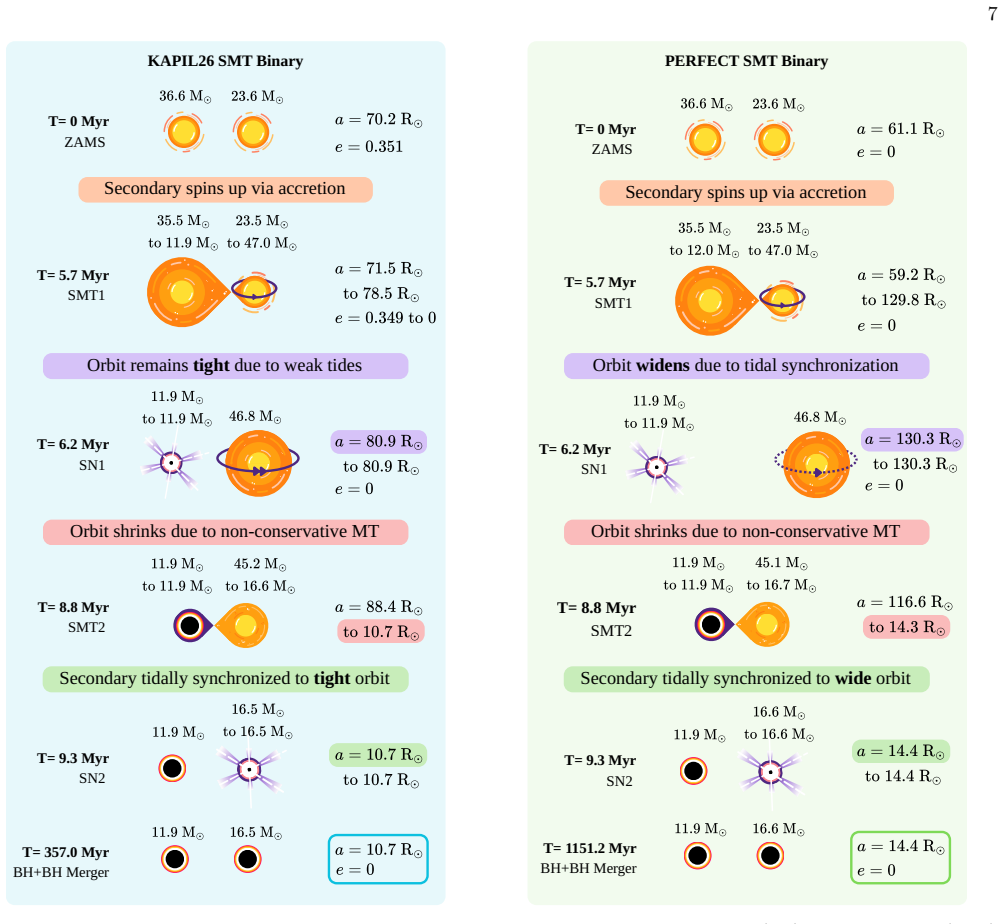
Self-consistent tidal dissipation implementation that determines spin synchronization efficiency from stellar mass, evolutionary stage, and mass transfer history.
Load-bearing premise
The new tidal dissipation model accurately captures efficiency and its dependence on mass transfer history across all relevant stellar masses and evolutionary stages.
What would settle it
A statistically significant sample of low-redshift merging binary black holes showing substantially more than three percent with χ_eff above 0.5 would contradict the predicted selection bias.
Figures





read the original abstract
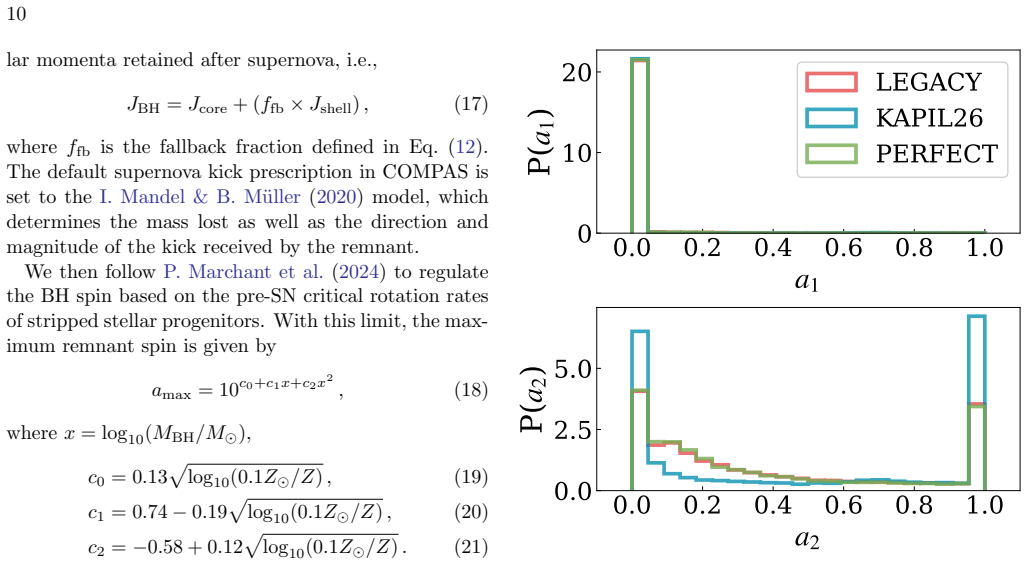
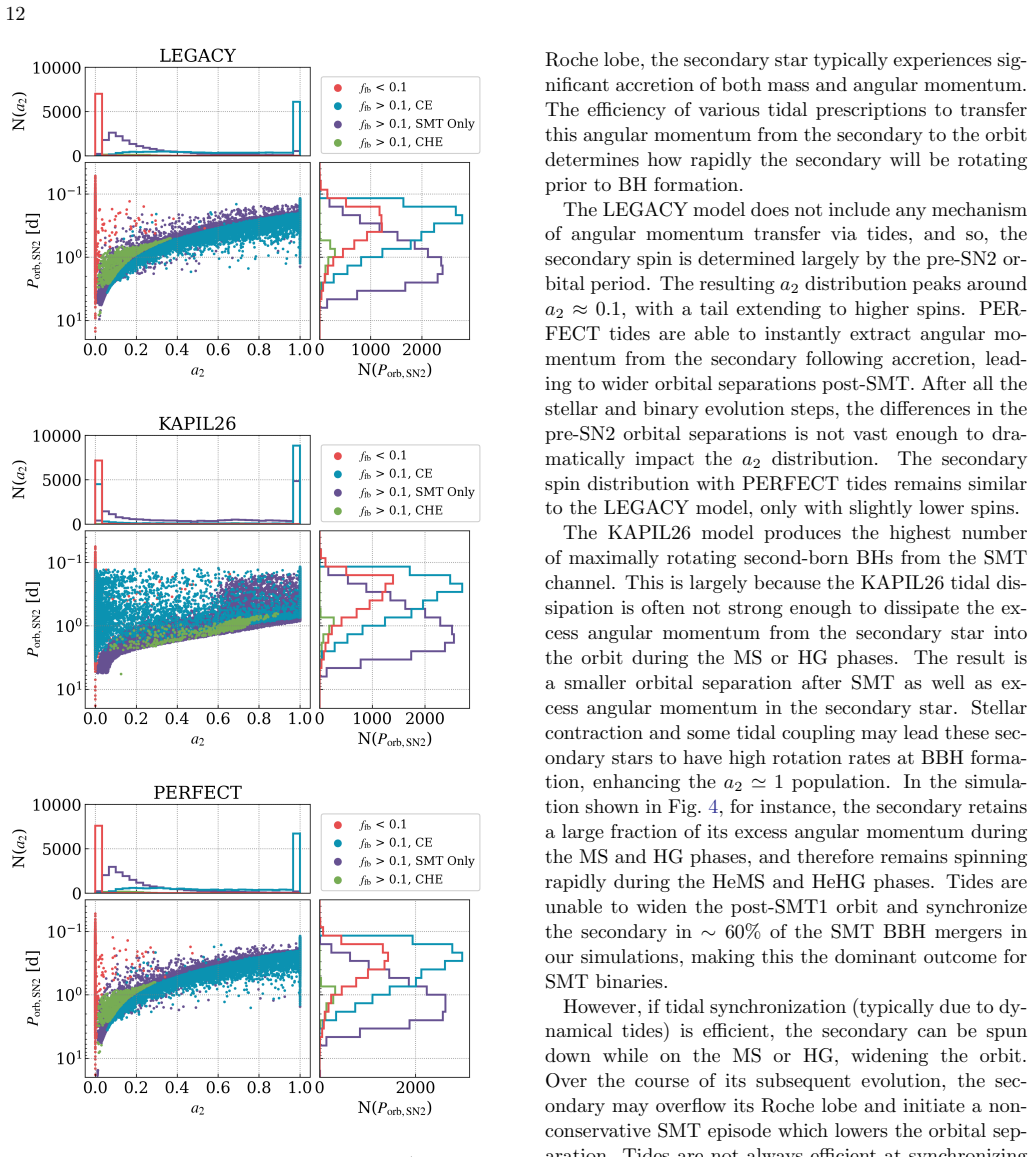
We present predictions for the merger rates and effective spin ($\chi_{\rm eff}$) distribution of binary black holes (BBHs) from isolated binary evolution, using a new self-consistent tidal dissipation implementation in the rapid binary population synthesis code COMPAS. Most of the first-born black holes (BHs) in our simulated merging BBHs are formed with zero spins, with the exception of BBHs formed from chemically homogeneous evolution. The spins of the second-born BHs with the new model depend significantly on the efficiency of tidal dissipation and mass transfer history, and crucially, are not always consistent with pre-supernova synchronization. High-$\chi_{\rm eff}$ binaries preferentially merge at high redshift due to smaller binary separations at BBH formation and shorter coalescence times, thus rendering them largely inaccessible to current gravitational wave (GW) detectors. We expect the intrinsic spin distribution of merging BBHs formed from isolated evolution to be strongly biased toward low $\chi_{\rm eff}$ with current detectors, with a third of systems having $\chi_{\rm eff} < 0.05$ and only $\sim 3\%$ with $\chi_{\rm eff}>0.5$. However, $\chi_{\rm eff}$ will increase as GW detectors become sensitive to higher redshift sources, with up to $\sim 15\%$ of systems having $\chi_{\rm eff}>0.5$.
Editorial analysis
A structured set of objections, weighed in public.
Referee Report
Summary. The paper presents predictions for BBH merger rates and χ_eff distributions from isolated binary evolution using a new self-consistent tidal dissipation implementation in COMPAS. It claims most first-born BHs form with zero spin (except chemically homogeneous evolution cases), second-born BH spins depend significantly on tidal dissipation efficiency and mass-transfer history (not always pre-SN synchronized), high-χ_eff systems preferentially merge at high redshift due to smaller separations and shorter coalescence times, and the intrinsic distribution for current detectors is biased low (∼1/3 with χ_eff < 0.05, ∼3% with χ_eff > 0.5), increasing to ∼15% >0.5 at higher redshifts accessible to future detectors.
Significance. If the tidal model holds, the results would be significant for GW astrophysics by providing falsifiable predictions for the isolated-channel contribution to the observed BBH spin distribution, including its redshift evolution, and by highlighting how tidal interactions after mass transfer shape second-born BH spins.
major comments (2)
- [Tidal model section (implementation and results)] The headline χ_eff fractions and redshift-evolution claim rest on the new tidal dissipation implementation. No benchmarks or comparisons against detailed stellar models (e.g., MESA grids spanning the relevant mass range and post-mass-transfer stages) are referenced to validate the efficiency or its dependence on mass-transfer history; this is load-bearing because the abstract states second-born spins “depend significantly on the efficiency of tidal dissipation and mass transfer history.”
- [Results on χ_eff distributions] The reported low-χ_eff bias (1/3 systems <0.05) is presented as robust, yet the model includes a free parameter for tidal dissipation efficiency whose variation range and impact on the quoted percentages are not quantified; without this, it is unclear whether the bias is a genuine prediction or an artifact of the chosen efficiency value.
minor comments (2)
- [Abstract] Clarify in the abstract or methods the specific range of tidal dissipation efficiencies explored and whether any observational constraints were used to set it.
- [Methods] Add a short table or figure caption explicitly listing the free parameters retained in the new tidal model versus those fixed by the self-consistent treatment.
Simulated Author's Rebuttal
We thank the referee for their insightful comments, which have helped us improve the clarity and robustness of our manuscript. Below we address each major comment in turn, outlining the revisions we intend to make.
read point-by-point responses
-
Referee: The headline χ_eff fractions and redshift-evolution claim rest on the new tidal dissipation implementation. No benchmarks or comparisons against detailed stellar models (e.g., MESA grids spanning the relevant mass range and post-mass-transfer stages) are referenced to validate the efficiency or its dependence on mass-transfer history; this is load-bearing because the abstract states second-born spins “depend significantly on the efficiency of tidal dissipation and mass transfer history.”
Authors: The tidal dissipation model is introduced and its implementation validated against detailed calculations in the companion paper (Paper I). However, we agree that explicit references to benchmarks, particularly for post-mass-transfer stages relevant to second-born BHs, would strengthen the presentation in this work. In the revised manuscript, we will add a new subsection in the methods that summarizes the validation performed in Paper I, including comparisons to MESA grids where available, and discuss the dependence on mass-transfer history. We will also cite additional literature on tidal synchronization in massive binaries. revision: yes
-
Referee: The reported low-χ_eff bias (1/3 systems <0.05) is presented as robust, yet the model includes a free parameter for tidal dissipation efficiency whose variation range and impact on the quoted percentages are not quantified; without this, it is unclear whether the bias is a genuine prediction or an artifact of the chosen efficiency value.
Authors: We acknowledge that the sensitivity to the tidal dissipation efficiency parameter was not fully explored in the submitted version. To address this, we will conduct additional simulations varying the efficiency parameter across its physically motivated range and include these results in a new figure or table in the revised manuscript. This will quantify the impact on the χ_eff distribution fractions and demonstrate the robustness of the reported low-χ_eff bias for the fiducial choice. revision: yes
Circularity Check
No significant circularity; outputs are simulation results from new model, not reductions to inputs
full rationale
The provided abstract and context describe predictions generated by running the COMPAS population synthesis code with a newly implemented tidal dissipation prescription. No equations, fitting procedures, or self-referential definitions are visible that would make the reported χ_eff distribution or merger rates equivalent to the model inputs by construction. The spin outcomes are stated to depend on dissipation efficiency and mass-transfer history, but this is presented as a model consequence rather than a tautology or fitted prediction. No load-bearing self-citation chain or ansatz smuggling is exhibited in the text. The derivation chain is therefore self-contained against external benchmarks for the purpose of this circularity analysis.
Axiom & Free-Parameter Ledger
free parameters (1)
- tidal dissipation efficiency
Reference graph
Works this paper leans on
-
[1]
Alvarez-Lopez, Sofia and Heinzel, Jack and Vitale, Salvatore. Evidence for additional structure in the effective spin distribution hints at multiple formation pathways in GWTC-5.0. 2026. arXiv:2606.12205
Pith/arXiv arXiv 2026
-
[2]
Abac, A. G. and others. GWTC-5.0: Population Properties of Merging Compact Binaries. 2026. arXiv:2605.27226
Pith/arXiv arXiv 2026
-
[3]
Abac, A. G. and others. GWTC-5.0: Observations from the Second Part of the Fourth LIGO-Virgo-KAGRA Observing Run and Updates to the Gravitational-Wave Transient Catalog. 2026. arXiv:2605.27225
Pith/arXiv arXiv 2026
-
[4]
Vigna-G\'omez, Alejandro and MacLeod, Morgan and Neijssel, Coenraad J. and Broekgaarden, Floor S. and Justham, Stephen and Howitt, George and de Mink, Selma E. and Vinciguerra, Serena and Mandel, Ilya. Common-Envelope Episodes that lead to Double Neutron Star formation. Publ. Astron. Soc. Aust. 2020. doi:10.1017/pasa.2020.31. arXiv:2001.09829
-
[5]
Monthly Notices of the Royal Astronomical Society , volume =
Vick, Michelle and Lai, Dong , title = ". Monthly Notices of the Royal Astronomical Society , volume =. 2020 , month =. doi:10.1093/mnras/staa1784 , url =
-
[6]
Monthly Notices of the Royal Astronomical Society , volume =
Vick, Michelle and Lai, Dong , title = ". Monthly Notices of the Royal Astronomical Society , volume =. 2018 , month =. doi:10.1093/mnras/sty225 , url =
-
[7]
Hurley, Jarrod R. and Tout, Christopher A. and Pols, Onno R. Evolution of binary stars and the effect of tides on binary populations. Mon. Not. R. Astron. Soc. 2002. doi:10.1046/j.1365-8711.2002.05038.x. arXiv:astro-ph/0201220
-
[8]
, volume =
Tidal evolution in close binary systems. , volume =. Astronomy and Astrophysics , author =. 1981 , pages =
1981
-
[9]
, volume =
Tidal friction in close binary systems. , volume =. Astronomy and Astrophysics , author =. 1977 , pages =
1977
-
[10]
Stegmann, Jakob and Antonini, Fabio. Flipping spins in mass transferring binaries and origin of spin-orbit misalignment in binary black holes. Phys. Rev. D. 2021. doi:10.1103/PhysRevD.103.063007. arXiv:2012.06329
-
[11]
Dynamical Formation of Close Binaries During the Pre-main-sequence Phase
Moe, Maxwell and Kratter, Kaitlin M. Dynamical Formation of Close Binaries During the Pre-main-sequence Phase. Astrophys. J. 2018. doi:10.3847/1538-4357/aaa6d2. arXiv:1706.09894
work page internal anchor Pith review Pith/arXiv arXiv doi:10.3847/1538-4357/aaa6d2 2018
-
[12]
The Role of Chaos in the Circularization of Tidal Capture Binaries. I. The Chaos Boundary. Astrophys. J. doi:10.1086/176178 , adsurl =
-
[13]
Compact Object Modeling with the StarTrack Population Synthesis Code
Belczynski, Krzystof and Kalogera, Vassiliki and Rasio, Frederic A. and Taam, Ronald E. and Zezas, Andreas and Bulik, Tomasz and Maccarone, Thomas J. and Ivanova, Natalia. Compact object modeling with the startrack population synthesis code. Astrophys. J. Supp. S. 2008. doi:10.1086/521026. arXiv:astro-ph/0511811
work page internal anchor Pith review Pith/arXiv arXiv doi:10.1086/521026 2008
-
[14]
Astronomy and Astrophysics, vol
Stability of tidal equilibrium , author=. Astronomy and Astrophysics, vol. 92, no. 1-2, Dec. 1980, p. 167-170. , volume=
1980
-
[15]
Song, H. F. and Meynet, G. and Maeder, A. and Ekstr. Close binary evolution -. Astronomy & Astrophysics , language =. 2018 , bdsk-url-1 =. doi:10.1051/0004-6361/201731073 , issn =
-
[16]
The spin of the second-born black hole in coalescing binary black holes
Qin, Y. and Fragos, T. and Meynet, G. and Andrews, J. and S rensen, M. and Song, H. F. The spin of the second-born black hole in coalescing binary black holes. Astron. Astrophys. 2018. doi:10.1051/0004-6361/201832839. arXiv:1802.05738
work page internal anchor Pith review Pith/arXiv arXiv doi:10.1051/0004-6361/201832839 2018
-
[17]
Type Ib/c supernovae in binary systems I. Evolution and properties of the progenitor stars
Yoon, Sung-Chul and Woosley, Stan E. and Langer, Norbert. Type Ib/c supernovae in binary systems I. Evolution and properties of the progenitor stars. Astrophys. J. 2010. doi:10.1088/0004-637X/725/1/940. arXiv:1004.0843
work page internal anchor Pith review Pith/arXiv arXiv doi:10.1088/0004-637x/725/1/940 2010
-
[18]
On formation of close binaries by two-body tidal capture. Astrophys. J. doi:10.1086/155143 , adsurl =
-
[19]
Sciarini, Luca and Ekstr\"om, Sylvia and Eggenberger, Patrick and Meynet, Georges and Fragos, Tassos and Song, Han Feng , title = ". Astron. Astrophys. 2024. doi:10.1051/0004-6361/202348424. arXiv:2312.08437
-
[20]
Grishin, Evgeni and Perets, Hagai B. Chaotic dynamics of wide triples induced by galactic tides: a novel channel for producing compact binaries, mergers, and collisions. Mon. Not. R. Astron. Soc. 2022. doi:10.1093/mnras/stac706. arXiv:2112.11475
-
[21]
Rasio, F. A. and Tout, C. A. and Lubow, S. H. and Livio, M. Tidal decay of close planetary orbits. Astrophys. J. 1996. doi:10.1086/177941. arXiv:astro-ph/9605059
work page internal anchor Pith review Pith/arXiv arXiv doi:10.1086/177941 1996
-
[22]
Preece and Adrian S
Holly P. Preece and Adrian S. Hamers and Patrick G. Neunteufel and Adam L. Schaefer and Christopher A. Tout , doi =. The Equilibrium Tide: An Updated Prescription for Population Synthesis Codes , url =. The Astrophysical Journal , month =. 2022 , bdsk-url-1 =
2022
-
[23]
The Equilibrium-Tide Model for Tidal Friction
Eggleton, Peter P. and Kiseleva, Ludmila G. and Hut, Piet. The Equilibrium tide model for tidal friction. Astrophys. J. 1998. doi:10.1086/305670. arXiv:astro-ph/9801246
work page internal anchor Pith review Pith/arXiv arXiv doi:10.1086/305670 1998
-
[24]
Kushnir, Doron and Zaldarriaga, Matias and Kollmeier, Juna A. and Waldman, Roni , title = ". Monthly Notices of the Royal Astronomical Society , volume =. 2017 , month =. doi:10.1093/mnras/stx255 , url =
-
[25]
doi:10.1051/0004-6361/202040174 , journal =
Dynamical tide in stellar radiative zones - General formalism and evolution for low-mass stars , url =. doi:10.1051/0004-6361/202040174 , journal =
-
[26]
Tidal dissipation in stars and giant planets
Ogilvie, Gordon I. Tidal dissipation in stars and giant planets. Annu. Rev. Astron. Astrophys. 2014. doi:10.1146/annurev-astro-081913-035941. arXiv:1406.2207
work page internal anchor Pith review Pith/arXiv arXiv doi:10.1146/annurev-astro-081913-035941 2014
-
[27]
Monthly Notices of the Royal Astronomical Society , keywords =
Tidal dissipation in evolving low-mass and solar-type stars with predictions for planetary orbital decay. Monthly Notices of the Royal Astronomical Society , keywords =. doi:10.1093/mnras/staa2405 , archivePrefix =. 2008.03262 , primaryClass =
-
[28]
Monthly Notices of the Royal Astronomical Society , volume =
Duguid, Craig D and Barker, Adrian J and Jones, C A , title = ". Monthly Notices of the Royal Astronomical Society , volume =. 2020 , month =. doi:10.1093/mnras/staa2216 , url =
-
[29]
Hurley, Jarrod R. and Pols, Onno R. and Tout, Christopher A. Comprehensive analytic formulae for stellar evolution as a function of mass and metallicity. Mon. Not. R. Astron. Soc. 2000. doi:10.1046/j.1365-8711.2000.03426.x. arXiv:astro-ph/0001295
-
[30]
Fits for the convective envelope mass in massive stars
Picker, Lewis and Hirai, Ryosuke and Mandel, Ilya. Fits for the convective envelope mass in massive stars. 2024. arXiv:2402.13180
arXiv 2024
-
[31]
Ogilvie, Gordon I. Tides in rotating barotropic fluid bodies: the contribution of inertial waves and the role of internal structure. Mon. Not. R. Astron. Soc. 2013. doi:10.1093/mnras/sts362. arXiv:1211.0837
work page internal anchor Pith review Pith/arXiv arXiv doi:10.1093/mnras/sts362 2013
-
[32]
Astronomy and Astrophysics , keywords =
The dynamical tide in close binaries. Astronomy and Astrophysics , keywords =
-
[33]
Calibration of Equilibrium Tide Theory for Extrasolar Planet Systems
Hansen, Brad. Calibration of Equilibrium Tide Theory for Extrasolar Planet Systems. Astrophys. J. 2010. doi:10.1088/0004-637X/723/1/285. arXiv:1009.3027
work page internal anchor Pith review Pith/arXiv arXiv doi:10.1088/0004-637x/723/1/285 2010
-
[34]
2024 , eprint=
Rotational synchronisation of B-type binaries in 30 Doradus , author=. 2024 , eprint=
2024
-
[35]
Love, A. E. H. , title = ". Monthly Notices of the Royal Astronomical Society , volume =. 1909 , month =. doi:10.1093/mnras/69.6.476 , url =
-
[36]
Dhital, Saurav and West, Andrew A. and Stassun, Keivan G. and Bochanski, John J. Sloan Low-Mass Wide Pairs of Kinematically Equivalent Stars (SLoWPoKES): A Catalog of Very Wide, Low-mass Pairs. Astron. J. 2010. doi:10.1088/0004-6256/139/6/2566. arXiv:1004.2755
work page internal anchor Pith review Pith/arXiv arXiv doi:10.1088/0004-6256/139/6/2566 2010
-
[37]
The Sloan Digital Sky Survey: Technical Summary
York, Donald G. and others. The Sloan Digital Sky Survey: Technical Summary. Astron. J. 2000. doi:10.1086/301513. arXiv:astro-ph/0006396
work page internal anchor Pith review Pith/arXiv arXiv doi:10.1086/301513 2000
-
[38]
The Seventh Data Release of the Sloan Digital Sky Survey
Abazajian, Kevork N. and others. The Seventh Data Release of the Sloan Digital Sky Survey. Astrophys. J. Supp. S. 2009. doi:10.1088/0067-0049/182/2/543. arXiv:0812.0649
work page internal anchor Pith review Pith/arXiv arXiv doi:10.1088/0067-0049/182/2/543 2009
-
[39]
Monthly Notices of the Royal Astronomical Society , volume =
Hwang, Hsiang-Chih and Ting, Yuan-Sen and Zakamska, Nadia L , title = ". Monthly Notices of the Royal Astronomical Society , volume =. 2022 , month =. doi:10.1093/mnras/stac675 , url =
-
[40]
Combining HIPPARCOS and Gaia data for the study of binaries: The BINARYS tool , DOI= "10.1051/0004-6361/202244144", url= "https://doi.org/10.1051/0004-6361/202244144", journal =
-
[41]
Perryman, M. A. C. and others. The Hipparcos catalogue. Astron. Astrophys. 1997
1997
-
[42]
Gaia Data Release 3 - Stellar multiplicity, a teaser for the hidden treasure , DOI= "10.1051/0004-6361/202243782", url= "https://doi.org/10.1051/0004-6361/202243782", journal =
-
[43]
Søren Meibom and Robert D. Mathieu , title =. The Astrophysical Journal , abstract =. 2005 , month =. doi:10.1086/427082 , url =
-
[44]
J. J. Zanazzi , title =. The Astrophysical Journal Letters , abstract =. 2022 , month =. doi:10.3847/2041-8213/ac6516 , url =
-
[45]
and Mayor, M
Duquennoy, A. and Mayor, M. Multiplicity among solar - type stars in the solar neighbourhood. 2. Distribution of the orbital elements in an unbiased sample. Astron. Astrophys. 1991
1991
-
[46]
Peacock, J. A. , title = ". Monthly Notices of the Royal Astronomical Society , volume =. 1983 , month =. doi:10.1093/mnras/202.3.615 , url =
-
[47]
E. M. Leiner and R. D. Mathieu and N. M. Gosnell and A. M. Geller , title =. The Astronomical Journal , abstract =. 2015 , month =. doi:10.1088/0004-6256/150/1/10 , url =
-
[48]
Statistical view of orbital circularisation with 14 000 characterised TESS eclipsing binaries
-
[49]
Orbital properties of binary post-AGB stars , DOI= "10.1051/0004-6361/201833816", url= "https://doi.org/10.1051/0004-6361/201833816", journal =
-
[50]
Bradford B. Behr and Andrew T. Cenko and Arsen R. Hajian and Robert S. McMillan and Marc Murison and Jeff Meade and Robert Hindsley , title =. The Astronomical Journal , abstract =. 2011 , month =. doi:10.1088/0004-6256/142/1/6 , url =
-
[51]
Vitesses radiales et
Prevot, L , journal=. Vitesses radiales et
-
[52]
Resolved double-lined spectroscopic binaries: A neglected source of hypothesis-free parallaxes and stellar masses , DOI= "10.1051/aas:2000237", url= "https://doi.org/10.1051/aas:2000237", journal =
-
[53]
Evolution of the Convective Core Mass during the Main Sequence
Shikauchi, Minori and Hirai, Ryosuke and Mandel, Ilya. Evolution of the Convective Core Mass during the Main Sequence. 2024. arXiv:2409.00460
arXiv 2024
-
[54]
and Fragos, Tassos and Qin, Ying and Zapartas, Emmanouil and Neijssel, Coenraad J
Bavera, Simone S. and Fragos, Tassos and Qin, Ying and Zapartas, Emmanouil and Neijssel, Coenraad J. and Mandel, Ilya and Batta, Aldo and Gaebel, Sebastian M. and Kimball, Chase and Stevenson, Simon. The origin of spin in binary black holes: Predicting the distributions of the main observables of Advanced LIGO. Astron. Astrophys. 2020. doi:10.1051/0004-63...
-
[55]
Double Compact Objects III: Gravitational Wave Detection Rates
Dominik, Michal and Berti, Emanuele and O'Shaughnessy, Richard and Mandel, Ilya and Belczynski, Krzysztof and Fryer, Christopher and Holz, Daniel E. and Bulik, Tomasz and Pannarale, Francesco. Double Compact Objects III: Gravitational Wave Detection Rates. Astrophys. J. 2015. doi:10.1088/0004-637X/806/2/263. arXiv:1405.7016
work page internal anchor Pith review Pith/arXiv arXiv doi:10.1088/0004-637x/806/2/263 2015
-
[56]
Gallegos-Garcia, Monica and Berry, Christopher P. L. and Marchant, Pablo and Kalogera, Vicky. Binary Black Hole Formation with Detailed Modeling: Stable Mass Transfer Leads to Lower Merger Rates. Astrophys. J. 2021. doi:10.3847/1538-4357/ac2610. arXiv:2107.05702
-
[57]
Bavera, Simone S. and others. Probing the progenitors of spinning binary black-hole mergers with long gamma-ray bursts. Astron. Astrophys. 2022. doi:10.1051/0004-6361/202141979. arXiv:2106.15841
-
[58]
Kroupa, Pavel. On the variation of the initial mass function. Mon. Not. R. Astron. Soc. 2001. doi:10.1046/j.1365-8711.2001.04022.x. arXiv:astro-ph/0009005
-
[59]
Binary interaction dominates the evolution of massive stars
Sana, H. and de Mink, S. E. and de Koter, A. and Langer, N. and Evans, C. J. and Gieles, M. and Gosset, E. and Izzard, R. G. and Bouquin, J. -B. Le and Schneider, F. R. N. Binary interaction dominates the evolution of massive stars. Science. 2012. doi:10.1126/science.1223344. arXiv:1207.6397
work page internal anchor Pith review Pith/arXiv arXiv doi:10.1126/science.1223344 2012
-
[60]
Tidal Spin-up of Black Hole Progenitor Stars
Ma, Linhao and Fuller, Jim. Tidal Spin-up of Black Hole Progenitor Stars. Astrophys. J. 2023. doi:10.3847/1538-4357/acdb74. arXiv:2305.08356
-
[61]
Most Black Holes are Born Very Slowly Rotating
Fuller, Jim and Ma, Linhao. Most Black Holes are Born Very Slowly Rotating. Astrophys. J. Lett. 2019. doi:10.3847/2041-8213/ab339b. arXiv:1907.03714
-
[62]
Heger, A. and Langer, N. and Woosley, S. E. Presupernova evolution of rotating massive stars. 1. Numerical method and evolution of the internal stellar structure. Astrophys. J. 2000. doi:10.1086/308158. arXiv:astro-ph/9904132
work page internal anchor Pith review Pith/arXiv arXiv doi:10.1086/308158 2000
-
[63]
Spruit, H. C. Differential rotation and magnetic fields in stellar interiors. Astron. Astrophys. 1999. arXiv:astro-ph/9907138
Pith/arXiv arXiv 1999
-
[64]
Supernova Fallback as Origin of Neutron Star Spins and Spin-kick Alignment
Janka, Hans-Thomas and Wongwathanarat, Annop and Kramer, Michael. Supernova Fallback as Origin of Neutron Star Spins and Spin-kick Alignment. Astrophys. J. 2022. doi:10.3847/1538-4357/ac403c. arXiv:2104.07493
-
[65]
O'Shaughnessy, Richard and Gerosa, Davide and Wysocki, Daniel. Inferences about supernova physics from gravitational-wave measurements: GW151226 spin misalignment as an indicator of strong black-hole natal kicks. Phys. Rev. Lett. 2017. doi:10.1103/PhysRevLett.119.011101. arXiv:1704.03879
work page internal anchor Pith review Pith/arXiv arXiv doi:10.1103/physrevlett.119.011101 2017
-
[66]
Spin-Orbit Misalignment in Close Binaries with Two Compact Objects
Kalogera, Vassiliki. Spin orbit misalignment in close binaries with two compact objects. Astrophys. J. 2000. doi:10.1086/309400. arXiv:astro-ph/9911417
work page internal anchor Pith review Pith/arXiv arXiv doi:10.1086/309400 2000
-
[67]
Revising the Spin and Kick Connection in Isolated Binary Black Holes
Baibhav, Vishal and Kalogera, Vicky. Revising the Spin and Kick Connection in Isolated Binary Black Holes. 2024. arXiv:2412.03461
arXiv 2024
-
[68]
GW150914: Spin based constraints on the merger time of the progenitor system
Kushnir, Doron and Zaldarriaga, Matias and Kollmeier, Juna A. and Waldman, Roni. GW150914: Spin based constraints on the merger time of the progenitor system. Mon. Not. R. Astron. Soc. 2016. doi:10.1093/mnras/stw1684. arXiv:1605.03839
work page internal anchor Pith review Pith/arXiv arXiv doi:10.1093/mnras/stw1684 2016
-
[69]
An upper limit on the spins of merging binary black holes formed through isolated binary evolution
Marchant, Pablo and Podsiadlowski, Philipp and Mandel, Ilya. An upper limit on the spins of merging binary black holes formed through isolated binary evolution. Astron. Astrophys. 2024. doi:10.1051/0004-6361/202348190. arXiv:2311.14041
-
[70]
Mandel, Ilya and M\"uller, Bernhard , title = ". Mon. Not. R. Astron. Soc. 2020. doi:10.1093/mnras/staa3043. arXiv:2006.08360
-
[71]
Kapil, Veome and Mandel, Ilya and Berti, Emanuele and M\"uller, Bernhard , title = ". Mon. Not. R. Astron. Soc. 2023. doi:10.1093/mnras/stad019. arXiv:2209.09252
-
[72]
and Stevenson, Simon and Thrane, Eric
Broekgaarden, Floor S. and Stevenson, Simon and Thrane, Eric. Signatures of Mass Ratio Reversal in Gravitational Waves from Merging Binary Black Holes. Astrophys. J. 2022. doi:10.3847/1538-4357/ac8879. arXiv:2205.01693
-
[73]
Double white dwarfs as progenitors of R Coronae Borealis stars and type I supernovae. Astrophys. J. , keywords =. doi:10.1086/161701 , adsurl =
-
[74]
Common Envelope Evolution and Double Cores of Planetary Nebulae. Astrophys. J. , keywords =. doi:10.1086/168974 , adsurl =
-
[75]
On the Binding Energy Parameter $\lambda$ of Common Envelope Evolution
Xu, Xiao-Jie and Li, Xiang-Dong. On the Binding Energy Parameter of Common Envelope Evolution. Astrophys. J. 2010. doi:10.1088/0004-637X/716/1/114. arXiv:1004.4957
work page internal anchor Pith review Pith/arXiv arXiv doi:10.1088/0004-637x/716/1/114 2010
-
[76]
Chemically homogeneous evolution: a rapid population synthesis approach
Riley, Jeff and Mandel, Ilya and Marchant, Pablo and Butler, Ellen and Nathaniel, Kaila and Neijssel, Coenraad and Shortt, Spencer and Vigna-Gomez, Alejandro. Chemically homogeneous evolution: a rapid population synthesis approach. Mon. Not. R. Astron. Soc. 2021. doi:10.1093/mnras/stab1291. arXiv:2010.00002
-
[77]
de Mink, S. E. and Cantiello, M. and Langer, N. and Pols, O. R. Chemically homogeneous evolution in massive binaries. AIP Conf. Proc. 2010. doi:10.1063/1.3536387. arXiv:1010.2177
work page internal anchor Pith review Pith/arXiv arXiv doi:10.1063/1.3536387 2010
-
[78]
Mandel, Ilya and de Mink, Selma E. Merging binary black holes formed through chemically homogeneous evolution in short-period stellar binaries. Mon. Not. R. Astron. Soc. 2016. doi:10.1093/mnras/stw379. arXiv:1601.00007
work page internal anchor Pith review Pith/arXiv arXiv doi:10.1093/mnras/stw379 2016
-
[79]
Abbott, B. P. and others. GWTC-1: A Gravitational-Wave Transient Catalog of Compact Binary Mergers Observed by LIGO and Virgo during the First and Second Observing Runs. Phys. Rev. X. 2019. doi:10.1103/PhysRevX.9.031040. arXiv:1811.12907
work page internal anchor Pith review Pith/arXiv arXiv doi:10.1103/physrevx.9.031040 2019
-
[80]
Abbott, R. and others. GWTC-2: Compact Binary Coalescences Observed by LIGO and Virgo During the First Half of the Third Observing Run. Phys. Rev. X. 2021. doi:10.1103/PhysRevX.11.021053. arXiv:2010.14527
work page internal anchor Pith review Pith/arXiv arXiv doi:10.1103/physrevx.11.021053 2021
discussion (0)
Sign in with ORCID, Apple, or X to comment. Anyone can read and Pith papers without signing in.