Scheduling jobs with unknown size distribution in a M/G/1 queue: the shifted empirical Gittins
Pith reviewed 2026-06-25 22:22 UTC · model grok-4.3
The pith
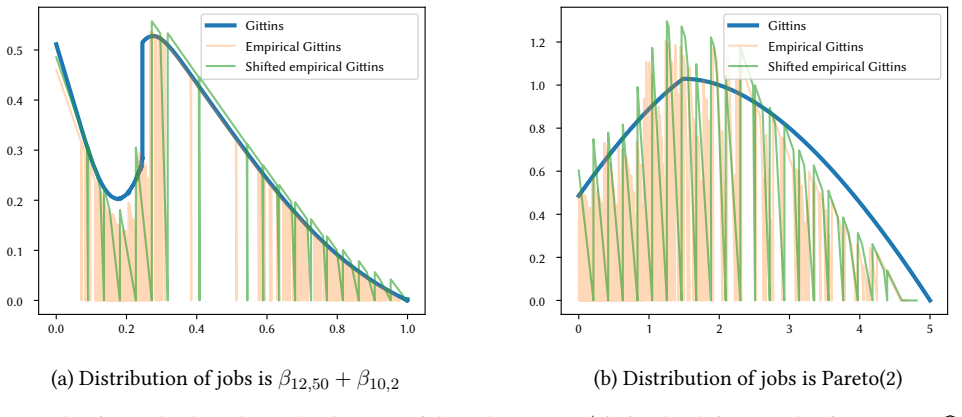
Gittins indices from shifted empirical samples of job sizes are asymptotically optimal for M/G/1 response time minimization.
A machine-rendered reading of the paper's core claim, the machinery that carries it, and where it could break.
Core claim
The Gittins index of the empirical distribution of shifted samples is close to the Gittins index of the original distribution, which implies the asymptotic optimality of the index policy for minimizing expected response time.
What carries the argument
Shifted empirical Gittins index, computed after discretizing the support and shifting samples to the right to the nearest point.
If this is right
- The index policy based on these computed indices minimizes expected response time asymptotically as the number of samples grows.
- The construction works for job size distributions with bounded support.
- Numerical experiments confirm better efficiency compared to alternative sample-based methods.
Where Pith is reading between the lines
- The method could be applied to other performance measures in queueing systems that admit Gittins-like indices.
- Implementation in computer systems would require online sampling of job sizes and periodic recomputation of the index policy.
Load-bearing premise
The job size distribution has bounded support, which allows the discretization step.
What would settle it
A counterexample where the response time of the proposed policy fails to approach the optimal value as the sample size n tends to infinity.
Figures



read the original abstract
In this paper we consider a M/G/1 queue for which we want to minimize the expected response time. We show how to compute indices from $n$ samples of the job size distribution such that the corresponding index policy is asymptotically optimal as $n$ grows. This construction is based on a discretization of the bounded support of the job size distribution and a shift of the samples to their nearest discrete point to the right. We show that the Gittins index of the empirical distribution of these shifted samples is close to the Gittins index of the original distribution. This translates to the asymptotic optimality of the corresponding index policy for minimizing the expected response time. Numerical comparison with other approaches further confirm the efficiency of our approach.
Editorial analysis
A structured set of objections, weighed in public.
Referee Report
Summary. The paper considers an M/G/1 queue with unknown job-size distribution having bounded support. From n i.i.d. samples it constructs a shifted empirical distribution by discretizing the support and shifting each sample to the nearest grid point on its right; the Gittins index computed from this empirical measure is shown to be close to the true Gittins index, which in turn yields asymptotic optimality (as n o∞) of the resulting index policy for minimizing expected response time. Numerical comparisons with other policies are provided.
Significance. If the convergence and optimality claims hold, the work supplies a practical, sample-driven route to near-optimal scheduling in the classic M/G/1 setting without parametric assumptions on the service-time law, together with explicit discretization and shifting steps that make the Gittins index computable from finite data.
major comments (2)
- [§3] §3 (Discretization construction): the partition of the bounded support is introduced with a fixed mesh size δ independent of n. The Gittins index of the right-shifted empirical measure then converges to the Gittins index of the discretized (not the original) distribution; the claimed closeness to the continuous Gittins index therefore requires an additional argument that δ_n o 0 at a suitable rate with n, which is not supplied.
- [Theorem 4.2] Theorem 4.2 (asymptotic optimality): the translation from index closeness to policy optimality uses a uniform continuity argument for the Gittins index map; this step is load-bearing for the central claim yet rests on the same fixed-grid construction, so the error term does not vanish when the mesh is held constant.
minor comments (2)
- [Abstract] The abstract states that the support is bounded but does not record the explicit dependence (or independence) of the discretization parameter on the sample size n; this should be clarified in the statement of the main result.
- [§2] Notation for the shifted empirical measure (e.g., the right-shift operator) is introduced without a displayed equation; adding an explicit definition would improve readability.
Simulated Author's Rebuttal
We thank the referee for the careful reading and for identifying these important technical points. We agree that the current fixed-mesh construction does not suffice for convergence to the original Gittins index and will revise the manuscript to let the mesh size vanish with n.
read point-by-point responses
-
Referee: [§3] §3 (Discretization construction): the partition of the bounded support is introduced with a fixed mesh size δ independent of n. The Gittins index of the right-shifted empirical measure then converges to the Gittins index of the discretized (not the original) distribution; the claimed closeness to the continuous Gittins index therefore requires an additional argument that δ_n o 0 at a suitable rate with n, which is not supplied.
Authors: We agree that a fixed δ yields convergence only to the Gittins index of the discretized distribution. In the revision we will replace δ by a sequence δ_n → 0 (at a rate balancing discretization error against the n^{-1/2} empirical fluctuation) and supply the corresponding uniform bounds on the difference between the Gittins indices of the original, discretized, and shifted-empirical measures. revision: yes
-
Referee: [Theorem 4.2] Theorem 4.2 (asymptotic optimality): the translation from index closeness to policy optimality uses a uniform continuity argument for the Gittins index map; this step is load-bearing for the central claim yet rests on the same fixed-grid construction, so the error term does not vanish when the mesh is held constant.
Authors: We concur that the uniform-continuity step requires the index error to vanish, which the fixed-grid construction does not guarantee. We will update the proof of Theorem 4.2 to incorporate δ_n → 0, verify that the resulting index policy is asymptotically optimal for the original distribution, and add the necessary continuity modulus that accounts for the vanishing mesh. revision: yes
Circularity Check
No significant circularity; asymptotic convergence claim is independent of inputs.
full rationale
The paper constructs shifted empirical indices from n samples on a discretized bounded support and proves (via unspecified arguments in the full text) that these indices converge to the true Gittins index as n grows, yielding asymptotic optimality. No equation or step reduces the optimality result to a fitted quantity defined by the same data, a self-citation chain, or an ansatz smuggled from prior work. The discretization is an explicit modeling choice justified by the bounded-support assumption rather than a hidden redefinition. This is a standard self-contained asymptotic analysis with no load-bearing circular reductions.
Axiom & Free-Parameter Ledger
axioms (1)
- domain assumption Job-size distribution has bounded support.
Reference graph
Works this paper leans on
-
[1]
ACM SIGMETRICS Performance Evaluation Review , volume=
Robust Gittins for stochastic scheduling , author=. ACM SIGMETRICS Performance Evaluation Review , volume=. 2025 , publisher=
2025
-
[2]
Empirical Gittins for Data-Driven M/G/1 Scheduling with Arbitrary Job Size Distributions , author=
-
[3]
Scully, Ziv and Harchol-Balter, Mor , booktitle=. The
-
[4]
Mor Harchol-Balter , title =
-
[5]
Schrage , title =
L.E. Schrage , title =. Operations Research , year = 1968, volume = 16, pages =
1968
-
[6]
Rudemo , title =
M. Rudemo , title =. Scandinavian Journal of Statistics , year = 1982, volume = 9, pages =
1982
-
[7]
Ziv Scully , title =
-
[8]
A. SIGMETRICS Perform. Eval. Rev. , author =. 2023 , pages =. doi:10.1145/3579342.3579344 , abstract =
-
[9]
Markovian. Mathematics , author =. 2023 , note =. doi:10.3390/math11071639 , abstract =
-
[10]
Probability in the Engineering and Informational Sciences , author =. 2011 , pages =. doi:10.1017/S0269964811000015 , abstract =
-
[11]
Bubeck, Sébastien and Cesa-Bianchi, Nicolò and Lugosi, Gábor , month = sep, year =. Bandits with heavy tail , url =. doi:10.48550/arXiv.1209.1727 , abstract =
work page internal anchor Pith review Pith/arXiv arXiv doi:10.48550/arxiv.1209.1727
-
[12]
Journal of Applied Probability , author =
Restless. Journal of Applied Probability , author =. 1988 , note =. doi:10.2307/3214163 , abstract =
-
[13]
and Shah, Pratik , month = dec, year =
Avrachenkov, Konstantin and Borkar, Vivek S. and Shah, Pratik , month = dec, year =. Lagrangian. doi:10.48550/arXiv.2412.12641 , abstract =
-
[14]
Scully, Ziv and Harchol-Balter, Mor , month = nov, year =. The. doi:10.48550/arXiv.2111.10703 , abstract =
discussion (0)
Sign in with ORCID, Apple, or X to comment. Anyone can read and Pith papers without signing in.