Beyond Single-Source Cognitive Taskonomy:Multi-Source Task Relations through fMRI Transfer Learning
Pith reviewed 2026-06-26 01:33 UTC · model grok-4.3
The pith
Multi-source fMRI transfer shows task relations depend on source set composition rather than pairwise links alone.
A machine-rendered reading of the paper's core claim, the machinery that carries it, and where it could break.
Core claim
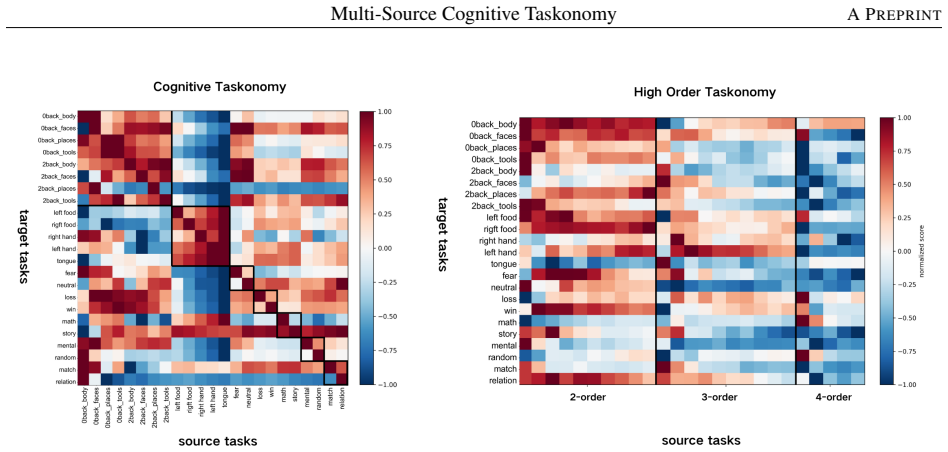
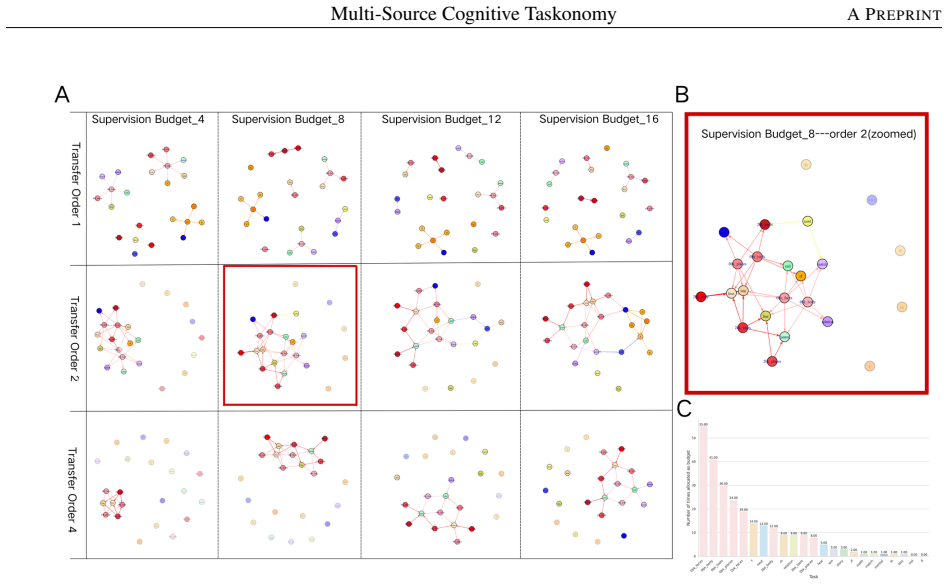
We extend an fMRI cognitive taskonomy from single-source to multi-source transfer across 23 Human Connectome Project task states and use Boolean Integer Programming (BIP) to analyze budget-constrained task allocation. Single-source transfer is directional and paradigm structured: motor states transfer well within the motor paradigm but provide limited support to most non-motor targets. Multi-source transfer depends on the composition of the source set, suggesting that many-to-one task relations are not fully captured by pairwise taskonomy alone. Across supervision budgets, BIP repeatedly allocates direct supervision to several 0-back and 2-back working-memory states. Together, these findings
What carries the argument
Masked fMRI reconstruction used as a shared self-supervised objective to measure transfer, extended through Boolean Integer Programming to select source sets under supervision budgets.
If this is right
- Single-source transfer remains directional and limited by paradigm boundaries, with motor states confined to motor targets.
- Many-to-one task relations cannot be recovered from pairwise taskonomy alone.
- BIP allocation favors 0-back and 2-back working-memory states across multiple supervision budgets even when they are not the strongest single sources.
- The pattern may reflect integration of perceptual, attentional, and executive processes inside working-memory tasks.
Where Pith is reading between the lines
- Task taxonomies built on brain data may need to model source combinations explicitly to capture integrative hubs.
- The same allocation method could be tested on other self-supervised objectives to check whether working-memory priority generalizes beyond reconstruction.
- Prioritizing working-memory states in limited-data regimes might improve downstream prediction of activity in non-memory tasks.
- The motor cluster finding suggests that cross-paradigm motor representations are more effector-specific than previously assumed from single-source maps.
Load-bearing premise
Masked fMRI reconstruction supplies a valid common objective that quantifies the degree of shared neural processes across different cognitive task states.
What would settle it
A result in which multi-source model accuracy stays constant across different source-set compositions, or in which BIP never selects the 0-back and 2-back working-memory states, would falsify the dependence on source composition and the allocation pattern.
Figures

read the original abstract
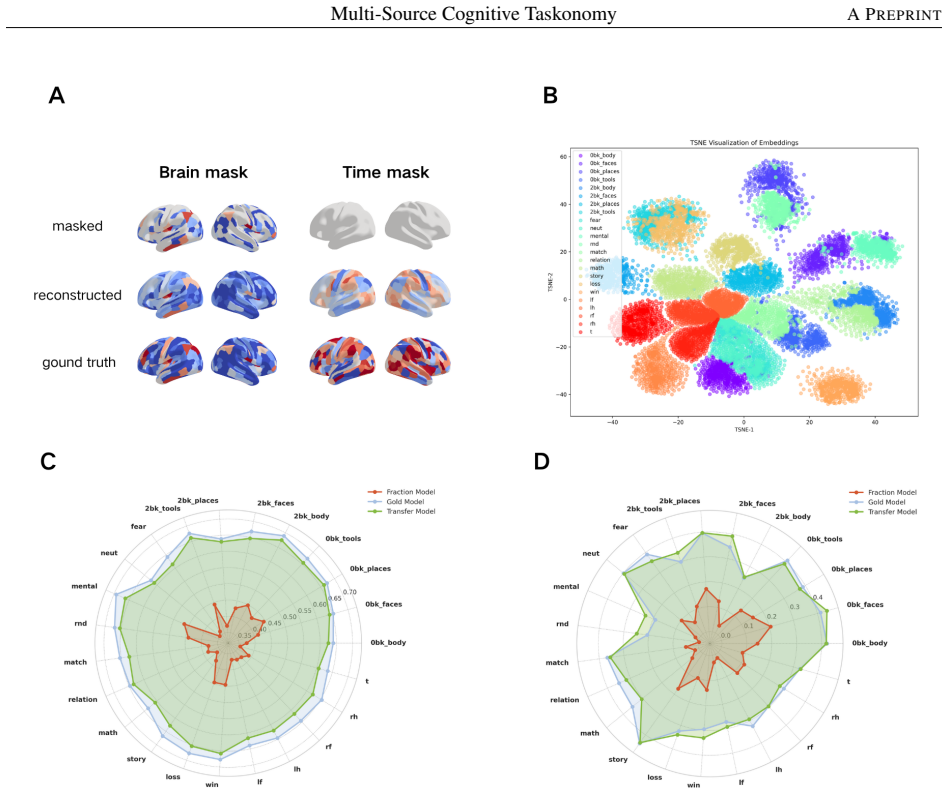
Cognitive tasks are organized by shared and specialized neural processes. Masked fMRI reconstruction provides a common self-supervised objective for quantifying transfer relations among task states, but existing reconstruction-based taskonomies mainly study one-to-one transfer from a single source task to a target. Here, we extend an fMRI cognitive taskonomy from single-source to multi-source transfer across 23 Human Connectome Project task states and use Boolean Integer Programming (BIP) to analyze budget-constrained task allocation. We train 1,127 task-specific and transfer models. Single-source transfer is directional and paradigm structured: motor states transfer well within the motor paradigm but provide limited support to most non-motor targets, consistent with a shared sensorimotor execution system and effector-specific representations. Multi-source transfer depends on the composition of the source set, suggesting that many-to-one task relations are not fully captured by pairwise taskonomy alone. Across supervision budgets, BIP repeatedly allocates direct supervision to several 0-back and 2-back working-memory states, although these states are not consistently the strongest individual sources. This pattern may reflect the integration of perceptual, attentional, and executive processes in working-memory tasks. Together, these findings reveal a cross-paradigm-limited motor cluster and working-memory states with high priority under the specified global allocation objective. Our study extends reconstruction-based fMRI taskonomy from one-to-one transfer to many-to-one task relations and budget-constrained task dependencies.
Editorial analysis
A structured set of objections, weighed in public.
Referee Report
Summary. The paper extends reconstruction-based fMRI taskonomy from single-source (one-to-one) to multi-source (many-to-one) transfer across 23 Human Connectome Project task states. It trains 1,127 task-specific and transfer models under a masked fMRI reconstruction objective, reports directional and paradigm-structured single-source transfers (e.g., motor within-paradigm), shows that multi-source transfer performance depends on source-set composition in ways not recoverable from pairwise relations, and uses Boolean Integer Programming (BIP) to identify budget-constrained optimal source allocations that repeatedly prioritize several 0-back and 2-back working-memory states.
Significance. If the masked-reconstruction objective is shown to validly index shared cognitive processes, the work would demonstrate that many-to-one task relations require explicit multi-source modeling and would identify working-memory states as high-priority under a global allocation objective. The scale (1,127 models) and use of BIP for budget-constrained optimization are concrete strengths that could inform experimental design in cognitive neuroscience if the proxy assumption holds.
major comments (2)
- [Abstract / Methods] Abstract and Methods: The central premise that masked fMRI reconstruction error quantifies transfer relations among the 23 task states is stated without any description of the masking strategy, conditioning of the model on task labels, loss weighting, or controls for confounds (motion, SNR differences, paradigm-specific hemodynamic properties). This assumption is load-bearing for every reported transfer relation and BIP allocation.
- [Abstract / Results] Abstract / Results: Claims that multi-source transfer depends on source-set composition (and cannot be recovered from pairwise taskonomy) and that BIP consistently allocates to 0-back/2-back states are presented without cross-validation details, statistical testing, effect sizes, or sensitivity analyses to hyperparameter choices. The abstract reports training 1,127 models but supplies no quantitative support for robustness of the multi-source vs. pairwise discrepancy.
minor comments (1)
- [Abstract] Notation for the 23 task states (0-back vs. 2-back working-memory) is used without an explicit table or section defining the full set of HCP tasks and their paradigm groupings.
Simulated Author's Rebuttal
We thank the referee for the constructive comments emphasizing methodological transparency and quantitative robustness. We address each major comment below and commit to revisions that strengthen the manuscript without altering its core claims.
read point-by-point responses
-
Referee: [Abstract / Methods] Abstract and Methods: The central premise that masked fMRI reconstruction error quantifies transfer relations among the 23 task states is stated without any description of the masking strategy, conditioning of the model on task labels, loss weighting, or controls for confounds (motion, SNR differences, paradigm-specific hemodynamic properties). This assumption is load-bearing for every reported transfer relation and BIP allocation.
Authors: We agree that these details are essential for evaluating the central premise and were insufficiently described in the submitted version. In the revised manuscript we will expand the Methods section with a dedicated subsection specifying the masking strategy, task-label conditioning mechanism, loss formulation and weighting, and explicit controls for confounds including motion regression, SNR normalization, and checks for paradigm-specific hemodynamic effects. The Abstract will be updated to reference these controls. This revision directly addresses the load-bearing assumption. revision: yes
-
Referee: [Abstract / Results] Abstract / Results: Claims that multi-source transfer depends on source-set composition (and cannot be recovered from pairwise taskonomy) and that BIP consistently allocates to 0-back/2-back states are presented without cross-validation details, statistical testing, effect sizes, or sensitivity analyses to hyperparameter choices. The abstract reports training 1,127 models but supplies no quantitative support for robustness of the multi-source vs. pairwise discrepancy.
Authors: We agree that the abstract and results would benefit from explicit reporting of cross-validation, statistical tests, effect sizes, and sensitivity analyses. These elements were part of the experimental pipeline but not highlighted sufficiently. In the revision we will add a paragraph in Results detailing the cross-validation procedure across the 1,127 models, paired statistical comparisons of multi-source versus pairwise performance, effect sizes, and sensitivity checks on BIP budgets and masking hyperparameters. The abstract will be revised to note the robustness of the reported multi-source dependency. This provides the requested quantitative support. revision: yes
Circularity Check
No significant circularity; transfer metrics and BIP allocations derived from independent model trainings
full rationale
The paper trains 1,127 separate task-specific and transfer models under a masked fMRI reconstruction objective, then measures empirical transfer performance to populate the relations used by BIP. No equation or step defines a reported transfer ratio, source-set dependence, or BIP allocation in terms of fitted parameters from the same model; the reconstruction loss is applied as an external self-supervised proxy, and the multi-source vs. pairwise discrepancy follows directly from those measured performances rather than from any self-definitional reduction, fitted-input renaming, or self-citation chain. The derivation chain remains self-contained against the external training outcomes.
Axiom & Free-Parameter Ledger
axioms (1)
- domain assumption Masked fMRI reconstruction provides a common self-supervised objective for quantifying transfer relations among task states
Reference graph
Works this paper leans on
-
[1]
Poldrack, Aniket Kittur, Donald Kalar, Eric Miller, Christian Seppa, Yolanda Gil, D
Russell A. Poldrack, Aniket Kittur, Donald Kalar, Eric Miller, Christian Seppa, Yolanda Gil, D. Stott Parker, Fred W. Sabb, and Robert M. Bilder. The cognitive atlas: Toward a knowledge foundation for cognitive neuroscience.Frontiers in Neuroinformatics, 5:17, 2011. doi:10.3389/fninf.2011.00017
-
[2]
Jessica A. Turner and Angela R. Laird. The cognitive paradigm ontology: Design and application. Neuroinformatics, 10(1):57–66, 2012. doi:10.1007/s12021-011-9126-x
-
[3]
Joglekar, H
Guangyu Robert Yang, Madhura R. Joglekar, H. Francis Song, William T. Newsome, and Xiao-Jing Wang. Task representations in neural networks trained to perform many cognitive tasks.Nature Neuroscience, 22(2):297–306,
-
[4]
10 Multi-Source Cognitive TaskonomyA PREPRINT
doi:10.1038/s41593-018-0310-2. 10 Multi-Source Cognitive TaskonomyA PREPRINT
-
[5]
Learning neural representations of human cognition across many fMRI studies
Arthur Mensch, Julien Mairal, Danilo Bzdok, Bertrand Thirion, and Ga"el Varoquaux. Learning neural representations of human cognition across many fMRI studies. InAdvances in Neural Information Processing Systems, volume 30, 2017
2017
-
[6]
Tomoya Nakai and Shinji Nishimoto. Representations and decodability of diverse cognitive functions are preserved across the human cortex, cerebellum, and subcortex.Communications Biology, 5:1245, 2022. doi:10.1038/s42003-022-04221-y
-
[7]
Zamir, Alexander Sax, William Shen, Leonidas J
Amir R. Zamir, Alexander Sax, William Shen, Leonidas J. Guibas, Jitendra Malik, and Silvio Savarese. Taskonomy: Disentangling task transfer learning. InProceedings of the IEEE Conference on Computer Vision and Pattern Recognition, pages 3712–3722, 2018
2018
-
[8]
Representation similarity analysis for efficient task taxonomy and transfer learning
Kshitij Dwivedi and Gemma Roig. Representation similarity analysis for efficient task taxonomy and transfer learning. InProceedings of the IEEE/CVF Conference on Computer Vision and Pattern Recognition, pages 12387–12396, 2019
2019
-
[9]
Trevor Standley, Amir Zamir, Dawn Chen, Leonidas Guibas, Jitendra Malik, and Silvio Savarese. Which tasks should be learned together in multi-task learning? InProceedings of the 37th International Conference on Machine Learning, volume 119 ofProceedings of Machine Learning Research, pages 9120–9132, 2020
2020
-
[10]
Efficiently identifying task groupings for multi-task learning
Christopher Fifty, Ehsan Amid, Zhe Zhao, Tianhe Yu, Rohan Anil, and Chelsea Finn. Efficiently identifying task groupings for multi-task learning. InAdvances in Neural Information Processing Systems, volume 34, 2021
2021
-
[11]
Uncovering cognitive taskonomy through transfer learning in masked autoencoder-based fmri reconstruction
Youzhi Qu, Junfeng Xia, Xinyao Jian, Wendu Li, Kaining Peng, Zhichao Liang, Haiyan Wu, and Quanying Liu. Uncovering cognitive taskonomy through transfer learning in masked autoencoder-based fmri reconstruction. In International Workshop on Human Brain and Artificial Intelligence, pages 35–50. Springer, 2024
2024
-
[12]
A genetic algorithms for optimizing structural brain network across cognitive tasks
Youzhi Qu, Wendu Lit, Junfeng Xia, Jiahao Tang, Kaining Peng, Zhichao Liang, Haiyan Wu, and Quanying Liu. A genetic algorithms for optimizing structural brain network across cognitive tasks. In2024 China Automation Congress (CAC), pages 5210–5215. IEEE, 2024
2024
-
[13]
Masked autoencoders are scalable vision learners
Kaiming He, Xinlei Chen, Saining Xie, Yanghao Li, Piotr Dollár, and Ross Girshick. Masked autoencoders are scalable vision learners. InProceedings of the IEEE/CVF Conference on Computer Vision and Pattern Recognition, pages 16000–16009, 2022
2022
-
[14]
SimMIM: A simple framework for masked image modeling
Zhenda Xie, Zheng Zhang, Yue Cao, Yutong Lin, Jianmin Bao, Zhuliang Yao, Qi Dai, and Han Hu. SimMIM: A simple framework for masked image modeling. InProceedings of the IEEE/CVF Conference on Computer Vision and Pattern Recognition, pages 9653–9663, 2022
2022
-
[15]
Rizvi, Matteo Rosati, Christopher Averill, James L
Josue Ortega Caro, Antonio Henrique de Oliveira Fonseca, Syed A. Rizvi, Matteo Rosati, Christopher Averill, James L. Cross, Prateek Mittal, Emanuele Zappala, Rahul Madhav Dhodapkar, Chadi G. Abdallah, and David van Dijk. BrainLM: A foundation model for brain activity recordings. InThe Twelfth International Conference on Learning Representations, 2024. URL...
2024
-
[16]
Junfeng Xia, Wenhao Ye, Xuanye Pan, Xinke Shen, Mo Wang, and Quanying Liu. Brain-dit: A universal multi-state fmri foundation model with metadata-conditioned pretraining.arXiv preprint arXiv:2604.12683, 2026
Pith/arXiv arXiv 2026
-
[17]
Junfeng Xia, Wenhao Ye, Junxiang Zhang, Xuanye Pan, Mo Wang, and Quanying Liu. Brainworld: A structural-prior-conditioned generative model for whole-brain 4d fmri dynamics.arXiv preprint arXiv:2606.17742, 2026
Pith/arXiv arXiv 2026
-
[18]
Mo Wang, Junfeng Xia, Wenhao Ye, Enyu Liu, Kaining Peng, Jianfeng Feng, Quanying Liu, and Hongkai Wen. Slim-brain: A data-and training-efficient foundation model for fmri data analysis.arXiv preprint arXiv:2512.21881, 2025
arXiv 2025
-
[19]
Omni-fmri: A universal atlas-free fmri foundation model.arXiv preprint arXiv:2601.23090, 2026
Mo Wang, Wenhao Ye, Junfeng Xia, Junxiang Zhang, Xuanye Pan, Minghao Xu, Haotian Deng, Hongkai Wen, and Quanying Liu. Omni-fmri: A universal atlas-free fmri foundation model.arXiv preprint arXiv:2601.23090, 2026
arXiv 2026
-
[20]
Mo Wang, Wenhao Ye, Junfeng Xia, Minghao Xu, Hongkai Wen, and Quanying Liu. Flexibrain: Resolution-agnostic voxel-level encoding for native fmri.arXiv preprint arXiv:2606.11500, 2026
Pith/arXiv arXiv 2026
-
[21]
Zijian Dong, Ruilin Li, Yilei Wu, Thuan Tinh Nguyen, Joanna Su Xian Chong, Fang Ji, Nathanael Ren Jie Tong, Christopher Li Hsian Chen, and Juan Helen Zhou. Brain-JEPA: Brain dynamics foundation model with gradient positioning and spatiotemporal masking.arXiv preprint arXiv:2409.19407, 2024. doi:10.48550/arXiv.2409.19407
-
[22]
David C. Van Essen, Stephen M. Smith, Deanna M. Barch, Timothy E. J. Behrens, Essa Yacoub, Kamil Ugurbil, et al. The WU-Minn human connectome project: An overview.NeuroImage, 80:62–79, 2013. doi:10.1016/j.neuroimage.2013.05.041. 11 Multi-Source Cognitive TaskonomyA PREPRINT
-
[23]
Deanna M. Barch, Gregory C. Burgess, Michael P. Harms, Steven E. Petersen, Bradley L. Schlaggar, Maurizio Corbetta, Matthew F. Glasser, Sandra Curtiss, Sachin Dixit, Cindy Feldt, et al. Function in the human connectome: Task-fMRI and individual differences in behavior.NeuroImage, 80:169–189, 2013. doi:10.1016/j.neuroimage.2013.05.033
-
[24]
Matthew F. Glasser, Stamatios N. Sotiropoulos, J. Anthony Wilson, Timothy S. Coalson, Bruce Fischl, Jesper L. Andersson, Junqian Xu, Saad Jbabdi, Matthew Webster, Jonathan R. Polimeni, et al. The minimal preprocessing pipelines for the human connectome project.NeuroImage, 80:105–124, 2013. doi:10.1016/j.neuroimage.2013.04.127
-
[25]
Matthew F. Glasser, Timothy S. Coalson, Emma C. Robinson, Carl D. Hacker, John Harwell, Essa Yacoub, Kamil Ugurbil, Jesper Andersson, Christian F. Beckmann, Mark Jenkinson, et al. A multi-modal parcellation of human cerebral cortex.Nature, 536(7615):171–178, 2016. doi:10.1038/nature18933
-
[26]
Mark D’Esposito and Bradley R. Postle. The cognitive neuroscience of working memory.Annual Review of Psychology, 66:115–142, 2015. doi:10.1146/annurev-psych-010814-015031
-
[27]
The multiple-demand (MD) system of the primate brain: Mental programs for intelligent behaviour
John Duncan. The multiple-demand (MD) system of the primate brain: Mental programs for intelligent behaviour. Trends in Cognitive Sciences, 14(4):172–179, 2010. doi:10.1016/j.tics.2010.01.004
-
[28]
Weidong Cai, Jalil Taghia, and Vinod Menon. A multi-demand operating system underlying diverse cognitive tasks.Nature Communications, 15:2185, 2024. doi:10.1038/s41467-024-46511-5. 12
discussion (0)
Sign in with ORCID, Apple, or X to comment. Anyone can read and Pith papers without signing in.