Axon: A Synthesizing Superoptimizer for Tensor Programs
Pith reviewed 2026-06-26 00:37 UTC · model grok-4.3
The pith
Axon uses SMT over unbounded tensors to automatically discover and verify algebraic transformations for tensor programs without hand-crafted rewrite rules.
A machine-rendered reading of the paper's core claim, the machinery that carries it, and where it could break.
Core claim
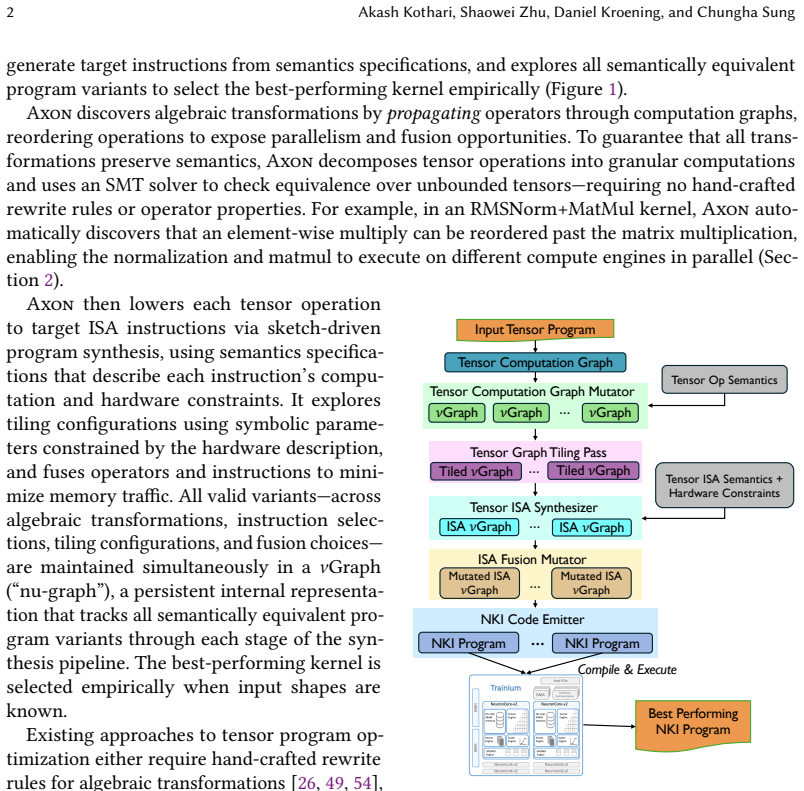
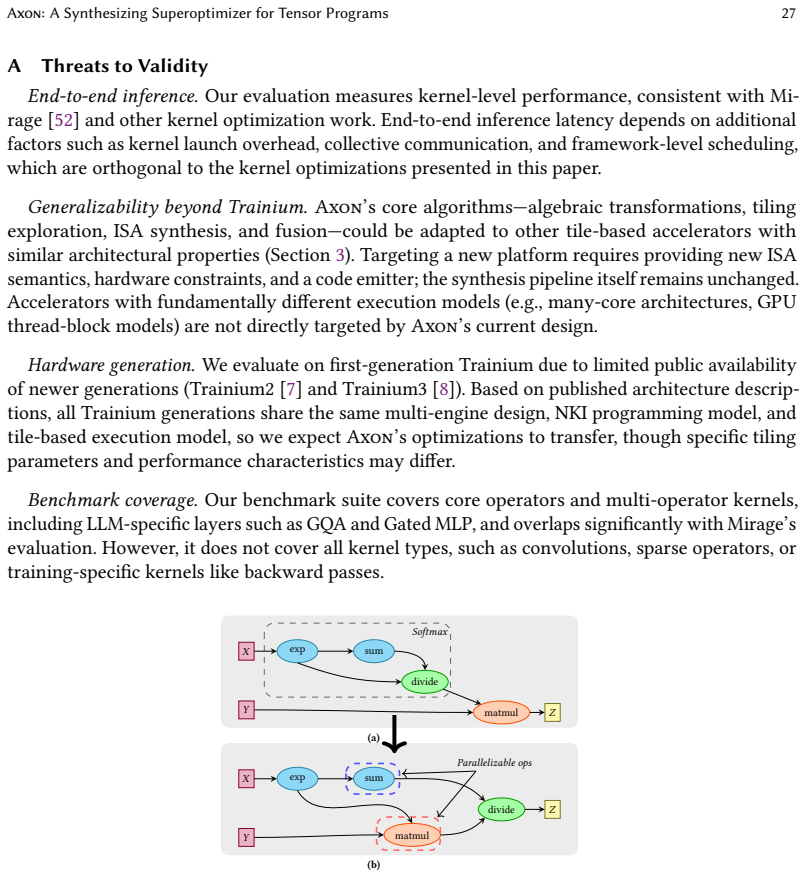
Axon is a synthesizing superoptimizer that automatically generates target instructions from semantics specifications, explores semantically equivalent program variants to select the best performing kernel empirically, discovers algebraic transformations by propagating operators through computation graphs, and uses SMT over unbounded tensors to guarantee that all transformations preserve semantics without requiring hand crafted rewrite rules; it then lowers tensor operations to target ISA instructions, explores tiling configurations constrained by hardware descriptions, and fuses operators and instructions to minimize memory traffic.
What carries the argument
SMT encoding of tensor semantics over unbounded domains, used to validate transformations discovered by operator propagation through computation graphs.
If this is right
- Algebraic transformations become discoverable without maintaining libraries of hand-crafted rewrite rules.
- Kernels can be lowered, tiled, and fused while respecting hardware constraints supplied as descriptions.
- Performance selection occurs by empirical measurement of synthesized variants rather than static heuristics.
- Semantic preservation holds for all transformations because each is checked by the SMT solver over unbounded domains.
Where Pith is reading between the lines
- The same SMT-based verification could be applied to other program domains that currently rely on rewrite-rule engines.
- If the unbounded-domain encoding scales, it removes a common source of incompleteness in bounded model checking of tensor code.
- Hardware description files could become the primary interface for retargeting the optimizer to new accelerators.
Load-bearing premise
The SMT encoding of tensor semantics over unbounded domains is both sound and complete enough to validate the algebraic transformations found by operator propagation.
What would settle it
A concrete tensor input and output pair where an SMT-approved transformation produces different results from the original program, or a valid semantic equivalence that the SMT solver rejects.
Figures


read the original abstract
Writing high performance kernels for AI accelerators requires deep expertise in tiling, instruction selection, data layout, and operator fusion placing a significant burden on programmers. In this paper, we focus on tile based AI accelerator programs and present Axon, a synthesizing superoptimizer for tensor programs: it uses program synthesis to automatically generate target instructions from semantics specifications, and explores semantically equivalent program variants to select the best performing kernel empirically. Axon discovers algebraic transformations by propagating operators through computation graphs and uses SMT over unbounded tensors to guarantee that all transformations preserve semantics without requiring hand crafted rewrite rules. It then lowers tensor operations to target ISA instructions, explores tiling configurations constrained by hardware descriptions, and fuses operators and instructions to minimize memory traffic.
Editorial analysis
A structured set of objections, weighed in public.
Referee Report
Summary. The paper presents Axon, a synthesizing superoptimizer for tensor programs targeting AI accelerators. It claims to use program synthesis to generate target instructions from semantic specifications, discover algebraic transformations via operator propagation in computation graphs, and apply SMT solving over unbounded tensors to guarantee that all transformations preserve semantics without hand-crafted rewrite rules. The system then lowers tensor operations to target ISA instructions, explores hardware-constrained tiling configurations, and fuses operators/instructions to minimize memory traffic.
Significance. If the SMT encoding is shown to be sound and sufficiently complete, the approach would offer a notable advance in automated kernel optimization by replacing manual rewrite rules with formally verified algebraic transformations discovered through synthesis and propagation, potentially easing the expertise burden for high-performance tensor code on accelerators.
major comments (2)
- [Abstract] Abstract: the central claim that 'SMT over unbounded tensors' guarantees semantic preservation without hand-crafted rules depends on an encoding of tensor operations (broadcasting, reductions, elementwise ops) whose soundness and completeness are not described, derived, or validated anywhere in the manuscript; no encoding details, meta-proof, or test suite of known equivalences is supplied.
- [Abstract] The workflow description: operator propagation is asserted to produce semantics-preserving rewrites solely via SMT, yet the manuscript supplies neither the SMT encoding of unbounded tensor semantics nor any argument that the solver's decisions are faithful to the actual tensor semantics (e.g., shape-dependent behavior or reduction semantics).
minor comments (1)
- [Abstract] The abstract is overloaded; separating the synthesis, SMT verification, lowering, and empirical search phases into distinct sentences or a short workflow diagram would improve readability.
Simulated Author's Rebuttal
We thank the referee for the careful review and for identifying the need for explicit details on the SMT encoding. We agree that the current presentation leaves the soundness argument implicit and will revise the manuscript accordingly.
read point-by-point responses
-
Referee: [Abstract] Abstract: the central claim that 'SMT over unbounded tensors' guarantees semantic preservation without hand-crafted rules depends on an encoding of tensor operations (broadcasting, reductions, elementwise ops) whose soundness and completeness are not described, derived, or validated anywhere in the manuscript; no encoding details, meta-proof, or test suite of known equivalences is supplied.
Authors: We acknowledge that the manuscript does not supply the concrete SMT encoding, a meta-proof of soundness, or an equivalence test suite. In the revision we will insert a new subsection (approximately 4.2) that (1) defines the SMT encoding for broadcasting, reductions, and elementwise operations over unbounded tensors, (2) sketches the soundness argument with respect to the standard tensor semantics, and (3) reports a validation suite of 50+ known algebraic equivalences that the solver confirms. revision: yes
-
Referee: [Abstract] The workflow description: operator propagation is asserted to produce semantics-preserving rewrites solely via SMT, yet the manuscript supplies neither the SMT encoding of unbounded tensor semantics nor any argument that the solver's decisions are faithful to the actual tensor semantics (e.g., shape-dependent behavior or reduction semantics).
Authors: The observation is correct; the current text does not detail how the SMT encoding captures shape-dependent behavior or reduction semantics. The revised manuscript will augment the operator-propagation description with the precise encoding rules and an explicit argument that the solver decisions remain faithful to the tensor semantics, including the handling of shape-dependent broadcasting and reduction identities. revision: yes
Circularity Check
No circularity: derivation relies on external SMT solvers and hardware measurements
full rationale
The paper presents Axon as using program synthesis, operator propagation through graphs, SMT solving over unbounded tensors for semantic equivalence, and empirical performance selection via hardware measurements. No equations, fitted parameters, or self-citations are shown that reduce any claimed result to its own inputs by construction. The soundness of the SMT encoding is an external assumption (not derived within the paper), and the approach is self-contained against independent benchmarks like solver results and runtime measurements. This matches the default expectation of no significant circularity.
Axiom & Free-Parameter Ledger
Reference graph
Works this paper leans on
-
[1]
Maaz Bin Safeer Ahmad, Alexander J Root, Andrew Adams, Shoaib Kamil, and Alvin Cheung. 2022. Vector instruction selection for digital signal processors using program synthesis. InProceedings of the 27th ACM International Conference on Architectural Support for Programming Languages and Operating Systems. 1004–1016
2022
-
[2]
Ebtesam Almazrouei, Hamza Alobeidli, Abdulaziz Alshamsi, Alessandro Cappelli, Ruxandra Cojocaru, Daniel Mérieux, Mazzotta Pontez, et al. 2023. The Falcon Series of Open Language Models.arXiv preprint arXiv:2311.16867(2023)
Pith/arXiv arXiv 2023
-
[3]
Amazon Web Services. 2025. AWS Neuron Compiler — Documentation. https://awsdocs-neuron.readthedocs- hosted.com/en/latest/compiler/index.html Online; accessed 2025-12-10
2025
-
[4]
Arm Limited. 2025. Arm Neon Intrinsics Reference. Online documentation. https://arm-software.github.io/acle/neon_ intrinsics/advsimd.html Version: 2025Q2; Release Date: 06 June 2025
2025
-
[5]
Jai Arora, Sirui Lu, Devansh Jain, Tianfan Xu, Farzin Houshmand, Phitchaya Mangpo Phothilimthana, Mohsen Lesani, Praveen Narayanan, Karthik Srinivasa Murthy, Rastislav Bodik, et al. 2025. TensorRight: Automated Verification of Tensor Graph Rewrites.Proceedings of the ACM on Programming Languages9, POPL (2025), 832–863
2025
-
[6]
AWS. n.d.. Neuron Kernel Interface (NKI) - Beta. https://awsdocs-neuron.readthedocs-hosted.com/en/latest/general/ nki/index.html Accessed: 2025-04-04
2025
-
[7]
AWS. n.d.. Trainium2 Architecture Guide for NKI. https://awsdocs-neuron.readthedocs-hosted.com/en/latest/about- neuron/arch/neuron-hardware/trainium2.html Accessed: 2026-03-16
2026
-
[8]
AWS. n.d.. Trainium3 Architecture Guide for NKI. https://awsdocs-neuron.readthedocs-hosted.com/en/latest/about- neuron/arch/neuron-hardware/trainium3.html Accessed: 2026-03-16
2026
-
[9]
AWS. n.d.. Trainium/Inferentia2 Architecture Guide for NKI. https://awsdocs-neuron.readthedocs-hosted.com/en/ latest/about-neuron/arch/neuron-hardware/trainium.html Accessed: 2025-04-04
2025
-
[10]
AWS Neuron. 2025. nki-samples: Example NKI programs and samples. https://github.com/aws-neuron/nki-samples. GitHub repository, accessed 2025-12-10
2025
-
[11]
Alexander Brauckmann, Aarsh Chaube, José W De Souza Magalhães, Elizabeth Polgreen, and Michael FP O’Boyle. 2026. Tensor Program Superoptimization through Cost-Guided Symbolic Program Synthesis. In2026 IEEE/ACM International Symposium on Code Generation and Optimization (CGO). IEEE, 683–695
2026
-
[12]
Tianqi Chen, Thierry Moreau, Ziheng Jiang, Lianmin Zheng, Eddie Yan, Haichen Shen, Meghan Cowan, Leyuan Wang, Yuwei Hu, Luis Ceze, et al. 2018. TVM: An Automated End-to-End Optimizing Compiler for Deep Learning. In13th USENIX Symposium on Operating Systems Design and Implementation (OSDI 18). 578–594
2018
-
[13]
Tianqi Chen, Lianmin Zheng, Eddie Yan, Ziheng Jiang, Thierry Moreau, Luis Ceze, Carlos Guestrin, and Arvind Krishnamurthy. 2018. Learning to optimize tensor programs.Advances in Neural Information Processing Systems31 (2018)
2018
-
[14]
Joel Coburn, Chunqiang Tang, Sameer Abu Asal, Neeraj Agrawal, Raviteja Chinta, Harish Dixit, Brian Dodds, Saritha Dwarakapuram, Amin Firoozshahian, Cao Gao, et al. 2025. Meta’s Second Generation AI Chip: Model-Chip Co-Design and Productionization Experiences. InProceedings of the 52nd Annual International Symposium on Computer Architecture. 1689–1702
2025
-
[15]
Lucian Codrescu. 2015. Architecture of the Hexagon™680 DSP for mobile imaging and computer vision. In2015 IEEE Hot Chips 27 Symposium (HCS). IEEE, 1–26
2015
-
[16]
Sylvain Conchon, Guillaume Melquiond, Cody Roux, and Mohamed Iguernelala. 2012. Built-in treatment of an axiomatic floating-point theory for SMT solvers. In10th International Workshop on Satisfiability Modulo Theories. 12–21
2012
-
[17]
Leonardo De Moura and Nikolaj Bjørner. 2008. Z3: An Efficient SMT Solver. InInternational Conference on Tools and Algorithms for the Construction and Analysis of Systems. Springer, 337–340
2008
-
[18]
Yaoyao Ding, Cody Hao Yu, Bojian Zheng, Yizhi Liu, Yida Wang, and Gennady Pekhimenko. 2023. Hidet: Task-mapping Programming Paradigm for Deep Learning Tensor Programs. InProceedings of the 28th ACM International Conference on Architectural Support for Programming Languages and Operating Systems, Volume 2. 370–384
2023
-
[19]
Siyuan Feng, Bohan Hou, Hongyi Jin, Wuwei Lin, Junru Shao, Ruihang Lai, Zihao Ye, Lianmin Zheng, Cody Hao Yu, Yong Yu, and Tianqi Chen. 2022. TensorIR: An Abstraction for Automatic Tensorized Program Optimization. arXiv:2207.04296 [cs.LG]
arXiv 2022
-
[20]
Aaron Grattafiori, Abhimanyu Dubey, Abhinav Jauhri, Abhinav Pandey, Abhishek Kadian, Ahmad Al-Dahle, Aiesha Letman, Akhil Mathur, Alan Schelten, Alex Vaughan, et al . 2024. The Llama 3 Herd of Models.arXiv preprint arXiv:2407.21783(2024). , Vol. 1, No. 1, Article . Publication date: June 2026. Axon: A Synthesizing Superoptimizer for Tensor Programs 25
Pith/arXiv arXiv 2024
-
[21]
Bastian Hagedorn, Bin Fan, Hanfeng Chen, Cris Cecka, Michael Garland, and Vinod Grover. 2023. Graphene: An IR for Optimized Tensor Computations on GPUs. InProceedings of the 28th ACM International Conference on Architectural Support for Programming Languages and Operating Systems, Volume 3 (ASPLOS 2023). ACM, New York, NY, USA, 302–313. doi:10.1145/358201...
-
[22]
Charles R Harris, K Jarrod Millman, Stéfan J Van Der Walt, Ralf Gommers, Pauli Virtanen, David Cournapeau, Eric Wieser, Julian Taylor, Sebastian Berg, Nathaniel J Smith, et al. 2020. Array programming with NumPy.Nature585, 7825 (2020), 357–362
2020
-
[23]
Intel. 2019. Intel Deep Learning Boost. https://www.intel.com/content/dam/www/public/us/en/documents/product- overviews/dl-boost-product-overview.pdf
2019
-
[24]
Anastasiia Izycheva, Eva Darulova, and Helmut Seidl. 2020. Counterexample-and simulation-guided floating-point loop invariant synthesis. InInternational Static Analysis Symposium. Springer, 156–177
2020
-
[25]
JAX Team. 2025. Pallas — TPU. https://docs.jax.dev/en/latest/pallas/tpu/index.html. Online; accessed 2025-10-31
2025
-
[26]
Zhihao Jia, Oded Padon, James Thomas, Todd Warszawski, Matei Zaharia, and Alex Aiken. 2019. TASO: optimizing deep learning computation with automatic generation of graph substitutions. InProceedings of the 27th ACM Symposium on Operating Systems Principles. 47–62
2019
-
[27]
Akash Kothari, Abdul Rafae Noor, Muchen Xu, Hassam Uddin, Dhruv Baronia, Stefanos Baziotis, Vikram Adve, Charith Mendis, and Sudipta Sengupta. 2024. Hydride: A Retargetable and Extensible Synthesis-based Compiler for Modern Hardware Architectures. InProceedings of the 29th ACM International Conference on Architectural Support for Programming Languages and...
2024
-
[28]
Chris Lattner and Vikram Adve. 2004. LLVM: A compilation framework for lifelong program analysis & transformation. InInternational symposium on code generation and optimization, 2004. CGO 2004.IEEE, 75–86
2004
-
[29]
Chris Lattner, Mehdi Amini, Uday Bondhugula, Albert Cohen, Andy Davis, Jacques Pienaar, River Riddle, Tatiana Shpeisman, Nicolas Vasilache, and Oleksandr Zinenko. 2021. MLIR: Scaling compiler infrastructure for domain specific computation. In2021 IEEE/ACM International Symposium on Code Generation and Optimization (CGO). IEEE, 2–14
2021
-
[30]
Yi Li, Aws Albarghouthi, Zachary Kincaid, Arie Gurfinkel, and Marsha Chechik. 2014. Symbolic optimization with SMT solvers.ACM SIGPLAN Notices49, 1 (2014), 607–618
2014
-
[31]
Yixuan Li, José Wesley de Souza Magalhães, Alexander Brauckmann, Michael FP O’Boyle, and Elizabeth Polgreen
-
[32]
Guided tensor lifting.Proceedings of the ACM on Programming Languages9, PLDI (2025), 1984–2006
2025
-
[33]
Amanda Liu, Gilbert Louis Bernstein, Adam Chlipala, and Jonathan Ragan-Kelley. 2022. Verified Tensor-Program Optimization Via High-Level Scheduling Rewrites.Proc. ACM Program. Lang.6, POPL, Article 55 (2022). doi:10.1145/ 3498717
2022
-
[34]
2025.Enhanced performance for Amazon Bedrock Custom Model Import
Nick McCarthy, Prashant Patel, Yashowardhan Shinde, and Yanyan Zhang. 2025.Enhanced performance for Amazon Bedrock Custom Model Import. Amazon Web Services. https://aws.amazon.com/blogs/machine-learning/enhanced- performance-for-amazon-bedrock-custom-model-import/ AWS Machine Learning Blog
2025
-
[35]
Abdul Rafae Noor, Dhruv Baronia, Akash Kothari, Muchen Xu, Charith Mendis, and Vikram S Adve. 2025. MISAAL: Synthesis-Based Automatic Generation of Efficient and Retargetable Semantics-Driven Optimizations.Proceedings of the ACM on Programming Languages9, PLDI (2025), 1269–1292
2025
-
[36]
NVIDIA. 2025. cuTile: A Parallel Programming Model for NVIDIA GPUs. Web page. https://docs.nvidia.com/cuda/ cutile-python/
2025
-
[37]
NVIDIA. 2025. Tensor Cores: Versatility for HPC & AI. Web page. https://www.nvidia.com/en-us/data-center/tensor- cores/
2025
-
[38]
OpenXLA. 2025. XLA. https://openxla.org/xla. Online; accessed 2025-10-31
2025
-
[39]
Xuanyu Peng, Dominic Kennedy, Yuyou Fan, Ben Greenman, John Regehr, and Loris D’Antoni. 2026. Nice to Meet You: Synthesizing Practical MLIR Abstract Transformers.Proceedings of the ACM on Programming Languages10, POPL (2026)
2026
-
[40]
PyTorch Project. 2025. Helion: PyTorch Research Repository. https://github.com/pytorch/helion. GitHub repository; accessed 2025-10-31
2025
-
[41]
Jonathan Ragan-Kelley, Connelly Barnes, Andrew Adams, Sylvain Paris, Frédo Durand, and Saman Amarasinghe. 2013. Halide: a language and compiler for optimizing parallelism, locality, and recomputation in image processing pipelines. Acm Sigplan Notices48, 6 (2013), 519–530
2013
-
[42]
Alexander J Root, Maaz Bin Safeer Ahmad, Dillon Sharlet, Andrew Adams, Shoaib Kamil, and Jonathan Ragan-Kelley
-
[43]
InProceedings of the 28th ACM International Conference on Architectural Support for Programming Languages and Operating Systems, Volume 4
Fast Instruction Selection for Fast Digital Signal Processing. InProceedings of the 28th ACM International Conference on Architectural Support for Programming Languages and Operating Systems, Volume 4. 125–137
-
[44]
AWS Neuron Team. 2026. NKI Matrix Multiplication. https://awsdocs-neuron.readthedocs-hosted.com/en/latest/nki/ guides/tutorials/matrix_multiplication.html. GitHub repository, accessed on 2026-01-09
2026
-
[45]
TensorFlow Team. 2025. Graph Optimization. https://www.tensorflow.org/guide/graph_optimization. Accessed: 2025-12-10. , Vol. 1, No. 1, Article . Publication date: June 2026. 26 Akash Kothari, Shaowei Zhu, Daniel Kroening, and Chungha Sung
2025
-
[46]
Philippe Tillet, Hsiang-Tsung Kung, and David Cox. 2019. Triton: an intermediate language and compiler for tiled neural network computations. InProceedings of the 3rd ACM SIGPLAN International Workshop on Machine Learning and Programming Languages. 10–19
2019
-
[47]
Patrick Trentin and Roberto Sebastiani. 2019. Optimization modulo the theory of floating-point numbers. InInternational Conference on Automated Deduction. Springer, 550–567
2019
-
[48]
Guido van Rossum et al. 2007. Python Programming Language. InUSENIX Annual Technical Conference, Vol. 41. Santa Clara, CA, 1–36
2007
-
[49]
Alexa VanHattum, Rachit Nigam, Vincent T Lee, James Bornholt, and Adrian Sampson. 2021. Vectorization for digital signal processors via equality saturation. InProceedings of the 26th ACM International Conference on Architectural Support for Programming Languages and Operating Systems. 874–886
2021
-
[50]
Arya Vohra, Leo Seojun Lee, Jakub Bachurski, Oleksandr Zinenko, Phitchaya Mangpo Phothilimthana, Albert Cohen, and William S Moses. 2025. Mind the Abstraction Gap: Bringing Equality Saturation to Real-World ML Compilers. Proceedings of the ACM on Programming Languages9, OOPSLA2 (2025), 329–356
2025
-
[51]
Haojie Wang, Jidong Zhai, Mingyu Gao, Zixuan Ma, Shizhi Tang, Liyan Zheng, Yuanzhi Li, Kaiyuan Rong, Yuanyong Chen, and Zhihao Jia. 2021. PET: Optimizing Tensor Programs with Partially Equivalent Transformations and Automated Corrections. In15th USENIX Symposium on Operating Systems Design and Implementation (OSDI 21). 37–54
2021
-
[52]
Lei Wang, Yu Cheng, Yining Shi, Zhengju Tang, Zhiwen Mo, Wenhao Xie, Lingxiao Ma, Yuqing Xia, Jilong Xue, Fan Yang, et al. 2025. TileLang: A Composable Tiled Programming Model for AI Systems.arXiv preprint arXiv:2504.17577 (2025)
arXiv 2025
-
[53]
Max Willsey, Chandrakana Nandi, Yisu Remy Wang, Oliver Flatt, Zachary Tatlock, and Pavel Panchekha. 2021. egg: Fast and Extensible Equality Saturation.Proceedings of the ACM on Programming Languages5, POPL (2021), 1–29
2021
-
[54]
Mengdi Wu, Xinhao Cheng, Shengyu Liu, Chunan Shi, Jianan Ji, Man Kit Ao, Praveen Velliengiri, Xupeng Miao, Oded Padon, and Zhihao Jia. 2025. Mirage: A Multi-Level Superoptimizer for Tensor Programs. In19th USENIX Symposium on Operating Systems Design and Implementation (OSDI 25). 21–38
2025
-
[55]
Sherry Xu and Chandru Ramakrishnan. 2024. Microsoft Maia: A Cloud-Scale AI Accelerator for Training and Inference. InProceedings of the 36th Annual Hot Chips Symposium (HOT CHIPS 2024). Stanford, CA, USA. https: //hc2024.hotchips.org/assets/program/conference/day2/81_HC2024.Microsoft.Xu.Ramakrishnan.final.v2.pdf Session: Microsoft AI Accelerator
2024
-
[56]
Yichen Yang, Phitchaya Phothilimthana, Yisu Wang, Max Willsey, Sudip Roy, and Jacques Pienaar. 2021. Equality Saturation for Tensor Graph Superoptimization.Proceedings of Machine Learning and Systems3 (March 2021), 255–268
2021
-
[57]
Z3Prover. 2016. Z3 very slow on simple floating-point VC (Issue #823). GitHub issue. https://github.com/Z3Prover/z3/ issues/823 Accessed: 2026-03-17
2016
-
[58]
Biao Zhang and Rico Sennrich. 2019. Root Mean Square Layer Normalization. InAdvances in Neural Information Processing Systems, Vol. 32
2019
-
[59]
Yihong Zhang, Derek Gerstmann, Andrew Adams, and Maaz Bin Safeer Ahmad. 2026. Pushing tensor accelerators beyond matmul in a user-schedulable language. In2026 IEEE/ACM International Symposium on Code Generation and Optimization (CGO). IEEE, 242–254
2026
-
[60]
Lianmin Zheng, Chengfan Jia, Minmin Sun, Zhao Wu, Cody Hao Yu, Ameer Haj-Ali, Yida Wang, Jun Yang, Danyang Zhuo, Koushik Sen, et al. 2020. Ansor: Generating High-Performance Tensor Programs for Deep Learning. In14th USENIX Symposium on Operating Systems Design and Implementation (OSDI 20). 863–879
2020
-
[61]
Liyan Zheng, Haojie Wang, Jidong Zhai, Muyan Hu, Zixuan Ma, Tuowei Wang, Shuhong Huang, Xupeng Miao, Shizhi Tang, Kezhao Huang, and Zhihao Jia. 2023. EINNET: Optimizing Tensor Programs with Derivation-Based Transformations. In17th USENIX Symposium on Operating Systems Design and Implementation (OSDI 23). USENIX Association, Boston, MA, 739–755. https://ww...
2023
-
[62]
Size Zheng, Yun Liang, Shuo Wang, Renze Chen, and Kaiwen Sheng. 2020. FlexTensor: An Automatic Schedule Exploration and Optimization Framework for Tensor Computation on Heterogeneous System. InProceedings of the Twenty-Fifth International Conference on Architectural Support for Programming Languages and Operating Systems (ASPLOS ’20). ACM, 859–873. doi:10...
discussion (0)
Sign in with ORCID, Apple, or X to comment. Anyone can read and Pith papers without signing in.