Supernova remnants in the new radio astronomy era
Pith reviewed 2026-06-26 04:12 UTC · model grok-4.3
The pith
SKA and its precursors will enable detailed radio mapping of supernova remnants to clarify their interaction with the interstellar medium.
A machine-rendered reading of the paper's core claim, the machinery that carries it, and where it could break.
Core claim
SKA will markedly enhance current observations by providing higher sensitivity, higher angular resolution, wider frequency coverage, and improved image fidelity, leading to a better understanding of the SNR-interstellar medium interplay.
What carries the argument
SKA's ability to probe spatial scales from a few arcseconds to a few degrees at tens of microjansky sensitivity, which supports integrated flux measurements and arcsecond-scale spectral-index maps for dozens of remnants.
If this is right
- Fainter SNRs become detectable in polarization, exposing diffuse structures and underlying magnetic field configurations.
- Compact remnants can be mapped in detail while fine structures suffer less depolarization, allowing filaments and shock fronts to be traced.
- Unexplored frequency windows reveal spectral turnovers or cut-offs that connect radio data directly to X-ray and gamma-ray emission, constraining electron populations.
- Improved image fidelity supports reliable cross-matching with other wavelengths and refines models of non-thermal emission.
Where Pith is reading between the lines
- Better constraints on SNR particle energetics could refine estimates of their contribution to Galactic cosmic rays.
- Detailed magnetic field maps in remnants might inform simulations of how supernovae regulate star formation in galaxies.
- Wider frequency coverage could test whether certain remnants show unexpected spectral features that current models do not predict.
Load-bearing premise
The stated performance levels of SKA and its precursors will produce the expected scientific gains without major unforeseen problems in calibration, data processing, or source confusion.
What would settle it
SKA observations that fail to detect additional faint polarized SNRs or to resolve new spectral turnovers and breaks beyond what current instruments achieve would undermine the claim of marked enhancement.
Figures

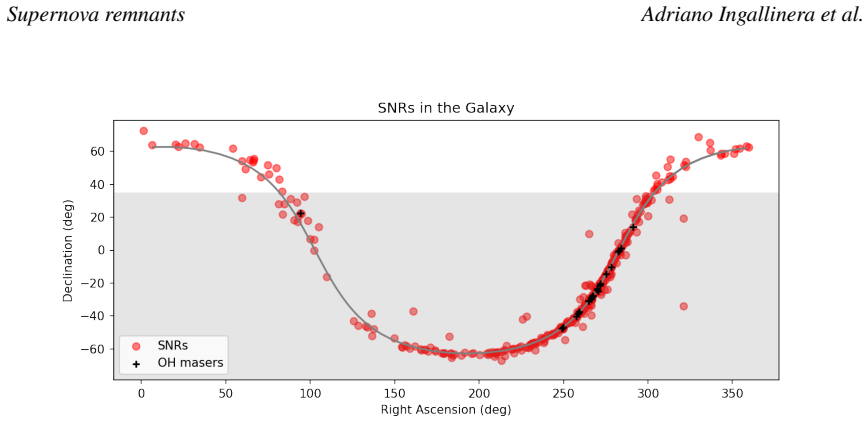
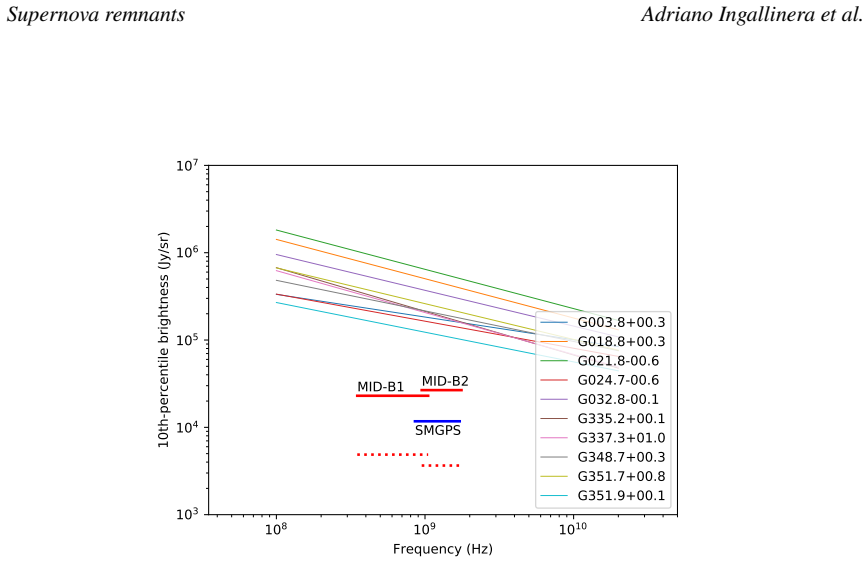
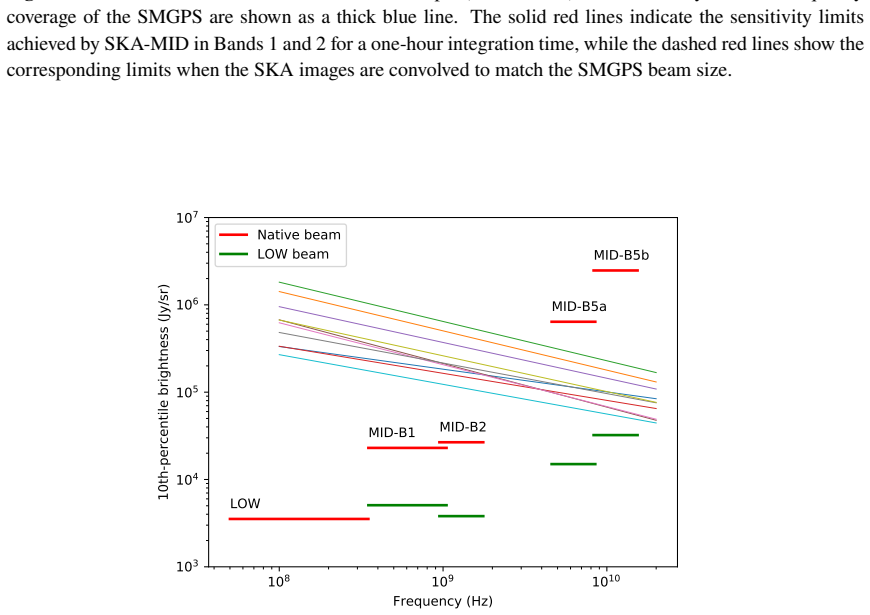
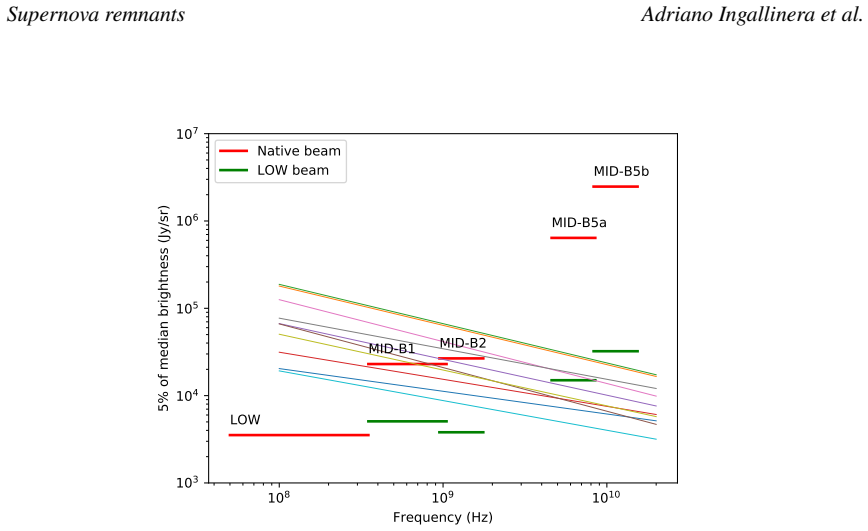
read the original abstract
Supernova remnants (SNRs) are what is left after stellar explosions, when the stellar ejecta, the explosion shock and the circumstellar medium interact. Despite being among the first objects studied in radio astronomy, observational difficulties have so far prevented a definitive characterisation, which would help answer open questions related to these sources. It is debated which is the contribution of SNRs to Galactic cosmic rays, or how the interaction with the surrounding environments influences the particle energetics. The SKA precursors are providing valuable and unexpected discoveries on SNRs, thanks to their unique capabilities to probe spatial scales from a few arcseconds to a few degrees with a sensitivity of tens of microjansky. Accurate integrated flux density measurements and arcsecond-scale spectral-index maps are now possible for tens of SNRs, substantially expanding the small subset of remnants traditionally studied in great detail. SKA will markedly enhance current observations by providing: higher sensitivity, enabling the detection of fainter SNRs also in polarisation, revealing diffuse structures and the underlying magnetic field configuration; higher angular resolution, allowing detailed mapping of compact remnants and reducing depolarisation in fine structures, tracing filaments and shocks fronts; wider frequency coverage to probe unexplored spectral windows, where spectral turnovers and breaks or cut-off may occur, establishing a direct connection to X-ray and {\gamma}-ray emission that constrains the electron population, and enabling accurate modelling of the non-thermal emission across the electromagnetic spectrum; improved image fidelity for more reliable cross-matching with other wavelengths, leading to a better understanding of the SNR-interstellar medium interplay.
Editorial analysis
A structured set of objections, weighed in public.
Referee Report
Summary. The manuscript is a review article that summarizes longstanding observational challenges in radio studies of supernova remnants (SNRs), including difficulties in definitive characterization, debates over their contribution to Galactic cosmic rays, and the influence of the interstellar medium on particle energetics. It describes recent gains from SKA precursors (sensitivity of tens of μJy, arcsecond-to-degree scales) that have expanded detailed studies to tens of SNRs, and projects that the full SKA will further advance the field via higher sensitivity (including in polarization), higher angular resolution, wider frequency coverage for spectral features, and improved image fidelity, ultimately improving multi-wavelength understanding of SNR-ISM interplay.
Significance. As a forward-looking synthesis grounded in published instrument specifications rather than new data or modeling, the review usefully identifies priority science areas for the SKA era. It correctly links technical capabilities to open questions on non-thermal emission and cosmic-ray acceleration without introducing untested derivations or quantitative predictions.
minor comments (1)
- [Abstract] Abstract: the final sentence is a single, lengthy run-on clause that enumerates four distinct benefits; splitting it into shorter sentences would improve readability without altering content.
Simulated Author's Rebuttal
We thank the referee for their positive assessment of the manuscript as a forward-looking synthesis that correctly links SKA technical capabilities to open questions on non-thermal emission and cosmic-ray acceleration. We are pleased that the review is viewed as useful for identifying priority science areas without introducing untested derivations.
Circularity Check
No significant circularity
full rationale
This is a review paper summarizing prospective observational gains for SNRs from SKA and precursors, grounded in published instrument specifications (sensitivity, resolution, frequency coverage). No derivations, equations, fitted parameters, or predictions appear that reduce by construction to quantities defined inside the paper. Claims are conditional on external technical performance and do not invoke self-citation chains, uniqueness theorems, or ansatzes that collapse the argument. The central narrative remains self-contained against external benchmarks.
Axiom & Free-Parameter Ledger
axioms (1)
- domain assumption SNRs form from the interaction of stellar ejecta, explosion shock, and circumstellar medium
Reference graph
Works this paper leans on
-
[1]
A Sino-German 6 cm polarization survey of the Galactic plane. VII. Small supernova remnants. , keywords =. doi:10.1051/0004-6361/201117693 , archivePrefix =. 1110.1106 , primaryClass =
work page internal anchor Pith review Pith/arXiv arXiv doi:10.1051/0004-6361/201117693
-
[2]
2019 , eprint=
Anticipated Performance of the Square Kilometre Array -- Phase 1 (SKA1) , author=. 2019 , eprint=
2019
-
[3]
2015 , publisher=
Advancing Astrophysics with the Square Kilometre Array (AASKA14) , author=. 2015 , publisher=
2015
-
[4]
A Spatially Resolved Study of Hard X-Ray Emission in Kepler's Supernova Remnant: Indications of Different Regimes of Particle Acceleration. , keywords =. doi:10.3847/1538-4357/ac8160 , archivePrefix =. 2207.06804 , primaryClass =
-
[5]
Nature Communications , keywords =
The supernova remnant SN 1006 as a Galactic particle accelerator. Nature Communications , keywords =. doi:10.1038/s41467-022-32781-4 , archivePrefix =. 2208.14491 , primaryClass =
-
[6]
Evidence for protons accelerated and escaped from the Puppis A region using Fermi-LAT observations. , keywords =. doi:10.1051/0004-6361/202555126 , archivePrefix =. 2507.11208 , primaryClass =
-
[7]
Time Evolution of the Synchrotron X-Ray Emission in Kepler's Supernova Remnant: The Effects of Turbulence and Shock Velocity. , keywords =. doi:10.3847/1538-4357/ad6566 , archivePrefix =. 2407.18980 , primaryClass =
-
[8]
Radio Evolution of Supernova Remnants Including Nonlinear Particle Acceleration: Insights from Hydrodynamic Simulations. , keywords =. doi:10.3847/1538-4357/aaa1e6 , archivePrefix =. 1711.06013 , primaryClass =
work page internal anchor Pith review Pith/arXiv arXiv doi:10.3847/1538-4357/aaa1e6
-
[9]
Hydrodynamical and radio evolution of young supernova remnant G1.9+0.3 based on the model of diffusive shock acceleration. , keywords =. doi:10.1093/mnras/stx497 , archivePrefix =. 1702.07418 , primaryClass =
work page internal anchor Pith review Pith/arXiv arXiv doi:10.1093/mnras/stx497
-
[10]
The MeerKAT view on Galactic supernova remnants. , keywords =. doi:10.1051/0004-6361/202450404 , adsurl =
-
[11]
The supernova remnant population of the Small Magellanic Cloud. , keywords =. doi:10.1051/0004-6361/201936583 , archivePrefix =. 1908.11234 , primaryClass =
-
[12]
The ASKAP EMU Early Science Project: radio continuum survey of the Small Magellanic Cloud. , keywords =. doi:10.1093/mnras/stz2650 , archivePrefix =. 1909.10425 , primaryClass =
-
[13]
New optically identified supernova remnants in the Large Magellanic Cloud. , keywords =. doi:10.1093/mnras/staa3382 , archivePrefix =. 2010.14698 , primaryClass =
-
[14]
New ASKAP radio supernova remnants and candidates in the Large Magellanic Cloud. , keywords =. doi:10.1093/mnras/stac2922 , archivePrefix =. 2210.05090 , primaryClass =
-
[15]
First study of the supernova remnant population in the Large Magellanic Cloud with eROSITA. , keywords =. doi:10.1051/0004-6361/202348868 , archivePrefix =. 2401.17307 , primaryClass =
-
[16]
Statistical Analysis of Supernova Remnants in the Large Magellanic Cloud
Statistical Analysis of Supernova Remnants in the Large Magellanic Cloud. , keywords =. doi:10.3847/1538-4365/aa653c , archivePrefix =. 1703.02676 , primaryClass =
work page internal anchor Pith review Pith/arXiv arXiv doi:10.3847/1538-4365/aa653c
-
[17]
The population of X-ray supernova remnants in the Large Magellanic Cloud
The population of X-ray supernova remnants in the Large Magellanic Cloud. , keywords =. doi:10.1051/0004-6361/201526932 , archivePrefix =. 1509.09223 , primaryClass =
work page internal anchor Pith review Pith/arXiv arXiv doi:10.1051/0004-6361/201526932
-
[18]
The ASKAP-EMU Early Science Project: 888 MHz radio continuum survey of the Large Magellanic Cloud. , keywords =. doi:10.1093/mnras/stab1858 , archivePrefix =. 2106.12013 , primaryClass =
-
[19]
2025, A&A, 693, L15, doi: 10.1051/0004-6361/202452178
Supernova remnants on the outskirts of the Large Magellanic Cloud. , keywords =. doi:10.1051/0004-6361/202452178 , adsurl =
-
[20]
A New Sample of Radio-selected and Optically Confirmed Supernova Remnants in M33. , keywords =. doi:10.1086/313175 , adsurl =
-
[21]
BH scaling relations and the AGN luminosity function
Deep MERLIN 5GHz radio imaging of supernova remnants in the M82 starburst. , keywords =. doi:10.1111/j.1365-2966.2008.13986.x , archivePrefix =. 0810.0424 , primaryClass =
-
[22]
The D relation for supernova remnants in nearby galaxies. , keywords =. doi:10.1051/0004-6361:20042535 , adsurl =
-
[23]
Radio-Continuum study of the Nearby Sculptor Group Galaxies. Part 1: NGC 300 at lambda = 20 cm
Radio-continuum study of the Nearby sculptor group galaxies. Part 1: NGC 300 at =20 cm. , keywords =. doi:10.1007/s10509-012-1044-3 , archivePrefix =. 1203.1688 , primaryClass =
work page internal anchor Pith review Pith/arXiv arXiv doi:10.1007/s10509-012-1044-3
-
[24]
Radio-continuum study of the nearby Sculptor group Galaxies. Part 2: NGC 55 at =20, 13, 6 and 3 cm. , keywords =. doi:10.1007/s10509-013-1489-z , archivePrefix =. 1305.3374 , primaryClass =
work page internal anchor Pith review Pith/arXiv arXiv doi:10.1007/s10509-013-1489-z
-
[25]
An X-Ray, Optical, and Radio Search for Supernova Remnants in the Nearby Sculptor Group Sd Galaxy NGC 7793. , keywords =. doi:10.1086/337918 , archivePrefix =. astro-ph/0112128 , primaryClass =
work page internal anchor Pith review Pith/arXiv arXiv doi:10.1086/337918
-
[26]
Radio-continuum study of the nearby sculptor group galaxies. Part 3: NGC 7793 at =12.2, 6 and 3 cm. , keywords =. doi:10.1007/s10509-014-2051-3 , archivePrefix =. 1407.2653 , primaryClass =
work page internal anchor Pith review Pith/arXiv arXiv doi:10.1007/s10509-014-2051-3 2051
-
[27]
An X-Ray, Optical, and Radio Search for Supernova Remnants in the Nearby Sculptor Group Sd Galaxy NGC 300. , keywords =. doi:10.1086/317238 , adsurl =
-
[28]
Compact Radio Sources in the Starburst Galaxy M82 and the Sigma -D Relation for Supernova Remnants. , keywords =. doi:10.1086/173876 , adsurl =
-
[29]
A Study of Compact Radio Sources in Nearby Face-on Spiral Galaxies. II. Multiwavelength Analyses of Sources in M51. , keywords =. doi:10.1086/515573 , archivePrefix =. astro-ph/0702310 , primaryClass =
work page internal anchor Pith review Pith/arXiv arXiv doi:10.1086/515573
-
[30]
A Survey of Compact Radio Sources in NGC 6946. , keywords =. doi:10.1086/312989 , adsurl =
-
[31]
20 cm VLA Radio-Continuum Study of M31 - Images and Point Source Catalogues DR2: Extraction of a Supernova Remnant Sample. Serbian Astronomical Journal , keywords =. doi:10.2298/SAJ140505002G , archivePrefix =. 1409.0591 , primaryClass =
work page internal anchor Pith review Pith/arXiv arXiv doi:10.2298/saj140505002g
-
[32]
Mysterious odd radio circle near the large magellanic cloud - an intergalactic supernova remnant?. , keywords =. doi:10.1093/mnras/stac210 , archivePrefix =. 2201.10026 , primaryClass =
-
[33]
The MeerKAT 1.3 GHz Survey of the Small Magellanic Cloud. , keywords =. doi:10.1093/mnras/stae277 , archivePrefix =. 2401.11024 , primaryClass =
-
[34]
Physical Properties of the Supernova Remnant Population in the Small Magellanic Cloud. , keywords =. doi:10.3847/1538-4357/ac6025 , archivePrefix =. 2204.01550 , primaryClass =
-
[35]
New XMM-Newton observations of SNRs in the SMC
New XMM-Newton observations of supernova remnants in the Small Magellanic Cloud. , keywords =. doi:10.1051/0004-6361:200809642 , archivePrefix =. 0805.0165 , primaryClass =
work page internal anchor Pith review Pith/arXiv arXiv doi:10.1051/0004-6361:200809642
-
[36]
and Cole, Shaun and Eisenstein, Daniel J
An ATCA radio-continuum study of the Small Magellanic Cloud - V. Long-slit optical spectroscopy of supernova remnants and confirmation of a new candidate supernova remnant. , keywords =. doi:10.1111/j.1365-2966.2007.11561.x , adsurl =
-
[37]
An ATCA radio-continuum study of the Small Magellanic Cloud - III. Supernova remnants and their environments. , keywords =. doi:10.1111/j.1365-2966.2005.09554.x , adsurl =
-
[38]
New candidate radio supernova remnants detected in the GLEAM survey over 345 < l < 60 , 180 < l < 240. , keywords =. doi:10.1017/pasa.2019.34 , archivePrefix =. 1911.08126 , primaryClass =
-
[39]
On the Origin of Asymmetries in Bilateral Supernova Remnants
On the origin of asymmetries in bilateral supernova remnants. , keywords =. doi:10.1051/0004-6361:20066045 , archivePrefix =. 0704.0890 , primaryClass =
work page internal anchor Pith review Pith/arXiv arXiv doi:10.1051/0004-6361:20066045
-
[40]
Role of Ejecta Clumping and Back-reaction of Accelerated Cosmic Rays in the Evolution of Type Ia Supernova Remnants. , keywords =. doi:10.1088/0004-637X/749/2/156 , archivePrefix =. 1202.3593 , primaryClass =
work page internal anchor Pith review Pith/arXiv arXiv doi:10.1088/0004-637x/749/2/156
-
[41]
3D simulations of supernova remnants evolution including non-linear particle acceleration
3D simulations of supernova remnants evolution including non-linear particle acceleration. , keywords =. doi:10.1051/0004-6361/200913666 , archivePrefix =. 0912.4886 , primaryClass =
work page internal anchor Pith review Pith/arXiv arXiv doi:10.1051/0004-6361/200913666
-
[42]
Hydrodynamic Instabilities in Supernova Remnants: Self-similar Driven Waves. , keywords =. doi:10.1086/171411 , adsurl =
-
[43]
Evolution of ejecta structure and asymmetries in SNR Cassiopeia A
The fully developed remnant of a neutrino-driven supernova. Evolution of ejecta structure and asymmetries in SNR Cassiopeia A. , keywords =. doi:10.1051/0004-6361/202039335 , archivePrefix =. 2009.01789 , primaryClass =
-
[44]
Constraining the Circumstellar Medium Structure and Progenitor Mass-loss History of Interacting Supernovae Through 3D Hydrodynamic Modeling: The Case of SN 2014C. , keywords =. doi:10.3847/1538-4357/ad8ac8 , archivePrefix =. 2410.17699 , primaryClass =
-
[45]
Constraints on local interstellar magnetic field from non-thermal emission of SN1006
Constraints on the local interstellar magnetic field from non-thermal emission of SN1006. , keywords =. doi:10.1051/0004-6361/201016341 , archivePrefix =. 1105.2689 , primaryClass =
work page internal anchor Pith review Pith/arXiv arXiv doi:10.1051/0004-6361/201016341
-
[46]
3D MHD modeling of the expanding remnant of SN 1987A. Role of magnetic field and non-thermal radio emission. , keywords =. doi:10.1051/0004-6361/201834487 , archivePrefix =. 1812.00021 , primaryClass =
work page internal anchor Pith review Pith/arXiv arXiv doi:10.1051/0004-6361/201834487
-
[47]
D., Camilo, F., Faerber, T., et al
Supernova remnant candidates discovered by the SARAO MeerKAT Galactic Plane Survey. , keywords =. doi:10.1051/0004-6361/202451038 , archivePrefix =. 2409.16607 , primaryClass =
-
[48]
D., Kothes, R., Rosolowsky, E., et al
A catalogue of radio supernova remnants and candidate supernova remnants in the EMU/POSSUM Galactic pilot field. , keywords =. doi:10.1093/mnras/stad1953 , archivePrefix =. 2307.01948 , primaryClass =
-
[49]
Discovery of Perun (G329.9-0.5): a new, young, Galactic SNR. , year = 2024, month = nov, volume =. doi:10.1093/mnras/stae2237 , adsurl =
-
[50]
Research Notes of the American Astronomical Society , keywords =
ASKAP-EMU Discovery of ``Raspberry'': A New Galactic SNR Candidate G308.73+1.38. Research Notes of the American Astronomical Society , keywords =. doi:10.3847/2515-5172/ad40a9 , archivePrefix =. 2405.03733 , primaryClass =
-
[51]
The Large Galactic Supernova Remnant (SNR) G278.94+1.35
Diprotodon on the sky. The Large Galactic Supernova Remnant (SNR) G278.94+1.35. , keywords =. doi:10.1017/pasa.2024.93 , archivePrefix =. 2412.20836 , primaryClass =
-
[52]
Sifting the debris: Patterns in the SNR population with unsupervised ML methods. , keywords =. doi:10.1051/0004-6361/202451096 , archivePrefix =. 2409.06383 , primaryClass =
-
[53]
Journal of Astrophysics and Astronomy , keywords =
An updated catalogue of 310 Galactic supernova remnants and their statistical properties. Journal of Astrophysics and Astronomy , keywords =. doi:10.1007/s12036-024-10038-4 , archivePrefix =. 2411.03367 , primaryClass =
-
[54]
Evidence for Thermal Absorption inside Cassiopeia A. , keywords =. doi:10.1086/309802 , adsurl =
-
[55]
Low-Frequency Radio Absorption in Cassiopeia A
Low-frequency radio absorption in Cassiopeia A. , keywords =. doi:10.1051/0004-6361/201732411 , archivePrefix =. 1801.04887 , primaryClass =
work page internal anchor Pith review Pith/arXiv arXiv doi:10.1051/0004-6361/201732411
-
[56]
The Crab Nebula at subarcsecond resolution with the International LOFAR Telescope. arXiv e-prints , keywords =. doi:10.48550/arXiv.2506.19460 , archivePrefix =. 2506.19460 , primaryClass =
-
[57]
Spatial Spectral Index Variations in Galactic Shell Supernova Remnants G39.2-0.3 and G41.1-0.3. , keywords =. doi:10.1086/172609 , adsurl =
-
[58]
Radio spectral characteristics of the supernova remnant Puppis A and nearby sources
Radio spectral characteristics of the supernova remnant Puppis A and nearby sources. , keywords =. doi:10.1093/mnras/stv1147 , archivePrefix =. 1506.03801 , primaryClass =
work page internal anchor Pith review Pith/arXiv arXiv doi:10.1093/mnras/stv1147
-
[59]
The low-frequency radio emission and spectrum of the extended SNR <ASTROBJ>W44</ASTROBJ>: new VLA observations at 74 and 324 MHz. , keywords =. doi:10.1051/0004-6361:20077062 , archivePrefix =. astro-ph/0702746 , primaryClass =
work page internal anchor Pith review Pith/arXiv arXiv doi:10.1051/0004-6361:20077062
-
[60]
A low-frequency view of mixed-morphology supernova remnant VRO 42.05.01, and its neighbourhood
A low-frequency view of mixed-morphology supernova remnant VRO 42.05.01, and its neighbourhood. , keywords =. doi:10.1051/0004-6361/201833865 , archivePrefix =. 1810.07584 , primaryClass =
work page internal anchor Pith review Pith/arXiv arXiv doi:10.1051/0004-6361/201833865
-
[61]
Spatially Resolved Low Frequency VLA observations of the Supernova Remnant 3C 391
Spatially Resolved Low-Frequency Very Large Array Observations of the Supernova Remnant 3C 391. , keywords =. doi:10.1086/430852 , archivePrefix =. astro-ph/0503061 , primaryClass =
work page internal anchor Pith review Pith/arXiv arXiv doi:10.1086/430852
-
[62]
High-resolution radio study of SNR IC443 at low radio frequencies
High-resolution radio study of SNR IC 443 at low radio frequencies. , keywords =. doi:10.1051/0004-6361/201016081 , archivePrefix =. 1104.0205 , primaryClass =
work page internal anchor Pith review Pith/arXiv arXiv doi:10.1051/0004-6361/201016081
-
[63]
Thermal radio absorption as a tracer of the interaction of SNRs with their environments. , keywords =. doi:10.1051/0004-6361/202141635 , archivePrefix =. 2108.08178 , primaryClass =
-
[64]
Low-frequency Radio Absorption in Tycho s Supernova Remnant. , keywords =. doi:10.3847/1538-3881/ab4f80 , archivePrefix =. 1911.02943 , primaryClass =
-
[65]
One size fits all: Insights into extrinsic thermal absorption based on the similarity of supernova remnant radio-continuum spectra. , keywords =. doi:10.1051/0004-6361/202346896 , archivePrefix =. 2312.11440 , primaryClass =
-
[66]
OH 1720 MHz Masers in Supernova Remnants --- C-Shock Indicators
OH 1720 Megahertz Masers in Supernova Remnants: C-Shock Indicators. , keywords =. doi:10.1086/306667 , archivePrefix =. astro-ph/9809019 , primaryClass =
work page internal anchor Pith review Pith/arXiv arXiv doi:10.1086/306667
-
[67]
Enhanced OH in C-type shock waves in molecular clouds
Enhanced OH in C-Type Shock Waves in Molecular Clouds. , keywords =. doi:10.1086/312351 , archivePrefix =. astro-ph/9908161 , primaryClass =
work page internal anchor Pith review Pith/arXiv arXiv doi:10.1086/312351
-
[68]
, year = 1968, month = jan, volume =
OH Emission at 1720 MHz in the Direction of Non-Thermal Galactic Sources. , year = 1968, month = jan, volume =
1968
-
[69]
Discovery of shocked CO within a supernova remnant. , keywords =. doi:10.1086/183057 , adsurl =
-
[70]
CO observations toward supernova remnants with associated OH 1720 MHz masers
CO Observations toward Supernova Remnants with Associated OH 1720 MHZ Masers. , keywords =. doi:10.1086/317854 , archivePrefix =. astro-ph/0010043 , primaryClass =
work page internal anchor Pith review Pith/arXiv arXiv doi:10.1086/317854
-
[71]
Shock Excited Maser Emission from the Supernova Remnant W28
Shock-excited Maser Emission from the Supernova Remnant W28. , keywords =. doi:10.1086/187287 , archivePrefix =. astro-ph/9312025 , primaryClass =
work page internal anchor Pith review Pith/arXiv arXiv doi:10.1086/187287
-
[72]
A Survey for OH (1720 MHz) Maser Emission Toward Supernova Remnants. , keywords =. doi:10.1086/117904 , adsurl =
-
[73]
Continuation of a survey of OH (1720 MHz) Maser Emission Towards Supernova Remnants. , keywords =. doi:10.1086/118626 , adsurl =
-
[74]
A Survey of Hydroxyl Toward Supernova Remnants: Evidence for Extended 1720 MHz Maser Emission
A Survey of Hydroxyl toward Supernova Remnants: Evidence for Extended 1720 MHz Maser Emission. , keywords =. doi:10.1086/588652 , archivePrefix =. 0802.3878 , primaryClass =
work page internal anchor Pith review Pith/arXiv arXiv doi:10.1086/588652
-
[75]
Origins of its complex morphology and X-ray emission
Modeling the mixed-morphology supernova remnant IC 443. Origins of its complex morphology and X-ray emission. , keywords =. doi:10.1051/0004-6361/202039940 , archivePrefix =. 2012.08017 , primaryClass =
-
[76]
OH (1720 MHz) Masers: A Multiwavelength Study of the Interaction between the W51C Supernova Remnant and the W51B Star Forming Region. , keywords =. doi:10.1088/0004-637X/771/2/91 , archivePrefix =. 1305.2793 , primaryClass =
work page internal anchor Pith review Pith/arXiv arXiv doi:10.1088/0004-637x/771/2/91
-
[77]
Australian Journal of Physics , keywords =
Nonthermal galactic radio sources. Australian Journal of Physics , keywords =. doi:10.1071/PH700425 , adsurl =
-
[78]
Statistical studies of supernova remnants. , keywords =. doi:10.1093/mnras/209.3.449 , adsurl =
-
[79]
Distances to the supernova remnants in the inner disk. , keywords =. doi:10.1051/0004-6361/201936868 , archivePrefix =. 2005.08270 , primaryClass =
-
[80]
Inverse Multiview. I. Multicalibrator Inverse Phase Referencing for Microarcsecond Very Long Baseline Interferometry Astrometry. , keywords =. doi:10.3847/1538-4357/ac6d5b , archivePrefix =. 2205.00092 , primaryClass =
discussion (0)
Sign in with ORCID, Apple, or X to comment. Anyone can read and Pith papers without signing in.