A Rare Gamma-ray Flaring episode of the Narrow-Line Seyfert 1 Galaxy 1H 0323+342
Pith reviewed 2026-06-29 03:28 UTC · model grok-4.3
The pith
A narrow-line Seyfert 1 galaxy produced a gamma-ray flare with jet power of 10^46 erg s^{-1}.
A machine-rendered reading of the paper's core claim, the machinery that carries it, and where it could break.
Core claim
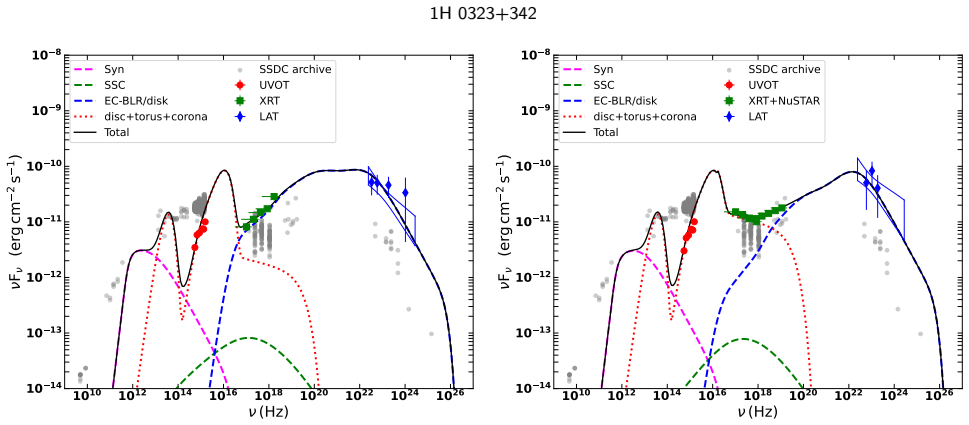
The source exhibited significant gamma-ray flux enhancement with sub-hour variability. X-ray spectra showed a transition from jet-dominated to mixed jet+corona state. Broadband SED modeling with a one-zone leptonic model indicates external Compton scattering dominates high-energy emission, yielding jet powers around 10^{46} erg s^{-1}, similar to powerful FSRQs.
What carries the argument
One-zone leptonic model assuming external Compton scattering of accretion disk and broad line region photons, which reproduces the SED and allows calculation of jet power.
Load-bearing premise
The high-energy emission is dominated by external Compton scattering in a single emission zone with no significant contribution from other processes.
What would settle it
Detection of significant synchrotron self-Compton or hadronic emission components in the SED of a similar flare would challenge the external Compton dominance.
Figures
read the original abstract
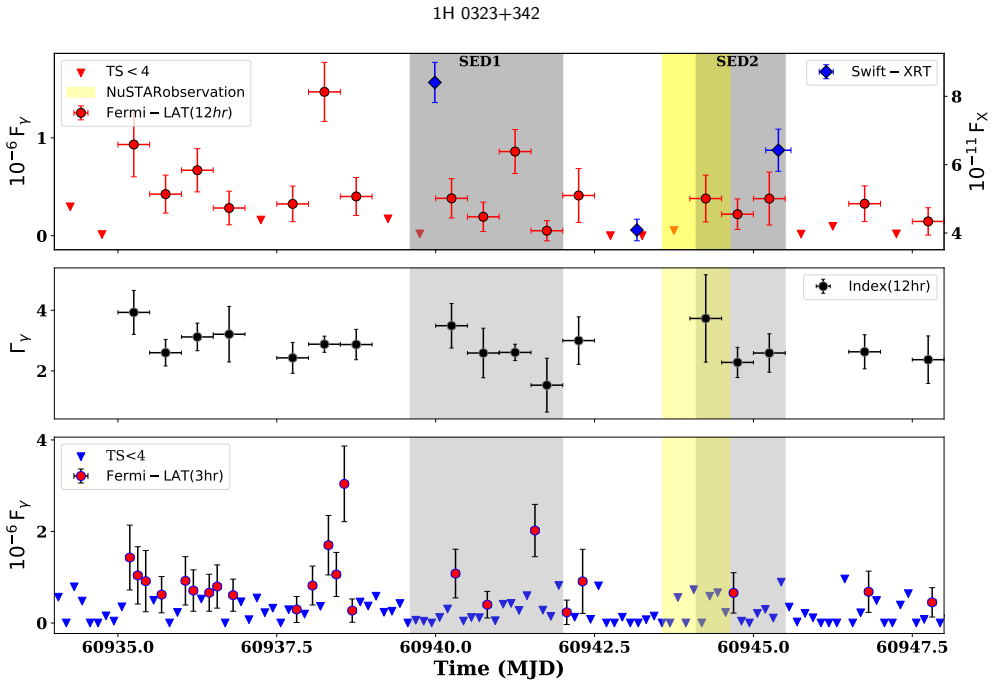
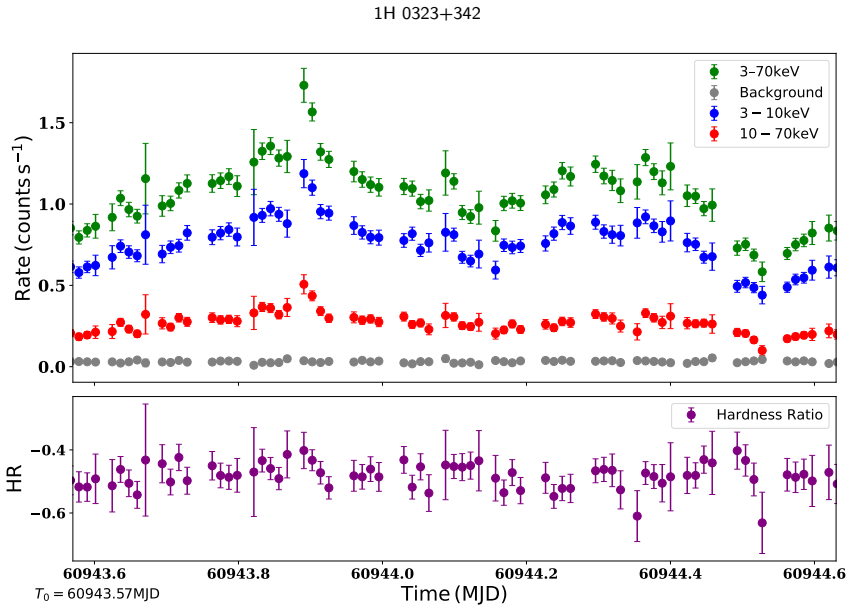
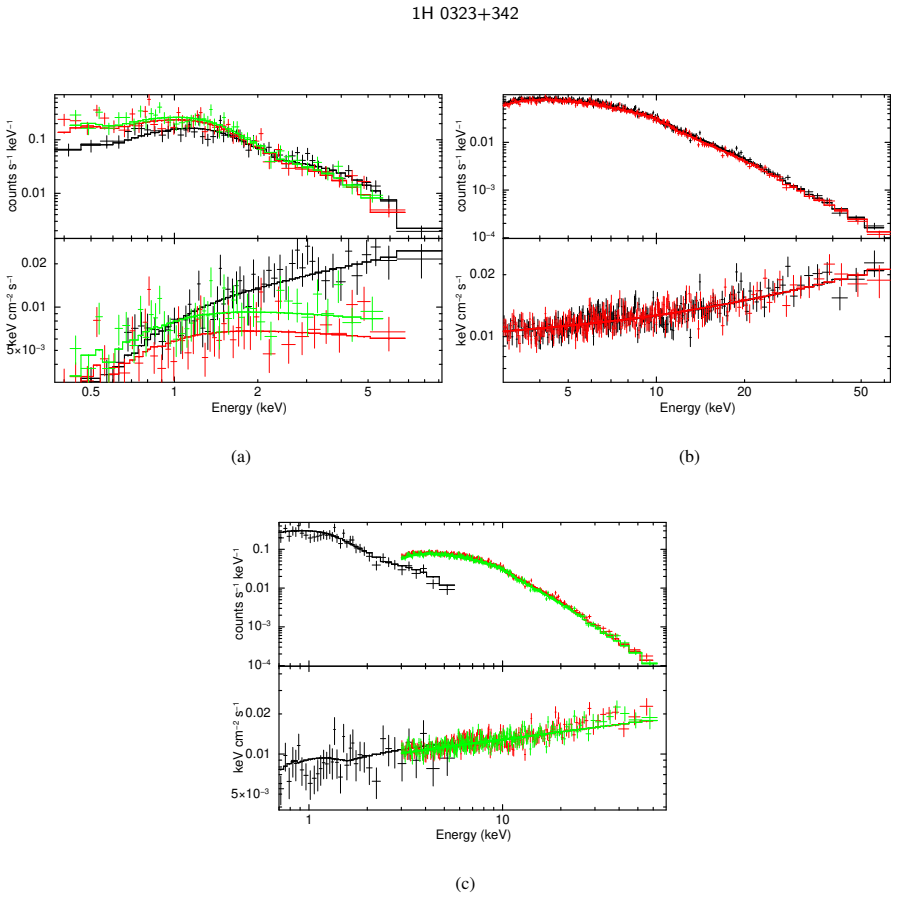
Gamma-ray-emitting narrow-line Seyfert 1 ($\gamma$-NLSy1) galaxies represent an enigmatic class of active galactic nuclei (AGNs) bridging populations of radio-quiet and radio-loud AGNs. Here we report the multi-wavelength investigation of a rare $\gamma$-ray flaring episode of an NLSy1 galaxy, 1H 0323+342 ($z=0.063$), using data from Fermi-Large Area Telescope, Swift, and Nuclear Spectroscopic Telescopic Array. The source exhibited a significant enhancement in $\gamma$-ray flux along with rapid variability on $\sim$sub-hour timescales in both $\gamma$-ray and hard X-ray wavelengths, hinting that the energy dissipation is happening from a compact region close to the central supermassive black-hole. The time-resolved X-ray spectral study revealed a transition between a jet-dominated and a mixed jet+corona emission state. Reproducing the broadband spectral energy distribution with a one-zone leptonic model suggested that the high-energy emission is mainly produced by external Compton scattering of the accretion disc and broad line region photons. The inferred jet power reaches values of the order of $10^{46}$ erg s$^{-1}$ comparable to those of powerful flat-spectrum radio quasars, suggesting that even low black-hole mass systems can occasionally produce powerful $\gamma$-ray outbursts.
Editorial analysis
A structured set of objections, weighed in public.
Referee Report
Summary. The manuscript reports a multi-wavelength study of a gamma-ray flaring episode in the NLSy1 galaxy 1H 0323+342 (z=0.063) using Fermi-LAT, Swift, and NuSTAR data. It documents significant gamma-ray flux enhancement with sub-hour variability in gamma-ray and hard X-ray bands, a transition from jet-dominated to mixed jet+corona X-ray emission, and a one-zone leptonic SED model in which high-energy emission arises primarily via external Compton scattering of accretion-disk and broad-line-region photons. The modeling yields a jet power of order 10^{46} erg s^{-1}, comparable to powerful flat-spectrum radio quasars.
Significance. If the modeling is robust, the result shows that even low black-hole-mass systems can produce powerful gamma-ray outbursts, helping to bridge radio-quiet and radio-loud AGN populations.
major comments (2)
- [Modeling section] Modeling section: The central jet-power claim rests on a single one-zone leptonic model with external-Compton dominance on disk+BLR photons. No quantitative comparison to synchrotron-self-Compton, hadronic, or multi-zone alternatives is provided, nor is the relative contribution of each process to the high-energy luminosity stated; a factor-of-several change in the external radiation energy density or Doppler factor would move the inferred P_jet across the FSRQ threshold.
- [Jet-power derivation] Jet-power derivation: The reported P_jet ~ 10^{46} erg s^{-1} is obtained from the fitted model parameters, yet the manuscript does not specify the assumed cold-proton-to-electron ratio or present sensitivity tests to plausible variations in this ratio, in R, or in δ. Because P_jet = P_e + P_B + P_p, an order-of-magnitude uncertainty in proton loading directly undermines the claim that the value is comparable to powerful FSRQs.
minor comments (2)
- The time-resolved X-ray spectral analysis is mentioned but lacks explicit description of the fitting statistic, background subtraction, and how the jet-versus-corona decomposition was performed; adding these details would improve reproducibility.
- Figure captions should explicitly state the energy ranges and instruments used for each SED component to avoid ambiguity.
Simulated Author's Rebuttal
We thank the referee for the constructive and detailed comments. We address each major point below and have revised the manuscript to incorporate additional discussion, explicit assumptions, and sensitivity tests as requested.
read point-by-point responses
-
Referee: [Modeling section] Modeling section: The central jet-power claim rests on a single one-zone leptonic model with external-Compton dominance on disk+BLR photons. No quantitative comparison to synchrotron-self-Compton, hadronic, or multi-zone alternatives is provided, nor is the relative contribution of each process to the high-energy luminosity stated; a factor-of-several change in the external radiation energy density or Doppler factor would move the inferred P_jet across the FSRQ threshold.
Authors: We agree that the manuscript would benefit from explicit discussion of model alternatives. In the revised version we will add a dedicated paragraph in the modeling section noting that (i) pure SSC fails to reproduce the observed gamma-ray luminosity without requiring magnetic fields or electron densities inconsistent with the sub-hour variability timescale, (ii) the best-fit one-zone EC model has external Compton contributing >95% of the high-energy luminosity, and (iii) hadronic scenarios are disfavored by the absence of neutrino associations and would require even higher jet powers. We will also present sensitivity tests varying the external radiation energy density and Doppler factor by factors of 2–5; these show that P_jet remains above ~5×10^45 erg s^{-1} in all cases, preserving the conclusion that the jet power is comparable to powerful FSRQs. revision: yes
-
Referee: [Jet-power derivation] Jet-power derivation: The reported P_jet ~ 10^{46} erg s^{-1} is obtained from the fitted model parameters, yet the manuscript does not specify the assumed cold-proton-to-electron ratio or present sensitivity tests to plausible variations in this ratio, in R, or in δ. Because P_jet = P_e + P_B + P_p, an order-of-magnitude uncertainty in proton loading directly undermines the claim that the value is comparable to powerful FSRQs.
Authors: We acknowledge that the proton-loading assumption was not stated. The modeling adopts a standard cold proton-to-electron number-density ratio of unity. We will explicitly document this choice in the revised text and add a new appendix containing sensitivity tests for proton-to-electron ratios from 0 to 20, as well as variations in R and δ within the 1σ uncertainties of the fit. These tests demonstrate that P_jet stays within (0.5–2)×10^{46} erg s^{-1} for all plausible parameter combinations; only extreme values (proton loading ≳50 or δ≲5) would drop it below the FSRQ threshold, which are ruled out by the data and variability constraints. revision: yes
Circularity Check
No circularity: jet power derived from standard one-zone leptonic SED fit to public multi-wavelength data.
full rationale
The paper reports Fermi/Swift/NuSTAR observations of a flare, measures sub-hour variability, performs time-resolved X-ray spectroscopy, and fits a one-zone leptonic model (EC on disk+BLR) to the broadband SED. Jet power is computed from the resulting fitted parameters (electron distribution, magnetic field, Doppler factor, size). This is a conventional forward-modeling step, not a self-definition, not a fitted input renamed as prediction, and not dependent on self-citation chains. No equations reduce the output to the input by construction; the result remains falsifiable against independent multi-zone or hadronic models and external equipartition checks. The derivation is therefore self-contained.
Axiom & Free-Parameter Ledger
free parameters (1)
- jet power normalization
axioms (1)
- domain assumption One-zone leptonic emission model applies to the flare SED
Reference graph
Works this paper leans on
-
[1]
1999, MNRAS, 309, 447, doi: 10.1046/j.1365-8711.1999.02853.x
Rapid variability in the synchrotron self-Compton model for blazars. , keywords =. doi:10.1046/j.1365-8711.1999.02538.x , archivePrefix =. astro-ph/9810263 , primaryClass =
-
[2]
Particle acceleration and synchrotron emission in blazar jets
Particle acceleration and synchrotron emission in blazar jets. , keywords =. doi:10.48550/arXiv.astro-ph/9801265 , archivePrefix =. astro-ph/9801265 , primaryClass =
work page internal anchor Pith review Pith/arXiv arXiv doi:10.48550/arxiv.astro-ph/9801265
-
[3]
Nonthermal processes in galactic and extragalactic sources
Radio astrophysics. Nonthermal processes in galactic and extragalactic sources
-
[4]
Broadband Spectral Fitting of Blazars using XSPEC
Broadband spectral fitting of blazars using XSPEC. Research in Astronomy and Astrophysics , keywords =. doi:10.1088/1674-4527/18/3/35 , archivePrefix =. 1801.00685 , primaryClass =
work page internal anchor Pith review Pith/arXiv arXiv doi:10.1088/1674-4527/18/3/35
-
[5]
Rapid Variability of Blazar 3C 279 during Flaring States in 2013-2014 with Joint Fermi-LAT, NuSTAR, Swift, and Ground-Based Multiwavelength Observations. , keywords =. doi:10.1088/0004-637X/807/1/79 , archivePrefix =. 1502.04699 , primaryClass =
work page internal anchor Pith review Pith/arXiv arXiv doi:10.1088/0004-637x/807/1/79 2013
-
[6]
Multiwavelength spectral modelling of the candidate neutrino blazar PKS 0735+178. , keywords =. doi:10.1093/mnras/stae296 , archivePrefix =. 2401.12680 , primaryClass =
-
[7]
The far emission region of the gamma-ray blazar PKS B1424-418
The far emission region of the -ray blazar PKS B1424-418. , keywords =. doi:10.1093/mnrasl/slt087 , archivePrefix =. 1306.0734 , primaryClass =
work page internal anchor Pith review Pith/arXiv arXiv doi:10.1093/mnrasl/slt087
-
[8]
The large gamma-ray flare of the FSRQ PKS 0346-27
The large gamma-ray flare of the flat-spectrum radio quasar PKS 0346-27. , keywords =. doi:10.1051/0004-6361/201935461 , archivePrefix =. 1906.08314 , primaryClass =
work page internal anchor Pith review Pith/arXiv arXiv doi:10.1051/0004-6361/201935461 1906
-
[9]
VHE gamma-ray detection of FSRQ QSO B1420+326 and modeling of its enhanced broadband state in 2020. , keywords =. doi:10.1051/0004-6361/202039687 , archivePrefix =. 2012.11380 , primaryClass =
-
[10]
On the Origin of Gamma-Ray Flares from Bright Fermi Blazars. , keywords =. doi:10.3847/1538-4365/ac365d , archivePrefix =. 2111.04379 , primaryClass =
-
[11]
Very High Energy -Rays from the Universe's Middle Age: Detection of the z = 0.940 Blazar PKS 1441+25 with MAGIC. , keywords =. doi:10.1088/2041-8205/815/2/L23 , archivePrefix =. 1512.04435 , primaryClass =
work page internal anchor Pith review Pith/arXiv arXiv doi:10.1088/2041-8205/815/2/l23 2041
-
[13]
The red blazar PMN J2345-1555 becomes blue
The red blazar PMN J2345-1555 becomes blue. , keywords =. doi:10.1093/mnrasl/slt041 , archivePrefix =. 1302.4444 , primaryClass =
work page internal anchor Pith review Pith/arXiv arXiv doi:10.1093/mnrasl/slt041
-
[14]
The Large Area Telescope on the Fermi Gamma-ray Space Telescope Mission
The Large Area Telescope on the Fermi Gamma-Ray Space Telescope Mission. , keywords =. doi:10.1088/0004-637X/697/2/1071 , archivePrefix =. 0902.1089 , primaryClass =
work page internal anchor Pith review Pith/arXiv arXiv doi:10.1088/0004-637x/697/2/1071
-
[15]
Convex X-ray spectra of PKS 2155-304 and constraints on the minimum electron energy. , keywords =. doi:10.1093/mnras/stab1993 , archivePrefix =. 2107.04534 , primaryClass =
-
[16]
The Astronomer's Telegram , keywords =
Fermi-LAT detection of renewed gamma-ray activity from the FSRQ OP 313. The Astronomer's Telegram , keywords =
-
[17]
Progress in unveiling extreme particle acceleration in persistent astrophysical jets. Nature Astronomy , keywords =. doi:10.1038/s41550-019-0988-4 , archivePrefix =. 2001.09222 , primaryClass =
-
[18]
Modeling the Extragalactic Background Light and the Cosmic Star Formation History. , keywords =. doi:10.3847/1538-4357/ac9843 , archivePrefix =. 2210.01157 , primaryClass =
-
[19]
Dust Extinction from Balmer Decrements of Star-forming Galaxies at 0.75 <= z <= 1.5 with Hubble Space Telescope/Wide-Field-Camera 3 Spectroscopy from the WFC3 Infrared Spectroscopic Parallel Survey. , keywords =. doi:10.1088/0004-637X/763/2/145 , archivePrefix =. 1206.1867 , primaryClass =
work page internal anchor Pith review Pith/arXiv arXiv doi:10.1088/0004-637x/763/2/145
-
[20]
detection of very high-energy -ray emission from the quasar PKS 0736+017
H.E.S.S. detection of very high-energy -ray emission from the quasar PKS 0736+017. , keywords =. doi:10.1051/0004-6361/201935906 , archivePrefix =. 1911.04761 , primaryClass =
-
[21]
Gamma rays from the quasar PKS 1441+25: story of an escape
Gamma-Rays from the Quasar PKS 1441+25: Story of an Escape. , keywords =. doi:10.1088/2041-8205/815/2/L22 , archivePrefix =. 1512.04434 , primaryClass =
work page internal anchor Pith review Pith/arXiv arXiv doi:10.1088/2041-8205/815/2/l22 2041
-
[22]
Very-High-Energy Gamma Rays from a Distant Quasar: How Transparent Is the Universe?
Very-High-Energy gamma rays from a Distant Quasar: How Transparent Is the Universe?. Science , keywords =. doi:10.1126/science.1157087 , archivePrefix =. 0807.2822 , primaryClass =
work page internal anchor Pith review Pith/arXiv arXiv doi:10.1126/science.1157087
-
[23]
Gamma-Gamma Absorption in the Broad Line Region Radiation Fields of Gamma-Ray Blazars
Gamma-Gamma Absorption in the Broad Line Region Radiation Fields of Gamma-Ray Blazars. , keywords =. doi:10.3847/0004-637X/821/2/102 , archivePrefix =. 1603.02785 , primaryClass =
work page internal anchor Pith review Pith/arXiv arXiv doi:10.3847/0004-637x/821/2/102
-
[24]
Radiation fields of disk, BLR and torus in quasars and blazars: implications for / -ray absorption. Astroparticle Physics , keywords =. doi:10.1016/S0927-6505(02)00155-X , archivePrefix =. astro-ph/0202068 , primaryClass =
work page internal anchor Pith review Pith/arXiv arXiv doi:10.1016/s0927-6505(02)00155-x
-
[25]
The Fourth Catalog of Active Galactic Nuclei Detected by the Fermi Large Area Telescope. , keywords =. doi:10.3847/1538-4357/ab791e , archivePrefix =. 1905.10771 , primaryClass =
-
[26]
Detection of persistent VHE gamma-ray emission from PKS 1510-089 by the MAGIC telescopes during low states between 2012 and 2017. , keywords =. doi:10.1051/0004-6361/201833618 , archivePrefix =. 1806.05367 , primaryClass =
work page internal anchor Pith review Pith/arXiv arXiv doi:10.1051/0004-6361/201833618 2012
-
[27]
Unveiling the broad-band spectral and temporal properties of PKS 0903-57 during its brightest flare. , keywords =. doi:10.1093/mnras/stab834 , archivePrefix =. 2103.13657 , primaryClass =
-
[28]
Multi-Wavelength Observations of 3C 279 During the Extremely Bright Gamma-Ray Flare in 2014 March-April. , keywords =. doi:10.1088/0004-637X/803/1/15 , archivePrefix =. 1501.07363 , primaryClass =
work page internal anchor Pith review Pith/arXiv arXiv doi:10.1088/0004-637x/803/1/15 2014
-
[29]
A Tight Connection between Gamma-Ray Outbursts and Parsec-Scale Jet Activity in the Quasar 3C 454.3
A Tight Connection between Gamma-Ray Outbursts and Parsec-scale Jet Activity in the Quasar 3C 454.3. , keywords =. doi:10.1088/0004-637X/773/2/147 , archivePrefix =. 1307.2522 , primaryClass =
work page internal anchor Pith review Pith/arXiv arXiv doi:10.1088/0004-637x/773/2/147
-
[30]
Awakening of The High Redshift Blazar CGRaBS J0809+5341
Awakening of The High-Redshift Blazar CGRaBS J0809+5341. , keywords =. doi:10.1088/0004-637X/803/2/112 , archivePrefix =. 1502.05660 , primaryClass =
work page internal anchor Pith review Pith/arXiv arXiv doi:10.1088/0004-637x/803/2/112
-
[31]
Herschel PACS and SPIRE observations of blazar PKS 1510-089: a case for two blazar zones
Herschel PACS and SPIRE Observations of Blazar PKS 1510-089: A Case for Two Blazar Zones. , keywords =. doi:10.1088/0004-637X/760/1/69 , archivePrefix =. 1210.4552 , primaryClass =
work page internal anchor Pith review Pith/arXiv arXiv doi:10.1088/0004-637x/760/1/69
-
[32]
A change in the optical polarization associated with a gamma-ray flare in the blazar 3C 279
A change in the optical polarization associated with a -ray flare in the blazar 3C279. , keywords =. doi:10.1038/nature08841 , archivePrefix =. 1004.3828 , primaryClass =
work page internal anchor Pith review Pith/arXiv arXiv doi:10.1038/nature08841
-
[33]
Simultaneous Multiwavelength Spectrum and Variability of 3C 279 from 10 9 to 10 24 Hz. , keywords =. doi:10.1086/177095 , adsurl =
-
[34]
The Spectral Energy Distribution of Fermi bright blazars
The Spectral Energy Distribution of Fermi Bright Blazars. , keywords =. doi:10.1088/0004-637X/716/1/30 , archivePrefix =. 0912.2040 , primaryClass =
work page internal anchor Pith review Pith/arXiv arXiv doi:10.1088/0004-637x/716/1/30 2040
-
[35]
Journal of High Energy Astrophysics , keywords =
Gamma-ray variability and multi-wavelength insights into the unprecedented outburst from 4C 31.03. Journal of High Energy Astrophysics , keywords =. doi:10.1016/j.jheap.2024.04.005 , archivePrefix =. 2404.09137 , primaryClass =
-
[36]
High Energy Gamma-Ray Emission From PKS 1441+25
High energy gamma-ray emission from PKS 1441+25. , keywords =. doi:10.1093/mnras/stx1402 , archivePrefix =. 1706.01611 , primaryClass =
work page internal anchor Pith review Pith/arXiv arXiv doi:10.1093/mnras/stx1402
-
[38]
Fermi/LAT detection of extraordinary variability in the gamma-ray emission of the blazar PKS 1510-089. , keywords =. doi:10.1051/0004-6361/201321675 , archivePrefix =. 1304.2878 , primaryClass =
work page internal anchor Pith review Pith/arXiv arXiv doi:10.1051/0004-6361/201321675
-
[39]
Characterizing the Gamma-Ray Variability of the Brightest Flat Spectrum Radio Quasars Observed with the Fermi LAT. , keywords =. doi:10.3847/1538-4357/ab1651 , archivePrefix =. 1902.02291 , primaryClass =
-
[40]
The Astronomer's Telegram , keywords =
First detection of VHE gamma-ray emission from FSRQ OP 313 with LST-1. The Astronomer's Telegram , keywords =
-
[41]
The Astronomer's Telegram , keywords =
Fermi-LAT detection of renewed gamma-ray activity from the FSRQ OP 313, and enhanced gamma-ray activity from the FSRQ ON 393. The Astronomer's Telegram , keywords =
-
[42]
Gamma-ray Light Curves and Variability of Bright Fermi-Detected Blazars
Gamma-ray Light Curves and Variability of Bright Fermi-detected Blazars. , keywords =. doi:10.1088/0004-637X/722/1/520 , archivePrefix =. 1004.0348 , primaryClass =
work page internal anchor Pith review Pith/arXiv arXiv doi:10.1088/0004-637x/722/1/520
-
[43]
The Central Engines of Fermi Blazars. , keywords =. doi:10.3847/1538-4365/abe135 , archivePrefix =. 2101.10849 , primaryClass =
-
[44]
Gamma-ray-loud blazars and beaming. , keywords =. doi:10.1093/mnras/273.3.583 , adsurl =
-
[45]
Improved AGN light curve analysis with the z-transformed discrete correlation function
Improved AGN light curve analysis with the z-transformed discrete correlation function. arXiv e-prints , keywords =. doi:10.48550/arXiv.1302.1508 , archivePrefix =. 1302.1508 , primaryClass =
work page internal anchor Pith review Pith/arXiv arXiv doi:10.48550/arxiv.1302.1508
-
[46]
Study on temporal and spectral behaviour of 3C 279 during 2018 January flare. , keywords =. doi:10.1093/mnras/stz151 , archivePrefix =. 1901.04184 , primaryClass =
-
[47]
The Discrete Correlation Function: A New Method for Analyzing Unevenly Sampled Variability Data. , keywords =. doi:10.1086/166773 , adsurl =
-
[48]
A method for localizing energy dissipation in blazars using Fermi variability
A Method for Localizing Energy Dissipation in Blazars Using Fermi Variability. , keywords =. doi:10.1088/2041-8205/758/1/L15 , archivePrefix =. 1209.2053 , primaryClass =
work page internal anchor Pith review Pith/arXiv arXiv doi:10.1088/2041-8205/758/1/l15 2041
-
[49]
Lepto-hadronic modelling of blazar emission
Lepto-hadronic modelling of blazar emission. SF2A-2011: Proceedings of the Annual meeting of the French Society of Astronomy and Astrophysics , year = 2011, editor =. doi:10.48550/arXiv.1111.0557 , archivePrefix =. 1111.0557 , primaryClass =
work page internal anchor Pith review Pith/arXiv arXiv doi:10.48550/arxiv.1111.0557 2011
-
[50]
TeV Gamma Rays from BL Lac Objects due to Synchrotron Radiation of Extremely High Energy Protons
TeV gamma rays from BL Lac objects due to synchrotron radiation of extremely high energy protons. , keywords =. doi:10.1016/S1384-1076(00)00039-7 , archivePrefix =. astro-ph/0003159 , primaryClass =
work page internal anchor Pith review Pith/arXiv arXiv doi:10.1016/s1384-1076(00)00039-7
-
[52]
Clues on High Energy Emission Mechanism from Blazar 3C 454.3 during 2015 August Flare
Clues on high-energy emission mechanism from blazar 3C 454.3 during 2015 August flare. , keywords =. doi:10.1093/mnras/stx1194 , archivePrefix =. 1705.06185 , primaryClass =
work page internal anchor Pith review Pith/arXiv arXiv doi:10.1093/mnras/stx1194 2015
-
[53]
Comptonization of Diffuse Ambient Radiation by a Relativistic Jet: The Source of Gamma Rays from Blazars?. , keywords =. doi:10.1086/173633 , adsurl =
-
[54]
High-energy emission in Blazars
Constraining the location of gamma-ray emission in blazar jets. High-energy emission in Blazars. European Physical Journal Web of Conferences , year = 2013, series =. doi:10.1051/epjconf/20136105004 , adsurl =
-
[55]
Radiative Processes in Astrophysics
-
[56]
Modelling the very high energy flare of 3C 279 using one-zone leptonic model. , keywords =. doi:10.1111/j.1365-2966.2011.19829.x , archivePrefix =. 1109.2442 , primaryClass =
-
[57]
Leptonic and Hadronic Radiative Processes in Supermassive-Black-Hole Jets. Galaxies , keywords =. doi:10.3390/galaxies8040072 , archivePrefix =. 2012.13302 , primaryClass =
-
[58]
A Radio Reference Frame. , keywords =. doi:10.1086/117571 , adsurl =
-
[59]
The Sloan Digital Sky Survey Quasar Catalog. V. Seventh Data Release. , keywords =. doi:10.1088/0004-6256/139/6/2360 , archivePrefix =. 1004.1167 , primaryClass =
work page internal anchor Pith review Pith/arXiv arXiv doi:10.1088/0004-6256/139/6/2360
-
[60]
Investigating the Blazar TXS 0506+056 through Sharp Multiwavelength Eyes During 2017-2019. , keywords =. doi:10.3847/1538-4357/ac531d , archivePrefix =. 2202.02600 , primaryClass =
-
[61]
Multiwavelength study of high-redshift blazars. , keywords =. doi:10.1093/mnras/staa2477 , archivePrefix =. 2008.09675 , primaryClass =
-
[63]
A Jet Model for the Gamma-Ray--emitting Blazar 3C 279. , keywords =. doi:10.1086/186531 , adsurl =
-
[65]
Physics of Compact Nonthermal Sources. II. Determination of Physical Parameters. , year = 1974, month = sep, volume =. doi:10.1086/153057 , adsurl =
-
[68]
On the spectral shape of radiation due to Inverse Compton Scattering close to the maximum cut-off
On the Spectral Shape of Radiation due to Inverse Compton Scattering Close to the Maximum Cutoff. , keywords =. doi:10.1088/0004-637X/753/2/176 , archivePrefix =. 1205.2929 , primaryClass =
work page internal anchor Pith review Pith/arXiv arXiv doi:10.1088/0004-637x/753/2/176
-
[69]
On the Location of the Acceleration and Emission Sites in Gamma-Ray Blazars. , keywords =. doi:10.1086/191929 , adsurl =
-
[70]
Pair Cascades in Extragalactic Jets. I. Gamma Rays. , keywords =. doi:10.1086/175338 , adsurl =
-
[71]
GeV breaks in blazars as a result of gamma-ray absorption within the broad-line region
GeV Breaks in Blazars as a Result of Gamma-ray Absorption Within the Broad-line Region. , keywords =. doi:10.1088/2041-8205/717/2/L118 , archivePrefix =. 1005.3792 , primaryClass =
work page internal anchor Pith review Pith/arXiv arXiv doi:10.1088/2041-8205/717/2/l118 2041
-
[72]
Monthly Notices of the Royal Astronomical Society , volume =
Ghisellini, Gabriele and Madau, Piero , title = ". Monthly Notices of the Royal Astronomical Society , volume =. 1996 , month =. doi:10.1093/mnras/280.1.67 , url =
-
[73]
Fermi Large Area Telescope Fourth Source Catalog. , keywords =. doi:10.3847/1538-4365/ab6bcb , archivePrefix =. 1902.10045 , primaryClass =
-
[77]
Paliya and Chris Diltz and Markus Böttcher and C
Vaidehi S. Paliya and Chris Diltz and Markus Böttcher and C. S. Stalin and David Buckley , title =. doi:10.3847/0004-637x/817/1/61 , url =
-
[79]
Astronomical Data Analysis Software and Systems V , year = 1996, editor =
XSPEC: The First Ten Years. Astronomical Data Analysis Software and Systems V , year = 1996, editor =
1996
-
[80]
37th International Cosmic Ray Conference , year = 2022, month = mar, eid =
Statistical properties of flux variations in blazar light curves at GeV and TeV energies. 37th International Cosmic Ray Conference , year = 2022, month = mar, eid =. doi:10.22323/1.395.0868 , archivePrefix =. 2110.14797 , primaryClass =
-
[81]
Search for the shortest variability at gamma rays in flat-spectrum radio quasars
Search for the shortest variability at gamma rays in flat-spectrum radio quasars. , keywords =. doi:10.1051/0004-6361/201117064 , archivePrefix =. 1101.1085 , primaryClass =
work page internal anchor Pith review Pith/arXiv arXiv doi:10.1051/0004-6361/201117064
-
[82]
The Astronomer's Telegram , keywords =
Fermi-LAT detection of enhanced gamma-ray activity from FSRQ 4C +31.03. The Astronomer's Telegram , keywords =
-
[83]
Constraining Emission Models of Luminous Blazar Sources
Constraining Emission Models of Luminous Blazar Sources. , keywords =. doi:10.1088/0004-637X/704/1/38 , archivePrefix =. 0904.1414 , primaryClass =
work page internal anchor Pith review Pith/arXiv arXiv doi:10.1088/0004-637x/704/1/38
-
[84]
Fermi-Large Area Telescope Observations of the Exceptional Gamma-ray Flare from 3C 279 in 2015 June
Fermi-Large Area Telescope Observations of the Exceptional Gamma-Ray Flare from 3C 279 in 2015 June. , keywords =. doi:10.1088/2041-8205/808/2/L48 , archivePrefix =. 1507.03073 , primaryClass =
work page internal anchor Pith review Pith/arXiv arXiv doi:10.1088/2041-8205/808/2/l48 2015
-
[85]
Jet and accretion power in the most powerful Fermi blazars. , keywords =. doi:10.1111/j.1365-2966.2009.15397.x , archivePrefix =. 0906.2195 , primaryClass =
-
[86]
Relativistic Jets from Active Galactic Nuclei. , keywords =. doi:10.1146/annurev-astro-081817-051948 , archivePrefix =. 1812.06025 , primaryClass =
-
[87]
The Connection between X-ray- and Radio-Selected BL Lacertae Objects
The Connection between X-Ray-- and Radio-selected BL Lacertae Objects. , keywords =. doi:10.1086/175631 , archivePrefix =. astro-ph/9412073 , primaryClass =
work page internal anchor Pith review Pith/arXiv arXiv doi:10.1086/175631
-
[88]
A theoretical unifying scheme for gamma-ray bright blazars. , keywords =. doi:10.1046/j.1365-8711.1998.02032.x , archivePrefix =. astro-ph/9807317 , primaryClass =
-
[89]
Low power BL Lacertae objects and the blazar sequence: Clues on the particle acceleration process
Low power BL Lacertae objects and the blazar sequence. Clues on the particle acceleration process. , keywords =. doi:10.1051/0004-6361:20020275 , archivePrefix =. astro-ph/0202367 , primaryClass =
work page internal anchor Pith review Pith/arXiv arXiv doi:10.1051/0004-6361:20020275
-
[90]
The Third EGRET Catalog of High-Energy Gamma-Ray Sources. , keywords =. doi:10.1086/313231 , adsurl =
-
[91]
Spectroscopy of Broad Line Blazars from 1LAC
Spectroscopy of Broad-line Blazars from 1LAC. , keywords =. doi:10.1088/0004-637X/748/1/49 , archivePrefix =. 1201.0999 , primaryClass =
work page internal anchor Pith review Pith/arXiv arXiv doi:10.1088/0004-637x/748/1/49
discussion (0)
Sign in with ORCID, Apple, or X to comment. Anyone can read and Pith papers without signing in.