The impact of stellar binaries and star cluster dynamics on pair-instability supernovae
Pith reviewed 2026-06-29 02:31 UTC · model grok-4.3
The pith
Binary interactions can boost pair-instability supernova rates by up to a factor of three relative to single stars.
A machine-rendered reading of the paper's core claim, the machinery that carries it, and where it could break.
Core claim
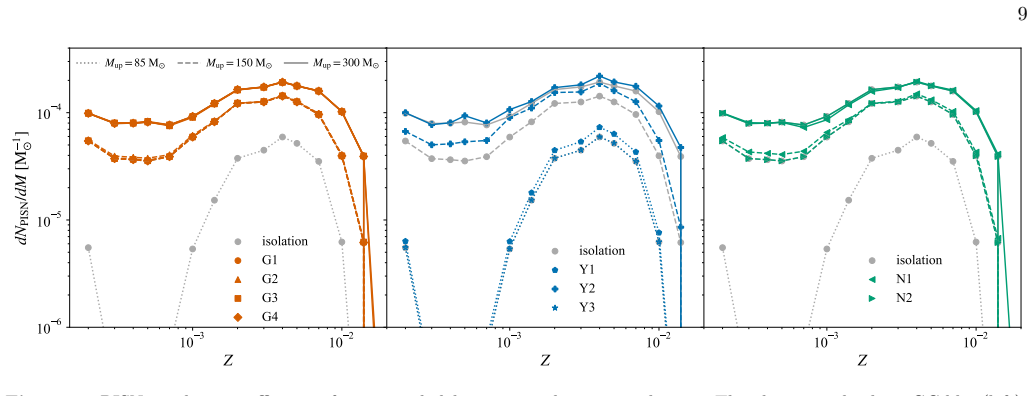
Binary interactions can boost the PISN rate by up to threefold relative to single stars, whereas binary hardening can either enhance or suppress PISN production depending on whether the progenitors are primordial or dynamically formed. The study supplies a comprehensive framework for the cosmic PISN rate that can be compared with observations to constrain stellar-wind mass loss in very-massive stars and the galaxy metallicity distribution throughout the Universe.
What carries the argument
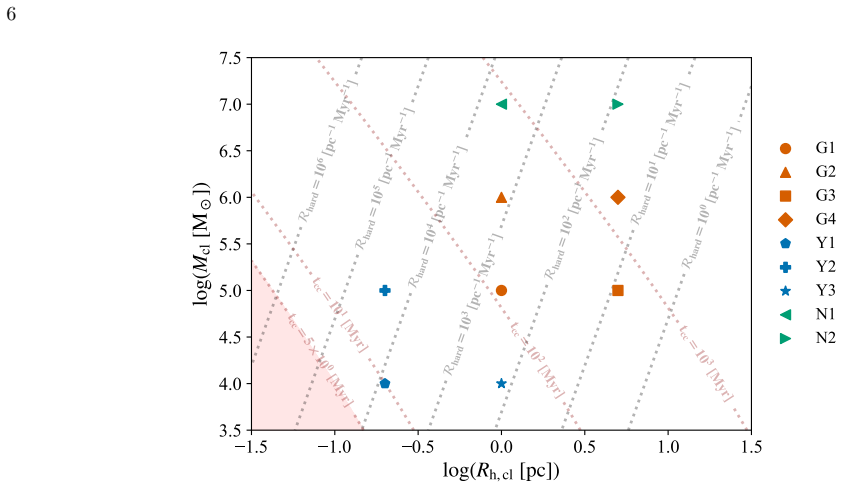
A suite of 35 synthetic binary populations evolved with the SEVN code using PARSEC stellar tracks, incorporating changes in formation channels, cluster properties, and the upper limit of the initial mass function.
If this is right
- Binary interactions raise the total PISN rate relative to single-star models.
- Binary hardening enhances PISN production for primordial binaries but can suppress it for dynamically formed ones.
- Comparison of the modeled cosmic rate with future observations constrains recipes for stellar-wind mass loss in very-massive stars.
- The same comparison constrains the metallicity distribution of galaxies across cosmic time.
- The updated rates bear on chemical enrichment of galaxies and on the interpretation of gravitational-wave signals from binary black-hole mergers.
Where Pith is reading between the lines
- Observed PISN rates or upper limits could distinguish between isolated-binary and cluster-channel contributions once metallicity is accounted for.
- The framework might be used to predict how PISN rates evolve with redshift and thereby inform searches for red dropout sources.
- Adjusting for the binary boost could narrow the expected range of heavy-element yields from PISNe in early galaxies.
Load-bearing premise
The PARSEC stellar tracks and SEVN binary evolution prescriptions correctly capture the mass-loss and interaction physics that decide whether a star reaches the pair-instability regime.
What would settle it
A measured cosmic PISN rate at low metallicity lying well outside the range spanned by the 35 populations when binary fraction, cluster density, and initial mass function cutoff are varied within the modeled limits.
Figures





read the original abstract
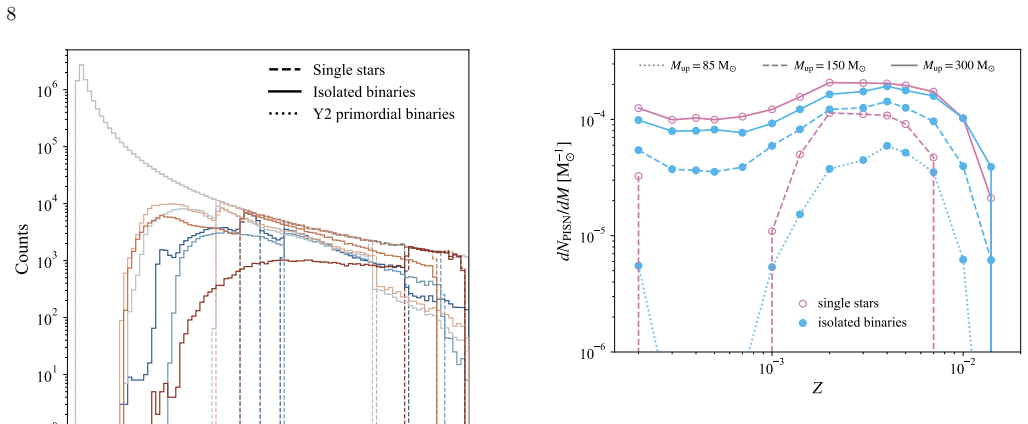
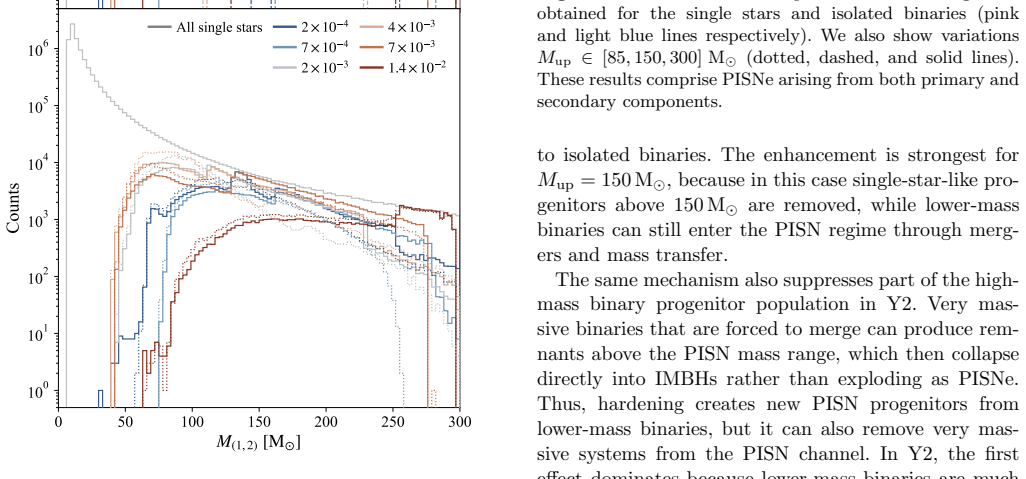
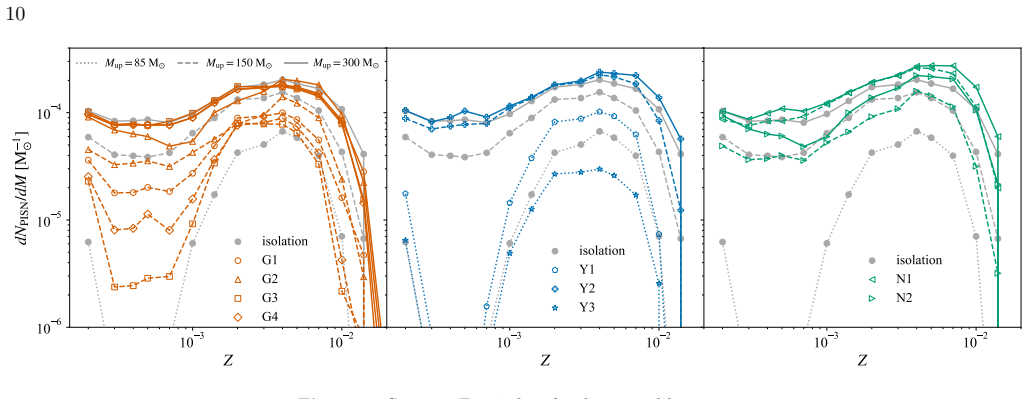
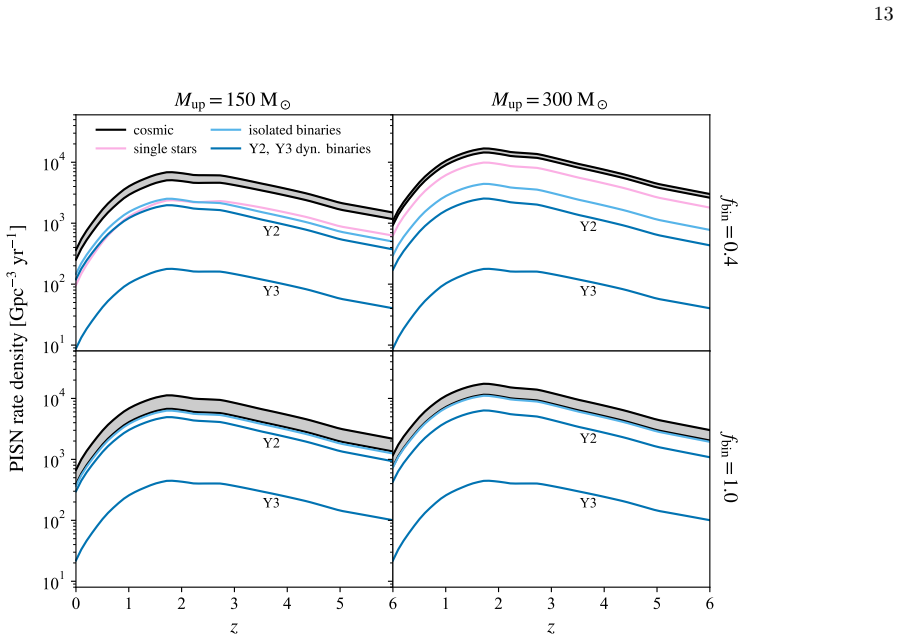
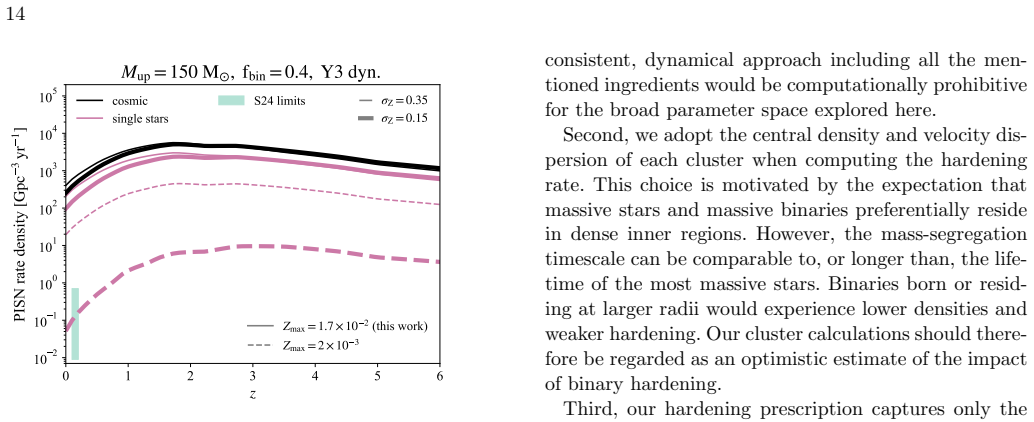
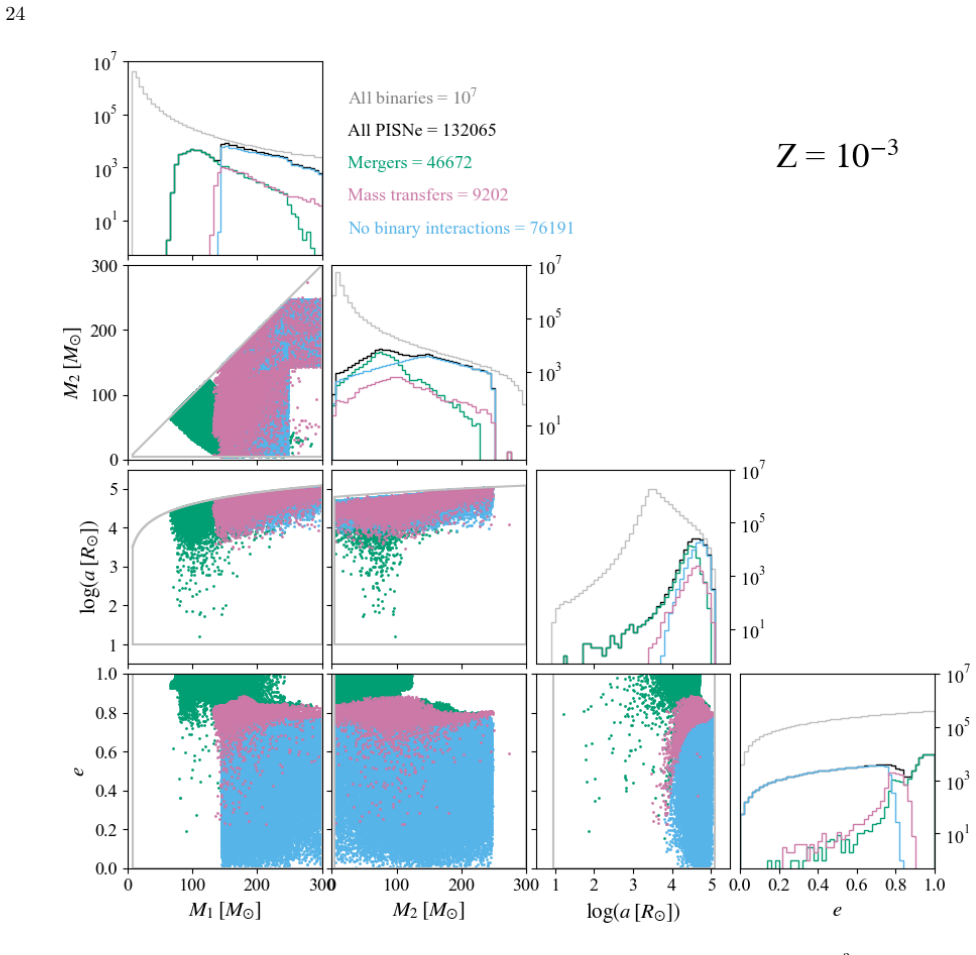
Pair-instability supernovae (PISNe) are among the most luminous transients in the Universe. However, they have never been confidently observed. Solving this puzzle would have key implications for several astrophysical topics, including galaxy chemical enrichment, the interpretation of gravitational waves from binary black hole mergers, and the nature of red dropout sources seen by JWST. With this aim, we present the first in-depth study of PISN occurrence in binary stars, both in isolation and in dense star clusters. We employ the SEVN code, with PARSEC stellar tracks, to evolve a suite of 35 synthetic binary populations, including variations on formation channels, cluster properties, and upper limit of the stellar initial mass function. We find that binary interactions can boost the PISN rate by up to threefold, relative to single stars, whereas binary hardening can either enhance or suppress PISN production, depending on whether the progenitors are primordial or dynamically formed. Moreover, we showcase how our comprehensive framework for the cosmic PISN rate can be used to constrain uncertain aspects of stellar and galaxy evolution models, via comparison with observations, including the recipes for stellar-wind mass loss in very-massive stars, and the galaxy metallicity distribution throughout the Universe.
Editorial analysis
A structured set of objections, weighed in public.
Referee Report
Summary. The manuscript uses the SEVN population synthesis code with PARSEC stellar tracks to evolve 35 synthetic binary populations, varying formation channels, cluster density, and IMF upper limit. It reports that binary interactions boost the PISN rate by up to a factor of three relative to single stars, while binary hardening can enhance or suppress PISN production depending on whether progenitors are primordial or dynamically formed. The work proposes using the resulting cosmic PISN rate framework to constrain stellar wind mass loss and galaxy metallicity distributions via future observations.
Significance. If the quantitative results hold, the study provides the first systematic exploration of binary and dynamical effects on PISN rates, with potential implications for GW source interpretation, chemical enrichment, and JWST dropout sources. The use of 35 populations spanning multiple channels and parameters is a clear strength, enabling exploration of formation uncertainties. The framework for observational constraints on stellar and galactic models is a useful contribution, though its impact depends on robustness to the fixed stellar-evolution engine.
major comments (3)
- [Abstract and results on rate calculations] Abstract and results section on rate calculations: The central claim of up to a threefold boost from binary interactions is derived from populations that hold the PARSEC/SEVN mass-loss and interaction prescriptions fixed while varying only channels, density, and IMF upper limit. No cross-code comparison (e.g., to COMPAS, BPASS, or MESA with alternate wind/overshooting recipes) is shown; such variations are known to shift the effective PISN mass window by several solar masses and could alter the reported enhancement factor.
- [Results section presenting the 35 populations] Results section presenting the 35 populations: No error bars, convergence tests with respect to population size or Monte Carlo sampling, or direct validation against observed PISN candidates or rate limits are reported. This leaves the quantitative threefold factor without quantified uncertainty, undermining its use for constraining stellar physics as proposed.
- [Section discussing binary hardening effects] Section discussing binary hardening effects: The distinction that hardening enhances PISN for primordial progenitors but can suppress it for dynamically formed ones is stated without explicit criteria or diagnostics used to classify progenitors as primordial vs. dynamically formed in the cluster simulations, making the channel-dependent claim difficult to assess.
minor comments (2)
- [Methods] The description of how the 35 populations are constructed would benefit from a summary table listing the varied parameters (formation channel, density, IMF limit) for each run.
- [Figures] Figure captions for rate plots should explicitly state whether rates are normalized to single-star cases or absolute, and include the single-star baseline for direct comparison.
Simulated Author's Rebuttal
We thank the referee for their thoughtful and constructive report. We address each major comment below and indicate where revisions will be made to strengthen the manuscript. Our responses focus on clarifying the scope of the study while acknowledging its limitations.
read point-by-point responses
-
Referee: Abstract and results section on rate calculations: The central claim of up to a threefold boost from binary interactions is derived from populations that hold the PARSEC/SEVN mass-loss and interaction prescriptions fixed while varying only channels, density, and IMF upper limit. No cross-code comparison (e.g., to COMPAS, BPASS, or MESA with alternate wind/overshooting recipes) is shown; such variations are known to shift the effective PISN mass window by several solar masses and could alter the reported enhancement factor.
Authors: We agree that the reported enhancement factor is specific to the SEVN code with PARSEC tracks and the fixed mass-loss prescriptions used. The study was intentionally designed to isolate the impact of binary interactions and dynamical encounters by holding stellar evolution physics constant across the 35 populations. Performing a full cross-code comparison lies outside the scope of this work, as it would require re-implementing the entire suite of cluster and binary simulations in multiple independent codes. We will revise the abstract, introduction, and discussion sections to explicitly state that the threefold boost is relative to single-star evolution within the SEVN/PARSEC framework and to note the potential sensitivity of the quantitative factor to alternate wind and overshooting prescriptions. revision: partial
-
Referee: Results section presenting the 35 populations: No error bars, convergence tests with respect to population size or Monte Carlo sampling, or direct validation against observed PISN candidates or rate limits are reported. This leaves the quantitative threefold factor without quantified uncertainty, undermining its use for constraining stellar physics as proposed.
Authors: The 35 populations were generated with fixed random seeds and sufficiently large sample sizes (typically 10^5–10^6 binaries per population) such that Poisson uncertainties on the PISN fractions are small compared to the reported trends. However, we did not include explicit convergence tests or error bars in the presented figures. Direct validation against observations is not yet possible because no confirmed PISN events exist. In the revised manuscript we will add a dedicated subsection discussing sample sizes, estimated statistical uncertainties on the rates, and the absence of observational anchors, while retaining the framework for future constraints once data become available. revision: yes
-
Referee: Section discussing binary hardening effects: The distinction that hardening enhances PISN for primordial progenitors but can suppress it for dynamically formed ones is stated without explicit criteria or diagnostics used to classify progenitors as primordial vs. dynamically formed in the cluster simulations, making the channel-dependent claim difficult to assess.
Authors: In the cluster simulations, a binary is classified as primordial if both components were paired at the initial time and no exchange interaction occurred prior to the PISN progenitor stage; it is classified as dynamically formed if at least one component was exchanged or captured during the N-body evolution. We will add a clear paragraph in the methods and results sections describing these classification criteria, together with the relevant diagnostic flags output by the SEVN cluster module, so that readers can reproduce the distinction. revision: yes
Circularity Check
No significant circularity; simulation outputs are independent of fitted inputs
full rationale
The paper computes PISN occurrence rates by evolving 35 synthetic binary populations with fixed PARSEC stellar tracks and SEVN binary prescriptions, varying only formation channels, cluster density, and IMF upper limit. The reported up-to-threefold boost is an emergent numerical result from these runs, not a re-expression of any parameter fitted inside the paper. No equation or section defines a quantity in terms of itself, renames a known result, or invokes a self-citation chain as the sole justification for the central claim. External observations are invoked only for future constraint, not for internal validation of the boost factor. The derivation chain is therefore self-contained.
Axiom & Free-Parameter Ledger
free parameters (1)
- upper limit of the stellar initial mass function
axioms (1)
- domain assumption PARSEC stellar tracks and SEVN binary prescriptions accurately model the evolution of very massive stars into the pair-instability regime
Reference graph
Works this paper leans on
-
[1]
JWST spectroscopic confirmation of the Cosmic Gems arc at z = 9.625: Insights into the small-scale structure of a post-burst system. , keywords =. doi:10.1051/0004-6361/202556574 , archivePrefix =. 2507.18705 , primaryClass =
-
[2]
Foreman-Mackey, Daniel and Hogg, David W. and Lang, Dustin and Goodman, Jonathan , year=. <ttgtremcee</ttgtr: The MCMC Hammer , volume=. PASP , publisher=. doi:10.1086/670067 , number=
-
[3]
Madau, Piero and Dickinson, Mark , year=. Cosmic Star-Formation History , volume=. ARA&A , publisher=. doi:10.1146/annurev-astro-081811-125615 , number=
work page internal anchor Pith review doi:10.1146/annurev-astro-081811-125615
-
[4]
Robertson, Brant E. and Ellis, Richard S. and Furlanetto, Steven R. and Dunlop, James S. , year=. Cosmic Reionization and Early Star-Forming Galaxies: a Joint Analysis of New Constraints from Planck and the Hubble Space Telescope , volume=. ApJ , publisher=. doi:10.1088/2041-8205/802/2/l19 , number=
-
[5]
and D’Aloisio, Anson and Paardekooper, Jan-Pieter and Russell Ryan Jr
Finkelstein, Steven L. and D’Aloisio, Anson and Paardekooper, Jan-Pieter and Russell Ryan Jr. and Behroozi, Peter and Finlator, Kristian and Livermore, Rachael and Sanderbeck, Phoebe R. Upton and Vecchia, Claudio Dalla and Khochfar, Sadegh , year=. Conditions for Reionizing the Universe with a Low Galaxy Ionizing Photon Escape Fraction , volume=. ApJ , pu...
-
[6]
Kennicutt, Robert C. and Evans, Neal J. , year=. Star Formation in the Milky Way and Nearby Galaxies , volume=. ARA&A , publisher=. doi:10.1146/annurev-astro-081811-125610 , number=
work page internal anchor Pith review doi:10.1146/annurev-astro-081811-125610
-
[7]
Cai, Zhen-Yi and Lapi, Andrea and Bressan, Alessandro and De Zotti, Gianfranco and Negrello, Mattia and Danese, Luigi , year=. A Physical Model for the Evolving Ultraviolet Luminosity Function of High Redshift Galaxies and their Contribution to the Cosmic Reionization , volume=. ApJ , publisher=. doi:10.1088/0004-637x/785/1/65 , number=
-
[8]
Alessandro Bressan and Paola Marigo and L. Stellar tracks and isochrones with the. doi:10.1111/j.1365-2966.2012.21948.x , url =
-
[9]
Chen, Yang and Girardi, LEo and Bressan, Alessandro and Marigo, Paola and Barbieri, Mauro and Kong, Xu , title = ". MNRAS , volume =. 2014 , month =. doi:10.1093/mnras/stu1605 , url =
-
[10]
Tang, Jing and Bressan, Alessandro and Rosenfield, Philip and Slemer, Alessandra and Marigo, Paola and Girardi, LEo and Bianchi, Luciana , title = ". MNRAS , volume =. 2014 , month =. doi:10.1093/mnras/stu2029 , url =
-
[11]
Chen, Yang and Bressan, Alessandro and Girardi, LEo and Marigo, Paola and Kong, Xu and Lanza, Antonio , title = ". MNRAS , volume =. 2015 , month =. doi:10.1093/mnras/stv1281 , url =
-
[12]
S. Goswami and A. Slemer and P. Marigo and A. Bressan and L. Silva and M. Spera and L. Boco and V. Grisoni and L. Pantoni and A. Lapi , title =. doi:10.1051/0004-6361/202039842 , url =
-
[13]
S. Goswami and L. Silva and A. Bressan and V. Grisoni and G. Costa and P. Marigo and G. L. Granato and A. Lapi and M. Spera , title =. doi:10.1051/0004-6361/202142031 , url =
-
[14]
LSST Science Book, Version 2.0
LSST Science Book, Version 2.0. arXiv e-prints , keywords =. doi:10.48550/arXiv.0912.0201 , archivePrefix =. 0912.0201 , primaryClass =
work page internal anchor Pith review Pith/arXiv arXiv doi:10.48550/arxiv.0912.0201
-
[15]
Costa, Guglielmo and Girardi, LEo and Bressan, Alessandro and Marigo, Paola and Rodrigues, Thaíse S and Chen, Yang and Lanza, Antonio and Goudfrooij, Paul , title = ". MNRAS , volume =. 2019 , month =. doi:10.1093/mnras/stz728 , url =
-
[16]
Formation of GW190521 from stellar evolution: the impact of the hydrogen-rich envelope, dredge-up, and ^ 12 C( , ) ^ 16 O rate on the pair-instability black hole mass gap. , keywords =. doi:10.1093/mnras/staa3916 , archivePrefix =. 2010.02242 , primaryClass =
-
[17]
Nguyen, C. T. and Costa, G. and Girardi, L. and Volpato, G. and Bressan, A. and Chen, Y. and Marigo, P. and Fu, X. and Goudfrooij, P. , year=. PARSEC V2.0: Stellar tracks and isochrones of low- and intermediate-mass stars with rotation , volume=. doi:10.1051/0004-6361/202244166 , journal=
-
[18]
Planck 2018 results , journal =. doi:10.1051/0004-6361/201833910 , url =
-
[19]
2011, http://dx.doi.org/10.1007/s11207-010-9541-4 magenta Sol
E. Caffau and H.-G. Ludwig and M. Steffen and B. Freytag and P. Bonifacio , title =. doi:10.1007/s11207-010-9541-4 , url =
-
[20]
Larson, Richard B. , title = ". MNRAS , volume =. 1998 , month =. doi:10.1046/j.1365-8711.1998.02045.x , url =
-
[21]
Gruppioni, C. and Pozzi, F. and Rodighiero, G. and Delvecchio, I. and Berta, S. and Pozzetti, L. and Zamorani, G. and Andreani, P. and Cimatti, A. and Ilbert, O. and Le Floc’h, E. and Lutz, D. and Magnelli, B. and Marchetti, L. and Monaco, P. and Nordon, R. and Oliver, S. and Popesso, P. and Riguccini, L. and Roseboom, I. and Rosario, D. J. and Sargent, M...
-
[22]
Gruppioni, C. and BEthermin, M. and Loiacono, F. and Le Fèvre, O. and Capak, P. and Cassata, P. and Faisst, A. L. and Schaerer, D. and Silverman, J. and Yan, L. and Bardelli, S. and Boquien, M. and Carraro, R. and Cimatti, A. and Dessauges-Zavadsky, M. and Ginolfi, M. and Fujimoto, S. and Hathi, N. P. and Jones, G. C. and Khusanova, Y. and Koekemoer, A. M...
-
[23]
Oesch, P. A. and Bouwens, R. J. and Illingworth, G. D. and LabbE, I. and Stefanon, M. , year=. The Dearth of z=10 Galaxies in All HST Legacy Fields—The Rapid Evolution of the Galaxy Population in the First 500 Myr , volume=. ApJ , publisher=. doi:10.3847/1538-4357/aab03f , number=
-
[24]
Bouwens, R. J. and Oesch, P. A. and Stefanon, M. and Illingworth, G. and LabbE, I. and Reddy, N. and Atek, H. and Montes, M. and Naidu, R. and Nanayakkara, T. and Nelson, E. and Wilkins, S. , year=. New Determinations of the UV Luminosity Functions from z=9 to 2 Show a Remarkable Consistency with Halo Growth and a Constant Star Formation Efficiency , volu...
-
[25]
Donnan, C T and McLeod, D J and Dunlop, J S and McLure, R J and Carnall, A C and Begley, R and Cullen, F and Hamadouche, M L and Bowler, R A A and Magee, D and McCracken, H J and Milvang-Jensen, B and Moneti, A and Targett, T , title = ". MNRAS , volume =. 2022 , month =. doi:10.1093/mnras/stac3472 , url =
-
[26]
Harikane, Yuichi and Ouchi, Masami and Oguri, Masamune and Ono, Yoshiaki and Nakajima, Kimihiko and Isobe, Yuki and Umeda, Hiroya and Mawatari, Ken and Zhang, Yechi , year=. A Comprehensive Study of Galaxies at z = 9–16 Found in the Early JWST Data: Ultraviolet Luminosity Functions and Cosmic Star Formation History at the Pre-reionization Epoch , volume=....
-
[27]
Weaver, J. R. and Davidzon, I. and Toft, S. and Ilbert, O. and McCracken, H. J. and Gould, K. M. L. and Jespersen, C. K. and Steinhardt, C. and Lagos, C. D. P. and Capak, P. L. and Casey, C. M. and Chartab, N. and Faisst, A. L. and Hayward, C. C. and Kartaltepe, J. S. and Kauffmann, O. B. and Koekemoer, A. M. and Kokorev, V. and Laigle, C. and Liu, D. and...
-
[28]
Spera, Mario and Mapelli, Michela , year=. Very massive stars, pair-instability supernovae and intermediate-mass black holes with the sevn code , volume=. MNRAS , publisher=. doi:10.1093/mnras/stx1576 , number=
-
[29]
Marigo, Paola and Cummings, Jeffrey D. and Curtis, Jason Lee and Kalirai, Jason and Chen, Yang and Tremblay, Pier-Emmanuel and Ramirez-Ruiz, Enrico and Bergeron, Pierre and Bladh, Sara and Bressan, Alessandro and Girardi, LEo and Pastorelli, Giada and Trabucchi, Michele and Cheng, Sihao and Aringer, Bernhard and Tio, Piero Dal , year=. Carbon star formati...
-
[30]
Cummings, Jeffrey D. and Kalirai, Jason S. and Tremblay, P.-E. and Ramirez-Ruiz, Enrico and Choi, Jieun , year=. The White Dwarf Initial–Final Mass Relation for Progenitor Stars from 0.85 to 7.5 Msun , volume=. ApJ , publisher=. doi:10.3847/1538-4357/aadfd6 , number=
-
[31]
The Initial-Final Mass Relation of White Dwarfs: A Tool to Calibrate the Third Dredge-Up. Universe , keywords =. doi:10.3390/universe8040243 , archivePrefix =. 2204.06470 , primaryClass =
-
[32]
Observational Clues to the Progenitors of Type Ia Supernovae , volume=
Maoz, Dan and Mannucci, Filippo and Nelemans, Gijs , year=. Observational Clues to the Progenitors of Type Ia Supernovae , volume=. ARA&A , publisher=. doi:10.1146/annurev-astro-082812-141031 , number=
-
[33]
JADES: Insights into the low-mass end of the mass-metallicity-SFR relation at 3 < z < 10 from deep JWST/NIRSpec spectroscopy. , keywords =. doi:10.1051/0004-6361/202346698 , archivePrefix =. 2304.08516 , primaryClass =
-
[34]
doi:10.1093/mnras/stac3214 , url =
P Popesso and A Concas and G Cresci and S Belli and G Rodighiero and H Inami and M Dickinson and O Ilbert and M Pannella and D Elbaz , title =. doi:10.1093/mnras/stac3214 , url =
-
[35]
Chruślińska, Martyna and Nelemans, Gijs and Boco, Lumen and Lapi, Andrea , title = ". MNRAS , volume =. 2021 , month =. doi:10.1093/mnras/stab2690 , url =
-
[36]
Graur, O. and Poznanski, D. and Maoz, D. and Yasuda, N. and Totani, T. and Fukugita, M. and Filippenko, A. V. and Foley, R. J. and Silverman, J. M. and Gal-Yam, A. and Horesh, A. and Jannuzi, B. T. , year=. Supernovae in the Subaru Deep Field: the rate and delay-time distribution of Type Ia supernovae out to redshift 2: Supernovae in the Subaru Deep Field...
-
[37]
Taylor, Matt and Cinabro, David and Dilday, Ben and Galbany, Lluis and Gupta, Ravi R. and Kessler, R. and Marriner, John and Nichol, Robert C. and Richmond, Michael and Schneider, Donald P. and Sollerman, Jesper , year=. The Core Collapse Supernova Rate from the SDSS-II Supernova Survey , volume=. ApJ , publisher=. doi:10.1088/0004-637x/792/2/135 , number=
-
[38]
Graur, Or and Bianco, Federica B. and Modjaz, Maryam , year=. A unified explanation for the supernova rate-galaxy mass dependence based on supernovae detected in Sloan galaxy spectra , volume=. MNRAS , publisher=. doi:10.1093/mnras/stv713 , number=
-
[39]
Cappellaro, E. and Botticella, M. T. and Pignata, G. and Grado, A. and Greggio, L. and Limatola, L. and Vaccari, M. and Baruffolo, A. and Benetti, S. and Bufano, F. and Capaccioli, M. and Cascone, E. and Covone, G. and De Cicco, D. and Falocco, S. and Della Valle, M. and Jarvis, M. and Marchetti, L. and Napolitano, N. R. and Paolillo, M. and Pastorello, A...
-
[40]
and Graur, Or and Riess, Adam G
Strolger, Louis-Gregory and Dahlen, Tomas and Rodney, Steven A. and Graur, Or and Riess, Adam G. and McCully, Curtis and Ravindranath, Swara and Mobasher, Bahram and Shahady, A. Kristin , year=. The Rate of Core Collapse Supernovae to Redshift 2.5 from the Candels and Clash Supernova Surveys , volume=. ApJ , publisher=. doi:10.1088/0004-637x/813/2/93 , number=
-
[41]
Petrushevska, T. and Amanullah, R. and Goobar, A. and Fabbro, S. and Johansson, J. and Kjellsson, T. and Lidman, C. and Paech, K. and Richard, J. and Dahle, H. and Ferretti, R. and Kneib, J. P. and Limousin, M. and Nordin, J. and Stanishev, V. , year=. High-redshift supernova rates measured with the gravitational telescope A1689 , volume=. doi:10.1051/000...
-
[42]
A new determination of supernova rates and a comparison with indicators for galactic star formation
A new determination of supernova rates and a comparison with indicators for galactic star formation. , keywords =. doi:10.48550/arXiv.astro-ph/9904225 , archivePrefix =. astro-ph/9904225 , primaryClass =
work page internal anchor Pith review Pith/arXiv arXiv doi:10.48550/arxiv.astro-ph/9904225
-
[43]
R., Vincenzi, M., et al.\ 2021, , 500, 5142, doi:10.1093/mnras/staa3607
Frohmaier, C and Angus, C R and Vincenzi, M and Sullivan, M and Smith, M and Nugent, P E and Cenko, S B and Gal-Yam, A and Kulkarni, S R and Law, N M and Quimby, R M , year=. From core collapse to superluminous: the rates of massive stellar explosions from the Palomar Transient Factory , volume=. MNRAS , publisher=. doi:10.1093/mnras/staa3607 , number=
-
[44]
Ziegler, Joshua J and Edwards, Thomas D P and Suliga, Anna M and Tamborra, Irene and Horiuchi, Shunsaku and Ando, Shin’ichiro and Freese, Katherine , year=. Non-universal stellar initial mass functions: large uncertainties in star formation rates at z = 2–4 and other astrophysical probes , volume=. MNRAS , publisher=. doi:10.1093/mnras/stac2748 , number=
-
[45]
Cappellaro, E. and Riello, M. and Altavilla, G. and Botticella, M. T. and Benetti, S. and Clocchiatti, A. and Danziger, J. I. and Mazzali, P. and Pastorello, A. and Patat, F. and Salvo, M. and Turatto, M. and Valenti, S. , year=. Death rate of massive stars at redshift. A&A , publisher=. doi:10.1051/0004-6361:20041256 , number=
-
[46]
Botticella, M. T. and Riello, M. and Cappellaro, E. and Benetti, S. and Altavilla, G. and Pastorello, A. and Turatto, M. and Greggio, L. and Patat, F. and Valenti, S. and Zampieri, L. and Harutyunyan, A. and Pignata, G. and Taubenberger, S. , year=. Supernova rates from the Southern inTermediate Redshift ESO Supernova Search (STRESS) , volume=. A&A , publ...
-
[47]
Bazin, G. and Palanque-Delabrouille, N. and Rich, J. and Ruhlmann-Kleider, V. and Aubourg, E. and Le Guillou, L. and Astier, P. and Balland, C. and Basa, S. and Carlberg, R. G. and Conley, A. and Fouchez, D. and Guy, J. and Hardin, D. and Hook, I. M. and Howell, D. A. and Pain, R. and Perrett, K. and Pritchet, C. J. and Regnault, N. and Sullivan, M. and A...
-
[48]
Botticella, M. T. and Smartt, S. J. and Kennicutt, R. C. and Cappellaro, E. and Sereno, M. and Lee, J. C. , year=. A comparison between star formation rate diagnostics and rate of core collapse supernovae within 11 Mpc , volume=. doi:10.1051/0004-6361/201117343 , journal=
-
[49]
Melinder, J. and Dahlen, T. and Mencía Trinchant, L. and Östlin, G. and Mattila, S. and Sollerman, J. and Fransson, C. and Hayes, M. and Kankare, E. and Nasoudi-Shoar, S. , year=. The rate of supernovae at redshift 0.1–1.0: The Stockholm VIMOS Supernova Survey III , volume=. doi:10.1051/0004-6361/201219364 , journal=
-
[50]
and Mobasher, Bahram and Chary, Ranga‐Ram and Conselice, Christopher J
Dahlen, Tomas and Strolger, Louis‐Gregory and Riess, Adam G. and Mobasher, Bahram and Chary, Ranga‐Ram and Conselice, Christopher J. and Ferguson, Henry C. and Fruchter, Andrew S. and Giavalisco, Mauro and Livio, Mario and Madau, Piero and Panagia, Nino and Tonry, John L. , year=. High‐Redshift Supernova Rates , volume=. ApJ , publisher=. doi:10.1086/4228...
-
[51]
Dahlen, Tomas and Strolger, Louis‐Gregory and Riess, Adam G. , year=. The ExtendedHSTSupernova Survey: The Rate of SNe Ia atzandgt; 1.4 Remains Low , volume=. ApJ , publisher=. doi:10.1086/587978 , number=
-
[52]
and Mattila, Seppo and Kankare, Erkki and Mobasher, Bahram , year=
Dahlen, Tomas and Strolger, Louis-Gregory and Riess, Adam G. and Mattila, Seppo and Kankare, Erkki and Mobasher, Bahram , year=. The Extended Hubble Space Telescope Supernova Survey: The Rate of Core Collapse Supernovae to z=1 , volume=. ApJ , publisher=. doi:10.1088/0004-637x/757/1/70 , number=
-
[53]
Li, Weidong and Leaman, Jesse and Chornock, Ryan and Filippenko, Alexei V. and Poznanski, Dovi and Ganeshalingam, Mohan and Wang, Xiaofeng and Modjaz, Maryam and Jha, Saurabh and Foley, Ryan J. and Smith, Nathan , year=. Nearby supernova rates from the Lick Observatory Supernova Search - II. The observed luminosity functions and fractions of supernovae in...
-
[54]
Mattila, S. and Dahlen, T. and Efstathiou, A. and Kankare, E. and Melinder, J. and Alonso-Herrero, A. and PErez-Torres, M. A. and Ryder, S. and Väisänen, P. and Östlin, G. , year=. Core-Collapse Supernovae Missed by Optical Surveys , volume=. ApJ , publisher=. doi:10.1088/0004-637x/756/2/111 , number=
-
[55]
Smartt, S. J. and Eldridge, J. J. and Crockett, R. M. and Maund, J. R. , title = ". MNRAS , volume =. 2009 , month =. doi:10.1111/j.1365-2966.2009.14506.x , url =
-
[56]
Poznanski, D. and Maoz, D. and Yasuda, N. and Foley, R. J. and Doi, M. and Filippenko, A. V. and Fukugita, M. and Gal-Yam, A. and Jannuzi, B. T. and Morokuma, T. and Oda, T. and Schweiker, H. and Sharon, K. and Silverman, J. M. and Totani, T. , year=. Supernovae in the Subaru Deep Field: an initial sample and Type Ia rate out to redshift 1.6 , volume=. MN...
-
[57]
Kuznetsova, N. and Barbary, K. and Connolly, B. and Kim, A. G. and Pain, R. and Roe, N. A. and Aldering, G. and Amanullah, R. and Dawson, K. and Doi, M. and Fadeyev, V. and Fruchter, A. S. and Gibbons, R. and Goldhaber, G. and Goobar, A. and Gude, A. and Knop, R. A. and Kowalski, M. and Lidman, C. and Morokuma, T. and Meyers, J. and Perlmutter, S. and Rub...
-
[58]
and Holtzman, Jon and Marriner, John and Miknaitis, Gajus and Nichol, Robert C
Dilday, Benjamin and Kessler, Richard and Frieman, Joshua A. and Holtzman, Jon and Marriner, John and Miknaitis, Gajus and Nichol, Robert C. and Romani, Roger and Sako, Masao and Bassett, Bruce and Becker, Andrew and Cinabro, David and DeJongh, Fritz and Depoy, Darren L. and Doi, Mamoru and Garnavich, Peter M. and Hogan, Craig J. and Jha, Saurabh and Koni...
-
[59]
Horesh, A. and Poznanski, D. and Ofek, E. O. and Maoz, D. , year=. The rate of Type Ia supernovae at z= 0.2 from SDSS-I overlapping fields: Supernova rate from SDSS-I , volume=. MNRAS , publisher=. doi:10.1111/j.1365-2966.2008.13697.x , number=
-
[60]
Graham, M. L. and Pritchet, C. J. and Sullivan, M. and Howell, D. A. and Gwyn, S. D. J. and Astier, P. and Balland, C. and Basa, S. and Carlberg, R. G. and Conley, A. and Fouchez, D. and Guy, J. and Hardin, D. and Hook, I. M. and Pain, R. and Perrett, K. and Regnault, N. and Rich, J. and Balam, D. and Fabbro, S. and Hsiao, E. Y. and Mourao, A. and Palanqu...
-
[61]
Dilday, Benjamin and Smith, Mathew and Bassett, Bruce and Becker, Andrew and Bender, Ralf and Castander, Francisco and Cinabro, David and Filippenko, Alexei V. and Frieman, Joshua A. and Galbany, Lluís and Garnavich, Peter M. and Goobar, Ariel and Hopp, Ulrich and Ihara, Yutaka and Jha, Saurabh W. and Kessler, Richard and Lampeitl, Hubert and Marriner, Jo...
-
[62]
Dilday, Benjamin and Bassett, Bruce and Becker, Andrew and Bender, Ralf and Castander, Francisco and Cinabro, David and Frieman, Joshua A. and Galbany, Lluís and Garnavich, Peter and Goobar, Ariel and Hopp, Ulrich and Ihara, Yutaka and Jha, Saurabh W. and Kessler, Richard and Lampeitl, Hubert and Marriner, John and Miquel, Ramon and Mollá, Mercedes and Ni...
-
[63]
Barbary, K. and Aldering, G. and Amanullah, R. and Brodwin, M. and Connolly, N. and Dawson, K. S. and Doi, M. and Eisenhardt, P. and Faccioli, L. and Fadeyev, V. and Fakhouri, H. K. and Fruchter, A. S. and Gilbank, D. G. and Gladders, M. D. and Goldhaber, G. and Goobar, A. and Hattori, T. and Hsiao, E. and Huang, X. and Ihara, Y. and Kashikawa, N. and Koe...
-
[64]
Barbary, K. and Aldering, G. and Amanullah, R. and Brodwin, M. and Connolly, N. and Dawson, K. S. and Doi, M. and Eisenhardt, P. and Faccioli, L. and Fadeyev, V. and Fakhouri, H. K. and Fruchter, A. S. and Gilbank, D. G. and Gladders, M. D. and Goldhaber, G. and Goobar, A. and Hattori, T. and Hsiao, E. and Huang, X. and Ihara, Y. and Kashikawa, N. and Koe...
-
[65]
Sand, David J. and Graham, Melissa L. and Bildfell, Chris and Zaritsky, Dennis and Pritchet, Chris and Hoekstra, Henk and Just, Dennis W. and Herbert-Fort, StEphane and Sivanandam, Suresh and Foley, Ryan J. and Mahdavi, Andisheh , year=. The Multi-Epoch Nearby Cluster Survey: Type Ia Supernova Rate Measurement in z=0.1 Clusters and the Late-Time Delay Tim...
-
[66]
Graur, Or and Maoz, Dan , year=. Discovery of 90 Type Ia supernovae among 700 000 Sloan spectra: the Type Ia supernova rate versus galaxy mass and star formation rate at redshift =0.1 , volume=. MNRAS , publisher=. doi:10.1093/mnras/sts718 , number=
-
[67]
Graur, O. and Rodney, S. A. and Maoz, D. and Riess, A. G. and Jha, S. W. and Postman, M. and Dahlen, T. and Holoien, T. W.-S. and McCully, C. and Patel, B. and Strolger, L.-G. and Benítez, N. and Coe, D. and Jouvel, S. and Medezinski, E. and Molino, A. and Nonino, M. and Bradley, L. and Koekemoer, A. and Balestra, I. and Cenko, S. B. and Clubb, K. I. and ...
-
[68]
Okumura, Jun E. and Ihara, Yutaka and Doi, Mamoru and Morokuma, Tomoki and Pain, Reynald and Totani, Tomonori and Barbary, Kyle and Takanashi, Naohiro and Yasuda, Naoki and Aldering, Greg and Dawson, Kyle and Goldhaber, Gerson and Hook, Isobel and Lidman, Chris and Perlmutter, Saul and Spadafora, Anthony and Suzuki, Nao and Wang, Lifan , year=. The Type I...
-
[69]
Perrett, K. and Sullivan, M. and Conley, A. and González-Gaitán, S. and Carlberg, R. and Fouchez, D. and Ripoche, P. and Neill, J. D. and Astier, P. and Balam, D. and Balland, C. and Basa, S. and Guy, J. and Hardin, D. and Hook, I. M. and Howell, D. A. and Pain, R. and Palanque-Delabrouille, N. and Pritchet, C. and Regnault, N. and Rich, J. and Ruhlmann-K...
-
[70]
Rodney, Steven A. and Riess, Adam G. and Strolger, Louis-Gregory and Dahlen, Tomas and Graur, Or and Casertano, Stefano and Dickinson, Mark E. and Ferguson, Henry C. and Garnavich, Peter and Hayden, Brian and Jha, Saurabh W. and Jones, David O. and Kirshner, Robert P. and Koekemoer, Anton M. and McCully, Curtis and Mobasher, Bahram and Patel, Brandon and ...
-
[71]
The Volumetric Rate of Calcium-rich Transients in the Local Universe , volume=
Frohmaier, Chris and Sullivan, Mark and Maguire, Kate and Nugent, Peter , year=. The Volumetric Rate of Calcium-rich Transients in the Local Universe , volume=. ApJ , publisher=. doi:10.3847/1538-4357/aabc0b , number=
-
[72]
Frohmaier, C and Sullivan, M and Nugent, P E and Smith, M and Dimitriadis, G and Bloom, J S and Cenko, S B and Kasliwal, M M and Kulkarni, S R and Maguire, K and Ofek, E O and Poznanski, D and Quimby, R M , year=. The volumetric rate of normal type Ia supernovae in the local Universe discovered by the Palomar Transient Factory , volume=. MNRAS , publisher...
-
[73]
Desai, D D and Kochanek, C S and Shappee, B J and Jayasinghe, T and Stanek, K Z and Holoien, T W -S and Thompson, T A and Ashall, C and Beacom, J F and Do, A and Dong, Subo and Prieto, J L , year=. Supernova rates and luminosity functions from ASAS-SN I: 2014–2017 Type Ia SNe and their subtypes , volume=. MNRAS , publisher=. doi:10.1093/mnras/stae606 , number=
-
[74]
Pain, R. and Fabbro, S. and Sullivan, M. and Ellis, R. S. and Aldering, G. and Astier, P. and Deustua, S. E. and Fruchter, A. S. and Goldhaber, G. and Goobar, A. and Groom, D. E. and Hardin, D. and Hook, I. M. and Howell, D. A. and Irwin, M. J. and Kim, A. G. and Kim, M. Y. and Knop, R. A. and Lee, J. C. and Lidman, C. and McMahon, R. G. and Nugent, P. E....
-
[75]
The Type Ia Supernova Rate , volume=
Scannapieco, Evan and Bildsten, Lars , year=. The Type Ia Supernova Rate , volume=. ApJ , publisher=. doi:10.1086/452632 , number=
-
[76]
Barris, Brian J. and Tonry, John L. , year=. The Rate of Type Ia Supernovae at High Redshift , volume=. ApJ , publisher=. doi:10.1086/498292 , number=
-
[77]
Neill, J. D. and Sullivan, M. and Balam, D. and Pritchet, C. J. and Howell, D. A. and Perrett, K. and Astier, P. and Aubourg, E. and Basa, S. and Carlberg, R. G. and Conley, A. and Fabbro, S. and Fouchez, D. and Guy, J. and Hook, I. and Pain, R. and Palanque-Delabrouille, N. and Regnault, N. and Rich, J. and Taillet, R. and Aldering, G. and Antilogus, P. ...
-
[78]
The Type Ia Supernova Rate at z$\sim 0.4 $
The Type IA Supernova Rate at Z approximately 0.4. , keywords =. doi:10.1086/178150 , archivePrefix =. astro-ph/9607034 , primaryClass =
work page internal anchor Pith review Pith/arXiv arXiv doi:10.1086/178150
-
[79]
Blanc, G. and Afonso, C. and Alard, C. and Albert, J. N. and Aldering, G. and Amadon, A. and Andersen, J. and Ansari, R. and Aubourg, E. and Balland, C. and Bareyre, P. and Beaulieu, J. P. and Charlot, X. and Conley, A. and Coutures, C. and DahlEn, T. and Derue, F. and Fan, X. and Ferlet, R. and Folatelli, G. and FouquE, P. and Garavini, G. and Glicenstei...
-
[80]
Madgwick, Darren S. and Hewett, Paul C. and Mortlock, Daniel J. and Wang, Lifan , year=. Spectroscopic Detection of Type Ia Supernovae in the Sloan Digital Sky Survey , volume=. ApJ , publisher=. doi:10.1086/381081 , number=
discussion (0)
Sign in with ORCID, Apple, or X to comment. Anyone can read and Pith papers without signing in.