MSFA-Net: An Advanced Deep Learning Model for Identifying Blue Horizontal-Branch Stars from LAMOST DR12
Pith reviewed 2026-06-30 04:33 UTC · model grok-4.3
The pith
A two-stage neural network identifies 3583 new blue horizontal-branch stars from LAMOST DR12 spectra at 98 percent refinement precision.
A machine-rendered reading of the paper's core claim, the machinery that carries it, and where it could break.
Core claim
MSFA-Net is a two-stage deep learning framework that applies multi-scale convolutions and soft frequency attention to learn discriminative representations from LAMOST spectra in both the wavelength and Fourier-frequency domains. On a held-out test set it reaches 94.67 percent precision in the initial multiclass screening and 98.07 percent in the binary refinement stage. When run on LAMOST DR12 the pipeline returns 27,853 BHB candidate spectra; after deduplication and removal of known objects, 3583 new BHB stars are identified and independently confirmed by Balmer-line profile fitting, with additional atmospheric parameters derived via the SLAM model and photometric validation against Gaia DR
What carries the argument
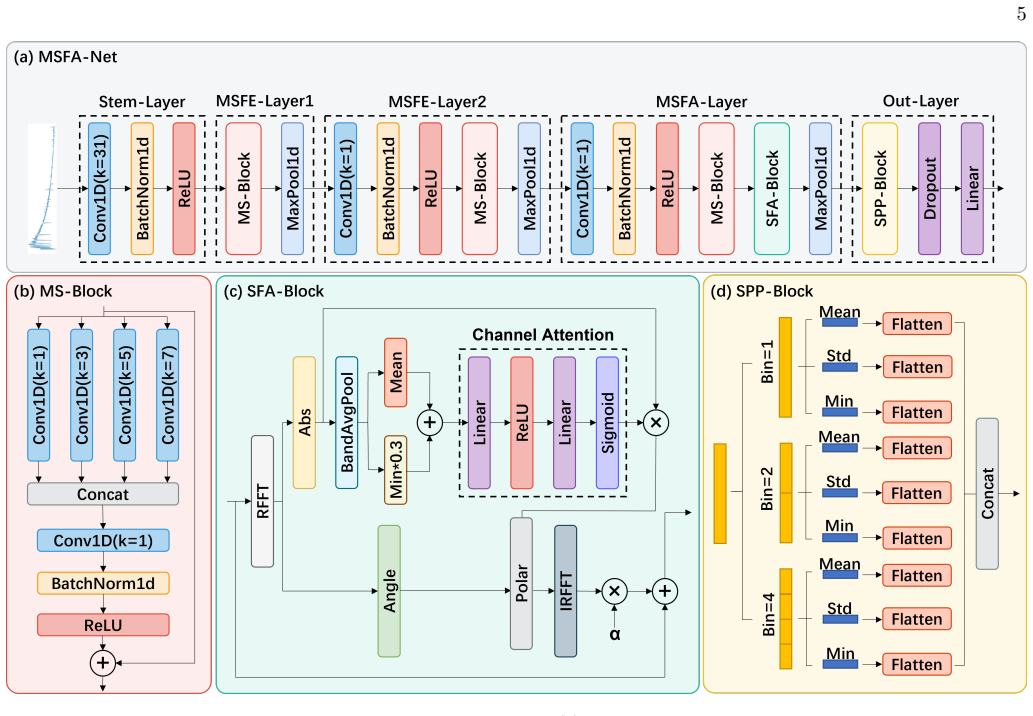
MSFA-Net, a two-stage framework that fuses multi-scale convolutions with a soft frequency attention mechanism operating across wavelength and Fourier-frequency domains to extract stellar-type features from low-resolution spectra.
If this is right
- The enlarged sample of 3583 new spectroscopically confirmed BHB stars supplies a homogeneous data set for mapping old, metal-poor populations in the Galactic halo.
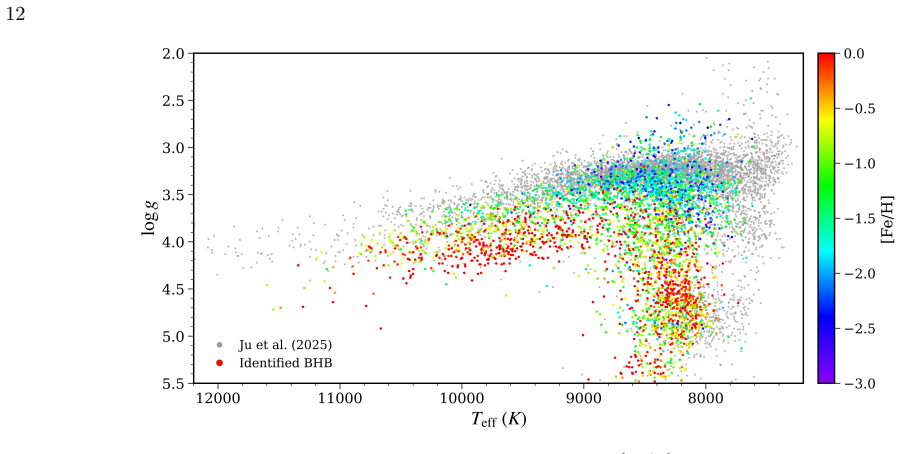
- Atmospheric parameters estimated for the candidates via the SLAM model allow examination of their Teff, log g, and [Fe/H] distributions.
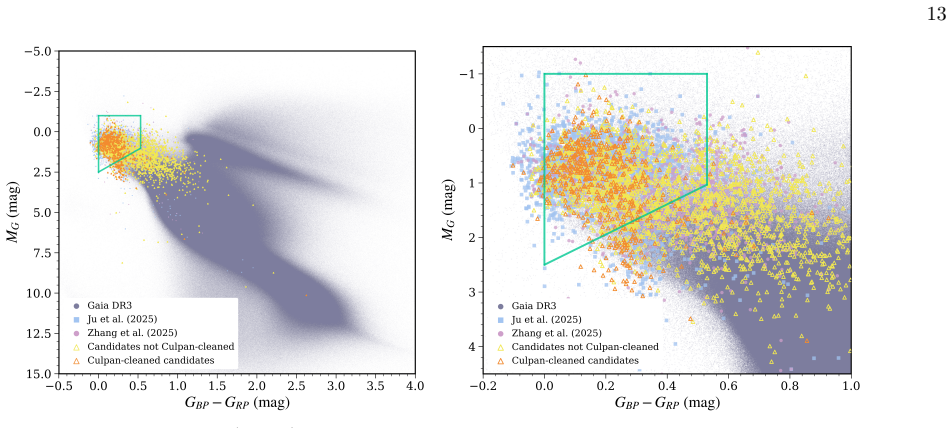
- Cross-matching with Gaia DR3 photometry and color-magnitude diagrams provides an external consistency check on the candidate list.
- The method substantially increases the number of BHB stars with LAMOST spectra available for studies of stellar populations and halo structure.
Where Pith is reading between the lines
- The frequency-attention component could be adapted to classification tasks involving other rare stellar types in large spectroscopic surveys.
- The new BHB catalog could be combined with kinematic data to place tighter constraints on halo substructure and accretion history.
- If the same two-stage architecture is retrained on spectra from other instruments, the precision numbers may transfer to those data sets with only modest retraining.
Load-bearing premise
Balmer-line profile fitting on the selected candidates supplies an independent and unbiased confirmation of true BHB status without appreciable contamination from other stellar types.
What would settle it
Independent high-resolution spectroscopy of a random subset of the 3583 candidates showing that a substantial fraction lack the Balmer-line shapes expected for BHB stars.
Figures
read the original abstract
Blue horizontal-branch (BHB) stars are low-mass, core helium-burning objects with nearly constant luminosities, making them powerful tracers of old, metal-poor populations and valuable standard candles for mapping the Galactic halo. However, robustly identifying BHB stars from low-resolution spectra remains challenging. We present MSFA-Net, a two-stage framework developed for the Large Sky Area Multi-Object Fiber Spectroscopic Telescope (LAMOST) DR12. By combining multi-scale convolutions with a soft frequency attention mechanism, MSFA-Net learns discriminative representations in both the wavelength domain and the Fourier-frequency domain. On the test set, the framework achieves a precision of 94.67% in the initial multiclass screening and 98.07% in the subsequent binary refinement. Applying the pipeline to LAMOST DR12, we retrieve 27,853 BHB candidate spectra. After spectral deduplication and removal of previously known objects, we identify 3583 new BHB stars, confirmed via Balmer-line profile fitting. We further estimate atmospheric parameters (Teff, log g, and [Fe/H]) using the machine-learning-based SLAM model and examine their distributions. A non-negligible subset shows unusually high log g and/or metallicities, which we interpret primarily as inference-related systematics rather than intrinsic properties. Photometric cross-matching with Gaia DR3 and color-magnitude diagrams provide an additional consistency check for the sample. The resulting catalog substantially enlarges the spectroscopically confirmed BHB sample from LAMOST and offers a homogeneous data set for studies of Galactic-halo structure and stellar populations.
Editorial analysis
A structured set of objections, weighed in public.
Referee Report
Summary. The manuscript presents MSFA-Net, a two-stage deep learning framework using multi-scale convolutions and soft frequency attention to identify blue horizontal-branch (BHB) stars from low-resolution LAMOST DR12 spectra. It reports test-set precisions of 94.67% (multiclass screening) and 98.07% (binary refinement), applies the pipeline to produce 27,853 BHB candidates, and after deduplication and removal of known objects identifies 3583 new BHB stars confirmed via Balmer-line profile fitting, with atmospheric parameters estimated via SLAM and consistency checks via Gaia DR3 cross-matches and color-magnitude diagrams.
Significance. If the Balmer-line confirmation step provides an independent and low-contamination validation, the resulting catalog would meaningfully enlarge the sample of spectroscopically confirmed BHB stars available for Galactic halo mapping and stellar population studies. The methodological combination of wavelength and Fourier-domain features is a targeted contribution to low-resolution spectral classification.
major comments (2)
- [Abstract] Abstract (final paragraph): The identification of 3583 new BHB stars rests on Balmer-line profile fitting as confirmation, yet no details are provided on whether this fitting uses features or labels independent of those in the MSFA-Net training set, nor is a recovery rate or false-positive rate quantified on a held-out literature BHB sample or higher-resolution spectra at LAMOST resolution; this directly affects the reliability of the 'new' count and downstream halo applications.
- [Abstract] Abstract: No information is given on the training/validation/test split sizes, handling of class imbalance, or error bars on the reported precision values (94.67% and 98.07%), which are load-bearing for assessing whether the test-set performance generalizes to the full DR12 application.
minor comments (1)
- [Abstract] Abstract: The phrase 'inference-related systematics' for the subset with anomalous high log g / [Fe/H] is used without quantifying the fraction affected or showing the distribution of these parameters.
Simulated Author's Rebuttal
We thank the referee for the constructive and detailed review. We address each major comment below and will revise the manuscript to incorporate the requested information and clarifications.
read point-by-point responses
-
Referee: [Abstract] Abstract (final paragraph): The identification of 3583 new BHB stars rests on Balmer-line profile fitting as confirmation, yet no details are provided on whether this fitting uses features or labels independent of those in the MSFA-Net training set, nor is a recovery rate or false-positive rate quantified on a held-out literature BHB sample or higher-resolution spectra at LAMOST resolution; this directly affects the reliability of the 'new' count and downstream halo applications.
Authors: We agree that the current manuscript provides insufficient detail on the independence and quantitative validation of the Balmer-line profile fitting step. In the revised version we will expand the methods section to explicitly describe the fitting procedure, confirm that it operates on independent line-profile parameters (e.g., equivalent widths and shapes of Balmer lines) not supplied to MSFA-Net, and report recovery and false-positive rates evaluated on a held-out literature BHB sample. We will also discuss the practical limitations of direct comparison with higher-resolution spectra at LAMOST resolution. These additions will strengthen the justification for the reported count of new candidates. revision: yes
-
Referee: [Abstract] Abstract: No information is given on the training/validation/test split sizes, handling of class imbalance, or error bars on the reported precision values (94.67% and 98.07%), which are load-bearing for assessing whether the test-set performance generalizes to the full DR12 application.
Authors: We acknowledge that these experimental details are missing from the abstract and methods. The revised manuscript will state the exact sizes of the training, validation, and test splits, describe the techniques used to mitigate class imbalance (including loss weighting or resampling), and supply uncertainty estimates on the precision figures, obtained via repeated training runs or cross-validation. These additions will be placed in the methods and results sections to permit a clearer assessment of generalizability. revision: yes
Circularity Check
No significant circularity; results rest on held-out test performance and external confirmation.
full rationale
The paper reports standard supervised ML performance (precision on held-out test set) and applies the model to new spectra, followed by confirmation via Balmer-line profile fitting plus Gaia cross-matches. No equations, fitted parameters, or self-citations reduce the reported precision, candidate count, or new BHB identifications to quantities defined by the model's own inputs. The chain is self-contained against external benchmarks with no load-bearing self-citation loops or definitional equivalence.
Axiom & Free-Parameter Ledger
free parameters (2)
- neural network weights and biases
- training hyperparameters (learning rate, batch size, etc.)
axioms (2)
- domain assumption The test-set spectra are statistically representative of the full LAMOST DR12 distribution and free of label leakage.
- domain assumption Balmer-line profile fitting provides an independent ground-truth label for BHB classification.
Reference graph
Works this paper leans on
-
[1]
The Astrophysical Journal , volume=
The structure of the Sagittarius stellar stream as traced by blue horizontal branch stars , author=. The Astrophysical Journal , volume=. 2011 , publisher=
2011
-
[2]
doi:10.1051/0004-6361/202040074 , archivePrefix =
Clean catalogues of blue horizontal-branch stars using Gaia EDR3 , journal =. doi:10.1051/0004-6361/202040074 , archivePrefix =. 2108.05172 , primaryClass =
-
[3]
VVV Survey of Blue Horizontal-Branch Stars in the Bulge-Halo Transition Region of the Milky Way
VVV Survey of Blue Horizontal Branch Stars in the Bulge-Halo Transition Region of the Milky Way. , keywords =. doi:10.3847/1538-4357/aae379 , archivePrefix =. 1810.00316 , primaryClass =
work page internal anchor Pith review Pith/arXiv arXiv doi:10.3847/1538-4357/aae379
-
[4]
Zhang, Yuhang and Bu, Yude and Zhang, Jiangchuan and Wang, Ke and Wu, Huili and Zhang, Mengmeng and Li, Shanshan and Sun, Jingzhen and Kong, Xiaoming and Yi, Zhenping and Liu, Meng , title =. 2025 , month =. doi:10.3847/1538-3881/adea95 , url =
-
[5]
Identification of Blue Horizontal-branch Stars from LAMOST DR5. , keywords =. doi:10.3847/1538-4365/ad0df9 , archivePrefix =. 2311.16430 , primaryClass =
-
[6]
The SDSS-Gaia View of the Color-Magnitude Relation for Blue Horizontal-branch Stars. , keywords =. doi:10.3847/1538-4357/ac983f , archivePrefix =. 2210.02820 , primaryClass =
-
[7]
Horizontal branch stars: the interplay between observations and theory, and insights into the formation of the Galaxy. , keywords =. doi:10.1007/s10509-009-9987-8 , archivePrefix =. astro-ph/0507464 , primaryClass =
work page internal anchor Pith review Pith/arXiv arXiv doi:10.1007/s10509-009-9987-8
-
[8]
A LAMOST BHB Catalog and Kinematics Therein. I. Catalog and Halo Properties. , keywords =. doi:10.3847/1538-4357/abe4d0 , archivePrefix =. 2102.09183 , primaryClass =
-
[9]
Xue, X. X. and Rix, H. W. and Zhao, G. and Re Fiorentin, P. and Naab, T. and Steinmetz, M. and van den Bosch, F. C. and Beers, T. C. and Lee, Y. S. and Bell, E. F. and Rockosi, C. and Yanny, B. and Newberg, H. and Wilhelm, R. and Kang, X. and Smith, M. C. and Schneider, D. P. , year=. The Milky Way's Circular Velocity Curve to 60 kpc and an Estimate of th...
-
[10]
Blue Horizontal-Branch Stars in the Sloan Digital Sky Survey. I. Sample Selection and Structure in the Galactic Halo. , keywords =. doi:10.1086/381483 , archivePrefix =. astro-ph/0311324 , primaryClass =
work page internal anchor Pith review Pith/arXiv arXiv doi:10.1086/381483
-
[11]
Final results for mapping the Milky Way's stellar halo with blue horizontal branch stars selected from the Subaru Hyper Suprime-Cam survey. , keywords =. doi:10.1093/pasj/psae108 , archivePrefix =. 2406.11923 , primaryClass =
-
[12]
The Power of High-precision Broadband Photometry: Tracing the Milky Way Density Profile with Blue Horizontal Branch Stars in the Dark Energy Survey. , keywords =. doi:10.3847/1538-4357/ad738f , archivePrefix =. 2402.00104 , primaryClass =
-
[13]
Spatial Pyramid Pooling in Deep Convolutional Networks for Visual Recognition , ISBN=
He, Kaiming and Zhang, Xiangyu and Ren, Shaoqing and Sun, Jian , year=. Spatial Pyramid Pooling in Deep Convolutional Networks for Visual Recognition , ISBN=. doi:10.1007/978-3-319-10578-9_23 , booktitle=
-
[14]
and Namboodiri, Vinay P
Patro, Badri N. and Namboodiri, Vinay P. and Agneeswaran, Vijay S. , booktitle=. SpectFormer: Frequency and Attention is what you need in a Vision Transformer , year=
-
[15]
Quantifying Kinematic Substructure in the Milky Way's Stellar Halo
Quantifying Kinematic Substructure in the Milky Way's Stellar Halo. , keywords =. doi:10.1088/0004-637X/738/1/79 , archivePrefix =. 1011.1925 , primaryClass =
work page internal anchor Pith review Pith/arXiv arXiv doi:10.1088/0004-637x/738/1/79 1925
-
[16]
Milky Way mass with K giants and BHB stars using LAMOST, SDSS/SEGUE, and Gaia: 3D spherical Jeans equation and tracer mass estimator. , keywords =. doi:10.1093/mnras/stac2036 , archivePrefix =. 2207.08839 , primaryClass =
-
[17]
A Catalog of Candidate Field Horizontal-Branch and A-Type Stars. III. A 2MASS-Cleaned Version. , keywords =. doi:10.1086/509921 , archivePrefix =. astro-ph/0610282 , primaryClass =
work page internal anchor Pith review Pith/arXiv arXiv doi:10.1086/509921
-
[18]
New hot subdwarf stars identified in Gaia DR2 with LAMOST DR5 spectra
New Hot Subdwarf Stars Identified in Gaia DR2 with LAMOST DR5 Spectra. , keywords =. doi:10.3847/1538-4357/aae82b , archivePrefix =. 1810.09625 , primaryClass =
work page internal anchor Pith review Pith/arXiv arXiv doi:10.3847/1538-4357/aae82b
-
[19]
New Hot Subdwarf Stars Identified in Gaia DR2 with LAMOST DR5 Spectra. II. , keywords =. doi:10.3847/1538-4357/ab2edc , archivePrefix =. 1907.00128 , primaryClass =
-
[20]
Hot Subdwarf Stars Identified in Gaia DR2 with Spectra of LAMOST DR6 and DR7. I. Single-lined Spectra. , keywords =. doi:10.3847/1538-4357/ab660a , archivePrefix =. 1912.11205 , primaryClass =
-
[21]
Hot Subdwarf Atmospheric Parameters, Kinematics, and Origins Based on 1587 Hot Subdwarf Stars Observed in Gaia DR2 and LAMOST DR7. , keywords =. doi:10.3847/1538-4365/ac11f6 , archivePrefix =. 2107.09302 , primaryClass =
-
[22]
Clewley, L. and Warren, S. J. and Hewett, P. C. and Norris, John E. and Evans, N. W. , year=. Distant field blue horizontal branch stars and the mass of the Galaxy - II. Photometry and spectroscopy of UKST candidates 16 <B< 19.5, 11 <R< 52 kpc , volume=. Monthly Notices of the Royal Astronomical Society , publisher=. doi:10.1111/j.1365-2966.20...
-
[23]
The Two Micron All Sky Survey (2MASS). , keywords =. doi:10.1086/498708 , adsurl =
-
[24]
The Century Survey Galactic Halo Project III: A Complete 4300 DEG ^ 2 Survey of Blue Horizontal Branch Stars in the Metal-Weak Thick Disk and Inner Halo. , keywords =. doi:10.1088/0004-6256/135/2/564 , archivePrefix =. 0711.2886 , primaryClass =
work page internal anchor Pith review Pith/arXiv arXiv doi:10.1088/0004-6256/135/2/564
-
[25]
Vickers, John J. and Grebel, Eva K. and Huxor, Avon P. Identifying Blue Horizontal Branch Stars Using the z Filter. Astronomical Journal. 2012. doi:10.1088/0004-6256/143/4/86
-
[26]
The Sloan Digital Sky Survey: Technical Summary
The Sloan Digital Sky Survey: Technical Summary. , keywords =. doi:10.1086/301513 , archivePrefix =. astro-ph/0006396 , primaryClass =
work page internal anchor Pith review Pith/arXiv arXiv doi:10.1086/301513
-
[27]
Summary of the contents and survey properties (Corrigendum)
Gaia Early Data Release 3. Summary of the contents and survey properties (Corrigendum). , keywords =. doi:10.1051/0004-6361/202039657e , adsurl =
-
[28]
AB stars in the southern galactic halo. II. Spectroscopy and radial velocities. , keywords =. doi:10.1086/190910 , adsurl =
-
[29]
A Catalog of Candidate Field Horizontal-Branch Stars. I. , keywords =. doi:10.1086/191280 , adsurl =
-
[30]
The Eighth Data Release of the Sloan Digital Sky Survey: First Data from SDSS-III
The Eighth Data Release of the Sloan Digital Sky Survey: First Data from SDSS-III. , keywords =. doi:10.1088/0067-0049/193/2/29 , archivePrefix =. 1101.1559 , primaryClass =
work page internal anchor Pith review Pith/arXiv arXiv doi:10.1088/0067-0049/193/2/29
-
[31]
The Sixth Data Release of the Sloan Digital Sky Survey. , keywords =. doi:10.1086/524984 , archivePrefix =. 0707.3413 , primaryClass =
-
[32]
2012, Research in Astronomy and Astrophysics, 12, 1197, doi: 10.1088/1674-4527/12/9/003
The Large Sky Area Multi-Object Fiber Spectroscopic Telescope (LAMOST). Research in Astronomy and Astrophysics , year = 2012, month = sep, volume =. doi:10.1088/1674-4527/12/9/003 , adsurl =
-
[33]
2012, Research in Astronomy and Astrophysics, 12, 723, doi: 10.1088/1674-4527/12/7/002
LAMOST spectral survey An overview. Research in Astronomy and Astrophysics , year = 2012, month = jul, volume =. doi:10.1088/1674-4527/12/7/002 , adsurl =
-
[34]
Carbon stars identified from LAMOST DR4 using Machine Learning
Carbon Stars Identified from LAMOST DR4 Using Machine Learning. , keywords =. doi:10.3847/1538-4365/aaa415 , archivePrefix =. 1712.07784 , primaryClass =
work page internal anchor Pith review Pith/arXiv arXiv doi:10.3847/1538-4365/aaa415
-
[35]
XGBoost: A scalable tree boosting system
Chen, Tianqi and Guestrin, Carlos , title =. Proceedings of the 22nd ACM SIGKDD International Conference on Knowledge Discovery and Data Mining , pages =. 2016 , isbn =. doi:10.1145/2939672.2939785 , abstract =
-
[36]
Publications of the Astronomical Society of the Pacific , abstract =
Wei, Jiaqi and Jiang, Bin and Zhang, Yanxia , title =. Publications of the Astronomical Society of the Pacific , abstract =. 2023 , month =. doi:10.1088/1538-3873/acea43 , url =
-
[37]
The Dark Energy Survey Data Release 2. , keywords =. doi:10.3847/1538-4365/ac00b3 , archivePrefix =. 2101.05765 , primaryClass =
-
[38]
LAMOST Experiment for Galactic Understanding and Exploration (LEGUE) The survey science plan
LAMOST Experiment for Galactic Understanding and Exploration (LEGUE) The survey's science plan. Research in Astronomy and Astrophysics , keywords =. doi:10.1088/1674-4527/12/7/003 , archivePrefix =. 1206.3578 , primaryClass =
work page internal anchor Pith review Pith/arXiv arXiv doi:10.1088/1674-4527/12/7/003
-
[39]
The Blue Horizontal-branch Stars from the LAMOST Survey: Atmospheric Parameters. , keywords =. doi:10.3847/1538-4365/ad946a , archivePrefix =. 2411.11250 , primaryClass =
-
[40]
Sheikh, A. H. and Medhi, Biman J. , title =. The Astronomical Journal , abstract =. 2024 , month =. doi:10.3847/1538-3881/ad84eb , url =
-
[41]
A White Dwarf Search Model Based on a Deep Transfer-learning Method. , keywords =. doi:10.3847/1538-4365/ace77a , adsurl =
-
[42]
The population of hot subdwarf stars studied with Gaia. IV. Catalogues of hot subluminous stars based on Gaia EDR3. , keywords =. doi:10.1051/0004-6361/202243337 , archivePrefix =. 2203.07938 , primaryClass =
-
[43]
Rethinking the Inception Architecture for Computer Vision , year=
Szegedy, Christian and Vanhoucke, Vincent and Ioffe, Sergey and Shlens, Jon and Wojna, Zbigniew , booktitle=. Rethinking the Inception Architecture for Computer Vision , year=
-
[44]
Steps Towards a Fully Automated Classification and Redshift-measurement Pipeline for LAMOST Spectra. I. Continuum level and wavelength estimation for galaxies. , keywords =. doi:10.1088/1009-9271/1/6/563 , adsurl =
-
[45]
Deep Residual Learning for Image Recognition
Deep Residual Learning for Image Recognition. 2016 IEEE Conference on Computer Vision and Pattern Recognition (CVPR) , year = 2016, month = jun, eid =. doi:10.1109/CVPR.2016.90 , archivePrefix =. 1512.03385 , primaryClass =
work page internal anchor Pith review Pith/arXiv arXiv doi:10.1109/cvpr.2016.90 2016
-
[46]
Proceedings of the Fourteenth International Conference on Artificial Intelligence and Statistics , pages =
Deep Sparse Rectifier Neural Networks , author =. Proceedings of the Fourteenth International Conference on Artificial Intelligence and Statistics , pages =. 2011 , editor =
2011
-
[47]
Focal Loss for Dense Object Detection , year=
Lin, Tsung-Yi and Goyal, Priya and Girshick, Ross and He, Kaiming and Dollár, Piotr , booktitle=. Focal Loss for Dense Object Detection , year=
-
[48]
International Conference on Learning Representations , year=
Decoupled Weight Decay Regularization , author=. International Conference on Learning Representations , year=
-
[49]
Very deep convolutional networks for large-scale image recognition , volume =
Simonyan, K and Zisserman, A , editor =. Very deep convolutional networks for large-scale image recognition , volume =. 3rd International Conference on Learning Representations (ICLR 2015) , booktitle =. 2015 , organizer =
2015
-
[50]
Krizhevsky, Alex and Sutskever, Ilya and Hinton, Geoffrey E. , title =. Commun. ACM , month = may, pages =. 2017 , issue_date =. doi:10.1145/3065386 , abstract =
-
[51]
Identification of A-colored Stars and Structure in the Halo of the Milky Way from Sloan Digital Sky Survey Commissioning Data. , keywords =. doi:10.1086/309386 , archivePrefix =. astro-ph/0004128 , primaryClass =
work page internal anchor Pith review Pith/arXiv arXiv doi:10.1086/309386
-
[52]
Atlas de Galaxias Australes
-
[53]
Distant field blue horizontal branch stars and the mass of the Galaxy - I. Classification of halo A-type stars. , keywords =. doi:10.1046/j.1365-8711.2002.05864.x , archivePrefix =. astro-ph/0207499 , primaryClass =
-
[54]
Origins of B-type stars at high Galactic latitudes based on abundances and kinematics. , keywords =. doi:10.1093/mnras/stac3562 , adsurl =
-
[55]
The population of hot subdwarf stars studied with Gaia. I. The catalog of known hot subdwarf stars. , keywords =. doi:10.1051/0004-6361/201630135 , archivePrefix =. 1612.02995 , primaryClass =
work page internal anchor Pith review Pith/arXiv arXiv doi:10.1051/0004-6361/201630135
-
[56]
Gaia Data Release 2 Catalogue of Extremely-low Mass White Dwarf Candidates
Gaia Data Release 2 catalogue of extremely low-mass white dwarf candidates. , keywords =. doi:10.1093/mnras/stz1876 , archivePrefix =. 1907.03766 , primaryClass =
work page internal anchor Pith review Pith/arXiv arXiv doi:10.1093/mnras/stz1876 1907
-
[57]
A 3D Dust Map Based on Gaia, Pan-STARRS 1 and 2MASS
A 3D Dust Map Based on Gaia, Pan-STARRS 1, and 2MASS. , keywords =. doi:10.3847/1538-4357/ab5362 , archivePrefix =. 1905.02734 , primaryClass =
work page internal anchor Pith review Pith/arXiv arXiv doi:10.3847/1538-4357/ab5362 1905
-
[58]
Chemical Abundances and Rotation Velocities of Blue Horizontal-Branch Stars in Six Globular Clusters
Chemical Abundances and Rotation Velocities of Blue Horizontal-Branch Stars in Six Globular Clusters. , keywords =. doi:10.1086/377509 , archivePrefix =. astro-ph/0307178 , primaryClass =
work page internal anchor Pith review Pith/arXiv arXiv doi:10.1086/377509
discussion (0)
Sign in with ORCID, Apple, or X to comment. Anyone can read and Pith papers without signing in.