Pulses, waves, and cascades in collective migration dynamics
Pith reviewed 2026-06-30 02:58 UTC · model grok-4.3
The pith
A minimal model of interdependent migration decisions produces spontaneous pulses, waves, and cascades in flows.
A machine-rendered reading of the paper's core claim, the machinery that carries it, and where it could break.
Core claim
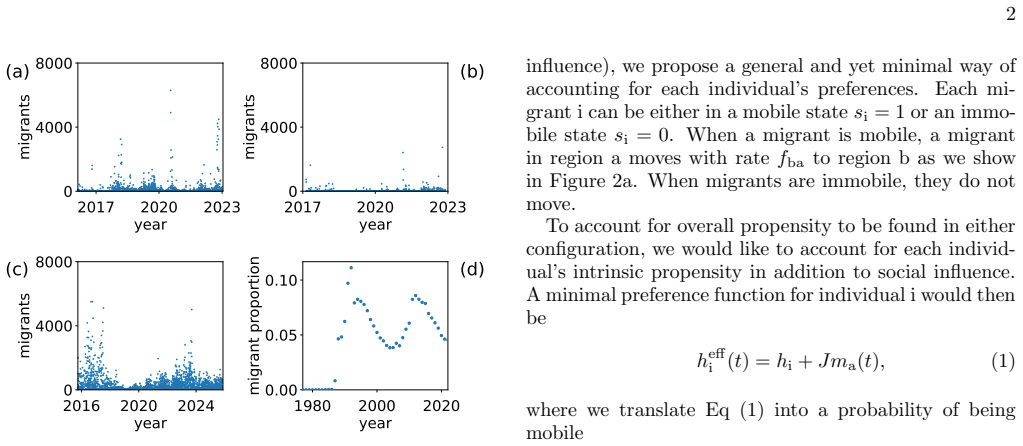
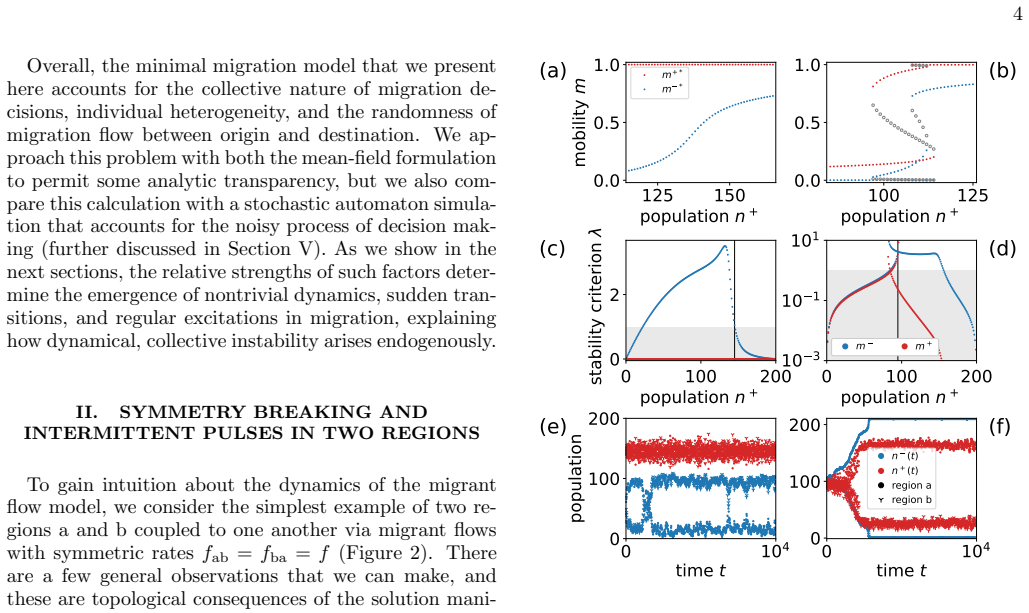
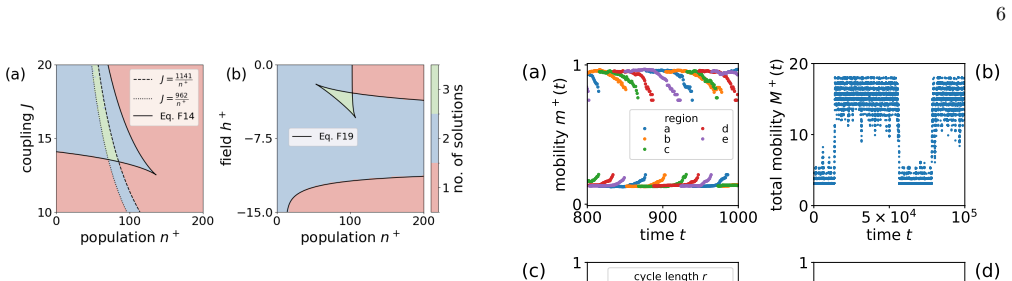
We propose a minimal migration model that accounts for social influence alongside individual heterogeneity in mobility as migrants move from region to region. In special locations of parameter space, migrant flows dramatically and spontaneously fluctuate. Such aspects mimic observed fluctuations in migration statistics and thus show how large fluctuations in data can reflect more than response to events like armed conflict and natural disasters. Correspondingly, the impact of exogenous factors can be confounded with the results of collective decisions.
What carries the argument
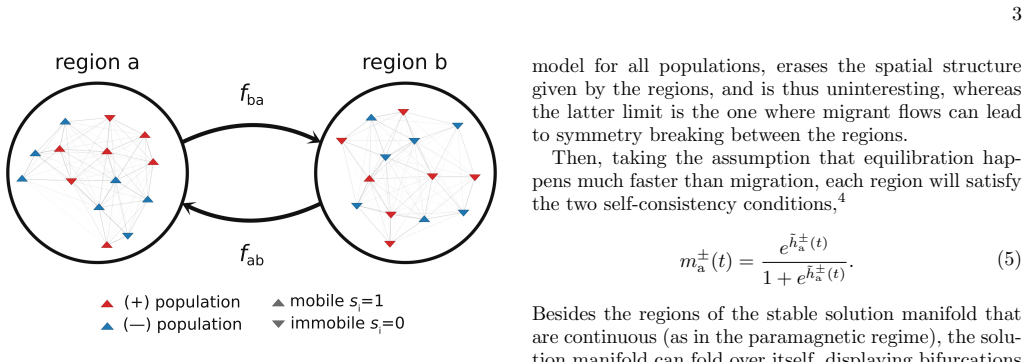
Minimal migration model with social influence and individual heterogeneity in mobility, which generates spontaneous fluctuations in special parameter regions.
If this is right
- Migrant flows exhibit pulses, waves, and cascades due to internal dynamics.
- Observed large fluctuations in migration data can arise without external triggers.
- The influence of external events on migration is confounded by collective effects.
- Nontrivial dynamics appear only in specific locations within the parameter space.
Where Pith is reading between the lines
- Testing the model against migration datasets from periods without major disruptions could distinguish endogenous from exogenous fluctuations.
- The approach may extend to modeling other forms of collective movement, such as urban commuting patterns.
- Identifying the critical parameter values could help forecast when migration systems are prone to instability.
Load-bearing premise
Dependence on others' decisions together with individual differences in mobility suffice to produce the nontrivial migration dynamics without external drivers or complex networks.
What would settle it
Real-world migration time series that lack the predicted spontaneous fluctuations during intervals free of major external events, or statistical mismatch between model outputs and empirical flow distributions.
Figures

read the original abstract
Decisions to migrate depend on others' decisions. Dependence can produce nontrivial dynamics. We propose a minimal migration model that accounts for social influence alongside individual heterogeneity in mobility as migrants move from region to region. In special locations of parameter space, migrant flows dramatically and spontaneously fluctuate. Such aspects mimic observed fluctuations in migration statistics and thus show how large fluctuations in data can reflect more than response to events like armed conflict and natural disasters. Correspondingly, the impact of exogenous factors can be confounded with the results of collective decisions.
Editorial analysis
A structured set of objections, weighed in public.
Referee Report
Summary. The manuscript proposes a minimal model of collective migration incorporating social influence (dependence on others' decisions) and individual heterogeneity in mobility as agents move between regions. It claims that in special regions of parameter space this model produces dramatic spontaneous fluctuations in migrant flows (pulses, waves, and cascades), which can mimic observed fluctuations in empirical migration statistics. The central implication is that large fluctuations in migration data need not be attributed solely to exogenous shocks such as armed conflict or natural disasters, as they can arise endogenously from collective decision-making.
Significance. If substantiated, the result supplies a clean proof-of-principle that endogenous social-influence mechanisms plus mobility heterogeneity are sufficient to generate nontrivial fluctuation statistics in migration flows. This strengthens the case for interpreting migration data through the lens of collective dynamics rather than purely external drivers and offers a minimal, falsifiable framework for socio-physical modeling of human mobility.
minor comments (2)
- [Abstract] The abstract states that fluctuations occur 'in special locations of parameter space' but supplies neither the model equations nor the parameter definitions, leaving the mechanism opaque to readers who have not yet reached the methods section.
- The manuscript would benefit from an explicit statement of the network topology (or lack thereof) on which the social-influence term acts, as this choice directly affects whether the reported fluctuations are robust or topology-dependent.
Simulated Author's Rebuttal
We thank the referee for the positive summary, significance assessment, and recommendation of minor revision. No specific major comments were raised in the report.
Circularity Check
No significant circularity
full rationale
The paper introduces a minimal agent-based migration model incorporating social influence and individual mobility heterogeneity, then demonstrates via simulation that spontaneous large fluctuations emerge endogenously in specific parameter regimes. This is presented as a proof-of-principle result showing that observed migration variability need not require external shocks. No equations reduce to fitted inputs by construction, no self-citations are invoked as load-bearing uniqueness theorems, and the central claim follows directly from the model's stated rules without renaming known results or smuggling ansatzes. The derivation chain is self-contained against the model's internal dynamics.
Axiom & Free-Parameter Ledger
Reference graph
Works this paper leans on
-
[1]
The Effects of Immigrant Diversity and Ethnic Competition on Collec- tive Conflict in Urban America: An Assessment of Two Moments of Mass Migration, 1869-1924 and 1965-1993
Suzanne Shanahan and Susan Olzak. The Effects of Immigrant Diversity and Ethnic Competition on Collec- tive Conflict in Urban America: An Assessment of Two Moments of Mass Migration, 1869-1924 and 1965-1993. Journal of American Ethnic History, 18(3):40–64, 1999
1924
-
[2]
University of California Press, Lon- don, 2010
Peter Schrag.Not Fit for Our Society: Immigration and Nativism in America. University of California Press, Lon- don, 2010
2010
-
[3]
Herbert Susmann and Adrian E. Raftery. Bayesian Pro- jection of Extant Refugee and Asylum Seeker Popula- tions, October 2025
2025
-
[4]
Thomas Gaskin and Guy J. Abel. Deep learning four decades of human migration, July 2025
2025
-
[5]
A theory of migration.Demography, 3(1):47–57, 1966
Everett S Lee. A theory of migration.Demography, 3(1):47–57, 1966
1966
-
[6]
Sjaastad
Larry A. Sjaastad. The Costs and Returns of Human Mi- gration.Journal of Political Economy, 70(5, Part 2):80– 93, October 1962
1962
-
[7]
Anderson
James E. Anderson. The Gravity Model.Annual Review of Economics, 3(1):133–160, September 2011
2011
-
[8]
Generalized gravity model for human mi- gration.New Journal of Physics, 20(9):093018, Septem- ber 2018
Hye Jin Park, Woo Seong Jo, Sang Hoon Lee, and Beom Jun Kim. Generalized gravity model for human mi- gration.New Journal of Physics, 20(9):093018, Septem- ber 2018
2018
-
[9]
Gonz´ alez, Amos Maritan, and Albert-L´ aszl´ o Barab´ asi
Filippo Simini, Marta C. Gonz´ alez, Amos Maritan, and Albert-L´ aszl´ o Barab´ asi. A universal model for mobility and migration patterns.Nature, 484(7392):96–100, April 2012
2012
-
[10]
Beyer, Jacob Schewe, and Hermann Lotze- Campen
Robert M. Beyer, Jacob Schewe, and Hermann Lotze- Campen. Gravity models do not explain, and cannot predict, international migration dynamics.Humanities and Social Sciences Communications, 9(1):56, February 2022
2022
-
[11]
Dynamic Count Models with Flexible Innovation Processes for Irregular Maritime Migration, August 2025
Gregor Zens and Jakub Bijak. Dynamic Count Models with Flexible Innovation Processes for Irregular Maritime Migration, August 2025
2025
-
[12]
Cohen, Marta Roig, Daniel C
Joel E. Cohen, Marta Roig, Daniel C. Reuman, and Cai GoGwilt. International migration beyond gravity: A sta- tistical model for use in population projections.Proceed- ings of the National Academy of Sciences, 105(40):15269– 15274, October 2008
2008
-
[13]
Forecasting Immigration in Official Population Projections Using an Econometric Model
˚Adne Cappelen, Terje Skjerpen, and Marianne Tønnessen. Forecasting Immigration in Official Population Projections Using an Econometric Model. International Migration Review, 49(4):945–980, Decem- ber 2015
2015
-
[14]
A gen- eralized simulation development approach for predicting refugee destinations.Scientific Reports, 7(1):13377, Oc- tober 2017
Diana Suleimenova, David Bell, and Derek Groen. A gen- eralized simulation development approach for predicting refugee destinations.Scientific Reports, 7(1):13377, Oc- tober 2017
2017
-
[15]
Modelling and predict- ing forced migration.PLOS ONE, 18(4):e0284416, April 2023
Haodong Qi and Tuba Bircan. Modelling and predict- ing forced migration.PLOS ONE, 18(4):e0284416, April 2023
2023
-
[16]
Tay- lor, and Derek Groen
Maziar Ghorbani, Diana Suleimenova, Alireza Jahani, Arindam Saha, Yani Xue, Kate Mintram, Anastasia Anagnostou, Auke Tas, William Low, Simon J.E. Tay- lor, and Derek Groen. Flee 3: Flexible agent-based sim- ulation for forced migration.Journal of Computational Science, 81:102371, September 2024
2024
-
[17]
Demographic influences on migration
David A Plane. Demographic influences on migration. Regional studies, 27(4):375–383, 1993
1993
-
[18]
Decomposing american immobility: Compositional and rate components of interstate, in- trastate, and intracounty migration and mobility decline
Thomas B Foster. Decomposing american immobility: Compositional and rate components of interstate, in- trastate, and intracounty migration and mobility decline. Demographic Research, 37:1515–1548, 2017
2017
-
[19]
Editorial: New method- ological approaches for migration and mobility studies: From traditional to big data.Frontiers in Human Dy- namics, 7:1710558, October 2025
Tuba Bircan and Haodong Qi. Editorial: New method- ological approaches for migration and mobility studies: From traditional to big data.Frontiers in Human Dy- namics, 7:1710558, October 2025
2025
-
[20]
Can Motivation Theory Explain Mi- gration Decisions?Prague Economic Papers, 16(1):70– 85, January 2007
Nat´ alie Reichlov´ a. Can Motivation Theory Explain Mi- gration Decisions?Prague Economic Papers, 16(1):70– 85, January 2007
2007
-
[21]
Statistical physics of social dynamics.Reviews of Modern Physics, 81(2):591–646, May 2009
Claudio Castellano, Santo Fortunato, and Vittorio Loreto. Statistical physics of social dynamics.Reviews of Modern Physics, 81(2):591–646, May 2009
2009
-
[22]
Bialek, A
W. Bialek, A. Cavagna, I. Giardina, T. Mora, O. Pohl, E. Silvestri, M. Viale, and A. M. Walczak. Social inter- actions dominate speed control in poising natural flocks near criticality.Proceedings of the National Academy of Sciences, 111(20):7212–7217, May 2014
2014
-
[23]
Lee, Chase P
Edward D. Lee, Chase P. Broedersz, and William Bialek. Statistical Mechanics of the US Supreme Court.Journal of Statistical Physics, 160(2):275–301, July 2015
2015
-
[24]
MacDonald and Leatrice D
John S. MacDonald and Leatrice D. MacDonald. Chain Migration Ethnic Neighborhood Formation and Social Networks.The Milbank Memorial Fund Quarterly, 42(1):82, January 1964
1964
-
[25]
Couzin, Jens Krause, Nigel R
Iain D. Couzin, Jens Krause, Nigel R. Franks, and Si- mon A. Levin. Effective leadership and decision-making in animal groups on the move.Nature, 433(7025):513– 516, February 2005
2005
-
[26]
Un- informed Individuals Promote Democratic Consensus in Animal Groups.Science, 334, December 2011
Iain D Couzin, Christos C Ioannou, G¨ uven Demirel, Thilo Gross, Colin J Torney, Andrew Hartnett, Larissa Conradt, Simon A Levin, and Naomi E Leonard. Un- informed Individuals Promote Democratic Consensus in Animal Groups.Science, 334, December 2011
2011
-
[27]
A meta- analysis of country-level studies on environmental change and migration.Nature Climate Change, 10(10):904–912, October 2020
Roman Hoffmann, Anna Dimitrova, Raya Muttarak, Je- sus Crespo Cuaresma, and Jonas Peisker. A meta- analysis of country-level studies on environmental change and migration.Nature Climate Change, 10(10):904–912, October 2020
2020
-
[28]
Schwarz, and Felix Pretis
Lisa Thalheimer, Moritz P. Schwarz, and Felix Pretis. Large weather and conflict effects on internal displace- ment in Somalia with little evidence of feedback onto conflict.Global Environmental Change, 79:102641, 2023
2023
-
[29]
Understanding Immobility: Moving Be- yond the Mobility Bias in Migration Studies.Interna- tional Migration Review, 54(2):328–355, June 2020
Kerilyn Schewel. Understanding Immobility: Moving Be- yond the Mobility Bias in Migration Studies.Interna- tional Migration Review, 54(2):328–355, June 2020
2020
-
[30]
Migration Drivers: Why Do People Migrate? In Peter Scholten, editor,Introduction to Migration Studies, pages 49–82
Mathias Czaika and Constantin Reinprecht. Migration Drivers: Why Do People Migrate? In Peter Scholten, editor,Introduction to Migration Studies, pages 49–82. Springer International Publishing, Cham, 2022
2022
-
[31]
Migration in the age of involuntary immobility: Theoretical reflections and Cape Verdean experiences.Journal of Ethnic and Migration Studies, 28(1):5–42, January 2002
J⊘rgen Carling. Migration in the age of involuntary immobility: Theoretical reflections and Cape Verdean experiences.Journal of Ethnic and Migration Studies, 28(1):5–42, January 2002
2002
-
[32]
Migration Decision-Making and Its Key Dimensions.The Annals of the American Academy of Political and Social Science, 697(1):15–31, September 2021
Mathias Czaika, Jakub Bijak, and Toby Prike. Migration Decision-Making and Its Key Dimensions.The Annals of the American Academy of Political and Social Science, 697(1):15–31, September 2021
2021
-
[33]
Gil S. Epstein. Informational Cascades and Decision to Migrate.SSRN Electronic Journal, 2002. 11
2002
-
[34]
Assessing Uncertain Migration Futures: A Typology of the Unknown
Jakub Bijak and Mathias Czaika. Assessing Uncertain Migration Futures: A Typology of the Unknown. Tech- nical Report Deliverable 1.1, University of Southampton and Danube University Krems, 2020
2020
-
[35]
PRMN Dashboard, 2022
UNHCR. PRMN Dashboard, 2022
2022
-
[36]
Situation Europe Sea Arrivals, 2026
UNHCR. Situation Europe Sea Arrivals, 2026
2026
-
[37]
Immigrants’ Social Relations with Neighbours: Does the Population Density of the Neigh- bourhood Matter?Journal of International Migration and Integration, 25(2):861–885, June 2024
Max Stick, Christoph Schimmele, Maciej Karpinski, and Am´ elie Arsenault. Immigrants’ Social Relations with Neighbours: Does the Population Density of the Neigh- bourhood Matter?Journal of International Migration and Integration, 25(2):861–885, June 2024
2024
-
[38]
Krannich
Thomas Greider and Richard S. Krannich. Neighboring Patterns, Social Support, and Rapid Growth: A Com- parison Analysis from Three Western Communities.So- ciological Perspectives, 28(1):51–70, 1985
1985
-
[39]
E. T. Jaynes. Information Theory and Statistical Me- chanics.Physical Review, 106(4):620–630, May 1957
1957
-
[40]
Traffic jams with- out bottlenecks—experimental evidence for the physical mechanism of the formation of a jam.New Journal of Physics, 10(3):033001, March 2008
Yuki Sugiyama, Minoru Fukui, Macoto Kikuchi, Kat- suya Hasebe, Akihiro Nakayama, Katsuhiro Nishinari, Shin-ichi Tadaki, and Satoshi Yukawa. Traffic jams with- out bottlenecks—experimental evidence for the physical mechanism of the formation of a jam.New Journal of Physics, 10(3):033001, March 2008
2008
-
[41]
Woi Sok Oh, Alvaro Carmona-Cabrero, Rafael Mu˜ noz- Carpena, and Rachata Muneepeerakul. On the interplay among multiple factors: Effects of factor configuration in a proof-of-concept migration agent-based model.Journal of Artificial Societies and Social Simulation, 25(2), 2022
2022
-
[42]
Addison-Wesley, Cambridge, MA, 1949
George Kingsley Zipf.Human Behavior and the Principle of Least Effort. Addison-Wesley, Cambridge, MA, 1949
1949
-
[43]
Mean-field theory for scale-free random networks
Albert-Laszlo Barabasi, Reka Albert, and Hawoong Jeong. Mean-field theory for scale-free random networks. Physica A, 272:173–187, 1999
1999
-
[44]
Cambridge University Press, 2010
David Easley and Jon Kleinberg.Networks, Crowds, and Markets: Reasoning About a Highly Connected World. Cambridge University Press, 2010
2010
-
[45]
OUP Oxford, 2018
Mark Newman.Networks. OUP Oxford, 2018
2018
-
[46]
A theory of migration: The aspirations- capabilities framework.Comparative Migration Studies, 9(1):8, February 2021
Hein de Haas. A theory of migration: The aspirations- capabilities framework.Comparative Migration Studies, 9(1):8, February 2021
2021
-
[47]
Springer Interna- tional Publishing, Cham, 2022
Jakub Bijak.Towards Bayesian Model-Based Demogra- phy: Agency, Complexity and Uncertainty in Migration Studies, volume 17 ofMethodos Series. Springer Interna- tional Publishing, Cham, 2022
2022
-
[48]
Dynamics of internal displacement and conflict in somalia.Journal of Ethnic and Migration Studies, pages 1–35, 2026
Christopher W Blair. Dynamics of internal displacement and conflict in somalia.Journal of Ethnic and Migration Studies, pages 1–35, 2026
2026
-
[49]
Community-based mortality surveillance among internally displaced vulnerable populations in banadir region, somalia, 2022–2023.Frontiers in public health, 13:1582558, 2025
Mohamed Hussein Adam, Bashiru Garba, Hassan Ab- dullahi Dahie, Joaquin Baruch, Jonathan A Polonsky, Ji- haan Hassan, Jamal Hassan Mohamoud, Dahir Abdi Ali, SK Md Mamunur Rahman Malik, Francesco Checchi, et al. Community-based mortality surveillance among internally displaced vulnerable populations in banadir region, somalia, 2022–2023.Frontiers in public ...
2022
-
[50]
Emergent network patterns of inter- nal displacement in somalia driven by natural disasters and conflicts.Global Environmental Change, 84:102793, 2024
Woi Oh, Rachata Muneepeerakul, Daniel Rubenstein, and Simon Levin. Emergent network patterns of inter- nal displacement in somalia driven by natural disasters and conflicts.Global Environmental Change, 84:102793, 2024. 12 Appendix A: Note on automaton simulation We simulate the migration dynamics as a collection of coupled Ising models, with stochastic tr...
2024
-
[51]
spring constant
the distribution group sizes from different origins are highly heterogeneous, 3) the drivers fluctuate, or 4) rates at which people are leave a region fluctuate such as in our dynamics. Needless to say, we are only considering the potential impact of 4. Appendix D: First-passage time for the first region to cross the fold We consider the time for the firs...
2000
discussion (0)
Sign in with ORCID, Apple, or X to comment. Anyone can read and Pith papers without signing in.