Global trends in morphology from massive to dwarf galaxies
Pith reviewed 2026-07-01 02:04 UTC · model grok-4.3
The pith
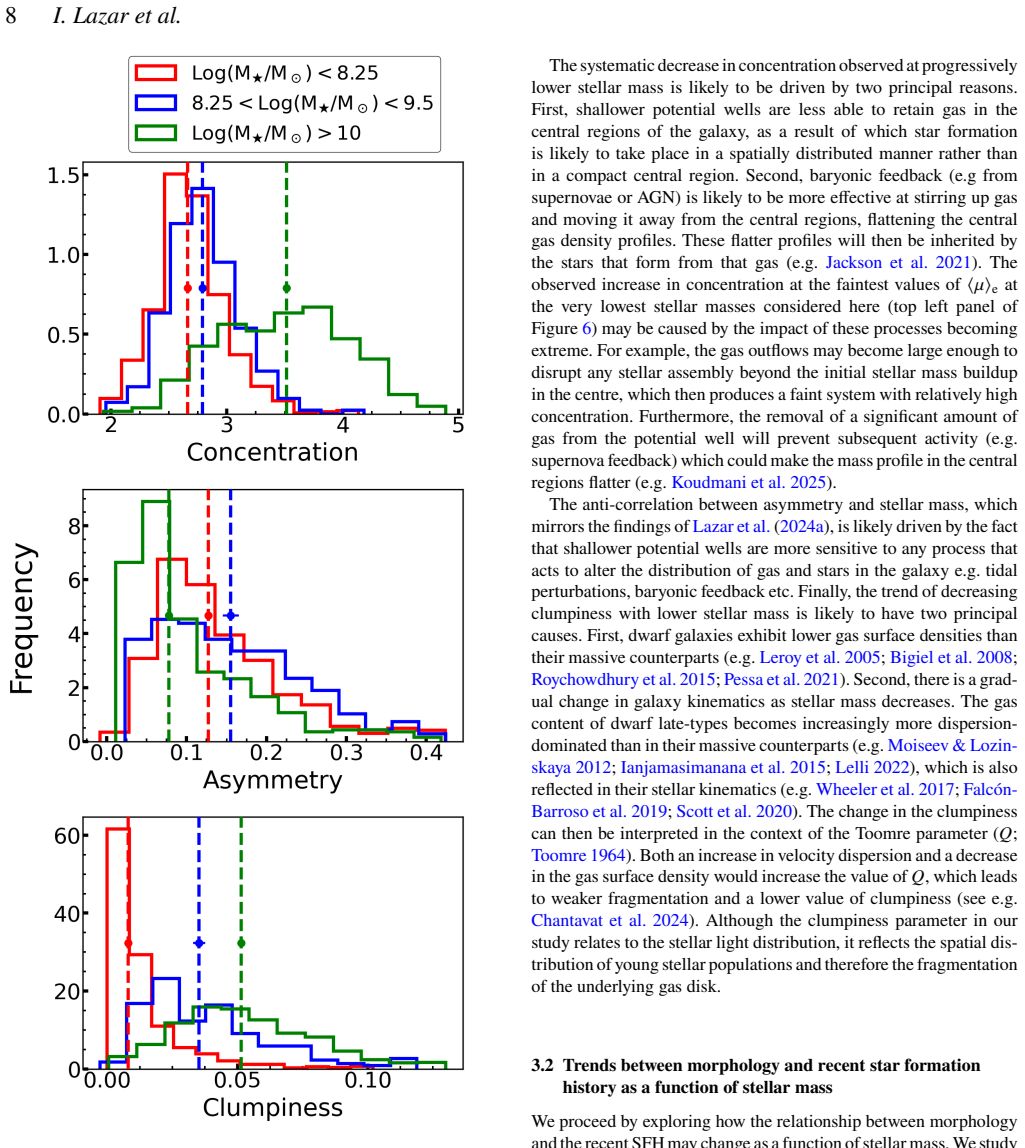
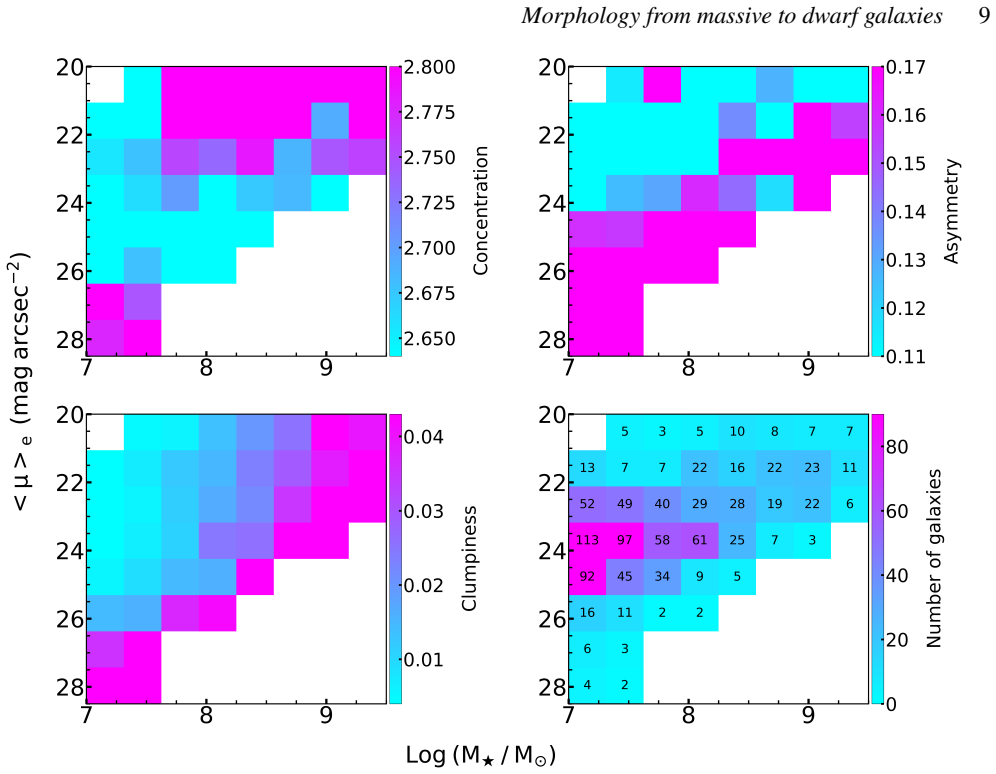
Galaxies become less concentrated, more asymmetric and less clumpy as stellar mass falls, with bars disappearing below 10^8 solar masses.
A machine-rendered reading of the paper's core claim, the machinery that carries it, and where it could break.
Core claim
Galaxies become less concentrated, more asymmetric and less clumpy with decreasing stellar mass. In both the massive and dwarf regimes, more concentrated and less asymmetric systems are more likely to be red. The bar fraction declines steadily with falling stellar mass and becomes consistent with zero near 10^8 solar masses. As a result, the CAS parameters lose their ability to separate early-type from late-type galaxies in the dwarf regime.
What carries the argument
CAS parameters (concentration, asymmetry and clumpiness) measured from JWST images, together with visual classifications and bar identifications, applied across a mass-complete sample.
If this is right
- The link between higher concentration, lower asymmetry and redder colors holds in both massive and dwarf regimes.
- CAS parameters lose leverage for separating morphological types once stellar mass drops below roughly 10^9.5 solar masses.
- Bar formation appears to require a minimum stellar mass near 10^8 solar masses.
- Morphological trends with effective surface brightness parallel those with stellar mass.
Where Pith is reading between the lines
- Models of galaxy assembly must explain why dynamical instabilities that produce bars and central concentration become ineffective below 10^8 solar masses.
- New morphological metrics tailored to low-mass systems may be needed once CAS parameters lose discriminatory power.
- The same mass threshold that eliminates bars may also mark a transition in how star-formation quenching couples to structure.
- Surveys that reach still lower masses could test whether the reported trends continue or flatten.
Load-bearing premise
The JWST-derived CAS parameters remain reliable and directly comparable for low-surface-brightness dwarf galaxies despite possible effects from resolution, noise or surface-brightness limits.
What would settle it
Deep, high-resolution imaging that finds a non-zero bar fraction in galaxies below 10^8 solar masses or shows that CAS values cleanly separate early- and late-type dwarfs would contradict the reported trends.
Figures


read the original abstract
The morphological properties of dwarf galaxies (Mstar < 10^9.5 MSun) remain largely unexplored, particularly outside the local neighbourhood. We explore how morphology changes across the massive to dwarf-galaxy regimes, using a mass-complete sample of ~1000 galaxies, with stellar masses and redshifts in the ranges 10^7 MSun < Mstar < 10^12 MSun and z < 0.15 respectively. By combining JWST-derived morphological parameters (concentration, asymmetry and clumpiness; `CAS') and visual morphological classifications, we explore: (1) how morphology changes with stellar mass and effective surface brightness, (2) the connection between morphology and recent star formation history, as a function of stellar mass, (3) how bar frequency changes between the massive and dwarf regimes and (4) how well the CAS parameters perform in separating early- and late-type galaxies, as a function of stellar mass. We demonstrate that galaxies become less concentrated, more asymmetric and less clumpy with decreasing stellar mass. In both mass regimes, galaxies that are more concentrated and less asymmetric are more likely to be red (i.e. quenched). The decrease in concentration towards lower stellar masses results in a loss of the leverage that this parameter can provide in separating early- and late-type galaxies. Thus, while the CAS system successfully separates early- and late-type systems in the massive-galaxy regime, these morphological classes become significantly more difficult to separate, using these parameters, in the dwarf regime. Finally, the bar fraction declines steadily with decreasing stellar mass and becomes consistent with zero at Mstar ~ 10^8 MSun, suggesting a lower limit for the galaxy mass needed to induce bar formation.
Editorial analysis
A structured set of objections, weighed in public.
Referee Report
Summary. The paper claims that in a mass-complete sample of ~1000 galaxies at z<0.15 spanning 10^7 to 10^12 solar masses, JWST-derived CAS parameters show galaxies become less concentrated, more asymmetric, and less clumpy with decreasing stellar mass. In both mass regimes, higher concentration and lower asymmetry correlate with redder colors. CAS parameters lose leverage for separating early- and late-type galaxies in the dwarf regime, while the bar fraction declines steadily and reaches consistency with zero near 10^8 solar masses.
Significance. If the CAS measurements remain unbiased, the work supplies empirical trends that constrain how morphology scales with stellar mass down to the dwarf regime, using a mass-complete sample that extends beyond the local volume. The reported bar-fraction threshold and the loss of CAS diagnostic power at low mass are potentially useful benchmarks for galaxy-formation models.
major comments (2)
- [Methods (CAS parameter derivation and sample selection)] The headline trends (declining C, rising A, falling S with Mstar; bar fraction o0 at ~10^8 Msun) rest on the assumption that JWST CAS values are directly comparable from 10^12 down to 10^7 Msun. The methods section must demonstrate that the observed trends are not driven by surface-brightness selection or noise-floor effects in the low-SB dwarf subsample; without recovery tests on simulated low-SB galaxies or explicit SB-limit corrections, the increase in asymmetry and drop in concentration could be partly systematic.
- [Results (bar fraction analysis)] Table or figure reporting the bar fraction versus stellar mass: the claim that the fraction becomes consistent with zero at Mstar ~10^8 Msun requires the visual classification completeness and false-positive rate at the lowest masses to be quantified; without these, the statistical significance of the decline cannot be assessed.
minor comments (2)
- The abstract states the sample size as ~1000 but does not break down the number of galaxies per mass decade; adding this would clarify the statistical weight of the dwarf regime.
- Ensure that all CAS parameter definitions and any adopted thresholds for bar identification are restated with references in the main text rather than only in supplementary material.
Simulated Author's Rebuttal
We thank the referee for their constructive comments, which highlight important aspects of robustness that will improve the manuscript. We respond point-by-point to the major comments below.
read point-by-point responses
-
Referee: [Methods (CAS parameter derivation and sample selection)] The headline trends (declining C, rising A, falling S with Mstar; bar fraction o0 at ~10^8 Msun) rest on the assumption that JWST CAS values are directly comparable from 10^12 down to 10^7 Msun. The methods section must demonstrate that the observed trends are not driven by surface-brightness selection or noise-floor effects in the low-SB dwarf subsample; without recovery tests on simulated low-SB galaxies or explicit SB-limit corrections, the increase in asymmetry and drop in concentration could be partly systematic.
Authors: We agree that explicit verification against surface-brightness and noise effects is required to support the robustness of the CAS trends. Our sample is constructed to be mass-complete using stellar-mass estimates, and the JWST imaging depth is sufficient for the included dwarfs; however, we did not include simulated recovery tests in the original submission. In the revised manuscript we will add a dedicated subsection describing recovery tests in which mock low-SB galaxies are inserted into the real images, CAS parameters are re-measured, and any systematic offsets are quantified and, if necessary, corrected. We will also tabulate the effective surface-brightness limits as a function of stellar mass. revision: yes
-
Referee: [Results (bar fraction analysis)] Table or figure reporting the bar fraction versus stellar mass: the claim that the fraction becomes consistent with zero at Mstar ~10^8 Msun requires the visual classification completeness and false-positive rate at the lowest masses to be quantified; without these, the statistical significance of the decline cannot be assessed.
Authors: We accept that the statistical significance of the bar-fraction decline cannot be fully evaluated without completeness and false-positive estimates at the lowest masses. The original analysis relied on single-pass visual classifications without these metrics. In the revision we will perform repeat classifications on a representative low-mass subsample, derive completeness and contamination fractions, and propagate these into the reported bar fractions and their uncertainties as a function of stellar mass. revision: yes
Circularity Check
No circularity: purely empirical reporting of observed trends
full rationale
The paper measures CAS parameters directly from JWST imaging and performs visual classifications on a mass-complete sample spanning 10^7 to 10^12 Msun. It then reports observed correlations between these quantities and stellar mass, color, and bar presence. No equations, model fits, predictions, or derivations are present that reduce any claimed result to a quantity defined by the paper's own parameters or self-citations. The analysis is self-contained against external benchmarks (imaging data and visual inspection) with no load-bearing self-citation chains or ansatzes.
Axiom & Free-Parameter Ledger
axioms (2)
- domain assumption Stellar masses and redshifts derived from photometry accurately place galaxies in the stated mass and redshift bins.
- domain assumption CAS morphological parameters measured on JWST images are comparable and unbiased between massive and dwarf galaxies.
Reference graph
Works this paper leans on
-
[1]
Hunter, J. D. , Title =. Computing In Science & Engineering , Volume =
-
[2]
doi:10.1051/0004-6361/201322068 , keywords =
Astropy: A community Python package for astronomy. , archivePrefix = "arXiv", eprint =. doi:10.1051/0004-6361/201322068 , adsurl =
-
[3]
ArXiv e-prints , archivePrefix = "arXiv", eprint =
Total density profile of massive early-type galaxies in Horizon-AGN simulation: impact of AGN feedback and comparison with observations. ArXiv e-prints , archivePrefix = "arXiv", eprint =
-
[4]
From tidal dwarf galaxies to satellite galaxies. , eprint =. doi:10.1051/0004-6361:20065248 , adsurl =
-
[5]
The Star Formation History of Field Galaxies. , eprint =. doi:10.1086/305523 , adsurl =
-
[6]
Cosmic Star-Formation History. , archivePrefix = "arXiv", eprint =. doi:10.1146/annurev-astro-081811-125615 , adsurl =
work page internal anchor Pith review doi:10.1146/annurev-astro-081811-125615
-
[7]
General properties of thick discs
Star formation history up to z = 7.4: implications for gamma-ray bursts and cosmic metallicity evolution. , archivePrefix = "arXiv", eprint =. doi:10.1111/j.1365-2966.2008.13488.x , adsurl =
-
[8]
, keywords =
Gas segregation in the interacting system ARP 105. , keywords =
-
[9]
Ultraluminous infrared galaxies and the origin of quasars. , keywords =. doi:10.1086/165983 , adsurl =
-
[10]
A Fossil Record of Galaxy Encounters. Science , eprint =. doi:10.1126/science.1081525 , adsurl =
-
[11]
, archivePrefix = "arXiv", eprint =
Newborn spheroids at high redshift: when and how did the dominant, old stars in today's massive galaxies form?. , archivePrefix = "arXiv", eprint =. doi:10.1093/mnras/sts031 , adsurl =
-
[12]
, archivePrefix = "arXiv", eprint =
The Major and Minor Galaxy Merger Rates at z 1.5. , archivePrefix = "arXiv", eprint =. doi:10.1088/0004-637X/742/2/103 , adsurl =
-
[13]
, archivePrefix = "arXiv", eprint =
The merger rates and sizes of galaxies across the peak epoch of star formation from the HiZELS survey. , archivePrefix = "arXiv", eprint =. doi:10.1093/mnras/sts684 , adsurl =
-
[14]
The nature of high-redshift galaxies. , eprint =. doi:10.1046/j.1365-8711.2001.03975.x , adsurl =
-
[15]
The Relation between Quasar and Merging Galaxy Luminosity Functions and the Merger-driven Star Formation History of the Universe. , eprint =. doi:10.1086/508503 , adsurl =
-
[16]
General properties of thick discs
The structures of distant galaxies - I. Galaxy structures and the merger rate to z \ 3 in the Hubble Ultra-Deep Field. , archivePrefix = "arXiv", eprint =. doi:10.1111/j.1365-2966.2008.13069.x , adsurl =
-
[17]
The effect of galaxy mass ratio on merger-driven starbursts. , archivePrefix = "arXiv", eprint =. doi:10.1111/j.1365-2966.2007.12730.x , adsurl =
-
[18]
Bell and Stefanie Phleps and Rachel S
The Merger Rate of Massive Galaxies. , eprint =. doi:10.1086/508408 , adsurl =
-
[19]
, archivePrefix = "arXiv", eprint =
Evolution of the dust emission of massive galaxies up to z = 4 and constraints on their dominant mode of star formation. , archivePrefix = "arXiv", eprint =. doi:10.1051/0004-6361/201425031 , adsurl =
-
[20]
, archivePrefix = "arXiv", eprint =
The Era of Star Formation in Galaxy Clusters. , archivePrefix = "arXiv", eprint =. doi:10.1088/0004-637X/779/2/138 , adsurl =
-
[21]
, archivePrefix = "arXiv", eprint =
The Lesser Role of Starbursts in Star Formation at z = 2. , archivePrefix = "arXiv", eprint =. doi:10.1088/2041-8205/739/2/L40 , adsurl =
-
[22]
, archivePrefix = "arXiv", eprint =
On the Evolution of the Molecular Gas Fraction of Star-Forming Galaxies. , archivePrefix = "arXiv", eprint =. doi:10.1088/2041-8205/730/2/L19 , adsurl =
-
[23]
, archivePrefix = "arXiv", eprint =
High molecular gas fractions in normal massive star-forming galaxies in the young Universe. , archivePrefix = "arXiv", eprint =. doi:10.1038/nature08773 , adsurl =
-
[24]
Gasdynamics and Starbursts in Major Mergers. , eprint =. doi:10.1086/177353 , adsurl =
work page internal anchor Pith review doi:10.1086/177353
-
[25]
, archivePrefix = "arXiv", eprint =
On the frequency, intensity, and duration of starburst episodes triggered by galaxy interactions and mergers. , archivePrefix = "arXiv", eprint =. doi:10.1051/0004-6361:200809480 , adsurl =
-
[26]
, archivePrefix = "arXiv", eprint =
Dancing in the dark: galactic properties trace spin swings along the cosmic web. , archivePrefix = "arXiv", eprint =. doi:10.1093/mnras/stu1227 , adsurl =
work page internal anchor Pith review doi:10.1093/mnras/stu1227
-
[27]
, archivePrefix = "arXiv", eprint =
The interaction-driven starburst contribution to the cosmic star formation rate density. , archivePrefix = "arXiv", eprint =. doi:10.1051/0004-6361/201220754 , adsurl =
-
[28]
High-resolution simulations of galaxy mergers: resolving globular cluster formation. , archivePrefix = "arXiv", eprint =. doi:10.1111/j.1745-3933.2008.00511.x , adsurl =
-
[29]
The Asymmetry of Galaxies: Physical Morphology for Nearby and High-Redshift Galaxies. , eprint =. doi:10.1086/308300 , adsurl =
-
[30]
and Primack, Joel and Madau, Piero , title =
A New Nonparametric Approach to Galaxy Morphological Classification. , eprint =. doi:10.1086/421849 , adsurl =
work page internal anchor Pith review doi:10.1086/421849
-
[31]
, year = 1966, month = nov, volume = 14, pages =
Atlas of Peculiar Galaxies. , year = 1966, month = nov, volume = 14, pages =. doi:10.1086/190147 , adsurl =
-
[32]
Correlations between UBV colors and fine structure in E and S0 galaxies - A first attempt at dating ancient merger events. , keywords =. doi:10.1086/116296 , adsurl =
-
[33]
, archivePrefix = "arXiv", eprint =
Linking the structural properties of galaxies and their star formation histories with STAGES. , archivePrefix = "arXiv", eprint =. doi:10.1093/mnras/stv2321 , adsurl =
-
[34]
, archivePrefix = "arXiv", eprint =
Major mergers are not significant drivers of star formation or morphological transformation around the epoch of peak cosmic star formation. , archivePrefix = "arXiv", eprint =. doi:10.1093/mnras/stw2895 , adsurl =
-
[35]
, archivePrefix = "arXiv", eprint =
The importance of minor-merger-driven star formation and black hole growth in disc galaxies. , archivePrefix = "arXiv", eprint =. doi:10.1093/mnras/stu338 , adsurl =
-
[36]
Triggering of starbursts in galaxies by minor mergers. , keywords =. doi:10.1086/187299 , adsurl =
-
[37]
Disc formation and the origin of clumpy galaxies at high redshift. , archivePrefix = "arXiv", eprint =. doi:10.1111/j.1745-3933.2009.00685.x , adsurl =
-
[38]
, archivePrefix = "arXiv", eprint =
A Physical Approach to the Identification of High-z Mergers: Morphological Classification in the Stellar Mass Domain. , archivePrefix = "arXiv", eprint =. doi:10.1088/0004-637X/805/2/181 , adsurl =
-
[39]
Constraints on the Assembly and Dynamics of Galaxies. II. Properties of Kiloparsec-scale Clumps in Rest-frame Optical Emission of z \ 2 Star-forming Galaxies. , archivePrefix = "arXiv", eprint =. doi:10.1088/0004-637X/739/1/45 , adsurl =
-
[40]
, archivePrefix = "arXiv", eprint =
Slow Evolution of the Specific Star Formation Rate at z 2: The Impact of Dust, Emission Lines, and a Rising Star Formation History. , archivePrefix = "arXiv", eprint =. doi:10.1088/0004-637X/781/1/34 , adsurl =
-
[41]
Semi-analytic modelling of galaxy formation: the local Universe. , eprint =. doi:10.1046/j.1365-8711.1999.03032.x , adsurl =
-
[42]
GALICS- I. A hybrid N-body/semi-analytic model of hierarchical galaxy formation. , eprint =. doi:10.1046/j.1365-8711.2003.05589.x , adsurl =
-
[43]
The many lives of active galactic nuclei: cooling flows, black holes and the luminosities and colours of galaxies. , eprint =. doi:10.1111/j.1365-2966.2005.09675.x , adsurl =
-
[44]
The dusty, albeit ultraviolet bright, infancy of galaxies. , archivePrefix = "arXiv", eprint =. doi:10.1111/j.1745-3933.2010.00820.x , adsurl =
-
[45]
, archivePrefix = "arXiv", eprint =
The EAGLE project: simulating the evolution and assembly of galaxies and their environments. , archivePrefix = "arXiv", eprint =. doi:10.1093/mnras/stu2058 , adsurl =
-
[46]
, archivePrefix = "arXiv", eprint =
Introducing the Illustris Project: simulating the coevolution of dark and visible matter in the Universe. , archivePrefix = "arXiv", eprint =. doi:10.1093/mnras/stu1536 , adsurl =
-
[47]
, archivePrefix = "arXiv", eprint =
The MassiveBlack-II simulation: the evolution of haloes and galaxies to z 0. , archivePrefix = "arXiv", eprint =. doi:10.1093/mnras/stv627 , adsurl =
-
[48]
A new high resolution code called RAMSES
Cosmological hydrodynamics with adaptive mesh refinement. A new high resolution code called RAMSES. , eprint =. doi:10.1051/0004-6361:20011817 , adsurl =
-
[49]
, archivePrefix = "arXiv", eprint =
Seven-year Wilkinson Microwave Anisotropy Probe (WMAP) Observations: Cosmological Interpretation. , archivePrefix = "arXiv", eprint =. doi:10.1088/0067-0049/192/2/18 , adsurl =
work page internal anchor Pith review doi:10.1088/0067-0049/192/2/18
-
[50]
ArXiv e-prints , archivePrefix = "arXiv", eprint =
The Horizon-AGN simulation: evolution of galaxy properties over cosmic time. ArXiv e-prints , archivePrefix = "arXiv", eprint =
-
[51]
, archivePrefix = "arXiv", eprint =
Towards simulating star formation in turbulent high-z galaxies with mechanical supernova feedback. , archivePrefix = "arXiv", eprint =. doi:10.1093/mnras/stv1211 , adsurl =
-
[52]
Constraining stellar assembly and active galactic nucleus feedback at the peak epoch of star formation. , archivePrefix = "arXiv", eprint =. doi:10.1111/j.1745-3933.2012.01309.x , adsurl =
-
[53]
Cosmic logistics in a hierarchical universe
The history of the baryon budget. Cosmic logistics in a hierarchical universe. , eprint =. doi:10.1051/0004-6361:20053116 , adsurl =
-
[54]
Evolution of metallicity gradients
The origin and implications of dark matter anisotropic cosmic infall on \ L _ * haloes. , eprint =. doi:10.1111/j.1365-2966.2004.07883.x , adsurl =
-
[55]
Towards improving galaxy formation models using subhaloes
Building merger trees from cosmological N-body simulations. Towards improving galaxy formation models using subhaloes. , archivePrefix = "arXiv", eprint =. doi:10.1051/0004-6361/200911787 , adsurl =
-
[56]
, archivePrefix = "arXiv", eprint =
High-redshift major mergers weakly enhance star formation. , archivePrefix = "arXiv", eprint =. doi:10.1093/mnras/stw2920 , adsurl =
-
[57]
Advanced Science Letters , archivePrefix = "arXiv", eprint =
The formation of disk galaxies in computer simulations. Advanced Science Letters , archivePrefix = "arXiv", eprint =
-
[58]
, archivePrefix = "arXiv", eprint =
Galaxy morphology and star formation in the Illustris Simulation at z = 0. , archivePrefix = "arXiv", eprint =. doi:10.1093/mnras/stv2078 , adsurl =
-
[59]
Formation and rotation of disc galaxies with haloes. , keywords =. doi:10.1093/mnras/193.2.189 , adsurl =
-
[60]
The Angular Momentum of Gas in Protogalaxies. I. Implications for the Formation of Disk Galaxies. , eprint =. doi:10.1086/341619 , adsurl =
-
[61]
Metallicity gradients and the [Z/H]-mass, [ /Fe]-mass relations
The formation of disc galaxies in a CDM universe. , archivePrefix = "arXiv", eprint =. doi:10.1111/j.1365-2966.2010.17530.x , adsurl =
-
[62]
Morphologies of 190,000 Galaxies at z = 0-10 Revealed with HST Legacy Data. I. Size Evolution. , archivePrefix = "arXiv", eprint =. doi:10.1088/0067-0049/219/2/15 , adsurl =
-
[63]
Early-Type Galaxies in the Sloan Digital Sky Survey. I. The Sample. , eprint =. doi:10.1086/367776 , adsurl =
-
[64]
, archivePrefix = "arXiv", eprint =
SINFONI/VLT 3D spectroscopy of massive galaxies: evidence of rotational support at z 1.4. , archivePrefix = "arXiv", eprint =. doi:10.1093/mnras/stu034 , adsurl =
-
[65]
Evolution since z = 1 of the Morphology-Density Relation for Galaxies. , eprint =. doi:10.1086/426930 , adsurl =
-
[66]
Evolution since z = 0.5 of the Morphology-Density Relation for Clusters of Galaxies. , eprint =. doi:10.1086/304890 , adsurl =
-
[67]
The Morphology-Density Relation in z \ 1 Clusters. , eprint =. doi:10.1086/428881 , adsurl =
-
[68]
, archivePrefix = "arXiv", eprint =
The unorthodox evolution of major merger remnants into star-forming spiral galaxies. , archivePrefix = "arXiv", eprint =. doi:10.1093/mnras/stx1516 , adsurl =
-
[69]
, archivePrefix = "arXiv", eprint =
Merger Histories of Galaxy Halos and Implications for Disk Survival. , archivePrefix = "arXiv", eprint =. doi:10.1086/588579 , adsurl =
-
[70]
Encyclopedia of Astronomy and Astrophysics , year = 2000, month = nov, editor =
Galaxies: Interactions and Mergers. Encyclopedia of Astronomy and Astrophysics , year = 2000, month = nov, editor =. doi:10.1888/0333750888/2623 , adsurl =
-
[71]
A Merger-driven Scenario for Cosmological Disk Galaxy Formation. , eprint =. doi:10.1086/504412 , adsurl =
-
[72]
ArXiv e-prints , archivePrefix = "arXiv", eprint =
The diversity of assembly histories leading to disc galaxy formation in a LambdaCDM model. ArXiv e-prints , archivePrefix = "arXiv", eprint =
-
[73]
Forming Disk Galaxies in Wet Major Mergers. I. Three Fiducial Examples. , archivePrefix = "arXiv", eprint =. doi:10.3847/0004-637X/821/2/90 , adsurl =
-
[74]
The fundamental properties of galaxies and a new galaxy classification system. , eprint =. doi:10.1111/j.1365-2966.2006.11114.x , adsurl =
-
[75]
The Mass Assembly Histories of Galaxies of Various Morphologies in the GOODS Fields. , eprint =. doi:10.1086/429549 , adsurl =
-
[76]
, archivePrefix = "arXiv", eprint =
CANDELS: The Correlation between Galaxy Morphology and Star Formation Activity at z \ 2. , archivePrefix = "arXiv", eprint =. doi:10.1088/0004-637X/774/1/47 , adsurl =
-
[77]
ArXiv e-prints , archivePrefix = "arXiv", eprint =
Large Synoptic Survey Telescope Galaxies Science Roadmap. ArXiv e-prints , archivePrefix = "arXiv", eprint =
-
[78]
Cooling functions for low-density astrophysical plasmas. , keywords =. doi:10.1086/191823 , adsurl =
-
[79]
Radiative Transfer in a Clumpy Universe. II. The Ultraviolet Extragalactic Background. , eprint =. doi:10.1086/177035 , adsurl =
-
[80]
The Global Schmidt Law in Star-forming Galaxies. , eprint =. doi:10.1086/305588 , adsurl =
work page internal anchor Pith review doi:10.1086/305588
discussion (0)
Sign in with ORCID, Apple, or X to comment. Anyone can read and Pith papers without signing in.