A Tutorial on Autonomous Fault-Tolerant Control Using Knowledge-Grounded LLM Agents
Pith reviewed 2026-07-01 03:55 UTC · model grok-4.3
The pith
LLM agents act as constrained supervisory planners for fault recovery in process plants, with every proposal checked by an external validator before actuation.
A machine-rendered reading of the paper's core claim, the machinery that carries it, and where it could break.
Core claim
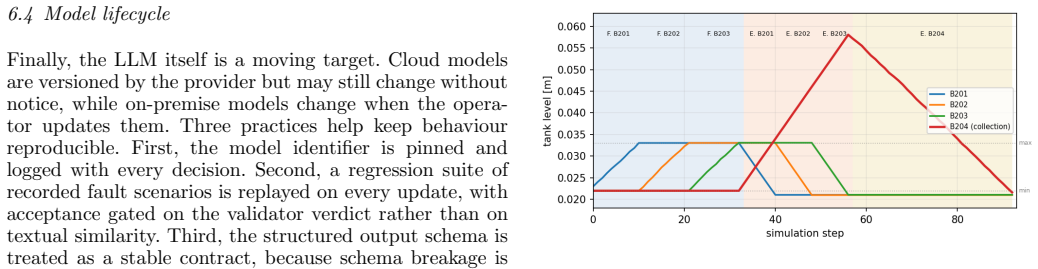
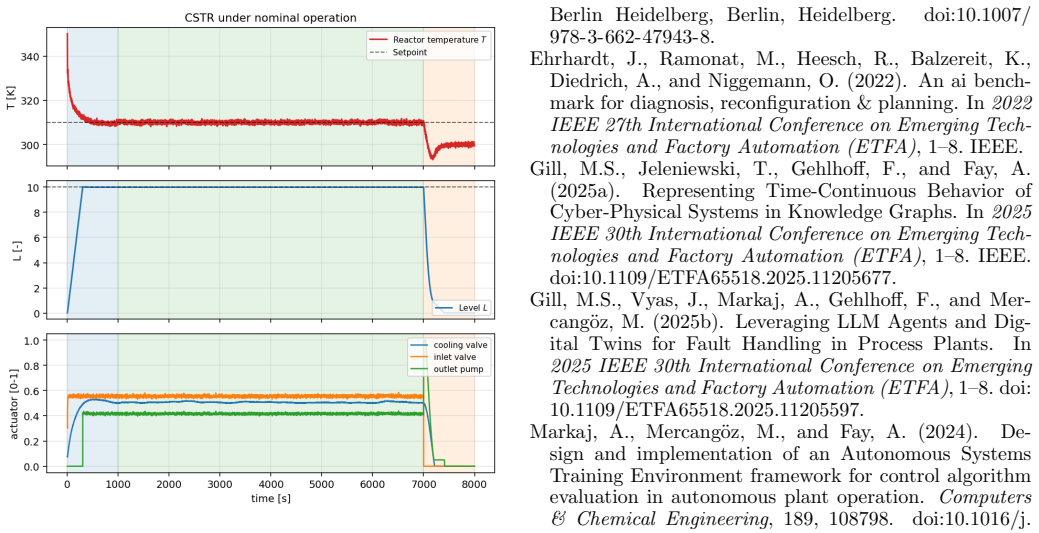
The central claim is that an LLM can serve as a constrained supervisory planner that proposes recovery actions from plant knowledge, provided every proposal passes through an external validator before actuation. The paper develops this into three design dimensions covering recovery patterns where the approach applies, validation strategies that distinguish admissible from inadmissible proposals, and deployment limits set by latency, knowledge engineering, safety integration, and model updates. Executable environments for a modular mixing module and a continuous stirred-tank reactor, each with configurable faults, make the framework immediately testable.
What carries the argument
The constrained supervisory planner, in which the LLM proposes actions grounded in plant knowledge and an external validator must approve each proposal before actuation.
If this is right
- Recovery patterns outside predefined logic become addressable by LLM proposals when paired with validation.
- Validation strategies using symbolic or simulation checks can enforce safety boundaries on LLM output.
- Deployment requires explicit handling of latency, knowledge maintenance, and integration with existing safety systems.
- Open executable environments allow direct testing of custom recovery and validation methods on mixing and reactor models.
Where Pith is reading between the lines
- The same validator-enforced structure could be tested on other continuous processes where operator intervention is currently required.
- Model updates would need scheduled re-validation of the entire knowledge base to maintain separation quality over time.
- Integration with live plant simulators might reveal whether validation speed limits real-time use.
Load-bearing premise
External validators can reliably and completely separate admissible from inadmissible LLM proposals without missing safety-critical errors that could lead to harm or shutdown.
What would settle it
A documented case in which an LLM proposes an unsafe recovery action, the validator approves it, and the plant reaches a harmful state or shutdown.
Figures

read the original abstract
Fault recovery in process plants still relies heavily on plant operators, especially when faults fall outside predefined supervisory logic. Operators interpret alarms, procedures, P\&IDs, interlocks, and process trends, then decide how to move the plant to a safe operating mode without triggering a shutdown. This paper examines how Large Language Model (LLM) agents can support such recovery decisions. The proposed framework treats the LLM as a constrained supervisory planner. It uses plant-specific knowledge to propose recovery actions, and every proposal is checked by an external validator (symbolic or simulation-based) before actuation. The paper develops three design dimensions for applying the framework: the recovery patterns for which LLM agents are useful, the validation strategies that separate admissible from inadmissible proposals, and the deployment constraints imposed by latency, knowledge engineering, safety integration, and model lifecycle management. To make the framework directly usable, two openly available executable Python environments are provided. Both re-implement established case studies, a modular mixing module and a continuous stirred-tank reactor, extended with configurable faults and defined interfaces for custom recovery and validation methods.
Editorial analysis
A structured set of objections, weighed in public.
Referee Report
Summary. The paper proposes a framework in which knowledge-grounded LLM agents act as constrained supervisory planners for fault recovery in process plants. LLM-generated recovery actions are always routed through an external validator (symbolic or simulation-based) before actuation. The manuscript develops three design dimensions—recovery patterns, validation strategies, and deployment constraints—and supplies two openly available Python environments that re-implement a modular mixing module and a CSTR, each extended with configurable faults and user-defined recovery/validation interfaces.
Significance. If the design dimensions prove actionable, the work could supply a reproducible template for hybrid LLM-symbolic fault-tolerant control that keeps the LLM proposal step separate from safety-critical actuation. The explicit provision of executable, open environments with defined extension points is a concrete strength that supports immediate experimentation and community extension.
major comments (2)
- [Framework introduction and environment interfaces] The framework description (abstract and the section introducing the constrained planner) states that every LLM proposal is checked by an external validator, yet no concrete specification or interface contract for the validator is given for either case study; without this, it is impossible to determine whether the supplied environments actually enforce the separation the framework claims.
- [Design dimensions section] The three design dimensions are presented as the main contribution, but the manuscript supplies no worked example that maps a specific recovery pattern through one of the dimensions to a validator outcome in either the mixing-module or CSTR environment; this leaves the dimensions at the level of taxonomy rather than demonstrated guidance.
minor comments (2)
- [Abstract and conclusion] The abstract and introduction refer to 'openly available executable Python environments' without a direct URL, DOI, or installation command in the main text; this should be added for immediate usability.
- [Introduction] Terminology such as 'knowledge-grounded' and 'constrained supervisory planner' is used repeatedly but never given an explicit operational definition or pseudocode; a short definitions subsection would improve clarity.
Simulated Author's Rebuttal
We thank the referee for the constructive review and recommendation of minor revision. We address each major comment below.
read point-by-point responses
-
Referee: [Framework introduction and environment interfaces] The framework description (abstract and the section introducing the constrained planner) states that every LLM proposal is checked by an external validator, yet no concrete specification or interface contract for the validator is given for either case study; without this, it is impossible to determine whether the supplied environments actually enforce the separation the framework claims.
Authors: We agree that the manuscript text does not provide an explicit interface contract. Although the open Python environments include defined validation interfaces, these are not documented in sufficient detail in the paper. In the revised version we will add a dedicated subsection specifying the validator interface contracts (method signatures, input/output formats, and enforcement of separation) for both case studies. revision: yes
-
Referee: [Design dimensions section] The three design dimensions are presented as the main contribution, but the manuscript supplies no worked example that maps a specific recovery pattern through one of the dimensions to a validator outcome in either the mixing-module or CSTR environment; this leaves the dimensions at the level of taxonomy rather than demonstrated guidance.
Authors: We accept that a concrete worked example would better demonstrate the utility of the design dimensions. In the revised manuscript we will insert a worked example that traces one recovery pattern (e.g., a valve fault in the mixing module) through a chosen recovery pattern, a validation strategy, and the corresponding validator outcome. revision: yes
Circularity Check
No significant circularity: framework tutorial without derivations or self-referential claims
full rationale
The paper is a tutorial proposing a constrained LLM supervisory planner framework for fault recovery, with external symbolic/simulation validators and open Python case-study environments. No equations, fitted parameters, derivations, or load-bearing self-citations appear. Central claims describe design dimensions and interfaces for user-supplied methods rather than asserting completeness or uniqueness via prior author work. The structure is self-contained against external benchmarks and does not reduce any prediction or result to its inputs by construction.
Axiom & Free-Parameter Ledger
axioms (2)
- domain assumption LLM agents can interpret plant-specific knowledge (alarms, procedures, P&IDs, trends) to generate useful recovery proposals.
- domain assumption External validators can reliably distinguish admissible from inadmissible proposals without critical false negatives.
Reference graph
Works this paper leans on
-
[1]
Zenith, Federico and Weinzierl, Christine and Krewer, Ulrike , year =. Model-based analysis of the feasibility envelope for autonomous operation of a portable direct methanol fuel-cell system , keywords =. Chemical Engineering Science , shorthand =. doi:10.1016/j.ces.2010.03.055 , number =
-
[2]
Annual Reviews in Control , shorthand =. 2016 , title =. doi:10.1016/j.arcontrol.2016.09.015 , abstract =
-
[3]
Alhazmi, Khalid and Albalawi, Fahad and Sarathy, S. Mani , year =. A reinforcement learning-based economic model predictive control framework for autonomous operation of chemical reactors , keywords =. Chemical Engineering Journal , shorthand =. doi:10.1016/j.cej.2021.130993 , abstract =
-
[4]
CEAS Aeronautical Journal , doi =
Gill, Milapji Singh and Fay, Alexander , year =. CEAS Aeronautical Journal , doi =
-
[5]
Meng, Lexuan and Dragicevic, Tomislav and Guerrero, Josep M. , year =. Adaptive Control Design for Autonomous Operation of Multiple Energy Storage Systems in Power Smoothing Applications , pages =. IEEE Transactions on Industrial Electronics , shortjournal =. doi:10.1109/TIE.2017.2756584 , number =
-
[6]
2025 , doi =
Gill, Milapji Singh and Jeleniewski, Tom and Gehlhoff, Felix and Fay, Alexander , title =. 2025 , doi =
2025
-
[7]
Distributed Control Strategy for Autonomous Operation of Hybrid AC/DC Microgrid , keywords =
Baek, Jongbok and Choi, Wooin and Chae, Suyong , year =. Distributed Control Strategy for Autonomous Operation of Hybrid AC/DC Microgrid , keywords =. Energies , shorthand =. doi:10.3390/en10030373 , number =
-
[8]
2021 5th International Conference on System Reliability and Safety (ICSRS) , year =
Lee, Daeil and Kim, Hyojin and Choi, Younhee and Kim, Jonghyun , title =. 2021 5th International Conference on System Reliability and Safety (ICSRS) , year =. doi:10.1109/ICSRS53853.2021.9660722 , shorthand =
-
[9]
Olivier, Laurentz E. and Craig, Ian K. , year =. Model-based fault-tolerant control with robustness to unanticipated faults , pages =. IFAC-PapersOnLine , shorthand =. doi:10.1016/j.ifacol.2017.08.401 , number =
-
[10]
Manee and R
V. Manee and R. Baratti and J. Romagnoli , title =. Chemical Engineering Research and Design , volume =
-
[11]
TechRxiv Preprint , year =
Georgi Tancev , title =. TechRxiv Preprint , year =
-
[12]
Xun Tang and Yuhe Tian and V. S. D. , title =. Processes , publisher =
-
[13]
Control-Informed Reinforcement Learning for Chemical Processes , journal =
Maximilian Bloor and Akhil Ahmed and Niki Kotecha and Mehmet Mercang. Control-Informed Reinforcement Learning for Chemical Processes , journal =
-
[14]
Kwon , title =
Niranjan Sitapure and Joseph S. Kwon , title =. arXiv preprint , year =
-
[15]
2023 IEEE 49th IECON , year =
Westermann, Tom and Gill, Milapji Singh and Fay, Alexander , title =. 2023 IEEE 49th IECON , year =
2023
-
[16]
2023 IEEE 28th ETFA , year =
Gill, Milapji Singh and Westermann, Tom and Schieseck, Marvin and Fay, Alexander , title =. 2023 IEEE 28th ETFA , year =
2023
-
[17]
2024 IEEE 29th ETFA , year =
Gill, Milapji Singh and Westermann, Tom and Steindl, Gernot and Gehlhoff, Felix and Fay, Alexander , title =. 2024 IEEE 29th ETFA , year =
2024
-
[18]
Proceedings of the 46th International Conference on Software Engineering: Software Engineering in Practice , publisher =
Fakih, Mohamad and Dharmaji, Rahul and Moghaddas, Yasamin and Quiros, Gustavo and Ogundare, Oluwatosin and Al Faruque, Mohammad Abdullah , year =. Proceedings of the 46th International Conference on Software Engineering: Software Engineering in Practice , publisher =
-
[19]
Pre-Trained Large Language Models for Industrial Control , publisher =. 2023 , copyright =. doi:10.48550/ARXIV.2308.03028 , author =
-
[20]
LLM4PLC: Harnessing Large Language Models for Verifiable Programming of PLCs in Industrial Control Systems , DOI =
Fakih, Mohamad and Dharmaji, Rahul and Moghaddas, Yasamin and Quiros, Gustavo and Ogundare, Oluwatosin and Al Faruque, Mohammad Abdullah , year =. LLM4PLC: Harnessing Large Language Models for Verifiable Programming of PLCs in Industrial Control Systems , DOI =. Proceedings of the 46th International Conference on Software Engineering: Software Engineering...
-
[21]
2026 , volume=
Liu, Zihan and Zeng, Ruinan and Wang, Dongxia and Peng, Gengyun and Liu, Xiaoxia and Liu, Qiang and Liu, Peiyu and Wang, Wenhai and Wang, Jingyi , journal=. 2026 , volume=
2026
-
[22]
Control Industrial Automation System with Large Language Models , publisher =. 2024 , copyright =. doi:10.48550/ARXIV.2409.18009 , author =
-
[23]
Towards autonomous system: flexible modular production system enhanced with large language model agents , year=
Xia, Yuchen and Shenoy, Manthan and Jazdi, Nasser and Weyrich, Michael , booktitle=. Towards autonomous system: flexible modular production system enhanced with large language model agents , year=
-
[24]
2024 , eprint=
ControlAgent: Automating Control System Design via Novel Integration of LLM Agents and Domain Expertise , author=. 2024 , eprint=
2024
-
[25]
Proceedings of the 1st International Workshop on Designing and Building Hybrid Human--AI Systems (SYNERGY 2024) , volume=
Towards an llm-based intelligent assistant for industry 5.0 , author=. Proceedings of the 1st International Workshop on Designing and Building Hybrid Human--AI Systems (SYNERGY 2024) , volume=
2024
-
[26]
Resiliency Analysis of LLM generated models for Industrial Automation , year=
Ogundare, Oluwatosin and Araya, Gustavo Quiros and Akrotirianakis, Ioannis and Shukla, Ankit , booktitle=. Resiliency Analysis of LLM generated models for Industrial Automation , year=
-
[27]
2022 IEEE 27th International Conference on Emerging Technologies and Factory Automation (ETFA) , pages=
An AI benchmark for diagnosis, reconfiguration & planning , author=. 2022 IEEE 27th International Conference on Emerging Technologies and Factory Automation (ETFA) , pages=. 2022 , organization=
2022
-
[28]
Tao, Laifa and Huang, Qixuan and Wu, Xianjun and Zhang, Weiwei and Wu, Yunlong and Li, Bin and Lu, Chen and Hai, Xingshuo , date =
-
[29]
, title =
Balhorn, Lukas Schulze and Caballero, Marc and Schweidtmann, Artur M. , title =. 2024 , doi =
2024
-
[30]
Multi-agent systems for chemical engineering: a review and perspective , journal =. 2026 , issn =. doi:https://doi.org/10.1016/j.coche.2025.101209 , author =
-
[31]
2024 IEEE 29th International Conference on Emerging Technologies and Factory Automation (ETFA), 2024 , year =
Xia, Yuchen and Jazdi, Nasser and Weyrich, Michael , title =. 2024 IEEE 29th International Conference on Emerging Technologies and Factory Automation (ETFA), 2024 , year =
2024
-
[32]
and Wagner, Lukas P
Reinpold, Lasse M. and Wagner, Lukas P. and Gehlhoff, Felix and Ramonat, Malte and Kilthau, Maximilian and Gill, Milapji S. and Reif, Jonathan T. and Henkel, Vincent and Scholz, Lena and Fay, Alexander , year =. Journal of Intelligent Manufacturing , doi =
-
[33]
Digital Twin in manufacturing: A categorical literature review and classification , pages =
Kritzinger, Werner and Karner, Matthias and Traar, Georg and Henjes, Jan and Sihn, Wilfried , year =. Digital Twin in manufacturing: A categorical literature review and classification , pages =
-
[34]
Tao, Fei and Zhang, He and Liu, Ang and Nee, A. Y. C. , year =. IEEE Transactions on Industrial Informatics , doi =
-
[35]
, year =
Thambirajah, Jegatheeswaran and Benabbas, Lamia and Bauer, Margret and Thornhill, Nina F. , year =
-
[36]
2024 , title =
Markaj, Artan and Mercang. 2024 , title =
2024
-
[37]
2025 , volume=
Gill, Milapji Singh and Vyas, Javal and Markaj, Artan and Gehlhoff, Felix and Mercangöz, Mehmet , booktitle=. 2025 , volume=
2025
-
[38]
Gill, Milapji Singh and Jeleniewski, Tom and Gehlhoff, Felix and Fay, Alexander , year =
-
[39]
, year =
Rupprecht, Sophia and Gao, Qinghe and Karia, Tanuj and Schweidtmann, Artur M. , year =
-
[40]
Lee, Donghyeon and Lee, Jaewook and Shin, Dongil , year =
-
[41]
Sakhinana, Sagar Srinivas and. 2024 , title =. doi:10.1609/aaaiss.v4i1.31796 , file =
-
[42]
2025 , title =
Vyas, Javal and Mercang. 2025 , title =
2025
-
[43]
2025 , doi =
Pajak, Emma and Bahamdan, Abdullah and Hellgardt, Klaus and Ro-Chanona, Antoniodel , title =. 2025 , doi =
2025
-
[44]
Driess, Danny and Xia, Fei and Sajjadi, Mehdi S. M. and Lynch, Corey and Chowdhery, Aakanksha and Ichter, Brian and Wahid, Ayzaan and Tompson, Jonathan and Vuong, Quan and Yu, Tianhe and Huang, Wenlong and Chebotar, Yevgen and Sermanet, Pierre and Duckworth, Daniel and Levine, Sergey and Vanhoucke, Vincent and Hausman, Karol and Toussaint, Marc and Greff,...
-
[45]
doi:10.1007/978-3-662-47943-8 , file =
Blanke, Mogens and Kinnaert, Michel and Lunze, Jan and Staroswiecki, Marcel , year =. doi:10.1007/978-3-662-47943-8 , file =
-
[46]
From automated to autonomous process operations , journal =. 2025 , issn =. doi:https://doi.org/10.1016/j.compchemeng.2025.109064 , author =
-
[47]
Control Industrial Automation System with Large Language Model Agents , year=
Xia, Yuchen and Jazdi, Nasser and Zhang, Jize and Shah, Chaitanya and Weyrich, Michael , booktitle=. Control Industrial Automation System with Large Language Model Agents , year=
-
[48]
Webert, Heiko and D. 2022 , title =. doi:10.3390/s22062205 , file =
-
[49]
Manca, Gianluca and Fay, Alexander , year =
-
[50]
2022 IEEE 27th International Conference on Emerging Technologies and Factory Automation (ETFA) , year =
Gill, Milapji Singh and Reiche, Leif-Thore and Fay, Alexander , title =. 2022 IEEE 27th International Conference on Emerging Technologies and Factory Automation (ETFA) , year =
2022
-
[51]
and Caesar, Birte and Gundlach, Claas Steffen and Fay, Alexander , year =
Hildebrandt, Constantin and Köcher, Aljosha and Kustner, Christof and Lopez-Enriquez, Carlos-Manuel and Muller, Andreas W. and Caesar, Birte and Gundlach, Claas Steffen and Fay, Alexander , year =. IEEE T-ASE , doi =
-
[52]
and Schmidt,J
Single,J. and Schmidt,J. and Denecke,J. , year =
-
[53]
Laurenzi, Emanuele and Mathys, Adrian and Martin, Andreas , year =
-
[54]
2024 , volume=
Soularidis, Andreas and Kotis, Konstantinos and Lamolle, Myriam and Mejdoul, Zakaria and Lortal, Gaëlle and Vouros, George , booktitle=. 2024 , volume=
2024
-
[55]
2020 , title =
17th International Conference on Accelerator and Large Experimental Physics Control Systems. 2020 , title =
2020
-
[56]
I. de Zarz. Sensors , volume =. 2023 , doi =
2023
-
[57]
2025 , volume=
Xia, Yuchen and Jazdi, Nasser and Zhang, Jize and Shah, Chaitanya and Weyrich, Michael , booktitle=. 2025 , volume=
2025
-
[58]
and Maleh, Y
Lamaakal, I. and Maleh, Y. and. 2025 , title =
2025
-
[59]
2023 , title =
de Zarz. 2023 , title =
2023
discussion (0)
Sign in with ORCID, Apple, or X to comment. Anyone can read and Pith papers without signing in.