Radiation-pressure instability is an artifact of constant-α closure
Pith reviewed 2026-07-01 03:29 UTC · model grok-4.3
The pith
Making viscosity depend on the gas-to-radiation pressure ratio removes the radiation-pressure instability from thin-disk models.
A machine-rendered reading of the paper's core claim, the machinery that carries it, and where it could break.
Core claim
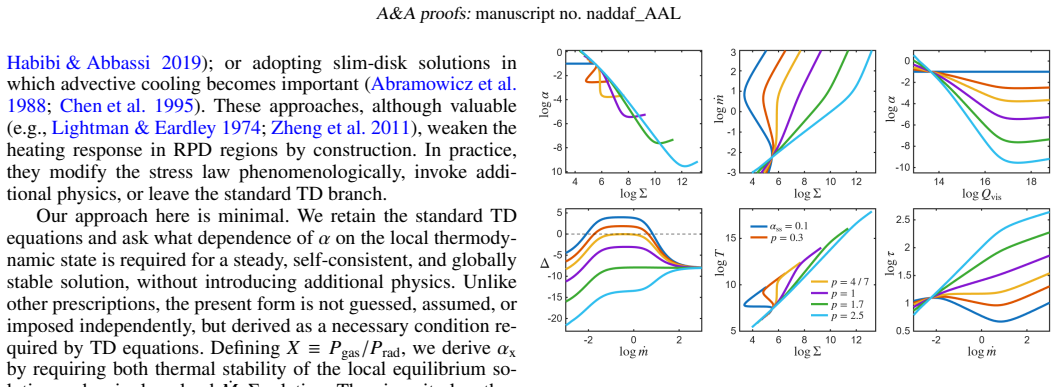
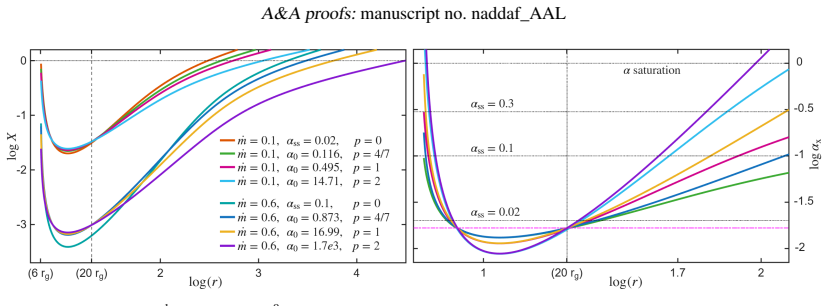
Requiring the steady thin-disk to remain thermally stable and single-valued in the Ṁ--Σ plane yields a necessary condition η_x ≡ d ln α_x / d ln X > 4/7, where X ≡ P_gas / P_rad. The resulting viscosity law α_x ≡ α(X) emerges directly from the internal consistency of thin-disk equations, removes the radiation-pressure dominated unstable branch, produces a smooth globally single-valued disk structure with higher Σ and τ in the inner regions, and preserves the standard effective-temperature profile.
What carries the argument
The viscosity closure α_x(X) with X the gas-to-radiation pressure ratio, required to satisfy the stability derivative condition η_x > 4/7.
If this is right
- The disk structure becomes smooth and globally single-valued with higher surface density and optical depth in the inner radiation-pressure dominated zone.
- The standard effective-temperature profile is preserved.
- Thermal and inflow timescales increase.
- Accretion-state dependent variability arises naturally without large-amplitude radiation-pressure limit cycles.
- AGN disk tensions such as microlensing sizes and continuum reverberation lags become candidates for re-examination with improved radiative-transfer modeling.
Where Pith is reading between the lines
- The same pressure-ratio dependence might be checked in three-dimensional MHD simulations to see whether turbulent stresses naturally produce an alpha that rises with increasing gas-pressure fraction.
- Observed state transitions in X-ray binaries could be re-interpreted as crossings between different alpha regimes rather than passages through unstable branches.
- Extending the same consistency requirement to slim-disk or advection-dominated solutions might constrain viscosity closures in those regimes without additional ad-hoc assumptions.
Load-bearing premise
A steady thin-disk solution must be thermally stable and single-valued in the accretion-rate versus surface-density plane.
What would settle it
A time-dependent thin-disk simulation that exhibits large-amplitude thermal limit cycles when alpha is held constant but shows none when alpha is allowed to vary with the local gas-to-radiation pressure ratio according to the derived condition.
Figures
read the original abstract
The standard $\alpha$-disk formalism parametrizes turbulent angular momentum transport through a dimensionless coefficient $\alpha$, assumed to be spatially and thermodynamically invariant. While analytically convenient, this assumption leads to the well-known thermal and viscous instabilities in radiation-pressure dominated (RPD) regions. We show that this instability is not the consequence of radiation pressure, but is due to enforcing a constant $\alpha$ across distinct thermodynamic regimes. Requiring the steady thin-disk (TD) to remain thermally stable and single-valued in the $\dot{M}$--$\Sigma$ plane yields a necessary condition on the stress response, expressed as $\eta_{\rm x} \equiv d\ln\alpha_{\rm x}\,/\,d\ln X > 4/7$, where $X \equiv P_{\rm gas}/P_{\rm rad}$. The resulting viscosity law $\alpha_{\rm x} \equiv \alpha(X)$ emerges directly from the internal consistency of TD equations, without modifying the stress law or invoking any additional physics. $\alpha_{\rm x}$ removes the RPD unstable branch. The disk structure becomes smooth and globally single-valued, with higher $\Sigma$ and $\tau$ in the inner RPD disk, while preserving the standard effective-temperature profile. This increases thermal and inflow timescales, offering a natural route to accretion-state dependent variability without large-amplitude radiation-pressure limit cycles. It also motivates revisiting AGN disk tensions, including microlensing sizes and continuum reverberation lags with improved radiative-transfer modeling. The results show that the RPD instability, and possibly some associated AGN disk tensions, reflect an inconsistent viscosity closure.
Editorial analysis
A structured set of objections, weighed in public.
Referee Report
Summary. The paper claims that radiation-pressure instabilities in thin accretion disks are an artifact of the constant-α assumption rather than radiation pressure itself. Requiring steady thin-disk solutions to be thermally stable and single-valued in the Ṁ–Σ plane yields the necessary condition η_x ≡ d ln α_x / d ln X > 4/7 (with X ≡ P_gas/P_rad), producing a viscosity law α(X) that removes the unstable branch, yields a smooth single-valued disk structure with higher inner Σ and τ, preserves the standard T_eff profile, and increases thermal/inflow timescales.
Significance. If the central derivation holds without circularity, the result would remove the need to invoke radiation-pressure limit cycles for explaining accretion-state variability and could address AGN disk tensions (microlensing sizes, continuum lags) via a thermodynamically responsive closure. It supplies an explicit, testable condition on the stress response derived from thin-disk consistency requirements.
major comments (3)
- [Abstract] Abstract (paragraph beginning 'Requiring the steady thin-disk...'): The stability and single-valuedness in the Ṁ–Σ plane are imposed as an input requirement to derive the bound η_x > 4/7 and select α(X). This makes removal of the unstable branch a consequence of the imposed selection rule rather than an output that follows solely from the unmodified thin-disk equations (vertical equilibrium, radiative transfer, angular-momentum transport). The abstract's assertion that α_x 'emerges directly from the internal consistency of TD equations, without ... invoking any additional physics' therefore requires explicit justification that the stability axiom is already contained in the standard TD model.
- [Abstract] Abstract: The statement 'without modifying the stress law' is in tension with the introduction of a new functional dependence α ≡ α(X). While constant-α is replaced by a thermodynamically dependent form, the manuscript must clarify whether this constitutes a modification of the stress closure or merely a relaxation of the constant-α assumption; the distinction is load-bearing for the claim that no additional physics is invoked.
- [Abstract] Abstract and derivation of η_x: The steps converting the thermal-stability/single-valuedness requirement into the specific numerical threshold η_x > 4/7 are not visible in the abstract. The manuscript must show the explicit differentiation of the thin-disk structure equations (including how the 4/7 factor arises) and demonstrate that the functional form is unique rather than one of several possible closures satisfying the inequality.
minor comments (2)
- Notation: α_x and η_x are introduced without an immediate parenthetical definition of the subscript x; consistent use of X ≡ P_gas/P_rad should be stated at first appearance.
- The claim that the effective-temperature profile is preserved should be tied to a specific equation or figure showing that T_eff(Ṁ) remains unchanged while Σ and τ increase in the inner disk.
Simulated Author's Rebuttal
We thank the referee for their thoughtful and detailed report. We address each major comment below and will revise the abstract (and, where appropriate, the main text) for improved clarity while preserving the core argument that the instability arises from the constant-α assumption.
read point-by-point responses
-
Referee: [Abstract] Abstract (paragraph beginning 'Requiring the steady thin-disk...'): The stability and single-valuedness in the Ṁ–Σ plane are imposed as an input requirement to derive the bound η_x > 4/7 and select α(X). This makes removal of the unstable branch a consequence of the imposed selection rule rather than an output that follows solely from the unmodified thin-disk equations (vertical equilibrium, radiative transfer, angular-momentum transport). The abstract's assertion that α_x 'emerges directly from the internal consistency of TD equations, without ... invoking any additional physics' therefore requires explicit justification that the stability axiom is already contained in the standard TD model.
Authors: The thin-disk equations are solved under the assumption of a steady state. Any branch that is thermally or viscously unstable cannot constitute a realizable steady solution; requiring single-valuedness and stability is therefore a consistency condition already implicit in the steady thin-disk framework rather than an external axiom. The bound η_x > 4/7 follows from differentiating the standard vertical-structure and energy-balance equations while imposing dṀ/dΣ > 0. We will revise the abstract to state explicitly that the stability requirement is part of the steady-state assumption and to point to the derivation in Section 3. revision: partial
-
Referee: [Abstract] Abstract: The statement 'without modifying the stress law' is in tension with the introduction of a new functional dependence α ≡ α(X). While constant-α is replaced by a thermodynamically dependent form, the manuscript must clarify whether this constitutes a modification of the stress closure or merely a relaxation of the constant-α assumption; the distinction is load-bearing for the claim that no additional physics is invoked.
Authors: By 'without modifying the stress law' we mean that the underlying parametrization of the turbulent stress (the α prescription relating stress to total pressure) is retained; only the assumption that α is independent of thermodynamic state is relaxed. The functional dependence α(X) is required for internal consistency of the thin-disk equations and does not introduce new transport mechanisms or additional physics. We will rephrase the abstract and introduction to make this distinction explicit. revision: yes
-
Referee: [Abstract] Abstract and derivation of η_x: The steps converting the thermal-stability/single-valuedness requirement into the specific numerical threshold η_x > 4/7 are not visible in the abstract. The manuscript must show the explicit differentiation of the thin-disk structure equations (including how the 4/7 factor arises) and demonstrate that the functional form is unique rather than one of several possible closures satisfying the inequality.
Authors: The explicit differentiation yielding the factor 4/7 is given in Section 3; the abstract is space-limited. The inequality η_x > 4/7 is a necessary condition for stability and single-valuedness; it is not claimed to select a unique functional form. Any α(X) satisfying the inequality removes the unstable branch. We will add a short clause in the abstract referencing the derivation and clarifying that the result is the inequality rather than a unique closure. revision: yes
Circularity Check
Stability and single-valuedness imposed as premise to derive η_x > 4/7 and α(X) that removes instability by construction
specific steps
-
self definitional
[Abstract]
"Requiring the steady thin-disk (TD) to remain thermally stable and single-valued in the Ṁ--Σ plane yields a necessary condition on the stress response, expressed as η_x ≡ d ln α_x / d ln X > 4/7, where X ≡ P_gas / P_rad. The resulting viscosity law α_x ≡ α(X) emerges directly from the internal consistency of TD equations, without modifying the stress law or invoking any additional physics. α_x removes the RPD unstable branch."
The necessary condition η_x > 4/7 is obtained exactly by imposing thermal stability and single-valuedness. The functional form α(X) is then chosen to satisfy this imposed condition, so the removal of the unstable branch follows tautologically from the premise rather than emerging independently from the unmodified thin-disk equations.
full rationale
The paper's derivation begins by requiring the thin-disk solution to be thermally stable and single-valued in the Ṁ–Σ plane; this requirement directly produces the inequality η_x > 4/7 on the stress response. The viscosity law α(X) is then defined to obey that inequality, which by construction eliminates the multi-valued and unstable branches that the constant-α equations already admit. The central claim that α(X) 'emerges directly from the internal consistency of TD equations, without ... invoking any additional physics' therefore rests on treating the stability/single-valuedness condition itself as part of the unmodified TD model, when it functions as an external selection rule that forces the desired outcome.
Axiom & Free-Parameter Ledger
axioms (2)
- domain assumption Standard thin-disk equations (vertical structure, radiative transfer, angular-momentum transport) remain valid in the radiation-pressure dominated regime
- ad hoc to paper A physically acceptable steady thin-disk solution must be thermally stable and single-valued in the Ṁ--Σ plane
Reference graph
Works this paper leans on
-
[1]
, keywords =
Formation of low ionization lines in active galactic nuclei. , keywords =
-
[2]
Active galactic nuclei : from the central black hole to the galactic environment
-
[3]
Are narrow-line Seyfert 1 galaxies highly accreting low-M _ BH AGNs?. , keywords =. doi:10.1093/mnras/sty1868 , adsurl =
-
[4]
Searching for the physical drivers of eigenvector 1: influence of black hole mass and Eddington ratio. , keywords =. doi:10.1046/j.1365-2966.2003.07033.x , archivePrefix =. astro-ph/0307367 , primaryClass =
-
[5]
Accretion disc viscosity: how big is alpha?. , keywords =. doi:10.1111/j.1365-2966.2007.11556.x , archivePrefix =. astro-ph/0701803 , primaryClass =
-
[6]
, archivePrefix = "arXiv", eprint =
The causal connection between disc and power-law variability in hard state black hole X-ray binaries. , keywords =. doi:10.1111/j.1745-3933.2011.01056.x , archivePrefix =. 1104.0634 , primaryClass =
-
[7]
Model for Relaxation Oscillations of Luminous Accretion Disk in GRS1915+105: Variable Inner Edge
Model for Relaxation Oscillations of a Luminous Accretion Disk in GRS 1915+105: Variable Inner Edge. , keywords =. doi:10.1086/377576 , archivePrefix =. astro-ph/0306548 , primaryClass =
work page internal anchor Pith review Pith/arXiv arXiv doi:10.1086/377576 1915
-
[8]
A theory of the instability of disk accretion on to black holes and the variability of binary X-ray sources, galactic nuclei and quasars. , keywords =. doi:10.1093/mnras/175.3.613 , adsurl =
-
[9]
The role of viscosity and cooling mechanisms in the stability of accretion disks. , keywords =. doi:10.1086/156069 , adsurl =
-
[10]
On the Thermal Stability of Radiation Dominated Accretion Disks
On the Thermal Stability of Radiation-dominated Accretion Disks. , keywords =. doi:10.1088/0004-637X/778/1/65 , archivePrefix =. 1309.5646 , primaryClass =
work page internal anchor Pith review Pith/arXiv arXiv doi:10.1088/0004-637x/778/1/65
-
[11]
Saturation of the MRI in Strongly Radiation Dominated Accretion Disks
Saturation of the Magneto-rotational Instability in Strongly Radiation-dominated Accretion Disks. , keywords =. doi:10.1088/0004-637X/767/2/148 , archivePrefix =. 1303.1823 , primaryClass =
work page internal anchor Pith review Pith/arXiv arXiv doi:10.1088/0004-637x/767/2/148
-
[12]
Magnetic field instabilities in accretion disks. , keywords =. doi:10.1086/161697 , adsurl =
-
[13]
Accretion disk models for QSOs and active galactic nuclei - The role of magnetic viscosity. , keywords =. doi:10.1086/159005 , adsurl =
-
[14]
Radiation-Dominated Disks Are Thermally Stable
Radiation-Dominated Disks are Thermally Stable. , keywords =. doi:10.1088/0004-637X/691/1/16 , archivePrefix =. 0809.1708 , primaryClass =
work page internal anchor Pith review Pith/arXiv arXiv doi:10.1088/0004-637x/691/1/16
-
[15]
Local Dynamical Instabilities in Magnetized, Radiation Pressure Supported Accretion Disks
Local Dynamical Instabilities in Magnetized, Radiation Pressure-supported Accretion Disks. , keywords =. doi:10.1086/320968 , archivePrefix =. astro-ph/0011097 , primaryClass =
work page internal anchor Pith review Pith/arXiv arXiv doi:10.1086/320968
-
[16]
Intrinsic disc emission and the soft X-ray excess in active galactic nuclei. , keywords =. doi:10.1111/j.1365-2966.2011.19779.x , archivePrefix =. 1107.5429 , primaryClass =
-
[17]
, year = 1974, month = jan, volume =
Black Holes in Binary Systems: Instability of Disk Accretion. , year = 1974, month = jan, volume =. doi:10.1086/181377 , adsurl =
-
[18]
Radiation pressure confinement - II. Application to the broad line region in active galactic nuclei
Radiation pressure confinement - II. Application to the broad-line region in active galactic nuclei. , keywords =. doi:10.1093/mnras/stt2230 , archivePrefix =. 1309.7953 , primaryClass =
work page internal anchor Pith review Pith/arXiv arXiv doi:10.1093/mnras/stt2230
-
[19]
Accretion discs in astrophysics. , keywords =. doi:10.1146/annurev.aa.19.090181.001033 , adsurl =
-
[20]
Global Radiation Magnetohydrodynamic Simulations of sub-Eddington Accretion Disks around Supermassive Black Holes. , keywords =. doi:10.3847/1538-4357/ab4a00 , archivePrefix =. 1904.01674 , primaryClass =
-
[21]
On the limit-cycle instability in magnetized accretion discs. , keywords =. doi:10.1111/j.1365-2966.2006.10889.x , archivePrefix =. astro-ph/0603159 , primaryClass =
-
[22]
Accretion disk dynamo as the trigger for X-ray binary state transitions
Accretion Disk Dynamo as the Trigger for X-Ray Binary State Transitions. , keywords =. doi:10.1088/0004-637X/809/2/118 , archivePrefix =. 1507.03996 , primaryClass =
work page internal anchor Pith review Pith/arXiv arXiv doi:10.1088/0004-637x/809/2/118
-
[23]
Accretion Power in Astrophysics: Third Edition
-
[24]
Constraints for the accretion disk evaporation rate in AGN from the existence of the Broad Line Region. , keywords =. doi:10.1051/0004-6361:20040487 , archivePrefix =. astro-ph/0403507 , primaryClass =
work page internal anchor Pith review Pith/arXiv arXiv doi:10.1051/0004-6361:20040487
-
[25]
Reverberation Mapping of Active Galactic Nuclei. , keywords =. doi:10.1086/133140 , adsurl =
-
[26]
Phenomenology of Broad Emission Lines in Active Galactic Nuclei. , keywords =. doi:10.1146/annurev.astro.38.1.521 , adsurl =
-
[27]
Panchromatic properties of the extreme Fe II emitter PHL 1092. , keywords =. doi:10.1093/mnras/staa934 , archivePrefix =. 2004.01811 , primaryClass =
-
[28]
CIV Emission Line Properties and Systematic Trends in Quasar Black Hole Mass Estimates
C IV emission-line properties and systematic trends in quasar black hole mass estimates. , keywords =. doi:10.1093/mnras/stw1360 , archivePrefix =. 1606.02726 , primaryClass =
work page internal anchor Pith review Pith/arXiv arXiv doi:10.1093/mnras/stw1360
-
[29]
Correcting CIV-Based Virial Black Hole Masses
Correcting C IV-based virial black hole masses. , keywords =. doi:10.1093/mnras/stw2797 , archivePrefix =. 1610.08977 , primaryClass =
work page internal anchor Pith review Pith/arXiv arXiv doi:10.1093/mnras/stw2797
-
[30]
High-ionization emission-line ratios from quasar broad-line regions: metallicity or density?. , keywords =. doi:10.1093/mnras/stab1610 , archivePrefix =. 2106.01379 , primaryClass =
-
[31]
Extreme quasars at high redshift
Extreme quasars at high redshift. , keywords =. doi:10.1051/0004-6361/201833541 , archivePrefix =. 1807.11006 , primaryClass =
work page internal anchor Pith review Pith/arXiv arXiv doi:10.1051/0004-6361/201833541
-
[32]
Highly accreting quasars: The SDSS low-redshift catalog
Highly accreting quasars: The SDSS low-redshift catalog. , keywords =. doi:10.1051/0004-6361/201833285 , archivePrefix =. 1809.08310 , primaryClass =
work page internal anchor Pith review Pith/arXiv arXiv doi:10.1051/0004-6361/201833285
-
[33]
Double-peaked Emission Lines in Active Galactic Nuclei. , keywords =. doi:10.1086/191856 , adsurl =
-
[34]
, year = 1965, month = aug, volume =
Thermal Instability. , year = 1965, month = aug, volume =. doi:10.1086/148317 , adsurl =
-
[35]
Irradiation of accretion discs in active galactic nuclei due to the presence of a warm absorber. , keywords =. doi:10.1111/j.1365-2966.2004.08387.x , archivePrefix =. astro-ph/0409221 , primaryClass =
-
[36]
arXiv e-prints , keywords =
Qwind3: UV line-driven accretion disc wind models for AGN feedback. arXiv e-prints , keywords =
-
[37]
Nuclear Activity in Galaxies Across Cosmic Time , year = 2021, editor =
The role of failed accretion disk winds in active galactic nuclei. Nuclear Activity in Galaxies Across Cosmic Time , year = 2021, editor =. doi:10.1017/S1743921320002628 , archivePrefix =. 2002.07564 , primaryClass =
-
[38]
Two-phase models of quasar emission line regions. , keywords =. doi:10.1086/159303 , adsurl =
-
[39]
Non-Axisymmetric Line Driven Disc Winds I - Disc Perturbations
Non-axisymmetric line-driven disc winds - I. Disc perturbations. , keywords =. doi:10.1093/mnras/sty030 , archivePrefix =. 1710.07882 , primaryClass =
work page internal anchor Pith review Pith/arXiv arXiv doi:10.1093/mnras/sty030
-
[40]
Global Effects of Thermal Conduction on Two-Phase Media. , keywords =. doi:10.1086/168994 , adsurl =
-
[41]
Black hole outflows. , keywords =. doi:10.1111/j.1365-2966.2009.16013.x , archivePrefix =. 0911.1639 , primaryClass =
-
[42]
The near-to-mid infrared spectrum of quasars
The near-to-mid infrared spectrum of quasars. , keywords =. doi:10.1093/mnras/stw2107 , archivePrefix =. 1605.04867 , primaryClass =
work page internal anchor Pith review Pith/arXiv arXiv doi:10.1093/mnras/stw2107
-
[43]
The resolved size and structure of hot dust in the immediate vicinity of AGN. , keywords =. doi:10.1051/0004-6361/201936767 , archivePrefix =. 1910.00593 , primaryClass =
-
[44]
Are AGN broad emission lines formed by discrete clouds? Analysis of Keck high-resolution spectroscopy of NGC 4151. , keywords =. doi:10.1046/j.1365-8711.1998.297004990.x , archivePrefix =. astro-ph/9801012 , primaryClass =
-
[45]
Multiphase AGN Winds from X-Ray-irradiated Disk Atmospheres. , keywords =. doi:10.3847/1538-4357/abfbe6 , archivePrefix =. 2101.09273 , primaryClass =
-
[46]
Two-phase radiative/conductive equilibrium in active galactic nuclei and galactic black holes. , keywords =. doi:10.1046/j.1365-8711.2000.03429.x , archivePrefix =. astro-ph/9906101 , primaryClass =
-
[47]
On Synthetic Absorption Line Profiles of Thermally Driven Winds from Active Galactic Nuclei. , keywords =. doi:10.3847/1538-4357/abf939 , archivePrefix =. 2103.06497 , primaryClass =
-
[48]
The intermediate line region in active galactic nuclei
The Intermediate-line Region in Active Galactic Nuclei. , keywords =. doi:10.3847/0004-637X/831/1/68 , archivePrefix =. 1606.00284 , primaryClass =
work page internal anchor Pith review Pith/arXiv arXiv doi:10.3847/0004-637x/831/1/68
-
[49]
, year = 1963, month = mar, volume =
3C 273 : A Star-Like Object with Large Red-Shift. , year = 1963, month = mar, volume =. doi:10.1038/1971040a0 , adsurl =
-
[50]
Spatially resolved rotation of the broad-line region of a quasar at sub-parsec scale
Spatially resolved rotation of the broad-line region of a quasar at sub-parsec scale. , keywords =. doi:10.1038/s41586-018-0731-9 , archivePrefix =. 1811.11195 , primaryClass =
work page internal anchor Pith review Pith/arXiv arXiv doi:10.1038/s41586-018-0731-9
-
[51]
An Optical Spectroscopic Atlas of Low-Redshift Active Galactic Nuclei. , keywords =. doi:10.1086/346025 , adsurl =
-
[52]
Self-shadowing Effects of Slim Accretion Disks in Active Galactic Nuclei: The Diverse Appearance of the Broad-line Region. , keywords =. doi:10.1088/0004-637X/797/1/65 , archivePrefix =. 1410.5285 , primaryClass =
work page internal anchor Pith review Pith/arXiv arXiv doi:10.1088/0004-637x/797/1/65
-
[53]
Astronomische Nachrichten , keywords =
Polarization in broad emission lines of active galactic nuclei. Astronomische Nachrichten , keywords =. doi:10.1002/asna.20210089 , archivePrefix =. 2111.06237 , primaryClass =
-
[54]
The CaFe project: Optical Fe II and near-infrared Ca II triplet emission in active galaxies: simulated EWs and the co-dependence of cloud size and metal content. , keywords =. doi:10.1051/0004-6361/202140393 , archivePrefix =. 2004.13113 , primaryClass =
-
[55]
IAU Colloq
Broad Emission Lines in Active Galactic Nuclei. IAU Colloq. 159: Emission Lines in Active Galaxies: New Methods and Techniques , year = 1997, editor =
1997
-
[56]
The analysis of the broad hydrogen Balmer line ratios: Possible implications for the physical properties of the broad line region of AGNs. , keywords =. doi:10.1051/0004-6361/201219299 , archivePrefix =. 1205.3950 , primaryClass =
work page internal anchor Pith review Pith/arXiv arXiv doi:10.1051/0004-6361/201219299
-
[57]
The spatially resolved broad line region of IRAS 09149-6206. , keywords =. doi:10.1051/0004-6361/202039067 , archivePrefix =. 2009.08463 , primaryClass =
-
[58]
The central parsec of NGC 3783: a rotating broad emission line region, asymmetric hot dust structure, and compact coronal line region. , keywords =. doi:10.1051/0004-6361/202040061 , archivePrefix =. 2102.00068 , primaryClass =
-
[59]
Testing broad-line region models with reverberation mapping. , keywords =. doi:10.1093/mnras/staa767 , archivePrefix =. 2003.07660 , primaryClass =
-
[60]
Central Masses and Broad-Line Region Sizes of Active Galactic Nuclei. I. Comparing the Photoionization and Reverberation Techniques. , keywords =. doi:10.1086/308017 , archivePrefix =. astro-ph/9905224 , primaryClass =
work page internal anchor Pith review Pith/arXiv arXiv doi:10.1086/308017
-
[61]
Continuum reverberation mapping and a new lag-luminosity relationship for AGN. , keywords =. doi:10.1093/mnras/stab3133 , archivePrefix =. 2110.05512 , primaryClass =
-
[62]
Ion-by-ion Cooling efficiencies
Ion-by-ion Cooling Efficiencies. , keywords =. doi:10.1088/0067-0049/199/1/20 , archivePrefix =. 1111.6980 , primaryClass =
work page internal anchor Pith review Pith/arXiv arXiv doi:10.1088/0067-0049/199/1/20
-
[63]
, year = 1943, month = jan, volume =
Nuclear Emission in Spiral Nebulae. , year = 1943, month = jan, volume =. doi:10.1086/144488 , adsurl =
-
[64]
A Structure for Quasars. , keywords =. doi:10.1086/317778 , archivePrefix =. astro-ph/0008064 , primaryClass =
work page internal anchor Pith review Pith/arXiv arXiv doi:10.1086/317778
-
[65]
The Origin of Fe II Emission in AGN
The Origin of Fe II Emission in Active Galactic Nuclei. , keywords =. doi:10.1086/424683 , archivePrefix =. astro-ph/0407404 , primaryClass =
work page internal anchor Pith review Pith/arXiv arXiv doi:10.1086/424683
-
[66]
Modelling of the quasar main sequence in the optical plane
Modeling of the Quasar Main Sequence in the Optical Plane. , keywords =. doi:10.3847/1538-4357/aae209 , archivePrefix =. 1806.08571 , primaryClass =
work page internal anchor Pith review Pith/arXiv arXiv doi:10.3847/1538-4357/aae209
-
[67]
The Sloan Digital Sky Survey Reverberation Mapping Project: The H Radius-Luminosity Relation. , keywords =. doi:10.3847/1538-4357/aba001 , archivePrefix =. 1910.10719 , primaryClass =
-
[68]
Rosseland and Planck Mean Opacities for Protoplanetary Discs
Rosseland and Planck mean opacities for protoplanetary discs. , keywords =. doi:10.1051/0004-6361:20031279 , archivePrefix =. astro-ph/0308344 , primaryClass =
work page internal anchor Pith review Pith/arXiv arXiv doi:10.1051/0004-6361:20031279
-
[69]
, year = 1999, month = oct, volume =
Vertical structure of accretion discs with hot coronae in active galactic nuclei. , keywords =. doi:10.1046/j.1365-8711.1999.02425.x , archivePrefix =. astro-ph/9811380 , primaryClass =
-
[70]
Line-driven Disk Winds in Active Galactic Nuclei: The Critical Importance of Ionization and Radiative Transfer. , keywords =. doi:10.1088/0004-637X/789/1/19 , archivePrefix =. 1402.1849 , primaryClass =
work page internal anchor Pith review Pith/arXiv arXiv doi:10.1088/0004-637x/789/1/19
-
[71]
The Low-Luminosity End of the Radius-Luminosity Relationship for Active Galactic Nuclei
The Low-luminosity End of the Radius-Luminosity Relationship for Active Galactic Nuclei. , keywords =. doi:10.1088/0004-637X/767/2/149 , archivePrefix =. 1303.1742 , primaryClass =
work page internal anchor Pith review Pith/arXiv arXiv doi:10.1088/0004-637x/767/2/149
-
[72]
Accretion Disk Winds from Active Galactic Nuclei. , keywords =. doi:10.1086/176238 , adsurl =
-
[73]
Black hole mass and spin estimates of the most distant quasars
Black hole mass and spin estimates of the most distant quasars. , keywords =. doi:10.1051/0004-6361/201834167 , archivePrefix =. 1809.00010 , primaryClass =
work page internal anchor Pith review Pith/arXiv arXiv doi:10.1051/0004-6361/201834167
-
[74]
Massive thin accretion discs. - I. Calculated spectra. , keywords =. doi:10.1093/mnras/238.3.897 , adsurl =
-
[75]
A spectroscopic analysis of a sample of narrow-line Seyfert 1 galaxies selected from the Sloan Digital Sky Survey. , keywords =. doi:10.1093/mnras/stw1689 , archivePrefix =. 1607.03438 , primaryClass =
work page internal anchor Pith review Pith/arXiv arXiv doi:10.1093/mnras/stw1689
-
[76]
A spectrophotometric atlas of Narrow-Line Seyfert 1 galaxies
A spectrophotometric atlas of Narrow-Line Seyfert 1 galaxies. , keywords =. doi:10.1051/0004-6361:20010489 , archivePrefix =. astro-ph/0104151 , primaryClass =
work page internal anchor Pith review Pith/arXiv arXiv doi:10.1051/0004-6361:20010489
-
[77]
The UV Properties of the Narrow Line Quasar I Zwicky 1
The Ultraviolet Properties of the Narrow-Line Quasar I Zw 1. , keywords =. doi:10.1086/304816 , archivePrefix =. astro-ph/9706264 , primaryClass =
work page internal anchor Pith review Pith/arXiv arXiv doi:10.1086/304816
-
[78]
Classification of IRAS-selected X-Ray Galaxies in the ROSAT All-Sky Survey. , keywords =. doi:10.1086/192341 , adsurl =
-
[79]
Spectral shifting strongly constrains molecular cloud disruption by radiation pressure on dust
Spectral shifting strongly constrains molecular cloud disruption by radiation pressure on dust. , keywords =. doi:10.1051/0004-6361/201731698 , archivePrefix =. 1710.02854 , primaryClass =
work page internal anchor Pith review Pith/arXiv arXiv doi:10.1051/0004-6361/201731698
-
[80]
QWIND3: UV line-driven accretion disc wind models for AGN feedback. , keywords =. doi:10.1093/mnras/stac3171 , archivePrefix =. 2111.02742 , primaryClass =
discussion (0)
Sign in with ORCID, Apple, or X to comment. Anyone can read and Pith papers without signing in.