Energy-Efficient Power Control of Train-ground mmWave Communication for High Speed Trains
Pith reviewed 2026-05-24 20:18 UTC · model grok-4.3
The pith
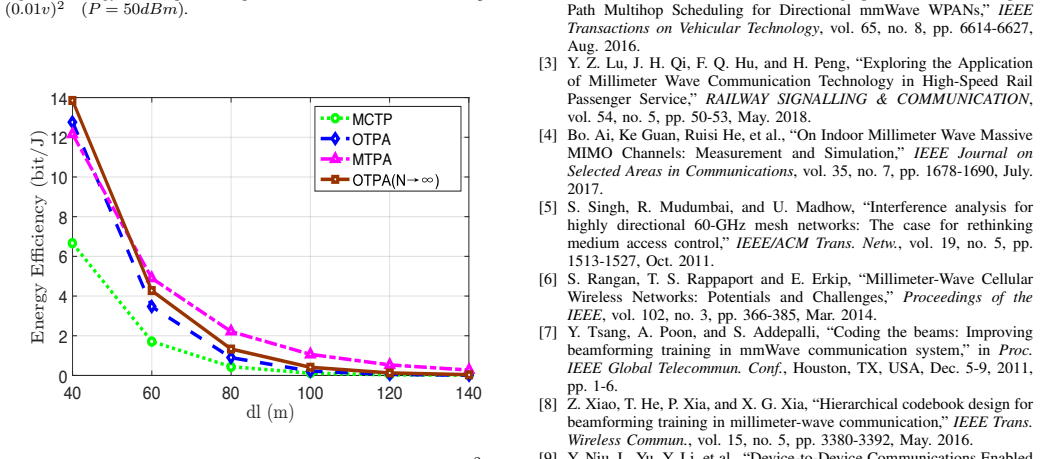
A hybrid optimization scheme for mmWave train communications reaches the lower bound on total energy consumption as the number of track segments increases without limit.
A machine-rendered reading of the paper's core claim, the machinery that carries it, and where it could break.
Core claim
The hybrid optimization scheme finds the limit of total energy consumption when the number of segments goes to infinity while ensuring the total amount of transmission data.
What carries the argument
The hybrid optimization scheme that combines per-segment power minimization with progressive segment refinement to locate the energy lower bound.
If this is right
- Total energy consumption converges to a computable lower bound as segment count grows.
- Power is allocated segment by segment to meet the cumulative data target at minimum cost.
- Beam alignment relies on predicted position rather than continuous tracking.
- The scheme remains effective when velocity estimates contain realistic error.
Where Pith is reading between the lines
- The same segmentation-plus-limit approach could apply to other linear high-mobility mmWave links such as highway vehicles.
- Hardware designers could use the derived energy bound as a target for minimum transmit power circuitry.
- Field trials that replace the analytic models with live channel measurements would test whether the limit still holds.
- Integration with existing rail signaling systems might reuse the position prediction step for both communication and safety.
Load-bearing premise
The position prediction model, realistic directional antenna model, and receive power model accurately represent the physical train-ground mmWave channel and beam alignment process under velocity estimation error.
What would settle it
Run the hybrid scheme on a real high-speed rail testbed with measured velocity errors, increase the number of beam-switching segments, and check whether measured energy consumption approaches the predicted limit.
Figures


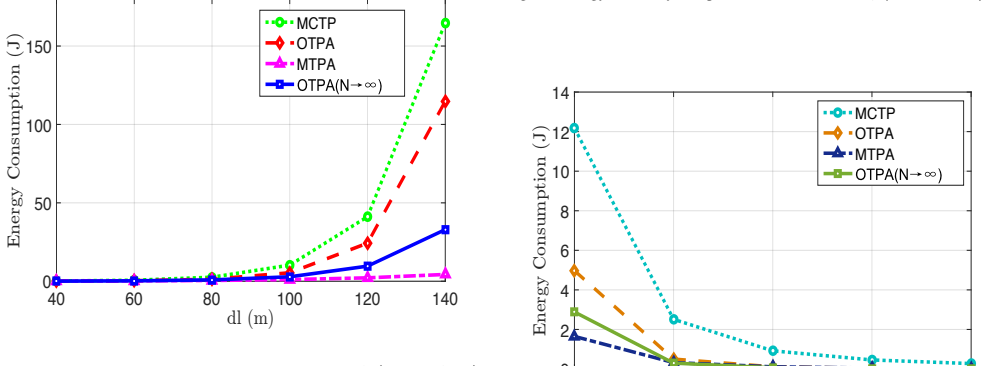
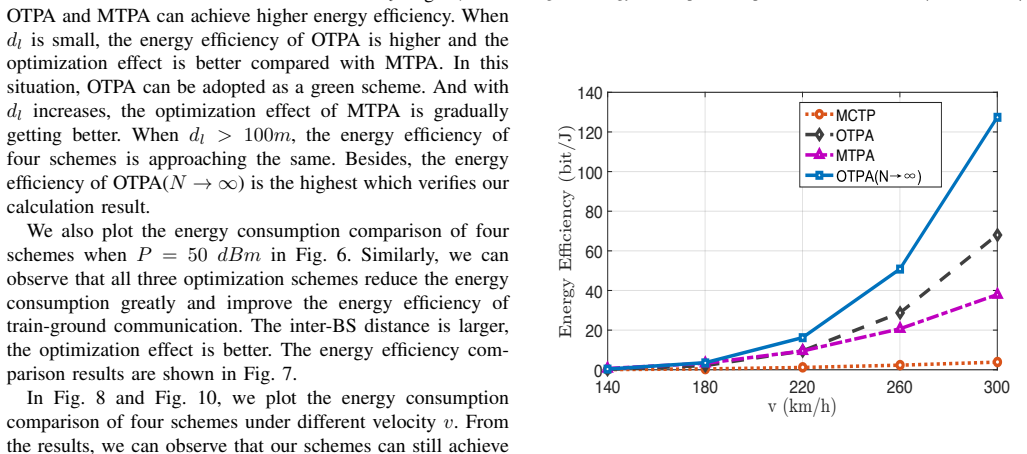


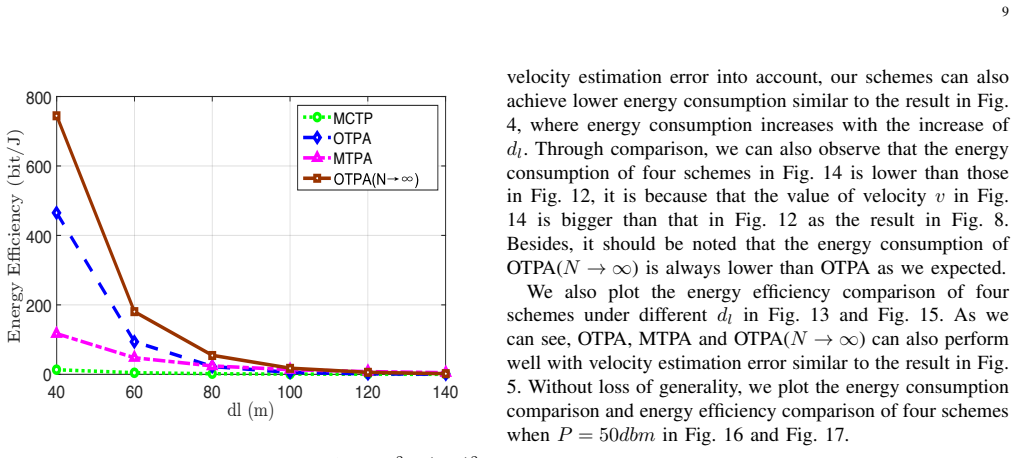
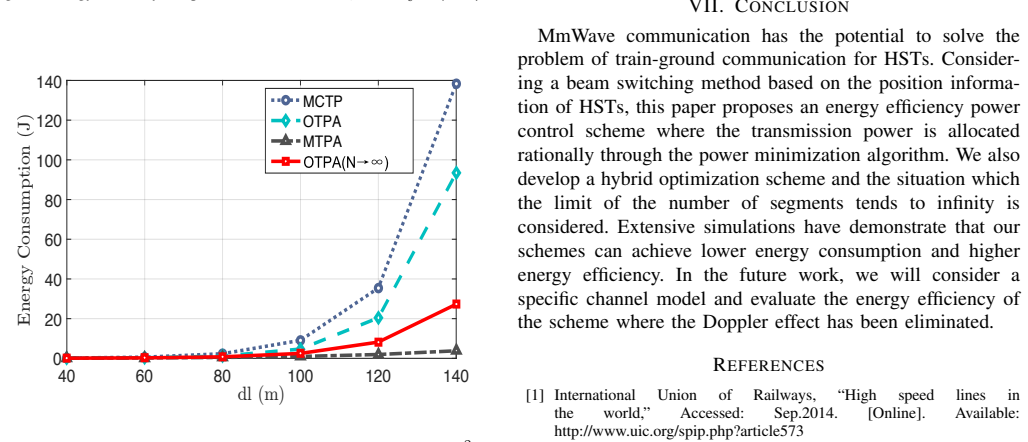
read the original abstract
High speed train system has proven to be a very flexible and attractive system that can be developed under various circumstances and in different contexts and cultures. As a result, high speed trains are widely deployed around the world. Providing more reliable and higher data rate communication services for high speed trains has become one of the most urgent challenges. With vast amounts of spectrum available, the millimeter wave (mmWave) system is able to provide transmission rates of several gigabits per second for high speed trains. At the same time, mmWave communication also suffers from high attenuation, thus higher energy efficiency should be considered. This paper proposes an energy efficient power control scheme of train-ground mmWave communication for high speed trains. Considering a beam switching method for efficient beam alignment, we first establish position prediction model, the realistic direction antenna model and receive power model. And then we allocate the transmission power rationally through the power minimization algorithm while ensuring the total amount of transmission data. Based on this, this paper also develops a hybrid optimization scheme and finds the limit of total energy consumption when the number of segments goes to infinity. Through simulation with various system parameters and taking velocity estimation error into account, we demonstrate the superior performance of our schemes.
Editorial analysis
A structured set of objections, weighed in public.
Referee Report
Summary. The manuscript proposes an energy-efficient power control scheme for train-ground mmWave communication in high-speed trains. It establishes a position prediction model, a realistic directional antenna model, and a receive power model; develops a power minimization algorithm that allocates transmission power while satisfying a total data transmission constraint; and introduces a hybrid optimization scheme that derives the limiting total energy consumption as the number of segments tends to infinity. Simulations that incorporate velocity estimation error are reported to demonstrate superior performance of the proposed schemes.
Significance. If the analytic models are shown to be accurate, the hybrid optimization result for the energy limit as segment count N → ∞ would supply a useful theoretical benchmark for energy-efficient mmWave HST link design. The explicit inclusion of velocity estimation error in the simulation framework is a constructive element. At present, however, the absence of model validation against measured data restricts the result to an unverified simulation setting.
major comments (1)
- The position prediction model, realistic directional antenna model, and receive power model (described in the abstract) are load-bearing for both the per-segment power allocation and the hybrid optimization that yields the energy-consumption limit as N → ∞. The manuscript provides no derivation details, error analysis, or cross-validation of these models against measured mmWave HST propagation or beam-alignment data, especially under velocity estimation error. Any mismatch would invalidate the claimed limit while still satisfying the total-data constraint.
Simulated Author's Rebuttal
We thank the referee for the positive assessment of the hybrid optimization result and the inclusion of velocity estimation error. We provide a point-by-point response to the major comment below.
read point-by-point responses
-
Referee: The position prediction model, realistic directional antenna model, and receive power model (described in the abstract) are load-bearing for both the per-segment power allocation and the hybrid optimization that yields the energy-consumption limit as N → ∞. The manuscript provides no derivation details, error analysis, or cross-validation of these models against measured mmWave HST propagation or beam-alignment data, especially under velocity estimation error. Any mismatch would invalidate the claimed limit while still satisfying the total-data constraint.
Authors: We thank the referee for highlighting this important point. The models are presented with derivations in the manuscript (Sections II and III), based on standard mmWave propagation models and train motion equations. However, we acknowledge the absence of cross-validation with measured data from real HST mmWave deployments. This is a limitation of the current work, which is primarily theoretical and simulation-based. We will add a new subsection discussing the model assumptions, derivation steps in more detail, and an error analysis under velocity estimation error in the revised manuscript. The hybrid optimization limit is derived analytically assuming the models hold, and simulations show performance under modeled errors. revision: partial
Circularity Check
No circularity: models, optimization, and limit are independent steps
full rationale
The paper first states it establishes position prediction, directional antenna, and receive power models, then applies a power minimization algorithm subject to a total transmission data constraint, and finally computes the energy-consumption limit as segment count N tends to infinity via a hybrid optimization scheme. None of these steps is shown to reduce by the paper's own equations to a fitted parameter renamed as a prediction, a self-citation chain, or an ansatz smuggled in from prior work. The limit is presented as the mathematical outcome of the optimization problem under the stated constraint; the models are treated as inputs rather than outputs derived from the result. This is a standard modeling-plus-optimization workflow with no load-bearing self-referential reduction.
Axiom & Free-Parameter Ledger
Reference graph
Works this paper leans on
-
[1]
High speed lines in the world,
International Union of Railways, “High speed lines in the world,” Accessed: Sep.2014. [Online]. Available: http://www.uic.org/spip.php?article573
work page 2014
-
[2]
Boosting Spatial Reuse via Multiple- Path Multihop Scheduling for Directional mmWave WPANs,
Y . Niu, C. H. Gao, Y . Li, et al., “Boosting Spatial Reuse via Multiple- Path Multihop Scheduling for Directional mmWave WPANs,” IEEE Transactions on V ehicular Technology , vol. 65, no. 8, pp. 6614-6627, Aug. 2016
work page 2016
-
[3]
Y . Z. Lu, J. H. Qi, F. Q. Hu, and H. Peng, “Exploring the Application of Millimeter Wave Communication Technology in High-Speed Rail Passenger Service,” RAILWAY SIGNALLING & COMMUNICATION , vol. 54, no. 5, pp. 50-53, May. 2018
work page 2018
-
[4]
On Indoor Millimeter Wave Massive MIMO Channels: Measurement and Simulation,
Bo. Ai, Ke Guan, Ruisi He, et al., “On Indoor Millimeter Wave Massive MIMO Channels: Measurement and Simulation,” IEEE Journal on Selected Areas in Communications , vol. 35, no. 7, pp. 1678-1690, July. 2017
work page 2017
-
[5]
S. Singh, R. Mudumbai, and U. Madhow, “Interference analysis for highly directional 60-GHz mesh networks: The case for rethinking medium access control,” IEEE/ACM Trans. Netw. , vol. 19, no. 5, pp. 1513-1527, Oct. 2011
work page 2011
-
[6]
Millimeter-Wave Cellular Wireless Networks: Potentials and Challenges,
S. Rangan, T. S. Rappaport and E. Erkip, “Millimeter-Wave Cellular Wireless Networks: Potentials and Challenges,” Proceedings of the IEEE, vol. 102, no. 3, pp. 366-385, Mar. 2014
work page 2014
-
[7]
Coding the beams: Improving beamforming training in mmWave communication system,
Y . Tsang, A. Poon, and S. Addepalli, “Coding the beams: Improving beamforming training in mmWave communication system,” in Proc. IEEE Global Telecommun. Conf. , Houston, TX, USA, Dec. 5-9, 2011, pp. 1-6
work page 2011
-
[8]
Hierarchical codebook design for beamforming training in millimeter-wave communication,
Z. Xiao, T. He, P. Xia, and X. G. Xia, “Hierarchical codebook design for beamforming training in millimeter-wave communication,” IEEE Trans. Wireless Commun., vol. 15, no. 5, pp. 3380-3392, May. 2016
work page 2016
-
[9]
Device-to-Device Communications Enabled Energy Efficient Multicast Scheduling in mmWave Small Cells,
Y . Niu, L. Yu, Y . Li, et al., “Device-to-Device Communications Enabled Energy Efficient Multicast Scheduling in mmWave Small Cells,” IEEE Transactions on V ehicular Technology , vol. 66, no. 3, pp. 1093-1109, Mar. 2018. 10
work page 2018
-
[10]
5G: A tutorial overview of standards, trials, challenges, deployment, and practice,
M. Shafi, A. F. Molisch, P. J. Simth, et al., “5G: A tutorial overview of standards, trials, challenges, deployment, and practice,” IEEE J. Sel. Areas Commun., vol. 35, no. 6, pp. 1201-1221, Jun. 2017
work page 2017
-
[11]
5G PPP Architecture Working Group, “View on 5G architecture,” 5GPPP, White Paper v2.0, Dec. 2017
work page 2017
-
[12]
Flexible and Reliable UA V-Assisted Backhaul Operation in 5G mmWave Cellular Networks,
M. Gapeyenko, V . Petrov, D. Moltchanov, et al., “Flexible and Reliable UA V-Assisted Backhaul Operation in 5G mmWave Cellular Networks,” IEEE Journal on Selected Areas in Communications , vol. 36, no. 11, pp. 2486-2496, Nov. 2018
work page 2018
-
[13]
Y . Niu, C. H. Gao, Y . Li, et al., “Energy-Efficient Scheduling for mmWave Backhauling of Small Cells in Heterogeneous Cellular Net- works,” IEEE Transactions on V ehicular Technology, vol. 66, no. 3, pp. 2674-2687, Mar. 2017
work page 2017
-
[14]
Future railway services-oriented mobile communications network,
B. Ai, K. Guan, M. Rupp, et al., “Future railway services-oriented mobile communications network,” in IEEE Communications Magazine , vol. 53, no. 10, pp. 78-85, Oct. 2015
work page 2015
-
[15]
Smart, Green and Integrated Transport Revised, EC Decision C(2015)2453, Apr
HORIZON 2020 Work Programme 2014-2015 17. Smart, Green and Integrated Transport Revised, EC Decision C(2015)2453, Apr. 2015
work page 2020
-
[16]
HIGH SPEED RAIL Brochure-2018,
International Union of Railways, “HIGH SPEED RAIL Brochure-2018,” Accessed: Jun.2018. [Online]. Available: http://www.uic.org/spip.php?article573
work page 2018
-
[17]
A fully integrated 16-element phased-array transmitter in SiGe BiCMOS for 60-GHz communications,
A. Valdes-Garcia, S. T. Nicolson, J. W. Lai, et al., “A fully integrated 16-element phased-array transmitter in SiGe BiCMOS for 60-GHz communications,” IEEE J. Solid-State Circuits. , vol. 45, no. 12, pp. 2757-2773, Dec. 2010
work page 2010
-
[18]
Beamforming investigation for wireless com- munication at 60GHz,
S. Gautam and T. R. Rao. “Beamforming investigation for wireless com- munication at 60GHz,” in 2017 International Conference on WiSPNET , 2017, pp. 1765-1768
work page 2017
-
[19]
Enabling Gigabit services for IEEE 802.11ad-capable high-speed train networks,
J. Kim and A. F. Molisch, “Enabling Gigabit services for IEEE 802.11ad-capable high-speed train networks,” in IEEE Radio and Wire- less Symposium (RWS) , Jan. 2013. pp. 145-147,
work page 2013
-
[20]
Beam Switching for Millimeter Wave Communication to Support High Speed Trains,
V . Va, X. C. Zhang, and R. W. Heath Jr., “Beam Switching for Millimeter Wave Communication to Support High Speed Trains,” IEEE, Sept.2015
work page 2015
-
[21]
J. Kim, I. G. Kim. “Distributed Antenna System-based Millimeter-Wave Mobile Broadband Communication System for High Speed Trains,” in 2013 International Conference on ICT Convergence (ICTC) , Jeju, Oct. 2013, pp. 218-222
work page 2013
-
[22]
An mmWave Beamforming Scheme for Disaster Detection in High Speed Railway,
L. L. He, X. M. Fang, H. C. Li, C. Li, and Y . M. Liu, “An mmWave Beamforming Scheme for Disaster Detection in High Speed Railway,” in 2016 IEEE/CIC International Conference on Communications in China (ICCC), Chengdu, July. 2016, pp. 1-6
work page 2016
-
[23]
H. Song, X. Fang and Y . Fang, “Millimeter-Wave Network Architec- tures for Future High-Speed Railway Communications: Challenges and Solutions,” IEEE Wireless Communications, vol. 23, no. 6, pp. 114-122, Dec. 2016
work page 2016
-
[24]
Hybrid Spatial Modulation Beamforming for mmWave Railway Communication Systems,
Y . P. Cui, X. M. Fang, and L. Yan. “Hybrid Spatial Modulation Beamforming for mmWave Railway Communication Systems,” IEEE Transactions on V ehicular Technology, vol. 65, no. 12, pp. 9597-9606, Dec. 2016
work page 2016
-
[25]
mmWave-based Mobile Backhaul Transceiver for High Speed Train Communication Systems,
G. Noh, J. Kim, H. S. Chung, et al., “mmWave-based Mobile Backhaul Transceiver for High Speed Train Communication Systems,” in 2017 IEEE Globecom Workshops (GC Wkshps) , Singapore, Dec. 2017, pp. 1-5
work page 2017
-
[26]
K. Guan, B. Ai, B. Peng, et al. “Towards Realistic High-Speed Train Channels at 5G Millimeter-Wave Band-Part I: Paradigm, Significance Analysis, and Scenario Reconstruction,” IEEE Transactions on V ehicular Technology, vol. 67, no. 10, pp. 9112-9128, Oct. 2018
work page 2018
-
[27]
Positioning of High- speed Trains using 5G New Radio Synchronization Signals,
J. Talvitie, T. Levanen and M. Koivisto. “Positioning of High- speed Trains using 5G New Radio Synchronization Signals,” in 2018 IEEE Wireless Communications and Networking Conference (WCNC) , Barcelona, Apr. 2018, pp. 1-6
work page 2018
-
[28]
Ultra- Reliable Communication in 5G mmWave Networks: A Risk-Sensitive Approach,
T. K. Vu, M. Bennis, M. Debbah, M. Latva-aho and C. S. Hong, “Ultra- Reliable Communication in 5G mmWave Networks: A Risk-Sensitive Approach,” IEEE Communications Letters , vol. 22, no. 4, pp. 708-711, Apr. 2018
work page 2018
-
[29]
Enhanced Channel Estimation and Codebook Design for Millimeter-Wave Communication,
Z. Xiao, H. Dong, L. Bai, P. Xia and X. Xia, “Enhanced Channel Estimation and Codebook Design for Millimeter-Wave Communication,” IEEE Transactions on V ehicular Technology, vol. 67, no. 10, pp. 9393- 9405, Oct. 2018
work page 2018
-
[30]
Z. Xiao, L. Zhu, J. Choi, P. Xia and X. Xia, “Joint Power Allocation and Beamforming for Non-Orthogonal Multiple Access (NOMA) in 5G Millimeter Wave Communications,” in IEEE Transactions on Wireless Communications, vol. 17, no. 5, pp. 2961-2974, May 2018
work page 2018
-
[31]
Performance Analysis of Millimeter Wave NOMA Networks with Beam Misalignment,
Y . Zhou, V . W. S. Wong and R. Schober, “Performance Analysis of Millimeter Wave NOMA Networks with Beam Misalignment,” 2018 IEEE International Conference on Communications (ICC) , Kansas City, MO, 2018, pp. 1-7
work page 2018
-
[32]
Y . Liu, X. Fang and M. Xiao, “Discrete Power Control and Transmission Duration Allocation for Self-Backhauling Dense mmWave Cellular Networks,” in IEEE Transactions on Communications , vol. 66, no. 1, pp. 432-447, Jan. 2018
work page 2018
-
[33]
User Selection and Power Allocation for mmWave-NOMA Networks,
J. Cui, Y . Liu, Z. Ding, P. Fan, and A. Nallanathan, “User Selection and Power Allocation for mmWave-NOMA Networks,” GLOBECOM 2017- 2017 IEEE Global Communications Conference , Singapore, 2017, pp. 1-6
work page 2017
-
[34]
Spatial reuse strategy in mmWave WPANs with directional antennas,
Q. Chen, X. Peng, J. Yang, and F. Chin, “Spatial reuse strategy in mmWave WPANs with directional antennas,” in 2012 IEEE Global Communications Conference(CLOBECOM) , Anaheim, CA, Dec. 2012, pp. 5392-5397
work page 2012
-
[35]
Orthogonal Time Frequency Space Modulation,
R. Hadani, S. Rakib, M. Tsatsanis, et al., “Orthogonal Time Frequency Space Modulation,” 2017 IEEE Wireless Communications and Network- ing Conference (WCNC) , San Francisco, CA, 2017, pp. 1-6
work page 2017
-
[36]
J. Qiao, L. X. Cai, X. Shen and J. W. Mark, “STDMA-based scheduling algorithm for concurrent transmissions in directional millimeter wave networks,” 2012 IEEE International Conference on Communications (ICC), Ottawa, ON, 2012, pp. 5221-5225
work page 2012
-
[37]
L. X. Cai, L. Cai, X. Shen and J. W. Mark, “Rex: A randomized EXclusive region based scheduling scheme for mmWave WPANs with directional antenna,” in IEEE Transactions on Wireless Communications, vol. 9, no. 1, pp. 113-121, Jan. 2010
work page 2010
-
[38]
Enabling Multi-Hop Concurrent Transmissions in 60 GHz Wireless Personal Area Networks,
J. Qiao, L. X. Cai, X. S. Shen and J. W. Mark, “Enabling Multi-Hop Concurrent Transmissions in 60 GHz Wireless Personal Area Networks,” in IEEE Transactions on Wireless Communications , vol. 10, no. 11, pp. 3824-3833, Nov. 2011
work page 2011
-
[39]
C.-S. Sum, Z. Lan, R. Funada, et al., “Virtual time-slot allocation scheme for throughput enhancement in a millimeter-wave multi-Gbps WPAN system,” in IEEE Journal on Selected Areas in Communications , vol. 27, no. 8, pp. 1379-1389, Oct. 2009. Lei Wang was born in Shanxi, China, in 1997. She received the B.S. degree in mathematics and ap- plied mathematic...
work page 2009
discussion (0)
Sign in with ORCID, Apple, or X to comment. Anyone can read and Pith papers without signing in.