Embedding Non-Distortive Cancelable Face Template Generation
Pith reviewed 2026-05-24 03:36 UTC · model grok-4.3
The pith
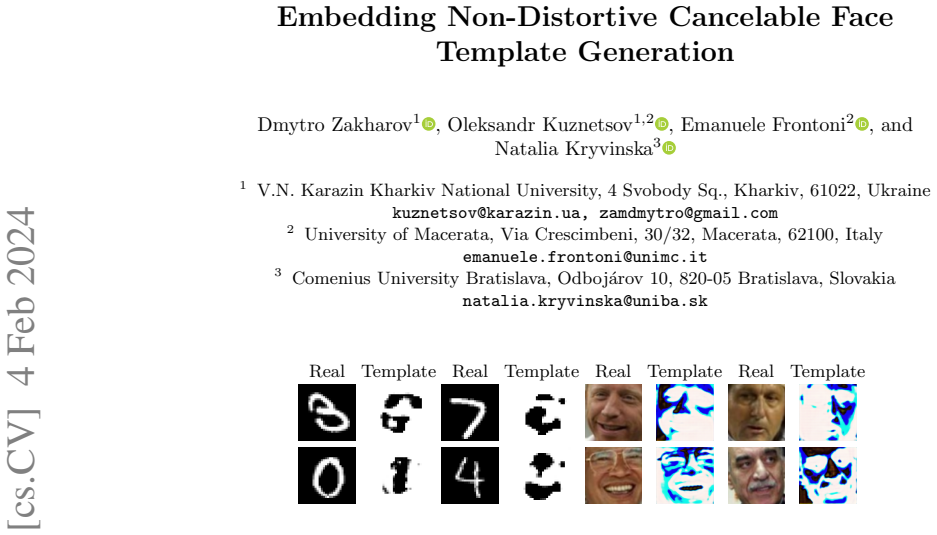
A tunable distortion method renders faces unrecognizable to humans while preserving identity predictions in any embedding network.
A machine-rendered reading of the paper's core claim, the machinery that carries it, and where it could break.
Core claim
An innovative image distortion technique makes facial images unrecognizable to the eye but still identifiable by any custom embedding neural network model. The approach tests biometric recognition networks by finding the maximum distortion that leaves the predicted identity unchanged, with effectiveness assessed on MNIST and LFW datasets via traditional comparison metrics.
What carries the argument
The tunable image distortion technique that is applied until it reaches a maximum level without changing the embedding model's identity prediction.
If this is right
- Biometric systems can generate cancelable face templates that enhance privacy without direct storage of raw data.
- Recognition networks can be evaluated for robustness by measuring the distortion threshold before identity prediction changes.
- The technique supports comparison of different embedding models using standard metrics on datasets like MNIST and LFW.
Where Pith is reading between the lines
- The approach may allow template revocation in biometric systems if a template is compromised.
- Extension to other modalities such as fingerprints could follow the same distortion logic.
- Further work would be needed to confirm the maximum distortion holds when the embedding model is replaced after deployment.
Load-bearing premise
A maximum distortion level exists that leaves the embedding model's identity prediction unchanged and can be tuned without specifying how this level is determined or validated across models.
What would settle it
A test on multiple embedding models where any distortion sufficient to make the image unrecognizable to humans also alters the predicted identity.
Figures


read the original abstract
Biometric authentication systems are crucial for security, but developing them involves various complexities, including privacy, security, and achieving high accuracy without directly storing pure biometric data in storage. We introduce an innovative image distortion technique that makes facial images unrecognizable to the eye but still identifiable by any custom embedding neural network model. Using the proposed approach, we test the reliability of biometric recognition networks by determining the maximum image distortion that does not change the predicted identity. Through experiments on MNIST and LFW datasets, we assess its effectiveness and compare it based on the traditional comparison metrics.
Editorial analysis
A structured set of objections, weighed in public.
Referee Report
Summary. The manuscript proposes an image distortion technique for cancelable biometric templates. It claims that facial images can be distorted to become unrecognizable to human observers while remaining identifiable by arbitrary embedding neural network models. The central contribution is a procedure to identify the maximum distortion level that leaves the model's identity prediction unchanged, with experiments reported on MNIST and LFW and comparisons against traditional metrics.
Significance. If the method can be shown to work with a reproducible, model-agnostic tuning procedure and quantitative validation, it would address a practical need in privacy-preserving biometrics by allowing templates that are visually cancelable yet still usable by existing embedding networks. The absence of any reported numbers, stopping criteria, or cross-model tests in the current text prevents assessment of whether this contribution is realized.
major comments (2)
- [Abstract] Abstract: the statement that experiments were performed on MNIST and LFW is not accompanied by any quantitative results, accuracy figures, error analysis, or description of how identity preservation was measured, leaving the central empirical claim unsupported.
- [Abstract] Abstract and method description: the procedure for locating the 'maximum image distortion that does not change the predicted identity' is not specified (no algorithm, stopping criterion, optimization method, or per-sample search strategy is given), and results are reported only for the models used in the experiments rather than demonstrating invariance across unrelated embedding networks.
minor comments (1)
- [Title/Abstract] The title refers to 'Non-Distortive' templates while the abstract describes an image distortion technique; this tension should be clarified in the introduction.
Simulated Author's Rebuttal
We thank the referee for the detailed and constructive report. We address each major comment below and have revised the manuscript to improve clarity, add missing details, and strengthen the presentation of results where appropriate.
read point-by-point responses
-
Referee: [Abstract] Abstract: the statement that experiments were performed on MNIST and LFW is not accompanied by any quantitative results, accuracy figures, error analysis, or description of how identity preservation was measured, leaving the central empirical claim unsupported.
Authors: We agree that the abstract would benefit from explicit quantitative support. In the revised manuscript we have updated the abstract to report the key accuracy figures achieved on both MNIST and LFW, together with a concise statement of how identity preservation was measured (unchanged top-1 prediction of the embedding network after distortion). The full error analysis and per-sample statistics remain in the experimental section but are now cross-referenced from the abstract. revision: yes
-
Referee: [Abstract] Abstract and method description: the procedure for locating the 'maximum image distortion that does not change the predicted identity' is not specified (no algorithm, stopping criterion, optimization method, or per-sample search strategy is given), and results are reported only for the models used in the experiments rather than demonstrating invariance across unrelated embedding networks.
Authors: The original method section described the overall distortion approach but lacked an explicit algorithmic statement. We have added a dedicated subsection that specifies the per-sample binary-search procedure, the stopping criterion (first distortion level at which the model output changes), and the optimization method used. Regarding cross-model invariance, the tuning procedure is deliberately model-specific; each embedding network receives its own maximum-distortion threshold. We have clarified this point in the text and added a short discussion noting that the same search strategy can be applied to any new network without modification of the core algorithm, while acknowledging that empirical validation on additional unrelated models would require further experiments. revision: partial
Circularity Check
No circularity: no equations, derivations, or self-citation chains present
full rationale
The provided abstract and visible text introduce a distortion technique and a maximum-distortion test but contain no equations, parameter-fitting steps, or derivations. No load-bearing claims reduce to self-definition, fitted inputs renamed as predictions, or self-citation. The central assertion is an empirical technique whose validity would require external validation rather than internal reduction; absence of any mathematical chain means the derivation is self-contained by default. No steps qualify under the enumerated patterns.
Axiom & Free-Parameter Ledger
Reference graph
Works this paper leans on
-
[1]
Artificial Intelligence for Cybersecurity, Advances in Information Security, vol. 54. Springer International Publishing, Cham (2022). https://doi.org/10.1007/978-3- 030-97087-1, https://link.springer.com/10.1007/978-3-030-97087-1
-
[2]
Bio-inspiring cyber security and cloud services: trends and innovations pp
Amin, R., Gaber, T., ElTaweel, G., Hassanien, A.E.: Biometric and traditional mobile authentication techniques: Overviews and open issues. Bio-inspiring cyber security and cloud services: trends and innovations pp. 423–446 (2014)
work page 2014
-
[3]
Security and Communication Networks 2021, 6624890 (2021)
Bok-Min, G., Abanda, Y., Tiedeu, A., Kom, G.: Image encryption with fu- sion of two maps. Security and Communication Networks 2021, 6624890 (2021). https://doi.org/10.1155/2021/6624890, https://doi.org/10.1155/2021/6624890
-
[4]
IEEE Signal Processing Magazine 29(6), 141–142 (2012)
Deng, L.: The mnist database of handwritten digit images for machine learning research. IEEE Signal Processing Magazine 29(6), 141–142 (2012)
work page 2012
-
[5]
Galbally, J., Fierrez, J., Ortega-Garc´ ıa, J.: Vulnerabilities in biometric systems: Attacks and recent advances in liveness detection. Database 1(3), 1–8 (2007)
work page 2007
-
[6]
In: 2016 IEEE Conference on Computer Vision and Pattern Recog- nition (CVPR)
Gatys, L.A., Ecker, A.S., Bethge, M.: Image style transfer using convolutional neu- ral networks. In: 2016 IEEE Conference on Computer Vision and Pattern Recog- nition (CVPR). pp. 2414–2423 (2016). https://doi.org/10.1109/CVPR.2016.265
-
[7]
Advances in neural infor- mation processing systems 27 (2014)
Goodfellow, I., Pouget-Abadie, J., Mirza, M., Xu, B., Warde-Farley, D., Ozair, S., Courville, A., Bengio, Y.: Generative adversarial nets. Advances in neural infor- mation processing systems 27 (2014)
work page 2014
-
[8]
Huang, G.B., Ramesh, M., Berg, T., Learned-Miller, E.: Labeled faces in the wild: A database for studying face recognition in unconstrained environments. Tech. Rep. 07-49, University of Massachusetts, Amherst (October 2007)
work page 2007
-
[9]
Image-to-Image Translation with Conditional Adversarial Networks
Isola, P., Zhu, J., Zhou, T., Efros, A.A.: Image-to-image translation with con- ditional adversarial networks. CoRR abs/1611.07004 (2016), http://arxiv.org/ abs/1611.07004
work page internal anchor Pith review Pith/arXiv arXiv 2016
-
[10]
Future Generation Computer Systems 102, 30–41 (Jan 2020)
Kaur, H., Khanna, P.: Privacy preserving remote multi-server biometric authenti- cation using cancelable biometrics and secret sharing. Future Generation Computer Systems 102, 30–41 (Jan 2020). https://doi.org/10.1016/j.future.2019.07.023
-
[11]
Adam: A Method for Stochastic Optimization
Kingma, D.P., Ba, J.: Adam: A method for stochastic optimization. arXiv preprint arXiv:1412.6980 (2014)
work page internal anchor Pith review Pith/arXiv arXiv 2014
-
[12]
On weight initialization in deep neural networks
Kumar, S.K.: On weight initialization in deep neural networks. CoRR abs/1704.08863 (2017), http://arxiv.org/abs/1704.08863
work page internal anchor Pith review Pith/arXiv arXiv 2017
-
[13]
CoRR abs/1908.08628 (2019), http://arxiv.org/abs/1908.08628
Le, H.M., Samaras, D.: Shadow removal via shadow image decomposition. CoRR abs/1908.08628 (2019), http://arxiv.org/abs/1908.08628
-
[14]
CoRR abs/2103.12997 (2021), https://arxiv.org/abs/2103
Liu, Z., Yin, H., Wu, X., Wu, Z., Mi, Y., Wang, S.: From shadow generation to shadow removal. CoRR abs/2103.12997 (2021), https://arxiv.org/abs/2103. 12997
-
[15]
Proceedings of the IEEE 97(6), 1128–1148 (2009)
Matoba, O., Nomura, T., Perez-Cabre, E., Millan, M.S., Javidi, B.: Optical tech- niques for information security. Proceedings of the IEEE 97(6), 1128–1148 (2009). https://doi.org/10.1109/JPROC.2009.2018367 Embedding Non-Distortive Template Generation 13
-
[16]
In: BMVC 2015- Proceedings of the British Machine Vision Conference 2015
Parkhi, O., Vedaldi, A., Zisserman, A.: Deep face recognition. In: BMVC 2015- Proceedings of the British Machine Vision Conference 2015. British Machine Vision Association (2015)
work page 2015
-
[17]
Wiley-ISTE, Hoboken, 1st edition edn
Puech, W.: Multimedia Security 2: Biometrics, Video Surveillance and Multimedia Encryption. Wiley-ISTE, Hoboken, 1st edition edn. (Jul 2022)
work page 2022
-
[18]
U-Net: Convolutional Networks for Biomedical Image Segmentation
Ronneberger, O., Fischer, P., Brox, T.: U-net: Convolutional networks for biomed- ical image segmentation. CoRR abs/1505.04597 (2015), http://arxiv.org/abs/ 1505.04597
work page internal anchor Pith review Pith/arXiv arXiv 2015
-
[19]
FaceNet: A Unified Embedding for Face Recognition and Clustering
Schroff, F., Kalenichenko, D., Philbin, J.: Facenet: A unified embedding for face recognition and clustering. CoRR abs/1503.03832 (2015), http://arxiv.org/abs/ 1503.03832
work page internal anchor Pith review Pith/arXiv arXiv 2015
-
[20]
IEEE Access 9, 23409–23423 (2021)
Subramanian, N., Elharrouss, O., Al-Maadeed, S., Bouridane, A.: Image steganog- raphy: A review of the recent advances. IEEE Access 9, 23409–23423 (2021). https://doi.org/10.1109/ACCESS.2021.3053998
-
[21]
In: 2021 IEEE/CVF Conference on Computer Vision and Pattern Recognition Workshops (CVPRW)
Vasluianu, F.A., Romero, A., Van Gool, L., Timofte, R.: Shadow removal with paired and unpaired learning. In: 2021 IEEE/CVF Conference on Computer Vision and Pattern Recognition Workshops (CVPRW). pp. 826–835 (2021). https://doi.org/10.1109/CVPRW53098.2021.00092
-
[22]
NormFace: L2 Hypersphere Embedding for Face Verification
Wang, F., Xiang, X., Cheng, J., Yuille, A.L.: Normface: L2 hypersphere embedding for face verification. CoRR abs/1704.06369 (2017), http://arxiv.org/abs/1704. 06369
work page internal anchor Pith review Pith/arXiv arXiv 2017
-
[23]
Journal of Physics: Conference Series 2337(1), 012009 (sep 2022)
Yang, P., Zhang, M., Wu, R., Su, Y., Guo, K.: Hiding image within image based on deep learning. Journal of Physics: Conference Series 2337(1), 012009 (sep 2022). https://doi.org/10.1088/1742-6596/2337/1/012009, https://dx.doi.org/10. 1088/1742-6596/2337/1/012009
-
[24]
Computers & Secu- rity 114, 102583 (Mar 2022)
Yang, W., Wang, S., Kang, J.J., Johnstone, M.N., Bedari, A.: A linear convolution- based cancelable fingerprint biometric authentication system. Computers & Secu- rity 114, 102583 (Mar 2022). https://doi.org/10.1016/j.cose.2021.102583
-
[25]
Jour- nal of Information Security and Applications 58, 102704 (May 2021)
Yang, W., Wang, S., Shahzad, M., Zhou, W.: A cancelable biometric authentication system based on feature-adaptive random projection. Jour- nal of Information Security and Applications 58, 102704 (May 2021). https://doi.org/10.1016/j.jisa.2020.102704
-
[26]
SteganoGAN: High Capacity Image Steganography with GANs
Zhang, K.A., Cuesta-Infante, A., Veeramachaneni, K.: Steganogan: High capacity image steganography with gans. arXiv preprint arXiv:1901.03892 (2019), https: //arxiv.org/abs/1901.03892
work page internal anchor Pith review Pith/arXiv arXiv 1901
-
[27]
IEEE Access 4, 2507–2519 (2016)
Zhang, Y., Zhang, L.Y., Zhou, J., Liu, L., Chen, F., He, X.: A review of com- pressive sensing in information security field. IEEE Access 4, 2507–2519 (2016). https://doi.org/10.1109/ACCESS.2016.2569421
-
[28]
IEEE Transactions on Computational Imaging 3(1), 47–57 (2017)
Zhao, H., Gallo, O., Frosio, I., Kautz, J.: Loss functions for image restoration with neural networks. IEEE Transactions on Computational Imaging 3(1), 47–57 (2017). https://doi.org/10.1109/TCI.2016.2644865
-
[29]
Inverting face embeddings with convolutional neural networks
Zhmoginov, A., Sandler, M.: Inverting face embeddings with convolutional neu- ral networks. ArXiv abs/1606.04189 (2016), https://api.semanticscholar.org/ CorpusID:15785666
work page internal anchor Pith review Pith/arXiv arXiv 2016
discussion (0)
Sign in with ORCID, Apple, or X to comment. Anyone can read and Pith papers without signing in.