Exploring a Behavioral Model of "Positive Friction" in Human-AI Interaction
Pith reviewed 2026-05-24 03:48 UTC · model grok-4.3
The pith
A positive friction model shows how deliberate delays and checks can benefit both AI users and developers.
A machine-rendered reading of the paper's core claim, the machinery that carries it, and where it could break.
Core claim
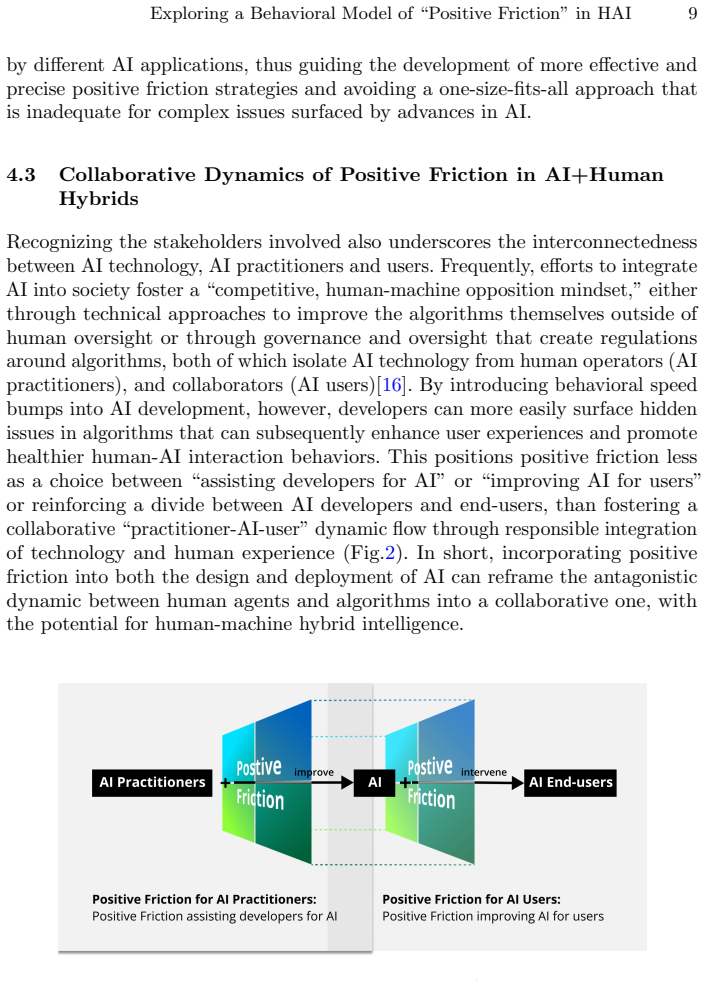
The paper claims that a positive friction model can characterize how friction is currently beneficial in user and developer experiences with AI, diagnose the potential need for friction where it may not yet exist in these contexts, and inform how positive friction can be used to generate solutions, especially as advances in AI continue to progress and new opportunities emerge.
What carries the argument
The positive friction model, a framework that maps deliberate friction to outcomes like reflection and bias reduction in AI user and developer workflows.
If this is right
- AI users would gain from inserted pauses that encourage consideration of outputs instead of immediate acceptance.
- Development teams could apply friction during collaboration to surface diverse viewpoints and reduce group bias.
- AI product design would incorporate targeted friction points to support unexpected discoveries and reduce over-reliance on automation.
- A hybrid AI-plus-human approach would become a practical design choice for managing when and how friction is introduced.
Where Pith is reading between the lines
- Interface patterns that insert short mandatory review steps before AI actions could be prototyped and measured for changes in decision quality.
- The same model might apply to other automated systems outside AI, such as recommendation engines or autonomous vehicles, where seamless operation is currently the default.
- Longitudinal field studies tracking user retention and reflection metrics after friction is added would provide direct evidence for or against the model's predictions.
Load-bearing premise
Introducing deliberate friction in AI interactions will produce net benefits such as greater reflection without causing user frustration or disengagement.
What would settle it
A controlled experiment in which users of an AI tool with added friction complete fewer tasks and report higher frustration than users of an otherwise identical frictionless tool would undermine the model's claimed utility.
Figures


read the original abstract
Designing seamless, frictionless user experiences has long been a dominant trend in both applied behavioral science and artificial intelligence (AI), in which the goal of making desirable actions easy and efficient informs efforts to minimize friction in user experiences. However, in some settings, friction can be genuinely beneficial, such as the insertion of deliberate delays to increase reflection, preventing individuals from resorting to automatic or biased behaviors, and enhancing opportunities for unexpected discoveries. More recently, the popularization and availability of AI on a widespread scale has only increased the need to examine how friction can help or hinder users of AI; it also suggests a need to consider how positive friction can benefit AI practitioners, both during development processes (e.g., working with diverse teams) and to inform how AI is designed into offerings. This paper first proposes a "positive friction" model that can help characterize how friction is currently beneficial in user and developer experiences with AI, diagnose the potential need for friction where it may not yet exist in these contexts, and inform how positive friction can be used to generate solutions, especially as advances in AI continue to be progress and new opportunities emerge. It then explores this model in the context of AI users and developers by proposing the value of taking a hybrid "AI+human" lens, and concludes by suggesting questions for further exploration.
Editorial analysis
A structured set of objections, weighed in public.
Referee Report
Summary. The manuscript proposes a conceptual 'positive friction' model for human-AI interaction. The model is intended to characterize beneficial friction in user and developer experiences with AI, diagnose where additional friction may be needed, and guide the generation of design solutions. It explores the model via a hybrid 'AI+human' lens and concludes with open questions for future work. No empirical data, formal derivations, or validation are presented.
Significance. If adopted and later validated, the framework could usefully shift HCI and AI design discourse away from purely frictionless paradigms toward intentional friction that supports reflection and bias reduction. Its current contribution is primarily organizational and generative rather than evidentiary; significance therefore hinges on whether subsequent work can operationalize the model with testable criteria or case studies.
major comments (2)
- [Abstract / model proposal] Abstract and model-proposal section: the central claim that the model can 'diagnose the potential need for friction where it may not yet exist' and 'inform how positive friction can be used to generate solutions' is not supported by any diagnostic criteria, decision rules, or worked examples within the manuscript, leaving the asserted utility un-demonstrated.
- [Introduction and hybrid-lens exploration] The behavioral premise that deliberate friction will reliably produce net benefits (increased reflection, reduced bias) without inducing user frustration or disengagement is stated but not addressed with boundary conditions, trade-off analysis, or mitigation strategies, making the model's practical applicability for both users and developers difficult to evaluate.
minor comments (2)
- [Abstract] Abstract contains a typographical error: 'continue to be progress' should read 'continue to progress'.
- [Hybrid lens section] The hybrid 'AI+human' lens is introduced but its concrete operationalization (e.g., specific interaction points or design heuristics) remains high-level; a brief illustrative vignette would improve clarity.
Simulated Author's Rebuttal
We thank the referee for their constructive comments on our conceptual proposal. We address each major comment below, clarifying the manuscript's scope as an exploratory framework while agreeing where revisions can strengthen the presentation of its intended utility and limitations.
read point-by-point responses
-
Referee: [Abstract / model proposal] Abstract and model-proposal section: the central claim that the model can 'diagnose the potential need for friction where it may not yet exist' and 'inform how positive friction can be used to generate solutions' is not supported by any diagnostic criteria, decision rules, or worked examples within the manuscript, leaving the asserted utility un-demonstrated.
Authors: We agree that the manuscript does not include diagnostic criteria, decision rules, or worked examples, as it is a conceptual proposal intended to lay groundwork for such operationalization in future work rather than demonstrate it. The claims describe the model's potential role. To address this, we will add a new subsection with illustrative scenarios drawn from prior HCI and behavioral literature to show how the model might be applied, while explicitly stating that these are not validated criteria. revision: partial
-
Referee: [Introduction and hybrid-lens exploration] The behavioral premise that deliberate friction will reliably produce net benefits (increased reflection, reduced bias) without inducing user frustration or disengagement is stated but not addressed with boundary conditions, trade-off analysis, or mitigation strategies, making the model's practical applicability for both users and developers difficult to evaluate.
Authors: The manuscript focuses on proposing the model and hybrid lens rather than exhaustively analyzing all boundary conditions or trade-offs. This is a fair observation about the limits of a conceptual paper. We will revise the introduction and add a dedicated limitations paragraph in the conclusion to discuss potential risks of frustration or disengagement, reference relevant behavioral science on when friction may backfire, and outline mitigation approaches, while emphasizing the need for empirical testing. revision: yes
Circularity Check
No significant circularity; conceptual model is self-contained
full rationale
The paper is a purely conceptual proposal that introduces a positive-friction model as an organizing lens based on stated premises about beneficial friction in AI contexts. It contains no equations, no fitted parameters, no quantitative predictions, and no derivations that reduce to prior results by construction. The central claim is the utility of the proposed model for diagnosis and solution generation, which rests on explicit behavioral assumptions rather than any self-referential chain or renamed input. No self-citations are invoked as load-bearing uniqueness theorems, and the text does not smuggle ansatzes or rename known empirical patterns via new coordinates. The derivation chain is therefore independent of its own outputs.
Axiom & Free-Parameter Ledger
axioms (1)
- domain assumption In some settings, friction can be genuinely beneficial, such as the insertion of deliberate delays to increase reflection, preventing individuals from resorting to automatic or biased behaviors, and enhancing opportunities for unexpected discoveries.
invented entities (1)
-
Positive friction model
no independent evidence
Reference graph
Works this paper leans on
-
[1]
Bardlavens, T.: How adobe’s product equity team is setting new standards for our experiences — adobe blog (Sep 2023), https://blog.adobe.com/en/publish/2023/09/ 20/how-adobes-product-equity-team-setting-new-standards-for-our-experiences
work page 2023
-
[2]
Bellamy, R.K., Dey, K., Hind, M., Hoffman, S.C., Houde, S., Kannan, K., Lohia, P., Martino, J., Mehta, S., Mojsilovic, A., et al.: Ai fairness 360: An extensible toolkit for detecting, understanding, and mitigating unwanted algorithmic bias. arXiv preprint arXiv:1810.01943 (2018)
work page internal anchor Pith review Pith/arXiv arXiv 2018
- [3]
-
[4]
Bird, S., Dud´ ık, M., Edgar, R., Horn, B., Lutz, R., Milan, V., Sameki, M., Wallach, H., Walker, K.: Fairlearn: A toolkit for assessing and improving fairness in ai. Microsoft, Tech. Rep. MSR-TR-2020-32 (2020)
work page 2020
-
[5]
Bridle, J.: Autonomous trap 001. NTT InterCommunication Center [ICC] (2017), https://www.ntticc.or.jp/en/archive/works/autonomous-trap-001/
work page 2017
-
[6]
Google (Dec 2023), https://blog.google/products/chrome/ privacy-sandbox-tracking-protection/
Chavez, A.: The next step toward phasing out third-party cookies in chrome. Google (Dec 2023), https://blog.google/products/chrome/ privacy-sandbox-tracking-protection/
work page 2023
-
[7]
Chowdhury, R., Williams, J.: Introducing twitter’s first algorithmic bias bounty challenge (Jul 2021), https://blog.twitter.com/engineering/en us/topics/insights/ 2021/algorithmic-bias-bounty-challenge
work page 2021
-
[8]
In: Proceedings of the 2016 CHI conference extended abstracts on human factors in computing systems
Cox, A.L., Gould, S.J., Cecchinato, M.E., Iacovides, I., Renfree, I.: Design frictions for mindful interactions: The case for microboundaries. In: Proceedings of the 2016 CHI conference extended abstracts on human factors in computing systems. pp. 1389–1397 (2016)
work page 2016
-
[9]
Journal of General Internal Medicine 33(5), 659–667 (Jan 2018)
Cutrona, S.L., Golden, J.G., Goff, S.L., Ogarek, J., Barton, B., Fisher, L., Preusse, P., Sundaresan, D., Garber, L., Mazor, K.M.: Improving rates of outpatient in- fluenza vaccination through ehr portal messages and interactive automated calls: A randomized controlled trial. Journal of General Internal Medicine 33(5), 659–667 (Jan 2018). https://doi.org/...
-
[10]
Duckworth, A., Milkman, K.L., Laibson, D.: Beyond willpower: Strategies for reducing failures of self-control. Psychological Science in the Public Interest 19(3), 102–129 (Dec 2018), https://doi.org/10.1177/1529100618821893
-
[11]
London Publishing Partner, S.L
Dyson, P., Sutherland, R.: TRANSPORT FOR HUMANS : are we nearly there yet?. London Publishing Partner, S.L. (2021)
work page 2021
-
[12]
Eggink, W., van der HEIJDEN, K., Dorrestijn, S., Ouwens, I., et al.: Tool-based ethics education for engineers; wonderberries and wisdom tiles. In: DS 117: Pro- ceedings of the 24th International Conference on Engineering and Product Design Education (E&PDE 2022), London South Bank University in London, UK. 8th-9th September 2022 (2022)
work page 2022
-
[13]
Design Issues 23(3), 30–45 (Jul 2007)
Faiola, A.: The design enterprise: Rethinking the hci education paradigm. Design Issues 23(3), 30–45 (Jul 2007). https://doi.org/10.1162/desi.2007.23.3.30, https: //doi.org/10.1162/desi.2007.23.3.30
-
[14]
Gosline, R.R.: Why ai customer journeys need more friction (Jun 2022), https: //hbr.org/2022/06/why-ai-customer-journeys-need-more-friction
work page 2022
-
[15]
Grammarly: Circles at grammarly: How we foster an inclusive culture (May 2023), https://www.grammarly.com/blog/fostering-inclusive-culture/#: ∼:text= At%20Grammarly%2C%20Circles%20are%20employee
work page 2023
-
[16]
Guszcza, J., Danks, D., Fox, C.R., Hammond, K.J., Ho, D.E., Imas, A., Landay, J., Levi, M., Logg, J., Picard, R.W., et al.: Hybrid intelligence: A paradigm for more responsible practice. Available at SSRN (2022) 18 Z. Chen and R. Schmidt
work page 2022
-
[17]
The BMJ 344(jan30 1), e522 (Jan 2012), https://doi.org/10.1136/bmj.e522
Halpern, S.D., Asch, D.A., Volpp, K.G.: Commitment contracts as a way to health. The BMJ 344(jan30 1), e522 (Jan 2012), https://doi.org/10.1136/bmj.e522
-
[18]
EAI Endorsed Transactions on Game-Based Learning 4(12), 153401 (Dec 2017)
Harris, A., Islam, S.u., Qadir, J., Khan, U.A.: Persuasive technology for human development: Review and case study. EAI Endorsed Transactions on Game-Based Learning 4(12), 153401 (Dec 2017). https://doi.org/https://doi.org/10.4108/eai.8- 12-2017.153401
-
[19]
Digital Journalism 10(10), 1710–1730 (2022)
Heitz, L., Lischka, J.A., Birrer, A., Paudel, B., Tolmeijer, S., Laugwitz, L., Bernstein, A.: Benefits of diverse news recommendations for democracy: A user study. Digital Journalism 10(10), 1710–1730 (2022)
work page 2022
-
[20]
Journal of Risk and Uncertainty 14(3), 235–257 (1997)
Jenni, K., Loewenstein, G.: Explaining the identifiable victim ef- fect. Journal of Risk and Uncertainty 14(3), 235–257 (1997). https://doi.org/https://doi.org/10.1023/a:1007740225484
- [21]
-
[22]
Kaled, E.: Public transit is driving toward frictionless travel — genfare (Sep 2019), https://genfare.com/archive/public-transit-driving-toward-frictionless-travel/
work page 2019
-
[23]
Kim, S.: The psychology behind why you spend so much money on amazon prime (Oct 2021), https://www.cnbc.com/2021/10/29/ hooked-psychology-explains-why-you-spend-money-on-amazon-prime.html
work page 2021
-
[24]
In: Proceedings of the fifth Decennial Aarhus Conference on critical alternatives
Korn, M., Voida, A.: Creating friction: Infrastructuring civic engagement in everyday life. In: Proceedings of the fifth Decennial Aarhus Conference on critical alternatives. pp. 145–156 (2015)
work page 2015
-
[25]
Psychological Science in the Public Interest 21(3), 103–156 (2020)
Kozyreva, A., Lewandowsky, S., Hertwig, R.: Citizens versus the internet: Con- fronting digital challenges with cognitive tools. Psychological Science in the Public Interest 21(3), 103–156 (2020)
work page 2020
-
[26]
Kumar, V.: 101 design methods: A structured approach for driving innovation in your organization. John Wiley & Sons (2012)
work page 2012
-
[27]
Lab, F.R.: Inside facebook reality labs: The next era of human-computer interaction (Mar 2021), https://tech.facebook.com/reality-labs/2021/3/ inside-facebook-reality-labs-the-next-era-of-human-computer-interaction/
work page 2021
-
[28]
Leaver, T., Srdarov, S.: Chatgpt isn’t magic: The hype and hypocrisy of generative artificial intelligence (ai) rhetoric. M/C Journal 26(5) (2023)
work page 2023
-
[29]
Journal of Clinical Medicine 10(9), 1860 (Apr 2021)
Lee, J.E., Zeng, N., Oh, Y., Lee, D., Gao, Z.: Effects of pok´ emon go on physical activity and psychological and social outcomes: A sys- tematic review. Journal of Clinical Medicine 10(9), 1860 (Apr 2021). https://doi.org/https://doi.org/10.3390/jcm10091860
-
[30]
Proceedings of the SIGCHI Conference on Human Factors in Computing Systems (May 2011)
Lee, M.K., Kiesler, S., Forlizzi, J.: Mining behavioral economics to design persuasive technology for healthy choices. Proceedings of the SIGCHI Conference on Human Factors in Computing Systems (May 2011). https://doi.org/https://doi.org/10.1145/1978942.1978989
-
[31]
Social Influence 11(3), 199–215 (Jul 2016)
Lee, S., Feeley, T.H.: The identifiable victim effect: a meta- analytic review. Social Influence 11(3), 199–215 (Jul 2016). https://doi.org/https://doi.org/10.1080/15534510.2016.1216891
-
[32]
of Life Institute, F.: Pause giant ai experiments: An open letter - future of life insti- tute (Nov 2023), https://futureoflife.org/open-letter/pause-giant-ai-experiments/
work page 2023
-
[33]
Linkov, J.: Tesla recalls models with full self-driving due to software-related crash risk (Feb 2023), https://www.consumerreports.org/cars/car-recalls-defects/ tesla-recalls-models-due-to-software-related-crash-risk-a1156985481/
work page 2023
-
[34]
Loewenstein, G.: Hot-cold empathy gaps and medical decision making. Health psychology 24(4S), S49 (2005) Exploring a Behavioral Model of “Positive Friction” in HAI 19
work page 2005
-
[35]
Organizational Behavior and Human Decision Processes 151, 90–103 (2019)
Logg, J.M., Minson, J.A., Moore, D.A.: Algorithm appreciation: People prefer algorithmic to human judgment. Organizational Behavior and Human Decision Processes 151, 90–103 (2019)
work page 2019
-
[36]
Proceedings of the National Academy of Sciences 114(46), 12162–12165 (Oct 2017)
Luca, M., Malhotra, D., Poliquin, C.: Handgun waiting periods reduce gun deaths. Proceedings of the National Academy of Sciences 114(46), 12162–12165 (Oct 2017). https://doi.org/https://doi.org/10.1073/pnas.1619896114
-
[37]
arXiv preprint arXiv:2306.07415 (2023)
Lund, G., Omelianchuk, K., Samokhin, I.: Gender-inclusive grammatical error correction through augmentation. arXiv preprint arXiv:2306.07415 (2023)
-
[38]
Accident Analysis & Prevention 183, 106968 (2023)
Luo, X., Ge, Y., Qu, W.: The association between the big five personality traits and driving behaviors: A systematic review and meta-analysis. Accident Analysis & Prevention 183, 106968 (2023)
work page 2023
-
[39]
A guide to designing interventions
Michie, S., Atkins, L., West, R., et al.: The behaviour change wheel. A guide to designing interventions. 1st ed. Great Britain: Silverback Publishing 1003, 1010 (2014)
work page 2014
- [40]
-
[41]
Mitchell, M.: The pillars of a rights-based approach to ai development (Dec 2023), https://www.techpolicy.press/ the-pillars-of-a-rightsbased-approach-to-ai-development/
work page 2023
-
[42]
Moran, C.D.: Aisles abroad: Dutch grocer jumbo embraces a slower checkout option (Mar 2023), https://www.grocerydive.com/news/ aisles-abroad-dutch-grocer-jumbo-slow-chat-checkouts/645702/
work page 2023
-
[43]
In: 2021 8th Interna- tional Conference on Behavioral and Social Computing (BESC)
Naiseh, M., Al-Mansoori, R.S., Al-Thani, D., Jiang, N., Ali, R.: Nudging through friction: An approach for calibrating trust in explainable ai. In: 2021 8th Interna- tional Conference on Behavioral and Social Computing (BESC). pp. 1–5. IEEE (2021)
work page 2021
-
[44]
Nold, C.: Towards a sociomaterial framework for systems in design (2021)
work page 2021
-
[45]
OpenAI: Introducing chatgpt (Nov 2022), https://openai.com/blog/chatgpt
work page 2022
-
[46]
Perspective API (2023), https://perspectiveapi
Perspective API: How it works. Perspective API (2023), https://perspectiveapi. com/how-it-works/, accessed: Feb 2023
work page 2023
-
[47]
Piras, M.: Using friction as a feature in machine learning algo- rithms (Aug 2023), https://www.smashingmagazine.com/2023/08/ friction-feature-machine-learning-algorithms/
work page 2023
-
[48]
In: Proceedings of the 2021 CHI conference on human factors in computing systems
Poursabzi-Sangdeh, F., Goldstein, D.G., Hofman, J.M., Wortman Vaughan, J.W., Wallach, H.: Manipulating and measuring model interpretability. In: Proceedings of the 2021 CHI conference on human factors in computing systems. pp. 1–52 (2021)
work page 2021
-
[49]
mozilla.org/en/blog/the-importance-of-friction-in-ai-systems/
Rakova, B.: The importance of friction in ai systems (Jan 2023), https://foundation. mozilla.org/en/blog/the-importance-of-friction-in-ai-systems/
work page 2023
-
[50]
Science Advances 8(34), eabo6254 (2022)
Roozenbeek, J., Van Der Linden, S., Goldberg, B., Rathje, S., Lewandowsky, S.: Psychological inoculation improves resilience against misinformation on social media. Science Advances 8(34), eabo6254 (2022)
work page 2022
-
[51]
Schmidt, R.: Strange bedfellows: Design research and behavioral design. DRS Biennial Conference Series (Aug 2020), https://dl.designresearchsociety.org/ drs-conference-papers/drs2020/researchpapers/69/
work page 2020
-
[52]
She Ji: The Journal of Design, Economics, and Innovation 8(4), 504–525 (2022)
Schmidt, R., Chen, Z., Soldan, V.P.: Choice posture, architecture, and infrastructure: systemic behavioral design for public health policy. She Ji: The Journal of Design, Economics, and Innovation 8(4), 504–525 (2022)
work page 2022
-
[53]
The Journal of Positive Psychology 17(2), 171–176 (Jan 2022)
Schwartz, B.: Security: Tradeoffs between efficiency and friction, freedom and constraint. The Journal of Positive Psychology 17(2), 171–176 (Jan 2022). https://doi.org/10.1080/17439760.2021.2016908, https://doi.org/10.1080/17439760. 2021.2016908 20 Z. Chen and R. Schmidt
-
[54]
Oxford University Press (2022)
Shneiderman, B.: Human-Centered AI. Oxford University Press (2022)
work page 2022
-
[55]
Siddiqui, F.: Tesla owners are using steering-wheel weights to drive hands-free. Washington Post (Jul 2023), https://www.washingtonpost.com/technology/2023/ 07/07/tesla-fsd-autopilot-wheel-weights/
work page 2023
-
[56]
Nature 613(7945), 620–621 (2023)
Stokel-Walker, C.: Chatgpt listed as author on research papers: many scientists disapprove. Nature 613(7945), 620–621 (2023)
work page 2023
-
[57]
arXiv preprint arXiv:2306.00891 (2023)
Struckman, I., Kupiec, S.: Why they’re worried: Examining experts’ motivations for signing the’pause letter’. arXiv preprint arXiv:2306.00891 (2023)
-
[58]
Support@Support, T.: Read before you tweet: Twitter’s latest feature to pro- mote informed discussion. Twitter (Jun 2020), https://twitter.com/Support/ status/1270783537667551233, tweet URL: https://twitter.com/Support/status/ 1270783537667551233
-
[59]
Tan, C.: On ai anthropomorphism (Jun 2023), https://medium.com/ human-centered-ai/on-ai-anthropomorphism-abff4cecc5ae#bb4b
work page 2023
-
[60]
tesla.com/support/insurance/real-time-insurance
Tesla: Tesla insurance using real-time driving behavior (Oct 2021), https://www. tesla.com/support/insurance/real-time-insurance
work page 2021
-
[61]
Tesla, Inc.: Tesla Model 3 Owner’s Manual: Using Autopi- lot (2023), https://www.tesla.com/ownersmanual/model3/en us/GUID-20F2262F-CDF6-408E-A752-2AD9B0CC2FD6.html# GUID-A64D9025-E8AE-4661-9528-80A188DFA2BB, accessed: Feb 2023
work page 2023
-
[62]
Journal of Political Economy 112(S1), S164–S187 (Feb 2004)
Thaler, R.H., Benartzi, S.: Save more tomorrowtm: Using behavioral economics to increase employee saving. Journal of Political Economy 112(S1), S164–S187 (Feb 2004). https://doi.org/https://doi.org/10.1086/380085
-
[63]
The Behavioural Insights Team (BIT): East: Four simple ways to ap- ply behavioural insights (Apr 2014), https://www.bi.team/publications/ east-four-simple-ways-to-apply-behavioural-insights/
work page 2014
-
[64]
Vennelakanti, R.: Frictionless multimodal mobility for public transporta- tion (Aug 2021), https://social-innovation.hitachi/en-us/think-ahead/ transportation/frictionless-multimodal-mobility-for-public-transportation/#: ∼: text=With%20a%20frictionless%20public%20transportation,to%20realizing% 20true%20multimodal%20mobility
work page 2021
-
[65]
Weiss-Blatt, N.: Tweet on [insert topic or first few words of the tweet here]. Twitter post (Dec 2023), https://twitter.com/DrTechlash/status/1675155157880016898, https://twitter.com/DrTechlash/status/1675155157880016898
-
[66]
Multimodal Technologies and Interaction 4(4), 71 (Sep 2020)
Wiese, L., Pohlmeyer, A.E., Hekkert, P.: Design for sustained wellbeing through pos- itive activities—a multi-stage framework. Multimodal Technologies and Interaction 4(4), 71 (Sep 2020). https://doi.org/https://doi.org/10.3390/mti4040071
-
[67]
Winner, L.: Do artifacts have politics? In: Computer ethics, pp. 177–192. Routledge (2017)
work page 2017
-
[68]
Wise, J.: Lawyer’s ai blunder shows perils of chatgpt in “early days” (May 2023), https://news.bloomberglaw.com/business-and-practice/ lawyers-ai-blunder-shows-perils-of-chatgpt-in-early-days
work page 2023
-
[69]
Yavnyi, S.: Earnings for earrings: mitigating gender bias in auto- correct (Apr 2020), https://www.grammarly.com/blog/engineering/ mitigating-gender-bias-in-autocorrect/
work page 2020
-
[70]
Yee, K., Peradejordi, I.: Sharing learnings from the first algorithmic bias bounty challenge (Sep 2021), https://blog.twitter.com/engineering/en us/topics/insights/ 2021/learnings-from-the-first-algorithmic-bias-bounty-challenge
work page 2021
discussion (0)
Sign in with ORCID, Apple, or X to comment. Anyone can read and Pith papers without signing in.