Nested cobordisms, Cyl-objects and Temperley-Lieb algebras
Pith reviewed 2026-05-24 02:57 UTC · model grok-4.3
The pith
The striped cylinder cobordism category Cyl has a complete presentation by generators and relations, with its objects in a category C corresponding to Temperley-Lieb algebras and cyclic objects.
A machine-rendered reading of the paper's core claim, the machinery that carries it, and where it could break.
Core claim
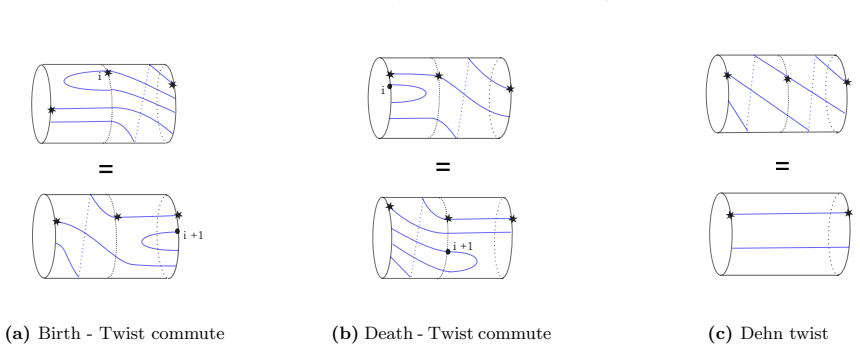
Restricting to the striped cylinder cobordism category Cyl yields a complete set of relations for the generators obtained from stratified Morse theory. Cyl-objects, defined as functors from Cyl to a target category C, relate directly to Temperley-Lieb algebras and to cyclic objects. The structure also inspires a doubling construction on cyclic objects and a cylindrical bar construction on self-dual objects in a monoidal category.
What carries the argument
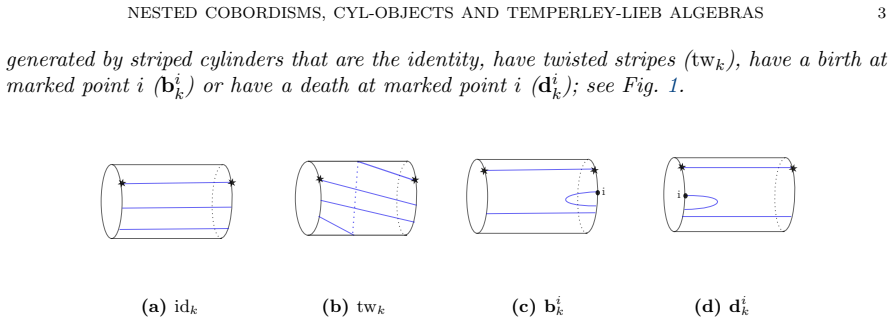
The striped cylinder cobordism category Cyl, whose generators and relations provide the presentation that links cobordism functors to algebraic structures such as Temperley-Lieb algebras.
Load-bearing premise
A variation of stratified Morse theory applies to the nested case and produces the correct generators for the general nested cobordism category.
What would settle it
An explicit check that a proposed relation among generators in Cyl cannot be derived from the listed relations, or a Cyl-object that does not match any Temperley-Lieb algebra structure.
Figures




read the original abstract
We introduce a discrete cobordism category for nested manifolds and nested cobordisms between them. A variation of stratified Morse theory applies in this case, and yields generators for a general nested cobordism category. Restricting to a low-dimensional example of the ``striped cylinder'' cobordism category Cyl, we give a complete set of relations for the generators. With an eye towards the study of TQFTs defined on a nested cobordism category, we describe functors Cyl$\to\mathcal{C}$, which we call Cyl-objects in $\mathcal{C}$, and show that they are related to known algebraic structures such as Temperley-Lieb algebras and cyclic objects. We moreover define novel algebraic constructions inspired by the structure of Cyl-objects, namely a doubling construction on cyclic objects analogous to edgewise subdivision, and a cylindrical bar construction on self-dual objects in a monoidal category.
Editorial analysis
A structured set of objections, weighed in public.
Referee Report
Summary. The paper introduces a discrete cobordism category for nested manifolds and nested cobordisms. It asserts that a variation of stratified Morse theory yields generators for the general nested cobordism category. Restricting to the striped cylinder category Cyl, it claims a complete set of relations among those generators. It defines Cyl-objects in a category C as functors from Cyl, relates them to Temperley-Lieb algebras and cyclic objects, and introduces a doubling construction on cyclic objects and a cylindrical bar construction on self-dual objects in monoidal categories.
Significance. If the generators and relations are correctly identified and the functors well-defined, the work supplies an algebraic presentation of a nested cobordism category that could support new TQFT constructions, while the doubling and bar constructions provide concrete algebraic tools extending known structures such as edgewise subdivision and bar constructions.
major comments (1)
- [Abstract] Abstract: The completeness of the relation set for the Cyl category is asserted relative to generators obtained from a variation of stratified Morse theory in the nested setting. No explicit statement of the stratification conditions, nesting depth restrictions, or verification that all critical loci and handle attachments are captured appears in the provided text; without this, the claim that the listed relations are complete cannot be assessed and is load-bearing for the central algebraic presentation.
Simulated Author's Rebuttal
We thank the referee for their careful reading of the manuscript and for highlighting this point about the abstract. We address the comment below.
read point-by-point responses
-
Referee: [Abstract] Abstract: The completeness of the relation set for the Cyl category is asserted relative to generators obtained from a variation of stratified Morse theory in the nested setting. No explicit statement of the stratification conditions, nesting depth restrictions, or verification that all critical loci and handle attachments are captured appears in the provided text; without this, the claim that the listed relations are complete cannot be assessed and is load-bearing for the central algebraic presentation.
Authors: The abstract is a high-level summary and therefore omits the technical details of the stratified Morse theory variation, which are developed at length in the body of the paper (in the sections deriving the generators for the general nested cobordism category). We agree, however, that the abstract's brevity makes the completeness claim difficult to assess on its own. We will therefore revise the abstract to include a concise statement of the stratification conditions, the nesting-depth restrictions, and a brief indication that the variation captures the relevant critical loci and handle attachments. revision: yes
Circularity Check
No significant circularity; derivation self-contained
full rationale
The paper introduces the nested cobordism category, states that a variation of stratified Morse theory yields its generators, restricts to the Cyl subcategory to list explicit relations among those generators, defines Cyl-objects as functors to a target category C, and introduces independent algebraic constructions (doubling on cyclic objects, cylindrical bar construction). None of these steps reduce a claimed output to an input by definition, by fitting a parameter to related data, or by a self-citation chain whose content is itself unverified. The relations are presented as complete relative to the stated generators; the algebraic objects and constructions are defined directly rather than derived tautologically from the geometric data. The derivation chain therefore contains no load-bearing self-referential steps.
Axiom & Free-Parameter Ledger
axioms (2)
- standard math Standard axioms of category theory (objects, morphisms, composition, identities)
- domain assumption A variation of stratified Morse theory applies to nested manifolds and produces generators
Lean theorems connected to this paper
-
IndisputableMonolith/Foundation/AlexanderDuality.leanalexander_duality_circle_linking unclear?
unclearRelation between the paper passage and the cited Recognition theorem.
Theorem 3.12, Theorem 3.14, Corollary 3.16: generators id_k, tw_k, b^i_k, d^i_k and complete relations (snake, bracelet, twist commutation, etc.) for Cyl
-
IndisputableMonolith/Foundation/ArithmeticFromLogic.leanLogicNat.equivNat unclear?
unclearRelation between the paper passage and the cited Recognition theorem.
Corollary 4.1: data for Cyl-objects (objects c_n, isomorphisms t_n, maps d^i_n, s^j_n) satisfying simplicial + cyclic relations
What do these tags mean?
- matches
- The paper's claim is directly supported by a theorem in the formal canon.
- supports
- The theorem supports part of the paper's argument, but the paper may add assumptions or extra steps.
- extends
- The paper goes beyond the formal theorem; the theorem is a base layer rather than the whole result.
- uses
- The paper appears to rely on the theorem as machinery.
- contradicts
- The paper's claim conflicts with a theorem or certificate in the canon.
- unclear
- Pith found a possible connection, but the passage is too broad, indirect, or ambiguous to say the theorem truly supports the claim.
Forward citations
Cited by 1 Pith paper
-
Uncoiled affine Temperley-Lieb algebras and their Wenzl-Jones projectors
Introduces uncoiled affine and periodic Temperley-Lieb algebras as finite quotients and constructs explicit Wenzl-Jones idempotents projecting onto their one-dimensional modules, with Markov trace evaluations expresse...
Reference graph
Works this paper leans on
-
[1]
Blumberg, Teena Gerhardt, Michael A
Vigleik Angeltveit, Andrew J. Blumberg, Teena Gerhardt, Michael A. Hill, Tyler Lawson, and Michael A. Mandell, Topological cyclic homology via the norm, Doc. Math. 23 (2018), 2101--2163
work page 2018
-
[2]
Lowell Abrams, Two-dimensional topological quantum field theories and F robenius algebras , Journal of Knot theory and its ramifications 5 (1996), no. 05, 569--587
work page 1996
-
[3]
David Ayala, Geometric cobordism categories, arXiv preprint arXiv:0811.2280 (2008)
work page internal anchor Pith review Pith/arXiv arXiv 2008
-
[4]
Nils A. Baas, Ralph L. Cohen, and Antonio Ramirez, The topology of the category of open and closed strings, 2004
work page 2004
-
[5]
Bruce Bartlett, Christopher L. Douglas, Christopher J. Schommer-Pries, and Jamie Vicary, Modular categories as representations of the 3-dimensional bordism 2-category, 2015
work page 2015
-
[6]
M. B\"okstedt, W.C. Hsiang, and I. Madsen, The cyclotomic trace and algebraic K -theory of spaces , Invent Math 111 (1993), 465--539
work page 1993
-
[7]
Nils Carqueville, Lecture notes on two-dimensional defect TQFT , Advanced school on topological quantum field theory, Banach Center Publ., 114 114 (2018), 49--84
work page 2018
-
[8]
Alain Connes, Cohomologie cyclique et foncteurs ext^n , C.R.A.S. 296 (1983), 953--958
work page 1983
-
[9]
Freed, -invariants and determinant lines, Journal of Mathematical Physics 35 (1994), no
Xianzhe Dai and Daniel S. Freed, -invariants and determinant lines, Journal of Mathematical Physics 35 (1994), no. 10, 5155–5194
work page 1994
-
[10]
R. H. Dijkgraaf, A geometrical approach to two-dimensional conformal field theory, Ph.D. thesis, 1989
work page 1989
-
[11]
Karin Erdmann and Richard M. Green, On representations of affine T emperley– L ieb algebras, II , Pacific Journal of Mathematics 191 (1998), 243--273
work page 1998
-
[12]
C. Kenneth Fan and R. Green, On the affine T emperley– L ieb algebras , Journal of the London Mathematical Society 60 (1997)
work page 1997
-
[13]
Daniel S Freed and Michael J Hopkins, Reflection positivity and invertible topological phases, Geometry & Topology 25 (2021), no. 3, 1165–1330
work page 2021
-
[14]
D.S. Freed, Conference Board of the Mathematical Sciences, and National Science Foundation (U.S.), Lectures on field theory and topology, CBMS Regional Conference Series in Mathematics, Conference Board of the Mathematical Sciences, 2019
work page 2019
-
[15]
Dan Freed, Lecture notes, an application of morse-cerf theory
-
[16]
J. J. Graham and G. I. Lehrer, The representation theory of affine T emperley- L ieb algebras , L'Enseignement Math\'ematique 44 (1998), 173--218
work page 1998
-
[17]
Mark Goresky and Robert MacPherson, Stratified M orse Theory , Springer, 1988
work page 1988
-
[18]
370, American Mathematical Soc., 2010
Victor Guillemin and Alan Pollack, Differential topology, vol. 370, American Mathematical Soc., 2010
work page 2010
-
[19]
Green, On representations of affine T emperley– L ieb algebras , CMS Conference Proceedings, vol
R.M. Green, On representations of affine T emperley– L ieb algebras , CMS Conference Proceedings, vol. 24, American Mathematical Society, 1998, pp. 245--261
work page 1998
-
[20]
David Gay, Katrin Wehrheim, and Chris Woodward, Connected C erf theory , preprint (2012)
work page 2012
-
[21]
Elizabeth Hanbury, An open-closed cobordism category with background space, Algebraic & Geometric Topology 9 (2009), no. 2, 833–863
work page 2009
-
[22]
Hoekzema, Algebraic topology of manifolds--higher orientability and spaces of nested manifolds, Ph.D
Renee S. Hoekzema, Algebraic topology of manifolds--higher orientability and spaces of nested manifolds, Ph.D. thesis, University of Oxford, 2018
work page 2018
-
[23]
Theo Johnson-Freyd, On the classification of topological orders, Communications in Mathematical Physics 393 (2022), no. 2, 989–1033
work page 2022
-
[24]
Jones, The annular structure of subfactors, essays on geometry and related topics, Monogr
V.F.R. Jones, The annular structure of subfactors, essays on geometry and related topics, Monogr. Enseign. Math. 1 (2001), 401--463
work page 2001
-
[25]
V. F. R. Jones, Planar algebras, I , New Zealand J. Math. 52 (2021), 1--107. 4374438
work page 2021
-
[26]
Joachim Kock, Frobenius algebras and 2-d topological quantum field theories, London Mathematical Society Student Texts, Cambridge University Press, 2003
work page 2003
-
[27]
J.L. Loday, Cyclic spaces and S^1 -equivariant homology , Cyclic Homology, Grundlehren der mathematischen Wissenschaften, vol. 301, Springer, Berlin, Heidelberg, 1992
work page 1992
-
[28]
Cary Malkiewich, A visual introduction to cyclic sets and cyclotomic spectra, 2015
work page 2015
-
[29]
Massey, Stratified M orse theory: past and present , Pure Appl
David B. Massey, Stratified M orse theory: past and present , Pure Appl. Math. Q. 2 (2006), no. 4, 1053--1084. 2282413
work page 2006
-
[30]
2258, Princeton university press, 1965
John Milnor, Lectures on the h-cobordism theorem, vol. 2258, Princeton university press, 1965
work page 1965
-
[31]
Gregory Moore, Lectures on branes, K -theory and RR charges
-
[32]
David Penneys, A cyclic approach to the annular Temperley-Lieb category , Journal of Knot Theory and Its Ramifications 21 (2012), no. 6
work page 2012
-
[33]
Lev Pontrjagin, Smooth manifolds and their applications in homotopy theory, AMS Translation 11 (1959)
work page 1959
-
[34]
Oscar Randal-Williams, Embedded cobordism categories and spaces of submanifolds, International Mathematics Research Notices 2011 (2011), no. 3, 572--608
work page 2011
-
[35]
Schommer-Pries, The classification of two-dimensional extended topological field theories, 2014
Christopher J. Schommer-Pries, The classification of two-dimensional extended topological field theories, 2014
work page 2014
-
[36]
Robert Evert Stong, On the cobordism of pairs, Pacific Journal of Mathematics 38 (1971), 803--816
work page 1971
-
[37]
CTC Wall, Cobordism of pairs, Commentarii Mathematici Helvetici 35 (1961), no. 1, 136--145
work page 1961
-
[38]
Edward Witten, Fermion path integrals and topological phases, Reviews of Modern Physics 88 (2016), no. 3
work page 2016
-
[39]
Kevin Walker and Zhenghan Wang, (3+1)- TQFTs and topological insulators , 2011
work page 2011
discussion (0)
Sign in with ORCID, Apple, or X to comment. Anyone can read and Pith papers without signing in.