Bigraded path homology and the magnitude-path spectral sequence
Pith reviewed 2026-05-24 02:18 UTC · model grok-4.3
The pith
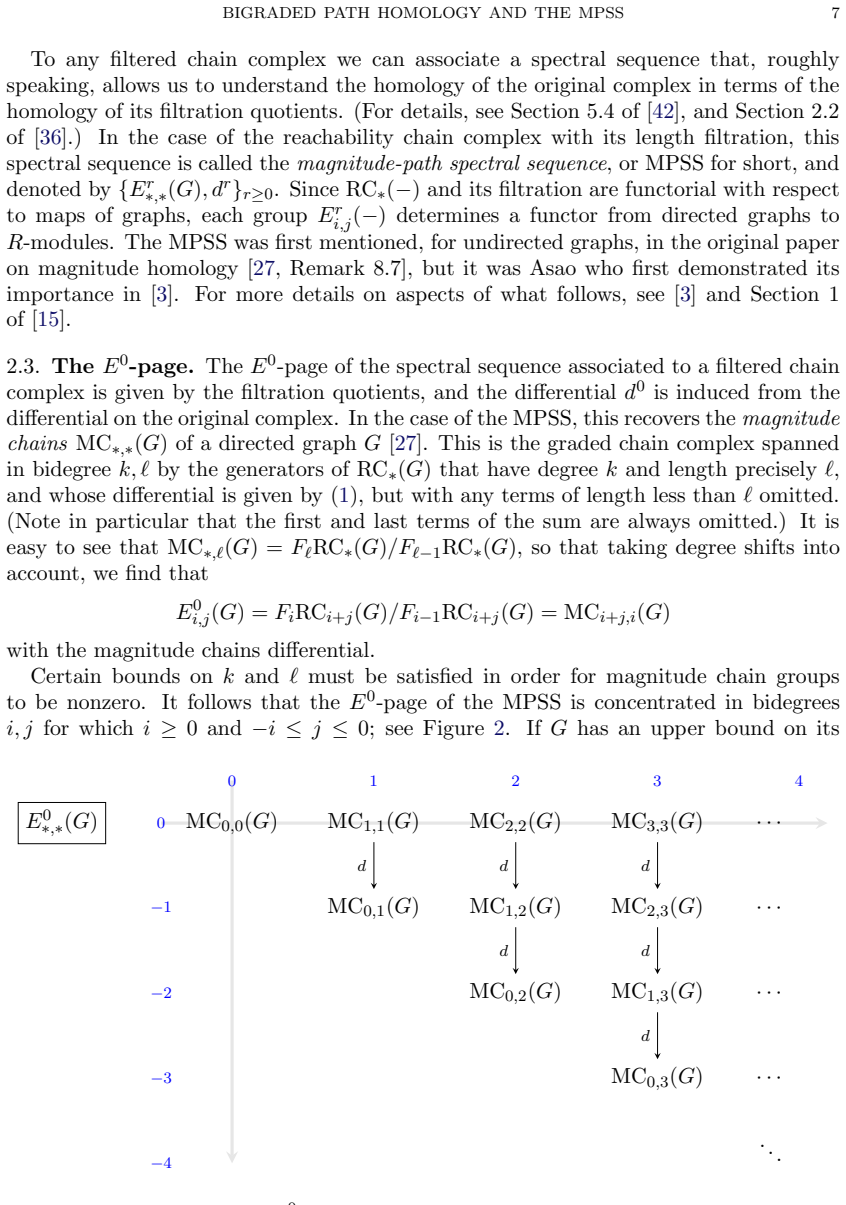
The magnitude-path spectral sequence turns each of its pages into a homology theory for directed graphs with excision and Kunneth properties.
A machine-rendered reading of the paper's core claim, the machinery that carries it, and where it could break.
Core claim
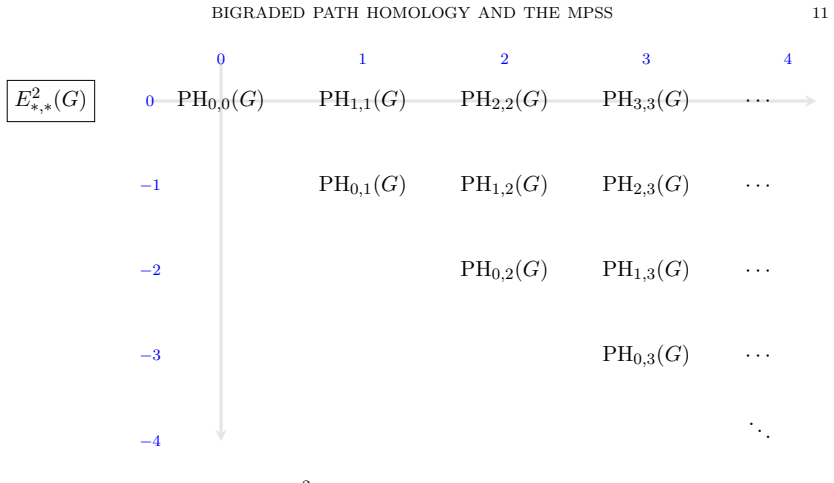
Magnitude homology appears as the E1 page of the magnitude-path spectral sequence, and path homology appears as an axis of the E2 page. The full E2 page is called bigraded path homology. Every page satisfies excision and the Kunneth theorem. Magnitude homology and bigraded path homology satisfy Mayer-Vietoris theorems. There is a cofibration category structure on directed graphs in which weak equivalences are maps inducing isomorphisms on bigraded path homology.
What carries the argument
The magnitude-path spectral sequence, with magnitude homology as the E1 page and bigraded path homology as the full E2 page, which carries excision, Kunneth, and Mayer-Vietoris properties while defining weak equivalences.
If this is right
- The cofibration category on directed graphs refines the existing structure based on ordinary path homology.
- Magnitude homology satisfies a Mayer-Vietoris theorem.
- Bigraded path homology satisfies a Mayer-Vietoris theorem.
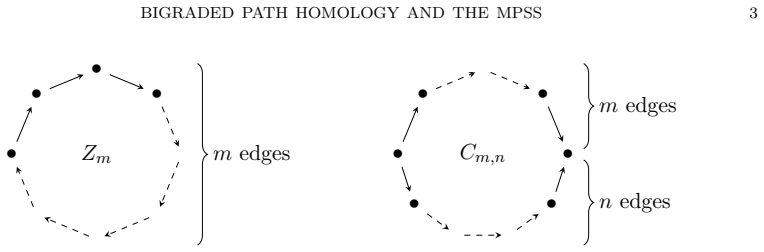
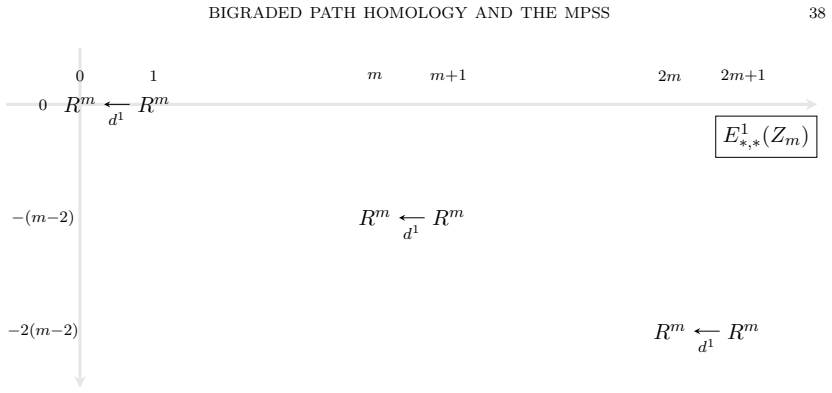
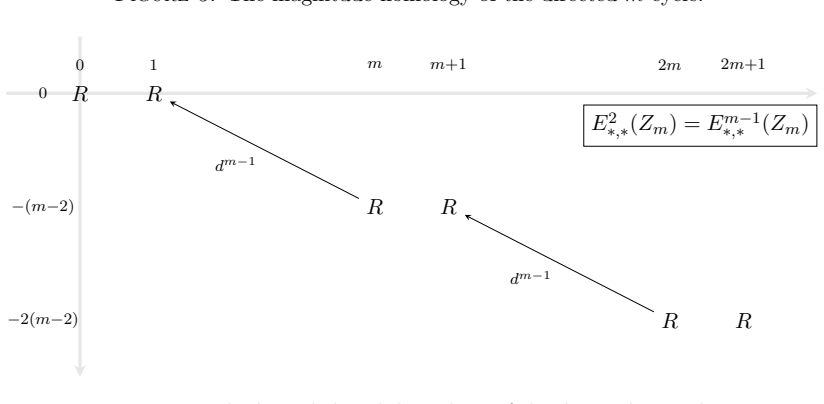
- The MPSS admits complete computations for the families of directed cycles and bi-directed cycles.
- Each page of the MPSS is homotopy invariant.
Where Pith is reading between the lines
- Excision permits computation of these homologies by decomposing graphs into simpler pieces.
- Bigraded path homology supplies a finer invariant than ordinary path homology for distinguishing directed graphs.
- The cofibration category may support the construction of higher homotopy invariants for graphs.
- The spectral sequence could be applied to compute path homology in cases where direct methods are intractable.
Load-bearing premise
The magnitude-path spectral sequence exists with magnitude homology on the E1 page and path homology on an axis of the E2 page, as established in prior work.
What would settle it
A pair of directed graphs whose tensor product violates the claimed Kunneth theorem for bigraded path homology.
Figures

read the original abstract
Two important invariants of directed graphs, namely magnitude homology and path homology, have recently been shown to be intimately connected: there is a 'magnitude-path spectral sequence' or 'MPSS' in which magnitude homology appears as the first page, and in which path homology appears as an axis of the second page. In this paper we study the homological and computational properties of the spectral sequence, and in particular of the full second page, which we now call 'bigraded path homology'. We demonstrate that every page of the MPSS deserves to be regarded as a homology theory in its own right, satisfying excision and Kunneth theorems (along with a homotopy invariance property already established by Asao), and that magnitude homology and bigraded path homology also satisfy Mayer-Vietoris theorems. We construct a homotopy theory of graphs (in the form of a cofibration category structure) in which weak equivalences are the maps inducing isomorphisms on bigraded path homology, strictly refining an existing structure based on ordinary path homology. And we provide complete computations of the MPSS for two important families of graphs - the directed and bi-directed cycles - which demonstrate the power of both the MPSS, and bigraded path homology in particular, to distinguish graphs that ordinary path homology cannot.
Editorial analysis
A structured set of objections, weighed in public.
Referee Report
Summary. The paper examines the magnitude-path spectral sequence (MPSS) connecting magnitude homology and path homology of directed graphs. It defines bigraded path homology as the full second page of the MPSS and shows that every page satisfies excision and Künneth theorems (with homotopy invariance already known), that magnitude homology and bigraded path homology satisfy Mayer-Vietoris, constructs a cofibration category on graphs whose weak equivalences are maps inducing isomorphisms on bigraded path homology (refining the ordinary path-homology version), and computes the MPSS explicitly for directed and bi-directed cycles.
Significance. If the claims hold, the work supplies a family of homology theories refining path homology, equips the category of graphs with a finer homotopy theory, and demonstrates via concrete computations that bigraded path homology distinguishes graphs invisible to ordinary path homology. The explicit cycle computations and the cofibration-category construction are concrete strengths.
major comments (2)
- [§4, Theorem 4.3] §4, Theorem 4.3 (excision for each page): the proof sketch invokes the standard five-lemma argument on the long exact sequence of a pair, but the identification of the relative groups with the quotient chain complexes is not written out; this step is load-bearing for the claim that every page is an excision theory.
- [§6, Definition 6.1 and Theorem 6.4] §6, Definition 6.1 and Theorem 6.4 (cofibration category): the weak equivalences are defined via isomorphisms on bigraded path homology, yet the verification that the class satisfies the two-out-of-three property and the factorization axioms is only indicated by reference to the ordinary path-homology case; an explicit check that the new weak equivalences are strictly finer is needed to confirm the refinement claim.
minor comments (2)
- [Notation] Notation for the bigraded groups on page 3 is introduced as H_{p,q} but later appears as PH_{p,q}; a single consistent symbol should be fixed.
- [§7] The computations in §7 for the directed cycle C_n are presented in tables without an accompanying statement of the differential on the E2 page; adding the explicit differential would make the vanishing results easier to verify.
Simulated Author's Rebuttal
We thank the referee for their careful reading, positive assessment, and constructive suggestions. We address each major comment below and will incorporate the requested clarifications in a revised version.
read point-by-point responses
-
Referee: [§4, Theorem 4.3] §4, Theorem 4.3 (excision for each page): the proof sketch invokes the standard five-lemma argument on the long exact sequence of a pair, but the identification of the relative groups with the quotient chain complexes is not written out; this step is load-bearing for the claim that every page is an excision theory.
Authors: We agree that the identification step should be made fully explicit rather than left as a sketch. The relative chain groups for each page of the MPSS are defined via the quotient of the bigraded chain complex by the subcomplex generated by the subspace, and the boundary maps descend accordingly. We will expand the argument in the revised §4 to include this identification explicitly before invoking the five-lemma, confirming that excision holds pagewise. revision: yes
-
Referee: [§6, Definition 6.1 and Theorem 6.4] §6, Definition 6.1 and Theorem 6.4 (cofibration category): the weak equivalences are defined via isomorphisms on bigraded path homology, yet the verification that the class satisfies the two-out-of-three property and the factorization axioms is only indicated by reference to the ordinary path-homology case; an explicit check that the new weak equivalences are strictly finer is needed to confirm the refinement claim.
Authors: We acknowledge that the verification of the cofibration-category axioms is referenced rather than written out in full for the refined class. Because an isomorphism on bigraded path homology (the full E² page) induces an isomorphism on ordinary path homology, the two-out-of-three and factorization properties carry over directly from the path-homology case; we will add a short explicit paragraph confirming this inheritance. Strict refinement follows from the cycle computations in §7, which exhibit graphs with identical path homology but distinct bigraded path homology; we will include a brief pointer to those examples in the revised statement of Theorem 6.4. revision: yes
Circularity Check
No significant circularity identified
full rationale
The derivation relies on the pre-existing magnitude-path spectral sequence (taken as given from prior independent work) together with the standard axioms of homological algebra and the definition of a cofibration category. New claims about excision, Künneth, Mayer-Vietoris, and the refined weak equivalences are obtained by applying these external axioms to the spectral sequence pages; no step reduces by construction to a fitted parameter, self-definition, or load-bearing self-citation chain. The central results remain independent of the paper's own inputs.
Axiom & Free-Parameter Ledger
axioms (1)
- standard math Standard axioms of homological algebra and category theory (abelian categories, spectral sequences, cofibration categories)
invented entities (1)
-
Bigraded path homology
no independent evidence
Forward citations
Cited by 1 Pith paper
-
The discrete homotopy hypothesis for directed graphs
Localizing the category of directed graphs at cubical homotopy equivalences produces an ∞-category equivalent to the ∞-category of spaces.
Reference graph
Works this paper leans on
-
[1]
Magnitude homology of geodesic metric spaces with an upper curvature bound
Yasuhiko Asao. Magnitude homology of geodesic metric spaces with an upper curvature bound. Algebr. Geom. Topol., 21(2):647–664, 2021
work page 2021
-
[2]
Magnitude and magnitude homology of filtered set enriched categories
Yasuhiko Asao. Magnitude and magnitude homology of filtered set enriched categories. arXiv:2303.05677, 2023
-
[3]
Magnitude homology and path homology.Bull
Yasuhiko Asao. Magnitude homology and path homology.Bull. Lond. Math. Soc., 55(1):375–398, 2023
work page 2023
-
[4]
Girth, magnitude homology and phase tran- sition of diagonality.Proc
Yasuhiko Asao, Yasuaki Hiraoka, and Shu Kanazawa. Girth, magnitude homology and phase tran- sition of diagonality.Proc. R. Soc. Edinb. A: Math., page 1–27, 2023
work page 2023
-
[5]
H´ el` ene Barcelo, Valerio Capraro, and Jacob A. White. Discrete homology theory for metric spaces. Bull. Lond. Math. Soc., 46(5):889–905, 2014
work page 2014
-
[6]
Baues.Algebraic homotopy, volume 15 ofCambridge Studies in Advanced Mathematics
H.J. Baues.Algebraic homotopy, volume 15 ofCambridge Studies in Advanced Mathematics. Cam- bridge University Press, Cambridge, 1989
work page 1989
-
[7]
Magnitude homology, diagonality, and median spaces.Homol
R´ emi Bottinelli and Tom Kaiser. Magnitude homology, diagonality, and median spaces.Homol. Ho- motopy Appl., 23(2):121–140, 2021
work page 2021
-
[8]
Kenneth S. Brown. Abstract homotopy theory and generalized sheaf cohomology.Trans. Amer. Math. Soc., 186:419–458, 1973
work page 1973
-
[9]
Cofibration category of digraphs for path homology.Algebr
Daniel Carranza, Brandon Doherty, Krzyzstof Kapulkin, Morgan Opie, Maru Sarazola, and Liang Ze Wong. Cofibration category of digraphs for path homology.Algebr. Comb., 7(2):475–514, 2024
work page 2024
-
[10]
Nonexistence of colimits in naive discrete homotopy theory.Appl
Daniel Carranza, Krzysztof Kapulkin, and Jinho Kim. Nonexistence of colimits in naive discrete homotopy theory.Appl. Categ. Struct., 31(5), 2023. Article number 41
work page 2023
-
[11]
Princeton Landmarks in Mathematics
Henri Cartan and Samuel Eilenberg.Homological algebra. Princeton Landmarks in Mathematics. Princeton University Press, Princeton, NJ, 1999. With an appendix by David A. Buchsbaum, Reprint of the 1956 original
work page 1999
-
[12]
La classe des morphismes de Dwyer n’est pas stable par retractes
Denis-Charles Cisinski. La classe des morphismes de Dwyer n’est pas stable par retractes. Cah. Topol. G´ eom. Diff´ er. Cat´ eg., 40(3):227–231, 1999
work page 1999
-
[13]
Pierre Deligne. Th´ eorie de Hodge. II.Inst. Hautes ´Etudes Sci. Publ. Math., (40):5–57, 1971
work page 1971
-
[14]
Zero divisor graphs of semigroups.J
Frank DeMeyer and Lisa DeMeyer. Zero divisor graphs of semigroups.J. Algebra, 283(1):190–198, 2005
work page 2005
-
[15]
Ivanov, Lev Mukoseev, and Mengmeng Zhang
Shaobo Di, Sergei O. Ivanov, Lev Mukoseev, and Mengmeng Zhang. On the path homology of Cayley digraphs and covering digraphs.J. Algebra, 653:156–199, 2024
work page 2024
-
[16]
Samuel Eilenberg and Saunders Mac Lane. On the groups ofH(Π, n). I.Ann. of Math. (2), 58:55– 106, 1953
work page 1953
-
[17]
A combinatorial method for computing Steenrod squares
Roc´ ıo Gonz´ alez-D´ ıaz and Pedro Real. A combinatorial method for computing Steenrod squares. J. Pure Appl. Algebra, 139:89–108, 1999
work page 1999
-
[18]
S. Goyal and R. Santhanam. Cofibration category structures on the category of graphs. arXiv:2301.13587, 2020
-
[19]
S. Goyal and R. Santhanam. (Lack of) model structures on the category of graphs. Appl. Categ. Struct., 29(4):671–683, 2021
work page 2021
-
[20]
A. A. Grigor’yan, Yong Lin, Yu. V. Muranov, and Shintan Yau. Path complexes and their homolo- gies.Fundam. Prikl. Mat., 21(5):79–128, 2016
work page 2016
-
[21]
Homotopy theory for di- graphs.Pure Appl
Alexander Grigor’yan, Yong Lin, Yuri Muranov, and Shing-Tung Yau. Homotopy theory for di- graphs.Pure Appl. Math. Q., 10(4):619–674, 2014
work page 2014
-
[22]
Homologies of digraphs and K¨ unneth formulas.Comm
Alexander Grigor’yan, Yuri Muranov, and Shing-Tung Yau. Homologies of digraphs and K¨ unneth formulas.Comm. Anal. Geom., 25(5):969–1018, 2017
work page 2017
-
[23]
Homologies of path complexes and digraphs
Alexander Grigor’yan, Yong Lin, Yuri Muranov, and Shing-Tung Yau. Homologies of path complexes and digraphs.arXiv:1207.2834, 2013
work page internal anchor Pith review Pith/arXiv arXiv 2013
-
[24]
Cambridge University Press, Cambridge, 2002
Allen Hatcher.Algebraic topology. Cambridge University Press, Cambridge, 2002
work page 2002
-
[25]
Pairings and convergence of spectral sequences
Gard Olav Helle. Pairings and convergence of spectral sequences. Master’s thesis, University of Oslo,
-
[26]
Available athttps://www.mn.uio.no/math/personer/vit/rognes/theses/HelleGardOlav. pdf
-
[27]
The reachability homology of a directed graph.Int
Richard Hepworth and Emily Roff. The reachability homology of a directed graph.Int. Math. Res. Not. IMRN, (3):Paper No. rnae280, 18, 2025. BIGRADED PATH HOMOLOGY AND THE MPSS 49
work page 2025
-
[28]
Categorifying the magnitude of a graph.Homol
Richard Hepworth and Simon Willerton. Categorifying the magnitude of a graph.Homol. Homotopy Appl., 19:31–60, 2017
work page 2017
- [29]
-
[30]
Sergei O. Ivanov and Fedor Pavutnitskiy. Simplicial approach to path homology of quivers, marked categories, groups and algebras.J. Lond. Math. Soc., 109(1), 2024. e12812
work page 2024
-
[31]
Magnitude homology of metric spaces and order complexes
Ryuki Kaneta and Masahiko Yoshinaga. Magnitude homology of metric spaces and order complexes. Bull. Lond. Math. Soc., 53(3):893–905, 2021
work page 2021
-
[32]
A homology vanishing theorem for graphs with positive curvature.Comm
Mark Kempton, Florentin M¨ unch, and Shing-Tung Yau. A homology vanishing theorem for graphs with positive curvature.Comm. Anal. Geom., 29(6):1449–1473, 2021
work page 2021
-
[33]
The magnitude of metric spaces.Doc
Tom Leinster. The magnitude of metric spaces.Doc. Math., 18:857–905, 2013
work page 2013
-
[34]
Tom Leinster. The magnitude of a graph.Math. Proc. Cambridge Philos. Soc., 166(2):247–264, 2019
work page 2019
-
[35]
Magnitude homology of enriched categories and metric spaces
Tom Leinster and Michael Shulman. Magnitude homology of enriched categories and metric spaces. Algebr. Geom. Topol., 21(5):2175–2221, 2021
work page 2021
-
[36]
Discrete Morse theory on digraphs.Pure Appl
Yong Lin, Chong Wang, and Shing-Tung Yau. Discrete Morse theory on digraphs.Pure Appl. Math. Q., 17(5):1711–1737, 2021
work page 2021
-
[37]
Cambridge University Press, Cambridge, second edition, 2001
John McCleary.A User’s Guide to Spectral Sequences, volume 58 ofCambridge Studies in Advanced Mathematics. Cambridge University Press, Cambridge, second edition, 2001
work page 2001
-
[38]
Topological strata of weighted complex networks.PLoS One, 8(6):1–8, 06 2013
Giovanni Petri, Martina Scolamiero, Irene Donato, and Francesco Vaccarino. Topological strata of weighted complex networks.PLoS One, 8(6):1–8, 06 2013
work page 2013
-
[39]
Iterated magnitude homology.Adv
Emily Roff. Iterated magnitude homology.Adv. Math., 468:Paper No. 110210, 42, 2025
work page 2025
-
[40]
The stacks project.https://stacks.math.columbia.edu, 2024
The Stacks project authors. The stacks project.https://stacks.math.columbia.edu, 2024
work page 2024
-
[41]
Causal order complex and magnitude homotopy type of metric spaces.Int
Yu Tajima and Masahiko Yoshinaga. Causal order complex and magnitude homotopy type of metric spaces.Int. Math. Res. Not. IMRN, (4):3176–3222, 2024
work page 2024
-
[42]
R. W. Thomason. Cat as a closed model category.Cah. Topol. G´ eom. Diff´ er. Cat´ eg., 21, 1980
work page 1980
-
[43]
Weibel.An Introduction to Homological Algebra, volume 38 ofCambridge Studies in Advanced Mathematics
Charles A. Weibel.An Introduction to Homological Algebra, volume 38 ofCambridge Studies in Advanced Mathematics. Cambridge University Press, Cambridge, 1994. Institute of Mathematics, University of Aberdeen, Scotland Email address:r.hepworth@abdn.ac.uk School of Mathematics, University of Edinburgh, Scotland Email address:emily.roff@ed.ac.uk
work page 1994
discussion (0)
Sign in with ORCID, Apple, or X to comment. Anyone can read and Pith papers without signing in.