Short, new proofs of Dowker duality
Pith reviewed 2026-05-23 21:32 UTC · model grok-4.3
The pith
Dowker duality follows from a long exact sequence in homology obtained from relational join and relational product complexes.
A machine-rendered reading of the paper's core claim, the machinery that carries it, and where it could break.
Core claim
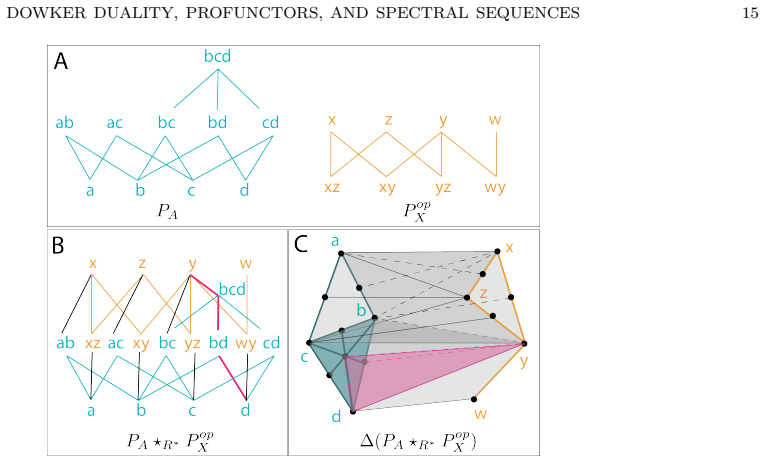
Relational join and relational product complexes can be formed whenever a relation exists between the face posets of simplicial complexes; their homologies together with those of the original complexes satisfy a long exact sequence, and three applications of poset fiber lemmas to this sequence each recover Dowker duality as a special case.
What carries the argument
Relational join and relational product complexes: modifications of ordinary joins and products that incorporate a given relation on face posets and produce a long exact sequence relating the three homologies.
If this is right
- Dowker duality is recovered directly as the special case of the long exact sequence when the relation is the usual one.
- The same long exact sequence applies when the relation comes from a cover of a simplicial complex.
- Three separate proofs of the duality arise from three different poset fiber lemmas applied to the same sequence.
Where Pith is reading between the lines
- The general construction may apply to other duality statements that arise from relations on posets.
- The existence of a single long exact sequence could be used to define new homology invariants that interpolate between a complex and its dual.
- Short proofs via fiber lemmas might make algorithmic checks of duality statements more feasible in concrete examples.
Load-bearing premise
Any relation between the face posets of two simplicial complexes allows the construction of the corresponding relational join and relational product complexes.
What would settle it
An explicit relation between two face posets for which the three associated homology groups do not satisfy the claimed long exact sequence.
Figures




read the original abstract
This paper presents three short, new proofs of Dowker duality using various poset fiber lemmas. We introduce modifications of joins and products of simplicial complexes called relational join and relational product complexes. These relational complexes can be constructed whenever there is a relation between the face posets of simplicial complexes, which includes the context of Dowker duality and covers of simplicial complexes. In this more general setting, we show that the homologies of the simplicial complexes and the relational complexes fit together in a long exact sequence.
Editorial analysis
A structured set of objections, weighed in public.
Referee Report
Summary. The paper presents three short new proofs of Dowker duality by defining relational join and relational product complexes for any relation between the face posets of simplicial complexes K and L. It claims these relational complexes can always be constructed in this setting (including Dowker duality and covers) and that the homologies of K, L, and the relational complexes fit into a long exact sequence, established via poset fiber lemmas.
Significance. If the constructions and long exact sequence are valid in the stated generality, the work would supply concise proofs and a unified framework extending Dowker duality to arbitrary relations on face posets, which could be useful in combinatorial topology. The reliance on existing poset fiber lemmas for brevity is a potential strength when the fiber hypotheses are verified.
major comments (2)
- [Section introducing relational join and relational product complexes] Definition of relational join/product complexes: the claim that these can be constructed 'whenever there is a relation' between face posets requires explicit confirmation that the relation induces a monotone poset map whose order-complex fibers are contractible (or acyclic) so that the poset fiber lemmas apply and yield the long exact sequence. Arbitrary binary relations need not produce such maps or fibers without further hypotheses.
- [The three proofs] Proofs of the long exact sequence: the abstract asserts that the homologies fit into a long exact sequence but provides no derivation steps, no verification that the induced maps satisfy the fiber conditions of the cited poset fiber lemmas, and no error analysis; this is load-bearing for the central claim.
minor comments (1)
- The abstract could briefly name the specific poset fiber lemmas employed.
Simulated Author's Rebuttal
We thank the referee for the careful review and for identifying points where the manuscript would benefit from greater explicitness. We address the two major comments below and will revise the paper to incorporate the requested verifications and derivations.
read point-by-point responses
-
Referee: [Section introducing relational join and relational product complexes] Definition of relational join/product complexes: the claim that these can be constructed 'whenever there is a relation' between face posets requires explicit confirmation that the relation induces a monotone poset map whose order-complex fibers are contractible (or acyclic) so that the poset fiber lemmas apply and yield the long exact sequence. Arbitrary binary relations need not produce such maps or fibers without further hypotheses.
Authors: We agree that the manuscript should contain an explicit check that any relation between face posets induces a monotone map whose order-complex fibers satisfy the contractibility (or acyclicity) hypotheses of the cited poset fiber lemmas. In the revised version we will insert a short subsection immediately after the definitions of the relational join and relational product that verifies monotonicity of the induced poset map and shows that the fibers are contractible (hence acyclic). This verification uses only the definition of the relational complexes and the standard order-complex construction; it therefore justifies the claim that the constructions are available for every binary relation while simultaneously confirming that the fiber lemmas apply without additional hypotheses. revision: yes
-
Referee: [The three proofs] Proofs of the long exact sequence: the abstract asserts that the homologies fit into a long exact sequence but provides no derivation steps, no verification that the induced maps satisfy the fiber conditions of the cited poset fiber lemmas, and no error analysis; this is load-bearing for the central claim.
Authors: The three proofs are deliberately concise because they invoke the poset fiber lemmas once the relational complexes have been defined. Nevertheless, we accept that the manuscript would be clearer if the application of those lemmas were spelled out. In revision we will expand each proof by (i) stating the precise map to which the fiber lemma is applied, (ii) citing the newly added verification subsection for the fiber hypotheses, and (iii) recording the resulting long exact sequence of homology groups. Because the fiber conditions are already satisfied by construction, no separate error analysis is required; the expansion will simply make this reasoning visible while preserving the overall brevity of the arguments. revision: yes
Circularity Check
No significant circularity; relies on external poset fiber lemmas and explicit new definitions
full rationale
The paper defines relational join and relational product complexes directly from any relation on face posets, then invokes standard poset fiber lemmas (external to this work) to obtain the long exact sequence relating H_*(K), H_*(L) and the homology of the relational complex. No equation or construction is shown to be equivalent to its own input by definition, no parameter is fitted and then renamed as a prediction, and no load-bearing step reduces to a self-citation whose content is itself unverified. The derivation therefore remains self-contained against external benchmarks.
Axiom & Free-Parameter Ledger
axioms (2)
- standard math Poset fiber lemmas apply to the face posets arising from the given relations
- standard math Homology functors produce long exact sequences under the stated constructions
invented entities (2)
-
relational join complex
no independent evidence
-
relational product complex
no independent evidence
Reference graph
Works this paper leans on
-
[1]
Galois connections and the leray spectral sequence
Kenneth Baclawski. “Galois connections and the leray spectral sequence”. In: Advances in Mathematics 25.3 (Sept. 1977), pp. 191–215. issn: 0001-8708. doi: 10.1016/0001-8708(77)90073-1
-
[2]
A unified view on the functorial nerve theorem and its variations
Ulrich Bauer, Michael Kerber, Fabian Roll, and Alexander Rolle. “A unified view on the functorial nerve theorem and its variations”. In: Expositiones Mathematicae 41.4 (Dec. 2023), p. 125503. issn: 0723-0869. doi: 10.1016/j.exmath.2023.04.005
-
[3]
Homotopy type of posets and lattice complementation
Anders Bj¨ orner. “Homotopy type of posets and lattice complementation”. In:Journal of Combinatorial Theory, Series A 30.1 (Jan. 1981), pp. 90–100. issn: 0097-3165. doi: 10.1016/0097-3165(81)90042-X
-
[4]
Posets, Regular CW Complexes and Bruhat Order
Anders Bj¨ orner. “Posets, Regular CW Complexes and Bruhat Order”. en. In: European Journal of Combina- torics 5.1 (Mar. 1984), pp. 7–16. issn: 01956698. doi: 10.1016/S0195-6698(84)80012-8
-
[5]
Anders Bj¨ orner. “Topological methods”. In: Handbook of combinatorics (vol. 2) . Cambridge, MA, USA: MIT Press, Mar. 1996, pp. 1819–1872. isbn: 978-0-262-07171-0
work page 1996
-
[6]
Andrew D. Brooke-Taylor. Products of CW complexes . arXiv:1710.05296 [math]. Aug. 2018. doi: 10.48550/ arXiv.1710.05296
work page internal anchor Pith review Pith/arXiv arXiv 2018
-
[7]
Morten Brun, Marius G˚ ardsmann Fosse, and Lars M. Salbu. Dowker Duality for Relations of Categories . arXiv:2303.16032 [math]. Mar. 2023. doi: 10.48550/arXiv.2303.16032
-
[8]
The Dowker theorem via discrete Morse theory
Morten Brun and Darij Grinberg. The Dowker theorem via discrete Morse theory . arXiv:2407.15454 [math]. July 2024. doi: 10.48550/arXiv.2407.15454
-
[9]
The Rectangle Complex of a Relation
Morten Brun and Lars M. Salbu. “The Rectangle Complex of a Relation”. en. In: Mediterranean Journal of Mathematics 20.1 (Dec. 2022), p. 7. issn: 1660-5454. doi: 10.1007/s00009-022-02213-0
-
[10]
A functorial Dowker theorem and persistent homology of asymmetric networks
Samir Chowdhury and Facundo M´ emoli. “A functorial Dowker theorem and persistent homology of asymmetric networks”. en. In: Journal of Applied and Computational Topology 2.1 (Oct. 2018), pp. 115–175. issn: 2367-
work page 2018
-
[11]
doi: 10.1007/s41468-018-0020-6
-
[12]
Sheaves, cosheaves and applications
Justin Michael Curry. “Sheaves, cosheaves and applications”. English. ISBN: 9781303966156. PhD thesis. University of Pennsylvania, 2014
work page 2014
-
[13]
Homomorphism complexes, reconfiguration, and homotopy for di- rected graphs
Anton Dochtermann and Anurag Singh. “Homomorphism complexes, reconfiguration, and homotopy for di- rected graphs”. In: European Journal of Combinatorics 110 (May 2023), p. 103704. issn: 0195-6698. doi: 10.1016/j.ejc.2023.103704
-
[14]
C. H. Dowker. “Homology Groups of Relations”. In: Annals of Mathematics 56.1 (1952). Publisher: Annals of Mathematics, pp. 84–95. issn: 0003-486X. doi: 10.2307/1969768
-
[15]
Kenneth P. Ewing and Michael Robinson. Metric Comparisons of Relations . arXiv:2105.01690 [math]. Sept
-
[16]
doi: 10.48550/arXiv.2105.01690
-
[17]
An elementary illustrated introduction to simplicial sets
Greg Friedman. An elementary illustrated introduction to simplicial sets . en. Sept. 2008
work page 2008
-
[18]
Paul G. Goerss and John F. Jardine. Simplicial Homotopy Theory. Basel: Birkh¨ auser, 2009.doi: 10.1007/978- 3-0346-0189-4
-
[19]
Niklas Hellmer and Jan Spali´ nski.Density Sensitive Bifiltered Dowker Complexes via Total Weight. arXiv:2405.15592 [math]. May 2024. doi: 10.48550/arXiv.2405.15592. REFERENCES 39
-
[20]
On the homology of small categories and asynchronous transition systems
Ahmet A. Husainov. “On the homology of small categories and asynchronous transition systems”. In: Homology, Homotopy and Applications 6.1 (Jan. 2004). Publisher: International Press of Boston, pp. 439–471. issn: 1532- 0073, 1532-0081
work page 2004
-
[21]
Dowker complex based machine learning (DCML) models for protein-ligand binding affinity prediction
Xiang Liu, Huitao Feng, Jie Wu, and Kelin Xia. “Dowker complex based machine learning (DCML) models for protein-ligand binding affinity prediction”. In: PLoS Computational Biology 18.4 (Apr. 2022), e1009943. issn: 1553-734X. doi: 10.1371/journal.pcbi.1009943
-
[22]
Albert T. Lundell and Stephen Weingram. The Topology of CW Complexes. en. New York, NY: Springer, 1969. doi: 10.1007/978-1-4684-6254-8
-
[23]
Amit Patel and Primoz Skraba. M¨ obius Homology. arXiv:2307.01040 [cs, math]. July 2023. doi: 10.48550/ arXiv.2307.01040
-
[24]
Daniel Quillen. “Higher algebraic K-theory: I”. en. In: Higher K-Theories. Ed. by H. Bass. Berlin, Heidelberg: Springer, 1973, pp. 85–147. isbn: 978-3-540-37767-2. doi: 10.1007/BFb0067053
-
[25]
Homotopy properties of the poset of nontrivial p-subgroups of a group
Daniel Quillen. “Homotopy properties of the poset of nontrivial p-subgroups of a group”. In: Advances in Mathematics 28.2 (May 1978), pp. 101–128. issn: 0001-8708. doi: 10.1016/0001-8708(78)90058-0
-
[26]
A leisurely introduction to simplicial sets
Emily Riehl. A leisurely introduction to simplicial sets . doi: https://math.jhu.edu/~eriehl/ssets.pdf
-
[27]
Cosheaf representations of relations and Dowker complexes
Michael Robinson. “Cosheaf representations of relations and Dowker complexes”. en. In: Journal of Applied and Computational Topology 6.1 (Mar. 2022), pp. 27–63. issn: 2367-1734. doi: 10.1007/s41468-021-00078-y
-
[28]
Classifying spaces and spectral sequences
Graeme Segal. “Classifying spaces and spectral sequences”. en. In: Publications math´ ematiques de l’IH´ES 34.1 (Jan. 1968), pp. 105–112. issn: 1618-1913. doi: 10.1007/BF02684591
-
[29]
Stolz, Jagdeep Dhesi, Joshua A
Bernadette J. Stolz, Jagdeep Dhesi, Joshua A. Bull, Heather A. Harrington, Helen M. Byrne, and Iris H. R. Yoon. Relational persistent homology for multispecies data with application to the tumor microenvironment . arXiv:2308.06205 [math, q-bio]. Sept. 2023. doi: 10.48550/arXiv.2308.06205
-
[30]
Melvin Vaupel, Erik Hermansen, and Benjamin A. Dunn. A topological perspective on the dual nature of the neural state space and the correlation structure . en. Pages: 2023.10.17.562775 Section: New Results. Oct. 2023. doi: 10.1101/2023.10.17.562775
-
[31]
Homotopy Type and Euler Characteristic of Partially Ordered Sets
James W. Walker. “Homotopy Type and Euler Characteristic of Partially Ordered Sets”. In: European Journal of Combinatorics 2.4 (Dec. 1981), pp. 373–384. issn: 0195-6698. doi: 10.1016/S0195-6698(81)80045-5
-
[32]
Homology of Small Categories and Its Applications
Jing Wang. “Homology of Small Categories and Its Applications”. en. PhD thesis. The George Washington University, 2015
work page 2015
-
[33]
A Homology Theory for Small Categories
Charles E. Watts. “A Homology Theory for Small Categories”. en. In: Proceedings of the Conference on Categorical Algebra. Ed. by S. Eilenberg, D. K. Harrison, S. MacLane, and H. R¨ ohrl. Berlin, Heidelberg: Springer, 1966, pp. 331–335. isbn: 978-3-642-99902-4. doi: 10.1007/978-3-642-99902-4_15
-
[34]
Charles A. Weibel. An Introduction to Homological Algebra . Cambridge Studies in Advanced Mathematics. Cambridge: Cambridge University Press, 1994. isbn: 978-0-521-55987-4. doi: 10.1017/CBO9781139644136
-
[35]
Persistent extensions and analogous bars: data-induced relations between persistence barcodes
Hee Rhang Yoon, Robert Ghrist, and Chad Giusti. “Persistent extensions and analogous bars: data-induced relations between persistence barcodes”. en. In: Journal of Applied and Computational Topology 7.3 (Sept. 2023), pp. 571–617. issn: 2367-1734. doi: 10.1007/s41468-023-00115-y
-
[36]
Iris H. R. Yoon, Robert Jenkins, Emma Colliver, Hanyun Zhang, David Novo, David Moore, Zoe Ramsden, Antonio Rullan, Xiao Fu, Yinyin Yuan, Heather A. Harrington, Charles Swanton, Helen M. Byrne, and Erik Sahai. Deciphering the diversity and sequence of extracellular matrix and cellular spatial patterns in lung ade- nocarcinoma using topological data analys...
discussion (0)
Sign in with ORCID, Apple, or X to comment. Anyone can read and Pith papers without signing in.