REVIEW 5 major objections 6 minor 47 references
Context-Based Echo State Networks with Prediction Confidence for Human-Robot Shared Control
T0 review · 5 major / 6 minor · reviewed 2026-08-12 · deepseek-v4-flash
Pith's one-line read A lightweight reservoir-computing model can learn movement trajectories from demonstrations, output prediction intervals for its own forecasts, and use those intervals to automatically adjust how much control a human keeps in a…
desk verdict CESN+ adds standard prediction intervals to an existing reservoir-computing LfD model, but the shared-control experiment does not isolate the confidence signal. read the letter →
The pith
A machine-rendered reading of the paper's core claim, the machinery that carries it, and where it could break.
The reading
What carries the argument
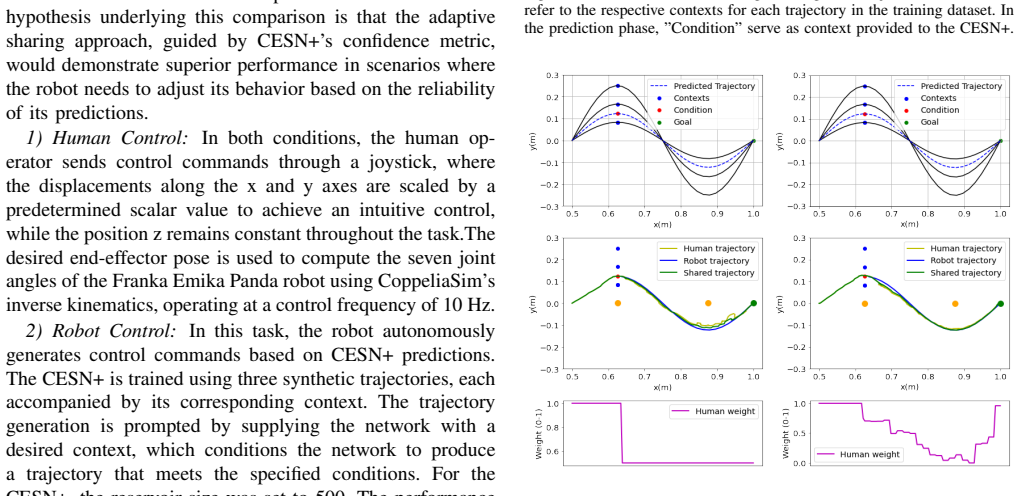
The load-bearing object is the Context-based Echo State Network plus prediction interval (CESN+). A reservoir of fixed random recurrent units with leaking rate $\alpha$ is driven by a context-augmented input; the readout $y(t)=W^{\mathrm{out}}[1;x(t)]$ is fit by linear regression to demonstrated trajectories. Confidence comes from the standard multivariate prediction interval $\hat{Y}_{\mathrm{pred}} \pm t_{\alpha/2}\, s\, \sqrt{1 + X_{\mathrm{pred}}^T (X^T X)^{-1} X_{\mathrm{pred}}}$ (Eq. 9), where $X$ collects training reservoir states and $s$ is the residual standard error. In shared control, the normalized width of this interval sets the human weight $\omega$, so the robot yields control when its own forecast is uncertain. The model needs no probabilistic parameters over the reservoir; the interval is computed from linear-regression statistics around the readout.
What would settle it
Run CESN+ on held-out trajectories and compare the empirical frequency with which the true trajectory falls inside the reported $t_{\alpha/2}$ interval against the nominal level (e.g., 95%): if the coverage is far below the nominal rate, especially for extrapolated conditions, then the interval is miscalibrated and the adaptive weight is not a reliable confidence signal. A second check is to inspect the autocorrelation of readout residuals; strong serial correlation directly violates the assumption behind Eq. (9).
Extended reading notes
Core claim
The central claim is that a reservoir readout trained by ordinary linear regression can be upgraded with prediction intervals (Eq. 9) to yield a practical confidence-aware movement generator. The authors argue that CESN+ generates trajectories that satisfy user-specified context points at least as accurately as Conditional Neural Movement Primitives (CNMP), and that it does better in extrapolation regimes where CNMP degrades; moreover, its confidence interval widens when its prediction is poor, whereas CNMP can report high confidence for badly wrong trajectories. In the shared-control experiment, the robot's control share is set from the normalized prediction interval after a checkpoint, and the adaptive scheme produces a statistically significant reduction in human command magnitude across 14 trials, with $p<0.0001$ on both a $t$-test and a Mann-Whitney $U$ test. The intended conclusion is that uncertainty from a frequentist prediction interval is sufficient to arbitrate shared control, without Bayesian machinery.
Load-bearing premise
The prediction-interval formula assumes that the errors of the readout around the fitted trajectory are independent and have constant variance, but reservoir states over time are strongly autocorrelated and the linear readout is only an approximation, so the stated coverage of the intervals may not hold.
Editorial extensions
If this is right
- A robot controller can use the prediction interval from a reservoir readout as a real-time authority signal, letting the human take over only when the model is uncertain.
- Since training is a single linear-regression fit, the approach can be re-trained online from a few demonstrations, making confidence-aware control feasible on low-power hardware.
- The comparison with CNMP suggests that frequentist intervals can expose model failure modes (overconfidence) that a learned variance output may hide.
- The adaptive arbitration scheme should transfer to other continuous shared-control tasks where a goal or obstacle configuration can be expressed as a context.
Reading between the lines
- Because the prediction interval is derived from local regression geometry, the method could be extended to conformal prediction to obtain distribution-free coverage guarantees; the paper does not attempt this.
- The single-checkpoint design could be generalized to continuous re-conditioning at multiple checkpoints; the authors list this as future work, and the results suggest each re-conditioning would refresh the context and narrow the interval.
- The human-effort reduction may partly reflect that the adaptive scheme trusts the robot more in easy segments and cedes control earlier; a human-factors study with real operators would be needed to confirm that the reduced joystick effort is experienced as reduced workload.
Signed reviews
Editorial analysis
A structured set of objections, weighed in public.
Referee Report
Summary. The paper introduces CESN+, an extension of the context-based echo state network that augments reservoir-computing trajectory generation with prediction intervals computed from linear-regression theory. The authors compare CESN+ with Conditional Neural Movement Primitives (CNMP) on simple trajectory-generation tasks, claiming better accuracy and more reliable confidence signals in interpolation and extrapolation cases, and then apply CESN+ in a simulated Franka Emika shared-control task in which the normalized prediction interval sets the sharing weight between human joystick commands and robot-generated commands. They report that adaptive weight sharing significantly reduces human effort relative to a fixed 50-50 sharing policy.
Significance. If the central claims held, CESN+ would be a valuable lightweight alternative to Bayesian or neural-process models for producing uncertainty-aware movement predictions and using those uncertainties for arbitration in shared control. The strengths of the paper are the simplicity of the model, the explicit use of frequentist prediction intervals rather than ad hoc variance heuristics, and the concrete proof-of-concept setup with a simulated robot. However, the current evidence is not sufficient: the shared-control result lacks the control condition needed to attribute the effect to the confidence signal, the prediction intervals are not checked for calibration, and the comparison with CNMP is qualitative. The idea is promising and the experiments are reproducible in principle, but the load-bearing empirical claims need additional controls and quantitative validation.
major comments (5)
- [Section V.A.3 and V.B (Table I)] The adaptive condition sets the sharing weight from the normalized prediction interval, while the fixed condition uses omega = 0.5. Because higher robot authority (lower omega) tends to reduce the human's commanded input, the significant reduction in effort reported in Table I could be explained entirely by the average omega being below 0.5 in the adaptive condition, regardless of whether the prediction interval carries information. The paper does not report the mean or distribution of omega in the adaptive condition, nor does it include a fixed-weight baseline with omega equal to that average. Without that matched control, the conclusion that confidence-based adaptation reduces human effort is not supported. Please add a fixed-omega baseline matched to the mean adaptive omega and report the omega trajectories.
- [Section V.B (Table I)] The statistical tests treat each time step as an independent sample (N = 1176 per condition from 14 trials). Human joystick input at 10 Hz is strongly autocorrelated within a trial, so the effective sample size is much smaller than 1176 and the reported p-values are spuriously small. Analyze the data at the trial level (for example, mean effort per trial) or use a mixed-effects model with trial as a random effect, and report effect sizes and confidence intervals. The number of human operators should also be stated, since all 14 trials may come from a single operator.
- [Section III.C (Eq. 9)] The prediction-interval formula assumes independent, homoscedastic residuals around the fitted linear readout. Reservoir state sequences are autocorrelated and the readout is a linear approximation of a nonlinear dynamical map, so the nominal coverage of these intervals is not guaranteed. No calibration check is reported anywhere in the paper; examples would be empirical coverage of the nominal 95% interval on held-out trajectories, or the correlation between interval width and absolute prediction error. Because the adaptive weight in Section V.A.3 is set directly from this interval, the shared-control claim is conditional on the intervals being meaningful. Please add such calibration evidence.
- [Section IV (Figs. 2-4)] The performance comparison between CESN+ and CNMP is qualitative. Statements such as 'CESN+ exhibits superior performance' and 'CNMP's confidence metric is misleading' are based on visual inspection of a small number of trajectories. Please provide quantitative error metrics, such as trajectory RMSE and final-point error for known, interpolation, and extrapolation conditions, and for the confidence comparison use a quantitative measure such as calibration error or the correlation between confidence and prediction error. Multiple random seeds for both models would also strengthen the comparison.
- [Section V.A.3] The mapping from the prediction interval to the sharing weight omega is not specified. The text says only that the 'normalized value of the prediction interval' determines omega; there is no equation, normalization constant, or clipping rule. This makes the experiment irreproducible and prevents assessment of how sensitive the result is to the chosen mapping. Please define the exact functional relationship and report the resulting range of omega values.
minor comments (6)
- [Abstract] The phrase 'with desirable properties such fast training' should read 'with desirable properties such as fast training'.
- [Section II.A] 'One challenge faced CNMPs' should be 'One challenge faced by CNMPs' or 'One challenge that CNMPs face'.
- [Section V.A.1] 'Thedesired end-effector pose' contains a missing space and should be 'The desired end-effector pose'.
- [Section III.C (Eq. 9)] The matrix X in Eq. (9) is not defined precisely; specify whether a bias or constant column is included and state the dimensions of X and X_pred.
- [Section III.B] The reservoir hyperparameters (spectral radius, leaking rate, input scaling) are not reported beyond the reservoir size; these values are needed for reproducibility and for assessing the fairness of the comparison with CNMP.
- [References] References [2] and [47] appear to be the same paper and should be consolidated.
Circularity Check
No significant circularity: the prediction-interval confidence signal is derived from an externally cited standard formula and evaluated in a new empirical shared-control experiment, not reduced to the paper's own inputs.
full rationale
The central claims of the paper are the generation quality of CESN+ and the human-effort reduction under adaptive weight sharing. The readout of CESN+ is fitted by standard linear regression, and the prediction interval in Equation (9) is the conventional OLS prediction-interval formula cited to an external source [46], not to the authors' own prior work. The CESN architecture itself comes from the authors' previous paper [11], but that citation is background for the base model, not a load-bearing justification of the confidence mechanism or the shared-control result. The adaptive weight is defined as an explicit function of the normalized prediction interval (Section V.A.3), and the observed reduction in human effort is an empirical outcome of a simulation comparison, not an algebraic consequence of the PI formula; no fitted parameter is renamed as a prediction, and no equation in the paper reduces the conclusion to its inputs by construction. The absence of a matched fixed-weight baseline with the same mean omega is a legitimate experimental-design concern about attributing the effect to confidence, and the pooled 1176 samples per condition raise independence questions, but these are validity risks rather than circularity. No specific circular reduction can be quoted and exhibited, so the honest finding is no circularity.
Assumptions & free parameters
free parameters (4)
- Reservoir size =
500
- ESN hyperparameters (spectral radius, leaking rate, input scaling) =
not reported
- Prediction interval confidence level alpha =
not reported
- PI normalization scheme for omega =
not reported
assumptions (3)
- standard math Standard linear-regression prediction interval formula (Eq. 9) is valid for the reservoir-state readout model.
- domain assumption Reservoir states provide a sufficient representation of the input trajectory for predicting outputs with the readout.
- domain assumption Human and robot commands are combined as a weighted convex combination, and the weight can be set freely based on the prediction interval.
Cite this review
Pith. "Pith review of Context-Based Echo State Networks with Prediction Confidence for Human-Robot Shared Control." pith.science (2026). https://pith.science/paper/KUAPRZRP
@misc{pith2026241200541,
  author       = {Pith},
  title        = {Pith review of: Context-Based Echo State Networks with Prediction Confidence for Human-Robot Shared Control},
  year         = {2026},
  howpublished = {\url{https://pith.science/paper/KUAPRZRP}},
  note         = {Machine review of arXiv:2412.00541}
}
read the original abstract
In this paper, we propose a novel lightweight learning from demonstration (LfD) model based on reservoir computing that can learn and generate multiple movement trajectories with prediction intervals, which we call as Context-based Echo State Network with prediction confidence (CESN+). CESN+ can generate movement trajectories that may go beyond the initial LfD training based on a desired set of conditions while providing confidence on its generated output. To assess the abilities of CESN+, we first evaluate its performance against Conditional Neural Movement Primitives (CNMP), a comparable framework that uses a conditional neural process to generate movement primitives. Our findings indicate that CESN+ not only outperforms CNMP but is also faster to train and demonstrates impressive performance in generating trajectories for extrapolation cases. In human-robot shared control applications, the confidence of the machine generated trajectory is a key indicator of how to arbitrate control sharing. To show the usability of the CESN+ for human-robot adaptive shared control, we have designed a proof-of-concept human-robot shared control task and tested its efficacy in adapting the sharing weight between the human and the robot by comparing it to a fixed-weight control scheme. The simulation experiments show that with CESN+ based adaptive sharing the total human load in shared control can be significantly reduced. Overall, the developed CESN+ model is a strong lightweight LfD system with desirable properties such fast training and ability to extrapolate to the new task parameters while producing robust prediction intervals for its output.
Figures


Figures from the paper (3 more)


Reference graph
Works this paper leans on
-
[1]
Human-robot mutual adapta- tion in collaborative tasks: Models and experiments,
S. Nikolaidis, D. Hsu, and S. Srinivasa, “Human-robot mutual adapta- tion in collaborative tasks: Models and experiments,”The International Journal of Robotics Research , vol. 36, no. 5-7, pp. 618–634, 2017
work page 2017
-
[2]
Adaptive shared control with human intention estimation for human agent collabora- tion,
N. Amirshirzad, E. Ugur, O. Bebek, and E. Oztop, “Adaptive shared control with human intention estimation for human agent collabora- tion,” in 2022 IEEE 18th International Conference on Automation Science and Engineering (CASE) , 2022, pp. 653–658
work page 2022
-
[3]
Safety assurances for human-robot interaction via confidence-aware game-theoretic human models,
R. Tian, L. Sun, A. Bajcsy, M. Tomizuka, and A. D. Dragan, “Safety assurances for human-robot interaction via confidence-aware game-theoretic human models,” in 2022 International Conference on Robotics and Automation (ICRA) , 2022, pp. 11 229–11 235
work page 2022
-
[4]
Probabilistically safe robot planning with confidence-based human predictions,
J. F. Fisac, A. Bajcsy, S. L. Herbert, D. Fridovich-Keil, S. Wang, C. J. Tomlin, and A. D. Dragan, “Probabilistically safe robot planning with confidence-based human predictions,” arXiv preprint arXiv:1806.00109, 2018
arXiv 2018
-
[5]
An overview of reservoir computing: theory, applications and implementations,
B. Schrauwen, D. Verstraeten, and J. Van Campenhout, “An overview of reservoir computing: theory, applications and implementations,” in Proceedings of the 15th european symposium on artificial neural networks. p. 471-482 2007 , 2007, pp. 471–482
work page 2007
-
[6]
H. Jaeger, “Echo state network,” scholarpedia, vol. 2, no. 9, p. 2330, 2007
work page 2007
-
[7]
A survey of robot learning from demonstration,
B. D. Argall, S. Chernova, M. Veloso, and B. Browning, “A survey of robot learning from demonstration,” Robotics and autonomous systems, vol. 57, no. 5, pp. 469–483, 2009
2009
-
[8]
M. Garnelo, D. Rosenbaum, C. Maddison, T. Ramalho, D. Saxton, M. Shanahan, Y . W. Teh, D. Rezende, and S. A. Eslami, “Conditional neural processes,” in International conference on machine learning . PMLR, 2018, pp. 1704–1713
work page 2018
Show all 47 references
-
[9]
Autoregressive conditional neural processes,
W. P. Bruinsma, S. Markou, J. Requiema, A. Y . Foong, T. R. Andersson, A. Vaughan, A. Buonomo, J. S. Hosking, and R. E. Turner, “Autoregressive conditional neural processes,” arXiv preprint arXiv:2303.14468, 2023
2023 arXiv
-
[10]
Conditional neural movement primitives
M. Y . Seker, M. Imre, J. H. Piater, and E. Ugur, “Conditional neural movement primitives.” in Robotics: Science and Systems , vol. 10, 2019
2019
-
[11]
Context based echo state networks for robot movement primitives,
N. Amirshirzad, M. Asada, and E. Oztop, “Context based echo state networks for robot movement primitives,” in 2023 32nd IEEE Inter- national Conference on Robot and Human Interactive Communication (RO-MAN). IEEE, 2023, pp. 1077–1082
2023
-
[12]
Human–machine adaptive shared control for safe driving under automation degradation,
C. Huang, C. Lv, P. Hang, Z. Hu, and Y . Xing, “Human–machine adaptive shared control for safe driving under automation degradation,” IEEE Intelligent Transportation Systems Magazine , vol. 14, no. 2, pp. 53–66, 2021
2021
-
[13]
Teleological and referential understanding of action in infancy,
G. Csibra, “Teleological and referential understanding of action in infancy,” Philosophical Transactions of the Royal Society of London. Series B: Biological Sciences , vol. 358, no. 1431, pp. 447–458, 2003
2003
-
[14]
Human adaptation to human–robot shared control,
N. Amirshirzad, A. Kumru, and E. Oztop, “Human adaptation to human–robot shared control,” IEEE Transactions on Human-Machine Systems, vol. 49, no. 2, pp. 126–136, 2019
2019
-
[15]
A survey of intent inference for human-robot interaction,
B. D. Argall, S. Chernova, M. Veloso, and B. Browning, “A survey of intent inference for human-robot interaction,” Robotics and Au- tonomous Systems, vol. 58, pp. 1151–1164, 2010
2010
-
[16]
Human–robot collaboration based on motion intention estimation,
Y . Li and S. S. Ge, “Human–robot collaboration based on motion intention estimation,” IEEE/ASME Transactions on Mechatronics , vol. 19, no. 3, pp. 1007–1014, 2013
2013
-
[17]
Deep repre- sentation learning for human motion prediction and classification,
J. Butepage, M. J. Black, D. Kragic, and H. Kjellstrom, “Deep repre- sentation learning for human motion prediction and classification,” in Proceedings of the IEEE conference on computer vision and pattern recognition, 2017, pp. 6158–6166
2017
-
[18]
Human intention pre- diction in human-robot collaborative tasks,
W. Wang, R. Li, Y . Chen, and Y . Jia, “Human intention pre- diction in human-robot collaborative tasks,” in Companion of the 2018 ACM/IEEE international conference on human-robot interaction, 2018, pp. 279–280
2018
-
[19]
A review of intent detection, arbitration, and communication aspects of shared control for physical human–robot interaction,
D. P. Losey, C. G. McDonald, E. Battaglia, and M. K. O’Malley, “A review of intent detection, arbitration, and communication aspects of shared control for physical human–robot interaction,” Applied Mechanics Reviews, vol. 70, no. 1, p. 010804, 2018
2018
-
[20]
Shared control: Balancing autonomy and human assistance with a group of quadrotor uavs,
A. Franchi, C. Secchi, M. Ryll, H. H. Bulthoff, and P. R. Giordano, “Shared control: Balancing autonomy and human assistance with a group of quadrotor uavs,” IEEE Robotics & Automation Magazine , vol. 19, no. 3, pp. 57–68, 2012
2012
-
[21]
A task-specific analysis of the benefit of haptic shared control during telemanipulation,
H. Boessenkool, D. A. Abbink, C. J. Heemskerk, F. C. van der Helm, and J. G. Wildenbeest, “A task-specific analysis of the benefit of haptic shared control during telemanipulation,” IEEE Transactions on Haptics, vol. 6, no. 1, pp. 2–12, 2012
2012
-
[22]
A survey of uncertainty in deep neural networks,
J. Gawlikowski, C. R. N. Tassi, M. Ali, J. Lee, M. Humt, J. Feng, A. Kruspe, R. Triebel, P. Jung, R. Roscher, et al. , “A survey of uncertainty in deep neural networks,” Artificial Intelligence Review , vol. 56, no. Suppl 1, pp. 1513–1589, 2023
2023
-
[23]
Aleatoric and epistemic uncer- tainty in machine learning: An introduction to concepts and methods,
E. H ¨ullermeier and W. Waegeman, “Aleatoric and epistemic uncer- tainty in machine learning: An introduction to concepts and methods,” Machine learning, vol. 110, no. 3, pp. 457–506, 2021
2021
-
[24]
Aleatoric uncertainty estimation with test-time augmen- tation for medical image segmentation with convolutional neural networks,
G. Wang, W. Li, M. Aertsen, J. Deprest, S. Ourselin, and T. Ver- cauteren, “Aleatoric uncertainty estimation with test-time augmen- tation for medical image segmentation with convolutional neural networks,” Neurocomputing, vol. 338, pp. 34–45, 2019
2019
-
[25]
Estimating and exploiting the aleatoric uncertainty in surface normal estimation,
G. Bae, I. Budvytis, and R. Cipolla, “Estimating and exploiting the aleatoric uncertainty in surface normal estimation,” in Proceedings of the IEEE/CVF International Conference on Computer Vision , 2021, pp. 13 137–13 146
2021
-
[26]
Deup: Direct epistemic uncertainty prediction,
S. Lahlou, M. Jain, H. Nekoei, V . I. Butoi, P. Bertin, J. Rector-Brooks, M. Korablyov, and Y . Bengio, “Deup: Direct epistemic uncertainty prediction,” arXiv preprint arXiv:2102.08501 , 2021
2021 arXiv
-
[27]
Epistemic uncer- tainty sampling,
V .-L. Nguyen, S. Destercke, and E. H ¨ullermeier, “Epistemic uncer- tainty sampling,” in Discovery Science: 22nd International Confer- ence, DS 2019, Split, Croatia, October 28–30, 2019, Proceedings 22 . Springer, 2019, pp. 72–86
2019
-
[28]
Trust in robots: Challenges and opportunities,
B. C. Kok and H. Soh, “Trust in robots: Challenges and opportunities,” Current Robotics Reports , vol. 1, no. 4, pp. 297–309, 2020
2020
-
[29]
Partially observable markov decision processes in robotics: A survey,
M. Lauri, D. Hsu, and J. Pajarinen, “Partially observable markov decision processes in robotics: A survey,” IEEE Transactions on Robotics, vol. 39, no. 1, pp. 21–40, 2022
2022
-
[30]
Active inference in robotics and artificial agents: Survey and challenges,
P. Lanillos, C. Meo, C. Pezzato, A. A. Meera, M. Baioumy, W. Ohata, A. Tschantz, B. Millidge, M. Wisse, C. L. Buckley, et al. , “Active inference in robotics and artificial agents: Survey and challenges,” arXiv preprint arXiv:2112.01871 , 2021
2021 arXiv
-
[31]
Gaussian processes in machine learning,
C. E. Rasmussen, “Gaussian processes in machine learning,” in Summer school on machine learning . Springer, 2003, pp. 63–71
2003
-
[32]
When gaussian process meets big data: A review of scalable gps,
H. Liu, Y .-S. Ong, X. Shen, and J. Cai, “When gaussian process meets big data: A review of scalable gps,” IEEE transactions on neural networks and learning systems , vol. 31, no. 11, pp. 4405–4423, 2020
2020
-
[33]
Classification un- certainty of deep neural networks based on gradient information,
P. Oberdiek, M. Rottmann, and H. Gottschalk, “Classification un- certainty of deep neural networks based on gradient information,” in Artificial Neural Networks in Pattern Recognition: 8th IAPR TC3 Workshop, ANNPR 2018, Siena, Italy, September 19–21, 2018, Pro- ceedings 8. Spr...
2018
-
[34]
Combining diversity measures for ensemble pruning,
G. D. Cavalcanti, L. S. Oliveira, T. J. Moura, and G. V . Carvalho, “Combining diversity measures for ensemble pruning,” Pattern Recog- nition Letters, vol. 74, pp. 38–45, 2016
2016
-
[35]
Deep eviden- tial regression,
A. Amini, W. Schwarting, A. Soleimany, and D. Rus, “Deep eviden- tial regression,” Advances in neural information processing systems , vol. 33, pp. 14 927–14 937, 2020
2020
-
[36]
Training neural networks with implicit variance,
J. Bayer, C. Osendorfer, S. Urban, and P. van der Smagt, “Training neural networks with implicit variance,” in Neural Information Pro- cessing: 20th International Conference, ICONIP 2013, Daegu, Korea, November 3-7, 2013. Proceedings, Part II 20 . Springer, 2013, pp. 132–139
2013
-
[37]
Bayesian neural networks: An introduction and survey,
E. Goan and C. Fookes, “Bayesian neural networks: An introduction and survey,” Case Studies in Applied Bayesian Data Science: CIRM Jean-Morlet Chair, Fall 2018, pp. 45–87, 2020
2018
-
[38]
Dropout as a bayesian approximation,
Y . Gal and Z. Ghahramani, “Dropout as a bayesian approximation,” arXiv preprint arXiv:1506.02157 , 2015
2015 arXiv
-
[39]
Practical confidence and prediction intervals,
T. Heskes, “Practical confidence and prediction intervals,” Advances in neural information processing systems , vol. 9, 1996
1996
-
[40]
A quantile regression approach to generating prediction intervals,
J. W. Taylor and D. W. Bunn, “A quantile regression approach to generating prediction intervals,” Management Science, vol. 45, no. 2, pp. 225–237, 1999
1999
-
[41]
Quantile regression and clustering models of prediction intervals for weather forecasts: A comparative study,
A. Zarnani, S. Karimi, and P. Musilek, “Quantile regression and clustering models of prediction intervals for weather forecasts: A comparative study,” Forecasting, vol. 1, no. 1, pp. 169–188, 2019
2019
-
[42]
Bootstrap prediction intervals for linear, nonlinear and nonparametric autoregressions,
L. Pan and D. N. Politis, “Bootstrap prediction intervals for linear, nonlinear and nonparametric autoregressions,” Journal of Statistical Planning and Inference , vol. 177, pp. 1–27, 2016
2016
-
[43]
Conformal prediction interval for dynamic time- series,
C. Xu and Y . Xie, “Conformal prediction interval for dynamic time- series,” in International Conference on Machine Learning . PMLR, 2021, pp. 11 559–11 569
2021
-
[44]
Acnmp: Skill transfer and task extrapolation through learn- ing from demonstration and reinforcement learning via representation sharing,
M. T. Akbulut, E. Oztop, M. Y . Seker, H. Xue, A. E. Tekden, and E. Ugur, “Acnmp: Skill transfer and task extrapolation through learn- ing from demonstration and reinforcement learning via representation sharing,” arXiv preprint arXiv:2003.11334 , 2020
2003 arXiv
-
[45]
A practical guide to applying echo state networks,
M. Luko ˇseviˇcius, “A practical guide to applying echo state networks,” Neural Networks: Tricks of the Trade: Second Edition , pp. 659–686, 2012
2012
-
[46]
Confidence intervals and prediction intervals for feed-forward neural networks
R. Dybowski and S. J. Roberts, “Confidence intervals and prediction intervals for feed-forward neural networks.” Cambridge University Press, 2001
2001
-
[47]
Adaptive shared control with human intention estimation for human agent collabora- tion,
N. Amirshirzad, E. Ugur, O. Bebek, and E. Oztop, “Adaptive shared control with human intention estimation for human agent collabora- tion,” in 2022 IEEE 18th International Conference on Automation Science and Engineering (CASE) . IEEE, 2022, pp. 653–658
2022
Reviewed August 12, 2026 · model on record in the stance chip above.
Discussion (0). Continue with ORCID to comment.