REVIEW 4 major objections 4 minor 44 references
Task-Oriented Dialog Systems for the Senegalese Wolof Language
T0 review · 4 major / 4 minor · reviewed 2026-08-11 · deepseek-v4-flash
Pith's one-line read The paper argues that a Wolof task-oriented chatbot can be trained on machine-translated French examples, achieving 0.995 macro F1 for intent classification, close to the 0.999 French score.
desk verdict A practical Wolof chatbot pipeline with a neat identifier trick, but the headline parity claim rests on a self-generated test set and needs human-validated evaluation before it can be believed. read the letter →
The pith
A machine-rendered reading of the paper's core claim, the machinery that carries it, and where it could break.
The reading
What carries the argument
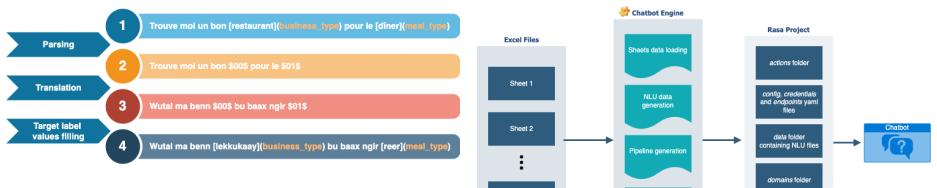
The load-bearing mechanism is the identifier-based annotation projection procedure: the system replaces every labeled French span with a token of the form `$0N$`, translates the modified sentence with a fine-tuned French-to-Wolof machine-translation model, then replaces each surviving identifier with the stored translation of the original span and reattaches its label. This avoids separate word-alignment models and, the authors report, preserves labels through translation more consistently than XML tags, brackets, parentheses, or bare numbers. The second component is the chatbot generation engine, built on the Rasa open-source dialogue framework, that compiles Excel domain files into a working chatbot with a fixed language-agnostic pipeline; the pipeline uses LaBSE multilingual sentence embeddings and the DIET model (Dual Intent and Entity Transformer) for intent detection and slot filling. The seed data is the French subset of MASSIVE, 9,638 examples across 27 intents and 10 domains.
What would settle it
Hand-translate and hand-annotate a few hundred Wolof utterances from the same 27 MASSIVE intents, run the trained Wolof intent classifier on them, and compare the macro F1 with the reported 0.995; a substantially lower score on human-annotated data would show that the near-parity is an artifact of evaluating on self-consistent machine-generated labels.
Extended reading notes
Core claim
The central claim, stated on the paper's own terms, is that annotation projection can be made reliable enough for intent classification by substituting labeled spans with `$0N$` identifiers before machine translation. The authors tested XML tags, brackets, parentheses, and plain numeric identifiers, and found that only the dollar-sign form consistently survives translation, so the translated sentence retains placeholders that can be replaced by the stored translations of the original spans. Feeding the resulting Wolof synthetic data through a fixed language-agnostic intent-and-slot pipeline gives a Wolof intent classifier with 0.995 macro F1 on the 27-intent benchmark, effectively matching the French classifier trained on the source data (0.999 macro F1). The authors attribute the lower slot-filling score (0.86 macro F1) to annotation fragments being translated independently of their sentence context, and they read the intent result as evidence that the methodology is sound and portable.
Load-bearing premise
That the French-to-Wolof translation preserves both the intent of each utterance and the meaning of each labeled span, so the projected Wolof labels are correct; the paper cannot verify this because its Wolof test set is produced by the same translation and projection pipeline.
Editorial extensions
If this is right
- A Wolof intent classifier with 0.995 macro F1 can be produced from translated French MASSIVE data without any human Wolof annotation.
- The same chatbot-generation engine can be pointed at any language with a source dataset and a translation system, because the intent pipeline does not change with the language.
- Modular chatbots built this way offer output control that the authors contrast with LLM-based assistants, whose hallucination risk motivates the work.
- Slot filling, at 0.86 macro F1, is the weaker link, and the authors tie it to decontextualized translation of span annotations.
- Improving the underlying French-to-Wolof translation quality is the lever that would most directly raise the quality of the synthetic Wolof dataset.
Reading between the lines
- Editorial: Because the Wolof test set is synthetic, the 0.995 figure is best read as internal consistency with the projection pipeline; a human-annotated Wolof benchmark is the test the paper does not provide.
- Editorial: The `$0N$` finding suggests a cheap design heuristic for other low-resource projections: before building alignment machinery, search for identifier token forms that survive the target machine-translation model, since a surviving placeholder removes the need for word alignment.
- Editorial: Improving translation of multi-word slot annotations with context, or retranslating each annotation along with its surrounding sentence, would likely close the slot-filling gap faster than improving intent classification.
- Editorial: Field deployment will additionally face the orthography split between official and conventional Wolof writing; the paper names spelling correction as future work, and without it a benchmark trained on official forms may underperform on real user text.
Editorial analysis
A structured set of objections, weighed in public.
Referee Report
Summary. The paper proposes a pipeline for building a task-oriented dialog system in Wolof by projecting annotations from the French portion of the MASSIVE dataset using an in-house French–Wolof machine translation system. The projection replaces annotated spans with numeric identifiers wrapped in dollar signs before translation, then back-fills the translated spans. The authors train a Rasa/DIET intent classifier and slot filler with LaBSE embeddings on the resulting synthetic Wolof data. They report an intent-classification macro F1 of 0.995 on Wolof versus 0.999 on French, and a slot-filling micro F1 of 0.89 on Wolof versus 0.97 on French, concluding that the Wolof classifier performs similarly to the French one and that the approach is extensible to other low-resource languages.
Significance. If the claims are validated, the contribution is a practical, low-cost recipe for bootstrapping task-oriented dialog data in low-resource languages without explicit word-alignment models: a marker-based projection method coupled with a language-agnostic classifier pipeline. The use of the public MASSIVE dataset and the explicit discussion of translation-quality limitations are strengths. However, the central evaluation is conducted on a Wolof test set generated by the same MT and projection pipeline as the training set, so the reported F1 values currently measure internal consistency of the pipeline rather than performance on authentic Wolof. The slot-filling gap in Table 3 suggests that the projection is noisy, which further underlines the need for human-annotated evaluation.
major comments (4)
- [Section 6, Table 2] The Wolof test set is produced by the same in-house French–Wolof MT system and annotation-projection pipeline that generated the training data, and intent labels are copied from the French MASSIVE source. The macro F1 of 0.995 therefore measures how well the model fits the projection pipeline's label assignments on translationese, not how well it classifies natural Wolof. The paper's own statement that 'annotation projection is heavily influenced by the machine translation system' and the slot-filling drop in Table 3 (micro F1 0.89 vs 0.97) indicate that the projected labels are noisy. To support the abstract's parity claim, the authors should evaluate on a human-annotated Wolof test set (e.g., a professionally translated and annotated sample) or, at minimum, report a manual inspection of a random sample of the projected test set, together with confidence intervals for the F1 scores.
- [Section 4] The marker/identifier choice (dollar-sign-prefixed numeric identifiers) is justified only by an informal 'empirically tested' procedure on sample sentences, with no quantitative assessment of projection correctness. The paper calls the methodology 'robust' but provides no direct evidence of projection quality. Please add a projection-quality evaluation: for example, manually annotate a random sample of projected Wolof sentences and report precision/recall of slot projection, and compare against an existing projection baseline such as word alignment (López de Lacalle et al., 2020) or mark-then-translate (Chen et al., 2023). This is necessary to substantiate the robustness claim.
- [Sections 5–6] The experimental setup is underspecified: no random seed, number of runs, or hyperparameter details for DIET/LaBSE are given, and the 80/20 split is described in a single sentence. Given that the reported intent F1 differences are small (0.999 vs 0.995), the reader cannot determine whether these differences are significant. Please report the variance over multiple runs or bootstrap confidence intervals, and state the exact train/test split procedure.
- [Reproducibility] No code, configuration, or synthetic Wolof dataset is released, and the in-house MT system is described only by a BLEU score (26.38) without architectural or training-data details. Since the main contribution is a data-generation methodology and a chatbot engine, the results cannot be verified or built upon without these artifacts. Please provide a public release or a detailed availability statement, including the generated Wolof dataset and the Rasa configuration files.
minor comments (4)
- [Section 4] The identifier format is written as '$0N$', which is ambiguous; please clarify whether the placeholder is '$' + '0' + N + '$' or something else, and align the notation between the text and Figure 1.
- [Section 6, Figure 6] The caption says 'Intent confidence matrix' but the figure appears to be a confusion matrix; please clarify the caption and fix the typo 'reccomandation_events' in the text.
- [Section 5] The phrase "We've used it" should be formalized to "We used it".
- [Table 3] Please specify whether slot filling is evaluated at the span level or with BIO tagging, and define what 'accuracy' means for slot filling.
Circularity Check
Wolof evaluation reuses the same projection/MT pipeline that generated the training data, so the parity F1 is a self-consistency score rather than evidence about human Wolof.
-
fitted input called prediction
[Section 4 (Annotation Projection), Section 5 (Experiments), Section 6 (Results, Table 2)]
"This shows that the model succeeds in discriminating the intents in the synthetic dataset, suggesting a sufficiently qualitative translation."
The Wolof train and test splits are both produced by the same in-house MT plus $0N$ identifier projection, with intent labels copied from the French MASSIVE source rather than assigned by Wolof speakers. Because the projection algorithm deterministically maps each French utterance and its label to a Wolof surface string, the held-out test set shares the same label-generation function as the training set; a systematic MT meaning shift would appear in both. The classifier's near-parity macro F1 therefore measures how well the model fits the projection pipeline's internally consistent label assignments, not agreement with natural Wolof. Using that score to conclude 'a sufficiently qualitative translation' validates the MT with data produced by the same MT, closing the loop.
full rationale
The central derivation, French-to-Wolof projection followed by Rasa/DIET training, is not circular in the strict equation-identity sense: the classifier could in principle fail on the held-out synthetic split, so the reported 0.995 macro F1 is an empirical result rather than a tautology. The circularity burden lies in the evaluation loop: the Wolof test set is generated by the same in-house MT and identifier-projection algorithm that produced the training set, with labels inherited from French source annotations. Consequently, the parity claim supports internal consistency of the synthetic pipeline, while the paper's own Section 6 caveats, including 'annotation projection is heavily influenced by the machine translation system,' concede the lack of independent translation-quality evidence. This is a partial, not total, circularity: the approach is self-contained and honestly reports its limitations, but external validation on human-annotated Wolof would be required to turn the parity claim into evidence about natural-language understanding. Self-citations in the paper are not load-bearing for the result.
Assumptions & free parameters
assumptions (4)
- domain assumption The French-to-Wolof MT system preserves utterance intent and slot label meaning well enough for the projected annotations to be correct.
- domain assumption The $0N$ identifiers are consistently preserved by the MT system.
- domain assumption Annotations translated in isolation retain their source labels.
- domain assumption LaBSE embeddings and the DIET pipeline are language-agnostic enough to train a comparable Wolof classifier.
Cite this review
Pith. "Pith review of Task-Oriented Dialog Systems for the Senegalese Wolof Language." pith.science (2026). https://pith.science/paper/6437ABDS
@misc{pith2026241211203,
  author       = {Pith},
  title        = {Pith review of: Task-Oriented Dialog Systems for the Senegalese Wolof Language},
  year         = {2026},
  howpublished = {\url{https://pith.science/paper/6437ABDS}},
  note         = {Machine review of arXiv:2412.11203}
}
read the original abstract
In recent years, we are seeing considerable interest in conversational agents with the rise of large language models (LLMs). Although they offer considerable advantages, LLMs also present significant risks, such as hallucination, which hinder their widespread deployment in industry. Moreover, low-resource languages such as African ones are still underrepresented in these systems limiting their performance in these languages. In this paper, we illustrate a more classical approach based on modular architectures of Task-oriented Dialog Systems (ToDS) offering better control over outputs. We propose a chatbot generation engine based on the Rasa framework and a robust methodology for projecting annotations onto the Wolof language using an in-house machine translation system. After evaluating a generated chatbot trained on the Amazon Massive dataset, our Wolof Intent Classifier performs similarly to the one obtained for French, which is a resource-rich language. We also show that this approach is extensible to other low-resource languages, thanks to the intent classifier's language-agnostic pipeline, simplifying the design of chatbots in these languages.
Figures


Figures from the paper (1 more)

Reference graph
Works this paper leans on
-
[1]
David Adelani, Jesujoba Alabi, Angela Fan, Julia Kreutzer, Xiaoyu Shen, Machel Reid, Dana Ruiter, Dietrich Klakow, Peter Nabende, Ernie Chang, Tajuddeen Gwadabe, Freshia Sackey, Bonaventure F. P. Dossou, Chris Emezue, Colin Leong, Michael Beukman, Shamsuddeen Muhammad, Guyo Jarso, Oreen Yousuf, Andre Niyongabo Rubungo, Gilles Hacheme, Eric Peter Wairagala...
2022
-
[2]
David Ifeoluwa Adelani, Jessica Ojo, Israel Abebe Azime, Jian Yun Zhuang, Jesujoba O. Alabi, Xuanli He, Millicent Ochieng, Sara Hooker, Andiswa Bukula, En-Shiun Annie Lee, Chiamaka Chukwuneke, Happy Buzaaba, Blessing Sibanda, Godson Kalipe, Jonathan Mukiibi, Salomon Kabongo, Foutse Yuehgoh, Mmasibidi Setaka, Lolwethu Ndolela, Nkiruka Odu, Rooweither Mabuy...
arXiv 2024
-
[3]
Naveen Arivazhagan, Ankur Bapna, Orhan Firat, Dmitry Lepikhin, Melvin Johnson, Maxim Krikun, Mia Xu Chen, Yuan Cao, George Foster, Colin Cherry, Wolfgang Macherey, Zhifeng Chen, and Yonghui Wu. 2019. https://arxiv.org/abs/1907.05019 Massively multilingual neural machine translation in the wild: Findings and challenges . Preprint, arXiv:1907.05019
arXiv 2019
-
[4]
Abhinav Arora, Akshat Shrivastava, Mrinal Mohit, Lorena Sainz-Maza Lecanda, and Ahmed Aly. 2020. https://openreview.net/forum?id=vP-CQG-ap-R Cross-lingual transfer learning for intent detection of covid-19 utterances
work page 2020
-
[5]
Mikel Artetxe, Sebastian Ruder, and Dani Yogatama. 2020. https://doi.org/10.18653/v1/2020.acl-main.421 On the cross-lingual transferability of monolingual representations . In Proceedings of the 58th Annual Meeting of the Association for Computational Linguistics, pages 4623--4637, Online. Association for Computational Linguistics
-
[6]
Laurent Besacier, Etienne Barnard, Alexey Karpov, and Tanja Schultz. 2014. https://doi.org/10.1016/j.specom.2013.07.008 Automatic speech recognition for under-resourced languages: A survey . Speech Communication, 56:85–100
-
[7]
Tom Bocklisch, Joey Faulkner, Nick Pawlowski, and Alan Nichol. 2017. https://arxiv.org/abs/1712.05181 Rasa: Open source language understanding and dialogue management . Preprint, arXiv:1712.05181
arXiv 2017
-
[8]
Tanja Bunk, Daksh Varshneya, Vladimir Vlasov, and Alan Nichol. 2020. https://arxiv.org/abs/2004.09936 Diet: Lightweight language understanding for dialogue systems . Preprint, arXiv:2004.09936
arXiv 2020
Show all 44 references
-
[9]
Yang Chen, Chao Jiang, Alan Ritter, and Wei Xu. 2023. https://doi.org/10.18653/v1/2023.findings-acl.357 Frustratingly easy label projection for cross-lingual transfer . In Findings of the Association for Computational Linguistics: ACL 2023, pages 5775--5796, Toronto, Canada. A...
2023 doi
-
[10]
Jacob Devlin, Ming-Wei Chang, Kenton Lee, and Kristina Toutanova. 2019. https://doi.org/10.18653/v1/N19-1423 BERT : Pre-training of deep bidirectional transformers for language understanding . In Proceedings of the 2019 Conference of the North A merican Chapter of the Associat...
2019 doi
-
[11]
Bamba Dione, Alla Lo, Elhadji Mamadou Nguer, and Sileye Ba
Cheikh M. Bamba Dione, Alla Lo, Elhadji Mamadou Nguer, and Sileye Ba. 2022. https://aclanthology.org/2022.lrec-1.717 Low-resource neural machine translation: Benchmarking state-of-the-art transformer for W olof - F rench . In Proceedings of the Thirteenth Language Resources an...
2022
-
[12]
Chris Dyer, Victor Chahuneau, and Noah A. Smith. 2013. https://aclanthology.org/N13-1073 A simple, fast, and effective reparameterization of IBM model 2 . In Proceedings of the 2013 Conference of the North A merican Chapter of the Association for Computational Linguistics: Hum...
2013
-
[13]
David Eberhard, Gary Simons, and Chuck Fennig. 2019. Ethnologue: Languages of the World, 22nd Edition. SIL International
2019
-
[14]
Angela Fan, Shruti Bhosale, Holger Schwenk, Zhiyi Ma, Ahmed El-Kishky, Siddharth Goyal, Mandeep Baines, Onur Celebi, Guillaume Wenzek, Vishrav Chaudhary, Naman Goyal, Tom Birch, Vitaliy Liptchinsky, Sergey Edunov, Edouard Grave, Michael Auli, and Armand Joulin. 2020. https://a...
2020 arXiv
-
[15]
Christian Federmann, Tom Kocmi, and Ying Xin. 2022. https://aclanthology.org/2022.sumeval-1.4 NTREX -128 -- news test references for MT evaluation of 128 languages . In Proceedings of the First Workshop on Scaling Up Multilingual Evaluation, pages 21--24, Online. Association f...
2022
-
[16]
Fangxiaoyu Feng, Yinfei Yang, Daniel Cer, Naveen Arivazhagan, and Wei Wang. 2022. https://arxiv.org/abs/2007.01852 Language-agnostic bert sentence embedding . Preprint, arXiv:2007.01852
2022 arXiv
-
[17]
Jack FitzGerald, Christopher Hench, Charith Peris, Scott Mackie, Kay Rottmann, Ana Sanchez, Aaron Nash, Liam Urbach, Vishesh Kakarala, Richa Singh, Swetha Ranganath, Laurie Crist, Misha Britan, Wouter Leeuwis, Gokhan Tur, and Prem Natarajan. 2023. https://doi.org/10.18653/v1/2...
2023 doi
-
[18]
Elodie Gauthier, Papa S \'e ga Wade, Thierry Moudenc, Patrice Collen, Emilie De Neef, Oumar Ba, Ndeye Khoyane Cama, Ahmadou Bamba Kebe, Ndeye Aissatou Gningue, and Thomas Mendo ' O Aristide. 2022. https://aclanthology.org/2022.jeptalnrecital-taln.40 Preuve de concept d ' un bo...
2022
-
[19]
Naman Goyal, Cynthia Gao, Vishrav Chaudhary, Peng-Jen Chen, Guillaume Wenzek, Da Ju, Sanjana Krishnan, Marc ' Aurelio Ranzato, Francisco Guzm \'a n, and Angela Fan. 2022. https://doi.org/10.1162/tacl\_a\_00474 The F lores-101 evaluation benchmark for low-resource and multiling...
2022 doi
-
[20]
Hedderich, Lukas Lange, Heike Adel, Jannik Strötgen, and Dietrich Klakow
Michael A. Hedderich, Lukas Lange, Heike Adel, Jannik Strötgen, and Dietrich Klakow. 2021. https://arxiv.org/abs/2010.12309 A survey on recent approaches for natural language processing in low-resource scenarios . Preprint, arXiv:2010.12309
2021 arXiv
-
[21]
Tushar Kanakagiri and Karthik Radhakrishnan. 2021. https://aclanthology.org/2021.dravidianlangtech-1.11 Task-oriented dialog systems for D ravidian languages . In Proceedings of the First Workshop on Speech and Language Technologies for Dravidian Languages, pages 85--93, Kyiv....
2021
-
[22]
Sang Yun Kwon, Gagan Bhatia, Elmoatez Billah Nagoudi, Alcides Alcoba Inciarte, and Muhammad Abdul-mageed. 2023. https://doi.org/10.18653/v1/2023.vardial-1.24 SIDLR : Slot and intent detection models for low-resource language varieties . In Tenth Workshop on NLP for Similar Lan...
2023 doi
-
[23]
Guillaume Lample and Alexis Conneau. 2019. https://arxiv.org/abs/1901.07291 Cross-lingual language model pretraining . Preprint, arXiv:1901.07291
2019 arXiv
-
[24]
Patrick Lewis, Barlas Oguz, Ruty Rinott, Sebastian Riedel, and Holger Schwenk. 2020. https://doi.org/10.18653/v1/2020.acl-main.653 MLQA : Evaluating cross-lingual extractive question answering . In Proceedings of the 58th Annual Meeting of the Association for Computational Lin...
2020 doi
-
[25]
Haoran Li, Abhinav Arora, Shuohui Chen, Anchit Gupta, Sonal Gupta, and Yashar Mehdad. 2021. https://doi.org/10.18653/v1/2021.eacl-main.257 MTOP : A comprehensive multilingual task-oriented semantic parsing benchmark . In Proceedings of the 16th Conference of the European Chapt...
2021 doi
-
[26]
Maddalen L \'o pez de Lacalle, Xabier Saralegi, and I \ n aki San Vicente. 2020. https://aclanthology.org/2020.lrec-1.340 Building a task-oriented dialog system for languages with no training data: the case for B asque . In Proceedings of the Twelfth Language Resources and Eva...
2020
-
[27]
Derguene Mbaye and Moussa Diallo. 2023. https://arxiv.org/abs/2305.08518 Beqi: Revitalize the senegalese wolof language with a robust spelling corrector . Preprint, arXiv:2305.08518
2023 arXiv
-
[28]
Derguene Mbaye, Moussa Diallo, and Thierno Ibrahima Diop. 2024. Low-resourced machine translation for senegalese wolof language. In Proceedings of Eighth International Congress on Information and Communication Technology, pages 243--255, Singapore. Springer Nature Singapore
2024
-
[29]
Bryan McCann, James Bradbury, Caiming Xiong, and Richard Socher. 2018. https://arxiv.org/abs/1708.00107 Learned in translation: Contextualized word vectors . Preprint, arXiv:1708.00107
2018 arXiv
-
[30]
Alireza Mohammadshahi, Vassilina Nikoulina, Alexandre Berard, Caroline Brun, James Henderson, and Laurent Besacier. 2022. https://arxiv.org/abs/2210.11621 Small-100: Introducing shallow multilingual machine translation model for low-resource languages . Preprint, arXiv:2210.11621
2022 arXiv
-
[31]
Wilhelmina Nekoto, Vukosi Marivate, Tshinondiwa Matsila, Timi Fasubaa, Tajudeen Kolawole, Taiwo Fagbohungbe, Solomon Oluwole Akinola, Shamsuddeen Hassan Muhammad, Salomon Kabongo, Salomey Osei, Sackey Freshia, Rubungo Andre Niyongabo, Ricky Macharm, Perez Ogayo, Orevaoghene Ah...
2020 arXiv
-
[32]
Massimo Nicosia, Zhongdi Qu, and Yasemin Altun. 2021. https://doi.org/10.18653/v1/2021.findings-emnlp.279 T ranslate & F ill: I mproving zero-shot multilingual semantic parsing with synthetic data . In Findings of the Association for Computational Linguistics: EMNLP 2021, page...
2021 doi
-
[33]
Ponti, Anna Korhonen, and Ivan Vulić
Evgeniia Razumovskaia, Goran Glavaš, Olga Majewska, Edoardo M. Ponti, Anna Korhonen, and Ivan Vulić. 2022. https://arxiv.org/abs/2104.08570 Crossing the conversational chasm: A primer on natural language processing for multilingual task-oriented dialogue systems . Preprint, ar...
2022 arXiv
-
[34]
Peters, Swabha Swayamdipta, and Thomas Wolf
Sebastian Ruder, Matthew E. Peters, Swabha Swayamdipta, and Thomas Wolf. 2019. https://doi.org/10.18653/v1/N19-5004 Transfer learning in natural language processing . In Proceedings of the 2019 Conference of the North A merican Chapter of the Association for Computational Ling...
2019 doi
-
[35]
Sebastian Schuster, Sonal Gupta, Rushin Shah, and Mike Lewis. 2019. https://doi.org/10.18653/v1/N19-1380 Cross-lingual transfer learning for multilingual task oriented dialog . In Proceedings of the 2019 Conference of the North A merican Chapter of the Association for Computat...
2019 doi
-
[36]
Stephanie Strassel and Jennifer Tracey. 2016. https://aclanthology.org/L16-1521 LORELEI language packs: Data, tools, and resources for technology development in low resource languages . In Proceedings of the Tenth International Conference on Language Resources and Evaluation (...
2016
-
[37]
NLLB Team, Marta R. Costa-jussà, James Cross, Onur Çelebi, Maha Elbayad, Kenneth Heafield, Kevin Heffernan, Elahe Kalbassi, Janice Lam, Daniel Licht, Jean Maillard, Anna Sun, Skyler Wang, Guillaume Wenzek, Al Youngblood, Bapi Akula, Loic Barrault, Gabriel Mejia Gonzalez, Prang...
2022 arXiv
-
[38]
Jörg Tiedemann. 2012. Parallel data, tools and interfaces in opus. In Proceedings of the Eight International Conference on Language Resources and Evaluation (LREC'12), Istanbul, Turkey. European Language Resources Association (ELRA)
2012
-
[39]
Gomez, Lukasz Kaiser, and Illia Polosukhin
Ashish Vaswani, Noam Shazeer, Niki Parmar, Jakob Uszkoreit, Llion Jones, Aidan N. Gomez, Lukasz Kaiser, and Illia Polosukhin. 2023. https://arxiv.org/abs/1706.03762 Attention is all you need . Preprint, arXiv:1706.03762
2023 arXiv
-
[40]
Gengyu Wang, Cheng Qian, Lin Pan, Haode Qi, Ladislav Kunc, and Saloni Potdar. 2022. https://doi.org/10.18653/v1/2022.mia-1.7 Benchmarking language-agnostic intent classification for virtual assistant platforms . In Proceedings of the Workshop on Multilingual Information Access...
2022 doi
-
[41]
Weijia Xu, Batool Haider, and Saab Mansour. 2020. https://doi.org/10.18653/v1/2020.emnlp-main.410 End-to-end slot alignment and recognition for cross-lingual NLU . In Proceedings of the 2020 Conference on Empirical Methods in Natural Language Processing (EMNLP), pages 5052--50...
2020 doi
-
[42]
Zheng Zhang, Ryuichi Takanobu, Qi Zhu, Minlie Huang, and Xiaoyan Zhu. 2020. https://arxiv.org/abs/2003.07490 Recent advances and challenges in task-oriented dialog system . Preprint, arXiv:2003.07490
2020 arXiv
-
[43]
online" 'onlinestring :=
ENTRY address archivePrefix author booktitle chapter edition editor eid eprint eprinttype howpublished institution journal key month note number organization pages publisher school series title type volume year doi pubmed url lastchecked label extra.label sort.label short.list...
-
[44]
write newline
" write newline "" before.all 'output.state := FUNCTION n.dashify 't := "" t empty not t #1 #1 substring "-" = t #1 #2 substring "--" = not "--" * t #2 global.max substring 't := t #1 #1 substring "-" = "-" * t #2 global.max substring 't := while if t #1 #1 substring * t #2 gl...
Reviewed August 11, 2026 · model on record in the stance chip above.
Discussion (0). Continue with ORCID to comment.