REVIEW 4 major objections 5 minor 1 cited by
LENS-XAI: Redefining Lightweight and Explainable Network Security through Knowledge Distillation and Variational Autoencoders for Scalable Intrusion Detection in Cybersecurity
T0 review · 4 major / 5 minor · reviewed 2026-08-10 · deepseek-v4-flash
Pith's one-line read LENS-XAI claims that a VAE-based teacher–student pipeline with attribution explainability reaches state-of-the-art intrusion detection accuracy on four benchmarks while training on 10% of the data.
desk verdict The 10%-data training claim is contradicted by the paper's own Algorithm 2, so the headline accuracies are unsupported as written, despite solid organization and useful engineering detail. read the letter →
The pith
A machine-rendered reading of the paper's core claim, the machinery that carries it, and where it could break.
The reading
What carries the argument
The load-bearing mechanism is a three-stage pipeline: a VAE encoder compresses each input into a low-dimensional latent representation; a high-capacity teacher model is trained on those embeddings; and a compact student model learns to match the teacher's temperature-softened output distribution (Equation 3) while also fitting hard labels. The distillation temperature $T=2$ and mixing weight $\alpha=0.5$ control how much soft versus hard signal the student receives. Explainability comes from a variable-attribution decomposition (Equations 4–8) that expresses a prediction as a baseline plus sequential marginal contributions of features, with a two-step heuristic ordering to reduce order sensitivity. This attribution step is what turns the detector's decisions into per-feature explanations for analysts.
What would settle it
Train the VAE, teacher, and student strictly on the 10% partition described in Section 3.6, keep the remaining 90% completely untouched during training, and re-report the four accuracies; if the numbers fall materially below 95.34%, 99.92%, 98.42%, and 99.34%, the central claim is not supported.
Extended reading notes
Core claim
On its own terms, LENS-XAI is a claim that one architecture can jointly deliver data efficiency, lightweight operation, and explainability for intrusion detection. The teacher model trains on VAE latent embeddings, and the student is distilled from it using temperature-scaled soft targets; variable attribution then breaks each prediction into baseline plus per-feature contributions. Across the four datasets, the framework reports the four accuracies above, with the student model cutting parameter counts substantially and reducing per-batch inference time while keeping accuracy within a fraction of a point (and on NSL-KDD exceeding the teacher). The paper presents this as outperforming the state-of-the-art baselines it compares against on each dataset.
Load-bearing premise
The 10%-data claim collapses if the model components were trained on the full dataset before the 90%/10% split, and the paper's own Algorithm 2 plus Section 3.4.1 both suggest they were.
Editorial extensions
If this is right
- If the 10%-training result is real, intrusion detection systems could be deployed in settings with very few labeled attack samples.
- The distilled student model's parameter and inference-time reductions make the approach feasible on edge hardware without sacrificing much accuracy.
- Feature-level attributions allow security analysts to inspect why a flow was flagged, addressing the black-box objection to deep-learning IDS.
- The same VAE-plus-distillation pattern could be transferred to other anomaly detection domains where labeled data is scarce.
Reading between the lines
- A strict reading of Algorithm 2 suggests the VAE and distillation steps occur before the 10/90 split, so the data-efficiency advantage may be smaller than advertised; rerunning with a genuine 10% training partition would settle this.
- The attribution method's dependence on feature ordering means explanations are heuristic; different orderings could change which features appear responsible for a prediction.
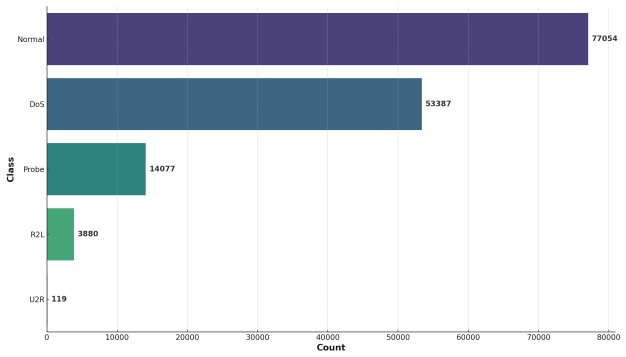
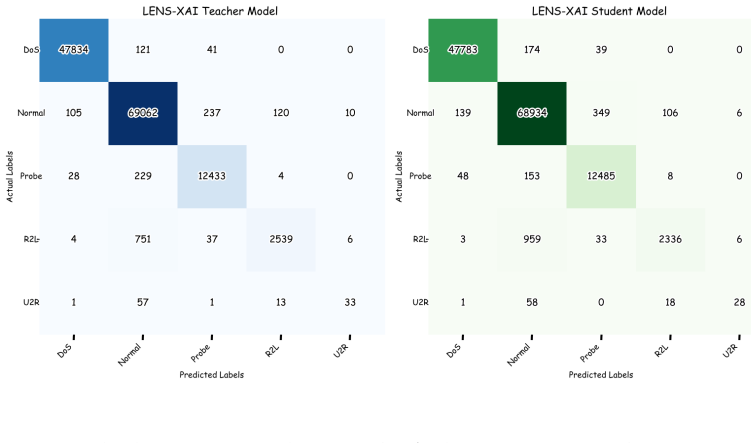
- Because the reported performance on rare attack classes such as SQL Injection and U2R is much lower than the aggregate accuracy, the headline numbers mainly reflect frequent classes; a deployment-focused evaluation should weight rare attacks separately.
Editorial analysis
A structured set of objections, weighed in public.
Referee Report
Summary. The paper proposes LENS-XAI, a framework that combines variational autoencoders, knowledge distillation, and variable-attribution-based explainability for network intrusion detection in IIoT and edge environments. The central claim is that the framework achieves state-of-the-art performance (95.34% on Edge-IIoTset, 99.92% on UKM20, 98.42% on CTU-13, and 99.34% on NSL-KDD) while training on only 10% of the available data. The methodology describes preprocessing, VAE latent representation learning, teacher-student distillation with a 10/90 train/test split, and attribution-based explanations. The evaluation compares the teacher and student models against several baselines across four datasets and reports complexity, inference time, and explainability results.
Significance. If the results were valid, the paper would offer a practically relevant lightweight IDS with a clear integration of VAE-based representation learning, knowledge distillation, and XAI, and the 10%-data training claim would be noteworthy for resource-constrained deployment. The paper also provides an explicit pipeline in Algorithm 2, which is helpful for reproducibility assessment, and it reports a full ablation-free comparison across several public datasets. However, the central empirical claim is not supported by the experimental protocol as described: the pipeline appears to train the VAE, teacher, and student on the full dataset before the 10/90 split, which makes the reported accuracies upper bounds on a genuinely 10%-trained system. Because the main contribution of the paper is empirical, this flaw undermines the significance of the reported results.
major comments (4)
- [Algorithm 2, Steps 2-3 and 5; Section 3.4.1] The reported results do not support the claim of training on 10% of the data. Algorithm 2 trains the VAE on mini-batches sampled from the full merged dataset D in Step 2, trains the teacher on all latent embeddings {z} from D and trains the student on the same full-D latent embeddings in Step 3, and only in Step 5 partitions the data into 10% for training and 90% for testing. Section 3.4.1 explicitly states that the teacher is 'Trained on the full dataset.' This means test instances contribute to the VAE's latent space, the teacher's soft targets, and the student's distillation objective before any evaluation is performed. Section 3.6's description of a 'stringent partition' is therefore internally inconsistent with the pipeline in Algorithm 2, and the accuracies in Tables 3-9 cannot be interpreted as the performance of a model trained on 10% of the data.
- [Section 4.3.4 and Section 4.2 (NSL-KDD)] The evaluation on NSL-KDD uses a random 10/90 split of the full dataset, whereas the standard NSL-KDD protocol uses the fixed KDDTrain+ and KDDTest+ subsets, as the paper itself notes in Section 4.2. Comparisons with prior results trained and tested on the official split (RNN-IDS, MCNN-DFS, etc. in Table 8) are not valid under a different, nonstandard split. The paper does not report the class distribution of the 10% training partition, so it is unclear whether rare classes like U2R are present at all in training; the very low U2R accuracy (37.14% for the teacher, 23.80% for the student in Table 9) is consistent with a training partition that largely omits or underrepresents that class. The protocol needs to be clarified and, if a nonstandard split is used, justified with the class breakdown.
- [Abstract and Conclusion vs. Tables 3, 5, 7, 8] The headline accuracy figures mix teacher and student results without attribution. The 95.34% on Edge-IIoTset, 99.92% on UKM20, and 98.42% on CTU-13 are teacher-model results (Tables 3, 5, and 7), while the 99.34% on NSL-KDD is the student-model result (Table 8; the teacher achieves 98.66%). The abstract and conclusion present these four numbers as a single claim for the framework, which obscures which model is being claimed as the lightweight deployable system. Since the paper argues that the student model is the efficient solution, the student's per-dataset accuracy should be reported consistently and separately.
- [Section 4.1, Eq. (2) and Eq. (3)] The framework's central efficiency and performance claims are not supported by any sensitivity analysis or hyperparameter selection procedure. The hyperparameters beta, latent dimension k, temperature T, distillation weight alpha, training epochs, and train_fraction are set to single values without a validation-based criterion or an ablation study. In particular, the observation that the student occasionally outperforms the teacher (e.g., Edge-IIoTset F1 in Table 3 and NSL-KDD accuracy in Table 8) is unexpected under standard knowledge distillation and is not explained. The paper should provide a parameter study or, at minimum, state how these values were chosen and whether performance is stable under small perturbations.
minor comments (5)
- [Abstract and Section 4.3] The order of the four datasets in the abstract and conclusion ('Edge-IIoTset, UKM20, CTU-13, NSL-KDD') matches the results order, but the reader must reconstruct which number belongs to which model; please state explicitly, e.g., 'teacher model on Edge-IIoTset, student model on NSL-KDD.'
- [Section 1 and throughout] The text contains typographical and formatting issues, including 'artifical intelligence' in the introduction and 'V AEs' with a space throughout; these should be corrected for consistency.
- [Section 4.3.4, Table 8] The table caption and the surrounding text use both 'LENS-XAI' and 'LENSXAI' inconsistently; the same applies to 'Teacher' vs. 'T eacher' in Table 4.
- [Section 5.3 (Limitations)] The limitations section discusses dependence on labeled data and explainability overhead, but it does not acknowledge the apparent leakage of test data into the training pipeline described in Algorithm 2, nor does it discuss the discrepancy between the 10%-data claim and the full-data teacher training described in Section 3.4.1.
- [Algorithm 1] The variable attribution algorithm defines conditional expectations over partially specified feature subsets, but the practical implementation of these expectations (e.g., using background data, a surrogate model, or approximations) is not described; please specify how Equation (6) is computed in the experiments.
Circularity Check
Algorithm 2 fits scaler, VAE, teacher, and student on the full dataset before the 10/90 split, so the headline 10%-data accuracies are in-sample fit quality, not measured generalization.
-
fitted input called prediction
[Algorithm 2 (Steps 2, 3, 5); Section 3.4.1; Section 3.6; Abstract]
"Teacher Model: Trained on the full dataset (or its latent representations) to achieve high accuracy. [§3.4.1] ... Step 2: for each mini-batch x sampled from D do ... Update network parameters ϕ and θ via backpropagation ... Step 3: Train teacher model ft on latent embeddings {z} ... Train student model fs ... Step 5: Partition the data: 10% for training, 90% for testing. Use student model fs to predict anomaly scores ŷs(x). [Alg. 2] ... By leveraging a training set comprising 10% of the available data, the framework optimizes computational efficiency without sacrificing performance. [Abstract]"
The Abstract's central claim is that 10% of the available data suffices for competitive accuracy, and Section 3.6 promises a 'stringent partition' (10% train / 90% test). The accuracies reported in Section 4.3 are produced by Algorithm 2, whose ordering makes that regime impossible: Step 1 fits the Standard Scaler on the full merged dataset D, Step 2 trains the VAE on mini-batches sampled from D, Step 3 trains the teacher on latent embeddings {z} of D and then distills to the student, and only Step 5 partitions into 10% train / 90% test.
full rationale
One step rises to circularity: the headline 10%-data claim. Algorithm 2 trains the VAE (Step 2) and the teacher/student pair (Step 3) on the full dataset D, and Section 3.4.1 states the teacher is 'Trained on the full dataset'; the 10/90 partition occurs only in Step 5 (with Step 4 even referring to 'test sample xtest' before the split exists). Consequently, the 'test' rows' latent embeddings and labels entered every fitted component, and the Section 4.3 accuracies offered as evidence for the Abstract's 'training set comprising 10% of the available data' are the fit quality of models that consumed the full data including the evaluation rows. This is the fitted-input-called-prediction pattern: the derived quantity (generalization under a 10%-data regime) is, by the algorithm's own construction, in-sample accuracy of full-data training. The self-citation to the authors' prior KD-XVAE [23] (Section 2.4) is noticeable but not load-bearing: the architecture follows the external, standard KD/VAE literature (Hinton [32], Kingma [31]), [23] is a published peer-reviewed workshop artifact, and the benchmark comparisons (Tables 3-9) are made against external baselines not derived from this paper's constants. The attribution decomposition (Eqs. 4-8, Algorithm 1) is the standard local-accuracy identity; contributions are defined to sum to the prediction, presented as methodology rather than as a derived result, so it is not a circular step. No uniqueness theorem or ansatz is smuggled via self-citation. Section 5.3's admitted 'Dependence on Labeled Data' sits uneasily beside the 10%-data claim and is consistent with the full-data protocol actually executed. Had the pipeline genuinely fit scaler, VAE, teacher, and student on the 10% partition before scoring the holdout, the numbers would be independent empirical claims; as written, the paper's central efficiency claim is unsupported by its own protocol, giving partial circularity (6) rather than a clean 0-2.
Assumptions & free parameters
free parameters (6)
- train_fraction =
0.10
- beta (VAE KL weight) =
not reported
- latent dimension k =
not reported
- temperature T =
2
- distillation weight alpha =
0.5
- training epochs per dataset =
100 to 500
assumptions (5)
- domain assumption Benchmark datasets faithfully represent IIoT and network attack distributions.
- domain assumption Preprocessing, including imputation, one-hot encoding, and z-score scaling, preserves class structure and does not leak information across the split.
- domain assumption A teacher trained on the full dataset can be distilled into a student that retains accuracy on the same distribution.
- domain assumption Variational autoencoder latent representations are sufficient for downstream intrusion classification.
- standard math VAE reparameterization and standard knowledge distillation losses are as in Kingma and Welling [31] and Hinton et al. [32].
Cite this review
Pith. "Pith review of LENS-XAI: Redefining Lightweight and Explainable Network Security through Knowledge Distillation and Variational Autoencoders for Scalable Intrusion Detection in Cybersecurity." pith.science (2026). https://pith.science/paper/F72NUVHW
@misc{pith2026250100790,
  author       = {Pith},
  title        = {Pith review of: LENS-XAI: Redefining Lightweight and Explainable Network Security through Knowledge Distillation and Variational Autoencoders for Scalable Intrusion Detection in Cybersecurity},
  year         = {2026},
  howpublished = {\url{https://pith.science/paper/F72NUVHW}},
  note         = {Machine review of arXiv:2501.00790}
}
read the original abstract
The rapid proliferation of Industrial Internet of Things (IIoT) systems necessitates advanced, interpretable, and scalable intrusion detection systems (IDS) to combat emerging cyber threats. Traditional IDS face challenges such as high computational demands, limited explainability, and inflexibility against evolving attack patterns. To address these limitations, this study introduces the Lightweight Explainable Network Security framework (LENS-XAI), which combines robust intrusion detection with enhanced interpretability and scalability. LENS-XAI integrates knowledge distillation, variational autoencoder models, and attribution-based explainability techniques to achieve high detection accuracy and transparency in decision-making. By leveraging a training set comprising 10% of the available data, the framework optimizes computational efficiency without sacrificing performance. Experimental evaluation on four benchmark datasets: Edge-IIoTset, UKM-IDS20, CTU-13, and NSL-KDD, demonstrates the framework's superior performance, achieving detection accuracies of 95.34%, 99.92%, 98.42%, and 99.34%, respectively. Additionally, the framework excels in reducing false positives and adapting to complex attack scenarios, outperforming existing state-of-the-art methods. Key strengths of LENS-XAI include its lightweight design, suitable for resource-constrained environments, and its scalability across diverse IIoT and cybersecurity contexts. Moreover, the explainability module enhances trust and transparency, critical for practical deployment in dynamic and sensitive applications. This research contributes significantly to advancing IDS by addressing computational efficiency, feature interpretability, and real-world applicability. Future work could focus on extending the framework to ensemble AI systems for distributed environments, further enhancing its robustness and adaptability.
Figures


Figures from the paper (6 more)




Forward citations
Cited by 1 Pith paper
-
Enhancing IoT Network Security through Adaptive Curriculum Learning and XAI
A curriculum-learning neural network with LIME feature un-learning and ensemble stacking reports 97 to 98 percent accuracy on Edge-IIoT, CIC-APT-IIoT-2024, and CIC-IoV-2024 intrusion detection benchmarks.
Reference graph
Works this paper leans on
-
[1]
I. Alrashdi, K. M. Sallam, M. A. Alrowaily, O. Alruwaili, B. Arain, Fidwatch: Federated incremental distillation for continuous monitoring of iot security threats, Ad Hoc Networks 165 (2024) 103637. doi:10. 1016/j.adhoc.2024.103637
-
[2]
F. Ullah, S. Ullah, G. Srivastava, J. C.-W. Lin, Ids-int: Intrusion de- tection system using transformer-based transfer learning for imbalanced network traffic, Digital Communications and Networks 10 (1) (2024) 190–204. doi:10.1016/j.dcan.2023.03.008
-
[3]
E. C. Nkoro, J. N. Njoku, C. I. Nwakanma, J.-M. Lee, D.-S. Kim, Zero- trust marine cyberdefense for iot-based communications: An explainable approach, Electronics (Switzerland) 13 (2) (2024) 276. doi:10.3390/ electronics13020276
work page 2024
-
[4]
K. Fatema, M. Anannya, S. K. Dey, C. Su, R. Mazumder, Securing networks: A deep learning approach with explainable ai (xai) and fed- erated learning for intrusion detection, in: Lecture Notes in Computer Science (including subseries Lecture Notes in Artificial Intelligence and Lecture Notes in Bioinformatics), Vol. 15215 LNCS, 2025, pp. 260–275. doi:10.10...
-
[5]
R. Kumar, A. Aljuhani, D. Javeed, P. Kumar, S. Islam, A. K. M. N. Islam, Blockchain and explainable ai for enhanced decision making in cyber threat detection, Software - Practice and Experience 54 (8) (2024) 1337–1360. doi:10.1002/spe.3319. 43
- [6]
-
[7]
S. Bellegdi, A. Selamat, S. O. Olatunji, H. Fujita, O. Krejcar, Explain- able machine learning for intrusion detection 14748 LNAI (2024) 122–
work page 2024
- [8]
Show all 57 references
-
[9]
Nalini, B
M. Nalini, B. Yamini, P. Sinthia, S. Praveena Rachel Kamala, Deep- roughnetid: A robust framework for network anomaly intrusion detec- tion with high detection rates, IETE Journal of Research 70 (9) (2024) 7137–7148. doi:10.1080/03772063.2024.2350932
2024
-
[10]
Krishnaveni, S
S. Krishnaveni, S. Sivamohan, B. Jothi, T. M. Chen, M. Sathiya- narayanan, Twinsec-ids: An enhanced intrusion detection system in sdn-digital-twin-based industrial cyber-physical systems, Concurrency and Computation: Practice and Experience (2024). doi:10.1002/cpe. 8334
2024 doi
-
[11]
Alzu’bi, O
A. Alzu’bi, O. Darwish, A. Albashayreh, Y. Tashtoush, Cyberattack event logs classification using deep learning with semantic feature anal- ysis, Computers and Security 150 (2025) 104222.doi:10.1016/j.cose. 2024.104222
2025
-
[12]
Walczyna, D
T. Walczyna, D. Jankowski, Z. Piotrowski, Enhancing anomaly de- tection through latent space manipulation in autoencoders: A com- parative analysis, Applied Sciences 15 (1) (2024) 286. doi:10.3390/ app15010286
2024
-
[13]
AL-Essa, G
M. AL-Essa, G. Andresini, A. Appice, D. Malerba, Panacea: A neural model ensemble for cyber-threat detection, Machine Learning 113 (8) (2024) 5379–5422. doi:10.1007/s10994-023-06470-2
2024 doi
-
[14]
Y. K. Saheed, J. E. Chukwuere, Xaiensembletl-iov: A new explainable artificial intelligence ensemble transfer learning for zero-day botnet at- 44 tack detection in the internet of vehicles, Results in Engineering 24 (2024) 103171. doi:10.1016/j.rineng.2024.103171
2024
-
[15]
S. R. Sindiramutty, C. E. Tan, S. P. Lau, R. Thangaveloo, A. H. Gharib, Explainable ai for cybersecurity, Advances in Explainable AI Applica- tions for Smart Cities (2024) 31–97.doi:10.4018/978-1-6684-6361-1. ch002
2024 doi
-
[16]
S. R. Alotaibi, H. K. Alkahtani, M. Aljebreen, A. Alshuhail, M. K. Saeed, S. A. Ebad, W. S. Almukadi, M. Alotaibi, Explainable artificial intelligence in web phishing classification on secure iot with cloud-based cyber-physical systems, Alexandria Engineering Journal 110 (2025) 490–
2025
-
[17]
R. Zhao, Y. Chen, Y. Wang, Y. Shi, Z. Xue, An efficient and lightweight approach for intrusion detection based on knowledge distillation, in: Proceedings of the IEEE International Conference on Communications, 2021, pp. 1–8. doi:10.1109/ICC42927.2021.9500574
2021
-
[18]
Y. Chen, S. Al-Rubaye, A. Tsourdos, L. Baker, C. Gillingham, Differentially-private federated intrusion detection via knowledge dis- tillation in third-party iot systems of smart airports, IEEE Interna- tional Conference on Communications 2023-May (2023) 603–608. doi: 10.1109/...
2023
-
[19]
Bacevicius, A
M. Bacevicius, A. Paulauskaite-Taraseviciene, Machine learning algo- rithms for raw and unbalanced intrusion detection data in a multi-class classification problem, Applied Sciences (Switzerland) 13 (2023) 7328. doi:10.3390/app13127328
2023 doi
-
[20]
S. Roy, J. Li, V. Pandey, Y. Bai, An explainable deep neural frame- work for trustworthy network intrusion detection, in: Proceedings of the 2022 10th IEEE International Conference on Mobile Cloud Com- puting, Services, and Engineering (MobileCloud), 2022, pp. 25–30. doi:10.11...
2022
-
[21]
Ahmed, Z
U. Ahmed, Z. Jiangbin, A. Almogren, S. Khan, M. T. Sadiq, A. Al- tameem, A. U. Rehman, Explainable ai-based innovative hybrid ensem- ble model for intrusion detection, Journal of Cloud Computing 13 (1) (2024) 150. doi:10.1186/s13677-024-00712-x . 45
2024 doi
-
[22]
Moustafa, N
N. Moustafa, N. Koroniotis, M. Keshk, A. Y. Zomaya, Z. Tari, Explain- able intrusion detection for cyber defences in the internet of things: Op- portunities and solutions, IEEE Communications Surveys and Tutorials 25 (3) (2023) 1775–1807. doi:10.1109/COMST.2023.3280465
2023
-
[23]
M. A. Yagiz, P. MohajerAnsari, M. D. Pes´ e, P. Goktas, Transform- ing in-vehicle network intrusion detection: Vae-based knowledge dis- tillation meets explainable ai, in: Proceedings of the Sixth Workshop on CPS&IoT Security and Privacy, ACM, 2024, pp. 93–103. doi: 10.1145/36...
2024
-
[24]
T.-T.-H. Le, R. W. Wardhani, D. S. C. Putranto, U. Jo, H. Kim, To- ward enhanced attack detection and explanation in intrusion detection system-based iot environment data, IEEE Access 11 (2023) 131661– 131676. doi:10.1109/ACCESS.2023.3336678
2023
-
[25]
Kostopoulos, D
N. Kostopoulos, D. Kalogeras, D. Pantazatos, M. Grammatikou, V. Maglaris, Shap interpretations of tree and neural network dns clas- sifiers for analyzing dga family characteristics, IEEE Access 11 (2023) 61144–61160. doi:10.1109/ACCESS.2023.3286313
2023
-
[26]
M. M. Shtayat, M. K. Hasan, R. Sulaiman, S. Islam, A. U. R. Khan, An explainable ensemble deep learning approach for intrusion detection in industrial internet of things, IEEE Access 11 (2023) 115047–115061. doi:10.1109/ACCESS.2023.3323573
2023
-
[27]
Sivamohan, S
S. Sivamohan, S. Sridhar, S. Krishnaveni, Tea-ekho-ids: An intrusion detection system for industrial cps with trustworthy explainable ai and enhanced krill herd optimization, Peer-to-Peer Networking and Appli- cations 16 (4) (2023) 1993–2021. doi:10.1007/s12083-023-01507-8
2023 doi
-
[28]
Hattak, G
A. Hattak, G. Iadarola, F. Martinelli, F. Mercaldo, A. Santone, A method for robust and explainable image-based network traffic clas- sification with deep learning, in: Proceedings of the International Conference on Security and Cryptography, 2023, pp. 385–393. doi: 10.5220/00...
2023 doi
-
[29]
Arisdakessian, O
S. Arisdakessian, O. A. Wahab, A. Mourad, H. Otrok, M. Guizani, A survey on iot intrusion detection: Federated learning, game theory, so- cial psychology, and explainable ai as future directions, IEEE Internet 46 of Things Journal 10 (5) (2023) 4059–4092. doi:10.1109/JIOT.2022...
2023 doi
-
[30]
Kumar, A
R. Kumar, A. Aljuhani, D. Javeed, P. Kumar, S. Islam, A. N. Islam, Dig- ital twins-enabled zero touch network: A smart contract and explainable ai integrated cybersecurity framework, Future Generation Computer Systems 156 (2024) 191–205. doi:10.1016/j.future.2024.02.015
2024 doi
-
[31]
D. P. Kingma, M. Welling, Auto-encoding variational bayes, in: Inter- national Conference on Learning Representations (ICLR), 2014. URL https://arxiv.org/abs/1312.6114
2014 arXiv
-
[32]
Hinton, O
G. Hinton, O. Vinyals, J. Dean, Distilling the knowledge in a neural net- work, in: NIPS Deep Learning and Representation Learning Workshop, Curran Associates, Inc., 2015. URL https://arxiv.org/abs/1503.02531
2015 arXiv
-
[33]
Gosiewska, P
A. Gosiewska, P. Biecek, ibreakdown: Uncertainty of model explana- tions for non-additive predictive models, arXiv (2019). URL https://arxiv.org/abs/1903.11420v1
2019 arXiv
-
[34]
Robnik- ˇSikonja, I
M. Robnik- ˇSikonja, I. Kononenko, Explaining classifications for individ- ual instances, IEEE Transactions on Knowledge and Data Engineering 20 (5) (2008) 589–600. doi:10.1109/tkde.2007.190734
2008
-
[35]
Robnik- ˇSikonja, Explainprediction: Explanation of predictions for classification and regression models, r package (2018)
M. Robnik- ˇSikonja, Explainprediction: Explanation of predictions for classification and regression models, r package (2018). URL https://CRAN.R-project.org/package=ExplainPrediction
2018
-
[36]
Biecek, T
P. Biecek, T. Burzykowski, Explore, Explain, and Examine Predictive Models: With Examples in R and Python, CRC Press, 2020
2020
-
[37]
Break-down plots for additive attributions, https://ema.drwhy.ai/ breakDown.html#BDMethodGen, accessed: 2024-12-28
2024
-
[38]
K. Yang, J. Wang, M. Li, An improved intrusion detection method for iiot using attention mechanisms, bigru, and inception-cnn, Scientific Re- ports 14 (1) (2024) 19339. doi:10.1038/s41598-024-70094-2 . 47
2024 doi
-
[39]
W. N. H. Ibrahim, S. Anuar, A. Selamat, O. Krejcar, R. G. Crespo, E. Herrera-Viedma, H. Fujita, Multilayer framework for botnet detec- tion using machine learning algorithms, IEEE Access: Practical Inno- vations, Open Solutions 9 (2021) 48753–48768. doi:10.1109/ACCESS. 2021.3060778
2021
-
[40]
Sharma, H
A. Sharma, H. Babbar, Detecting cyber threats in real-time: A super- vised learning perspective on the ctu-13 dataset, in: 2024 5th Inter- national Conference for Emerging Technology (INCET), 2024, pp. 1–5. doi:10.1109/INCET61516.2024.10593100
2024
-
[41]
Letteri, G
I. Letteri, G. Della Penna, P. Caianiello, Feature selection strategies for http botnet traffic detection, in: 2019 IEEE European Symposium on Security and Privacy Workshops (EuroS&PW), IEEE, 2019, pp. 202–
2019
-
[42]
Pekta¸ s, T
A. Pekta¸ s, T. Acarman, Botnet detection based on network flow sum- mary and deep learning, International Journal of Network Management 28 (6) (Nov. 2018). doi:10.1002/nem.2039
2018 doi
-
[43]
Taheri, M
S. Taheri, M. Salem, J. S. Yuan, Leveraging image representation of net- work traffic data and transfer learning in botnet detection, Big Data and Cognitive Computing 2 (4) (2018) 1–16. doi:10.3390/bdcc2040037. URL https://stars.library.ucf.edu/scopus2015/7328
2018 doi
-
[44]
Al-Qatf, Y
M. Al-Qatf, Y. Lasheng, M. Al-Habib, K. Al-Sabahi, Deep learning approach combining sparse autoencoder with svm for network intrusion detection, IEEE Access 6 (2018) 52843–52856. doi:10.1109/ACCESS. 2018.2869577
2018
-
[45]
Ingre, A
B. Ingre, A. Yadav, Performance analysis of nsl-kdd dataset using ann, in: 2015 International Conference on Signal Processing and Commu- nication Engineering Systems, IEEE, 2015, pp. 92–96. doi:10.1109/ SPACES.2015.7058223
2015
-
[46]
Javaid, Q
A. Javaid, Q. Niyaz, W. Sun, M. Alam, A deep learning approach for net- work intrusion detection system, in: Proceedings of the 9th EAI Inter- national Conference on Bio-inspired Information and Communications Technologies, 2016, pp. 21–26. doi:10.4108/eai.3-12-2015.2262516 . 48
2016
-
[47]
Vinayakumar, M
R. Vinayakumar, M. Alazab, K. P. Soman, P. Poornachandran, A. Al- Nemrat, S. Venkatraman, Deep learning approach for intelligent in- trusion detection system, IEEE Access 7 (2019) 41525–41550. doi: 10.1109/ACCESS.2019.2895334
2019
-
[48]
C. Yin, Y. Zhu, J. Fei, X. He, A deep learning approach for intrusion detection using recurrent neural networks, IEEE Access 5 (2017) 21954– 21961. doi:10.1109/ACCESS.2017.2762418
2017
-
[49]
K. Wu, Z. Chen, W. Li, A novel intrusion detection model for a mas- sive network using convolutional neural networks, IEEE Access 6 (2018) 50850–50859. doi:10.1109/ACCESS.2018.2868993
2018
-
[50]
Altwaijry, A
N. Altwaijry, A. ALQahtani, I. AlTuraiki, A deep learning approach for anomaly-based network intrusion detection, in: International Con- ference on Big Data and Security, Springer, 2019, pp. 603–615. doi: 10.1007/978-981-15-7530-3_46
2019 doi
-
[51]
Al-Turaiki, N
I. Al-Turaiki, N. Altwaijry, A convolutional neural network for improved anomaly-based network intrusion detection, Big Data 9 (3) (2021) 233–
2021
-
[56]
ping traffic
Overview of Attack Types • Backdoor: A covert method to bypass standard authentication mech- anisms, granting unauthorized access to a system. Often introduced via malware. • Distributed Denial of Service (DDoS): A coordinated cyberattack that disrupts the normal functioning o...
-
[57]
Available at: 5
Dataset Accessibility • Edge-IIoTset Dataset: A comprehensive and realistic cyber-security dataset for Internet of Things (IoT) and Industrial IoT (IIoT) applica- tions. Available at: 5. • UKM-IDS20 Dataset: Focused on Unmanned Aerial Vehicle (UA V) communication security, thi...
1999
-
[134]
doi:10.1007/978-981-97-4677-4_11
-
[210]
doi:10.1109/EuroSPW.2019.00029
2019
-
[252]
49 Appendix I: Attack Types and Definitions
doi:10.1089/big.2020.0263. 49 Appendix I: Attack Types and Definitions
2020
-
[505]
doi:10.1016/j.aej.2024.09.115
2024 doi
Reviewed August 10, 2026 · model on record in the stance chip above.
Discussion (0). Continue with ORCID to comment.