REVIEW 4 major objections 4 minor 20 references
Dialogue Systems for Emotional Support via Value Reinforcement
T0 review · 4 major / 4 minor · reviewed 2026-08-10 · deepseek-v4-flash
Pith's one-line read This paper claims that training emotional support chatbots to reinforce a help-seeker's core values—not just cheer them up—produces measurably better support than standard empathy-focused approaches.
desk verdict A genuinely new value-reinforcement training pipeline for support dialogue, but the evaluation is closed-loop around one F1=0.57 classifier and simulated seekers, so the headline claim of eliciting values is not yet established. read the letter →
The pith
A machine-rendered reading of the paper's core claim, the machinery that carries it, and where it could break.
The reading
What carries the argument
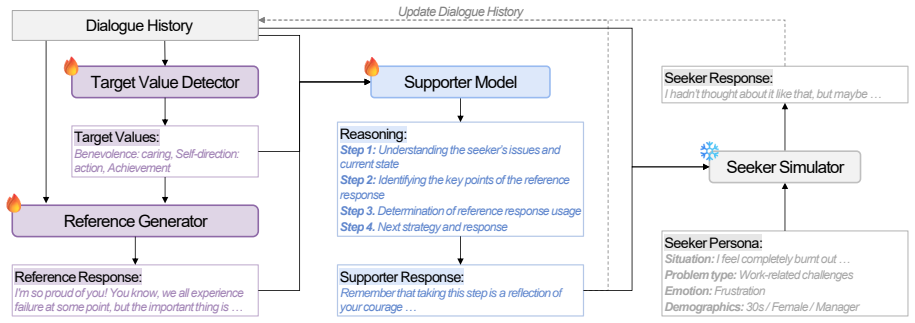
The central mechanism is the two-phase training pipeline with three components: (1) a target value detector that, given the dialogue history, predicts the top-3 human values (from the 20-value Schwartz-based taxonomy) that should be reinforced in the next seeker turn; (2) a reference generator that produces a supporter utterance conditioned on the dialogue history and target values; and (3) a supporter model that takes the dialogue history, target values, and reference response as inputs, reasons about whether to incorporate the reference, selects an emotional support strategy, and generates the response. The reward driving DPO training is $R(u_t) = \sum_{k=1}^{h} \gamma^{k-1} N_{t+k}$, the discounted frequency with which the target values appear in the seeker's subsequent utterances. The seeker simulator (GPT-4o-mini with generated personas) enables scalable simulation for training without human conversations.
What would settle it
A direct falsification would be to run the same training pipeline with the value detector replaced by a degraded or random value-labeling model (e.g., random top-3 values) and show that the supporter model's ES-Value win ratios and ES-Skills scores do not drop significantly, which would indicate the measured gains come from the reference responses or simulation procedure rather than value targeting. Additionally, a failure of the value detector on real support-seeker utterances—measured against a gold-standard therapist labeling of values in the Reddit dataset—with F1 below 0.4 would undermine the reward signal's validity.
Extended reading notes
Core claim
The central claim is that a dialogue system trained to reinforce a seeker's positive values—identified turn-by-turn by a target value detector and pursued with reference responses distilled from Reddit support threads—consistently outperforms baselines in emotional support quality (ES-Skills Overall 4.87 vs. 4.72 for GPT-4o-mini), lowers the seeker's negative emotional intensity (1.75 vs. 1.89), and wins pairwise value-reinforcement comparisons from both the seeker and supporter perspectives. The discovery is not a single analytical result but a demonstrated training methodology: value reinforcement can be operationalized as a reward signal, and optimizing for it yields better conversational support than optimizing for positive emotion alone. The paper also reports that value expressions are more frequent in the high-effectiveness group of the ESConv dataset, providing correlational motivation that value reinforcement tracks support effectiveness.
Load-bearing premise
The entire training signal and the main evaluation of value reinforcement depend on the accuracy of the value-detection classifier (F1 = 0.57 on the SemEval task): if that classifier cannot reliably identify human values in seekers' utterances, the rewards, target values, and success metrics derived from it are all unreliable.
Editorial extensions
If this is right
- If value reinforcement is a better training signal than emotion alone, future emotional support systems should incorporate values-based objectives alongside sentiment-based rewards.
- The Reddit-derived reference responses provide a reusable source of crowd knowledge for value-aligned support, reducing the need for expert-written examples.
- The generalizability experiment with the Cactus counseling dataset suggests the framework transfers to other dialogue corpora, widening its applicability.
- The therapist evaluation indicates the model's strengths lie in validating challenges and emphasizing positive aspects, which could inform targeted improvements in value-reinforcement techniques.
- The approach opens a concrete path for longitudinal evaluation: value reinforcement should be tested for sustained effects on well-being, which the current study does not measure.
Reading between the lines
- The authors' own analysis suggests that a purely emotion-based objective can be gamed by superficial positivity—their example shows a perfunctory 'thank you' scoring higher on sentiment than a genuine commitment to change—implying that value-based evaluation may be a more robust proxy for long-term support quality.
- One testable extension is whether the target value detector's predictions could be replaced or augmented by a seeker's explicit self-reported values, which might improve alignment in real-world deployment where detection error is high.
- The reward function could be extended to penalize value expression that is merely echoed rather than internalized, distinguishing conversation-level reinforcement from deeper acceptance.
- A neighboring problem this approach could inform is value-aligned negotiation or tutoring dialogues, where reinforcing a user's constructive values may improve long-term engagement and outcomes.
Editorial analysis
A structured set of objections, weighed in public.
Referee Report
Summary. The paper proposes ES-VR, a value-driven training framework for emotional support dialogue systems. It introduces a target value detector and a reference generator trained on Reddit data, then trains a supporter model with SFT and DPO using simulations with a GPT-4o-mini seeker simulator. The DPO reward is the discounted frequency with which target values appear in the seeker simulator's future utterances, as judged by a value classifier. Evaluation on simulated dialogues reports improvements in ES-Skills, lower ES-Intensity, and higher ES-Value win ratios relative to several baselines, with additional results on the Cactus dataset and a qualitative therapist review.
Significance. If the results hold, the paper would be the first to integrate human value reinforcement into emotional support dialogue training, and the framework is methodologically rich: it combines Reddit-derived supervision, a reference generator, and DPO with a look-ahead value-based reward. The authors also release code and data, which is a concrete strength. However, the central empirical claim depends on a single automated value classifier and on simulator-based evaluation; the evidence for genuine value elicitation from human seekers is currently indirect. The paper is significant as a proof-of-concept and a baseline for future work, but its headline claims need stronger validation before they can be taken as established.
major comments (4)
- [§4, §5.1, Eq. (3), §6.4.3] The value-reinforcement signal is circular. The same Schroter et al. (2023) classifier is used to label positive value expressions in Reddit (Section 4), to provide ground-truth target values for the detector in Eq. (1), to compute the training reward in Eq. (3), and to measure the target-value success rates in Table 4. The target value detector's own evaluation in Table 8 (F1=0.528) is against test labels produced by this same classifier, so it does not independently validate the measurement. Consequently, the abstract's claim of 'effectively exploring and eliciting values from seekers' may largely reflect the classifier's lexical biases rather than genuine value reinforcement. I ask the authors to provide an independent human-annotated evaluation of value expression in a held-out sample of simulator dialogues (and ideally of real seeker utterances), or to re-run the reward and success metric with a second, independently trained or manually validated value labeler.
- [§6.2, Table 14, Table 3, Appendix K] The quantitative evaluation is too weak to support fine-grained ranking. The ES-Intensity predictor has only 0.345 Spearman correlation with human ratings (Table 14), and the ES-Skills scores in Table 3 are near ceiling (most values 4.7-4.9 on a 5-point scale), so differences of 0.1 or less are of questionable practical significance. The GPT-4o-mini-based judges for ES-Skills and ES-Value show modest correlations with therapist ratings in Appendix K (0.198-0.778, several not significant). The paper should report the full score distributions, effect sizes, and confidence intervals for the key comparisons, and should temper claims that are based on these small absolute differences.
- [Abstract, §6.4.2, Table 3] The claim of 'consistently outperforming' baselines is overstated. In Table 3, Llama-Psych8k achieves a lower ES-Intensity (1.53 vs. 1.75 for ES-VR DPO) and a higher ES-Value supporter-perspective win ratio (0.62 vs. 0.5), while the Emotion-Reinforced DPO model is comparable to ES-VR DPO on most ES-Skills metrics and on ES-Intensity. The authors acknowledge some of these exceptions in §6.4.2, but the abstract and contribution bullets do not. The conclusions should be revised to state that value reinforcement performs competitively and often better than baselines, not uniformly better.
- [§5.4, §6.4, Figure 4] All headline evaluations are conducted with a GPT-4o-mini seeker simulator rather than human seekers. The human evaluation of the seeker simulator in Figure 4 measures naturalness, not whether the simulator's responses are representative of real help-seekers' values or emotional trajectories. The Target-value success rates in Table 4 are therefore computed on simulator outputs. To support the central claim about eliciting values from seekers, the paper needs at least a small-scale human study or a clear behavioral proxy (e.g., post-conversation value-elicitation statements from human participants), or the claims must be explicitly limited to simulated settings.
minor comments (4)
- [Appendix B, Table 11 caption] The caption reads 'performance of reference gesponse (RG)'; 'gesponse' should be 'response'.
- [§5.3] The statement that GPT avoids using reference responses in approximately 90% of cases is not quantified with respect to the simulation protocol; please specify how this percentage was measured and how the alternative-response procedure fully balances the training distribution.
- [Table 2 note] The note says 'ES-Value: The win-ratio of each model against GPT-4o-mini (Both)', but the table does not show a GPT-4o-mini (Both) row; please clarify the exact reference model used for these win ratios.
- [Appendix E.3] The phrase 'emotional distress is a universal human experience' is a rhetorical justification for evaluator competence; consider removing it or replacing it with a more concrete rationale for why non-expert evaluators can assess naturalness.
Circularity Check
Partial circularity: the Table 4 'success of target value reinforcement' metric is the same target-value occurrence count used as the DPO reward in Eq. (3), so that specific success claim reduces to the training signal; ES-Value, ES-Skills, and ES-Intensity retain independent content.
-
self definitional
[Section 4 (Reddit dataset) and Section 5.1, Eq. (1)]
"Values expressed in a positive comment by the OP can be considered successful target values at that time, while the preceding comment from a commenter can be regarded as an effective supporter utterance that promotes those values. ... The ground-truth values v_{t+1} are the top-3 values observed in o_{t+1}, based on their probabilities from the value detection model (Schroter et al., 2023)."
The construct of a 'successful target value' is defined as whatever the Schroter et al. value classifier tags in the OP's next positive reply. The target value detector (Eq. 1) is trained to reproduce those same classifier outputs, and later 'success of target value reinforcement' (Table 4) is measured by the same classifier. Thus 'value reinforcement success' is, by construction, agreement with one F1=0.57 classifier, not with an independent ground truth about seekers' values.
-
fitted input called prediction
[Section 5.3 DPO Stage, Eq. (3); Section 6.4.3; Appendix I]
"R(u_t^sup) = sum_{k=1}^h gamma^{k-1} N_{t+k} ... This reward is based on how many intended target values at that turn are expressed in the seeker's subsequent utterances. ... We engaged each model in conversations with a seeker simulator and analyzed the frequency of target values appearing in the seeker's subsequent responses. The success rate was assessed based on valid turns—the number of future turns within which the target values remained relevant."
Eq. (3) is the DPO training objective: a supporter response is preferred when the target values appear in the simulated seeker's later turns, as judged by the paper's value detection instrument. Appendix I and Table 4 then report 'success of target value reinforcement' as exactly this same quantity—the frequency of target values in the seeker simulator's subsequent responses within 1-3 valid turns. The model is optimized against this reward and then 'predicts' high scores on it, so Table 4 is a measurement of the training signal, not an independent evaluation of value elicitation.
full rationale
The paper is not wholly circular: ES-Skills, ES-Intensity, and the GPT-judged ES-Value pairwise comparisons are separate from the Schroter classifier and provide some independent support for the method. However, the most direct evidence for the central claim of value reinforcement—the success rates in Table 4—reduces to the DPO reward in Eq. (3) by construction. Target values are defined by the Schroter et al. classifier (Section 4 and Eq. 1), the DPO reward counts their appearance in later seeker utterances (Eq. 3), and the Section 6.4.3/Appendix I success metric counts the same appearances. The target value detector's own F1 score in Table 8 is also computed against labels from the same classifier, so it does not independently validate the measurement. The qualitative therapist evaluation in Section 6.4.5 is informative but is conducted by the two co-author therapists (footnote 3), so it does not break the closed loop. Because ES-Value and the skill/intensity metrics remain non-circular, this is partial circularity rather than a fully self-referential derivation.
Assumptions & free parameters
free parameters (5)
- Look-ahead horizon h =
3
- Discount factor gamma =
1
- Reward difference threshold Tdiff =
2
- Conversation termination emotion threshold =
0.6
- Number of target values per turn =
3
assumptions (5)
- domain assumption The value taxonomy of Kiesel et al. (2022) captures the human values relevant to emotional support.
- domain assumption The Schroter et al. (2023) SemEval 2023 Task 4 model correctly identifies human values expressed in support-dialogue utterances.
- domain assumption The GPT-4o-mini seeker simulator produces responses representative of real help-seekers.
- ad hoc to paper A higher frequency of classifier-detected target values in future seeker turns indicates effective value reinforcement.
- domain assumption Reddit r/offmychest comments preceding positive OP replies are effective supporter utterances for value promotion.
Cite this review
Pith. "Pith review of Dialogue Systems for Emotional Support via Value Reinforcement." pith.science (2026). https://pith.science/paper/4S7P44UZ
@misc{pith2026250117182,
  author       = {Pith},
  title        = {Pith review of: Dialogue Systems for Emotional Support via Value Reinforcement},
  year         = {2026},
  howpublished = {\url{https://pith.science/paper/4S7P44UZ}},
  note         = {Machine review of arXiv:2501.17182}
}
abstract
Emotional support dialogue systems aim to reduce help-seekers' distress and help them overcome challenges. While human values$\unicode{x2013}$core beliefs that shape an individual's priorities$\unicode{x2013}$are increasingly emphasized in contemporary psychological therapy for their role in fostering internal transformation and long-term emotional well-being, their integration into emotional support systems remains underexplored. To bridge this gap, we present a value-driven method for training emotional support dialogue systems designed to reinforce positive values in seekers. Notably, our model identifies which values to reinforce at each turn and how to do so, by leveraging online support conversations from Reddit. We evaluate the method across support skills, seekers' emotional intensity, and value reinforcement. Our method consistently outperforms various baselines, effectively exploring and eliciting values from seekers. Additionally, leveraging crowd knowledge from Reddit significantly enhances its effectiveness. Therapists highlighted its ability to validate seekers' challenges and emphasize positive aspects of their situations$\unicode{x2013}$both crucial elements of value reinforcement. Our work, being the first to integrate value reinforcement into emotional support systems, demonstrates its promise and establishes a foundation for future research.
Figures


Figures from the paper (1 more)

Reference graph
Works this paper leans on
-
[1]
Patient’s perspective: In which dialogue were positive human values more strongly explored and reinforced in the patient through the conversation?
-
[2]
The target values are those that are expected to be more frequently expressed by the patient
Target values: {Information on the target values} As a therapist supporting a patient with emotional difficulties, your goal is to reduce their dis- tress and guide them through challenges. The target values are those that are expected to be more frequently expressed by the patient. Generate the next turn of the utterance based on the dialogue history, ai...
-
[3]
Target values:{Information on the target values}
-
[4]
Identifying the human values behind argu- ments. In Proceedings of the 60th Annual Meeting of the Association for Computational Linguistics (Vol- ume 1: Long Papers), pages 4459–4471. Johannes Kiesel, Milad Alshomary, Nailia Mirzakhme- dova, Maximilian Heinrich, Nicolas Handke, Hen- ning Wachsmuth, and Benno Stein. 2023. SemEval- 2023 task 4: ValueEval: I...
arXiv 2023
-
[6]
Adam-smith at SemEval-2023 task 4: Dis- covering human values in arguments with ensembles of transformer-based models. In Proceedings of the 17th International Workshop on Semantic Evaluation (SemEval-2023), pages 532–541, Toronto, Canada. Association for Computational Linguistics. Shalom H Schwartz, Jan Cieciuch, Michele Vecchione, Eldad Davidov, Ronald ...
work page 2023
-
[7]
Self-direction: action, Benevo- lence: caring, Security: personal
Ask an expert: Leveraging language models to improve strategic reasoning in goal-oriented dialogue models. In Findings of the Association for Compu- tational Linguistics: ACL 2023 , pages 6665–6694, Toronto, Canada. Association for Computational Lin- guistics. Tenggan Zhang, Xinjie Zhang, Jinming Zhao, Li Zhou, and Qin Jin. 2024. ESCoT: Towards interpreta...
work page 2024
-
[9]
Dialogue history:{Dialogue history}
-
[11]
The target values are those that are expected to be more frequently expressed by the patient
Reference response:{Reference response} As a therapist supporting a patient with emotional difficulties, your goal is to reduce their distress and guide them through challenges. The target values are those that are expected to be more frequently expressed by the patient. You need to generate the therapist’s next utterance based on the dialogue history, ai...
Show all 20 references
-
[12]
Generate a minimum of 10 and a maximum of 30 diverse and non-overlapping situations
Supported value:{Human value} - Definition:{Definition of the human value} - Contained values:{Contained value 1}, {Contained value 2}, {Contained value 3} Define specific situations that individuals who prioritize the given human value (item 2) might face related to the prese...
-
[13]
The individual’s concerns or actions are entirely unrelated to the principles of this value
Supported value:{Human value} - Definition:{Definition of the human value} - Contained values:{Contained value 1}, {Contained value 2}, {Contained value 3} Rate the alignment of each situation with the given value on a scale of 1-5, using the criteria below to guide your asses...
-
[14]
Dialogue A:{Dialogue A}
-
[15]
After reading both conversations, evaluate them based on the criteria below
Dialogue B:{Dialogue B} The definitions and associated values of 20 human values are provided, along with two emo- tional support conversations (Dialogue A and Dialogue B) between a therapist and a patient struggling with emotional difficulties. After reading both conversation...
-
[17]
Therapist’s perspective: In which dialogue did the therapist more effectively help the patient in exploring and reinforcing positive human values? Template:
-
[18]
Reasoning: (Reasoning for the evaluation of all criteria)
-
[19]
Patient’s perspective: Dialogue A, Dialogue B, or Tie
-
[20]
System Given a conversation between a Therapist and a Patient, please assess whether the Patient’ emotional issue has been solved after the conversation
Therapist’s perspective: Dialogue A, Dialogue B or Tie Table 36: Prompts for evaluating the effectiveness of value reinforcement (ES-Value). System Given a conversation between a Therapist and a Patient, please assess whether the Patient’ emotional issue has been solved after ...
2022
-
[2008]
Public opinion quarterly, 72(3):420–445
Bringing values back in: The adequacy of the european social survey to measure values in 20 countries. Public opinion quarterly, 72(3):420–445. Yang Deng, Wenxuan Zhang, Wai Lam, See-Kiong Ng, and Tat-Seng Chua. 2024. Plug-and-play policy planner for large language model power...
2024 arXiv
-
[2018]
Advances in social sciences re- search journal, 5(1)
Emotional support and its relationship to emo- tional intelligence. Advances in social sciences re- search journal, 5(1). John T Blackledge and Steven C Hayes. 2001. Emotion regulation in acceptance and commitment therapy. Journal of clinical psychology, 57(2):243–255. Duane B...
2001 arXiv
-
[2022]
In Proceedings of the 2022 Conference on Empiri- cal Methods in Natural Language Processing, pages 3014–3026, Abu Dhabi, United Arab Emirates
Improving multi-turn emotional support dia- logue generation with lookahead strategy planning. In Proceedings of the 2022 Conference on Empiri- cal Methods in Natural Language Processing, pages 3014–3026, Abu Dhabi, United Arab Emirates. As- sociation for Computational Linguis...
2022
-
[2023]
In Advances in Neural Information Processing Systems, volume 36, pages 53728–53741
Direct preference optimization: Your language model is secretly a reward model. In Advances in Neural Information Processing Systems, volume 36, pages 53728–53741. Curran Associates, Inc. Hannah Rashkin, Eric Michael Smith, Margaret Li, and Y-Lan Boureau. 2019. Towards empathe...
2019
Reviewed August 10, 2026 · model on record in the stance chip above.
Discussion (0). Continue with ORCID to comment.