REVIEW 4 major objections 6 minor 45 references
Exploring Audio Editing Features as User-Centric Privacy Defenses Against Large Language Model(LLM) Based Emotion Inference Attacks
T0 review · 4 major / 6 minor · reviewed 2026-08-09 · deepseek-v4-flash
Pith's one-line read Pitch and tempo edits to a voice recording make the evaluated emotion-inference models—GPT-4o and a purpose-built 1D CNN—consistently misclassify the speaker's emotion, offering a familiar, user-friendly privacy defense.
desk verdict Pitch/tempo editing as a usable privacy defense is a genuinely new idea, but the evaluation lacks baselines and aggregates, so the central claim isn't supported. read the letter →
The pith
A machine-rendered reading of the paper's core claim, the machinery that carries it, and where it could break.
The reading
What carries the argument
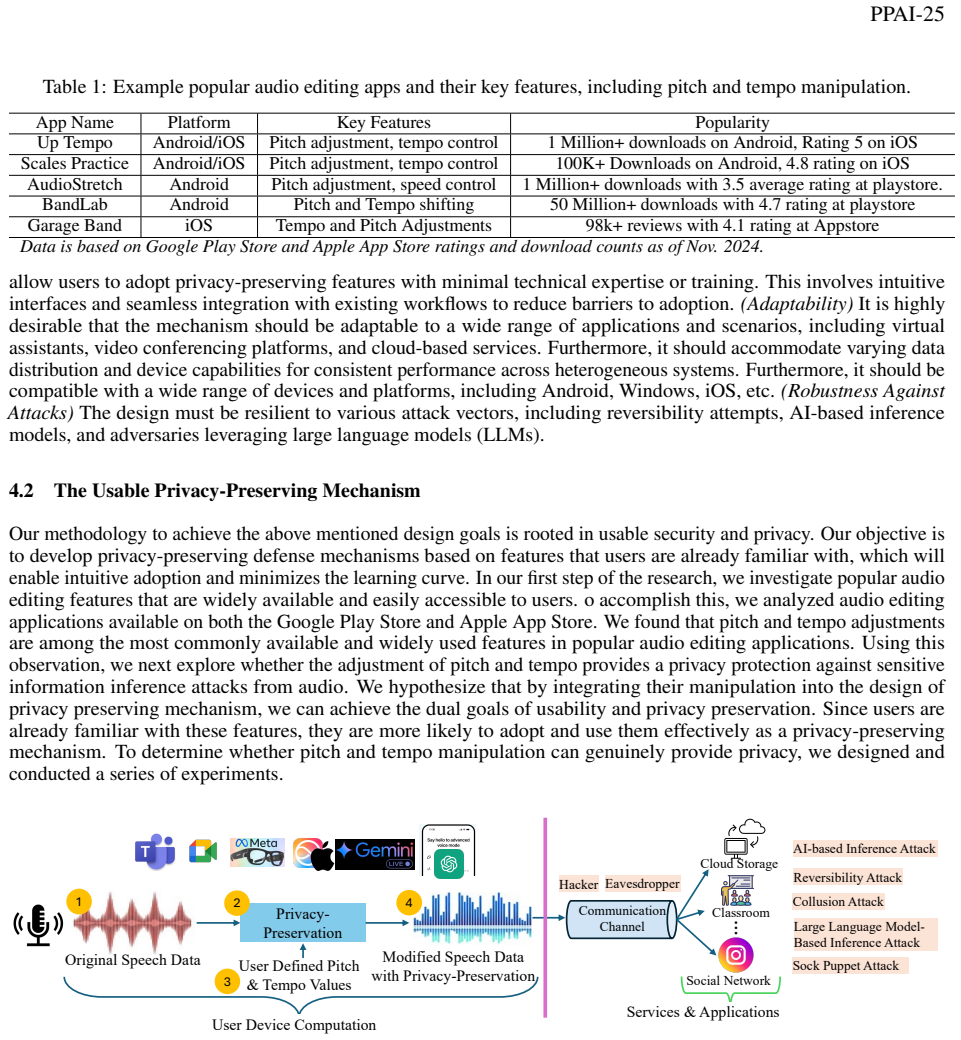
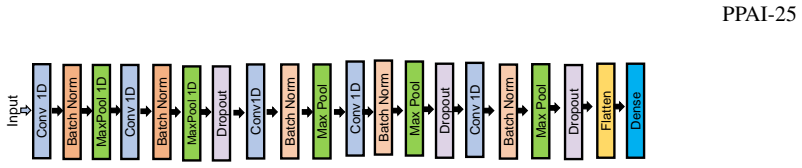
The mechanism is the prosodic transformation produced by pitch and tempo manipulation: changing fundamental frequency and speaking rate alters the acoustic cues that speech emotion recognition models rely on, shifting the predicted emotion category. The paper uses these edits as a privacy transformation applied before audio is transmitted to any service, with the user choosing the settings in a familiar audio-editing app. The evaluation apparatus consists of a custom 1D CNN trained on the three datasets, GPT-4o as a multimodal LLM attacker, and two protocols: random pitch/tempo values and a structured grid of pitch values (0, +4, -4, +8, and -8) crossed with tempo values (60, 80, 100, 120, and 140) for systematic analysis.
What would settle it
Re-run the paper's experiments with an unmodified-audio baseline and a larger number of speakers from the same datasets; if the 1D CNN and GPT-4o already misclassify the originals at the same rate as the modified clips, the apparent privacy protection is just baseline inaccuracy. Alternatively, train an attacker on pitch/tempo-modified clips paired with original labels; if it recovers the true emotions at high accuracy, the defense is not robust to adaptation.
Extended reading notes
Core claim
The central claim, on the paper's own terms, is that pitch and tempo manipulation effectively obfuscates emotional data in speech, so that an adversary with access to a lightweight 1D CNN or to GPT-4o cannot infer the original emotion from the modified recording. Across RAVDESS, CREMA-D, and TESS, the paper reports that both randomized and systematically varied pitch/tempo combinations shift the predicted emotion away from the ground truth, and that female actors from different datasets show similar shift patterns, such as anger and disgust moving toward fear at high pitch and high tempo. The paper frames this as a demonstration that intuitive, widely available audio-editing features can serve as a user-centric privacy defense, with design goals of lightweight on-device implementation, usability, adaptability, and robustness. It does not yet test the reversibility of the modifications, which its own threat model names as an attack vector.
Load-bearing premise
The claim breaks if the two tested models, evaluated on only a handful of actors without a baseline on unchanged audio, are not a fair stand-in for real emotion-inference adversaries; the paper's own Section 6 also leaves the reversibility attack untested.
Editorial extensions
If this is right
- A user can apply a few slider adjustments to their own voice recording before sharing it, reducing the risk that an emotion-inference system extracts affective state without consent.
- The defense requires no training on the user side, only an audio-editing capability already present in common apps, so it can plausibly run on smartphones, smart glasses, and other constrained devices.
- The structured results give a rough mapping from pitch/tempo settings to emotion shifts, which users or app designers could use to push sensitive emotions into unrelated categories.
- Because the manipulation happens on the user's device before data reaches a service, the defense is platform-agnostic and does not depend on the assistant or conferencing provider changing its behavior.
Reading between the lines
- An adaptive adversary who knows the defense could retrain the same 1D CNN or fine-tune an LLM on pitch/tempo-modified audio paired with the original labels; the paper does not test this, so its long-term robustness is unknown.
- The paper's own Section 6 defers reversibility testing; if simple signal processing can undo pitch and tempo shifts, the protection may amount to security by obscurity rather than a hard guarantee.
- The consistent emotion-shift patterns observed for female actors across datasets hint that the transformation is predictable, and that predictability could let an attacker invert the mapping to guess the original emotion.
- The approach could be combined with other lightweight transforms, such as formant shifting or time stretching, to make reversal harder, but that combination is not evaluated here.
Editorial analysis
A structured set of objections, weighed in public.
Referee Report
Summary. The paper proposes using pitch and tempo manipulation, which are common features in consumer audio editing apps, as a user-centric privacy defense against emotion inference attacks from speech. It describes a threat model that includes DNN-based and LLM-based adversaries, trains a 1D-CNN, and evaluates the defense using that CNN and GPT-4o on three datasets (RAVDESS, CREMA-D, TESS). The central claim, stated in the abstract and Section 6, is that modifying pitch and tempo causes the evaluated attack models to consistently fail to infer emotions, thereby protecting users' emotional privacy. The paper also sketches design principles for lightweight on-device implementation.
Significance. The core idea is novel and practically motivated: leveraging familiar audio editing features could make privacy protection more accessible than prior ML-heavy obfuscation methods. However, the current evidence does not support the central claim. The evaluation lacks a baseline on unmodified audio, is limited to a handful of hand-selected examples, and the abstract advertises reversibility testing that is deferred to future work. If the missing baseline experiments were added and the claims were scaled back to a preliminary feasibility study, the paper could be a useful starting point; in its present form, the conclusions outrun the data.
major comments (4)
- [§5.1 / §6] The paper never reports the attack models' accuracy on unmodified audio, so the conclusion in Section 6 that 'the evaluated attack models consistently failed to accurately infer emotions from the modified data' is unsupported. Without a baseline, we cannot determine whether pitch/tempo modification reduces inference accuracy at all, and the paper's own tables contain rows where both models predict the original emotion (e.g., Table 3, first row, original Neutral; Table 7, rows for Happy at pitch 0.0, tempo 132 and pitch 8.5, tempo 100). The claim of consistent failure is therefore contradicted by the presented data.
- [Abstract / §6] The abstract and Section 1 state that the threat model includes 'reversibility testing' and the abstract says this was rigorously evaluated, but Section 6 lists reversibility as future work ('We will also investigate the reversibility of pitch and tempo modifications') and no reversibility experiment appears in Section 5. The advertised evaluation is absent.
- [§5.1] The randomized evaluation selects one male and one female actor per dataset (TESS has only female actors) and presents only hand-selected rows in Tables 3–7, with no description of how rows were chosen, no aggregate accuracy over all modified files, no error bars, and no statistical tests. These tables cannot support the generalizability claims in Section 6 or the demographic-bias analysis promised in the Introduction.
- [§5.1] The observation that female actors 'exhibit notable commonalities in how their emotions are affected' is based on two female actors from different datasets and is not quantified; it is an anecdotal pattern, not a finding, and the specific claim that increasing tempo while keeping pitch constant changes neutral to disgust is not supported by a consistent pattern in the tables.
minor comments (6)
- [Abstract] The phrase 'and and reversibility testing' contains a duplicated 'and'.
- [§4.3] The sentence 'trained it using the RAVDESS, CREMA-D and three prominent dataset' should likely read 'these three prominent datasets'; the wording is confusing and the number of datasets is inconsistent with the experiments.
- [§5.1] The typo 'REVDESS' should be 'RAVDESS'.
- [Tables 3–7] The units for pitch and tempo are not specified; values such as -9.4 and 72 should be labeled (e.g., semitones, BPM) so the reader can interpret the manipulation settings.
- [Table 8] The row '0 -8' and the phrase 'Neutral tempo (0 BPM)' are confusing, since a tempo of 0 BPM is not meaningful; please clarify what value 0 represents.
- [§4.3] No train/validation/test split, input features, or hyperparameters are reported for the 1D-CNN, so the claimed 97% test accuracy cannot be reproduced or assessed.
Circularity Check
No significant circularity: the defense claim is empirical and not reduced to its inputs; limitations are correctness concerns, not circularity.
full rationale
The paper's central claim is empirical: pitch and tempo modifications make the evaluated 1-D CNN and GPT-4o fail to infer the original emotion labels. It is not a derivation in which an output quantity is defined in terms of an input quantity. No parameter is fitted to a subset of the data and then renamed as a prediction: the 1-D CNN is trained on unmodified benchmark audio and later evaluated on modified audio, while GPT-4o is used as a pre-trained model, so the observed failures are not forced by construction. The only co-authored citation, reference [9] by Shahid and Imteaj, supports background motivation about attribute inference in video-conferencing settings; it is not load-bearing for the pitch/tempo privacy claim. The paper does not invoke a uniqueness theorem from the same authors, and no known result is merely renamed. Weaknesses such as the absence of baseline accuracy on unmodified audio, the hand-selected table rows, the lack of aggregate statistics, and the deferred reversibility testing are threats to the validity or strength of the empirical conclusion, but they are not circularity: the claim is not defined in terms of the attack model's outputs, nor is the success metric a renamed training objective. No specific circular step can be quoted from the paper, so the appropriate finding is no significant circularity.
Assumptions & free parameters
free parameters (1)
- Pitch/tempo manipulation grid =
pitch: -8, -4, 0, 4, 8; tempo: 60, 80, 100, 120, 140 (random values also used)
assumptions (5)
- domain assumption Emotion inference from audio is a meaningful privacy threat in the target systems.
- domain assumption Pitch and tempo changes alter perceived or prosodic emotion sufficiently to shift classifier outputs.
- domain assumption GPT-4o can analyze audio files and infer emotion as an adversary.
- ad hoc to paper The selected actors (one male, one female per dataset) are representative enough to generalize across populations.
- ad hoc to paper Modified audio remains usable for downstream tasks.
Cite this review
Pith. "Pith review of Exploring Audio Editing Features as User-Centric Privacy Defenses Against Large Language Model(LLM) Based Emotion Inference Attacks." pith.science (2026). https://pith.science/paper/2G5OMJDZ
@misc{pith2026250118727,
  author       = {Pith},
  title        = {Pith review of: Exploring Audio Editing Features as User-Centric Privacy Defenses Against Large Language Model(LLM) Based Emotion Inference Attacks},
  year         = {2026},
  howpublished = {\url{https://pith.science/paper/2G5OMJDZ}},
  note         = {Machine review of arXiv:2501.18727}
}
read the original abstract
The rapid proliferation of speech-enabled technologies, including virtual assistants, video conferencing platforms, and wearable devices, has raised significant privacy concerns, particularly regarding the inference of sensitive emotional information from audio data. Existing privacy-preserving methods often compromise usability and security, limiting their adoption in practical scenarios. This paper introduces a novel, user-centric approach that leverages familiar audio editing techniques, specifically pitch and tempo manipulation, to protect emotional privacy without sacrificing usability. By analyzing popular audio editing applications on Android and iOS platforms, we identified these features as both widely available and usable. We rigorously evaluated their effectiveness against a threat model, considering adversarial attacks from diverse sources, including Deep Neural Networks (DNNs), Large Language Models (LLMs), and and reversibility testing. Our experiments, conducted on three distinct datasets, demonstrate that pitch and tempo manipulation effectively obfuscates emotional data. Additionally, we explore the design principles for lightweight, on-device implementation to ensure broad applicability across various devices and platforms.
Figures

Reference graph
Works this paper leans on
-
[1]
Chia-Wei Li, Tzu-Han Cheng, and Chen-Gia Tsai. Music enhances activity in the hypothalamus, brainstem, and anterior cerebellum during script-driven imagery of affective scenes. Neuropsychologia, 133:107073, 2019. 9 The 6th AAAI Workshop on Privacy-Preserving Artificial Intelligence PPAI-25
work page 2019
-
[2]
Alexa, siri, cortana, and more: an introduction to voice assistants
Matthew B Hoy. Alexa, siri, cortana, and more: an introduction to voice assistants. Medical reference services quarterly, 37(1):81–88, 2018
work page 2018
-
[3]
3-d sound for virtual reality and multimedia
Durand R Begault and Leonard J Trejo. 3-d sound for virtual reality and multimedia. Technical report, 2000
2000
-
[4]
Audio-visual perception of omnidirectional video for virtual reality applications
Fang-Yi Chao, Cagri Ozcinar, Chen Wang, Emin Zerman, Lu Zhang, Wassim Hamidouche, Olivier Deforges, and Aljosa Smolic. Audio-visual perception of omnidirectional video for virtual reality applications. In 2020 IEEE International Conference on Multimedia & Expo Workshops (ICMEW), pages 1–6, 2020
work page 2020
-
[5]
New challenges for content privacy in speech and audio
Jennifer Williams, Karla Pizzi, Shuvayanti Das, and Paul-Gauthier Noé. New challenges for content privacy in speech and audio. arXiv preprint arXiv:2301.08925, 2023
arXiv 2023
-
[6]
Privacy risks in speech emotion recognition: A systematic study on gender inference attack
Basmah Alsenani, Tanaya Guha, and Alessandro Vinciarelli. Privacy risks in speech emotion recognition: A systematic study on gender inference attack. 2023
work page 2023
-
[7]
Attribute Inference Attack of Speech Emotion Recognition in Federated Learning Settings
Tiantian Feng, Hanieh Hashemi, Rajat Hebbar, Murali Annavaram, and Shrikanth S Narayanan. Attribute inference attack of speech emotion recognition in federated learning settings. arXiv preprint arXiv:2112.13416, 2021
work page Pith review arXiv 2021
-
[8]
Zooming into video conferencing privacy
Dima Kagan, Galit Fuhrmann Alpert, and Michael Fire. Zooming into video conferencing privacy. IEEE Transactions on Computational Social Systems, 11(1):933–944, 2024
work page 2024
Show all 45 references
-
[9]
Shahid and Ahmed Imteaj
Abdur R. Shahid and Ahmed Imteaj. Securing User Privacy in Cloud-Based Whiteboard Services Against Health Attribute Inference Attacks . IEEE Transactions on Artificial Intelligence, 5(08):3872–3885, August 2024
2024
-
[10]
Sok: Data privacy in virtual reality
Gonzalo Munilla Garrido, Vivek Nair, and Dawn Song. Sok: Data privacy in virtual reality. Proceedings on Privacy Enhancing Technologies, 2024(1):21–40, January 2024
2024
-
[11]
Privacy preservation in artificial intelligence and extended reality (ai-xr) metaverses: A survey, 2023
Mahdi Alkaeed, Adnan Qayyum, and Junaid Qadir. Privacy preservation in artificial intelligence and extended reality (ai-xr) metaverses: A survey, 2023
2023
-
[12]
Privacy of the metaverse: Current issues, ai attacks, and possible solutions
Chamara Sandeepa, Shen Wang, and Madhusanka Liyanage. Privacy of the metaverse: Current issues, ai attacks, and possible solutions. In 2023 IEEE International Conference on Metaverse Computing, Networking and Applications (MetaCom), pages 234–241, 2023
2023
-
[13]
Gradient-level differential privacy against attribute inference attack for speech emotion recognition
Haijiao Chen, Huan Zhao, and Zixing Zhang. Gradient-level differential privacy against attribute inference attack for speech emotion recognition. IEEE Signal Processing Letters, 31:3124–3128, 2024
2024
-
[14]
Privacy-preserving voice analysis via disentangled representa- tions
Ranya Aloufi, Hamed Haddadi, and David Boyle. Privacy-preserving voice analysis via disentangled representa- tions. In Proceedings of the 2020 ACM SIGSAC Conference on Cloud Computing Security Workshop, CCSW’20, page 1–14, New York, NY , USA, 2020. Association for Computing Machinery
2020
-
[15]
An opt-in framework for privacy protection in audio-based applications
Wei-Cheng Wang, Sander De Coninck, Sam Leroux, and Pieter Simoens. An opt-in framework for privacy protection in audio-based applications. IEEE Pervasive Computing, 21(4):17–24, 2022
2022
-
[16]
Privacy against real-time speech emotion detection via acoustic adversarial evasion of machine learning
Brian Testa, Yi Xiao, Harshit Sharma, Avery Gump, and Asif Salekin. Privacy against real-time speech emotion detection via acoustic adversarial evasion of machine learning. Proc. ACM Interact. Mob. Wearable Ubiquitous Technol., 7(3), September 2023
2023
-
[17]
Apple intelligence
Apple Inc. Apple intelligence. https://www.apple.com/apple-intelligence/, 2024. Accessed: 2024-11- 28
2024
-
[18]
Google play store
Google. Google play store. https://play.google.com/, 2024. Accessed: 2024-11-28
2024
-
[19]
Apple app store
Apple Inc. Apple app store. https://www.apple.com/app-store/, 2024. Accessed: 2024-11-28
2024
-
[20]
Android official website
Google. Android official website. https://www.android.com/, 2024. Accessed: 2024-11-28
2024
-
[21]
ios 18 features
Apple Inc. ios 18 features. https://www.apple.com/ios/ios-18/, 2024. Accessed: 2024-11-28
2024
-
[22]
User-level differential privacy against attribute inference attack of speech emotion recognition in federated learning
Tiantian Feng, Raghuveer Peri, and Shrikanth Narayanan. User-level differential privacy against attribute inference attack of speech emotion recognition in federated learning. arXiv preprint arXiv:2204.02500, 2022
2022 arXiv
-
[23]
Privacy-enhanced federated learning against attribute inference attack for speech emotion recognition
Huan Zhao, Haijiao Chen, Yufeng Xiao, and Zixing Zhang. Privacy-enhanced federated learning against attribute inference attack for speech emotion recognition. In ICASSP 2023-2023 IEEE International Conference on Acoustics, Speech and Signal Processing (ICASSP), pages 1–5. IEEE, 2023
2023
-
[24]
Effects of pitch and musical sounds on body-representations when moving with sound
Judith Ley-Flores, Eslam Alshami, Aneesha Singh, Frédéric Bevilacqua, Nadia Bianchi-Berthouze, Ophelia Deroy, and Ana Tajadura-Jiménez. Effects of pitch and musical sounds on body-representations when moving with sound. Scientific reports, 12(1):2676, 2022
2022
-
[25]
Influence of tempo and rhythmic unit in musical emotion regulation
Alicia Fernández-Sotos, Antonio Fernández-Caballero, and José M Latorre. Influence of tempo and rhythmic unit in musical emotion regulation. Frontiers in computational neuroscience, 10:80, 2016. 10 The 6th AAAI Workshop on Privacy-Preserving Artificial Intelligence PPAI-25
2016
-
[26]
{SMACK}: Semantically meaningful adversarial audio attack
Zhiyuan Yu, Yuanhaur Chang, Ning Zhang, and Chaowei Xiao. {SMACK}: Semantically meaningful adversarial audio attack. In 32nd USENIX Security Symposium (USENIX Security 23), pages 3799–3816, 2023
2023
-
[27]
A cross-domain exploration of audio and textual data for multi-modal emotion detection
Mohd Ariful Haque, Roy George, Rakib Hossain Rifat, Md Shihab Uddin, Marufa Kamal, and Kishor Datta Gupta. A cross-domain exploration of audio and textual data for multi-modal emotion detection. In Proceedings of the 17th International Conference on PErvasive Technologies Rela...
2024
-
[28]
Theresa Goetz, Pulkit Arora, F. X. Erick, Nina Holzer, and Shrutika Sawant. Self-supervised representation learning using multimodal transformer for emotion recognition. In Proceedings of the 8th International Workshop on Sensor-Based Activity Recognition and Artificial Intell...
2023
-
[29]
Speech emotion recognition based on 1d cnn and mfcc
Gaoyun Li, Yong Liu, and Xiong Wang. Speech emotion recognition based on 1d cnn and mfcc. In2023 IEEE 5th International Conference on Civil Aviation Safety and Information Technology (ICCASIT), pages 956–960, 2023
2023
-
[30]
Emotion recognition in audio and video using deep neural networks
Mandeep Singh and Yuan Fang. Emotion recognition in audio and video using deep neural networks. arXiv preprint arXiv:2006.08129, 2020
2006 arXiv
-
[31]
Beyond silent letters: Amplifying llms in emotion recognition with vocal nuances
Zehui Wu, Ziwei Gong, Lin Ai, Pengyuan Shi, Kaan Donbekci, and Julia Hirschberg. Beyond silent letters: Amplifying llms in emotion recognition with vocal nuances. arXiv preprint arXiv:2407.21315, 2024
2024 arXiv
-
[32]
Secap: Speech emotion captioning with large language model
Yaoxun Xu, Hangting Chen, Jianwei Yu, Qiaochu Huang, Zhiyong Wu, Shi-Xiong Zhang, Guangzhi Li, Yi Luo, and Rongzhi Gu. Secap: Speech emotion captioning with large language model. In Proceedings of the AAAI Conference on Artificial Intelligence, volume 38, pages 19323–19331, 2024
2024
-
[33]
Alexa official website
Amazon. Alexa official website. https://www.alexa.com/, 2024. Accessed: 2024-11-28
2024
-
[34]
Siri by apple
Apple Inc. Siri by apple. https://www.apple.com/siri/, 2024. Accessed: 2024-11-28
2024
-
[35]
Google assistant official website
Google. Google assistant official website. https://assistant.google.com/, 2024. Accessed: 2024-11-28
2024
-
[36]
Chatgpt official website
OpenAI. Chatgpt official website. https://chatgpt.com/, 2024. Accessed: 2024-11-28
2024
-
[37]
Gemini by google
Google. Gemini by google. https://gemini.google.com/, 2024. Accessed: 2024-11-28
2024
-
[38]
Google meet
Google. Google meet. https://meet.google.com/, 2024. Accessed: 2024-11-28
2024
-
[39]
Zoom video communications
Zoom Video Communications, Inc. Zoom video communications. https://www.zoom.com/, 2024. Accessed: 2024-11-28
2024
-
[40]
Meta smart glasses
Meta Platforms, Inc. Meta smart glasses. https://www.meta.com/smart-glasses/, 2024. Accessed: 2024- 11-28
2024
-
[41]
The ryerson audio-visual database of emotional speech and song (ravdess): A dynamic, multimodal set of facial and vocal expressions in north american english
Steven R Livingstone and Frank A Russo. The ryerson audio-visual database of emotional speech and song (ravdess): A dynamic, multimodal set of facial and vocal expressions in north american english. PloS one, 13(5):e0196391, 2018
2018
-
[42]
Cooper, Michael K
Houwei Cao, David G. Cooper, Michael K. Keutmann, Ruben C. Gur, Ani Nenkova, and Ragini Verma. Crema-d: Crowd-sourced emotional multimodal actors dataset. IEEE Transactions on Affective Computing, 5(4):377–390, 2014
2014
-
[43]
Kathleen Pichora-Fuller and Kate Dupuis
M. Kathleen Pichora-Fuller and Kate Dupuis. Toronto emotional speech set (TESS), 2020
2020
-
[44]
emotion2vec: Self-supervised pre-training for speech emotion representation, 2023
Ziyang Ma, Zhisheng Zheng, Jiaxin Ye, Jinchao Li, Zhifu Gao, Shiliang Zhang, and Xie Chen. emotion2vec: Self-supervised pre-training for speech emotion representation, 2023
2023
-
[45]
wav2vec 2.0: A framework for self-supervised learning of speech representations, 2020
Alexei Baevski, Henry Zhou, Abdelrahman Mohamed, and Michael Auli. wav2vec 2.0: A framework for self-supervised learning of speech representations, 2020. 11 The 6th AAAI Workshop on Privacy-Preserving Artificial Intelligence
2020
Reviewed August 9, 2026 · model on record in the stance chip above.
Discussion (0). Continue with ORCID to comment.