REVIEW 3 major objections 5 minor 38 references
Optimizing Bidding Curves for Renewable Energy in Two-Settlement Electricity Markets
T0 review · 3 major / 5 minor · reviewed 2026-08-09 · deepseek-v4-flash
Pith's one-line read A single zero-price bid segment can match any complex renewable bidding curve.
desk verdict Clean theorem, plausible case study, but the 36% headline needs a check on how S_BiD was actually computed. read the letter →
The pith
A machine-rendered reading of the paper's core claim, the machinery that carries it, and where it could break.
The reading
What carries the argument
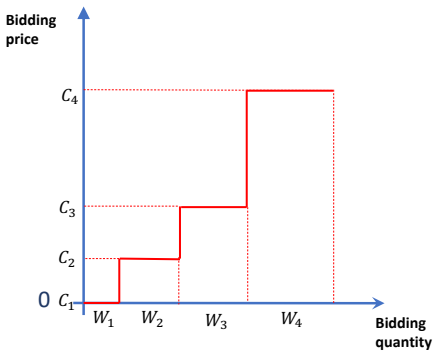
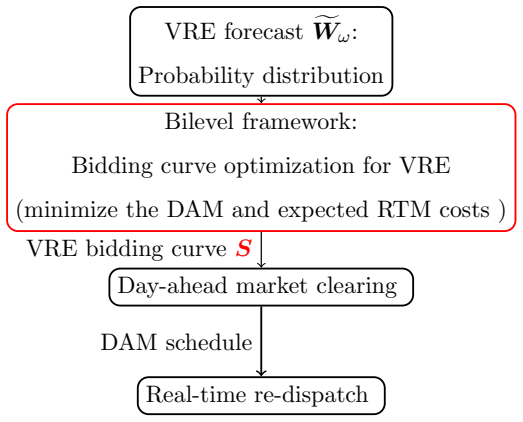
The central object is the bilevel program Problem BiD: the upper level picks VRE bidding prices and quantities, the lower level is the day-ahead LP market clearing, and the objective adds the expected real-time redispatch cost. The argument runs through Theorem 1's construction, which collapses any optimal multi-segment curve to a single zero-price segment whose quantity is the day-ahead VRE dispatch. Computationally, the paper replaces the lower-level KKT complementarity conditions by strong duality and linearizes the resulting bilinear terms with McCormick envelopes, a relaxation that replaces bilinear products by linear inequalities, yielding an LP relaxation that scales to the 1576-bus NYISO test system.
What would settle it
Run the bilevel comparison on a small network where unit commitment is enforced as binary on/off, such as a 6-bus system with one wind farm and three thermal units; if the best multi-segment non-zero-price bidding curve achieves a strictly lower expected system cost than the best single-segment zero-price curve, Theorem 1 is false.
Extended reading notes
Core claim
The paper states and proves Theorem 1: the general bilevel bidding-curve problem (BiD), which jointly optimizes prices and quantities of multi-segment day-ahead VRE bids, and the quantity-only problem (BiD-q), which uses a single segment at price zero, achieve the same expected system cost. The proof shows that from any optimal multi-segment solution, one can set the single-segment quantity equal to the total VRE quantity dispatched in the day-ahead market; the resulting day-ahead schedule remains optimal for the zero-price problem and yields the same real-time feasible set, hence the same expected cost. A corollary extends this to multi-segment curves as long as one segment is priced at zero. In the numerical case, the optimized bid produces an hourly system cost of $275k versus $430k for the myopic expected-forecast bid and $263k for stochastic dispatch.
Load-bearing premise
The proof and the solution method need both market-clearing problems to be convex linear programs, which the paper forces by relaxing binary unit-commitment decisions to continuous values; real day-ahead markets with discrete unit commitment are outside the guarantee.
Editorial extensions
If this is right
- System operators can replace complex VRE price bids with a single zero-price quantity benchmark for each producer and hour without losing expected-cost optimality.
- Multi-segment bids remain usable in practice: as long as one segment carries a zero price, the bilevel framework can set segment quantities to approximate the optimum.
- On the NYISO 1576-bus system, the framework achieves a 36% hourly cost reduction over myopic expected-forecast bids, approaching the stochastic-dispatch ideal.
- The strong-duality and McCormick-envelope LP relaxation is what makes the approach scale to realistic systems, unlike Big-M KKT reformulations tested only on small cases.
- The framework can serve as a centralized benchmark to guide or regulate VRE bidding, for example through risk scores.
Reading between the lines
- Because the proof requires the day-ahead clearing to be an LP, applying the same benchmark in a market with binary unit commitment could create a gap between the single-segment zero-price bid and the true optimal multi-segment bid; a dedicated counterexample search on a small mixed-integer system would reveal how large that gap can be.
- The theorem suggests a simple coordination instrument: publish only optimal VRE quantities at zero price, which would preserve system cost but change revenue distribution, so fairness and cost-recovery questions would need separate treatment.
- The same bilevel machinery could be extended to storage or demand response by adding intertemporal constraints; the theorem would likely fail there because storage has opportunity costs, so multi-segment price signals may regain a role.
- One testable prediction is that in systems with high VRE penetration and little fast-ramping capacity, the cost gap between myopic forecast bids and optimized quantity benchmarks should grow as forecast error and ramping scarcity increase.
Signed reviews
Editorial analysis
A structured set of objections, weighed in public.
Referee Report
Summary. The paper proposes a bilevel optimization framework for designing day-ahead bidding curves for variable renewable energy (VRE) in a two-settlement electricity market. The upper level chooses VRE bidding prices and quantities; the lower level is the day-ahead market-clearing linear program; the objective is the true day-ahead cost plus the expected real-time redispatch cost. The central theoretical result (Theorem 1) states that, when VRE marginal cost is zero, a single-segment zero-price bid with an optimized quantity (Problem BiD-q) attains the same expected system cost as the general multi-price multi-segment problem. Numerical experiments on a 1576-bus NYISO model with relaxed unit commitment report S_MyD = $430k, S_BiD = $275k, and S_StD = $263k, corresponding to a 36% hourly system-cost reduction relative to myopic forecast bidding.
Significance. The constructive proof of Theorem 1 in Appendix A is a genuine structural insight: it does not assume its conclusion, it does not rely on KKT or strong duality, and it is coherent within the stated convex LP market model. If the numerical results were verified as achievable costs, the paper would offer a practical, scalable benchmark for VRE bidding in sequential deterministic markets and a clear comparison with the stochastic-dispatch ideal. The main caveats are that the reported S_BiD comes from a McCormick-envelope relaxation whose gap is not reported, and that all numerical claims depend on the relaxation of binary unit commitment. These caveats are load-bearing for the 36% headline, so the significance is conditional until the gap is quantified or the optimized curves are evaluated in the original market-clearing problems.
major comments (3)
- [§5.1, §5.5] The solution method in §5.1 replaces the lower-level KKT conditions with strong duality and then relaxes the bilinear terms λ^W·W using McCormick envelopes. This produces an LP that is an outer relaxation of the true bilevel problem, so its optimal value is a lower bound rather than an achievable expected system cost. The paper does not state whether the reported S_BiD = $275k (and the BiD cost curves in Figs. 3–5) is the relaxation objective or the cost obtained by re-clearing the original day-ahead and real-time market problems with the optimized W*. Without this information, the 36% cost reduction is not verified as an achievable market outcome. Please either report the relaxation gap (for example, by evaluating the optimized bid curve in the original lower-level problems, or by quantifying the gap on a smaller instance where the exact bilevel problem can be solved) or explicitly label the reported S_BiD as a lower bound.
- [§2, after Eq. (1); §5] The market-clearing models relax binary unit-commitment decisions to continuous variables 'to preserve convexity'. All numerical results, including the S_StD benchmark and the displayed ordering S_MyD ≥ S_BiD ≥ S_StD in §5.3, are therefore for a convexified unit-commitment model. Actual day-ahead markets solve a mixed-integer program, so the 36% savings should be presented as conditional on this relaxation, and the paper should state explicitly that the proposed LP solution method does not directly apply to a binary-UC market-clearing problem. This does not invalidate Theorem 1, but it is essential context for the numerical claims.
- [§5.3] The inequality S_MyD ≥ S_BiD ≥ S_StD is asserted with a citation to prior work. If S_BiD is taken from the McCormick relaxation, the inequality need not hold for the true bilevel optimal value; the theoretical ordering should be stated for the exact Problem BiD, and the numerical comparison should distinguish the relaxation lower bound from a feasible system cost. This distinction is necessary to support the paper's 'absolute dominance' claim.
minor comments (5)
- [§5.4] The heading 'Single-Segment Biding Curves' contains a typo; it should read 'Bidding'.
- [Appendix A] In the proof after Eq. (A.3), the indices kα and tα are introduced but Eq. (A.4) writes pW‡_{k,t} without subscripts; the notation should be made consistent for readability.
- [§5.5, footnote 3] The footnote says that multi- and single-segment curves theoretically achieve the same cost but simulation results differ slightly; this difference is likely due to the LP relaxation and should be stated as such rather than treated as pure numerical noise.
- [§5.1] The solution method is delegated entirely to the authors' prior work (Zhao et al., 2024); a journal paper should include at least the key McCormick envelope constraints for λ^W·W or a precise equation-level reference so that the relaxation is reproducible.
- [§5.2] The scenario-generation procedure via PGscen and the choice of 20 scenarios are not described beyond a citation; a few sentences on scenario quality, sample size sensitivity, or the scaling of wind capacity would help the reader assess the robustness of the reported cost savings.
Circularity Check
No significant circularity: Theorem 1 is proved constructively in Appendix A, and the self-citations to prior work are supporting rather than load-bearing.
full rationale
The paper's central theoretical claim, Theorem 1, is derived from scratch in Appendix A. The proof takes an optimal solution to the general bilevel problem BiD, aggregates all dispatched VRE quantities into a single zero-price segment, and shows by contradiction that the aggregated quantity is optimal for the quantity-only problem BiD-q. This is a constructive feasibility argument that does not assume the equality it proves, and it does not rely on the numerical solution method or on any fitted parameter. The dominance relation SMyD >= SBiD >= SStD is cited to the authors' prior work (Zhao et al., 2024), and the LP solution method based on strong duality and McCormick envelopes is also taken from that paper. These are self-citations, but they are not load-bearing for the theorem: the theorem's proof is self-contained, and the cited inequality is also structurally evident because MyD is a feasible instance of BiD while StD is a co-optimized lower benchmark. The numerical 36% cost-saving claim is computed through the McCormick relaxation, which may introduce an unquantified relaxation gap; that is a legitimate correctness risk for the case study, but it is not a circular derivation. The paper also discloses modeling limitations such as relaxed unit commitment, no storage, and a short operation window, and none of these limitations makes the derivation equivalent to its inputs. Overall, the central result has independent mathematical content, so the paper exhibits no significant circularity.
Assumptions & free parameters
free parameters (3)
- Six-segment bidding prices C^W_1..C^W_6 =
0, 2, 22, 30, 32, 350 $/MWh
- Number of scenarios and wind capacity scaling =
20 scenarios; wind capacity scaled so average generation is 40% of demand
- Simulation window =
4 hours (7:00-10:00) on Aug 2, 2019
assumptions (5)
- domain assumption VRE true marginal cost is zero
- domain assumption Day-ahead market is a convex LP with relaxed unit commitment
- domain assumption DC power flow, inelastic demand with VoLL, and no storage or demand response
- domain assumption Central planner chooses VRE bids to minimize system cost
- standard math Strong duality and McCormick envelope relaxation are valid/tight for the lower-level LP
Cite this review
Pith. "Pith review of Optimizing Bidding Curves for Renewable Energy in Two-Settlement Electricity Markets." pith.science (2026). https://pith.science/paper/XJO7S3Z5
@misc{pith2026250118732,
  author       = {Pith},
  title        = {Pith review of: Optimizing Bidding Curves for Renewable Energy in Two-Settlement Electricity Markets},
  year         = {2026},
  howpublished = {\url{https://pith.science/paper/XJO7S3Z5}},
  note         = {Machine review of arXiv:2501.18732}
}
read the original abstract
Coordination of day-ahead and real-time electricity markets is imperative for cost-effective electricity supply and also to provide efficient incentives for the energy transition. Although stochastic market designs feature the least-cost coordination, they are incompatible with current deterministic markets. This paper proposes a new approach for compatible coordination in two-settlement markets based on benchmark bidding curves for variable renewable energy. These curves are optimized based on a bilevel optimization problem, anticipating per-scenario responses of deterministic market-clearing problems and ultimately minimizing the expected cost across day-ahead and real-time markets. Although the general bilevel model is challenging to solve, we theoretically prove that a single-segment bidding curve with a zero bidding price is sufficient to achieve system optimality if the marginal cost of variable renewable energy is zero, thus addressing the computational challenge. In practice, variable renewable energy producers can be allowed to bid multi-segment curves with non-zero prices. We test the bilevel framework for both single- and multiple-segment bidding curves under the assumption of fixed bidding prices. We leverage duality theory and McCormick envelopes to derive the linear programming approximation of the bilevel problem, which scales to practical systems such as a 1576-bus NYISO system. We benchmark the proposed coordination and find absolute dominance over the baseline solution, which assumes that renewables agnostically bid their expected forecasts. We also demonstrate that our proposed scheme provides a good approximation of the least-cost, yet unattainable in practice, stochastic market outcome.
Figures

Figures from the paper (2 more)


Reference graph
Works this paper leans on
-
[1]
\@@@lbr \@tempdima\@@@rbr\@@@lbr\@@@pcr
+ is cited as + ESG96 +. In connection with cross-referencing and possible future hyperlinking it is not a good idea to collect more that one literature item in one + +. The so-called Harvard or author-year style of referencing is enabled by the package natbib . With this package the literature can be cited as follows: enumerate [ ] Parenthetical: + WB96 ...
work page 1996
-
[2]
write newline
" write newline "" before.all 'output.state := FUNCTION n.dashify 't := "" t empty not t #1 #1 substring "-" = t #1 #2 substring "--" = not "--" * t #2 global.max substring 't := t #1 #1 substring "-" = "-" * t #2 global.max substring 't := while if t #1 #1 substring * t #2 global.max substring 't := if while FUNCTION word.in bbl.in ":" * " " * FUNCTION f...
-
[3]
Boyd, S., Boyd, S. P., and Vandenberghe, L. (2004). Convex optimization . Cambridge university press
work page 2004
- [4]
-
[5]
Carmona, R. and Yang, X. (2022). Joint stochastic model for electric load, solar and wind power at asset level and monte carlo scenario generationren 'e carmona & xinshuo yang. arXiv preprint arXiv:2209.13497
work page Pith review arXiv 2022
-
[6]
Cobos, N. G., Arroyo, J. M., Alguacil, N., and Street, A. (2018). Network-constrained unit commitment under significant wind penetration: A multistage robust approach with non-fixed recourse. Applied energy , 232:489--503
work page 2018
-
[7]
Dai, T. (2017). Optimum bidding of renewable energy system owners in electricity markets. In Optimization in Renewable Energy Systems , pages 117--158. Elsevier
work page 2017
-
[8]
Delikaraoglou, S. and Pinson, P. (2019). Optimal allocation of HVDC interconnections for exchange of energy and reserve capacity services. Energy Systems , 10(3):635--675
work page 2019
Show all 38 references
-
[9]
Dvorkin, V. (2024). Regression equilibrium in electricity markets. arXiv preprint arXiv:2405.17753
2024 arXiv
-
[10]
Dvorkin, V., Delikaraoglou, S., and Morales, J. M. (2018). Setting reserve requirements to approximate the efficiency of the stochastic dispatch. IEEE Trans. on Power Systems , 34(2):1524--1536
2018
-
[11]
Dvorkin, V., Mallapragada, D., and Botterud, A. (2023). Multi-stage decision rules for power generation & storage investments with performance guarantees. IEEE Transactions on Power Systems , pages 1--14
2023
-
[12]
Dvorkin, Y. (2019). A chance-constrained stochastic electricity market. IEEE Transactions on Power Systems , 35(4):2993--3003
2019
-
[13]
Exizidis , L., Kazempour , J., Papakonstantinou , A., Pinson , P., De Grève , Z., and Vallée , F. (2019). Incentive-compatibility in a two-stage stochastic electricity market with high wind power penetration. IEEE Transactions on Power Systems , 34(4):2846--2858
2019
-
[14]
Ghavidel, S. et al. (2019). Risk-constrained bidding strategy for a joint operation of wind power and caes aggregators. IEEE Trans. Sustain. Energy , 11(1):457--466
2019
-
[15]
Greene, S. (2022). NYISO network 2019. Technical report, University of Wisconsin-Madison
2022
-
[16]
Hu, B. et al. (2021). Price-maker bidding and offering strategies for networked microgrids in day-ahead electricity markets. IEEE Trans. Smart Grid , 12(6):5201--5211
2021
-
[17]
Kasina, S., Wogrin, S., and Hobbs, B. (2014). A comparison of unit commitment approximations for generation production costing. IEEE Transactions on Power Systems
2014
-
[18]
and Hobbs, B
Kazempour, J. and Hobbs, B. F. (2017). Value of flexible resources, virtual bidding, and self-scheduling in two-settlement electricity markets with wind generation—part i: principles and competitive model. IEEE Transactions on Power Systems , 33(1):749--759
2017
-
[19]
Kazempour , J., Pinson , P., and Hobbs , B. F. (2018). A stochastic market design with revenue adequacy and cost recovery by scenario: Benefits and costs. IEEE Transactions on Power Systems , 33(4):3531--3545
2018
-
[20]
Kirschen, D. S. and Strbac, G. (2018). Fundamentals of power system economics . John Wiley & Sons
2018
-
[21]
J., Ortega-Vazquez, M
Kuang, X., Dvorkin, Y., Lamadrid, A. J., Ortega-Vazquez, M. A., and Zuluaga, L. F. (2018). Pricing chance constraints in electricity markets. IEEE Transactions on Power Systems , 33(4):4634--4636
2018
-
[22]
McCormick, G. P. (1976). Computability of global solutions to factorable nonconvex programs: Part I —convex underestimating problems. Mathematical programming , 10(1):147--175
1976
-
[23]
Mieth, R., Roveto, M., and Dvorkin, Y. (2020). Risk trading in a chance-constrained stochastic electricity market. IEEE Control Systems Letters , 5(1):199--204
2020
-
[24]
M., Conejo, A
Morales, J. M., Conejo, A. J., Liu, K., and Zhong, J. (2012). Pricing electricity in pools with wind producers. IEEE Transactions on Power Systems , 27(3):1366--1376
2012
-
[25]
M., Zugno, M., Pineda, S., and Pinson, P
Morales, J. M., Zugno, M., Pineda, S., and Pinson, P. (2014). Electricity market clearing with improved scheduling of stochastic production. European Journal of Operational Research , 235(3):765--774
2014
-
[26]
2021-2040 system & resource outlook (the outlook)
NYISO (2022). 2021-2040 system & resource outlook (the outlook)
2022
-
[27]
NYISO : Wind and solar resource bidding, scheduling, dispatch, and settlement
NYISO (2023). NYISO : Wind and solar resource bidding, scheduling, dispatch, and settlement
2023
-
[28]
J., and Venkitasubramaniam, P
Sur, A., Lamadrid, A. J., and Venkitasubramaniam, P. (2024). Application of rating and scoring methodologies for risk management in electricity systems. In 2024 IEEE Power & Energy Society General Meeting (PESGM) , pages 1--6. IEEE
2024
-
[29]
M., and Cobos, N
Velloso, A., Street, A., Pozo, D., Arroyo, J. M., and Cobos, N. G. (2019). Two-stage robust unit commitment for co-optimized electricity markets: An adaptive data-driven approach for scenario-based uncertainty sets. IEEE Transactions on Sustainable Energy , 11(2):958--969
2019
-
[30]
Viafora, N., Delikaraoglou, S., Pinson, P., Hug, G., and Holbll, J. (2020). Dynamic reserve and transmission capacity allocation in wind-dominated power systems. IEEE Transactions on Power Systems
2020
-
[31]
and Fuller, J
Wong, S. and Fuller, J. D. (2007). Pricing energy and reserves using stochastic optimization in an alternative electricity market. IEEE Transactions on Power Systems , 22(2):631--638
2007
-
[32]
M., Kim, K., Anitescu, M., and Birge, J
Zavala, V. M., Kim, K., Anitescu, M., and Birge, J. (2017). A stochastic electricity market clearing formulation with consistent pricing properties. Operations Research , 65(3):557--576
2017
-
[33]
Zhang, Y., Jia, M., Wen, H., Bian, Y., and Shi, Y. (2024). Toward value-oriented renewable energy forecasting: An iterative learning approach. IEEE Transactions on Smart Grid
2024
-
[34]
Zhang, Y., Wen, H., Bian, Y., and Shi, Y. (2023). Deriving loss function for value-oriented renewable energy forecasting. arXiv preprint arXiv:2310.00571
2023 arXiv
-
[35]
Zhao, D., Botterud, A., and Ilic, M. (2023). Uniform pricing vs pay as bid in 100\ markets: A game-theoretical analysis. In Proc. of the ACM e-Energy , page 236–241
2023
-
[36]
Zhao, D., Dvorkin, V., Delikaraoglou, S., L., A. J. L., and Botterud, A. (2024). Uncertainty-informed renewable energy scheduling: A scalable bilevel framework. IEEE Transactions on Energy Markets, Policy and Regulation , 2(1):132--145
2024
-
[37]
Zhao, D. et al. (2019). Storage or no storage: Duopoly competition between renewable energy suppliers in a local energy market. IEEE J. Sel. Areas Commun. , 38(1):31--47
2019
-
[38]
Zhou, Z., Botterud, A., and Levin, T. (2022). Price formation in zero-carbon electricity markets: The role of hydropower. Technical report, Argonne National Lab.(ANL), Argonne, IL (United States)
2022
Reviewed August 9, 2026 · model on record in the stance chip above.
Discussion (0). Continue with ORCID to comment.