REVIEW 3 major objections 4 minor 13 references
When are Diffusion Priors Helpful in Sparse Reconstruction? A Study with Sparse-view CT
T0 review · 3 major / 4 minor · reviewed 2026-08-09 · deepseek-v4-flash
Pith's one-line read Diffusion priors beat classical priors for sparse CT reconstruction only in the 5-to-15-projection range, then plateau.
desk verdict A useful, honest empirical study with a real crossover finding, but the central comparison is undercut by hyperparameters tuned only at 360 projections. read the letter →
The pith
A machine-rendered reading of the paper's core claim, the machinery that carries it, and where it could break.
The reading
What carries the argument
The load-bearing mechanism is guided diffusion inference with projection-consistency gradients: at each of 50 timesteps, the predicted reconstruction is forward-projected, compared with the measured projections by mean squared error, and the gradient of that error is added back into the diffusion step with guidance weight $\lambda=0.1$. The classical baselines are total-variation-regularized least squares ($L_1$, $\lambda=10$) and Tikhonov-regularized least squares ($L_2$, $\lambda=10$), each run for 1000 iterations. The crossover analysis uses the formula $I=[\min\{n_{\text{proj}}: M \ge \tau_M\},\ \max\{n_{\text{proj}}: p \le \tau_p\}]$ for increasing metrics, where the Mann-Whitney U-test provides the significance bound, and the lower bound is read from the corner where the diffusion performance curve starts to plateau.
What would settle it
Repeat the comparison with a separate grid search over the diffusion guidance weight (and classical regularization strengths) at each projection count, covering at least 5, 10, 15, 30, 60, 120, and 360 projections on the same dataset; if the diffusion metrics keep improving past 15 projections or overtake classical priors at higher counts under projection-count-specific tuning, the plateau claim as stated would need revision.
Extended reading notes
Core claim
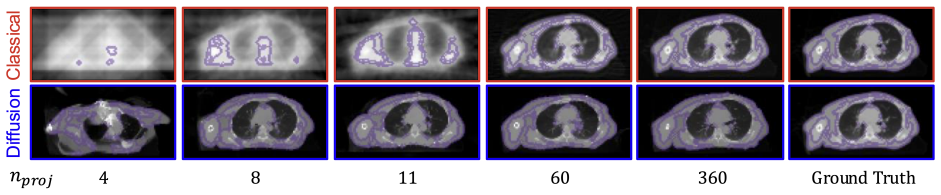
On an unconditional 2D U-Net diffusion model trained on 128x128 CT slices and guided at inference by projection-consistency gradients, the authors identify an interval $I=[LB,UB]$ of projection counts in which diffusion priors outperform classical priors with statistical significance. The upper bounds depend on metric and baseline: for pixel MSE the interval ends at $n_{\text{proj}}=15$ against both priors; for SSIM it ends at 25 against $L_1$ and 60 against $L_2$; for fat content it ends at 40 against both; for fat localization it ends at 25 against both. Beyond these counts, classical priors are superior on all metrics. Diffusion performance plateaus after roughly 10–15 projections rather than converging to the ground truth, and the reconstructions miss low-level structures such as vasculature even at high projection counts.
Load-bearing premise
The load-bearing premise is that hyperparameters tuned once at 360 projections, especially the diffusion guidance strength $\lambda=0.1$, remain the fair settings at every projection count, so the observed plateau and crossover could shift if the guidance weight were re-optimized separately for each number of projections.
Editorial extensions
If this is right
- For CT reconstruction with more than a few tens of projections, classical $L_1$/TV or $L_2$/Tikhonov priors are the safer choice on pixel, structural, and downstream fat metrics.
- In the 5–15 projection range, diffusion priors can deliver clinically usable fat quantification with up to roughly 97% dose reduction relative to full projection scans.
- Adding projections beyond about 15 does not sharpen diffusion-prior reconstructions, so extra scans confer little image-quality benefit for this method.
- Downstream fat-content and fat-localization metrics follow the same crossover pattern as pixel and structural metrics, so the trade-off is not an artifact of one scoring choice.
- Because diffusion priors can look realistic while missing low-level detail like vasculature, high-stakes clinical use should not rely on perceptual quality alone.
Reading between the lines
- Editorial inference: the plateau may be a property of the fixed guidance schedule rather than an intrinsic limit; projection-count-dependent guidance weights could push the crossover to higher $n_{\text{proj}}$.
- Editorial inference: the same crossover analysis could be run on other anatomies and downstream tasks, such as nodule detection or bone density, to test whether the 10–15 projection boundary generalizes.
- Editorial inference: the radiation-dose framing suggests a direct prospective study comparing fixed planar X-ray systems with standard CT for fat quantification, using true low-dose acquisitions rather than simulated sparse projections.
Editorial analysis
A structured set of objections, weighed in public.
Referee Report
Summary. The paper compares diffusion-prior sparse-view CT reconstruction against classical L1/TV and L2/Tikhonov regularization over a wide range of projection counts, using PSNR, SSIM, fat-content accuracy, and fat Dice on a 206-patient test set. The authors report that diffusion priors are statistically superior only for an extremely small number of projections (roughly 5–40 depending on the metric), that classical priors become superior once projections are 'sufficient', and that diffusion performance plateaus after about 10–15 projections. They introduce an interval-based definition of statistical superiority based on Mann-Whitney U tests and discuss clinical implications for low-dose thoracic fat quantification.
Significance. If the empirical comparison is accepted, the paper makes a valuable contribution by providing a cautionary calibration for the sparse-reconstruction community: it uses a large clinical dataset and downstream fat-segmentation metrics to challenge the assumption that diffusion priors are universally superior, and it highlights failure modes such as performance plateaus and hallucinated detail. The multi-metric evaluation and the explicit focus on a clinically relevant downstream task are strengths. However, the central claims about the crossover point and the plateau are only as strong as the fairness of the compared configurations at every projection count, and the current hyperparameter and statistical-testing choices leave this unresolved.
major comments (3)
- [Section 2, Inference] The hyperparameters for all three methods are fixed by a grid search that minimized MSE at 360 projections (L1 λ=10, L2 λ=10, diffusion λ=0.1). This single-point tuning is load-bearing for the central claims in Section 3 and Table 1: at low nproj the classical regularization strength may be over-smoothing, which would inflate the diffusion advantage, while at high nproj the diffusion guidance weight λ=0.1 may be too weak for the data-consistency gradient to dominate, which would artificially create the observed plateau. The authors' own explanation in Section 4, that naive gradient guidance gets 'stuck' balancing the prior and the external loss, is exactly the mechanism controlled by λ. The paper therefore does not yet establish that the crossover and plateau are intrinsic to diffusion priors; it establishes them for one particular configuration. A re-optimization of λ per nproj, or at least a sensitivity sweep across λ at several nproj values, is needed, and the use of a held-out validation set for this tuning should be stated explicitly.
- [Section 2 (Dataset and Metrics); Section 3] The Mann-Whitney U tests use 618 test slices, but these are nested within 206 patients (3 slices per patient). Treating all slices as independent overstates the effective sample size, so the nominal p-values in Table 1 and the resulting interval bounds are anti-conservative. A patient-level analysis, such as averaging metrics per patient before testing or using a cluster-robust permutation test, is required to support the quantitative UB values reported in Table 1.
- [Section 3, interval definition] The lower bound LB is chosen as the visible 'corner' of the performance curves, which is a subjective criterion not specified quantitatively, while the upper bound is determined by p < τp. The resulting interval I therefore conflates two different statistical procedures. In addition, the U-test is applied separately at each nproj without multiple-comparison control; because adjacent nproj comparisons are highly correlated, the reported p-values are not a valid basis for claiming that the interval endpoints are exact. The authors should specify an automatic rule for LB and state whether any multiplicity correction was applied.
minor comments (4)
- [Table 1] The header 'LB UB (p-value)' with rows 'L1 Prior L2 Prior' is ambiguous; for the MSE row it is unclear which UB corresponds to L1 and which to L2. Use separate L1 and L2 columns.
- [Section 3] The definition of the interval I uses 'LB, UB ∈ R × R', but LB and UB are real scalars; the notation should be LB, UB ∈ R, or I ⊂ R².
- [Figure 2] The label 'IQR5,95' is nonstandard; the figure is plotting the range between the 0.05 and 0.95 quantiles, so call it the 90% quantile range and define it in the caption.
- [Section 2, Metrics] The definition of fat content accuracy as 'the percentage of correct pixels classified as fat' should specify whether true negatives are included in the denominator; without this, the metric is not clearly defined as a content accuracy.
Circularity Check
Empirical comparison, not a derivation; no circularity found, though fixed hyperparameters tuned at 360 projections are a validity concern.
full rationale
This paper reports measurements comparing L1/L2 and diffusion-prior reconstruction across projection counts. There is no equation-level derivation in which an output is defined in terms of its own conclusion. The only mild issue is that all hyperparameters, including the diffusion guidance weight (lambda = 0.1), were chosen by grid search at 360 projections and then held fixed at every nproj; this could bias the comparison if the optimal guidance differs with projection count, but the reported crossover and plateau are empirical observations rather than consequences forced by construction. Self-citations ([3], [6]) are contextual and not load-bearing: the main claims rest on the authors' own experiments and external baselines. Consequently the central findings are not circular.
Assumptions & free parameters
free parameters (4)
- Diffusion guidance weight (lambda_diff) =
0.1
- L1 regularization weight (lambda_L1) =
10
- L2 regularization weight (lambda_L2) =
10
- User-defined threshold for minimum acceptable metric (tau_M) =
Not specified
assumptions (4)
- domain assumption The projection operator computed with tomosipo accurately models the CT acquisition geometry.
- domain assumption Fat is defined as voxels with Hounsfield units between -150 and -50.
- domain assumption The test cohort distribution (post-mastectomy chest wall CT) is representative of the clinical population for which conclusions are drawn.
- standard math Mann-Whitney U tests on per-slice metrics are a valid method for comparing methods across nproj.
Cite this review
Pith. "Pith review of When are Diffusion Priors Helpful in Sparse Reconstruction? A Study with Sparse-view CT." pith.science (2026). https://pith.science/paper/DOEHMMIA
@misc{pith2026250202771,
  author       = {Pith},
  title        = {Pith review of: When are Diffusion Priors Helpful in Sparse Reconstruction? A Study with Sparse-view CT},
  year         = {2026},
  howpublished = {\url{https://pith.science/paper/DOEHMMIA}},
  note         = {Machine review of arXiv:2502.02771}
}
abstract
Diffusion models demonstrate state-of-the-art performance on image generation, and are gaining traction for sparse medical image reconstruction tasks. However, compared to classical reconstruction algorithms relying on simple analytical priors, diffusion models have the dangerous property of producing realistic looking results \emph{even when incorrect}, particularly with few observations. We investigate the utility of diffusion models as priors for image reconstruction by varying the number of observations and comparing their performance to classical priors (sparse and Tikhonov regularization) using pixel-based, structural, and downstream metrics. We make comparisons on low-dose chest wall computed tomography (CT) for fat mass quantification. First, we find that classical priors are superior to diffusion priors when the number of projections is ``sufficient''. Second, we find that diffusion priors can capture a large amount of detail with very few observations, significantly outperforming classical priors. However, they fall short of capturing all details, even with many observations. Finally, we find that the performance of diffusion priors plateau after extremely few ($\approx$10-15) projections. Ultimately, our work highlights potential issues with diffusion-based sparse reconstruction and underscores the importance of further investigation, particularly in high-stakes clinical settings.
Figures

Reference graph
Works this paper leans on
-
[1]
Addressing the global expertise gap in radiation oncology: the radiation planning assistant,
Laurence Court, Ajay Aggarwal, Hester Burger, Carlos Cardenas, Christine Chung, Raphael Douglas, Monique du Toit, David Jaffray, Anuja Jhingran, Michael Mejia, et al., “Addressing the global expertise gap in radiation oncology: the radiation planning assistant,” JCO Global Oncology, vol. 9, pp. e2200431, 2023
work page 2023
-
[2]
Low-dose ct: technique, reading methods and image interpretation,
Cristiano Rampinelli, Daniela Origgi, and Massimo Bellomi, “Low-dose ct: technique, reading methods and image interpretation,” Cancer imaging, vol. 12, no. 3, pp. 548, 2012
work page 2012
-
[3]
Difr3ct: Latent diffusion for probabilistic 3d ct reconstruction from few planar x-rays,
Yiran Sun, Hana Baroudi, Tucker Netherton, Laurence Court, Osama Mawlawi, Ashok Veeraraghavan, and Guha Balakrishnan, “Difr3ct: Latent diffusion for probabilistic 3d ct reconstruction from few planar x-rays,” arXiv preprint arXiv:2408.15118 , 2024
arXiv 2024
-
[4]
Regularization strategies in statistical image reconstruction of low-dose x-ray ct: A review,
Hao Zhang, Jing Wang, Dong Zeng, Xi Tao, and Jianhua Ma, “Regularization strategies in statistical image reconstruction of low-dose x-ray ct: A review,” Medical physics, vol. 45, no. 10, pp. e886–e907, 2018
work page 2018
-
[5]
Diffusion models beat gans on image synthesis,
Prafulla Dhariwal and Alexander Nichol, “Diffusion models beat gans on image synthesis,” Advances in neural information processing systems , vol. 34, pp. 8780–8794, 2021
work page 2021
-
[6]
Metric-guided image reconstruction bounds via conformal prediction,
Matt Y Cheung, Tucker J Netherton, Laurence E Court, Ashok Veeraraghavan, and Guha Bal- akrishnan, “Metric-guided image reconstruction bounds via conformal prediction,” arXiv preprint arXiv:2404.15274, 2024
-
[7]
Imaging body fat: techniques and cardiometabolic impli- cations,
H Wang, YE Chen, and Daniel T Eitzman, “Imaging body fat: techniques and cardiometabolic impli- cations,” Arteriosclerosis, thrombosis, and vascular biology , vol. 34, no. 10, pp. 2217–2223, 2014
work page 2014
-
[8]
Epicardial and thoracic fat-noninvasive measurement and clinical implications,
Damini Dey, Ryo Nakazato, Debiao Li, and Daniel S Berman, “Epicardial and thoracic fat-noninvasive measurement and clinical implications,” Cardiovascular diagnosis and therapy , vol. 2, no. 2, pp. 85, 2012
work page 2012
Show all 13 references
-
[9]
Increased radiation dose to overweight and obese patients from radiographic examinations,
Jacquelyn C Yanch, Richard H Behrman, Michael J Hendricks, and John H McCall, “Increased radiation dose to overweight and obese patients from radiographic examinations,” Radiology, vol. 252, no. 1, pp. 128–139, 2009
2009
-
[10]
Denoising diffusion probabilistic models,
Jonathan Ho, Ajay Jain, and Pieter Abbeel, “Denoising diffusion probabilistic models,” Advances in neural information processing systems , vol. 33, pp. 6840–6851, 2020
2020
-
[11]
Tomosipo: fast, flexible, and convenient 3d tomography for complex scanning geometries in python,
Allard A Hendriksen, Dirk Schut, Willem Jan Palenstijn, Nicola Vigan´ o, Jisoo Kim, Dani¨ el M Pelt, Tristan Van Leeuwen, and K Joost Batenburg, “Tomosipo: fast, flexible, and convenient 3d tomography for complex scanning geometries in python,” Optics Express, vol. 29, no. 24,...
2021
-
[12]
Diffusion models as plug- and-play priors,
Alexandros Graikos, Nikolay Malkin, Nebojsa Jojic, and Dimitris Samaras, “Diffusion models as plug- and-play priors,” Advances in Neural Information Processing Systems , vol. 35, pp. 14715–14728, 2022
2022
-
[13]
Gradient guidance for diffusion models: An optimization perspective,
Yingqing Guo, Hui Yuan, Yukang Yang, Minshuo Chen, and Mengdi Wang, “Gradient guidance for diffusion models: An optimization perspective,” arXiv preprint arXiv:2404.14743 , 2024. 5
2024 arXiv
Reviewed August 9, 2026 · model on record in the stance chip above.
Discussion (0). Continue with ORCID to comment.