REVIEW 4 major objections 4 minor 35 references
Semantica: Decentralized Search using a LLM-Guided Semantic Tree Overlay
T0 review · 4 major / 4 minor · reviewed 2026-08-07 · deepseek-v4-flash
Pith's one-line read Semantica claims that organizing peers by LLM-produced document embeddings into a semantic trie lets decentralized search find up to ten times more similar users and retrieve over twice as many relevant documents at equal network load.
desk verdict Solid new algorithm for LLM-based decentralized semantic search, but the headline numbers rest on a thinner evaluation than they suggest. read the letter →
The pith
A machine-rendered reading of the paper's core claim, the machinery that carries it, and where it could break.
The reading
What carries the argument
The load-bearing structure is a binary semantic trie built by recursive $k=2$-means splitting of leaf nodes with capacity $M=50$. Each split-node stores two centroids; a new user descends toward the closer centroid, and if the difference in normed Euclidean distances is below threshold $\Delta$, the user is cloned into both subtrees. Each leaf supplies a user with a seed list of peers, expanded by breadth-first search into nearby leaves and then refined by expansion rounds that ask a random known peer for closer contacts using cosine similarity. Chain-hop queries greedily forward to the most similar known user, making the trie the mechanism that turns embedding similarity into short network paths.
What would settle it
Take the full, unfiltered AOL4PS user set (all 12,907 users, including those with no co-occurring document) or simulate churn by replacing each user's documents every week, then measure two-hop retrieval and closest-user recall; if Semantica's recall falls to the random baseline, the result is carried by the overlap-and-stability assumption rather than by the trie.
Extended reading notes
Core claim
The central discovery is that a trie over LLM embeddings can serve as a predictive overlay: users co-located in a leaf by $k=2$-means clustering are likely to share documents, so network adjacency can be derived from semantic adjacency. The paper introduces soft cloning at cluster boundaries, expansion rounds that refine each user's closest-user list through random neighbor queries, and chain-hop querying that forwards a query to the known user with the highest cosine similarity to the query. In emulation on a filtered real-world query log, Semantica's closest-user recall starts above 5 out of 50 while random achieves about 0.4, rises above 40 after 20 expansion rounds for thresholds around $\Delta=0.001$, and at a two-hop budget retrieves 12.75% of required documents while graph-diffusion and random baselines stay below 6%. The authors describe this as the first predictive decentralized document search to exploit pre-trained LLM embeddings without any training or retraining.
Load-bearing premise
The load-bearing premise is that users in the target workload store overlapping documents and that a user's mean document embedding is a stable semantic fingerprint, since the benefit of leaf-node co-location would vanish for users with disjoint or rapidly changing interests.
Editorial extensions
If this is right
- A decentralized network can identify a large share of a user's closest semantic peers from purely local interactions: after 20 expansion rounds, more than 40 of the 50 ground-truth closest users are found for the tested thresholds.
- Semantic routing gives the biggest gains in short, communication-limited regimes: with a two-hop budget, Semantica retrieves 12.75% of required documents while graph-diffusion and random baselines stay below 6%.
- The protocol keeps network overhead linear in queries and hops: each chain-hop query costs at most $\ell$ messages and $O(\ell \cdot (k+d))$ local computation, independent of network size.
- Tree construction scales as $O(N \log N)$ messages under balanced embeddings, with expansion rounds adding $O(r_{\mathrm{max}} N)$ messages, making the overlay feasible at large $N$ under ordinary data distributions.
- Soft clustering with a moderate threshold is what makes expansion rounds effective: with $\Delta=0$, neighbors within a leaf are redundant, and recall does not improve with expansion.
Reading between the lines
- Editorial inference: the trie is effectively a distributed approximate nearest-neighbor index, so the same construction could serve other semantic-overlay tasks such as decentralized recommendation or clustering of users by interest, not just document retrieval.
- Editorial inference: because embeddings are computed locally, a change in the embedding model or even its version would shift all user positions and fragment the tree, making embedding-space versioning a testable requirement the paper does not address.
- Editorial inference: the paper itself notes that chain-hopping's advantage shrinks as the hop limit grows and that some documents become unreachable inside clusters, so a hybrid that mixes semantic hops with occasional random edges is a natural extension that would likely preserve both short-hop recall and global reachability.
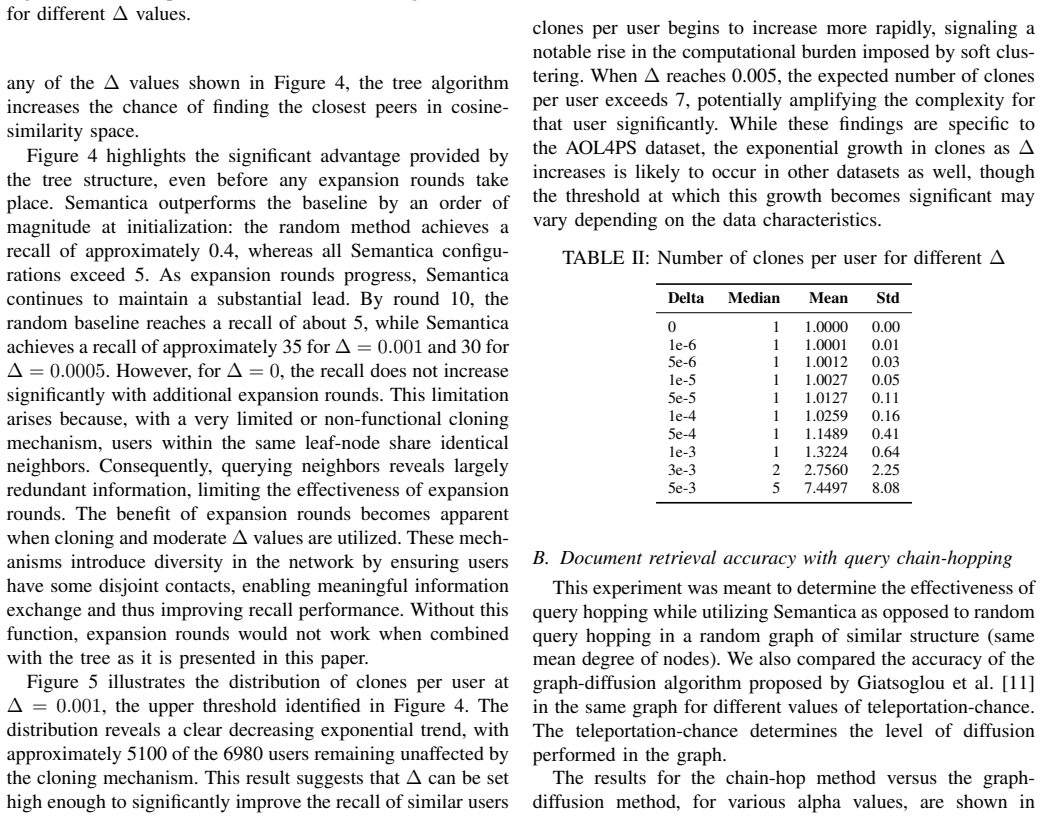
- Editorial inference: the threshold $\Delta$ controls a tradeoff between recall and clone blow-up, and clone count grows rapidly beyond $\Delta=0.001$ on this dataset, so a self-tuning per-node threshold based on local embedding density is a concrete testable extension.
Editorial analysis
A structured set of objections, weighed in public.
Referee Report
Summary. Semantica proposes a decentralized semantic overlay network in which each user is represented by the mean LLM embedding of their documents, and users are organized into a hierarchical binary tree via k-means splits with soft-clustering (cloning) at split nodes. Each user maintains a known-users list gathered from nearby leaf nodes and refines a closest-users list through expansion rounds; queries are routed by chain-hopping through the closest-users lists. The paper evaluates the design on the AOL4PS dataset with BERT embeddings, reporting closest-user recall against a 50-nearest ground truth, document-retrieval accuracy under a hop limit relative to a Barabási-Albert graph and a graph-diffusion baseline, and hop-distance distributions. The headline claims are that Semantica finds up to ten times more semantically similar users and retrieves more than twice as many relevant documents at the same network load.
Significance. If the experimental claims held under a fair accounting of network cost, Semantica would be a useful contribution to decentralized semantic search. The design is clearly specified, the complexity analysis in Section VII is reasonable for the average case, and the authors provide publicly available code and use a real-world workload, which are concrete strengths. The central novelty—using LLM embeddings to build a semantic trie with cloning and expansion rounds—is plausible and worth pursuing. However, the evaluation as written does not yet support the two headline quantitative claims: the 'same network load' comparison omits Semantica's construction and expansion costs, the main hyperparameter is selected on the same test data without variance reporting, and the filtered dataset limits the generality of the workload assumption. These issues are load-bearing for the abstract's claims rather than cosmetic.
major comments (4)
- [Abstract and §VI.B, Fig. 6b] The claim that Semantica retrieves 'more than two times the number of relevant documents given the same network load' is not supported by the reported experiment, because the load comparison counts only query messages. Section VII.A states that tree construction costs O(N log N) messages and expansion rounds cost O(rmax N) messages; for the evaluated N = 6,980 and rmax = 10, this is on the order of 10^5 setup messages, while the Barabási-Albert baseline has essentially no construction cost. Charging these setup messages against Semantica's query budget would materially reduce the reported 12.75% versus <6% two-hop retrieval advantage. Please either present an equal-total-message comparison, or justify why setup cost can be treated as amortized/one-time and quantify that amortization.
- [§V.A and §VI.A, Fig. 4 and Fig. 6b] No error bars, confidence intervals, or multiple-seed variability are reported, despite multiple sources of randomness: the user insertion order is shuffled in Algorithm 1, k-means is stochastic, expansion rounds select random known-users, and the test/train document split is random. The parameter Δ is also selected based on the same AOL4PS dataset on which the headline results are measured (e.g., Δ = 0.003 in Fig. 6b, Δ = 0.001 in Fig. 7). Since the cloning mechanism is highly sensitive to Δ (Table II shows mean clones growing from 1.32 at Δ = 1e-3 to 7.45 at Δ = 5e-3), the central performance numbers need a sensitivity analysis and variance reporting before they can be taken as reliable.
- [§V.A.1 and §II, Fig. 1] The evaluation filters AOL4PS from 12,907 users to 6,980 users with at least 30 unique documents, yet the workload assumption of document overlap is validated on the full dataset in Section II. The paper does not report retrieval or recall results on the filtered-out users, and it does not quantify co-occurrence or embedding similarity within the filtered subset. Because the entire benefit of leaf-node co-location depends on users having overlapping, semantically stable interests, the current experiments support the claimed advantage only for relatively active users; the paper should either extend the evaluation to the full population or explicitly scope the claim to the filtered workload.
- [§VI.B, Fig. 6b] The graph-diffusion baseline is run on a Barabási-Albert graph with m = 104, matched to Semantica's average known-users degree. This may disadvantage the baseline: graph diffusion as proposed by Giatsoglou et al. is designed to operate on an overlay whose edges are built for content routing, not on a random graph. As reported, the comparison is 'chain-hopping on a semantic graph' versus 'graph diffusion on a random graph,' which does not cleanly isolate the contribution of Semantica's tree. Please either run graph diffusion on the graph construction intended by its authors, or report graph diffusion on Semantica's known-users graph as an additional baseline.
minor comments (4)
- [Algorithm 2 and §IV.B] There is a notation inconsistency: Algorithm 2 uses the parameter ncu for the closest-users list size, but line 11 hardcodes the threshold as the '50th user,' and the text in Section V.A refers to L = 50 for leaf capacity while Algorithm 1 uses M. Please unify these names and make the threshold consistent with ncu.
- [Fig. 6 and §VI.B] The caption of Fig. 6b says 'at 50 queries sent to the network,' but the x-axis appears to range from 2 to 600 queries; please clarify whether the x-axis is the number of query messages, the number of hops, or the number of distinct query initiations.
- [§V.B, Experiment 2] The prose says the query is first sent to the user whose embedding is closest to the query embedding, while Algorithm 3 starts at the query initiator itself and only then forwards to the closest known user. This discrepancy should be resolved so the experimental protocol is unambiguous.
- [§I and §II] There are minor grammatical issues: 'In Section II defines the operational setting' should read 'Section II defines...' and 'AOL4PS data set used [12]' in Section IX is missing a verb. These do not affect the technical content.
Circularity Check
No significant circularity; nearest-neighbor recall is a legitimate internal consistency check and document retrieval uses held-out test documents.
full rationale
The paper's derivation chain is self-contained. Experiment 1 defines ground truth as the global top-50 users by cosine similarity of the same user embeddings of Eq. (2) that are used to build the tree; this is a standard recall@k check of an approximate nearest-neighbor overlay, not a circular reduction, because Semantica's local leaf/BFS/expansion procedure could fail to recover the global ranking—and indeed the random baseline recovers almost none. Experiment 2 holds out 10 test documents per user before computing user embeddings, so query embeddings are not part of the user-embedding or tree-construction input; the retrieval advantage is measured against a network-load-matched random graph and graph diffusion, and no test labels are used to fit tree parameters. The only self-citation, De-DSI [20], is used to position prior work and is not load-bearing for Semantica's correctness or for any uniqueness argument. The 'same network load' concern about uncounted tree-construction messages is a cost-accounting/fairness issue, not a case of a result reducing to its input by definition.
Assumptions & free parameters
free parameters (5)
- Leaf capacity M =
50
- Soft-clustering threshold Delta =
0.001 (headline recall), 0.003 (retrieval), 0.005 (upper bound)
- Closest-users list size ncu =
50
- Known-users collected per clone ncc =
not stated
- Expansion rounds rmax =
10
assumptions (4)
- domain assumption Users in the target workload have overlapping document sets (co-occurrence).
- domain assumption The mean of document embeddings is a faithful semantic fingerprint of a user.
- domain assumption Perfect local search: a node that holds a document returns it 100% of the time and never returns false positives.
- ad hoc to paper Filtering AOL4PS to users with at least 30 unique documents preserves the properties being evaluated.
invented entities (2)
-
Clone user identifier
-
Custodian node
Cite this review
Pith. "Pith review of Semantica: Decentralized Search using a LLM-Guided Semantic Tree Overlay." pith.science (2026). https://pith.science/paper/AEHM3AB2
@misc{pith2026250210151,
  author       = {Pith},
  title        = {Pith review of: Semantica: Decentralized Search using a LLM-Guided Semantic Tree Overlay},
  year         = {2026},
  howpublished = {\url{https://pith.science/paper/AEHM3AB2}},
  note         = {Machine review of arXiv:2502.10151}
}
read the original abstract
Centralized search engines are key for the Internet, but lead to undesirable concentration of power. Decentralized alternatives fail to offer equal document retrieval accuracy and speed. Nevertheless, Semantic Overlay Networks can come close to the performance of centralized solutions when the semantics of documents are properly captured. This work uses embeddings from Large Language Models to capture semantics and fulfill the promise of Semantic Overlay Networks. Our proposed algorithm, called Semantica, constructs a prefix tree (trie) utilizing document embeddings calculated by a language model. Users connect to each other based on the embeddings of their documents, ensuring that semantically similar users are directly linked. Thereby, this construction makes it more likely for user searches to be answered by the users that they are directly connected to, or by the users they are close to in the network connection graph. The implementation of our algorithm also accommodates the semantic diversity of individual users by spawning "clone" user identifiers in the tree. Our experiments use emulation with a real-world workload to show Semantica's ability to identify and connect to similar users quickly. Semantica finds up to ten times more semantically similar users than current state-of-the-art approaches. At the same time, Semantica can retrieve more than two times the number of relevant documents given the same network load. We also make our code publicly available to facilitate further research in the area.
Figures


Figures from the paper (4 more)



Reference graph
Works this paper leans on
-
[1]
What ever happened to peer-to-peer systems?
C. Baquero, “What ever happened to peer-to-peer systems?” Communi- cations of the ACM , 2023
work page 2023
-
[2]
A maximum entropy approach to natural language processing,
A. Berger, S. A. Della Pietra, and V . J. Della Pietra, “A maximum entropy approach to natural language processing,” Computational lin- guistics, vol. 22, no. 1, pp. 39–71, 1996
work page 1996
-
[3]
Worldwide visits to google.com from october 2023 to march 2024,
T. Bianchi, “Worldwide visits to google.com from october 2023 to march 2024,” Available from https://www.statista.com/statistics/268252/ web-visitor-traffic-to-googlecom/, 2024
work page 2023
-
[4]
The anatomy of a large-scale hypertextual web search engine,
S. Brin and L. Page, “The anatomy of a large-scale hypertextual web search engine,” Computer networks and ISDN systems , vol. 30, no. 1-7, pp. 107–117, 1998
1998
-
[5]
The rise and fall of napster-an evolutionary approach,
B. Carlsson and R. Gustavsson, “The rise and fall of napster-an evolutionary approach,” in International Computer Science Conference on Active Media Technology . Springer, 2001, pp. 347–354. 14
work page 2001
-
[6]
K. Cho, J. Choi, D.-i. D. Ko, T. Kwon, and Y . Choi, “Content-oriented networking as a future internet infrastructure: Concepts, strengths, and application scenarios,” Future Internet Technologies, 2008
work page 2008
-
[7]
Semantic overlay networks for p2p systems,
A. Crespo and H. Garcia-Molina, “Semantic overlay networks for p2p systems,” in International Workshop on Agents and P2P Computing . Springer, 2004, pp. 1–13
work page 2004
-
[8]
Indexing by latent semantic analysis,
S. Deerwester, S. T. Dumais, G. W. Furnas, T. K. Landauer, and R. Harshman, “Indexing by latent semantic analysis,” Journal of the American society for information science , vol. 41, no. 6, pp. 391–407, 1990
work page 1990
Show all 35 references
-
[9]
Using latent semantic analysis to improve access to textual information,
S. T. Dumais, G. W. Furnas, T. K. Landauer, S. Deerwester, and R. Harshman, “Using latent semantic analysis to improve access to textual information,” in Proceedings of the SIGCHI conference on Human factors in computing systems , 1988, pp. 281–285
1988
-
[10]
Predict then propagate: Graph neural networks meet personalized pagerank,
J. Gasteiger, A. Bojchevski, and S. G ¨unnemann, “Predict then propagate: Graph neural networks meet personalized pagerank,” arXiv preprint arXiv:1810.05997, 2018
2018 arXiv
-
[11]
A graph diffusion scheme for decentralized content search based on personalized pagerank,
N. Giatsoglou, E. Krasanakis, S. Papadopoulos, and I. Kompatsiaris, “A graph diffusion scheme for decentralized content search based on personalized pagerank,” in 2022 IEEE 42nd International Conference on Distributed Computing Systems Workshops (ICDCSW). IEEE, 2022, pp. 53–59
2022
-
[12]
Aol4ps: A large-scale data set for personalized search,
Q. Guo, W. Chen, and H. Wan, “Aol4ps: A large-scale data set for personalized search,” Data Intelligence, vol. 3, no. 4, pp. 548–567, 2021
2021
-
[13]
A detailed review on word embedding techniques with emphasis on word2vec,
S. J. Johnson, M. R. Murty, and I. Navakanth, “A detailed review on word embedding techniques with emphasis on word2vec,” Multimedia Tools and Applications, vol. 83, no. 13, pp. 37 979–38 007, 2024
2024
-
[14]
Bert: Pre-training of deep bidirectional transformers for language understanding,
J. D. M.-W. C. Kenton and L. K. Toutanova, “Bert: Pre-training of deep bidirectional transformers for language understanding,” in Proceedings of naacL-HLT, vol. 1. Minneapolis, Minnesota, 2019, p. 2
2019
-
[15]
On the feasibility of peer-to-peer web indexing and search,
J. Li, B. T. Loo, J. M. Hellerstein, M. F. Kaashoek, D. R. Karger, and R. Morris, “On the feasibility of peer-to-peer web indexing and search,” in International Workshop on Peer-to-Peer Systems . Springer, 2003, pp. 207–215
2003
-
[16]
The kazaa overlay: A measurement study,
J. Liang, R. Kumar, and K. W. Ross, “The kazaa overlay: A measurement study,” Computer networks journal (Elsevier) , vol. 49, no. 6, 2005
2005
-
[17]
Kademlia: A peer-to-peer informa- tion system based on the xor metric,
P. Maymounkov and D. Mazieres, “Kademlia: A peer-to-peer informa- tion system based on the xor metric,” in International Workshop on Peer-to-Peer Systems. Springer, 2002, pp. 53–65
2002
-
[18]
Recent advances in natural language processing via large pre-trained language models: A survey,
B. Min, H. Ross, E. Sulem, A. P. B. Veyseh, T. H. Nguyen, O. Sainz, E. Agirre, I. Heintz, and D. Roth, “Recent advances in natural language processing via large pre-trained language models: A survey,” ACM Computing Surveys, vol. 56, no. 2, pp. 1–40, 2023
2023
-
[19]
Bitcoin: A peer-to-peer electronic cash system,
S. Nakamoto, “Bitcoin: A peer-to-peer electronic cash system,” Tech. Rep., 2008
2008
-
[20]
De-dsi: Decentralised differentiable search index,
P. Neague, M. Gregoriadis, and J. Pouwelse, “De-dsi: Decentralised differentiable search index,” in Proceedings of the 4th Workshop on Machine Learning and Systems , 2024, pp. 134–143
2024
-
[21]
Glove: Global vectors for word representation,
J. Pennington, R. Socher, and C. D. Manning, “Glove: Global vectors for word representation,” in Proceedings of the 2014 conference on empirical methods in natural language processing (EMNLP) , 2014, pp. 1532–1543
2014
-
[22]
Peer-to-peer systems,
R. Rodrigues and P. Druschel, “Peer-to-peer systems,” Communications of the ACM , vol. 53, no. 10, pp. 72–82, 2010
2010
-
[23]
Achieving peak perfor- mance for large language models: A systematic review,
Z. R. K. Rostam, S. Sz ´en´asi, and G. Kert ´esz, “Achieving peak perfor- mance for large language models: A systematic review,” IEEE Access, 2024
2024
-
[24]
Semantic hashing,
R. Salakhutdinov and G. Hinton, “Semantic hashing,” International Journal of Approximate Reasoning , vol. 50, no. 7, pp. 969–978, 2009
2009
-
[25]
google.com website traffic, ranking, analytics,
Semrush, “google.com website traffic, ranking, analytics,” Available from https://www.semrush.com/website/google.com/overview/, Novem- ber 2024
2024
-
[26]
Chord: a scalable peer-to-peer lookup protocol for internet applications,
I. Stoica, R. Morris, D. Liben-Nowell, D. R. Karger, M. F. Kaashoek, F. Dabek, and H. Balakrishnan, “Chord: a scalable peer-to-peer lookup protocol for internet applications,” IEEE/ACM Transactions on network- ing, vol. 11, no. 1, pp. 17–32, 2003
2003
-
[27]
M. E. Stucke, Breaking away: How to regain control over our data, privacy, and autonomy . Oxford University Press, 2022
2022
-
[28]
Peer-to-peer information retrieval using self-organizing semantic overlay networks,
C. Tang, Z. Xu, and S. Dwarkadas, “Peer-to-peer information retrieval using self-organizing semantic overlay networks,” in Proceedings of the 2003 conference on Applications, technologies, architectures, and protocols for computer communications , 2003, pp. 175–186
2003
-
[29]
Transformer memory as a differentiable search index,
Y . Tay, V . Tran, M. Dehghani, J. Ni, D. Bahri, H. Mehta, Z. Qin, K. Hui, Z. Zhao, J. Gupta et al., “Transformer memory as a differentiable search index,” Advances in Neural Information Processing Systems, vol. 35, pp. 21 831–21 843, 2022
2022
-
[30]
Van Steen and A
M. Van Steen and A. S. Tanenbaum, Distributed systems. Maarten van Steen Leiden, The Netherlands, 2018
2018
-
[31]
Information centric network: Research challenges and opportunities,
A. V . Vasilakos, Z. Li, G. Simon, and W. You, “Information centric network: Research challenges and opportunities,” Journal of network and computer applications , vol. 52, pp. 1–10, 2015
2015
-
[32]
Attention is all you need,
A. Vaswani, “Attention is all you need,” Advances in Neural Information Processing Systems, 2017
2017
-
[33]
Ethereum: A secure decentralised generalised trans- action ledger,
G. Wood et al. , “Ethereum: A secure decentralised generalised trans- action ledger,” Ethereum project yellow paper , vol. 151, no. 2014, pp. 1–32, 2014
2014
-
[34]
A comparative study of tf* idf, lsi and multi-words for text classification,
W. Zhang, T. Yoshida, and X. Tang, “A comparative study of tf* idf, lsi and multi-words for text classification,” Expert systems with applications, vol. 38, no. 3, pp. 2758–2765, 2011
2011
-
[35]
Zuboff, The age of surveillance capitalism: The Fight for a Human Future at the New Frontier of Power
S. Zuboff, The age of surveillance capitalism: The Fight for a Human Future at the New Frontier of Power . Profile Books, 2019
2019
Reviewed August 7, 2026 · model on record in the stance chip above.
Discussion (0). Continue with ORCID to comment.