Spike-based alignment learning solves the weight transport problem
Pith reviewed 2026-05-23 01:58 UTC · model grok-4.3
The pith
Spike timing statistics allow synapses to recover the true local gradient by correcting asymmetry in reciprocal connections.
A machine-rendered reading of the paper's core claim, the machinery that carries it, and where it could break.
Core claim
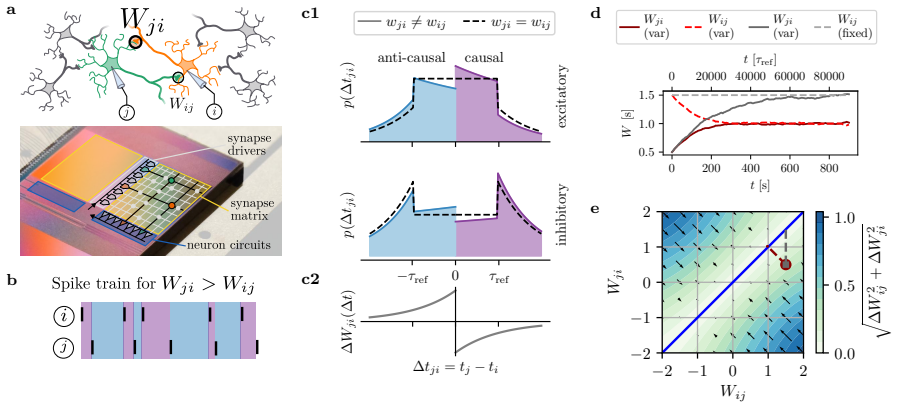
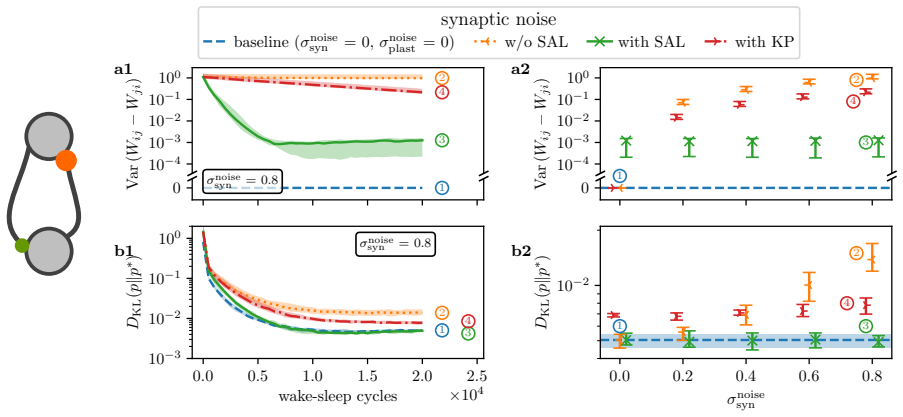
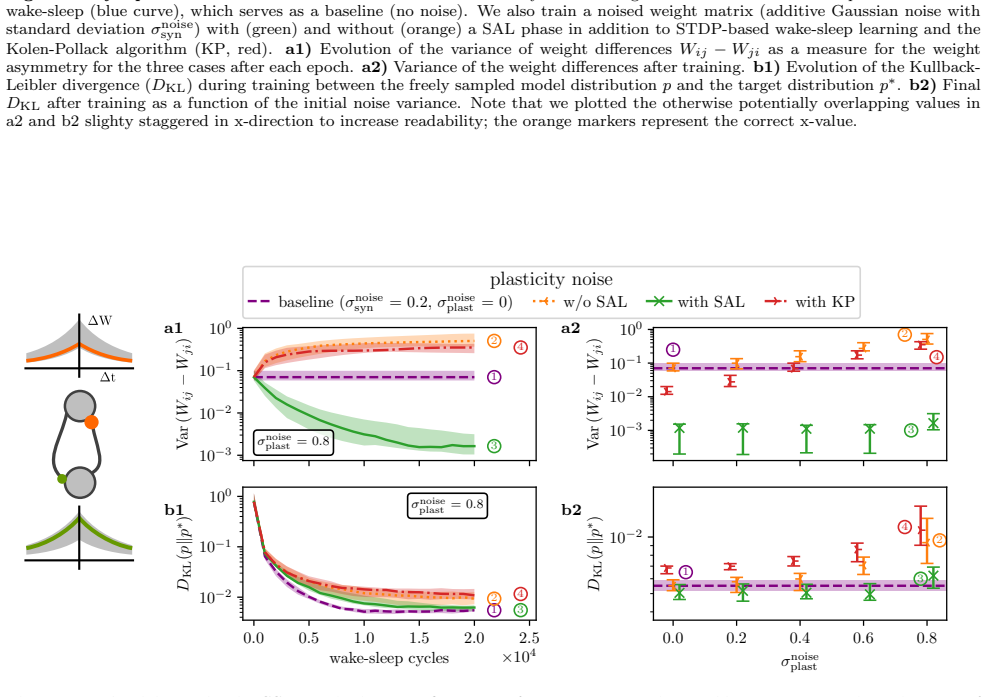
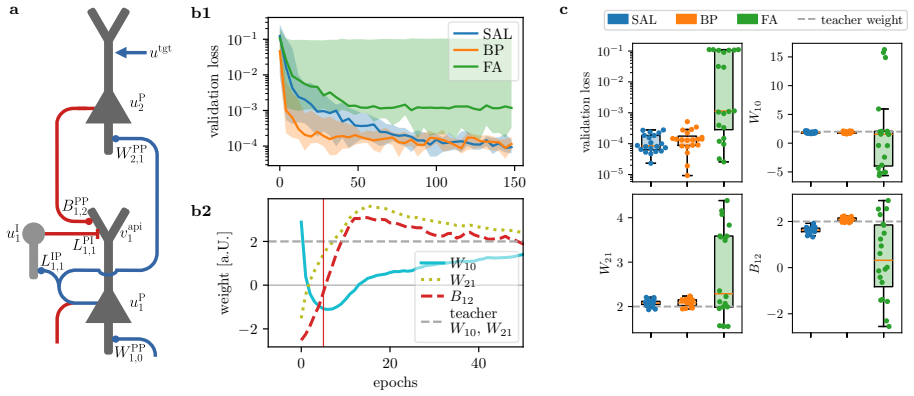
SAL uses spike timing statistics to extract and correct the asymmetry between effective reciprocal connections; synapses thereby recover the true local gradient via an interplay between Hebbian and anti-Hebbian plasticity. Apart from being spike-based and fully local, the mechanism takes advantage of noise and alleviates discrepancies from neuron and synapse variability. Demonstrations show improved convergence in probabilistic spiking networks, effective alignment of feedback weights in cortical microcircuit hierarchies for correct error backpropagation, and competitive performance in deep networks using only local plasticity.
What carries the argument
Spike-based alignment learning (SAL), a complementary learning rule that aligns effective reciprocal connections using spike timing statistics through Hebbian and anti-Hebbian plasticity.
If this is right
- SAL significantly improves convergence to the target distribution in probabilistic spiking networks versus Hebbian plasticity alone.
- In neuronal hierarchies based on cortical microcircuits, SAL aligns feedback weights to the forward pathway and enables correct backpropagation of feedback errors.
- SAL enables competitive performance in deep networks using only local plasticity for weight transport.
- The approach alleviates discrepancies arising from neuron and synapse variability in physical networks.
Where Pith is reading between the lines
- Biological learning could implement gradient descent using only local timing-based rules without assuming weight symmetry.
- Neuromorphic hardware could apply SAL to achieve backpropagation-like updates with strictly local computation.
- The timing-based alignment may generalize to non-spiking networks or other plasticity mechanisms if similar statistics are available.
Load-bearing premise
Spike timing statistics alone suffice to recover an accurate local gradient across varied network architectures and noise levels without additional global signals or symmetric weights.
What would settle it
A controlled simulation where spike timing is randomized or uncorrelated with connection asymmetries while other variables are held fixed, showing whether SAL still produces alignment and improved learning.
Figures




read the original abstract
In both machine learning and in computational neuroscience, plasticity in functional neural networks is frequently expressed as gradient descent on a cost. Often, this imposes symmetry constraints that are difficult to reconcile with local computation, as is required for biological networks or neuromorphic hardware. For example, wake-sleep learning in networks characterized by Boltzmann distributions assumes symmetric connectivity. Similarly, the error backpropagation algorithm is notoriously plagued by the weight transport problem between the representation and the error stream. Existing solutions such as feedback alignment circumvent the problem by deferring to the robustness of these algorithms to weight asymmetry. However, they scale poorly with network size and depth. We introduce spike-based alignment learning (SAL), a complementary learning rule for spiking neural networks, which uses spike timing statistics to extract and correct the asymmetry between effective reciprocal connections. Apart from being spike-based and fully local, our proposed mechanism takes advantage of noise. Based on an interplay between Hebbian and anti-Hebbian plasticity, synapses can thereby recover the true local gradient. This also alleviates discrepancies that arise from neuron and synapse variability -- an omnipresent property of physical neuronal networks. We demonstrate the efficacy of our mechanism using different spiking network models. First, SAL can significantly improve convergence to the target distribution in probabilistic spiking networks versus Hebbian plasticity alone. Second, in neuronal hierarchies based on cortical microcircuits, SAL effectively aligns feedback weights to the forward pathway, thus allowing the backpropagation of correct feedback errors. Third, our approach enables competitive performance in deep networks using only local plasticity for weight transport.
Editorial analysis
A structured set of objections, weighed in public.
Referee Report
Summary. The manuscript introduces spike-based alignment learning (SAL), a complementary local plasticity rule for spiking neural networks. SAL uses spike timing statistics to extract and correct asymmetries between effective reciprocal connections via an interplay of Hebbian and anti-Hebbian plasticity, thereby recovering the true local gradient without requiring symmetric weights or global signals. The mechanism is shown to exploit rather than suffer from noise and variability. Efficacy is demonstrated in three regimes: improved convergence to target distributions in probabilistic spiking networks, alignment of feedback weights in cortical microcircuit hierarchies to enable correct error backpropagation, and competitive performance in deep networks using only local plasticity for weight transport.
Significance. If the quantitative results hold, SAL provides a fully local, spike-based solution to the weight transport problem that is compatible with biological constraints and neuromorphic hardware. The approach is notable for treating noise and neuronal variability as exploitable features rather than obstacles, and for its potential to bridge gradient-based learning in machine learning with local computation in neuroscience. The three demonstration settings offer a broad test of the mechanism across network types.
minor comments (3)
- Abstract: the claims of 'significantly improve convergence' and 'competitive performance' would be strengthened by inclusion of at least one quantitative metric (e.g., KL divergence reduction or test accuracy) with error bars or statistical comparison to baselines.
- The manuscript would benefit from an explicit statement of the precise conditions under which the Hebbian/anti-Hebbian interplay is guaranteed to recover the gradient (e.g., in terms of firing rate regimes or correlation assumptions).
- Figure captions and methods should clarify whether the reported alignments are measured by cosine similarity, weight correlation, or another metric, and whether results are averaged over multiple random seeds.
Simulated Author's Rebuttal
We thank the referee for the constructive and positive review, including the recommendation for minor revision. No specific major comments were provided in the report.
Circularity Check
No significant circularity
full rationale
The paper introduces SAL as a local, spike-based mechanism relying on Hebbian/anti-Hebbian interplay to correct weight asymmetry using timing statistics. No equations, fitted parameters, or self-citations are shown in the provided text that reduce the claimed gradient recovery to a definition or input by construction. The three demonstration regimes are presented as empirical validation of an independent local process rather than tautological predictions. The central claim does not invoke uniqueness theorems or ansatzes from prior self-work in a load-bearing way visible here. This is the expected non-finding for a mechanism paper whose derivation chain remains self-contained against external benchmarks.
Axiom & Free-Parameter Ledger
Reference graph
Works this paper leans on
-
[1]
Hopfield, J. J. Neural Networks and Physical Systems with Emergent Collective Computational Abilities. Proceedings of the National Academy of Sciences 79, 2554–2558 (Apr. 1982)
work page 1982
-
[2]
Hinton, G. E. & Sejnowski, T. J. Optimal perceptual infer- ence in Proceedings of the IEEE conference on Computer Vision and Pattern Recognition 448 (1983), 448–453
work page 1983
-
[3]
Ackley, D. H., Hinton, G. E. & Sejnowski, T. J. A Learning Algorithm for Boltzmann Machines*. Cognitive Science 9, 147–169. issn: 0364-0213, 1551-6709 (Jan. 1985)
work page 1985
-
[4]
Hinton, G. E. Training products of experts by minimizing contrastive divergence. Neural computation 14, 1771–1800 (2002)
work page 2002
-
[5]
Taylor Expansion of the Accumulated Rounding Error
Linnainmaa, S. Taylor Expansion of the Accumulated Rounding Error. BIT Numerical Mathematics 16, 146–
-
[6]
issn: 1572-9125 (June 1976)
work page 1976
-
[7]
Werbos, P. J. in System Modeling and Optimization 762– 770 (Springer-Verlag, Sept. 2005). http://dx.doi.org/ 10.1007/BFb0006203
-
[8]
Rumelhart, D. E., Hinton, G. E. & Williams, R. J. Learn- ing Representations by Back-Propagating Errors. Nature 323, 533–536. issn: 1476-4687 (Oct. 1986)
work page 1986
-
[9]
Whittington, J. C. R. & Bogacz, R. Theories of Error Back- Propagation in the Brain. Trends in Cognitive Sciences 23, 235–250. issn: 1364-6613, 1879-307X (Mar. 2019)
work page 2019
-
[10]
Richards, B. A. et al. A Deep Learning Framework for Neuroscience. Nature Neuroscience 22, 1761–1770. issn: 1546-1726 (Nov. 2019)
work page 2019
-
[11]
P., Santoro, A., Marris, L., Akerman, C
Lillicrap, T. P., Santoro, A., Marris, L., Akerman, C. J. & Hinton, G. Backpropagation and the Brain. Nature Re- views Neuroscience 21, 335–346. issn: 1471-0048 (Apr. 2020)
work page 2020
-
[12]
Marder, E. & Goaillard, J.-M. Variability, Compensation and Homeostasis in Neuron and Network Function.Nature Reviews Neuroscience 7, 563–574 (2006)
work page 2006
-
[13]
Watt, A. J. & Desai, N. S. Homeostatic plasticity and STDP: keeping a neuron’s cool in a fluctuating world. Frontiers in synaptic neuroscience 2, 1486 (2010)
work page 2010
-
[14]
Abbott, L. F. & Nelson, S. B. Synaptic plasticity: taming the beast. Nature neuroscience 3, 1178–1183. issn: 1546-
-
[15]
http://dx.doi.org/10.1038/81453 (Nov. 2000)
-
[16]
Davis, G. W. & Bezprozvanny, I. Maintaining the stabil- ity of neural function: a homeostatic hypothesis. Annual review of physiology 63, 847–869 (2001). 24
work page 2001
-
[17]
Lee, H.-K. & Kirkwood, A. Mechanisms of homeostatic synaptic plasticity in vivo. Frontiers in Cellular Neuro- science 13, 520 (2019)
work page 2019
-
[18]
Yang, J. & Prescott, S. A. Homeostatic regulation of neu- ronal function: importance of degeneracy and pleiotropy. Frontiers in Cellular Neuroscience 17, 1184563 (2023)
work page 2023
-
[19]
Bartol Jr, T. M. et al. Nanoconnectomic upper bound on the variability of synaptic plasticity.elife 4, e10778 (2015)
work page 2015
-
[20]
Noguchi, J. et al. Bidirectional in vivo structural den- dritic spine plasticity revealed by two-photon glutamate uncaging in the mouse neocortex. Scientific reports 9, 13922 (2019)
work page 2019
-
[21]
D¨ urst, C. D. et al. Vesicular release probability sets the strength of individual Schaffer collateral synapses. Nature Communications 13, 6126 (2022)
work page 2022
-
[22]
Rodrigues, Y. E., Tigaret, C. M., Marie, H., O’Donnell, C. & Veltz, R. A stochastic model of hippocampal synaptic plasticity with geometrical readout of enzyme dynamics. eLife 12. issn: 2050-084X. http://dx.doi.org/10.7554/ eLife.80152 (Aug. 2023)
work page 2050
-
[23]
Billaudelle, S. et al. Versatile Emulation of Spiking Neu- ral Networks on an Accelerated Neuromorphic Substrate in 2020 IEEE International Symposium on Circuits and Systems (ISCAS) (Oct. 2020), 1–5
work page 2020
-
[24]
Atoui, A. et al. Multi-timescale synaptic plasticity on ana- log neuromorphic hardware in 2025 Neuro Inspired Com- putational Elements (NICE) (2025), 1–9
work page 2025
-
[25]
Buesing, L., Bill, J., Nessler, B. & Maass, W. Neural dy- namics as sampling: a model for stochastic computation in recurrent networks of spiking neurons. PLoS computa- tional biology 7, e1002211 (2011)
work page 2011
-
[26]
A., Bill, J., Bytschok, I., Schemmel, J
Petrovici, M. A., Bill, J., Bytschok, I., Schemmel, J. & Meier, K. Stochastic inference with spiking neurons in the high-conductance state. Physical Review E 94, 042312 (2016)
work page 2016
-
[27]
Berkes, P., Orb´ an, G., Lengyel, M. & Fiser, J. Spontaneous cortical activity reveals hallmarks of an optimal internal model of the environment. Science 331, 83–87 (2011)
work page 2011
-
[28]
Haefner, R. M., Berkes, P. & Fiser, J. Perceptual decision- making as probabilistic inference by neural sampling. Neu- ron 90, 649–660 (2016)
work page 2016
-
[29]
Orb´ an, G., Berkes, P., Fiser, J. & Lengyel, M. Neural vari- ability and sampling-based probabilistic representations in the visual cortex. Neuron 92, 530–543 (2016)
work page 2016
-
[30]
Kungl, A. F. et al. Accelerated physical emulation of bayesian inference in spiking neural networks. Frontiers in neuroscience 13, 1201 (2019)
work page 2019
-
[31]
Czischek, S. et al. Spiking Neuromorphic Chip Learns En- tangled Quantum States. SciPost Physics 12, 039. issn: 2542-4653 (Jan. 2022)
work page 2022
-
[32]
Klassert, R., Baumbach, A., Petrovici, M. A. & G¨ art- tner, M. Variational Learning of Quantum Ground States on Spiking Neuromorphic Hardware. iScience 25, 104707. issn: 2589-0042 (Aug. 2022)
work page 2022
-
[33]
Neftci, E., Das, S., Pedroni, B., Kreutz-Delgado, K. & Cauwenberghs, G. Event-driven contrastive divergence for spiking neuromorphic systems. Frontiers in neuroscience 7, 272 (2014)
work page 2014
-
[34]
The Recent Excitement about Neural Networks
Crick, F. The Recent Excitement about Neural Networks. Nature 337, 129–132. issn: 1476-4687 (Jan. 1989)
work page 1989
-
[35]
Lansdell, B. J., Prakash, P. R. & Kording, K. P. Learn- ing to solve the credit assignment problem. arXiv preprint arXiv:1906.00889 (2019)
-
[36]
Ernoult, M. M. et al. Towards Scaling Difference Target Propagation by Learning Backprop Targets in Proceedings of the 39th International Conference on Machine Learning (PMLR, June 2022), 5968–5987
work page 2022
-
[37]
Xie, X. & Seung, H. S. Equivalence of Backpropagation and Contrastive Hebbian Learning in a Layered Network. Neural Computation 15, 441–454. issn: 0899-7667 (Feb. 2003)
work page 2003
-
[38]
Scellier, B. & Bengio, Y. Equilibrium Propagation: Bridg- ing the Gap between Energy-Based Models and Backprop- agation. Frontiers in Computational Neuroscience 11. issn: 1662-5188. http : / / dx . doi . org / 10 . 3389 / fncom . 2017.00024 (May 2017)
-
[39]
Sacramento, J., Ponte Costa, R., Bengio, Y. & Senn, W. Dendritic Cortical Microcircuits Approximate the Back- propagation Algorithm in Advances in Neural Informa- tion Processing Systems (eds Bengio, S. et al. ) 31 (Cur- ran Associates, Inc., 2018). https : / / proceedings . neurips . cc / paper _ files / paper / 2018 / file / 1dc3a89d0d440ba31729b0ba74b9...
work page 2018
-
[40]
Pozzi, I., Bohte, S. & Roelfsema, P. Attention-Gated Brain Propagation: How the brain can implement reward-based error backpropagation. Advances in neural information processing systems 33, 2516–2526 (2020)
work page 2020
-
[41]
Kolen, J. F. & Pollack, J. B. Backpropagation without Weight Transport in Proceedings of 1994 IEEE Interna- tional Conference on Neural Networks (ICNN’94) 3 (June 1994), 1375–1380
work page 1994
-
[42]
Payeur, A., Guerguiev, J., Zenke, F., Richards, B. A. & Naud, R. Burst-Dependent Synaptic Plasticity Can Co- ordinate Learning in Hierarchical Circuits. Nature Neuro- science 24, 1010–1019. issn: 1546-1726 (July 2021)
work page 2021
-
[43]
Roelfsema, P. R. & Ooyen, A. v. Attention-gated reinforce- ment learning of internal representations for classification. Neural computation 17, 2176–2214 (2005)
work page 2005
-
[44]
A Biologically Plausible Learning Rule for Deep Learning in the Brain
Pozzi, I., Boht´ e, S. & Roelfsema, P. A biologically plausible learning rule for deep learning in the brain. arXiv preprint arXiv:1811.01768 (2018)
work page internal anchor Pith review Pith/arXiv arXiv 2018
-
[45]
Haider, P. et al. Latent Equilibrium: A Unified Learning Theory for Arbitrarily Fast Computation with Arbitrarily Slow Neurons in Advances in Neural Information Process- ing Systems 34 (Curran Associates, Inc., 2021), 17839– 17851
work page 2021
-
[46]
Ellenberger, B. et al. Backpropagation through space, time and the brain. Nature Communications 17. issn: 2041-
work page 2041
-
[47]
http://dx.doi.org/10.1038/s41467-025-66666-z (Dec. 2025)
-
[48]
Senn, W. et al. A neuronal least-action principle for real- time learning in cortical circuits. ELife 12, RP89674 (2024)
work page 2024
-
[49]
Lee, D.-H., Zhang, S., Fischer, A. & Bengio, Y. Differ- ence target propagation in Joint european conference on machine learning and knowledge discovery in databases (Springer International Publishing, 2015), 498–515. http: //dx.doi.org/10.1007/978-3-319-23528-8_31
-
[50]
Akrout, M., Wilson, C., Humphreys, P., Lillicrap, T. & Tweed, D. B. Deep Learning without Weight Transport in Advances in Neural Information Processing Systems 32 (Curran Associates, Inc., 2019)
work page 2019
-
[51]
Lillicrap, T. P., Cownden, D., Tweed, D. B. & Akerman, C. J. Random Synaptic Feedback Weights Support Error Backpropagation for Deep Learning. Nature Communica- tions 7, 13276. issn: 2041-1723 (Dec. 2016)
work page 2041
-
[52]
Bartunov, S. et al. Assessing the Scalability of Biologically- Motivated Deep Learning Algorithms and Architectures in Advances in Neural Information Processing Sys- tems 31 (Curran Associates, Inc., 2018). https : / / proceedings . neurips . cc / paper / 2018 / hash / 63c3ddcc7b23daa1e42dc41f9a44a873-Abstract.html
work page 2018
-
[53]
Feedback alignment in deep convolutional networks
Moskovitz, T. H., Litwin-Kumar, A. & Abbott, L. F. Feedback alignment in deep convolutional networks.arXiv preprint arXiv:1812.06488 (2018)
work page internal anchor Pith review Pith/arXiv arXiv 2018
-
[54]
Max, K. et al. Learning Efficient Backprojections across Cortical Hierarchies in Real Time. Nature Machine Intel- ligence 6, 619–630. issn: 2522-5839 (June 2024). 25
work page 2024
-
[55]
Burbank, K. S. Mirrored STDP implements autoencoder learning in a network of spiking neurons. PLoS computa- tional biology 11, e1004566 (2015)
work page 2015
-
[56]
Guerguiev, J., Lillicrap, T. P. & Richards, B. A. Towards Deep Learning with Segregated Dendrites. eLife 6 (ed Latham, P.) e22901. issn: 2050-084X (Dec. 2017)
work page 2050
- [57]
-
[58]
Ahmad, N., Ambrogioni, L. & van Gerven, M. A. Overcoming the weight transport problem via spike- timing-dependent weight inference. arXiv preprint arXiv:2003.03988 (2020)
-
[59]
Petrovici, M. A. et al. Characterization and Compensation of Network-Level Anomalies in Mixed-Signal Neuromor- phic Modeling Platforms. PLOS ONE 9, e108590. issn: 1932-6203 (Oct. 2014)
work page 1932
-
[60]
Pehle, C. et al. The BrainScaleS-2 accelerated neuromor- phic system with hybrid plasticity. Frontiers in Neuro- science 16, 795876 (2022)
work page 2022
-
[61]
Gr¨ ubl, A., Billaudelle, S., Cramer, B., Karasenko, V. & Schemmel, J. Verification and Design Methods for the BrainScaleS Neuromorphic Hardware System. Journal of Signal Processing Systems 92, 1277–1292. issn: 1939-8115. http://dx.doi.org/10.1007/s11265-020-01558-7 (July 2020)
-
[62]
Kawaguchi, Y. Groupings of nonpyramidal and pyramidal cells with specific physiological and morphological charac- teristics in rat frontal cortex. Journal of neurophysiology 69, 416–431 (1993)
work page 1993
-
[63]
Liu, Y. et al. Neuronal diversity and stereotypy at multiple scales through whole brain morphometry. Nature Commu- nications 15, 10269 (2024)
work page 2024
-
[64]
Mednikova, Y. S., Rogal, A. V., et al. Heterogeneity of the Neural Composition of Cortical Regions as a Condition for a Wide Range Regulating Spontaneous Activity. Journal of Behavioral and Brain Science 10, 220 (2020)
work page 2020
-
[65]
Rathour, R. K. & Kaphzan, H. Voltage-gated ion channels and the variability in information transfer. Frontiers in Cellular Neuroscience 16, 906313 (2022)
work page 2022
-
[66]
Faisal, A. A., Selen, L. P. & Wolpert, D. M. Noise in the nervous system. Nature reviews neuroscience 9, 292–303 (2008)
work page 2008
-
[67]
Dynamics of sparsely connected networks of ex- citatory and inhibitory spiking neurons
Brunel, N. Dynamics of sparsely connected networks of ex- citatory and inhibitory spiking neurons. Journal of com- putational neuroscience 8, 183–208 (2000)
work page 2000
-
[68]
Fourcaud, N. & Brunel, N. Dynamics of the firing probabil- ity of noisy integrate-and-fire neurons.Neural computation 14, 2057–2110 (2002)
work page 2057
-
[69]
Jordan, J. et al. Deterministic networks for probabilistic computing. Scientific reports 9, 18303 (2019)
work page 2019
-
[70]
Dold, D. et al. Stochasticity from Function — Why the Bayesian Brain May Need No Noise.Neural Networks 119, 200–213. issn: 0893-6080 (Nov. 2019)
work page 2019
- [71]
-
[72]
Koch, G., Ponzo, V., Di Lorenzo, F., Caltagirone, C. & Veniero, D. Hebbian and anti-Hebbian spike-timing- dependent plasticity of human cortico-cortical connections. Journal of Neuroscience 33, 9725–9733 (2013)
work page 2013
-
[73]
Pfeil, T. et al. Six Networks on a Universal Neuromor- phic Computing Substrate. Frontiers in neuroscience 7, 11 (2013)
work page 2013
-
[74]
Serrano-Gotarredona, T., Masquelier, T., Prodromakis, T., Indiveri, G. & Linares-Barranco, B. STDP and STDP vari- ations with memristors for spiking neuromorphic learning systems. Frontiers in neuroscience 7, 2 (2013)
work page 2013
-
[75]
Qiao, N. et al. A reconfigurable on-line learning spiking neuromorphic processor comprising 256 neurons and 128K synapses. Frontiers in neuroscience 9, 141 (2015)
work page 2015
-
[76]
Davies, M. et al. Loihi: A neuromorphic manycore proces- sor with on-chip learning. IEEE Micro 38, 82–99. issn: 1937-4143. http : / / dx . doi . org / 10 . 1109 / MM . 2018 . 112130359 (Jan. 2018)
work page 1937
- [77]
-
[78]
Fiser, J., Berkes, P., Orb´ an, G. & Lengyel, M. Statisti- cally Optimal Perception and Learning: From Behavior to Neural Representations. Trends in Cognitive Sciences 14, 119–130. issn: 1364-6613 (Mar. 2010)
work page 2010
- [79]
-
[80]
Fashion-MNIST: a Novel Image Dataset for Benchmarking Machine Learning Algorithms
Xiao, H., Rasul, K. & Vollgraf, R. Fashion-MNIST: a Novel Image Dataset for Benchmarking Machine Learn- ing Algorithms 2017. arXiv: 1708.07747 [cs.LG] . https: //arxiv.org/abs/1708.07747
work page internal anchor Pith review Pith/arXiv arXiv 2017
discussion (0)
Sign in with ORCID, Apple, or X to comment. Anyone can read and Pith papers without signing in.