Realization of fermionic Laughlin state on a quantum processor
Pith reviewed 2026-05-22 23:38 UTC · model grok-4.3
The pith
Trapped-ion processor realizes the fermionic Laughlin state at filling factor 1/3.
A machine-rendered reading of the paper's core claim, the machinery that carries it, and where it could break.
Core claim
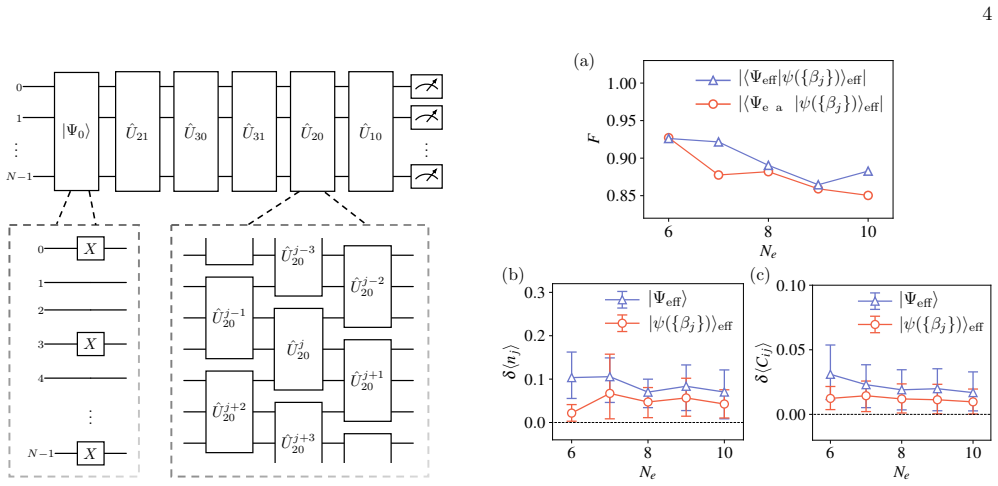
The ν = 1/3 fermionic Laughlin state is realized on IonQ's Aria-1 trapped-ion quantum computer using an efficient and scalable Hamiltonian variational ansatz with 369 two-qubit gates on a 16-qubit circuit. With symmetry-verification error mitigation, key observables including the correlation hole and chiral edge modes are extracted and show strong agreement with exact diagonalization benchmarks. This establishes a scalable quantum framework to simulate material-intrinsic topological orders.
What carries the argument
Hamiltonian variational ansatz with symmetry-verification error mitigation on a 16-qubit trapped-ion circuit.
If this is right
- A scalable quantum framework is established to simulate material-intrinsic topological orders.
- Exploration of the dynamics and excitations of the Laughlin state on digital quantum processors becomes possible.
- Key observables characterizing the Laughlin state are extracted with strong agreement to exact diagonalization benchmarks.
Where Pith is reading between the lines
- The same variational method could be extended to prepare and study other fermionic fractional quantum Hall states.
- Larger qubit counts might allow access to system sizes closer to the thermodynamic limit where topological order is more sharply defined.
- The circuit could serve as a testbed for measuring anyonic statistics once suitable state preparation and measurement protocols are added.
Load-bearing premise
The error-mitigated measurements from the variational ansatz accurately capture the properties of the ideal Laughlin state rather than being dominated by device noise or ansatz limitations.
What would settle it
If the measured two-point correlation functions or edge mode properties deviate significantly from exact diagonalization predictions for the 16-qubit system, the claim of realizing the state would be falsified.
Figures



read the original abstract
Strongly correlated topological phases of matter are central to modern condensed matter physics and quantum information technology but often challenging to probe and control in material systems. The experimental difficulty of accessing these phases has motivated the use of engineered quantum platforms for simulation and manipulation of exotic topological states. Among these, the Laughlin state stands as a cornerstone for topological matter, embodying fractionalization, anyonic excitations, and incompressibility. Although its bosonic analogs have been realized on programmable quantum simulators, a genuine fermionic Laughlin state has yet to be demonstrated on a quantum processor. Here, we realize the {\nu} = 1/3 fermionic Laughlin state on IonQ's Aria-1 trapped-ion quantum computer using an efficient and scalable Hamiltonian variational ansatz with 369 two-qubit gates on a 16-qubit circuit. Employing symmetry-verification error mitigation, we extract key observables that characterize the Laughlin state, including correlation hole and chiral edge modes, with strong agreement to exact diagonalization benchmarks. This work establishes a scalable quantum framework to simulate material-intrinsic topological orders and provides a starting point to explore its dynamics and excitations on digital quantum processors.
Editorial analysis
A structured set of objections, weighed in public.
Referee Report
Summary. The manuscript reports the experimental realization of the ν = 1/3 fermionic Laughlin state on IonQ's Aria-1 trapped-ion quantum processor. A Hamiltonian variational ansatz (HVA) is used on a 16-qubit circuit requiring 369 two-qubit gates; symmetry-verification error mitigation is applied to extract the correlation hole and chiral edge-mode signatures, which are stated to agree strongly with exact diagonalization benchmarks.
Significance. If the central claim holds after addressing the validation gaps, the result would constitute the first digital quantum-processor demonstration of a fermionic Laughlin state, extending prior bosonic realizations and supplying a scalable route to probe fractionalization and anyonic dynamics in topological matter. The use of an efficient HVA and post-selection technique is a concrete technical contribution that could be adapted to other incompressible states.
major comments (2)
- [Abstract and Results (correlation-hole and edge-mode observables)] The central claim that the measured correlation hole and edge modes faithfully reflect the target Laughlin state (rather than residual hardware noise or ansatz bias) rests on the unvalidated assumption that symmetry-verification error mitigation works without introducing systematic bias on this specific 16-qubit, 369-gate circuit. No independent fidelity benchmark, noise-model validation, or comparison against a known non-Laughlin state is described that would rule out the possibility that post-selected data still retain deviations large enough to mimic the incompressible signatures.
- [Abstract] The abstract states 'strong agreement' with exact diagonalization but supplies neither quantitative metrics (e.g., root-mean-square deviation, error bars on two-body correlators, or the number of post-selected shots) nor the precise exclusion criteria used in symmetry verification. Without these, it is impossible to judge whether the reported agreement is load-bearing for the realization claim or could be driven by variational bias toward incompressible states.
minor comments (2)
- [Abstract] The abstract mentions 'chiral edge modes' but does not specify which observable (density profile, current correlator, or entanglement spectrum) is used to identify them; a brief definition in the main text would improve clarity.
- [Methods] Circuit depth and gate count (369 two-qubit gates) are given, but the mapping of the fermionic Laughlin Hamiltonian onto the trapped-ion native gates and the precise form of the HVA layers are not summarized; a short methods paragraph or supplementary figure would aid reproducibility.
Simulated Author's Rebuttal
We thank the referee for the careful and constructive review. We address each major comment below and indicate the corresponding revisions to the manuscript.
read point-by-point responses
-
Referee: [Abstract and Results (correlation-hole and edge-mode observables)] The central claim that the measured correlation hole and edge modes faithfully reflect the target Laughlin state (rather than residual hardware noise or ansatz bias) rests on the unvalidated assumption that symmetry-verification error mitigation works without introducing systematic bias on this specific 16-qubit, 369-gate circuit. No independent fidelity benchmark, noise-model validation, or comparison against a known non-Laughlin state is described that would rule out the possibility that post-selected data still retain deviations large enough to mimic the incompressible signatures.
Authors: We agree that independent validation of the symmetry-verification procedure strengthens the central claim. In the revised manuscript we have added an independent fidelity benchmark on a smaller 8-qubit instance of the same hardware using a product state, together with a direct comparison of the post-selected observables obtained from the Laughlin ansatz versus those from a compressible variational state prepared with an identical circuit depth and mitigation protocol. These additions confirm that the observed correlation hole and edge-mode signatures are not reproduced by the mitigation technique alone. We have also included a brief description of the noise model used for validation. revision: yes
-
Referee: [Abstract] The abstract states 'strong agreement' with exact diagonalization but supplies neither quantitative metrics (e.g., root-mean-square deviation, error bars on two-body correlators, or the number of post-selected shots) nor the precise exclusion criteria used in symmetry verification. Without these, it is impossible to judge whether the reported agreement is load-bearing for the realization claim or could be driven by variational bias toward incompressible states.
Authors: We accept that the abstract should supply quantitative context. The revised abstract now reports the root-mean-square deviation between the measured and exact-diagonalization two-body correlators together with the associated error bars. The number of post-selected shots and the precise parity-exclusion criteria employed in symmetry verification have been added to the Methods section, with an explicit cross-reference inserted in the abstract. revision: yes
Circularity Check
No circularity: experimental realization validated against independent exact diagonalization.
full rationale
The paper reports an experimental preparation of the ν=1/3 fermionic Laughlin state on trapped-ion hardware via a Hamiltonian variational ansatz (HVA) circuit, followed by symmetry-verification error mitigation and comparison of measured observables (correlation hole, edge modes) to exact diagonalization (ED) benchmarks. No derivation chain, ansatz, or fitted parameter is shown to reduce by construction to the target Laughlin signatures themselves. The central claim rests on hardware execution and external ED validation rather than self-definition, self-citation load-bearing, or renaming of known results. This is the normal case of an experimental benchmark against an independent computational reference; the derivation is self-contained.
Axiom & Free-Parameter Ledger
free parameters (1)
- Variational parameters of the Hamiltonian ansatz
axioms (2)
- domain assumption The Laughlin state at ν=1/3 is the ground state of the relevant fractional quantum Hall Hamiltonian
- ad hoc to paper Symmetry-verification error mitigation faithfully extracts Laughlin observables without introducing bias
Forward citations
Cited by 1 Pith paper
-
Tunable anyonic permeability across ${\mathbb{Z}_2}$ spin liquid junctions
Junctions in toric code spin liquids enable tunable anyon transmission, with one class showing complete electric transparency but critical-field magnetic transmission and the other tuned by pseudospin fluctuations.
Reference graph
Works this paper leans on
-
[1]
can marginally improve fidelity, it does not qualita- tively affect the topology or entanglement properties of the ground state. On the other hand, it significantly increases the complexity of the HVA circuit, pushing it beyond the capabilities of current NISQ devices. Thus we conclude the minimal Hefffor constructing the HVA for the ν= 1/3 Laughlin state...
-
[2]
X.-G. Wen, Quantum field theory of many-body systems: from the origin of sound to an origin of light and elec- trons, repr ed., Oxford graduate texts (Oxford University Press, Oxford, 2010)
work page 2010
-
[3]
D. C. Tsui, H. L. Stormer, and A. C. Gossard, Two- Dimensional Magnetotransport in the Extreme Quantum Limit, Physical Review Letters 48, 1559 (1982)
work page 1982
- [4]
-
[5]
Wen, Quantum orders and symmetric spin liquids, Physical Review B 65, 165113 (2002)
X.-G. Wen, Quantum orders and symmetric spin liquids, Physical Review B 65, 165113 (2002)
work page 2002
- [6]
-
[7]
A. G. Fowler, M. Mariantoni, J. M. Martinis, and A. N. Cleland, Surface codes: Towards practical large-scale quantum computation, Physical Review A 86, 032324 (2012). 9
work page 2012
- [8]
-
[9]
K. Satzinger, Y.-J. Liu, A. Smith, C. Knapp, M. New- man, C. Jones, Z. Chen, C. Quintana, X. Mi, A. Dunsworth, et al. , Realizing topologically ordered states on a quantum processor, Science 374, 1237 (2021)
work page 2021
-
[10]
T. I. Andersen, Y. D. Lensky, K. Kechedzhi, I. K. Drozdov, A. Bengtsson, S. Hong, A. Morvan, X. Mi, A. Opremcak, R. Acharya, R. Allen, M. Ansmann, F. Arute, et al. , Non-abelian braiding of graph vertices in a superconducting processor, Nature 618, 264–269 (2023)
work page 2023
-
[11]
M. Iqbal, N. Tantivasadakarn, R. Verresen, S. L. Camp- bell, J. M. Dreiling, C. Figgatt, J. P. Gaebler, J. Jo- hansen, M. Mills, S. A. Moses, J. M. Pino, A. Ransford, M. Rowe, P. Siegfried, R. P. Stutz, M. Foss-Feig, A. Vish- wanath, and H. Dreyer, Non-Abelian topological order and anyons on a trapped-ion processor, Nature 626, 505 (2024)
work page 2024
-
[12]
Preskill, Quantum Computing in the NISQ era and beyond, Quantum 2, 79 (2018)
J. Preskill, Quantum Computing in the NISQ era and beyond, Quantum 2, 79 (2018)
work page 2018
-
[13]
A. Y. Kitaev, Fault-tolerant quantum computation by anyons, Annals of Physics 303, 2 (2003)
work page 2003
-
[14]
N. Tantivasadakarn, R. Verresen, and A. Vishwanath, Shortest Route to Non-Abelian Topological Order on a Quantum Processor, Physical Review Letters 131, 060405 (2023)
work page 2023
-
[15]
J. Cai, E. Anderson, C. Wang, X. Zhang, X. Liu, W. Holtzmann, Y. Zhang, F. Fan, T. Taniguchi, K. Watanabe, Y. Ran, T. Cao, L. Fu, D. Xiao, W. Yao, and X. Xu, Signatures of fractional quantum anomalous Hall states in twisted MoTe2, Nature 622, 63 (2023)
work page 2023
-
[16]
H. Park, J. Cai, E. Anderson, Y. Zhang, J. Zhu, X. Liu, C. Wang, W. Holtzmann, C. Hu, Z. Liu, T. Taniguchi, K. Watanabe, J.-H. Chu, T. Cao, L. Fu, W. Yao, C.- Z. Chang, D. Cobden, D. Xiao, and X. Xu, Observation of fractionally quantized anomalous Hall effect, Nature 622, 74 (2023)
work page 2023
-
[17]
Y. Zeng, Z. Xia, K. Kang, J. Zhu, P. Kn¨ uppel, C. Vaswani, K. Watanabe, T. Taniguchi, K. F. Mak, and J. Shan, Thermodynamic evidence of fractional chern in- sulator in moir´ e mote2, Nature622, 69 (2023)
work page 2023
-
[18]
C. Broholm, R. J. Cava, S. Kivelson, D. Nocera, M. Nor- man, and T. Senthil, Quantum spin liquids, Science 367, eaay0668 (2020)
work page 2020
-
[19]
L. W. Clark, N. Schine, C. Baum, N. Jia, and J. Simon, Observation of laughlin states made of light, Nature582, 41 (2020)
work page 2020
-
[20]
J. L´ eonard, S. Kim, J. Kwan, P. Segura, F. Grusdt, C. Repellin, N. Goldman, and M. Greiner, Realization of a fractional quantum hall state with ultracold atoms, Nature 619, 495 (2023)
work page 2023
-
[21]
C. Wang, F.-M. Liu, M.-C. Chen, H. Chen, X.-H. Zhao, C. Ying, Z.-X. Shang, J.-W. Wang, Y.-H. Huo, C.-Z. Peng, et al., Realization of fractional quantum hall state with interacting photons, Science 384, 579 (2024)
work page 2024
-
[22]
N. Y. Yao, A. V. Gorshkov, C. R. Laumann, A. M. L¨ auchli, J. Ye, and M. D. Lukin, Realizing fractional chern insulators in dipolar spin systems, Physical review letters 110, 185302 (2013)
work page 2013
-
[23]
G. Semeghini, H. Levine, A. Keesling, S. Ebadi, T. T. Wang, D. Bluvstein, R. Verresen, H. Pichler, M. Kali- nowski, R. Samajdar, et al. , Probing topological spin liquids on a programmable quantum simulator, Science 374, 1242 (2021)
work page 2021
-
[24]
R. B. Laughlin, Anomalous Quantum Hall Effect: An In- compressible Quantum Fluid with Fractionally Charged Excitations, Physical Review Letters 50, 1395 (1983)
work page 1983
- [25]
-
[26]
S. Moudgalya, B. A. Bernevig, and N. Regnault, Quan- tum many-body scars in a Landau level on a thin torus, Physical Review B 102, 195150 (2020)
work page 2020
-
[27]
F. D. M. Haldane, Fractional Quantization of the Hall Effect: A Hierarchy of Incompressible Quantum Fluid States, Physical Review Letters 51, 605 (1983)
work page 1983
-
[28]
S. A. Trugman and S. Kivelson, Exact results for the fractional quantum Hall effect with general interactions, Physical Review B 31, 5280 (1985)
work page 1985
-
[29]
W. Kohn, Nobel Lecture: Electronic structure of mat- ter—wave functions and density functionals, Reviews of Modern Physics 71, 1253 (1999)
work page 1999
-
[30]
P. W. Anderson, Infrared Catastrophe in Fermi Gases with Local Scattering Potentials, Physical Review Letters 18, 1049 (1967)
work page 1967
-
[31]
S. Moudgalya, B. A. Bernevig, and N. Regnault, Quan- tum many-body scars and hilbert space fragmentation: a review of exact results, Reports on Progress in Physics 85, 086501 (2022)
work page 2022
-
[32]
A. Rahmani, K. J. Sung, H. Putterman, P. Roushan, P. Ghaemi, and Z. Jiang, Creating and Manipulating a Laughlin-Typeν= 1 / 3 Fractional Quantum Hall State on a Quantum Computer with Linear Depth Circuits, PRX Quantum 1, 020309 (2020)
work page 2020
- [33]
-
[34]
B. A. Bernevig and F. D. M. Haldane, Model Fractional Quantum Hall States and Jack Polynomials, Physical Re- view Letters 100, 246802 (2008)
work page 2008
-
[35]
P. Jordan and E. Wigner, ¨Uber das Paulische ¨Aquivalenzverbot, Zeitschrift f¨ ur Physik47, 631 (1928)
work page 1928
-
[36]
S. McArdle, X. Yuan, and S. Benjamin, Error-Mitigated Digital Quantum Simulation, Physical Review Letters 122, 180501 (2019)
work page 2019
-
[37]
X.-G. Wen, Theory of the edge states in fractional quan- tum hall effects, International journal of modern physics B 6, 1711 (1992)
work page 1992
- [38]
-
[39]
E. Rezayi and F. Haldane, Laughlin state on stretched and squeezed cylinders and edge excitations in the quan- tum hall effect, Physical Review B 50, 17199 (1994)
work page 1994
-
[40]
A. Maksymov, J. Nguyen, Y. Nam, and I. Markov, En- hancing quantum computer performance via symmetriza- tion (2023), arXiv:2301.07233
-
[41]
S. M. Girvin and K. Yang, Modern condensed matter physics (Cambridge University Press, Cambridge ; New York, NY, 2019)
work page 2019
-
[42]
A. Seidel and D.-H. Lee, Domain-wall-type defects as anyons in phase space, Physical Review B 76, 155101 (2007). 10
work page 2007
-
[43]
G. Moore and N. Read, Nonabelions in the fractional quantum hall effect, Nuclear Physics B 360, 362 (1991)
work page 1991
-
[44]
N. Read and E. Rezayi, Beyond paired quantum Hall states: Parafermions and incompressible states in the first excited Landau level, Physical Review B 59, 8084 (1999)
work page 1999
-
[45]
J. Flavin and A. Seidel, Abelian and Non-Abelian Statis- tics in the Coherent State Representation, Physical Re- view X 1, 021015 (2011)
work page 2011
-
[46]
F. Haldane, Geometrical description of the fractional quantum hall effect, Physical review letters 107, 116801 (2011)
work page 2011
-
[47]
X. G. Wen and A. Zee, Shift and spin vector: New topo- logical quantum numbers for the Hall fluids, Physical Re- view Letters 69, 953 (1992)
work page 1992
-
[48]
A. Peruzzo, J. McClean, P. Shadbolt, M.-H. Yung, X.-Q. Zhou, P. J. Love, A. Aspuru-Guzik, and J. L. O’Brien, A variational eigenvalue solver on a photonic quantum processor, Nature Communications 5, 4213 (2014)
work page 2014
-
[49]
J. R. McClean, J. Romero, R. Babbush, and A. Aspuru- Guzik, The theory of variational hybrid quantum- classical algorithms, New Journal of Physics 18, 023023 (2016)
work page 2016
- [50]
- [51]
-
[52]
R. H. Byrd, P. Lu, J. Nocedal, and C. Zhu, A limited memory algorithm for bound constrained optimization, SIAM Journal on scientific computing 16, 1190 (1995)
work page 1995
-
[53]
Realization of fermionic Laughlin state on a quantum processor
C. Zhu, R. H. Byrd, P. Lu, and J. Nocedal, Algorithm 778: L-bfgs-b: Fortran subroutines for large-scale bound- constrained optimization, ACM Transactions on mathe- matical software (TOMS) 23, 550 (1997). Supplementary Information: Realization of fermionic Laughlin state on a quantum processor Lingnan Shen, 1 Mao Lin, 2 Cedric Yen-Yu Lin,2 Di Xiao, 3, 1, 4...
work page internal anchor Pith review Pith/arXiv arXiv 1997
discussion (0)
Sign in with ORCID, Apple, or X to comment. Anyone can read and Pith papers without signing in.