On the definition and importance of interpretability in scientific machine learning
Pith reviewed 2026-05-22 14:04 UTC · model grok-4.3
The pith
Interpretability in scientific machine learning means grasping physical mechanisms rather than seeking sparse equations.
A machine-rendered reading of the paper's core claim, the machinery that carries it, and where it could break.
Core claim
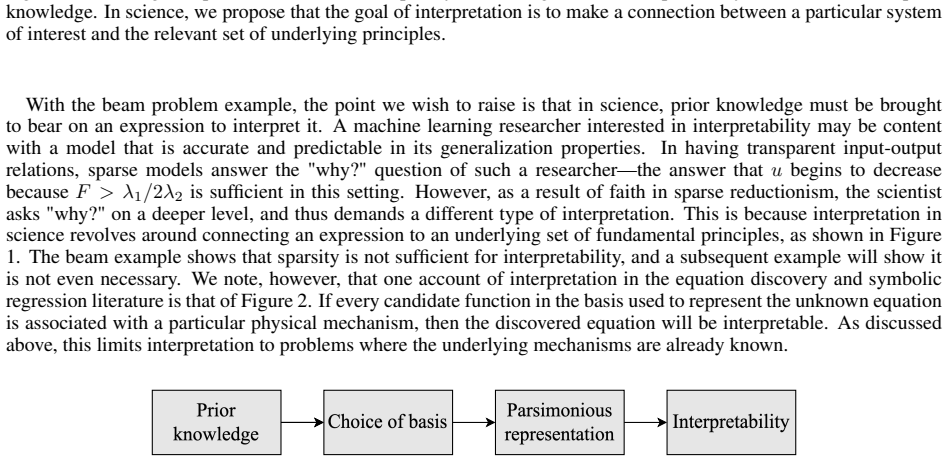
The authors argue that definitions and methods from general interpretable machine learning are inadequate for scientific machine learning, particularly equation discovery and symbolic regression. They propose instead an operational definition of interpretability for the physical sciences that prioritizes understanding of the mechanism over mathematical sparsity. This emphasis reveals that sparsity is often unnecessary and raises doubts about the feasibility of interpretable scientific discovery in the absence of prior knowledge.
What carries the argument
Operational definition of interpretability that emphasizes mechanism understanding over sparsity, used to evaluate and redirect research priorities in scientific equation discovery.
If this is right
- Sparsity in discovered equations does not by itself ensure the model can be integrated into scientific knowledge.
- Scientific machine learning efforts should incorporate prior physical knowledge to enable mechanistic interpretability.
- Research should shift focus from sparsity-promoting techniques toward methods that expose causal or physical mechanisms.
- Purely data-driven symbolic regression may not achieve interpretable scientific insights without built-in domain constraints.
Where Pith is reading between the lines
- Evaluation of SciML models could include tests for how well their outputs map onto known physical mechanisms rather than just predictive accuracy or sparsity metrics.
- This view connects to broader questions in automated scientific discovery about when data suffices versus when structured priors are essential.
- Tool development for symbolic regression might need to embed mechanism-extraction modules that operate even on non-sparse representations.
Load-bearing premise
That standard definitions from general interpretable machine learning cannot meet the distinct needs of physical sciences and equation discovery, so a new mechanism-centered definition is required.
What would settle it
A concrete case in which a sparse but non-mechanistic model from data alone yields a new, verifiable physical law that integrates into existing scientific theory without additional prior knowledge.
Figures



read the original abstract
Though neural networks trained on large datasets have been successfully used to describe and predict many physical phenomena, there is a sense among scientists that, unlike traditional scientific models comprising simple mathematical expressions, their findings cannot be integrated into the body of scientific knowledge. Critics of machine learning's inability to produce human-understandable relationships have converged on the concept of "interpretability" as its point of departure from more traditional forms of science. As the growing interest in interpretability has shown, researchers in the physical sciences seek not just predictive models, but also to uncover the fundamental principles that govern a system of interest. However, clarity around a definition of interpretability and the precise role that it plays in science is lacking in the literature. In this work, we argue that researchers in equation discovery and symbolic regression tend to conflate the concept of sparsity with interpretability. We review key papers on interpretable machine learning from outside the scientific community and argue that, though the definitions and methods they propose can inform questions of interpretability for scientific machine learning (SciML), they are inadequate for this new purpose. Noting these deficiencies, we propose an operational definition of interpretability for the physical sciences. Our notion of interpretability emphasizes understanding of the mechanism over mathematical sparsity. Innocuous though it may seem, this emphasis on mechanism shows that sparsity is often unnecessary. It also questions the possibility of interpretable scientific discovery when prior knowledge is lacking. We believe a precise and philosophically informed definition of interpretability in SciML will help focus research efforts toward the most significant obstacles to realizing a data-driven scientific future.
Editorial analysis
A structured set of objections, weighed in public.
Referee Report
Summary. The paper claims that researchers in equation discovery and symbolic regression for scientific machine learning (SciML) often conflate sparsity with interpretability. After reviewing key papers from the general interpretable machine learning (IML) literature, it argues that those definitions and methods are inadequate for the needs of the physical sciences. The authors propose a new operational definition of interpretability that emphasizes understanding of the underlying mechanism rather than mathematical sparsity. This emphasis implies that sparsity is frequently unnecessary and that truly interpretable scientific discovery is not possible without prior knowledge.
Significance. If the proposed distinction between mechanism-focused interpretability and sparsity holds and can be operationalized, the work could help redirect SciML research away from purely sparse symbolic models toward methods that better support integration with existing scientific knowledge. The literature review provides a useful synthesis, but the absence of concrete examples or validation limits the immediate impact.
major comments (2)
- [Proposed definition of interpretability for SciML] The section introducing the proposed operational definition states that interpretability 'emphasizes understanding of the mechanism over mathematical sparsity' but supplies no explicit, repeatable criteria for determining when mechanistic understanding has been achieved or how it differs operationally from post-hoc inspection methods already present in the reviewed IML literature. Without such criteria, the subsequent claims that sparsity is often unnecessary and that prior knowledge is required for interpretable discovery rest on an under-specified foundation.
- [Literature review and motivation] The argument that general IML definitions are inadequate for SciML (Introduction and literature review sections) is supported only by conceptual comparison rather than by demonstrating a concrete failure case in which an existing IML method produces a sparse but non-mechanistic model that cannot be integrated into scientific knowledge. A worked example would strengthen the load-bearing claim that a new definition is required.
minor comments (2)
- [Abstract and Introduction] The abstract and introduction use 'operational definition' without clarifying whether the definition is intended to be directly testable or merely conceptually sharper; a brief clarification would improve precision.
- [Review of interpretable machine learning literature] Several citations to IML papers are summarized at a high level; adding one or two sentences on the precise limitation each paper exhibits for equation discovery would make the critique more targeted.
Simulated Author's Rebuttal
We thank the referee for their constructive and insightful comments on our manuscript. We have carefully reviewed the major comments and provide detailed point-by-point responses below. Where appropriate, we have made revisions to address the concerns raised while preserving the core arguments of the work.
read point-by-point responses
-
Referee: [Proposed definition of interpretability for SciML] The section introducing the proposed operational definition states that interpretability 'emphasizes understanding of the mechanism over mathematical sparsity' but supplies no explicit, repeatable criteria for determining when mechanistic understanding has been achieved or how it differs operationally from post-hoc inspection methods already present in the reviewed IML literature. Without such criteria, the subsequent claims that sparsity is often unnecessary and that prior knowledge is required for interpretable discovery rest on an under-specified foundation.
Authors: We appreciate the referee's observation that the operational definition would be strengthened by more explicit criteria. Our definition frames interpretability in SciML as the achievement of mechanistic understanding that permits direct integration with existing scientific knowledge, as opposed to post-hoc explanations of black-box models. This is operationalized through the requirement that the resulting model must be consistent with known physical principles and enable hypothesis generation within the scientific domain. We acknowledge that the original presentation could have made the distinction from post-hoc methods more precise. In the revised manuscript, we have expanded the relevant section to include repeatable criteria: (i) the discovered relation must align with or derive from established theoretical frameworks, (ii) it must support extrapolation consistent with physical constraints, and (iii) it must facilitate new, testable predictions within the scientific literature. These criteria differentiate our approach by requiring prior knowledge to be incorporated during model construction rather than applied after the fact. This revision directly supports our claims regarding the role of prior knowledge and the frequent superfluity of sparsity. revision: yes
-
Referee: [Literature review and motivation] The argument that general IML definitions are inadequate for SciML (Introduction and literature review sections) is supported only by conceptual comparison rather than by demonstrating a concrete failure case in which an existing IML method produces a sparse but non-mechanistic model that cannot be integrated into scientific knowledge. A worked example would strengthen the load-bearing claim that a new definition is required.
Authors: The referee correctly identifies that our critique of existing IML methods for SciML applications rests primarily on conceptual analysis. While we believe the distinctions drawn from the reviewed literature are substantive, we agree that a concrete illustration would make the motivation more compelling. We have therefore added a worked example to the revised manuscript. The example considers a sparse symbolic regression result obtained on a physical system (e.g., a damped oscillator) that yields a compact expression lacking any connection to underlying physical mechanisms such as energy dissipation or force laws. This model, although sparse and accurate within the training regime, cannot be integrated into the body of scientific knowledge without substantial additional prior information. In contrast, an approach that embeds domain knowledge produces a relation that directly corresponds to known mechanistic components. This addition demonstrates a specific failure mode of sparsity-focused methods and reinforces the necessity of our proposed definition. revision: yes
Circularity Check
No significant circularity in definitional proposal
full rationale
The paper advances a conceptual argument by reviewing external interpretable ML literature, noting the conflation of sparsity with interpretability in equation discovery, and proposing an operational definition centered on mechanistic understanding. No equations, parameter fits, predictions, or self-citations appear in the provided text to support the central claims. The distinctions drawn rely on cited outside sources rather than reducing any result to the paper's own inputs or prior work by the same authors. This leaves the derivation self-contained as a philosophical reframing without circular reduction.
Axiom & Free-Parameter Ledger
axioms (1)
- domain assumption Scientific knowledge requires models that can be integrated into the existing body of understanding through human-understandable relationships and mechanisms.
Lean theorems connected to this paper
-
IndisputableMonolith/Cost/FunctionalEquation.leanwashburn_uniqueness_aczel echoes?
echoesECHOES: this paper passage has the same mathematical shape or conceptual pattern as the Recognition theorem, but is not a direct formal dependency.
Our notion of interpretability emphasizes understanding of the mechanism over mathematical sparsity... It also questions the possibility of interpretable scientific discovery when prior knowledge is lacking.
-
IndisputableMonolith/Foundation/AbsoluteFloorClosure.leanabsolute_floor_iff_bare_distinguishability echoes?
echoesECHOES: this paper passage has the same mathematical shape or conceptual pattern as the Recognition theorem, but is not a direct formal dependency.
a learned model is interpretable when it can either be derived from basic physical principles or it represents an empirical component of a model derived from basic physical principles.
What do these tags mean?
- matches
- The paper's claim is directly supported by a theorem in the formal canon.
- supports
- The theorem supports part of the paper's argument, but the paper may add assumptions or extra steps.
- extends
- The paper goes beyond the formal theorem; the theorem is a base layer rather than the whole result.
- uses
- The paper appears to rely on the theorem as machinery.
- contradicts
- The paper's claim conflicts with a theorem or certificate in the canon.
- unclear
- Pith found a possible connection, but the passage is too broad, indirect, or ambiguous to say the theorem truly supports the claim.
Reference graph
Works this paper leans on
-
[1]
Symbolic regression for scientific discovery: an application to wind speed forecasting, October 2021
Ismail Alaoui Abdellaoui and Siamak Mehrkanoon. Symbolic regression for scientific discovery: an application to wind speed forecasting, October 2021. arXiv:2102.10570 [cs]
-
[2]
Harsh Ahlawat, Naveen Aggarwal, and Deepti Gupta. Automatic Speech Recognition: A survey of deep learning techniques and approaches.International Journal of Cognitive Computing in Engineering, 6:201–237, December 2025
work page 2025
-
[3]
The History Began from AlexNet: A Comprehensive Survey on Deep Learning Approaches
Md Zahangir Alom, Tarek M. Taha, Christopher Yakopcic, Stefan Westberg, Paheding Sidike, Mst Shamima Nasrin, Brian C. Van Esesn, Abdul A. S. Awwal, and Vijayan K. Asari. The History Began from AlexNet: A Comprehensive Survey on Deep Learning Approaches, September 2018. arXiv:1803.01164 [cs]
work page internal anchor Pith review Pith/arXiv arXiv 2018
-
[4]
P. W. Anderson. More Is Different.Science, 177(4047):393–396, August 1972
work page 1972
-
[5]
Mechanistic Interpretability for AI Safety -- A Review
Leonard Bereska and Efstratios Gavves. Mechanistic Interpretability for AI Safety – A Review, August 2024. arXiv:2404.14082 [cs]
work page internal anchor Pith review arXiv 2024
-
[6]
Josh Bongard and Hod Lipson. Automated reverse engineering of nonlinear dynamical systems.Proceedings of the National Academy of Sciences of the United States of America, 104(24):9943–9948, June 2007
work page 2007
-
[7]
Mieke Boon and Sophie van Baalen. An Epistemological Shift: From Evidence-Based Medicine to Epistemo- logical Responsibility.ResearchGate, October 2024
work page 2024
-
[8]
Leo Breiman, Jerome Friedman, Charles J. Stone, and R. A. Olshen.Classification and Regression Trees. Taylor & Francis, January 1984
work page 1984
-
[9]
Steven L. Brunton, Joshua L. Proctor, and J. Nathan Kutz. Discovering governing equations from data by sparse identification of nonlinear dynamical systems.Proceedings of the National Academy of Sciences, 113(15):3932– 3937, April 2016
work page 2016
-
[10]
LNO: Laplace Neural Operator for Solving Differential Equations, May 2023
Qianying Cao, Somdatta Goswami, and George Em Karniadakis. LNO: Laplace Neural Operator for Solving Differential Equations, May 2023. arXiv:2303.10528 [cs]
-
[11]
New York, Basic Books, Inc, 1966
Rudolf Carnap.Philosophical foundations of physics; an introduction to the philosophy of science. New York, Basic Books, Inc, 1966
work page 1966
-
[12]
Kathleen Champion, Bethany Lusch, J. Nathan Kutz, and Steven L. Brunton. Data-driven discovery of co- ordinates and governing equations.Proceedings of the National Academy of Sciences, 116(45):22445–22451, November 2019
work page 2019
-
[13]
Ricky T. Q. Chen, Yulia Rubanova, Jesse Bettencourt, and David Duvenaud. Neural Ordinary Differential Equa- tions, December 2019. arXiv:1806.07366 [cs]
work page internal anchor Pith review Pith/arXiv arXiv 2019
-
[14]
Interpretable Machine Learning for Science with PySR and SymbolicRegression.jl
Miles Cranmer. Interpretable Machine Learning for Science with PySR and SymbolicRegression.jl, May 2023. arXiv:2305.01582 [astro-ph]
work page internal anchor Pith review Pith/arXiv arXiv 2023
-
[15]
The Next Great Scientific Theory is Hiding Inside a Neural Network, April 2024
Miles Cranmer. The Next Great Scientific Theory is Hiding Inside a Neural Network, April 2024
work page 2024
-
[16]
Charles B. Delahunt and J. Nathan Kutz. A toolkit for data-driven discovery of governing equations in high-noise regimes, December 2021. arXiv:2111.04870 [cs]
-
[17]
Saaketh Desai and Alejandro Strachan. Parsimonious neural networks learn interpretable physical laws.Scientific Reports, 11(1):12761, June 2021
work page 2021
- [18]
-
[19]
Towards A Rigorous Science of Interpretable Machine Learning, March
Finale Doshi-Velez and Been Kim. Towards A Rigorous Science of Interpretable Machine Learning, March
-
[20]
arXiv:1702.08608 [stat]
work page internal anchor Pith review Pith/arXiv arXiv
-
[21]
The Tyranny of Science.History of Philosophy & Logical Analysis, 16(1), 2013
Paul Feyerabend. The Tyranny of Science.History of Philosophy & Logical Analysis, 16(1), 2013
work page 2013
-
[22]
Moritz Flaschel, Siddhant Kumar, and Laura De Lorenzis. Unsupervised discovery of interpretable hyperelastic constitutive laws.Computer Methods in Applied Mechanics and Engineering, 381:113852, August 2021
work page 2021
-
[23]
LaSDI: Parametric Latent Space Dynamics Identification
William Fries, Xiaolong He, and Youngsoo Choi. LaSDI: Parametric Latent Space Dynamics Identification. Computer Methods in Applied Mechanics and Engineering, 399:115436, September 2022. arXiv:2203.02076 [math]
-
[24]
Jan N. Fuhg, Reese E. Jones, and Nikolaos Bouklas. Extreme sparsification of physics-augmented neural net- works for interpretable model discovery in mechanics, October 2023. arXiv:2310.03652 [cs]. 16
-
[25]
Karl Garbrecht, Miguel Aguilo, Allen Sanderson, Anthony Rollett, Robert M. Kirby, and Jacob Hochhalter. Interpretable Machine Learning for Texture-Dependent Constitutive Models with Automatic Code Generation for Topological Optimization.Integrating Materials and Manufacturing Innovation, 10(3):373–392, September 2021
work page 2021
-
[26]
Investigating the Duality of Interpretabil- ity and Explainability in Machine Learning
Moncef Garouani, Josiane Mothe, Ayah Barhrhouj, and Julien Aligon. Investigating the Duality of Interpretabil- ity and Explainability in Machine Learning. In2024 IEEE 36th International Conference on Tools with Artificial Intelligence (ICTAI), pages 861–867, October 2024. arXiv:2503.21356 [cs]
-
[27]
Explaining Explanations: An Overview of Interpretability of Machine Learning
Leilani H. Gilpin, David Bau, Ben Z. Yuan, Ayesha Bajwa, Michael Specter, and Lalana Kagal. Explaining Explanations: An Overview of Interpretability of Machine Learning, February 2019. arXiv:1806.00069 [cs]
work page internal anchor Pith review Pith/arXiv arXiv 2019
-
[28]
European Union regulations on algorithmic decision-making and a "right to explanation"
Bryce Goodman and Seth Flaxman. European Union regulations on algorithmic decision-making and a "right to explanation".AI Magazine, 38(3):50–57, September 2017. arXiv:1606.08813 [stat]
work page internal anchor Pith review Pith/arXiv arXiv 2017
-
[29]
Massucci, Manuel Miranda, Jordi Pal- lares, and Marta Sales-Pardo
Roger Guimera, Ignasi Reichardt, Antoni Aguilar-Mogas, Francesco A. Massucci, Manuel Miranda, Jordi Pal- lares, and Marta Sales-Pardo. A Bayesian machine scientist to aid in the solution of challenging scientific problems.Science Advances, 6(5):eaav6971, January 2020. arXiv:2004.12157 [cs]
-
[30]
Explanation in Science and in History
Carl G Hempel and James H Fetzer. Explanation in Science and in History. In Carl G Hempel and James H Fetzer, editors,The Philosophy of Carl G. Hempel: Studies in Science, Explanation, and Rationality, page 0. Oxford University Press, January 2001
work page 2001
-
[31]
Leah Henderson. The Problem of Induction. In Edward N. Zalta and Uri Nodelman, editors,The Stanford Encyclopedia of Philosophy. Metaphysics Research Lab, Stanford University, winter 2024 edition, 2024
work page 2024
-
[32]
(John Henry) Holland.Hidden order : how adaptation builds complexity
John H. (John Henry) Holland.Hidden order : how adaptation builds complexity. Cambridge, Mass. : Perseus Books, 1996
work page 1996
-
[33]
J. H. Irving and John G. Kirkwood. The Statistical Mechanical Theory of Transport Processes. IV. The Equations of Hydrodynamics.Journal of Chemical Physics, 18:817–829, June 1950. ADS Bibcode: 1950JChPh..18..817I
work page 1950
-
[34]
Thesis, Massachusetts Institute of Technology, 2015
Been Kim.Interactive and interpretable machine learning models for human machine collaboration. Thesis, Massachusetts Institute of Technology, 2015. Accepted: 2015-09-17T19:04:25Z
work page 2015
-
[35]
EXPLANATORY UNIFICATION.Philosophy of Science, 1981
Philip Kitcher. EXPLANATORY UNIFICATION.Philosophy of Science, 1981
work page 1981
-
[36]
Does Deep Blue use AI?AAAI Technical Report, 1997
Richard Korf. Does Deep Blue use AI?AAAI Technical Report, 1997
work page 1997
-
[37]
(PDF) Artificial Intelligence in Self Driving Cars: Applica- tions, Implications and Challenges
Manu Ks, Devanshi Mehta, and Karnati Akshitha. (PDF) Artificial Intelligence in Self Driving Cars: Applica- tions, Implications and Challenges
-
[38]
Kuhn.The Structure of Scientific Revolutions: 50th Anniversary Edition
Thomas S. Kuhn.The Structure of Scientific Revolutions: 50th Anniversary Edition. University of Chicago Press, Chicago, IL, April 2012
work page 2012
-
[39]
Rediscovering orbital mechanics with machine learning, February 2022
Pablo Lemos, Niall Jeffrey, Miles Cranmer, Shirley Ho, and Peter Battaglia. Rediscovering orbital mechanics with machine learning, February 2022. arXiv:2202.02306 [astro-ph]
-
[40]
Will artificial intelligence ever discover new laws of physics?, 2022
Thomas Lewton. Will artificial intelligence ever discover new laws of physics?, 2022
work page 2022
-
[41]
Qingliang Li, Cheng Zhang, Zhongwang Wei, Xiaochun Jin, Wei Shangguan, Hua Yuan, Jinlong Zhu, Lu Li, Pingping Liu, Xiao Chen, Yuguang Yan, and Yongjiu Dai. Advancing symbolic regression for earth science with a focus on evapotranspiration modeling.npj Climate and Atmospheric Science, 7(1):1–16, December 2024
work page 2024
-
[42]
Fourier Neural Operator for Parametric Partial Differential Equations
Zongyi Li, Nikola Kovachki, Kamyar Azizzadenesheli, Burigede Liu, Kaushik Bhattacharya, Andrew Stuart, and Anima Anandkumar. Fourier Neural Operator for Parametric Partial Differential Equations, May 2021. arXiv:2010.08895 [cs]
work page internal anchor Pith review Pith/arXiv arXiv 2021
-
[43]
Robert K. Lindsay, Bruce G. Buchanan, Edward A. Feigenbaum, and Joshua Lederberg. DENDRAL: A case study of the first expert system for scientific hypothesis formation.Artificial Intelligence, 61(2):209–261, June 1993
work page 1993
-
[44]
Zachary C. Lipton. The Mythos of Model Interpretability, March 2017. arXiv:1606.03490 [cs]
work page internal anchor Pith review Pith/arXiv arXiv 2017
-
[45]
Lu Lu, Pengzhan Jin, and George Em Karniadakis. DeepONet: Learning nonlinear operators for identifying differential equations based on the universal approximation theorem of operators.Nature Machine Intelligence, 3(3):218–229, March 2021. arXiv:1910.03193 [cs]
work page internal anchor Pith review Pith/arXiv arXiv 2021
-
[46]
Lu, Joan Ariño Bernad, and Marin Solja ˇci´c
Peter Y . Lu, Joan Ariño Bernad, and Marin Solja ˇci´c. Discovering sparse interpretable dynamics from partial observations.Communications Physics, 5(1):1–7, August 2022
work page 2022
-
[47]
Nour Makke and Sanjay Chawla. Interpretable scientific discovery with symbolic regression: a review.Artificial Intelligence Review, 57(1):2, January 2024. 17
work page 2024
-
[48]
Ri ˇcards Marcinkevi ˇcs and Julia E. V ogt. Interpretable and explainable machine learning: A methods-centric overview with concrete examples.WIREs Data Mining and Knowledge Discovery, 13(3):e1493, 2023. _eprint: https://onlinelibrary.wiley.com/doi/pdf/10.1002/widm.1493
-
[49]
Gemma Massonis, Alejandro F. Villaverde, and Julio R. Banga. Distilling identifiable and interpretable dynamic models from biological data.PLOS Computational Biology, 19(10):e1011014, October 2023
work page 2023
-
[50]
Neural Green's Operators for Parametric Partial Differential Equations
Hugo Melchers, Joost Prins, and Michael Abdelmalik. Neural Green’s Operators for Parametric Partial Differ- ential Equations, February 2025. arXiv:2406.01857 [cs]
work page internal anchor Pith review Pith/arXiv arXiv 2025
-
[51]
Interpretable Machine Learning, 2025
Cristoph Molnar. Interpretable Machine Learning, 2025
work page 2025
-
[52]
Morowitz.The Emergence of Everything: How the World Became Complex
Harold J. Morowitz.The Emergence of Everything: How the World Became Complex. Oxford University Press, USA, November 2002. Google-Books-ID: CbCHoV3Un4YC
work page 2002
-
[53]
James Murdoch, Chandan Singh, Karl Kumbier, Reza Abbasi-Asl, and Bin Yu
W. James Murdoch, Chandan Singh, Karl Kumbier, Reza Abbasi-Asl, and Bin Yu. Definitions, methods, and ap- plications in interpretable machine learning.Proceedings of the National Academy of Sciences, 116(44):22071– 22080, October 2019
work page 2019
-
[54]
The Physicist Working to Build Science-Literate AI, February 2025
John Pavlus. The Physicist Working to Build Science-Literate AI, February 2025
work page 2025
-
[55]
Willard V . O. Quine. Two Dogmas of Empiricism.Philosophical Review, 60(1):20–43, 1951. Publisher: New York: Harper Torchbooks
work page 1951
-
[56]
Deep Hidden Physics Models: Deep Learning of Nonlinear Partial Differential Equations, January
Maziar Raissi. Deep Hidden Physics Models: Deep Learning of Nonlinear Partial Differential Equations, January
-
[57]
arXiv:1801.06637 [stat]
work page internal anchor Pith review Pith/arXiv arXiv
-
[58]
Nisal Ranasinghe, Damith Senanayake, Sachith Seneviratne, Malin Premaratne, and Saman Halgamuge. GINN- LP: A Growing Interpretable Neural Network for Discovering Multivariate Laurent Polynomial Equations, February 2024. arXiv:2312.10913 [cs]
-
[59]
Deepjyoti Roy and Mala Dutta. A systematic review and research perspective on recommender systems.Journal of Big Data, 9(1):59, May 2022
work page 2022
-
[60]
Interpretable Machine Learning: Fundamental Principles and 10 Grand Challenges, July 2021
Cynthia Rudin, Chaofan Chen, Zhi Chen, Haiyang Huang, Lesia Semenova, and Chudi Zhong. Interpretable Machine Learning: Fundamental Principles and 10 Grand Challenges, July 2021. arXiv:2103.11251 [cs]
-
[61]
Data-driven discovery of partial differential equations
Samuel H. Rudy, Steven L. Brunton, Joshua L. Proctor, and J. Nathan Kutz. Data-driven discovery of partial differential equations, September 2016. arXiv:1609.06401 [nlin]
work page internal anchor Pith review Pith/arXiv arXiv 2016
-
[62]
Mahmoud, Akramul Azim, Gary Bauer, and Ian Bowles
Paria Sarzaeim, Qusay H. Mahmoud, Akramul Azim, Gary Bauer, and Ian Bowles. A Systematic Review of Using Machine Learning and Natural Language Processing in Smart Policing.Computers, 12(12):255, December
-
[63]
Distilling Free-Form Natural Laws from Experimental Data.Science, 324(5923):81–85, April 2009
Michael Schmidt and Hod Lipson. Distilling Free-Form Natural Laws from Experimental Data.Science, 324(5923):81–85, April 2009
work page 2009
-
[64]
Symbolic Regression of Implicit Equations
Michael Schmidt and Hod Lipson. Symbolic Regression of Implicit Equations. In Rick Riolo, Una-May O’Reilly, and Trent McConaghy, editors,Genetic Programming Theory and Practice VII, pages 73–85. Springer US, Boston, MA, 2010
work page 2010
-
[65]
Daniel E. Shea, Steven L. Brunton, and J. Nathan Kutz. SINDy-BVP: Sparse identification of nonlinear dynamics for boundary value problems.Physical Review Research, 3(2):023255, June 2021
work page 2021
-
[66]
Edward H. Shortliffe. Mycin: A Knowledge-Based Computer Program Applied to Infectious Diseases.Proceed- ings of the Annual Symposium on Computer Application in Medical Care, pages 66–69, October 1977
work page 1977
-
[67]
Farshud Sorourifar, You Peng, Ivan Castillo, Linh Bui, Juan Venegas, and Joel A. Paulson. Physics-Enhanced Neural Ordinary Differential Equations: Application to Industrial Chemical Reaction Systems.Industrial & Engineering Chemistry Research, 62(38):15563–15577, September 2023
work page 2023
-
[68]
Vahidullah Tac, Francisco Sahli Costabal, and Adrian B. Tepole. Data-driven tissue mechanics with polyconvex neural ordinary differential equations.Computer Methods in Applied Mechanics and Engineering, 398:115248, August 2022
work page 2022
-
[69]
Azevedo, Guillaume Cordonnier, and Barbara Solenthaler
Jingwei Tang, Vinicius C. Azevedo, Guillaume Cordonnier, and Barbara Solenthaler. Neural Green’s function for Laplacian systems.Computers & Graphics, 107:186–196, October 2022
work page 2022
-
[70]
University of Chicago Press, Chicago, IL, November 1999
Stephen Toulmin and June Goodfield.The Fabric of the Heavens: The Development of Astronomy and Dynamics. University of Chicago Press, Chicago, IL, November 1999
work page 1999
-
[71]
Sergio Trilles, Sahibzada Saadoon Hammad, and Ditsuhi Iskandaryan. Anomaly detection based on Artificial Intelligence of Things: A Systematic Literature Mapping.Internet of Things, 25:101063, April 2024. 18
work page 2024
-
[72]
Discovering interpretable Lagrangian of dynamical systems from data
Tapas Tripura and Souvik Chakraborty. Discovering interpretable Lagrangian of dynamical systems from data. Computer Physics Communications, 294:108960, January 2024
work page 2024
-
[73]
Khabir Uddin Ahamed, Md Ashraf Uddin, Md
Nazim Uddin, Md. Khabir Uddin Ahamed, Md Ashraf Uddin, Md. Manwarul Islam, Md. Alamin Talukder, and Sunil Aryal. An ensemble machine learning based bank loan approval predictions system with a smart application.International Journal of Cognitive Computing in Engineering, 4:327–339, June 2023
work page 2023
-
[74]
AI Feynman: a Physics-Inspired Method for Symbolic Regression, April 2020
Silviu-Marian Udrescu and Max Tegmark. AI Feynman: a Physics-Inspired Method for Symbolic Regression, April 2020. arXiv:1905.11481 [physics]
-
[75]
Support Vector Method for Function Approximation, Regression Estimation and Signal Processing
Vladimir Vapnik, Steven Golowich, and Alex Smola. Support Vector Method for Function Approximation, Regression Estimation and Signal Processing. InAdvances in Neural Information Processing Systems, volume 9. MIT Press, 1996
work page 1996
-
[76]
Learning Adaptive Hydrodynamic Models Using Neural ODEs in Complex Conditions, October 2024
Cong Wang, Aoming Liang, Fei Han, Xinyu Zeng, Zhibin Li, Dixia Fan, and Jens Kober. Learning Adaptive Hydrodynamic Models Using Neural ODEs in Complex Conditions, October 2024. arXiv:2410.00490 [cs]
-
[77]
Ding Wang, Yuntian Chen, and Shiyi Chen. Discovering an interpretable mathematical expression for a full wind-turbine wake with artificial intelligence enhanced symbolic regression.Physics of Fluids, 36(10):105110, October 2024
work page 2024
-
[78]
Brief Histories of Thermodynamics
Jitao Wang. Brief Histories of Thermodynamics. In Jitao Wang, editor,Modern Thermodynamics: Based on the Extended Carnot Theorem, pages 19–52. Springer, Berlin, Heidelberg, 2011
work page 2011
-
[79]
Wen-Xu Wang, Rui Yang, Ying-Cheng Lai, Vassilios Kovanis, and Celso Grebogi. Predicting Catastrophes in Nonlinear Dynamical Systems by Compressive Sensing.Physical Review Letters, 106(15):154101, April 2011
work page 2011
-
[80]
Yiqun Wang, Nicholas Wagner, and James M. Rondinelli. Symbolic Regression in Materials Science.MRS Communications, 9(3):793–805, September 2019. arXiv:1901.04136 [cond-mat]
discussion (0)
Sign in with ORCID, Apple, or X to comment. Anyone can read and Pith papers without signing in.