REVIEW 4 major objections 5 minor 4 cited by
Solving Inverse Problems via Diffusion-Based Priors: An Approximation-Free Ensemble Sampling Approach
T0 review · 4 major / 5 minor · reviewed 2026-08-07 · deepseek-v4-flash
Pith's one-line read A derived PDE evolves the exact posterior when the prior is a pre-trained diffusion model, giving an ensemble sampler whose error is controlled by score quality and particle number.
desk verdict A genuinely useful PDE derivation that overreaches: the main theorem doesn't cover the experiments, and the implementation skips the resampling the theory relies on. read the letter →
The pith
A machine-rendered reading of the paper's core claim, the machinery that carries it, and where it could break.
The reading
What carries the argument
The load-bearing object is the posterior-evolution PDE (3.4), derived by substituting the unnormalized posterior $\hat Q_y = \hat{\mathbf p}_t e^{-\mu_y}$ into the Fokker-Planck equation of the approximate diffusion prior and then normalizing. Its defining feature is the combination of a likelihood-gradient drift $-V(t)^2 \nabla_x \mu_y$ with a nonlinear reweighting term that couples every particle to the current ensemble average. The weighted-particle dynamics (3.6) are the numerical workhorse: each particle follows the guided drift with Brownian noise while its scalar weight accumulates the reweighting term, and the ensemble average inside the weight dynamics is precisely the mean-field coupling. A resampling step (Algorithm 1) keeps the effective sample size from collapsing, and both an SDE variant and an ODE-plus-corrector variant are instantiations of the same PDE.
What would settle it
For a Gaussian-mixture prior with a known score and a likelihood whose Hessian grows with $\|x\|$, simulate the particle dynamics (3.6) with increasing ensemble size $N$ and compare the weighted empirical law to a high-accuracy reference solution of the PDE (3.4). If the 2-Wasserstein distance does not decrease to zero as $N\to\infty$, the mean-field limit in Theorem 4.2, or its Assumption 4.4 premise, is violated.
Extended reading notes
Core claim
The central discovery is that, for a fixed observation, the time-dependent posterior obtained by weighting each evolving prior density with the likelihood factor satisfies a modified Fokker-Planck PDE (equation 3.4). The PDE contains the prior diffusion drift, a likelihood-gradient guidance term $-V(t)^2 \nabla_x \mu_y$, a diffusion term, and a state-dependent reweighting term that must be averaged over the current posterior. The paper shows this PDE can be simulated exactly by a weighted-particle SDE, where each particle evolves with the guided drift and a scalar weight, and it proves two theorems: the final posterior error is bounded by the score error and the integration horizon, and the empirical particle distribution converges to the PDE solution in the many-particle limit. In this sense the method is approximation-free: no heuristic substitute for the conditional score $\nabla_x \log p_t(y|x_t)$ is introduced.
Load-bearing premise
Everything rests on Assumption 4.4: the quantity $I(x,t) = \|\nabla_x \mu_y\|^2 - \Delta_x \mu_y - 2\phi_\theta^\top \nabla_x \mu_y$ must be uniformly bounded and Lipschitz over the whole space and time horizon; if that fails, the particle weights can blow up exponentially and the mean-field convergence proof, and with it the guarantee of accurate posterior sampling, no longer applies.
Editorial extensions
If this is right
- Posterior samples can be drawn without the heuristic likelihood approximations used by methods such as DPS or ILVR; the only inputs are the pretrained score, the likelihood, and an ensemble of particles.
- Under the paper's assumptions, the total-variation error between the sampled posterior and the true posterior decays like $\sqrt{\epsilon_s}$ when the integration horizon $T$ is chosen as $T \asymp \epsilon_s^{-1/2}$, so the method inherits the quality of the pretrained score.
- The weighted-particle dynamics converge to the exact PDE solution in the 2-Wasserstein sense as the number of particles goes to infinity, justifying the use of moderate-size ensembles in practice.
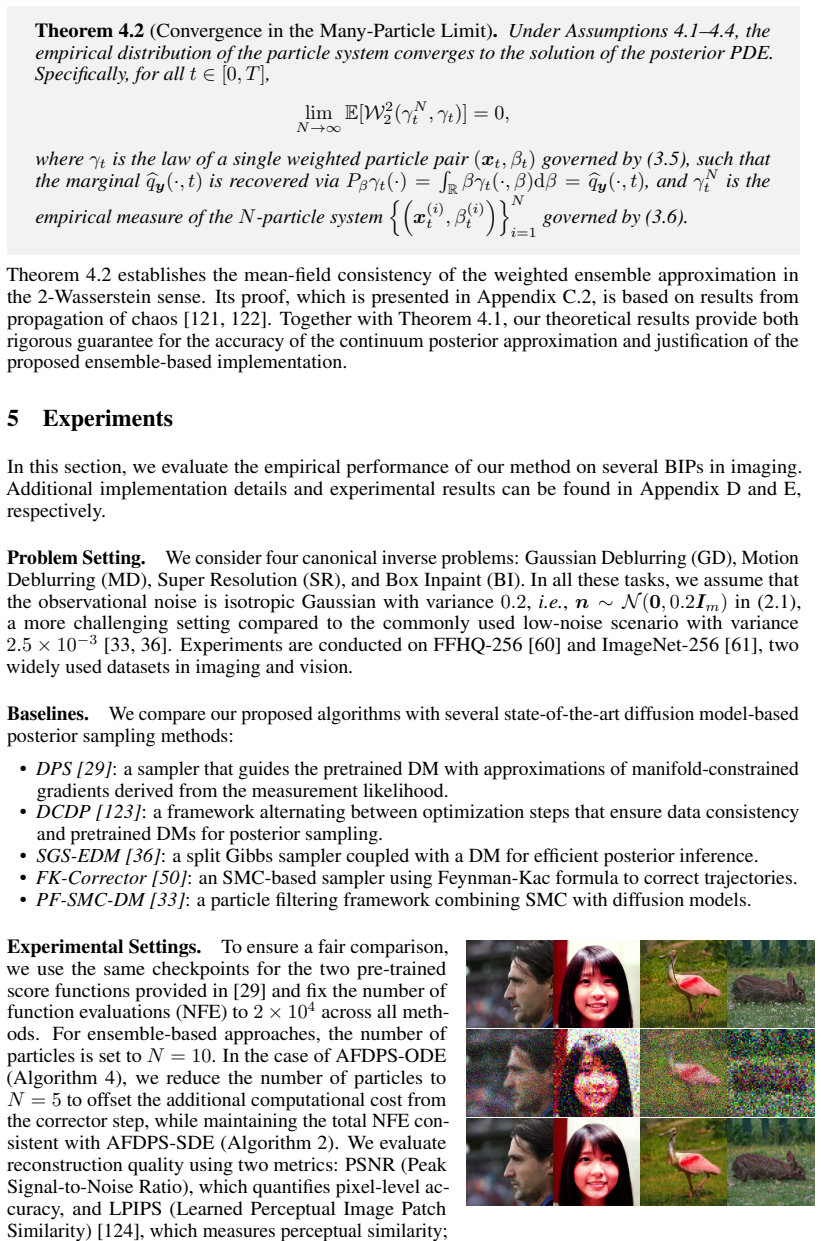
- On FFHQ-256 and ImageNet-256, the method reports higher PSNR and lower LPIPS than several baselines on Gaussian and motion deblurring, 4x super-resolution, and box inpainting.
Reading between the lines
- Editorial inference: the derivation transfers to other generative models that admit a Fokker-Planck description, including latent diffusion, flow matching, and denoising Markov models, so the same PDE-based weighting could define posterior samplers there; the authors list these extensions as future work but do not prove them.
- Editorial inference: the parameter $\eta$ introduced in Remark B.8 interpolates between the FK-Corrector dynamics and AFDPS dynamics; tuning it may be a cheap way to trade likelihood-guidance strength against diffusion-exploration strength, though the paper only reports the $\eta=1$ end.
- Editorial inference: because the reported experiments skip the resampling step, monitoring the effective sample size during simulation is the natural diagnostic for weight collapse; a direct consequence of Assumption 4.4 is that ESS should be tracked even though the paper does not develop this.
- Editorial inference: the empirical mean in the weight dynamics is the only nonlocal coupling, so replacing it with a control-variate or Rao-Blackwellized estimator should reduce particle noise without changing the limiting PDE; this is a testable modification the paper does not explore.
Editorial analysis
A structured set of objections, weighed in public.
Referee Report
Summary. The paper proposes an ensemble-based diffusion posterior sampler (AFDPS) for Bayesian inverse problems. Starting from the Fokker-Planck equation of the approximate prior diffusion, the authors derive a PDE for the time-dependent posterior (3.4), simulate it with weighted particles, and give two practical algorithms: an SDE variant (Algorithm 2) and an ODE+Corrector variant (Algorithm 4). The theoretical section proves a posterior-error bound in terms of score error and terminal time (Theorem 4.1) and a many-particle mean-field convergence result (Theorem 4.2). Experiments on FFHQ-256 and ImageNet-256 for deblurring, super-resolution, and inpainting report improved or competitive PSNR/LPIPS against several diffusion-based baselines.
Significance. If the derived PDE and convergence results were fully applicable, this would be a valuable contribution: the posterior evolution is derived from first principles rather than by ad hoc conditional-score approximations, and the explicit comparison with the Feynman-Kac corrector in Remark B.8 clarifies the novelty. The paper is also notable for providing detailed, self-contained proofs of the PDE derivation (Lemmas B.1, B.2, B.4) and for making the error dependence on score error and particle count explicit. The empirical study is substantial, covering two large image datasets and four inverse problems. However, the main theoretical guarantee is currently not matched to the experimental protocol, so the significance is conditional on closing that gap.
major comments (4)
- [Section 4, Assumption 4.4; Lemma C.3; Appendix D] Assumption 4.4 is incompatible with the linear-Gaussian likelihoods used in all experiments. For µ_y(x) = (1/(2σ²))||Ax−y||² with σ² = 0.2 and a nonzero forward operator A, we have ∇µ_y = (1/σ²)Aᵀ(Ax−y) and hence ||∇µ_y||² grows quadratically in ||x||, so I(x,t) = ||∇µ_y||² − ∆µ_y − 2φ_θᵀ∇µ_y is unbounded over Rⁿ×[0,T]. Therefore Theorem 4.2 and Lemma C.3, which require sup_{x,t}|I| ≤ B_y, do not apply to the Gaussian deblurring, motion deblurring, super-resolution, or box-inpainting experiments. The statement in Section 4 that the condition is 'enforced via the resampling step' is not a proof, and Appendix D explicitly states that the implementation skips resampling. This is a load-bearing gap between the theoretical claim and the validated setting.
- [Section 3.2, Algorithm 4; Section 4] The label 'approximation-free' is not supported for the ODE variant. Algorithm 4 inserts an Unadjusted Langevin Algorithm corrector (Algorithm 3), and ULA is an approximate sampler whose bias is not quantified anywhere in the paper. Moreover, the corrector-modified dynamics do not follow from the posterior PDE (3.4), so Theorem 4.2 does not cover Algorithm 4 as implemented. The paper should either provide a bias analysis of the corrector, or restrict the approximation-free claim to the SDE variant and treat the ODE variant as heuristic.
- [Section 4 (intro); Algorithms 2 and 4] The theory is explicitly continuous-time, while the practical algorithms use Euler-Maruyama or ODE discretization with a finite time grid, and the paper states that discretization error is left for future work. As stated, Theorem 4.1 and Theorem 4.2 therefore do not bound the error of Algorithm 2 or Algorithm 4. A discrete-time analysis, or at least a clear statement that the guarantees apply only to the continuous-time particle system (3.5)-(3.6), is needed before the abstract's claim that the algorithm 'provably samples from the posterior' can be accepted.
- [Abstract; Theorems 4.1 and 4.2] The abstract states that the posterior error can be bounded in terms of the score training error and the number of particles, but no single statement or proof composes the two bounds. Theorem 4.1 bounds the TV distance between the PDE-evolved posterior and the true posterior by score error and T, with no particle count, while Theorem 4.2 is an asymptotic mean-field limit (lim_{N→∞}) for the empirical measure, with no explicit rate. The relationship between the empirical weighted-particle distribution and the population posterior should be stated as a combined finite-N, finite-T bound, or the abstract should be revised to describe the two separate results.
minor comments (5)
- [Algorithm 2, line 6] The log-weight update appears to use β^{(j)}_{t_{k+1}} on the right-hand side, but this value has not yet been assigned; it should presumably be log β^{(j)}_{t_k} plus the increments.
- [Appendix D.1] There is a typo in 'whoses indexes'; it should read 'whose indexes'.
- [Theorem 4.1] The constant C_y^{(2)} is defined as e^{-C_y^{(1)}}/Z(y), where Z(y) is the posterior normalizing constant; calling it a constant depending only on y is formally correct but may be clearer if the definition is repeated in the theorem statement.
- [Assumption 4.2] The notation m_2^2 for the second-moment bound is slightly confusing because the proof later uses the square root m_2; a single symbol such as M_2 would avoid the impression of a squared variable.
- [Section 5 and Appendix D] The implementation returns the particle with the largest weight as the 'best estimator,' whereas the algorithm outputs in Algorithms 2 and 4 are the normalized weighted ensembles; the relationship between these two outputs should be clarified, since the theoretical results concern the weighted ensemble distribution.
Circularity Check
No significant circularity: the posterior PDE is derived by direct substitution into the Fokker–Planck equation, and the error bounds depend on external quantities such as score error and particle number.
full rationale
The paper's derivation chain is self-contained. The posterior-like density bq_y is defined in (3.1) as the tilted density b⃗p_t e^{−µ_y}/Z, and the main PDE (3.4) is obtained in Lemmas B.1 and B.2 by substituting this definition into the prior Fokker–Planck equation (3.2). This is direct calculus, not an assumption of the result. The weighted particle dynamics (3.6) are constructed so that their weighted projection solves this PDE (Lemma B.4), and Theorem 4.2 is a standard propagation-of-chaos/mean-field consistency statement under Assumptions 4.1–4.4 rather than a circular use of the target posterior. Theorem 4.1 bounds the TV error against the true posterior in terms of the score-matching error ε_s and the second moment m_2^2, both external quantities, so the central claim does not reduce to its inputs. No fitted parameter is renamed as a prediction, and no load-bearing uniqueness theorem is imported from the authors' prior work. Self-citations (e.g., [90], [154], [163]) appear only in related-work or method contexts and are not used to justify the main results. The nontrivial caveats—Assumption 4.4 may be violated by the unbounded quadratic ‖∇μ_y‖² arising in the linear-Gaussian likelihoods used in the experiments, and Appendix D states that resampling is skipped in implementation—are correctness and applicability gaps, not circular reductions. The manuscript itself flags these limitations in Section 4 and Appendix D, and they do not make the derivation circular.
Assumptions & free parameters
free parameters (4)
- Terminal time T =
8.0
- Ensemble size N =
10 (SDE), 5 (ODE)
- Corrector steps n_c =
4
- ULA stepsize h_c =
not specified
assumptions (5)
- standard math Fokker-Planck equation (3.2) accurately describes the evolution of the approximated backward process's law.
- domain assumption Assumption 4.1: log-likelihood is twice differentiable and lower bounded.
- domain assumption Assumption 4.3: Score network error uniformly bounded by epsilon_s.
- ad hoc to paper Assumption 4.4: I(x,t) is bounded and Lipschitz.
- domain assumption Stage I samplers (MALA/AIS) target bq_y(x,0) accurately.
Cite this review
Pith. "Pith review of Solving Inverse Problems via Diffusion-Based Priors: An Approximation-Free Ensemble Sampling Approach." pith.science (2026). https://pith.science/paper/7QHSTXYH
@misc{pith2026250603979,
  author       = {Pith},
  title        = {Pith review of: Solving Inverse Problems via Diffusion-Based Priors: An Approximation-Free Ensemble Sampling Approach},
  year         = {2026},
  howpublished = {\url{https://pith.science/paper/7QHSTXYH}},
  note         = {Machine review of arXiv:2506.03979}
}
read the original abstract
Diffusion models (DMs) have proven to be effective in modeling high-dimensional distributions, leading to their widespread adoption for representing complex priors in Bayesian inverse problems (BIPs). However, current DM-based posterior sampling methods proposed for solving common BIPs rely on heuristic approximations to the generative process. To exploit the generative capability of DMs and avoid the usage of such approximations, we propose an ensemble-based algorithm that performs posterior sampling without the use of heuristic approximations. Our algorithm is motivated by existing works that combine DM-based methods with the sequential Monte Carlo (SMC) method. By examining how the prior evolves through the diffusion process encoded by the pre-trained score function, we derive a modified partial differential equation (PDE) governing the evolution of the corresponding posterior distribution. This PDE includes a modified diffusion term and a reweighting term, which can be simulated via stochastic weighted particle methods. Theoretically, we prove that the error between the true posterior distribution can be bounded in terms of the training error of the pre-trained score function and the number of particles in the ensemble. Empirically, we validate our algorithm on several inverse problems in imaging to show that our method gives more accurate reconstructions compared to existing DM-based methods.
Figures


Figures from the paper (3 more)


Forward citations
Cited by 4 Pith papers
-
Provable Diffusion Posterior Sampling for Bayesian Inversion
A diffusion posterior sampler using Monte Carlo Langevin score estimation and warm start is proven to converge in Wasserstein-2 distance under semi-log-concavity and sub-Gaussian assumptions, and outperforms DPS/TV on...
-
Fast Convergence for High-Order ODE Solvers in Diffusion Probabilistic Models
A TV convergence bound O(d^{7/4} ε^{1/2} + d(dH)^p) is proved for p-th order (exponential) Runge-Kutta samplers of probability-flow ODEs under C² smoothness of the learned score.
-
ReGuidance: A Simple Diffusion Wrapper for Boosting Sample Quality on Hard Inverse Problems
A two-step wrapper (invert candidate to latent, then run DPS from that latent) improves hard inpainting results, with mixed or negative superresolution results and toy-model theory.
-
Provable diffusion-based posterior sampling for linear inverse problems via DDIM
A SVD-based, coordinate-wise DDIM sampler is claimed to asymptotically sample from the posterior for noisy linear inverse problems, but the proof's posterior identification step does not follow from the stated updates.
Reference graph
Works this paper leans on
-
[1]
Bayesian inverse problems for functions and applications to fluid mechanics
Simon L Cotter, Massoumeh Dashti, James Cooper Robinson, and Andrew M Stuart. Bayesian inverse problems for functions and applications to fluid mechanics. Inverse problems, 25(11): 115008, 2009
2009
-
[2]
Inverse problems in free surface flows: a review
Mathieu Sellier. Inverse problems in free surface flows: a review. Acta Mechanica, 227(3): 913–935, 2016
2016
-
[3]
Inverse problems: Basics, theory and applications in geophysics
Mathias Richter. Inverse problems: Basics, theory and applications in geophysics. Springer Nature, 2021
2021
-
[4]
Sparse mri: The application of compressed sensing for rapid mr imaging
Michael Lustig, David Donoho, and John M Pauly. Sparse mri: The application of compressed sensing for rapid mr imaging. Magnetic Resonance in Medicine: An Official Journal of the International Society for Magnetic Resonance in Medicine, 58(6):1182–1195, 2007
2007
-
[5]
Tomographic phase microscopy
Wonshik Choi, Christopher Fang-Yen, Kamran Badizadegan, Seungeun Oh, Niyom Lue, Ramachandra R Dasari, and Michael S Feld. Tomographic phase microscopy. Nature methods, 4(9):717–719, 2007
2007
-
[6]
Introduction to inverse problems in imaging
Mario Bertero, Patrizia Boccacci, and Christine De Mol. Introduction to inverse problems in imaging. CRC press, 2021
2021
-
[7]
Mcmc using hamiltonian dynamics
Radford M Neal et al. Mcmc using hamiltonian dynamics. Handbook of markov chain monte carlo, 2(11):2, 2011
2011
-
[8]
Bayesian learning via stochastic gradient langevin dynamics
Max Welling and Yee W Teh. Bayesian learning via stochastic gradient langevin dynamics. In Proceedings of the 28th international conference on machine learning (ICML-11), pages 681–688. Citeseer, 2011
2011
Show all 269 references
-
[9]
Dimension-independent likelihood- informed mcmc
Tiangang Cui, Kody JH Law, and Youssef M Marzouk. Dimension-independent likelihood- informed mcmc. Journal of Computational Physics, 304:109–137, 2016
2016
-
[10]
Invertible gen- erative models for inverse problems: mitigating representation error and dataset bias
Muhammad Asim, Max Daniels, Oscar Leong, Ali Ahmed, and Paul Hand. Invertible gen- erative models for inverse problems: mitigating representation error and dataset bias. In International conference on machine learning, pages 399–409. PMLR, 2020
2020
-
[11]
Solving bayesian inverse problems from the perspective of deep generative networks.Computational Mechanics, 64:395–408, 2019
Thomas Y Hou, Ka Chun Lam, Pengchuan Zhang, and Shumao Zhang. Solving bayesian inverse problems from the perspective of deep generative networks.Computational Mechanics, 64:395–408, 2019
2019
-
[12]
Multiscale invertible generative networks for high-dimensional bayesian inference
Shumao Zhang, Pengchuan Zhang, and Thomas Y Hou. Multiscale invertible generative networks for high-dimensional bayesian inference. In International Conference on Machine Learning, pages 12632–12641. PMLR, 2021
2021
-
[13]
Composing normalizing flows for inverse problems
Jay Whang, Erik Lindgren, and Alex Dimakis. Composing normalizing flows for inverse problems. In International Conference on Machine Learning, pages 11158–11169. PMLR, 2021
2021
-
[14]
Solving inverse problems with a flow-based noise model
Jay Whang, Qi Lei, and Alex Dimakis. Solving inverse problems with a flow-based noise model. In International Conference on Machine Learning, pages 11146–11157. PMLR, 2021
2021
-
[15]
Stochastic normalizing flows for in- verse problems: A markov chains viewpoint.SIAM/ASA Journal on Uncertainty Quantification, 10(3):1162–1190, 2022
Paul Hagemann, Johannes Hertrich, and Gabriele Steidl. Stochastic normalizing flows for in- verse problems: A markov chains viewpoint.SIAM/ASA Journal on Uncertainty Quantification, 10(3):1162–1190, 2022
2022
-
[16]
Bayesian inference with generative adversarial network priors
Dhruv Patel and Assad A Oberai. Bayesian inference with generative adversarial network priors. arXiv preprint arXiv:1907.09987, 2019
1907 arXiv
-
[17]
Compressed sensing using generative models
Ashish Bora, Ajil Jalal, Eric Price, and Alexandros G Dimakis. Compressed sensing using generative models. In International conference on machine learning, pages 537–546. PMLR, 2017
2017
-
[18]
Stochastic interpolants: A unifying framework for flows and diffusions
Michael S Albergo, Nicholas M Boffi, and Eric Vanden-Eijnden. Stochastic interpolants: A unifying framework for flows and diffusions. arXiv preprint arXiv:2303.08797, 2023. 31
2023 arXiv
-
[19]
Building normalizing flows with stochastic interpolants
Michael S Albergo and Eric Vanden-Eijnden. Building normalizing flows with stochastic interpolants. arXiv preprint arXiv:2209.15571, 2022
2022 arXiv
-
[20]
Flow matching for generative modeling
Yaron Lipman, Ricky TQ Chen, Heli Ben-Hamu, Maximilian Nickel, and Matt Le. Flow matching for generative modeling. arXiv preprint arXiv:2210.02747, 2022
2022 arXiv
-
[21]
Flow straight and fast: Learning to generate and transfer data with rectified flow
Xingchao Liu, Chengyue Gong, and Qiang Liu. Flow straight and fast: Learning to generate and transfer data with rectified flow. arXiv preprint arXiv:2209.03003, 2022
2022 arXiv
-
[22]
Deep un- supervised learning using nonequilibrium thermodynamics
Jascha Sohl-Dickstein, Eric Weiss, Niru Maheswaranathan, and Surya Ganguli. Deep un- supervised learning using nonequilibrium thermodynamics. In International Conference on Machine Learning, pages 2256–2265. PMLR, 2015
2015
-
[23]
Denoising diffusion probabilistic models.Advances in neural information processing systems, 33:6840–6851, 2020
Jonathan Ho, Ajay Jain, and Pieter Abbeel. Denoising diffusion probabilistic models.Advances in neural information processing systems, 33:6840–6851, 2020
2020
-
[24]
Denoising diffusion implicit models
Jiaming Song, Chenlin Meng, and Stefano Ermon. Denoising diffusion implicit models. arXiv preprint arXiv:2010.02502, 2020
2010 arXiv
-
[25]
Maximum likelihood training of score-based diffusion models
Yang Song, Conor Durkan, Iain Murray, and Stefano Ermon. Maximum likelihood training of score-based diffusion models. Advances in neural information processing systems , 34: 1415–1428, 2021
2021
-
[26]
Generative modeling by estimating gradients of the data distribution
Yang Song and Stefano Ermon. Generative modeling by estimating gradients of the data distribution. Advances in neural information processing systems, 32, 2019
2019
-
[27]
Score-based generative modeling through stochastic differential equations
Yang Song, Jascha Sohl-Dickstein, Diederik P Kingma, Abhishek Kumar, Stefano Ermon, and Ben Poole. Score-based generative modeling through stochastic differential equations. arXiv preprint arXiv:2011.13456, 2020
2011 arXiv
-
[28]
Monge-ampère flow for generative modeling
Linfeng Zhang, Weinan E, and Lei Wang. Monge-ampère flow for generative modeling. arXiv preprint arXiv:1809.10188, 2018
2018 arXiv
-
[29]
Diffu- sion posterior sampling for general noisy inverse problems
Hyungjin Chung, Jeongsol Kim, Michael T Mccann, Marc L Klasky, and Jong Chul Ye. Diffu- sion posterior sampling for general noisy inverse problems. arXiv preprint arXiv:2209.14687, 2022
2022 arXiv
-
[30]
Pseudoinverse-guided diffusion models for inverse problems
Jiaming Song, Arash Vahdat, Morteza Mardani, and Jan Kautz. Pseudoinverse-guided diffusion models for inverse problems. In International Conference on Learning Representations, 2023
2023
-
[31]
Practical and asymptotically exact conditional sampling in diffusion models
Luhuan Wu, Brian Trippe, Christian Naesseth, David Blei, and John P Cunningham. Practical and asymptotically exact conditional sampling in diffusion models. Advances in Neural Information Processing Systems, 36:31372–31403, 2023
2023
-
[32]
Monte carlo guided denoising diffusion models for bayesian linear inverse problems
Gabriel Cardoso, Sylvain Le Corff, Eric Moulines, et al. Monte carlo guided denoising diffusion models for bayesian linear inverse problems. InThe Twelfth International Conference on Learning Representations, 2023
2023
-
[33]
Diffusion posterior sampling for linear inverse problem solving: A filtering perspective
Zehao Dou and Yang Song. Diffusion posterior sampling for linear inverse problem solving: A filtering perspective. In The Twelfth International Conference on Learning Representations, 2024
2024
-
[34]
Provable probabilistic imaging using score-based generative priors
Yu Sun, Zihui Wu, Yifan Chen, Berthy T Feng, and Katherine L Bouman. Provable probabilistic imaging using score-based generative priors. IEEE Transactions on Computational Imaging, 2024
2024
-
[35]
Provably robust score-based diffusion posterior sampling for plug-and-play image reconstruction
Xingyu Xu and Yuejie Chi. Provably robust score-based diffusion posterior sampling for plug-and-play image reconstruction. arXiv preprint arXiv:2403.17042, 2024
2024 arXiv
-
[36]
Principled probabilistic imaging using diffusion models as plug-and-play priors
Zihui Wu, Yu Sun, Yifan Chen, Bingliang Zhang, Yisong Yue, and Katherine Bouman. Principled probabilistic imaging using diffusion models as plug-and-play priors. Advances in Neural Information Processing Systems, 37:118389–118427, 2024
2024
-
[37]
Provable posterior sampling with denoising oracles via tilted transport
Joan Bruna and Jiequn Han. Provable posterior sampling with denoising oracles via tilted transport. Advances in Neural Information Processing Systems, 37:82863–82894, 2024. 32
2024
-
[38]
A survey on diffusion models for inverse problems
Giannis Daras, Hyungjin Chung, Chieh-Hsin Lai, Yuki Mitsufuji, Jong Chul Ye, Peyman Milanfar, Alexandros G Dimakis, and Mauricio Delbracio. A survey on diffusion models for inverse problems. arXiv preprint arXiv:2410.00083, 2024
-
[39]
Ilvr: Conditioning method for denoising diffusion probabilistic models
Jooyoung Choi, Sungwon Kim, Yonghyun Jeong, Youngjune Gwon, and Sungroh Yoon. Ilvr: Conditioning method for denoising diffusion probabilistic models. arXiv preprint arXiv:2108.02938, 2021
2021 arXiv
-
[40]
Solving inverse problems in medical imaging with score-based generative models
Yang Song, Liyue Shen, Lei Xing, and Stefano Ermon. Solving inverse problems in medical imaging with score-based generative models. arXiv preprint arXiv:2111.08005, 2021
2021 arXiv
-
[41]
Tweedie moment projected diffusions for inverse problems
Benjamin Boys, Mark Girolami, Jakiw Pidstrigach, Sebastian Reich, Alan Mosca, and O Deniz Akyildiz. Tweedie moment projected diffusions for inverse problems. arXiv preprint arXiv:2310.06721, 2023
2023 arXiv
-
[42]
Zero-shot image restoration using denoising diffusion null-space model
Yinhuai Wang, Jiwen Yu, and Jian Zhang. Zero-shot image restoration using denoising diffusion null-space model. arXiv preprint arXiv:2212.00490, 2022
2022 arXiv
-
[43]
Denoising diffusion restora- tion models
Bahjat Kawar, Michael Elad, Stefano Ermon, and Jiaming Song. Denoising diffusion restora- tion models. Advances in Neural Information Processing Systems, 35:23593–23606, 2022
2022
-
[44]
Solving linear inverse problems provably via posterior sampling with latent diffusion models
Litu Rout, Negin Raoof, Giannis Daras, Constantine Caramanis, Alex Dimakis, and Sanjay Shakkottai. Solving linear inverse problems provably via posterior sampling with latent diffusion models. Advances in Neural Information Processing Systems , 36:49960–49990, 2023
2023
-
[45]
Plug-and-play split gibbs sampler: embedding deep generative priors in bayesian inference
Florentin Coeurdoux, Nicolas Dobigeon, and Pierre Chainais. Plug-and-play split gibbs sampler: embedding deep generative priors in bayesian inference. IEEE Transactions on Image Processing, 2024
2024
-
[46]
Inversebench: Benchmarking plug-and-play diffusion priors for inverse problems in physical sciences
Hongkai Zheng, Wenda Chu, Bingliang Zhang, Zihui Wu, Austin Wang, Berthy T Feng, Caifeng Zou, Yu Sun, Nikola Kovachki, Zachary E Ross, et al. Inversebench: Benchmarking plug-and-play diffusion priors for inverse problems in physical sciences. arXiv preprint arXiv:2503.11043, 2025
2025
-
[47]
Split-and-augmented gibbs sam- pler—application to large-scale inference problems
Maxime V ono, Nicolas Dobigeon, and Pierre Chainais. Split-and-augmented gibbs sam- pler—application to large-scale inference problems. IEEE Transactions on Signal Processing, 67(6):1648–1661, 2019
2019
-
[48]
The split gibbs sampler revisited: improvements to its algorithmic structure and augmented target distribution
Marcelo Pereyra, Luis A Vargas-Mieles, and Konstantinos C Zygalakis. The split gibbs sampler revisited: improvements to its algorithmic structure and augmented target distribution. SIAM Journal on Imaging Sciences, 16(4):2040–2071, 2023
2023
-
[49]
Solving linear-gaussian bayesian inverse problems with decoupled diffusion sequential monte carlo
Filip Ekström Kelvinius, Zheng Zhao, and Fredrik Lindsten. Solving linear-gaussian bayesian inverse problems with decoupled diffusion sequential monte carlo. arXiv preprint arXiv:2502.06379, 2025
2025
-
[50]
Feynman- kac correctors in diffusion: Annealing, guidance, and product of experts
Marta Skreta, Tara Akhound-Sadegh, Viktor Ohanesian, Roberto Bondesan, Alán Aspuru- Guzik, Arnaud Doucet, Rob Brekelmans, Alexander Tong, and Kirill Neklyudov. Feynman- kac correctors in diffusion: Annealing, guidance, and product of experts. arXiv preprint arXiv:2503.02819, 2025
2025 arXiv
-
[51]
Debiasing guidance for discrete diffusion with sequential monte carlo
Cheuk Kit Lee, Paul Jeha, Jes Frellsen, Pietro Lio, Michael Samuel Albergo, and Francisco Vargas. Debiasing guidance for discrete diffusion with sequential monte carlo. arXiv preprint arXiv:2502.06079, 2025
2025 arXiv
-
[52]
Leaps: A discrete neural sampler via locally equivariant networks
Peter Holderrieth, Michael S Albergo, and Tommi Jaakkola. Leaps: A discrete neural sampler via locally equivariant networks. arXiv preprint arXiv:2502.10843, 2025
2025 arXiv
-
[53]
Inverse problem sampling in latent space using sequential monte carlo
Idan Achituve, Hai Victor Habi, Amir Rosenfeld, Arnon Netzer, Idit Diamant, and Ethan Fetaya. Inverse problem sampling in latent space using sequential monte carlo. arXiv preprint arXiv:2502.05908, 2025
2025 arXiv
-
[54]
Monte Carlo strategies in scientific computing, volume 75
Jun S Liu. Monte Carlo strategies in scientific computing, volume 75. Springer, 2001. 33
2001
-
[55]
A sequential particle filter method for static models
Nicolas Chopin. A sequential particle filter method for static models. Biometrika, 89(3): 539–552, 2002
2002
-
[56]
Sequential monte carlo samplers
Pierre Del Moral, Arnaud Doucet, and Ajay Jasra. Sequential monte carlo samplers. Journal of the Royal Statistical Society Series B: Statistical Methodology, 68(3):411–436, 2006
2006
-
[57]
A tutorial on particle filtering and smoothing: Fifteen years later
Arnaud Doucet, Adam M Johansen, et al. A tutorial on particle filtering and smoothing: Fifteen years later. Handbook of nonlinear filtering, 12(656-704):3, 2009
2009
-
[58]
Mean field simulation for monte carlo integration
Pierre Del Moral. Mean field simulation for monte carlo integration. Monographs on Statistics and Applied Probability, 126(26):6, 2013
2013
-
[59]
Feynman-Kac formulae: genealogical and interacting particle systems with applications
Pierre Del Moral. Feynman-Kac formulae: genealogical and interacting particle systems with applications. Springer, 2004
2004
-
[60]
A style-based generator architecture for generative adversarial networks
Tero Karras, Samuli Laine, and Timo Aila. A style-based generator architecture for generative adversarial networks. In Proceedings of the IEEE/CVF conference on computer vision and pattern recognition, pages 4401–4410, 2019
2019
-
[61]
Imagenet: A large- scale hierarchical image database
Jia Deng, Wei Dong, Richard Socher, Li-Jia Li, Kai Li, and Li Fei-Fei. Imagenet: A large- scale hierarchical image database. In 2009 IEEE conference on computer vision and pattern recognition, pages 248–255. Ieee, 2009
2009
-
[62]
Inverse problems: a bayesian perspective
Andrew M Stuart. Inverse problems: a bayesian perspective. Acta numerica, 19:451–559, 2010
2010
-
[63]
Renormalizing diffusion models
Jordan Cotler and Semon Rezchikov. Renormalizing diffusion models. arXiv preprint arXiv:2308.12355, 2023
2023 arXiv
-
[64]
Diffusion models learn distributions generated by complex langevin dynamics
Diaa E Habibi, Gert Aarts, Lingxiao Wang, and Kai Zhou. Diffusion models learn distributions generated by complex langevin dynamics. arXiv preprint arXiv:2412.01919, 2024
2024 arXiv
-
[65]
Quantum state generation with structure-preserving diffusion model
Yuchen Zhu, Tianrong Chen, Evangelos A Theodorou, Xie Chen, and Molei Tao. Quantum state generation with structure-preserving diffusion model. arXiv preprint arXiv:2404.06336, 2024
2024 arXiv
-
[66]
Geod- iff: A geometric diffusion model for molecular conformation generation
Minkai Xu, Lantao Yu, Yang Song, Chence Shi, Stefano Ermon, and Jian Tang. Geod- iff: A geometric diffusion model for molecular conformation generation. arXiv preprint arXiv:2203.02923, 2022
2022 arXiv
-
[67]
Diffusion models in de novo drug design
Amira Alakhdar, Barnabas Poczos, and Newell Washburn. Diffusion models in de novo drug design. Journal of Chemical Information and Modeling, 2024
2024
-
[68]
Crystal structure determination from powder diffraction patterns with generative machine learning
Eric A Riesel, Tsach Mackey, Hamed Nilforoshan, Minkai Xu, Catherine K Badding, Alison B Altman, Jure Leskovec, and Danna E Freedman. Crystal structure determination from powder diffraction patterns with generative machine learning. Journal of the American Chemical Society, 14...
2024
-
[69]
Protein generation with evolutionary diffusion: sequence is all you need
Sarah Alamdari, Nitya Thakkar, Rianne van den Berg, Alex X Lu, Nicolo Fusi, Ava P Amini, and Kevin K Yang. Protein generation with evolutionary diffusion: sequence is all you need. BioRxiv, pages 2023–09, 2023
2023
-
[70]
De novo design of protein structure and function with rfdiffusion
Joseph L Watson, David Juergens, Nathaniel R Bennett, Brian L Trippe, Jason Yim, Helen E Eisenach, Woody Ahern, Andrew J Borst, Robert J Ragotte, Lukas F Milles, et al. De novo design of protein structure and function with rfdiffusion. Nature, 620(7976):1089–1100, 2023
2023
-
[71]
High-resolution image synthesis with latent diffusion models
Robin Rombach, Andreas Blattmann, Dominik Lorenz, Patrick Esser, and Björn Ommer. High-resolution image synthesis with latent diffusion models. InProceedings of the IEEE/CVF conference on computer vision and pattern recognition, pages 10684–10695, 2022
2022
-
[72]
Tutorial on diffusion models for imaging and vision
Stanley Chan et al. Tutorial on diffusion models for imaging and vision. Foundations and Trends® in Computer Graphics and Vision, 16(4):322–471, 2024. 34
2024
-
[73]
Diffusion-lm improves controllable text generation
Xiang Li, John Thickstun, Ishaan Gulrajani, Percy S Liang, and Tatsunori B Hashimoto. Diffusion-lm improves controllable text generation. Advances in Neural Information Process- ing Systems, 35:4328–4343, 2022
2022
-
[74]
Elucidating the design space of diffusion-based generative models
Tero Karras, Miika Aittala, Timo Aila, and Samuli Laine. Elucidating the design space of diffusion-based generative models. Advances in Neural Information Processing Systems, 35: 26565–26577, 2022
2022
-
[75]
Reverse-time diffusion equation models
Brian DO Anderson. Reverse-time diffusion equation models. Stochastic Processes and their Applications, 12(3):313–326, 1982
1982
-
[76]
Estimation of non-normalized statistical models by score matching
Aapo Hyvärinen and Peter Dayan. Estimation of non-normalized statistical models by score matching. Journal of Machine Learning Research, 6(4), 2005
2005
-
[77]
A connection between score matching and denoising autoencoders
Pascal Vincent. A connection between score matching and denoising autoencoders. Neural computation, 23(7):1661–1674, 2011
2011
-
[78]
Evaluating the design space of diffusion-based generative models
Yuqing Wang, Ye He, and Molei Tao. Evaluating the design space of diffusion-based generative models. arXiv preprint arXiv:2406.12839, 2024
2024 arXiv
-
[79]
The weighted particle method for convection-diffusion equations
Pierre Degond and Sylvie Mas-Gallic. The weighted particle method for convection-diffusion equations. i. the case of an isotropic viscosity. Mathematics of computation, 53(188):485–507, 1989
1989
-
[80]
A deterministic approximation of diffusion equations using particles
Pierre Degond and Francisco-José Mustieles. A deterministic approximation of diffusion equations using particles. SIAM Journal on Scientific and Statistical Computing , 11(2): 293–310, 1990
1990
-
[81]
A stochastic weighted particle method for the boltzmann equation
Sergej Rjasanow and Wolfgang Wagner. A stochastic weighted particle method for the boltzmann equation. Journal of Computational Physics, 124(2):243–253, 1996
1996
-
[82]
A stochastic particle method for the mckean-vlasov and the burgers equation
Mireille Bossy and Denis Talay. A stochastic particle method for the mckean-vlasov and the burgers equation. Mathematics of computation, 66(217):157–192, 1997
1997
-
[83]
A stochastic particle method with random weights for the computation of statistical solutions of mckean-vlasov equations
Denis Talay and Olivier Vaillant. A stochastic particle method with random weights for the computation of statistical solutions of mckean-vlasov equations. The Annals of Applied Probability, 13(1):140–180, 2003
2003
-
[84]
An analysis of particle methods
Pierre-Arnaud Raviart. An analysis of particle methods. In Numerical Methods in Fluid Dynamics: Lectures given at the 3rd 1983 Session of the Centro Internationale Matematico Estivo (CIME) held at Como, Italy, July 7–15, 1983, pages 243–324. Springer, 2006
1983
-
[85]
A practical guide to deterministic particle methods
Alina Chertock. A practical guide to deterministic particle methods. In Handbook of numerical analysis, volume 18, pages 177–202. Elsevier, 2017
2017
-
[86]
Langevin diffusions and metropolis-hastings algorithms
Gareth O Roberts and Osnat Stramer. Langevin diffusions and metropolis-hastings algorithms. Methodology and computing in applied probability, 4:337–357, 2002
2002
-
[87]
Annealed importance sampling
Radford M Neal. Annealed importance sampling. Statistics and computing, 11:125–139, 2001
2001
-
[88]
Accelerating langevin sampling with birth-death
Yulong Lu, Jianfeng Lu, and James Nolen. Accelerating langevin sampling with birth-death. arXiv preprint arXiv:1905.09863, 2019
1905 arXiv
-
[89]
Accelerate langevin sampling with birth-death process and exploration component
Lezhi Tan and Jianfeng Lu. Accelerate langevin sampling with birth-death process and exploration component. arXiv preprint arXiv:2305.05529, 2023
2023 arXiv
-
[90]
Ensemble-based annealed importance sampling
Haoxuan Chen and Lexing Ying. Ensemble-based annealed importance sampling. arXiv preprint arXiv:2401.15645, 2024
2024 arXiv
-
[91]
Ensemble markov chain monte carlo with teleporting walkers
Michael Lindsey, Jonathan Weare, and Anna Zhang. Ensemble markov chain monte carlo with teleporting walkers. SIAM/ASA Journal on Uncertainty Quantification, 10(3):860–885, 2022
2022
-
[92]
The probability flow ode is provably fast
Sitan Chen, Sinho Chewi, Holden Lee, Yuanzhi Li, Jianfeng Lu, and Adil Salim. The probability flow ode is provably fast. Advances in Neural Information Processing Systems, 36, 2024. 35
2024
-
[93]
Classifier-free guidance is a predictor-corrector
Arwen Bradley and Preetum Nakkiran. Classifier-free guidance is a predictor-corrector. arXiv preprint arXiv:2408.09000, 2024
2024 arXiv
-
[94]
Diffusion models beat gans on image synthesis
Prafulla Dhariwal and Alexander Nichol. Diffusion models beat gans on image synthesis. Advances in neural information processing systems, 34:8780–8794, 2021
2021
-
[95]
A dual algorithm for the solution of nonlinear variational problems via finite element approximation
Daniel Gabay and Bertrand Mercier. A dual algorithm for the solution of nonlinear variational problems via finite element approximation. Computers & mathematics with applications, 2(1): 17–40, 1976
1976
-
[96]
A new alternating minimization algorithm for total variation image reconstruction
Yilun Wang, Junfeng Yang, Wotao Yin, and Yin Zhang. A new alternating minimization algorithm for total variation image reconstruction. SIAM Journal on Imaging Sciences, 1(3): 248–272, 2008
2008
-
[97]
Distributed optimization and statistical learning via the alternating direction method of multipliers
Stephen Boyd, Neal Parikh, Eric Chu, Borja Peleato, Jonathan Eckstein, et al. Distributed optimization and statistical learning via the alternating direction method of multipliers. Foun- dations and Trends® in Machine learning, 3(1):1–122, 2011
2011
-
[98]
Deep admm-net for compressive sensing mri.Advances in neural information processing systems, 29, 2016
Jian Sun, Huibin Li, Zongben Xu, et al. Deep admm-net for compressive sensing mri.Advances in neural information processing systems, 29, 2016
2016
-
[99]
Plug-and-play admm for image restoration: Fixed-point convergence and applications
Stanley H Chan, Xiran Wang, and Omar A Elgendy. Plug-and-play admm for image restoration: Fixed-point convergence and applications. IEEE Transactions on Computational Imaging, 3 (1):84–98, 2016
2016
-
[100]
Plug-and-play methods provably converge with properly trained denoisers
Ernest Ryu, Jialin Liu, Sicheng Wang, Xiaohan Chen, Zhangyang Wang, and Wotao Yin. Plug-and-play methods provably converge with properly trained denoisers. In International Conference on Machine Learning, pages 5546–5557. PMLR, 2019
2019
-
[101]
A fast iterative shrinkage-thresholding algorithm for linear inverse problems
Amir Beck and Marc Teboulle. A fast iterative shrinkage-thresholding algorithm for linear inverse problems. SIAM journal on imaging sciences, 2(1):183–202, 2009
2009
-
[102]
Ista-net: Interpretable optimization-inspired deep network for image compressive sensing
Jian Zhang and Bernard Ghanem. Ista-net: Interpretable optimization-inspired deep network for image compressive sensing. In Proceedings of the IEEE conference on computer vision and pattern recognition, pages 1828–1837, 2018
2018
-
[103]
Fista-net: Learning a fast iterative shrinkage thresholding network for inverse problems in imaging.IEEE Transactions on Medical Imaging, 40(5):1329–1339, 2021
Jinxi Xiang, Yonggui Dong, and Yunjie Yang. Fista-net: Learning a fast iterative shrinkage thresholding network for inverse problems in imaging.IEEE Transactions on Medical Imaging, 40(5):1329–1339, 2021
2021
-
[104]
Theoretical in- sights for diffusion guidance: A case study for gaussian mixture models
Yuchen Wu, Minshuo Chen, Zihao Li, Mengdi Wang, and Yuting Wei. Theoretical in- sights for diffusion guidance: A case study for gaussian mixture models. arXiv preprint arXiv:2403.01639, 2024
2024 arXiv
-
[105]
What does guidance do? a fine-grained analysis in a simple setting.arXiv preprint arXiv:2409.13074, 2024
Muthu Chidambaram, Khashayar Gatmiry, Sitan Chen, Holden Lee, and Jianfeng Lu. What does guidance do? a fine-grained analysis in a simple setting.arXiv preprint arXiv:2409.13074, 2024
2024 arXiv
-
[106]
Classifier-free diffusion guidance
Jonathan Ho and Tim Salimans. Classifier-free diffusion guidance. arXiv preprint arXiv:2207.12598, 2022
2022 arXiv
-
[107]
Universal guidance for diffusion models
Arpit Bansal, Hong-Min Chu, Avi Schwarzschild, Soumyadip Sengupta, Micah Goldblum, Jonas Geiping, and Tom Goldstein. Universal guidance for diffusion models. In Proceedings of the IEEE/CVF Conference on Computer Vision and Pattern Recognition, pages 843–852, 2023
2023
-
[108]
Loss-guided diffusion models for plug-and-play controllable generation
Jiaming Song, Qinsheng Zhang, Hongxu Yin, Morteza Mardani, Ming-Yu Liu, Jan Kautz, Yongxin Chen, and Arash Vahdat. Loss-guided diffusion models for plug-and-play controllable generation. In International Conference on Machine Learning, pages 32483–32498. PMLR, 2023
2023
-
[109]
Manifold preserving guided diffusion
Yutong He, Naoki Murata, Chieh-Hsin Lai, Yuhta Takida, Toshimitsu Uesaka, Dongjun Kim, Wei-Hsiang Liao, Yuki Mitsufuji, J Zico Kolter, Ruslan Salakhutdinov, et al. Manifold preserving guided diffusion. arXiv preprint arXiv:2311.16424, 2023. 36
2023 arXiv
-
[110]
Gradient guidance for diffusion models: An optimization perspective
Yingqing Guo, Hui Yuan, Yukang Yang, Minshuo Chen, and Mengdi Wang. Gradient guidance for diffusion models: An optimization perspective. arXiv preprint arXiv:2404.14743, 2024
2024 arXiv
-
[111]
Guidance for twisted particle filter: a continuous-time perspective
Jianfeng Lu and Yuliang Wang. Guidance for twisted particle filter: a continuous-time perspective. arXiv preprint arXiv:2409.02399, 2024
2024 arXiv
-
[112]
Ensemble kalman diffusion guidance: A derivative-free method for inverse problems
Hongkai Zheng, Wenda Chu, Austin Wang, Nikola Kovachki, Ricardo Baptista, and Yisong Yue. Ensemble kalman diffusion guidance: A derivative-free method for inverse problems. arXiv preprint arXiv:2409.20175, 2024
2024 arXiv
-
[113]
Tfg: Unified training-free guidance for diffusion models
Haotian Ye, Haowei Lin, Jiaqi Han, Minkai Xu, Sheng Liu, Yitao Liang, Jianzhu Ma, James Y Zou, and Stefano Ermon. Tfg: Unified training-free guidance for diffusion models. Advances in Neural Information Processing Systems, 37:22370–22417, 2024
2024
-
[114]
Sampling is as easy as learning the score: theory for diffusion models with minimal data assumptions
Sitan Chen, Sinho Chewi, Jerry Li, Yuanzhi Li, Adil Salim, and Anru R Zhang. Sampling is as easy as learning the score: theory for diffusion models with minimal data assumptions. arXiv preprint arXiv:2209.11215, 2022
2022 arXiv
-
[115]
Improved analysis of score-based generative modeling: User-friendly bounds under minimal smoothness assumptions
Hongrui Chen, Holden Lee, and Jianfeng Lu. Improved analysis of score-based generative modeling: User-friendly bounds under minimal smoothness assumptions. In International Conference on Machine Learning, pages 4735–4763. PMLR, 2023
2023
-
[116]
Linear conver- gence bounds for diffusion models via stochastic localization.arXiv preprint arXiv:2308.03686, 2023
Joe Benton, Valentin De Bortoli, Arnaud Doucet, and George Deligiannidis. Linear conver- gence bounds for diffusion models via stochastic localization.arXiv preprint arXiv:2308.03686, 2023
2023 arXiv
-
[117]
Posterior sampling via langevin dynamics based on generative priors
Vishal Purohit, Matthew Repasky, Jianfeng Lu, Qiang Qiu, Yao Xie, and Xiuyuan Cheng. Posterior sampling via langevin dynamics based on generative priors. arXiv preprint arXiv:2410.02078, 2024
2024 arXiv
-
[118]
Birth–death dynamics for sampling: global convergence, approximations and their asymptotics
Yulong Lu, Dejan Slep ˇcev, and Lihan Wang. Birth–death dynamics for sampling: global convergence, approximations and their asymptotics. Nonlinearity, 36(11):5731, 2023
2023
-
[119]
Sampling via gradient flows in the space of probability measures
Yifan Chen, Daniel Zhengyu Huang, Jiaoyang Huang, Sebastian Reich, and Andrew M Stuart. Sampling via gradient flows in the space of probability measures. arXiv preprint arXiv:2310.03597, 2023
2023 arXiv
-
[120]
Learning gaussian mixtures using the wasserstein–fisher–rao gradient flow
Yuling Yan, Kaizheng Wang, and Philippe Rigollet. Learning gaussian mixtures using the wasserstein–fisher–rao gradient flow. The Annals of Statistics, 52(4):1774–1795, 2024
2024
-
[121]
Topics in propagation of chaos.Ecole d’été de probabilités de Saint-Flour XIX—1989, 1464:165–251, 1991
Alain-Sol Sznitman. Topics in propagation of chaos.Ecole d’été de probabilités de Saint-Flour XIX—1989, 1464:165–251, 1991
1989
-
[122]
Mean field games and interacting particle systems
Daniel Lacker. Mean field games and interacting particle systems. preprint, 2018
2018
-
[123]
De- coupled data consistency with diffusion purification for image restoration
Xiang Li, Soo Min Kwon, Ismail R Alkhouri, Saiprasad Ravishankar, and Qing Qu. De- coupled data consistency with diffusion purification for image restoration. arXiv preprint arXiv:2403.06054, 2024
2024 arXiv
-
[124]
The unrea- sonable effectiveness of deep features as a perceptual metric
Richard Zhang, Phillip Isola, Alexei A Efros, Eli Shechtman, and Oliver Wang. The unrea- sonable effectiveness of deep features as a perceptual metric. In Proceedings of the IEEE conference on computer vision and pattern recognition, pages 586–595, 2018
2018
-
[125]
Phase retrieval: An overview of recent developments
Kishore Jaganathan, Yonina C Eldar, and Babak Hassibi. Phase retrieval: An overview of recent developments. Optical Compressive Imaging, pages 279–312, 2016
2016
-
[126]
Phase retrieval algorithms: a comparison
James R Fienup. Phase retrieval algorithms: a comparison. Applied optics, 21(15):2758–2769, 1982
1982
-
[127]
Phase retrieval via wirtinger flow: Theory and algorithms
Emmanuel J Candes, Xiaodong Li, and Mahdi Soltanolkotabi. Phase retrieval via wirtinger flow: Theory and algorithms. IEEE Transactions on Information Theory, 61(4):1985–2007, 2015
1985
-
[128]
Phase retrieval from coded diffraction patterns
Emmanuel J Candes, Xiaodong Li, and Mahdi Soltanolkotabi. Phase retrieval from coded diffraction patterns. Applied and Computational Harmonic Analysis, 39(2):277–299, 2015. 37
2015
-
[129]
Sequential monte carlo methods for high-dimensional inverse problems: A case study for the navier–stokes equations
Nikolas Kantas, Alexandros Beskos, and Ajay Jasra. Sequential monte carlo methods for high-dimensional inverse problems: A case study for the navier–stokes equations. SIAM/ASA Journal on Uncertainty Quantification, 2(1):464–489, 2014
2014
-
[130]
Warped diffusion: Solving video inverse problems with image diffusion models
Giannis Daras, Weili Nie, Karsten Kreis, Alex Dimakis, Morteza Mardani, Nikola Kovachki, and Arash Vahdat. Warped diffusion: Solving video inverse problems with image diffusion models. Advances in Neural Information Processing Systems, 37:101116–101143, 2024
2024
-
[131]
Step: A general and scalable framework for solving video inverse problems with spatiotemporal diffusion priors
Bingliang Zhang, Zihui Wu, Berthy T Feng, Yang Song, Yisong Yue, and Katherine L Bouman. Step: A general and scalable framework for solving video inverse problems with spatiotemporal diffusion priors. arXiv preprint arXiv:2504.07549, 2025
2025 arXiv
-
[132]
Alphafold meets flow matching for generating protein ensembles
Bowen Jing, Bonnie Berger, and Tommi Jaakkola. Alphafold meets flow matching for generating protein ensembles. arXiv preprint arXiv:2402.04845, 2024
2024 arXiv
-
[133]
Inverse problems with experiment-guided alphafold
Advaith Maddipatla, Nadav Bojan Sellam, Meital Bojan, Sanketh Vedula, Paul Schanda, Ailie Marx, and Alex M Bronstein. Inverse problems with experiment-guided alphafold. arXiv preprint arXiv:2502.09372, 2025
2025 arXiv
-
[134]
Deep reinforcement learning for molecular inverse problem of nuclear magnetic resonance spectra to molecular structure
Bhuvanesh Sridharan, Sarvesh Mehta, Yashaswi Pathak, and U Deva Priyakumar. Deep reinforcement learning for molecular inverse problem of nuclear magnetic resonance spectra to molecular structure. The Journal of Physical Chemistry Letters, 13(22):4924–4933, 2022
2022
-
[135]
Accurate and efficient structure elucidation from routine one-dimensional nmr spectra using multitask machine learning
Frank Hu, Michael S Chen, Grant M Rotskoff, Matthew W Kanan, and Thomas E Markland. Accurate and efficient structure elucidation from routine one-dimensional nmr spectra using multitask machine learning. ACS Central Science, 10(11):2162–2170, 2024
2024
-
[136]
Multi- marginal generative modeling with stochastic interpolants
Michael S Albergo, Nicholas M Boffi, Michael Lindsey, and Eric Vanden-Eijnden. Multi- marginal generative modeling with stochastic interpolants. arXiv preprint arXiv:2310.03695, 2023
2023 arXiv
-
[137]
Mne: overparametrized neural evolution with applications to diffusion processes and sampling
Michael Lindsey. Mne: overparametrized neural evolution with applications to diffusion processes and sampling. arXiv preprint arXiv:2502.03645, 2025
2025 arXiv
-
[138]
Conditional text image generation with diffusion models
Yuanzhi Zhu, Zhaohai Li, Tianwei Wang, Mengchao He, and Cong Yao. Conditional text image generation with diffusion models. In Proceedings of the IEEE/CVF Conference on Computer Vision and Pattern Recognition, pages 14235–14245, 2023
2023
-
[139]
Reward-guided controlled generation for inference-time alignment in diffusion models: Tutorial and review
Masatoshi Uehara, Yulai Zhao, Chenyu Wang, Xiner Li, Aviv Regev, Sergey Levine, and Tommaso Biancalani. Reward-guided controlled generation for inference-time alignment in diffusion models: Tutorial and review. arXiv preprint arXiv:2501.09685, 2025
2025 arXiv
-
[140]
Solving inverse problems with latent diffusion models via hard data consistency
Bowen Song, Soo Min Kwon, Zecheng Zhang, Xinyu Hu, Qing Qu, and Liyue Shen. Solving inverse problems with latent diffusion models via hard data consistency. arXiv preprint arXiv:2307.08123, 2023
2023 arXiv
-
[141]
G2d2: Gradient-guided discrete diffusion for image inverse problem solving
Naoki Murata, Chieh-Hsin Lai, Yuhta Takida, Toshimitsu Uesaka, Bac Nguyen, Stefano Ermon, and Yuki Mitsufuji. G2d2: Gradient-guided discrete diffusion for image inverse problem solving. arXiv preprint arXiv:2410.14710, 2024
2024
-
[142]
Ddps: Discrete diffusion posterior sampling for paths in layered graphs
Hao Luan, See-Kiong Ng, and Chun Kai Ling. Ddps: Discrete diffusion posterior sampling for paths in layered graphs. arXiv preprint arXiv:2504.20754, 2025
2025 arXiv
-
[143]
Split gibbs discrete diffusion posterior sampling
Wenda Chu, Yang Song, and Yisong Yue. Split gibbs discrete diffusion posterior sampling. arXiv preprint arXiv:2503.01161, 2025
2025
-
[144]
Structured denoising diffusion models in discrete state-spaces.Advances in Neural Information Processing Systems, 34:17981–17993, 2021
Jacob Austin, Daniel D Johnson, Jonathan Ho, Daniel Tarlow, and Rianne Van Den Berg. Structured denoising diffusion models in discrete state-spaces.Advances in Neural Information Processing Systems, 34:17981–17993, 2021
2021
-
[145]
Autoregressive diffusion models
Emiel Hoogeboom, Alexey A Gritsenko, Jasmijn Bastings, Ben Poole, Rianne van den Berg, and Tim Salimans. Autoregressive diffusion models. arXiv preprint arXiv:2110.02037, 2021. 38
2021 arXiv
-
[146]
Argmax flows and multinomial diffusion: Learning categorical distributions
Emiel Hoogeboom, Didrik Nielsen, Priyank Jaini, Patrick Forré, and Max Welling. Argmax flows and multinomial diffusion: Learning categorical distributions. Advances in Neural Information Processing Systems, 34:12454–12465, 2021
2021
-
[147]
Concrete score matching: Generalized score matching for discrete data
Chenlin Meng, Kristy Choi, Jiaming Song, and Stefano Ermon. Concrete score matching: Generalized score matching for discrete data. Advances in Neural Information Processing Systems, 35:34532–34545, 2022
2022
-
[148]
Score-based continuous- time discrete diffusion models
Haoran Sun, Lijun Yu, Bo Dai, Dale Schuurmans, and Hanjun Dai. Score-based continuous- time discrete diffusion models. arXiv preprint arXiv:2211.16750, 2022
2022 arXiv
-
[149]
Categorical sdes with simplex diffusion
Pierre H Richemond, Sander Dieleman, and Arnaud Doucet. Categorical sdes with simplex diffusion. arXiv preprint arXiv:2210.14784, 2022
2022 arXiv
-
[150]
Discrete diffusion language modeling by estimating the ratios of the data distribution
Aaron Lou, Chenlin Meng, and Stefano Ermon. Discrete diffusion language modeling by estimating the ratios of the data distribution. arXiv preprint arXiv:2310.16834, 2023
2023 arXiv
-
[151]
Diffusion on the probability simplex
Griffin Floto, Thorsteinn Jonsson, Mihai Nica, Scott Sanner, and Eric Zhengyu Zhu. Diffusion on the probability simplex. arXiv preprint arXiv:2309.02530, 2023
2023 arXiv
-
[152]
Blackout diffusion: generative diffusion models in discrete-state spaces
Javier E Santos, Zachary R Fox, Nicholas Lubbers, and Yen Ting Lin. Blackout diffusion: generative diffusion models in discrete-state spaces. In International Conference on Machine Learning, pages 9034–9059. PMLR, 2023
2023
-
[153]
Convergence analysis of discrete diffusion model: Exact implementation through uniformization
Hongrui Chen and Lexing Ying. Convergence analysis of discrete diffusion model: Exact implementation through uniformization. arXiv preprint arXiv:2402.08095, 2024
2024 arXiv
-
[154]
How discrete and continuous diffusion meet: Comprehensive analysis of discrete diffusion models via a stochastic integral framework
Yinuo Ren, Haoxuan Chen, Grant M Rotskoff, and Lexing Ying. How discrete and continuous diffusion meet: Comprehensive analysis of discrete diffusion models via a stochastic integral framework. arXiv preprint arXiv:2410.03601, 2024
-
[155]
Flow priors for linear inverse problems via iterative corrupted trajectory matching
Yasi Zhang, Peiyu Yu, Yaxuan Zhu, Yingshan Chang, Feng Gao, Ying Nian Wu, and Oscar Leong. Flow priors for linear inverse problems via iterative corrupted trajectory matching. arXiv preprint arXiv:2405.18816, 2024
2024 arXiv
-
[156]
From denoising diffusions to denoising markov models
Joe Benton, Yuyang Shi, Valentin De Bortoli, George Deligiannidis, and Arnaud Doucet. From denoising diffusions to denoising markov models. Journal of the Royal Statistical Society Series B: Statistical Methodology, 86(2):286–301, 2024
2024
-
[157]
Generator matching: Generative modeling with arbitrary markov processes
Peter Holderrieth, Marton Havasi, Jason Yim, Neta Shaul, Itai Gat, Tommi Jaakkola, Brian Karrer, Ricky TQ Chen, and Yaron Lipman. Generator matching: Generative modeling with arbitrary markov processes. arXiv preprint arXiv:2410.20587, 2024
-
[158]
A unified approach to analysis and design of denoising markov models
Yinuo Ren, Grant M Rotskoff, and Lexing Ying. A unified approach to analysis and design of denoising markov models. arXiv preprint arXiv:2504.01938, 2025
2025 arXiv
-
[159]
Parallel sampling of diffusion models
Andy Shih, Suneel Belkhale, Stefano Ermon, Dorsa Sadigh, and Nima Anari. Parallel sampling of diffusion models. Advances in Neural Information Processing Systems, 36, 2024
2024
-
[160]
Accelerating parallel sampling of diffusion models
Zhiwei Tang, Jiasheng Tang, Hao Luo, Fan Wang, and Tsung-Hui Chang. Accelerating parallel sampling of diffusion models. arXiv preprint arXiv:2402.09970, 2024
2024 arXiv
-
[161]
Deep equilibrium diffusion restoration with parallel sampling
Jiezhang Cao, Yue Shi, Kai Zhang, Yulun Zhang, Radu Timofte, and Luc Van Gool. Deep equilibrium diffusion restoration with parallel sampling. In Proceedings of the IEEE/CVF Conference on Computer Vision and Pattern Recognition, pages 2824–2834, 2024
2024
-
[162]
Self-refining diffusion samplers: Enabling parallelization via parareal iterations
Nikil Roashan Selvam, Amil Merchant, and Stefano Ermon. Self-refining diffusion samplers: Enabling parallelization via parareal iterations. arXiv preprint arXiv:2412.08292, 2024
2024 arXiv
-
[163]
Accelerating diffusion mod- els with parallel sampling: Inference at sub-linear time complexity
Haoxuan Chen, Yinuo Ren, Lexing Ying, and Grant Rotskoff. Accelerating diffusion mod- els with parallel sampling: Inference at sub-linear time complexity. Advances in Neural Information Processing Systems, 37:133661–133709, 2024
2024
-
[164]
Faster diffusion-based sampling with randomized midpoints: Sequential and parallel
Shivam Gupta, Linda Cai, and Sitan Chen. Faster diffusion-based sampling with randomized midpoints: Sequential and parallel. arXiv preprint arXiv:2406.00924, 2024. 39
2024 arXiv
-
[165]
Dpm- solver++: Fast solver for guided sampling of diffusion probabilistic models
Cheng Lu, Yuhao Zhou, Fan Bao, Jianfei Chen, Chongxuan Li, and Jun Zhu. Dpm- solver++: Fast solver for guided sampling of diffusion probabilistic models. arXiv preprint arXiv:2211.01095, 2022
2022 arXiv
-
[166]
Pseudo numerical methods for diffusion models on manifolds
Luping Liu, Yi Ren, Zhijie Lin, and Zhou Zhao. Pseudo numerical methods for diffusion models on manifolds. arXiv preprint arXiv:2202.09778, 2022
2022 arXiv
-
[167]
Dpm-solver: A fast ode solver for diffusion probabilistic model sampling in around 10 steps
Cheng Lu, Yuhao Zhou, Fan Bao, Jianfei Chen, Chongxuan Li, and Jun Zhu. Dpm-solver: A fast ode solver for diffusion probabilistic model sampling in around 10 steps. Advances in Neural Information Processing Systems, 35:5775–5787, 2022
2022
-
[168]
Dpm-solver-v3: Improved diffusion ode solver with empirical model statistics
Kaiwen Zheng, Cheng Lu, Jianfei Chen, and Jun Zhu. Dpm-solver-v3: Improved diffusion ode solver with empirical model statistics. Advances in Neural Information Processing Systems, 36:55502–55542, 2023
2023
-
[169]
Accelerating convergence of score-based diffusion models, provably
Gen Li, Yu Huang, Timofey Efimov, Yuting Wei, Yuejie Chi, and Yuxin Chen. Accelerating convergence of score-based diffusion models, provably. arXiv preprint arXiv:2403.03852, 2024
2024 arXiv
-
[170]
Stochastic runge-kutta methods: Provable accelera- tion of diffusion models
Yuchen Wu, Yuxin Chen, and Yuting Wei. Stochastic runge-kutta methods: Provable accelera- tion of diffusion models. arXiv preprint arXiv:2410.04760, 2024
2024 arXiv
-
[171]
Fast solvers for discrete diffusion models: Theory and applications of high-order algorithms
Yinuo Ren, Haoxuan Chen, Yuchen Zhu, Wei Guo, Yongxin Chen, Grant M Rotskoff, Molei Tao, and Lexing Ying. Fast solvers for discrete diffusion models: Theory and applications of high-order algorithms. arXiv preprint arXiv:2502.00234, 2025
2025
-
[172]
Analytic continuation via domain knowledge free machine learning
Hongkee Yoon, Jae-Hoon Sim, and Myung Joon Han. Analytic continuation via domain knowledge free machine learning. Physical Review B, 98(24):245101, 2018
2018
-
[173]
Switchnet: a neural network model for forward and inverse scattering problems
Yuehaw Khoo and Lexing Ying. Switchnet: a neural network model for forward and inverse scattering problems. SIAM Journal on Scientific Computing, 41(5):A3182–A3201, 2019
2019
-
[174]
Solving inverse wave scattering with deep learning
Yuwei Fan and Lexing Ying. Solving inverse wave scattering with deep learning. arXiv preprint arXiv:1911.13202, 2019
1911 arXiv
-
[175]
Solving optical tomography with deep learning
Yuwei Fan and Lexing Ying. Solving optical tomography with deep learning. arXiv preprint arXiv:1910.04756, 2019
1910 arXiv
-
[176]
Solving electrical impedance tomography with deep learning
Yuwei Fan and Lexing Ying. Solving electrical impedance tomography with deep learning. Journal of Computational Physics, 404:109119, 2020
2020
-
[177]
Artificial neural network approach to the analytic continuation problem
Romain Fournier, Lei Wang, Oleg V Yazyev, and QuanSheng Wu. Artificial neural network approach to the analytic continuation problem. Physical Review Letters, 124(5):056401, 2020
2020
-
[178]
Extrapolated full-waveform inversion with deep learning
Hongyu Sun and Laurent Demanet. Extrapolated full-waveform inversion with deep learning. Geophysics, 85(3):R275–R288, 2020
2020
-
[179]
Deep learning for low-frequency extrapolation of multi- component data in elastic fwi
Hongyu Sun and Laurent Demanet. Deep learning for low-frequency extrapolation of multi- component data in elastic fwi. IEEE Transactions on Geoscience and Remote Sensing, 60: 1–11, 2021
2021
-
[180]
Accurate and robust deep learning framework for solving wave-based inverse problems in the super-resolution regime
Matthew Li, Laurent Demanet, and Leonardo Zepeda-Núñez. Accurate and robust deep learning framework for solving wave-based inverse problems in the super-resolution regime. arXiv preprint arXiv:2106.01143, 2021
2021 arXiv
-
[181]
Wide-band butterfly network: stable and efficient inversion via multi-frequency neural networks
Matthew Li, Laurent Demanet, and Leonardo Zepeda-Núñez. Wide-band butterfly network: stable and efficient inversion via multi-frequency neural networks. Multiscale Modeling & Simulation, 20(4):1191–1227, 2022
2022
-
[182]
A neural network warm-start approach for the inverse acoustic obstacle scattering problem
Mo Zhou, Jiequn Han, Manas Rachh, and Carlos Borges. A neural network warm-start approach for the inverse acoustic obstacle scattering problem. Journal of Computational Physics, 490:112341, 2023
2023
-
[183]
Solving traveltime tomography with deep learning
Yuwei Fan and Lexing Ying. Solving traveltime tomography with deep learning. Communica- tions in Mathematics and Statistics, 11(1):3–19, 2023. 40
2023
-
[184]
Neural inverse operators for solving pde inverse problems
Roberto Molinaro, Yunan Yang, Björn Engquist, and Siddhartha Mishra. Neural inverse operators for solving pde inverse problems. arXiv preprint arXiv:2301.11167, 2023
2023 arXiv
-
[185]
Multi-frequency progressive refinement for learned inverse scattering.Journal of Computational Physics, page 113809, 2025
Owen Melia, Olivia Tsang, Vasileios Charisopoulos, Yuehaw Khoo, Jeremy Hoskins, and Rebecca Willett. Multi-frequency progressive refinement for learned inverse scattering.Journal of Computational Physics, page 113809, 2025
2025
-
[186]
Solving inverse problems using data-driven models
Simon Arridge, Peter Maass, Ozan Öktem, and Carola-Bibiane Schönlieb. Solving inverse problems using data-driven models. Acta Numerica, 28:1–174, 2019
2019
-
[187]
Solving inverse problems with deep learning
Lexing Ying. Solving inverse problems with deep learning. InProceedings of the International Congress of Mathematicians, volume 7, pages 5154–5175, 2022
2022
-
[188]
Neumann networks for linear inverse problems in imaging
Davis Gilton, Greg Ongie, and Rebecca Willett. Neumann networks for linear inverse problems in imaging. IEEE Transactions on Computational Imaging, 6:328–343, 2019
2019
-
[189]
Solving inverse problems using normalizing flow prior: Application to optical spectra
Jun H Park, Juyeob Lee, and Jungseek Hwang. Solving inverse problems using normalizing flow prior: Application to optical spectra. Physical Review B, 109(16):165130, 2024
2024
-
[190]
Map-based problem- agnostic diffusion model for inverse problems
Pingping Tao, Haixia Liu, Jing Su, Xiaochen Yang, and Hongchen Tan. Map-based problem- agnostic diffusion model for inverse problems. arXiv preprint arXiv:2501.15128, 2025
2025
-
[191]
Unifying and extending diffusion models through pdes for solving inverse problems
Agnimitra Dasgupta, Alexsander Marciano da Cunha, Ali Fardisi, Mehrnegar Aminy, Brianna Binder, Bryan Shaddy, and Assad A Oberai. Unifying and extending diffusion models through pdes for solving inverse problems. arXiv preprint arXiv:2504.07437, 2025
2025 arXiv
-
[192]
Score-based diffusion models for accelerated mri.Medical image analysis, 80:102479, 2022
Hyungjin Chung and Jong Chul Ye. Score-based diffusion models for accelerated mri.Medical image analysis, 80:102479, 2022
2022
-
[193]
Score-based self-supervised mri denoising
Jiachen Tu, Yaokun Shi, and Fan Lam. Score-based self-supervised mri denoising. In The Thirteenth International Conference on Learning Representations, 2025
2025
-
[194]
Latent space diffusion models of cryo-em structures
Karsten Kreis, Tim Dockhorn, Zihao Li, and Ellen Zhong. Latent space diffusion models of cryo-em structures. arXiv preprint arXiv:2211.14169, 2022
2022 arXiv
-
[195]
Solving inverse problems in protein space using diffusion-based priors
Axel Levy, Eric R Chan, Sara Fridovich-Keil, Frédéric Poitevin, Ellen D Zhong, and Gordon Wetzstein. Solving inverse problems in protein space using diffusion-based priors. arXiv preprint arXiv:2406.04239, 2024
2024 arXiv
-
[196]
Ode-dps: Ode-based diffusion posterior sampling for linear inverse problems in partial differential equation
Enze Jiang, Jishen Peng, Zheng Ma, and Xiong-Bin Yan. Ode-dps: Ode-based diffusion posterior sampling for linear inverse problems in partial differential equation. Journal of Scientific Computing, 102(3):69, 2025
2025
-
[197]
Back-projection diffusion: Solving the wideband inverse scattering problem with diffusion models
Borong Zhang, Martín Guerra, Qin Li, and Leonardo Zepeda-Núñez. Back-projection diffusion: Solving the wideband inverse scattering problem with diffusion models. arXiv preprint arXiv:2408.02866, 2024
2024 arXiv
-
[198]
Subspace diffusion posterior sampling for travel-time tomog- raphy
Xiang Cao and Xiaoqun Zhang. Subspace diffusion posterior sampling for travel-time tomog- raphy. Inverse Problems, 2024
2024
-
[199]
Nonlinear assimilation with score-based sequential langevin sampling
Zhao Ding, Chenguang Duan, Yuling Jiao, Jerry Zhijian Yang, Cheng Yuan, and Pingwen Zhang. Nonlinear assimilation with score-based sequential langevin sampling. arXiv preprint arXiv:2411.13443, 2024
2024 arXiv
-
[200]
Learning inverse folding from millions of predicted structures
Chloe Hsu, Robert Verkuil, Jason Liu, Zeming Lin, Brian Hie, Tom Sercu, Adam Lerer, and Alexander Rives. Learning inverse folding from millions of predicted structures. In International conference on machine learning, pages 8946–8970. PMLR, 2022
2022
-
[201]
Bridge-if: Learning inverse protein folding with markov bridges
Yiheng Zhu, Jialu Wu, Qiuyi Li, Jiahuan Yan, Mingze Yin, Wei Wu, Mingyang Li, Jieping Ye, Zheng Wang, and Jian Wu. Bridge-if: Learning inverse protein folding with markov bridges. arXiv preprint arXiv:2411.02120, 2024
2024 arXiv
-
[202]
Probabilistic forecasting with stochastic interpolants and f\" ollmer processes
Yifan Chen, Mark Goldstein, Mengjian Hua, Michael S Albergo, Nicholas M Boffi, and Eric Vanden-Eijnden. Probabilistic forecasting with stochastic interpolants and f\" ollmer processes. arXiv preprint arXiv:2403.13724, 2024. 41
2024 arXiv
-
[203]
Diffusion-based models for unpaired super-resolution in fluid dynamics
Wuzhe Xu, Yulong Lu, Anqing Xuan, Ali Barzegari, et al. Diffusion-based models for unpaired super-resolution in fluid dynamics. arXiv preprint arXiv:2504.05443, 2025
2025 arXiv
-
[204]
Generative ai for fast and accurate statistical computation of fluids
Roberto Molinaro, Samuel Lanthaler, Bogdan Raoni ´c, Tobias Rohner, Victor Armegioiu, Stephan Simonis, Dana Grund, Yannick Ramic, Zhong Yi Wan, Fei Sha, et al. Generative ai for fast and accurate statistical computation of fluids. arXiv preprint arXiv:2409.18359, 2024
2024 arXiv
-
[205]
Nets: A non-equilibrium transport sampler
Michael S Albergo and Eric Vanden-Eijnden. Nets: A non-equilibrium transport sampler. arXiv preprint arXiv:2410.02711, 2024
2024 arXiv
-
[206]
Sequential controlled langevin diffusions
Junhua Chen, Lorenz Richter, Julius Berner, Denis Blessing, Gerhard Neumann, and Anima Anandkumar. Sequential controlled langevin diffusions. arXiv preprint arXiv:2412.07081, 2024
2024 arXiv
-
[207]
Transport meets variational inference: Controlled monte carlo diffusions
Francisco Vargas, Shreyas Padhy, Denis Blessing, and Nikolas Nüsken. Transport meets variational inference: Controlled monte carlo diffusions. arXiv preprint arXiv:2307.01050, 2023
2023 arXiv
-
[208]
Ensemble kalman sampling and diffusion prior in tandem: A split gibbs framework
Austin Wang, Hongkai Zheng, Zihui Wu, Ricardo Baptista, Daniel Zhengyu Huang, and Yisong Yue. Ensemble kalman sampling and diffusion prior in tandem: A split gibbs framework. In Frontiers in Probabilistic Inference: Learning meets Sampling, 2025
2025
-
[209]
Gener- alised parallel tempering: Flexible replica exchange via flows and diffusions
Leo Zhang, Peter Potaptchik, Arnaud Doucet, Hai-Dang Dau, and Saifuddin Syed. Gener- alised parallel tempering: Flexible replica exchange via flows and diffusions. arXiv preprint arXiv:2502.10328, 2025
2025
-
[210]
The variational formulation of the fokker–planck equation
Richard Jordan, David Kinderlehrer, and Felix Otto. The variational formulation of the fokker–planck equation. SIAM journal on mathematical analysis, 29(1):1–17, 1998
1998
-
[211]
Deep generative learning via variational gradient flow
Yuan Gao, Yuling Jiao, Yang Wang, Yao Wang, Can Yang, and Shunkang Zhang. Deep generative learning via variational gradient flow. In International Conference on Machine Learning, pages 2093–2101. PMLR, 2019
2019
-
[212]
Refining deep generative models via discriminator gradient flow
Abdul Fatir Ansari, Ming Liang Ang, and Harold Soh. Refining deep generative models via discriminator gradient flow. arXiv preprint arXiv:2012.00780, 2020
2012 arXiv
-
[213]
Variational wasser- stein gradient flow
Jiaojiao Fan, Qinsheng Zhang, Amirhossein Taghvaei, and Yongxin Chen. Variational wasser- stein gradient flow. arXiv preprint arXiv:2112.02424, 2021
2021 arXiv
-
[214]
Varia- tional inference via wasserstein gradient flows
Marc Lambert, Sinho Chewi, Francis Bach, Silvère Bonnabel, and Philippe Rigollet. Varia- tional inference via wasserstein gradient flows. Advances in Neural Information Processing Systems, 35:14434–14447, 2022
2022
-
[215]
Forward- backward gaussian variational inference via jko in the bures-wasserstein space
Michael Ziyang Diao, Krishna Balasubramanian, Sinho Chewi, and Adil Salim. Forward- backward gaussian variational inference via jko in the bures-wasserstein space. InInternational Conference on Machine Learning, pages 7960–7991. PMLR, 2023
2023
-
[216]
A rigor- ous link between deep ensembles and (variational) bayesian methods
Veit David Wild, Sahra Ghalebikesabi, Dino Sejdinovic, and Jeremias Knoblauch. A rigor- ous link between deep ensembles and (variational) bayesian methods. Advances in Neural Information Processing Systems, 36:39782–39811, 2023
2023
-
[217]
On kinetic optimal probability paths for generative models
Neta Shaul, Ricky TQ Chen, Maximilian Nickel, Matthew Le, and Yaron Lipman. On kinetic optimal probability paths for generative models. In International Conference on Machine Learning, pages 30883–30907. PMLR, 2023
2023
-
[218]
A mean-field games laboratory for generative modeling
Benjamin J Zhang and Markos A Katsoulakis. A mean-field games laboratory for generative modeling. arXiv preprint arXiv:2304.13534, 2023
2023 arXiv
-
[219]
Particle-based variational infer- ence with generalized wasserstein gradient flow
Ziheng Cheng, Shiyue Zhang, Longlin Yu, and Cheng Zhang. Particle-based variational infer- ence with generalized wasserstein gradient flow. Advances in Neural Information Processing Systems, 36, 2024
2024
-
[220]
Minimizing convex functionals over space of probability measures via kl divergence gradient flow
Rentian Yao, Linjun Huang, and Yun Yang. Minimizing convex functionals over space of probability measures via kl divergence gradient flow. In International Conference on Artificial Intelligence and Statistics, pages 2530–2538. PMLR, 2024. 42
2024
-
[221]
Scalable wasserstein gradient flow for generative modeling through unbalanced optimal transport
Jaemoo Choi, Jaewoong Choi, and Myungjoo Kang. Scalable wasserstein gradient flow for generative modeling through unbalanced optimal transport. arXiv preprint arXiv:2402.05443, 2024
2024 arXiv
-
[222]
Neural sinkhorn gradient flow
Huminhao Zhu, Fangyikang Wang, Chao Zhang, Hanbin Zhao, and Hui Qian. Neural sinkhorn gradient flow. arXiv preprint arXiv:2401.14069, 2024
2024 arXiv
-
[223]
Taming hyperparameter tuning in continuous normalizing flows using the jko scheme
Alexander Vidal, Samy Wu Fung, Luis Tenorio, Stanley Osher, and Levon Nurbekyan. Taming hyperparameter tuning in continuous normalizing flows using the jko scheme. Scientific reports, 13(1):4501, 2023
2023
-
[224]
Convergence of flow-based generative models via proximal gradient descent in wasserstein space
Xiuyuan Cheng, Jianfeng Lu, Yixin Tan, and Yao Xie. Convergence of flow-based generative models via proximal gradient descent in wasserstein space. IEEE Transactions on Information Theory, 2024
2024
-
[225]
Normalizing flow neural networks by jko scheme
Chen Xu, Xiuyuan Cheng, and Yao Xie. Normalizing flow neural networks by jko scheme. Advances in Neural Information Processing Systems, 36, 2024
2024
-
[226]
Flow-based generative models as iterative algorithms in proba- bility space
Yao Xie and Xiuyuan Cheng. Flow-based generative models as iterative algorithms in proba- bility space. arXiv preprint arXiv:2502.13394, 2025
2025 arXiv
-
[227]
Flow map matching
Nicholas M Boffi, Michael S Albergo, and Eric Vanden-Eijnden. Flow map matching. arXiv preprint arXiv:2406.07507, 2024
2024 arXiv
-
[228]
Progressive entropic optimal transport solvers
Parnian Kassraie, Aram-Alexandre Pooladian, Michal Klein, James Thornton, Jonathan Niles- Weed, and Marco Cuturi. Progressive entropic optimal transport solvers. arXiv preprint arXiv:2406.05061, 2024
2024 arXiv
-
[229]
Development of a pure diffusion quantum monte carlo method using a full generalized feynman–kac formula
Michel Caffarel and Pierre Claverie. Development of a pure diffusion quantum monte carlo method using a full generalized feynman–kac formula. i. formalism. The Journal of chemical physics, 88(2):1088–1099, 1988
1988
-
[230]
Development of a pure diffusion quantum monte carlo method using a full generalized feynman–kac formula
Michel Caffarel and Pierre Claverie. Development of a pure diffusion quantum monte carlo method using a full generalized feynman–kac formula. ii. applications to simple systems. The Journal of chemical physics, 88(2):1100–1109, 1988
1988
-
[231]
Quantum Monte Carlo Methods
James Gubernatis, Naoki Kawashima, and Philipp Werner. Quantum Monte Carlo Methods. Cambridge University Press, 2016
2016
-
[232]
Quantum Monte Carlo approaches for correlated systems
Federico Becca and Sandro Sorella. Quantum Monte Carlo approaches for correlated systems. Cambridge University Press, 2017
2017
-
[233]
The full configuration interaction quantum monte carlo method through the lens of inexact power iteration
Jianfeng Lu and Zhe Wang. The full configuration interaction quantum monte carlo method through the lens of inexact power iteration. SIAM Journal on Scientific Computing, 42(1): B1–B29, 2020
2020
-
[234]
A new optimal transport distance on the space of finite radon measures
Stanislav Kondratyev, Léonard Monsaingeon, and Dmitry V orotnikov. A new optimal transport distance on the space of finite radon measures. Advances in Differential Equations, 21(11-12): 1117–1164, 2016
2016
-
[235]
Optimal entropy-transport problems and a new hellinger–kantorovich distance between positive measures
Matthias Liero, Alexander Mielke, and Giuseppe Savaré. Optimal entropy-transport problems and a new hellinger–kantorovich distance between positive measures. Inventiones mathemati- cae, 211(3):969–1117, 2018
2018
-
[236]
An interpolat- ing distance between optimal transport and fisher–rao metrics
Lenaic Chizat, Gabriel Peyré, Bernhard Schmitzer, and François-Xavier Vialard. An interpolat- ing distance between optimal transport and fisher–rao metrics. Foundations of Computational Mathematics, 18:1–44, 2018
2018
-
[237]
Sampling in unit time with kernel fisher-rao flow.arXiv preprint arXiv:2401.03892, 2024
Aimee Maurais and Youssef Marzouk. Sampling in unit time with kernel fisher-rao flow.arXiv preprint arXiv:2401.03892, 2024
2024 arXiv
-
[238]
Adaptive monte carlo aug- mented with normalizing flows
Marylou Gabrié, Grant M Rotskoff, and Eric Vanden-Eijnden. Adaptive monte carlo aug- mented with normalizing flows. Proceedings of the National Academy of Sciences, 119(10): e2109420119, 2022. 43
2022
-
[239]
Connections between sequential bayesian inference and evolutionary dynamics
Sahani Pathiraja and Philipp Wacker. Connections between sequential bayesian inference and evolutionary dynamics. arXiv preprint arXiv:2411.16366, 2024
2024 arXiv
-
[240]
Uncertainty quantification in seismic inversion through integrated importance sampling and ensemble methods
Luping Qu, Mauricio Araya-Polo, and Laurent Demanet. Uncertainty quantification in seismic inversion through integrated importance sampling and ensemble methods. arXiv preprint arXiv:2409.06840, 2024
2024 arXiv
-
[241]
Efficient, multimodal, and derivative-free bayesian inference with fisher–rao gradient flows
Yifan Chen, Daniel Zhengyu Huang, Jiaoyang Huang, Sebastian Reich, and Andrew M Stuart. Efficient, multimodal, and derivative-free bayesian inference with fisher–rao gradient flows. Inverse Problems, 40(12):125001, 2024
2024
-
[242]
Solving high-dimensional eigenvalue problems using deep neural networks: A diffusion monte carlo like approach
Jiequn Han, Jianfeng Lu, and Mo Zhou. Solving high-dimensional eigenvalue problems using deep neural networks: A diffusion monte carlo like approach. Journal of Computational Physics, 423:109792, 2020
2020
-
[243]
Sequential-in-time training of nonlinear parametrizations for solving time-dependent partial differential equations
Huan Zhang, Yifan Chen, Eric Vanden-Eijnden, and Benjamin Peherstorfer. Sequential-in-time training of nonlinear parametrizations for solving time-dependent partial differential equations. arXiv preprint arXiv:2404.01145, 2024
2024 arXiv
-
[244]
Wasserstein quantum monte carlo: a novel approach for solving the quantum many-body schrödinger equation
Kirill Neklyudov, Jannes Nys, Luca Thiede, Juan Carrasquilla, Qiang Liu, Max Welling, and Alireza Makhzani. Wasserstein quantum monte carlo: a novel approach for solving the quantum many-body schrödinger equation. Advances in Neural Information Processing Systems, 36, 2024
2024
-
[245]
Teng: Time- evolving natural gradient for solving pdes with deep neural nets toward machine precision
Zhuo Chen, Jacob McCarran, Esteban Vizcaino, Marin Soljacic, and Di Luo. Teng: Time- evolving natural gradient for solving pdes with deep neural nets toward machine precision. In Forty-first International Conference on Machine Learning, 2024
2024
-
[246]
Multi-objective optimization via wasserstein-fisher-rao gradient flow
Yinuo Ren, Tesi Xiao, Tanmay Gangwani, Anshuka Rangi, Holakou Rahmanian, Lexing Ying, and Subhajit Sanyal. Multi-objective optimization via wasserstein-fisher-rao gradient flow. In International Conference on Artificial Intelligence and Statistics, pages 3862–3870. PMLR, 2024
2024
-
[247]
Fisher-rao gradient flows of linear programs and state-action natural policy gradients
Johannes Müller, Semih Çaycı, and Guido Montúfar. Fisher-rao gradient flows of linear programs and state-action natural policy gradients. arXiv preprint arXiv:2403.19448, 2024
2024 arXiv
-
[248]
A mean-field analysis of two-player zero-sum games
Carles Domingo-Enrich, Samy Jelassi, Arthur Mensch, Grant Rotskoff, and Joan Bruna. A mean-field analysis of two-player zero-sum games. Advances in neural information processing systems, 33:20215–20226, 2020
2020
-
[249]
On lyapunov functions and particle methods for regularized minimax problems
Lexing Ying. On lyapunov functions and particle methods for regularized minimax problems. Research in the Mathematical Sciences, 9(2):18, 2022
2022
-
[250]
A fisher-rao gradient flow for entropic mean-field min-max games
Razvan-Andrei Lascu, Mateusz B Majka, and Łukasz Szpruch. A fisher-rao gradient flow for entropic mean-field min-max games. arXiv preprint arXiv:2405.15834, 2024
2024 arXiv
-
[251]
Convergence of the point vortex method for the 2-d euler equations
Jonathan Goodman, Thomas Y Hou, and John Lowengrub. Convergence of the point vortex method for the 2-d euler equations. Communications on Pure and Applied Mathematics, 43 (3):415–430, 1990
1990
-
[252]
Wasserstein stability estimates for covariance-preconditioned fokker–planck equations
José A Carrillo and Urbain Vaes. Wasserstein stability estimates for covariance-preconditioned fokker–planck equations. Nonlinearity, 34(4):2275, 2021
2021
-
[253]
Wasserstein convergence rates for stochastic particle approximation of boltzmann models
Giacomo Borghi and Lorenzo Pareschi. Wasserstein convergence rates for stochastic particle approximation of boltzmann models. arXiv preprint arXiv:2504.10091, 2025
2025 arXiv
-
[254]
Mean-field theory of two-layers neural networks: dimension-free bounds and kernel limit
Song Mei, Theodor Misiakiewicz, and Andrea Montanari. Mean-field theory of two-layers neural networks: dimension-free bounds and kernel limit. In Conference on learning theory, pages 2388–2464. PMLR, 2019
2019
-
[255]
Mean-field langevin dynamics and energy landscape of neural networks
Kaitong Hu, Zhenjie Ren, David Šiška, and Łukasz Szpruch. Mean-field langevin dynamics and energy landscape of neural networks. In Annales de l’Institut Henri Poincare (B) Probabilites et statistiques, volume 57, pages 2043–2065. Institut Henri Poincaré, 2021. 44
2021
-
[256]
Scaling limit of the stein variational gradient descent: The mean field regime
Jianfeng Lu, Yulong Lu, and James Nolen. Scaling limit of the stein variational gradient descent: The mean field regime. SIAM Journal on Mathematical Analysis, 51(2):648–671, 2019
2019
-
[257]
Well-posedness and accuracy of the ensemble kalman filter in discrete and continuous time
David TB Kelly, Kody JH Law, and Andrew M Stuart. Well-posedness and accuracy of the ensemble kalman filter in discrete and continuous time. Nonlinearity, 27(10):2579, 2014
2014
-
[258]
Analysis of the ensemble kalman filter for inverse problems
Claudia Schillings and Andrew M Stuart. Analysis of the ensemble kalman filter for inverse problems. SIAM Journal on Numerical Analysis, 55(3):1264–1290, 2017
2017
-
[259]
Convergence analysis of ensemble kalman inversion: the linear, noisy case
Claudia Schillings and Andrew M Stuart. Convergence analysis of ensemble kalman inversion: the linear, noisy case. Applicable Analysis, 97(1):107–123, 2018
2018
-
[260]
Ensemble kalman inversion: mean-field limit and convergence analysis
Zhiyan Ding and Qin Li. Ensemble kalman inversion: mean-field limit and convergence analysis. Statistics and Computing, 31:1–21, 2021
2021
-
[261]
Ensemble kalman sampler: Mean-field limit and convergence analysis
Zhiyan Ding and Qin Li. Ensemble kalman sampler: Mean-field limit and convergence analysis. SIAM Journal on Mathematical Analysis, 53(2):1546–1578, 2021
2021
-
[262]
Macroscopic and large scale phenomena: coarse graining, mean field limits and ergodicity
Adrian Muntean, Jens Rademacher, and Antonios Zagaris. Macroscopic and large scale phenomena: coarse graining, mean field limits and ergodicity. Springer, 2016
2016
-
[263]
Convergence of sequential markov chain monte carlo methods: I
Andreas Eberle and Carlo Marinelli. Convergence of sequential markov chain monte carlo methods: I. nonlinear flow of probability measures. arXiv preprint math/0612074, 2006
2006 arXiv
-
[264]
Non-asymptotic error bounds for sequential mcmc and stability of feynman-kac propagators
Nikolaus Schweizer. Non-asymptotic error bounds for sequential mcmc and stability of feynman-kac propagators. arXiv preprint arXiv:1204.2382, 2012
2012 arXiv
-
[265]
Quantitative approximations of evolving probability measures and sequential markov chain monte carlo methods
Andreas Eberle and Carlo Marinelli. Quantitative approximations of evolving probability measures and sequential markov chain monte carlo methods. Probability Theory and Related Fields, 155:665–701, 2013
2013
-
[266]
Error bounds and normalis- ing constants for sequential monte carlo samplers in high dimensions
Alexandros Beskos, Dan O Crisan, Ajay Jasra, and Nick Whiteley. Error bounds and normalis- ing constants for sequential monte carlo samplers in high dimensions. Advances in Applied Probability, 46(1):279–306, 2014
2014
-
[267]
On the stability of sequential monte carlo methods in high dimensions
Alexandros Beskos, Dan Crisan, and Ajay Jasra. On the stability of sequential monte carlo methods in high dimensions. The Annals of Applied Probability, 24(4):1396–1445, 2014
2014
-
[268]
On the convergence of adaptive sequential monte carlo methods
Alexandros Beskos, Ajay Jasra, Nikolas Kantas, and Alexandre Thiery. On the convergence of adaptive sequential monte carlo methods. The Annals of Applied Probability, 26(2):1111–1146, 2016
2016
-
[269]
Nonasymptotic analysis of adaptive and annealed feynman–kac particle models
François Giraud and Pierre Del Moral. Nonasymptotic analysis of adaptive and annealed feynman–kac particle models. Bernoulli, 23(1):670–709, 2017. 45
2017
Reviewed August 7, 2026 · model on record in the stance chip above.
Discussion (0). Sign in to comment.