REVIEW 4 major objections 5 minor 5 references
Photoreal Scene Reconstruction from an Egocentric Device
T0 review · 4 major / 5 minor · reviewed 2026-08-07 · deepseek-v4-flash
Pith's one-line read The paper claims that photorealistic egocentric reconstruction hinges on two physical details—rolling-shutter-aware high-frequency trajectories from VIBA and a per-pixel image formation model inside Gaussian splatting—each adding a…
desk verdict Consistent +2 dB from VIBA plus a rolling-shutter/gamma-aware image formation model makes this a useful egocentric 3DGS system paper, though the physical-modeling claims lack independent pose/radiance validation and there are no error bars. read the letter →
The pith
A machine-rendered reading of the paper's core claim, the machinery that carries it, and where it could break.
The reading
What carries the argument
The load-bearing mechanism is the per-pixel rolling-shutter image formation model of Eq. 3: a pixel's color is a weighted, gamma-compressed integral over the exposure interval of the Gaussian rasterization function evaluated at poses sampled from a continuous trajectory, with the per-pixel time offset given by a rectified row-index lookup table R(u) rather than a raw row number. This lookup table is what carries the original sensor row timing through image rectification, so the approach works with pinhole or fisheye rectified images and any rasterization-based Gaussian splatting family. Motion sampling uses sparse SLAM depth anchors to estimate the temporal bracket that keeps half the reprojected pixels under one pixel of error, yielding on average eight pose samples across the 16 ms readout of the full-resolution RGB camera. The scene is additionally parameterized in gamma-2.2 space to whiten photon noise and preserve dynamic range, and raw sensor metadata—gain, exposure, readout start/end, lens shading—are fed in without ISP post-processing.
What would settle it
Render a synthetic scene with a known trajectory and a rolling-shutter model, then reconstruct it with this pipeline while setting the readout time metadata to zero; if the image-formation gain persists even though rows should expose at different times, the per-pixel timing model is not the cause of the gain. A complementary check is to run the pipeline on a global-shutter camera with the rolling-shutter model enabled, where any brightness or sharpness gain would reveal the model is absorbing other photometric effects rather than correcting shutter timing.
Extended reading notes
Core claim
On the paper's own terms, the central claim is that pixel-accurate novel-view synthesis from egocentric video requires modeling the physical image formation of a rolling-shutter sensor, not merely improving pose accuracy. The paper shows that a visual-inertial bundle adjustment step, which re-estimates all sensor calibration at IMU frequency and optimizes camera time offsets, yields a continuous trajectory that lets every pixel row get its own pose via the query time t(u) = t(0) + R(u) Δt_dr. Integrating this trajectory into Gaussian splatting rasterization as C(u) = φ(ω(u) ∫$₀^{{t_e}}$ π(u, S, T(t(u)+t)) dt) recovers a photorealistic scene, and the same formulation drops into rasterization-based variants (2D-GS) with no kernel changes. Across all experiments, VIBA contributes +1 dB PSNR and the image formation model another +1 dB, with larger improvements on complex scenes, and the capture protocol of short (≤2 ms) exposures makes low-light indoor reconstruction noise-free while preserving dynamic range.
Load-bearing premise
The pipeline assumes the device metadata (exposure start, readout time, gain) and the VIBA trajectory are accurate enough that the per-pixel query time and the linear exposure integration faithfully model true image formation; on devices where these quantities are systematically wrong, the claimed +1 dB gains would not transfer.
Editorial extensions
If this is right
- Egocentric reconstruction pipelines should stop using frame-rate poses and instead feed Gaussian splatting with high-frequency trajectories and per-pixel timestamps from VIBA, whether or not they adopt the rest of the system.
- The image formation model is a drop-in replacement for the rasterization call in any Gaussian splatting variant, so existing 3D-GS and 2D-GS implementations can gain from it without rewriting their kernels.
- The capture strategy of capping exposure at 2 ms in indoor scenes converts dark, noisy input into noise-free, high-dynamic-range radiance, so scene reconstruction and HDR rendering become one step instead of post-processing.
- The reported +1 dB per component is consistent across twelve scenes on Project Aria and one on Quest 3, and the same ablations hold on the DTC ground-truth dataset, indicating the gains are tied to the physics, not to a single scene type.
Reading between the lines
- If the per-pixel lookup-table idea carries over, any per-pixel sensor property—lens shading, non-linear row readout, per-pixel gain—could be propagated through rectification as a rectified image, letting physical models be added to existing rasterizers without touching the kernel.
- The consistent +1 dB gains on two devices suggest VIBA-style calibration may matter more than the choice of Gaussian splatting variant; an untested prediction is that the same pipeline would benefit any neural renderer (NeRF-based included) that can accept per-pixel pose queries.
- The underexposure capture protocol trades photon count for motion sharpness; an open question the paper leaves implicit is how the 2 ms cap behaves below the stated 150 lux limit, where the sensor may not accumulate enough signal even with noise-to-noise training.
- A perceptual follow-up would test whether the +2 dB PSNR gain translates to user-visible gains in LPIPS or FID for downstream editing; PSNR improvements on dim noisy content are not always perceptually uniform.
Editorial analysis
A structured set of objections, weighed in public.
Referee Report
Summary. The paper describes a complete pipeline for photorealistic 3D reconstruction from egocentric devices, with Project Aria and Meta Quest 3 as target platforms. The central proposals are (i) using visual-inertial bundle adjustment (VIBA) to obtain a high-frequency, rolling-shutter-aware camera trajectory instead of a single frame-rate pose per image, and (ii) incorporating a physical image formation model into Gaussian Splatting, including rolling-shutter pixel timings, lens shading, exposure, gain, and gamma-compressed scene radiance. The paper also introduces an underexposed capture protocol for indoor scenes. The evaluation compares against Splatfacto and 3DGS-on-move on an Aria scene dataset, the Digital Twin Catalog dataset, and one Quest 3 sequence, reporting consistent PSNR gains of about +1 dB from VIBA and an additional +1 dB from the image formation model.
Significance. If the claims hold, the paper provides a systematic, open-source pipeline for egocentric photoreal reconstruction that is applicable to multiple Gaussian-splatting backends and at least two devices, and it releases datasets and capture profiles that could benefit the community. The ablations are extensive and consistently isolate the effects of VIBA, motion sampling, and gamma modeling across many scenes. The main limitations are that the physical-image-formation model is not validated against known ground-truth trajectories or radiance, the VIBA ablation changes more than one variable, and the device-generalization claim rests on a single Quest 3 sequence without error bars or repeated runs.
major comments (4)
- [§5.2, §5.3, Eq. (3)] The color-space semantics of Eq. (3) are ambiguous and load-bearing. The equation integrates pi(u,S,T(t(u)+t)) over exposure and then applies phi, but the paper does not state whether pi returns linear radiance or gamma-compressed color. Section 5.3 says the Gaussian color c is encoded as "gamma compressed scene irradiance" with c = phi^{-1}(r), which suggests pi outputs gamma-compressed values; if so, integrating them before applying phi is not a physical exposure integral. If instead pi outputs linear radiance, the text needs to say so explicitly and describe how c is linearized before rasterization. This ambiguity matters because the claimed +1 dB from the image formation model depends on the model being physically correct.
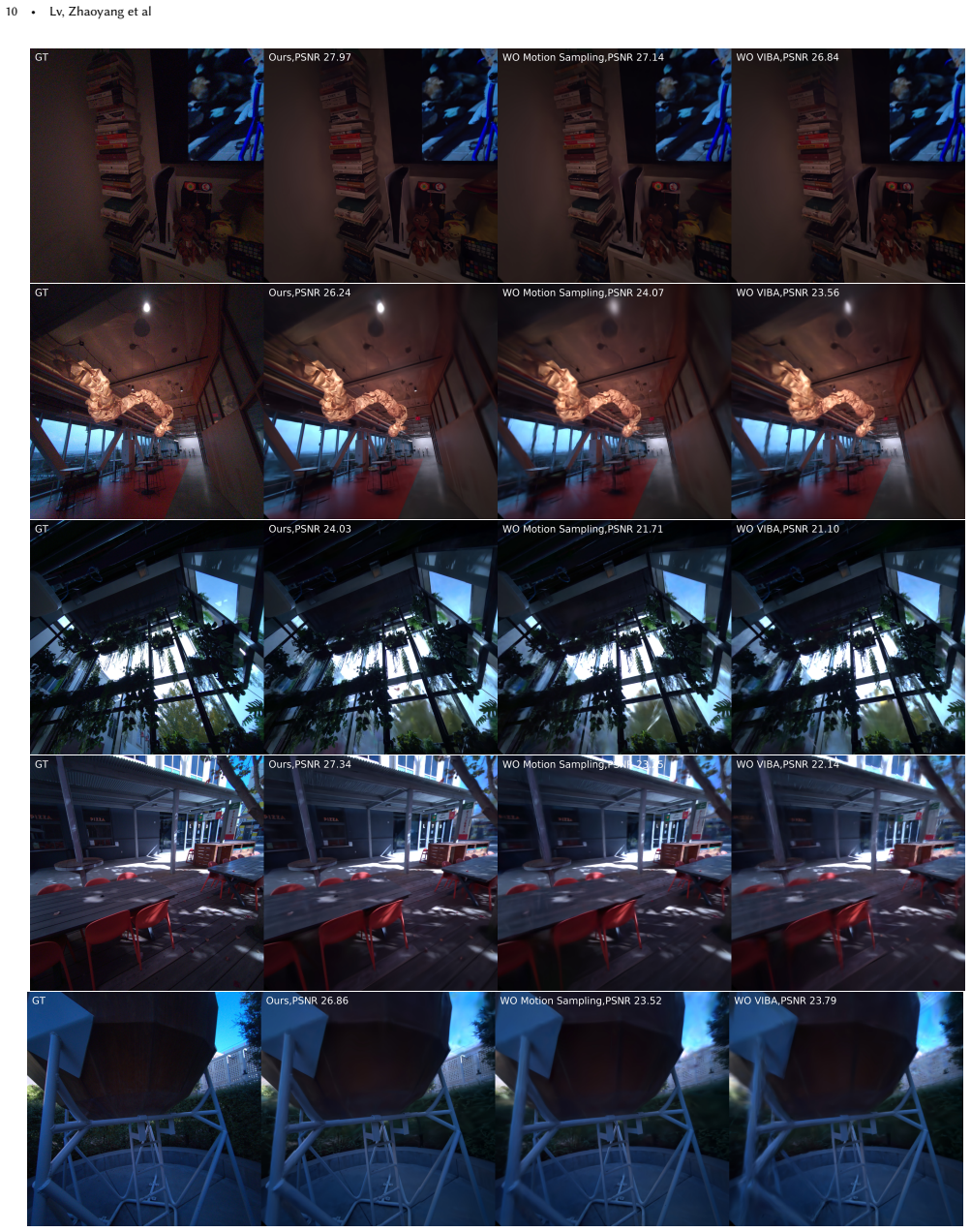
- [§7, Ablations: without VIBA] The "w/o VIBA" ablation does not isolate the effect of high-frequency rolling-shutter trajectory modeling. According to the paper, w/o VIBA uses the closed-loop SLAM trajectory and factory RGB calibration, while the full method uses the VIBA re-estimated trajectory and online calibration. Both the trajectory and the intrinsics/extrinsics change between the two conditions, so the +1 dB attributed to VIBA could come from improved calibration rather than from the rolling-shutter-aware high-frequency pose model. An ablation that changes only the trajectory representation, or only the calibration parameters, is needed to support the specific mechanistic claim.
- [§7, DTC dataset; §5, Methods] The physical accuracy of Eq. (2)-(4) is never validated against known ground truth. The DTC dataset provides ground-truth geometry, but not known camera trajectories or known radiance, so the reported gains could stem from a flexible reparameterization that compensates model error rather than from an accurate inverse of the sensor process. A synthetic experiment with rendered scenes and known per-row camera poses, or a calibration target with known motion, would directly test whether the rolling-shutter model recovers the correct pixel timings and exposures.
- [§7, Quest scene dataset; Table 3] The generalization claim to other headsets is supported by only one Quest 3 sequence, with no repeated runs or error bars, and the paper does not document for Quest 3 whether VIBA output, per-row timestamps, exposure metadata, and lens shading are available or how they are obtained. Reporting one sequence is acceptable as a pilot, but the abstract and conclusion phrase the result as consistent validation across platforms. At minimum, the paper should state the provenance of all Quest 3 inputs and add error bars or repeated capture statistics for at least one Aria scene and the Quest 3 scene.
minor comments (5)
- [§7, Table 1] Table 1 has typographical issues: the caption reads "Ourdoor scenes" and some entries are run together, e.g., "27.410.546" and "20.449 0.712". These should be corrected.
- [§7, Table 3] Table 3 omits the "w/o scene gamma" ablation row that is reported for Aria and DTC, so the Quest 3 comparison does not test all components of the image formation model.
- [§5.2] The phrase "the query time at t(u) from from the image capture time" contains a duplicated "from".
- [§6] The capture protocol limits exposure to 2 ms for indoor scenes, but the paper does not provide a sensitivity analysis of this threshold or report what exposure times and gains actually occurred in the indoor recordings; adding this would help reproducibility.
- [§5.3] The gamma value 2.2 is stated as the default, but no experiment examines sensitivity to this choice or compares it with a calibrated camera response function; a brief ablation or a justification would strengthen the claim that gamma modeling is physically motivated.
Circularity Check
No significant circularity: the +1 dB gains are measured against held-out frames, and the image-formation parameters come from device metadata and a public VIBA tool rather than from the reported PSNR.
full rationale
The paper's two claimed gains are empirical ablations, not derived quantities. The VIBA trajectory is obtained from a publicly available Project Aria tool ('We employed the publicly available tool to obtain all input in the paper'), and the image-formation model uses device metadata (exposure start, readout time, gain) plus a hand-set gamma default ('We use gamma value 2.2 as our default setting'); none of these are fitted to the validation PSNR. The validation protocol holds out every 8th frame ('we create the validation set following the common practices as [Mildenhall et al. 2019] that held out every 8th image as the validation images and use the rest for training'), and the DTC geometry evaluation uses an independently aligned ground-truth dataset, so the improvements are measured rather than constructed. Self-citations to Project Aria and DTC are platform/dataset citations by the same group, but they do not supply a forbidden uniqueness theorem or a fitted parameter renamed as a prediction. The physical accuracy of Eq. 3-4 and VIBA is an assumption that could fail on other devices, but that is a correctness/transferability risk, not circularity.
Assumptions & free parameters
free parameters (2)
- gamma =
2.2
- motion sampling threshold =
1 pixel reprojection error
assumptions (5)
- domain assumption The scene is static during capture.
- domain assumption Per-pixel timing can be derived from a piecewise continuous trajectory interpolated at IMU rate.
- domain assumption The camera response function is a simple gamma 2.2 compression.
- domain assumption Device metadata for exposure, gain, and lens shading are accurate.
- domain assumption The VIBA tool's rolling-shutter aware calibration is correct.
Cite this review
Pith. "Pith review of Photoreal Scene Reconstruction from an Egocentric Device." pith.science (2026). https://pith.science/paper/HKQ2LYZI
@misc{pith2026250604444,
  author       = {Pith},
  title        = {Pith review of: Photoreal Scene Reconstruction from an Egocentric Device},
  year         = {2026},
  howpublished = {\url{https://pith.science/paper/HKQ2LYZI}},
  note         = {Machine review of arXiv:2506.04444}
}
read the original abstract
In this paper, we investigate the challenges associated with using egocentric devices to photorealistic reconstruct the scene in high dynamic range. Existing methodologies typically assume using frame-rate 6DoF pose estimated from the device's visual-inertial odometry system, which may neglect crucial details necessary for pixel-accurate reconstruction. This study presents two significant findings. Firstly, in contrast to mainstream work treating RGB camera as global shutter frame-rate camera, we emphasize the importance of employing visual-inertial bundle adjustment (VIBA) to calibrate the precise timestamps and movement of the rolling shutter RGB sensing camera in a high frequency trajectory format, which ensures an accurate calibration of the physical properties of the rolling-shutter camera. Secondly, we incorporate a physical image formation model based into Gaussian Splatting, which effectively addresses the sensor characteristics, including the rolling-shutter effect of RGB cameras and the dynamic ranges measured by sensors. Our proposed formulation is applicable to the widely-used variants of Gaussian Splats representation. We conduct a comprehensive evaluation of our pipeline using the open-source Project Aria device under diverse indoor and outdoor lighting conditions, and further validate it on a Meta Quest3 device. Across all experiments, we observe a consistent visual enhancement of +1 dB in PSNR by incorporating VIBA, with an additional +1 dB achieved through our proposed image formation model. Our complete implementation, evaluation datasets, and recording profile are available at http://www.projectaria.com/photoreal-reconstruction/
Figures


Figures from the paper (7 more)




Reference graph
Works this paper leans on
-
[2021]
Deblur-NeRF: Neural Radiance Fields from Blurry Images
Deblur-NeRF: Neural Radiance Fields from Blurry Images.arXiv preprint arXiv:2111.14292(2021). Alexander Mai, Peter Hedman, George Kopanas, Dor Verbin, David Futschik, Qiangeng Xu, Falko Kuester, Jon Barron, and Yinda Zhang. 2024. EVER: Exact Volumetric Ellipsoid Rendering for Real-time View Synthesis. arXiv:2410.01804 [cs.CV] https: //arxiv.org/abs/2410.0...
work page Pith review arXiv 2021
-
[2022]
Mip-nerf 360: Unbounded anti-aliased neural radiance fields. InCVPR. 5470– 5479. Jonathan T. Barron, Ben Mildenhall, Dor Verbin, Pratul P. Srinivasan, and Peter Hedman
-
[2023]
Zip-NeRF: Anti-Aliased Grid-Based Neural Radiance Fields.ICCV(2023). Chen Chen, Qifeng Chen, Jia Xu, and Vladlen Koltun. 2018. Learning to See in the Dark. InCVPR. Jorge Condor, Sebastien Speierer, Lukas Bode, Aljaz Bozic, Simon Green, Piotr Didyk, and Adrian Jarabo. 2024. Don’t Splat your Gaussians: Volumetric Ray- Traced Primitives for Modeling and Rend...
work page Pith review arXiv 2023
-
[2024]
Sam Hasinoff, Dillon Sharlet, Ryan Geiss, Andrew Adams, Jonathan T
EgoLifter: Open-world 3D Segmentation for Egocentric Perception.ECCV (2024). Sam Hasinoff, Dillon Sharlet, Ryan Geiss, Andrew Adams, Jonathan T. Barron, Florian Kainz, Jiawen Chen, and Marc Levoy. 2016. Burst photography for high dynamic range and low-light imaging on mobile cameras.SIGGRAPH Asia(2016). http: //www.hdrplusdata.org/hdrplus.pdf Binbin Huang...
arXiv 2024
-
[2025]
Digital Twin Catalog: A Large-Scale Photorealistic 3D Object Digital Twin Dataset. InCVPR. Jakob Engel, Kiran Somasundaram, Michael Goesele, Albert Sun, Alexander Gamino, Andrew Turner, Arjang Talattof, Arnie Yuan, Bilal Souti, Brighid Meredith, Cheng Peng, Chris Sweeney, Cole Wilson, Dan Barnes, Daniel DeTone, David Caruso, Derek Valleroy, Dinesh Ginjupa...
arXiv 2023
Reviewed August 7, 2026 · model on record in the stance chip above.
Discussion (0). Continue with ORCID to comment.