REVIEW 4 major objections 5 minor 12 cited by
Real-Time Dynamics in a (2+1)-D Gauge Theory: The Stringy Nature on a Superconducting Quantum Simulator
T0 review · 4 major / 5 minor · reviewed 2026-08-06 · deepseek-v4-flash
Pith's one-line read A superconducting quantum processor with up to 144 qubits resolves a hierarchy of longitudinal and transverse string motions in a (2+1)-dimensional Z2-Higgs gauge theory, and observes multi-string fragmentation and recombination.
desk verdict A genuine scale milestone for digital (2+1)-D gauge theory simulation, but the abstract overstates the bending-mode claim relative to what the hardware actually resolves. read the letter →
The pith
A machine-rendered reading of the paper's core claim, the machinery that carries it, and where it could break.
The reading
What carries the argument
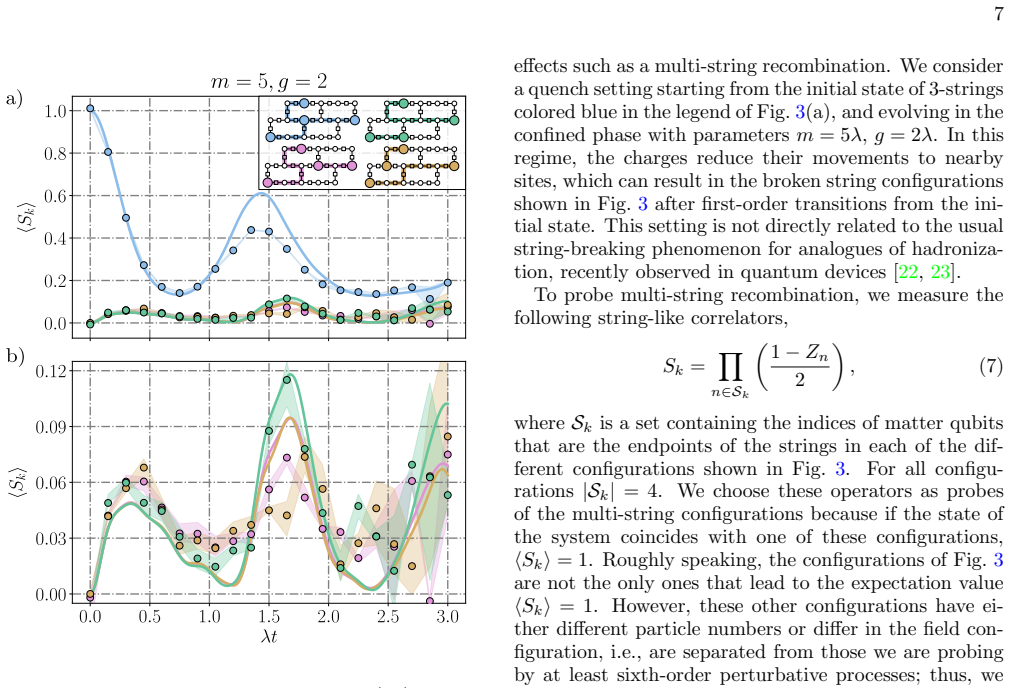
The load-bearing object is the $\mathbb{Z}_2$-Higgs Hamiltonian $H = -m\sum_n \tau^z_n - g\sum_{(n,v)} \sigma^z_{(n,v)} - \lambda\sum_{n,v} \tau^x_{n+v}\sigma^x_{(n,v)}\tau^x_n$, with Pauli matter operators on vertices and Pauli gauge operators on links. Its local gauge generators $G_n = \tau^z_n \prod_{v\in\ell_n}\sigma^z_{(n,v)}$ provide both the physical-state constraint (discrete Gauss law) and, through the paper's Gauss sector correction, a stabilizer code with bit-flip distance 3. The time evolution is implemented with second-order Trotter circuits assembled from commuting Pauli gadgets on a hexagonal qubit layout, and three further tools carry the error control: gauge dynamical decoupling randomizes the phases of non-physical states, Pauli twirling converts coherent noise into stochastic Pauli noise, and operator decoherence renormalization relates noisy to ideal Pauli expectation values. The observables that carry the claim are local matter occupations and four-body string correlators $S_k = \prod_{n\in S_k}(1-Z_n)/2$, which equal 1 when the charges occupy the specified endpoints, together with the predicted frequencies $\omega_y$ and $\omega_b$ against which hardware and tensor-network results are compared.
What would settle it
Run the confined-phase one-string quench without the Gauss-sector sample selection, or with the time step halved at the same final times; if the separated yo-yo and bending signatures disappear or shift beyond the quoted bootstrap error bars, those signatures are artifacts of the correction procedure rather than real string dynamics.
Extended reading notes
Core claim
The central discovery is that, after a sudden quench from a $\lambda=0$ string eigenstate into the $\lambda=1$ dynamics of the $\mathbb{Z}_2$-Higgs model, the electric string between two dynamical charges supports two well-separated modes of motion: a fast longitudinal oscillation with frequency $\omega_y = 2g$, in which the charges tunnel back and forth stretching and compressing the string, and a slower, second-order transverse bending mode with frequency $\omega_b = \lambda^2/g - \lambda^2/(2m+g)$, in which the endpoints move to rotated lattice positions while keeping the string length fixed. By working in the confined regime ($m=5\lambda$, $g=2\lambda$), the paper separates these timescales so that the yo-yo oscillations are visible on the hardware and the bending appears as a slower occupation drift at the original and rotated endpoints. In the deconfined and Higgs regimes, the same hardware shows matter spreading and damped glassy oscillations, respectively. The paper further reports that a four-charge '3-string' initial configuration fragments and recombines, detected through four-body string correlators $S_k$, in a process that is distinct from conventional string breaking.
Load-bearing premise
The paper's picture rests on the assumption that the error-corrected and error-mitigated measurements from the quantum device track the ideal quench dynamics, because the formal mathematical guarantee on the error from splitting the time evolution into short steps is larger than one for the circuit depths used.
Editorial extensions
If this is right
- A fast longitudinal and slow transverse mode hierarchy at string endpoints can be resolved in real time by local measurements, providing a dynamical signature that sits between static confinement potentials and asymptotic hadronization models.
- The gauge generators themselves can be used as a stabilizer code during Trotter evolution, so enforcing the discrete Gauss law after measurement extends the useful depth of noisy simulations even when formal Trotter bounds are not tight.
- Multi-string fragmentation and recombination in the heavy-mass regime is an additional channel beyond string breaking by pair creation, and future simulators should distinguish these two processes in their observed dynamics.
- The optimized hexagonal embedding and the error toolbox transfer to other $\mathbb{Z}_2$ lattice gauge theories with dynamical matter, broadening the class of models whose real-time confinement dynamics can be probed.
Reading between the lines
- A natural next test is to extract the bending frequency from longer tensor-network data and compare it to the second-order prediction $\omega_b = \lambda^2/g - \lambda^2/(2m+g)$; a systematic deviation would signal that the missing plaquette term adds stiffness beyond the estimate.
- The same mode hierarchy should show up in the time dependence of the string-length variance or in two-point gauge-field correlations along the string, which could be verified without modifying the current experiment.
- If the Gauss sector correction is as effective as it appears, local symmetry constraints of other lattice gauge theories could be used as a cheap error-correcting layer in Trotter circuits, converting part of measurement noise into detectable and correctable bit flips.
Editorial analysis
A structured set of objections, weighed in public.
Referee Report
Summary. This paper reports a digital quantum simulation of the (2+1)-dimensional Z2-Higgs model on IBM superconducting processors, with up to 144 qubits and circuit depths up to 192 two-qubit layers. The authors implement the gauge theory through a heavy-hex embedding, apply Trotterized time evolution, and combine error suppression, mitigation, and correction techniques including gauge dynamical decoupling, Gauss sector correction, and operator decoherence renormalization. They present quench dynamics for three phases: in the confined regime they observe fast longitudinal 'yo-yo' oscillations and a slower monotone drift interpreted as the initial stage of transverse bending of the string; in the deconfined regime they observe charge spreading; in the Higgs regime they observe damped glassy oscillations. They also study a multi-string configuration and report fragmentation and recombination of strings. The experimental data are compared with matrix-product-state (MPS) simulations using the basis update and Galerkin integrator.
Significance. If the central claims hold, this is a substantial experimental milestone: it would be one of the largest and deepest digital quantum simulations of a (2+1)-dimensional lattice gauge theory with dynamical matter, and it demonstrates that current superconducting hardware, combined with tailored error mitigation, can track real-time string-like dynamics over several correlation times. The paper has clear strengths: the experimental design is demanding (300,000 shots per circuit, 600,000 per time step); the work introduces and tests new error-handling ideas (GDD, GSC) and combines them with existing techniques; the comparison with MPS simulations is a sound and necessary validation strategy; and the analytical estimates for the yo-yo and bending frequencies are derived from the Hamiltonian rather than fitted to the data. The main gap is that the experimental evidence for the headline bending-mode 'resolution' covers only about a quarter of the predicted bending period, so the quantitative content of that specific claim is not yet supported by hardware data alone.
major comments (4)
- [Abstract and Sec. III.A] The abstract claims 'Our results resolve a dynamical hierarchy of longitudinal oscillations and transverse bending at the end points of the string,' but Sec. III.A states that 'the noise in the device prevents us from resolving a complete bending oscillation with period Tb = 15.08 lambda^-1.' The simulated time is t = 4 lambda^-1, i.e., only about 0.27 Tb, so the hardware data show only a slow, monotone drift in the initial- and rotated-endpoint occupations (Fig. 2(a)-(b)). Any time-dependent noise bias with the same sign could produce this signature. This is load-bearing because the bending-mode resolution is a central abstract claim. I recommend either rewording the claim to state that the hardware data are consistent with the early-time stage of the bending mode predicted by MPS, or adding a quantitative test that the drift is not an artifact, for example by varying the GSC selection threshold or performing a zero-noise extrapolation of the drift amplitude.
- [Sec. IV.A.2] The Gauss sector correction procedure retains only the 30,000 shots with the fewest decoder-detected flips among the 300,000 total shots. Since Fig. 4(b) shows that the mean flip count grows with circuit depth, the retained samples at later times are systematically those with lower inferred noise. This selection makes the estimator biased in a depth-dependent way: late-time expectation values are computed from a sub-ensemble that is not representative of the full noiseless distribution. Such a bias can artificially preserve the initial-endpoint population and reduce population transfer at later times, mimicking the slow monotone bending signature. The paper does not quantify this bias. Please provide a numerical study, e.g., noise-injected simulations comparing GSC-threshold selection with strict gauge-sector postselection or with the full unselected sample, to show that the bending drift is not an artifact of the selection rule.
- [Table I and App. A.2] The formal Trotter error bound reported in Table I is 50.28, 60.50, and 4.31 for the confined, deconfined, and Higgs simulations, all far above the unit error threshold. The paper replaces the bound with an empirical dt-invariance check, but Fig. 4(c) shows this check only for one observable (the upper string endpoint in the confined regime) and for one phase. The bending-mode drift, the rotated-site occupations, and the three-string correlators are not subjected to the same dt-invariance test. Since the formal bound is not useful and the main quantitative claims concern mode frequencies and correlated multi-site observables, please provide dt-invariance checks for the additional observables or explicitly state that the quantitative frequency claims are validated only against MPS simulations rather than by the hardware data.
- [Sec. III.A and Extended Data Fig. 8] The full bending oscillation shape shown in Fig. 8 comes from MPS calculations, not from hardware data. Using agreement with MPS as validation is reasonable, but the agreement is weakest precisely in the region where the hardware window is too short to measure a frequency: over 0.27 Tb the bending mode is a slow monotone drift, and the long-time oscillation shape is provided by the classical simulation. The paper should state this limitation more prominently and avoid the implication that the bending frequency has been measured on the device. In particular, the sentence 'we can resolve the initial instants of this rotation' is an appropriate level of claim, and the abstract should be adjusted to match it.
minor comments (5)
- [Extended Data Fig. 8 caption] 'basis update and Galekin' should be 'basis update and Galerkin'.
- [Sec. II] The text contains a typo in 'Shr¨ odinger conjugation'; the encoding artifact should be fixed to 'Schrödinger'.
- [App. A.4] '250K and 195K CLOPS' should read '250k and 195k CLOPS' or be written with explicit units, since K usually denotes kelvin.
- [Sec. I] In the fourth paragraph, 'one-quarter of the complete rotation of the string' is ambiguous; it should be clarified as one quarter of a full string rotation or one quarter of the bending period.
- [Sec. IV.A.2] Please specify the fraction of shots retained by GSC (30,000 out of 300,000) in the same paragraph that defines the threshold, for clarity.
Circularity Check
No significant circularity: central dynamics are compared against independent MPS and analytical solutions; the only fitted prefactor (γ≈0.25) sets a static phase boundary and does not enter the dynamical predictions.
full rationale
The paper's claims—yo-yo and endpoint-bending modes, deconfined spreading, glassy oscillations, and multi-string fragmentation—are all predictions from Eq. (1) with no fitted dynamical parameters. The yo-yo frequency ωy=2g and the bending frequency ωb=λ²/g−λ²/(2m+g) are derived from perturbative analysis of the Hamiltonian, and the hardware data are validated against parameter-free MPS simulations (BUG integrator) and, in the m=0 limit, the analytical solution Eq. (A7). The only fitted number, γ≈0.25 in J_eff^7=γλ⁶m⁻⁵, is obtained from a single-hexagon energy gap and is used only to sketch the static deconfined phase boundary; it does not enter the dynamical observables or the mode frequencies. Self-citations ([44]-[46],[49]) concern DMRG implementation details, bond-expansion techniques, and an outlook item; none is load-bearing for the central physics. The paper itself flags the relevant limitations: Table I states the Trotter bounds formally give ε>1, and Sec. III.A states 'The noise in the device prevents us from resolving a complete bending oscillation' (T_b≈15.08λ⁻¹ vs. t=4λ⁻¹). These are validation and overclaim concerns, not circular reductions: the bending identification retains independent content through the MPS long-time prediction and the perturbative frequency, though the hardware support is limited to the initial monotone segment. No equation is equivalent to its inputs by construction, and no fitted parameter is renamed as a prediction.
Assumptions & free parameters
free parameters (2)
- gamma (deconfined phase-boundary prefactor) =
0.25 (from single-hexagon gap at m >> lambda, g = 0)
- GSC shot-retention threshold =
30000 samples per observable
assumptions (5)
- domain assumption The no-plaquette Hamiltonian (1) still hosts a deconfined phase through sixth-order virtual plaquette fluctuations.
- domain assumption After Pauli twirling, the hardware noise is well approximated by a Pauli channel, so ODR's linear relation between noisy and ideal expectation values holds.
- standard math The gauge stabilizer code with G_n = tau^z_n prod sigma^z has distance 3 and the final syndrome decode corrects or identifies bit flips reliably.
- domain assumption The MPS BUG integrator with bond dimensions 64 to 512 and the DMRG calculations provide accurate reference dynamics for the sizes studied.
- ad hoc to paper The two-mode decomposition (yo-yo frequency omega_y = 2g and bending frequency omega_b = lambda^2/g - lambda^2/(2m+g)) accurately describes the quench dynamics.
Cite this review
Pith. "Pith review of Real-Time Dynamics in a (2+1)-D Gauge Theory: The Stringy Nature on a Superconducting Quantum Simulator." pith.science (2026). https://pith.science/paper/TCJBQACO
@misc{pith2026250708088,
  author       = {Pith},
  title        = {Pith review of: Real-Time Dynamics in a (2+1)-D Gauge Theory: The Stringy Nature on a Superconducting Quantum Simulator},
  year         = {2026},
  howpublished = {\url{https://pith.science/paper/TCJBQACO}},
  note         = {Machine review of arXiv:2507.08088}
}
abstract
Understanding the confinement mechanism in gauge theories and the universality of effective string-like descriptions of gauge flux tubes remains a fundamental challenge in modern physics. We probe string modes of motion with dynamical matter in a digital quantum simulation of a (2+1) dimensional gauge theory using a superconducting quantum processor with up to 144 qubits, stretching the hardware capabilities with quantum-circuit depths comprising up to 192 two-qubit layers. We realize the $Z_2$-Higgs model ($Z_2$HM) through an optimized embedding into a heavy-hex superconducting qubit architecture, directly mapping matter and gauge fields to vertex and link superconducting qubits, respectively. Using the structure of local gauge symmetries, we implement a comprehensive suite of error suppression, mitigation, and correction strategies to enable real-time observation and manipulation of electric strings connecting dynamical charges. Our results resolve a dynamical hierarchy of longitudinal oscillations and transverse bending at the end points of the string, which are precursors to hadronization and rotational spectra of mesons. We further explore multi-string processes, observing the fragmentation and recombination of strings. The experimental design supports 300,000 measurement shots per circuit, totaling 600,000 shots per time step, enabling high-fidelity statistics. We employ extensive tensor network simulations using the basis update and Galerkin method to predict large-scale real-time dynamics and validate our error-aware protocols. This work establishes a milestone for probing non-perturbative gauge dynamics via superconducting quantum simulation and elucidates the real-time behavior of confining strings.
Figures


Figures from the paper (7 more)


Forward citations
Cited by 12 Pith papers
-
Quantum Resources in Disorder-Free Localization Dynamics of Gauge Theories
In U(1) and SU(2) lattice gauge theories in the disorder-free localization regime, stabilizer and participation entropies grow as log log t at strong coupling, bounded by an exact counting of resonant configurations.
-
Role of flavor degrees of freedom in quantum simulations of disorder-free localization
In a flavor-extended Z2 lattice gauge theory, n=2 binary bond disorder yields only a long-lived nonergodic transient, whereas n=4 and n=8 multilevel disorder produce consistent many-body localization signatures; local...
-
Quantum Phase Diagram of the $2+1$D Untruncated SU$(2)$ Lattice Gauge Theory with Dynamical Fermions
An untruncated variational Monte Carlo study finds a magnetic-flux transition at λ*≈−0.040 and a weak-to-strong coupling delocalization crossover in 2+1D SU(2) lattice gauge theory with staggered fermions.
-
Neural quantum states for non-Abelian lattice gauge theories with dynamical fermions
A sign-problem-free variational Monte Carlo framework computes ground states of continuous SU(2) lattice gauge theory with dynamical fermions, matching strong-coupling perturbation theory and sketching the (g², λ) pha...
-
$p$-Form Gauge Dynamics and Digital Quantum Simulation -- Flux and Cosmological Constant Neutralization
Exact diagonalization of a Gauss-law-reduced Z2 two-form plaquette model finds cap flux discharge of 20–37% and a tension-to-density dynamical crossover near (m/ε_E)_c ≃ 1.89, with a digital circuit encoding.
-
Ground state preparation in $(2+1)$-dimensional pure $\mathbb{Z}_2$ lattice gauge theory via deterministic quantum imaginary time evolution
Deterministic QITE with a Gauss-law-reduced Pauli pool reproduces DMRG ground-state energies of (2+1)-D pure Z2 lattice gauge theory to within 0.1% for ladders of up to 32 qubits and coupling λ ∈ [0.5, 5].
-
Symmetry-protected topology and deconfined solitons in a multi-link $\mathbb{Z}_2$ gauge theory
In a multi-link Z2 lattice gauge theory with three bonds per site pair, gauge fluxes order in a Peierls-like pattern that coexists with topological order, and doping produces deconfined half-charge solitons.
-
(2+1)D quantum electrodynamics at finite density on a quantum computer
A VQE circuit that enforces Gauss's law identifies particle-number phase transitions in two-flavor (2+1)D QED on a 2x2 lattice, with inference runs on IBM hardware.
-
Real-time scattering and freeze-out dynamics in Rydberg-atom lattice gauge theory
Using a Rydberg atom array as a (1+1)-dimensional U(1) lattice gauge theory simulator, the authors observe real-time particle scattering and a double-quench freeze-out that halts the collision dynamics.
-
Quantum computer-based simulation of Stark many-body localization in a 1D Fermi-Hubbard model
A 12-qubit tilted Fermi-Hubbard simulation on IBM hardware, with ~88% two-qubit-gate reduction via spin-resolved mapping, SWAP networks, and tensor-network compression, reproduces finite-time Stark-MBL signatures.
-
Confinement and String Breaking in the Compact Abelian Higgs Model
A spin-1 qutrit lattice model with a local chemical potential yields universal linear string potentials, from which string tension, breaking length, and meson mass can be extracted by DMRG.
-
Observation of Robust and Coherent Non-Abelian Hadron Dynamics on Noisy Quantum Processors
A 60-site SU(2) lattice gauge theory was run on 120 qubits, but the implemented dynamics approximate to non-interacting fermion hopping, and the abstract's claimed breathing-mode frequency is not extracted anywhere.
Reference graph
Works this paper leans on
-
[1]
String dynamics in the confined phase In the confined phase of the Z2HM, matter particles and strings remain considerably localized after quench- ing, and the dynamics can be described using these as fundamental objects. In Figs. 2(a)-(b), we experimen- tally observe some characteristic features of confinement in the presence of dynamical matter. The effe...
-
[2]
Matter spreads in the deconfined phase The deconfined phase appears for large m and g < J pert 7 , where the number of charges is approximately conserved and there are large electric-field fluctuations. Contrary to what happens in the confined phase, these charges can now spread without the electric energy cost through the lattice because the energy to ch...
-
[3]
Damped glassy oscillations in the Higgs phase The quench dynamics in the Higgs regime arise from an interplay between glassy oscillations, which dominate for small m, and matter spreading as in the deconfined phase that becomes manifest as m grows, as shown in Fig. 2(c)-(d). Here, the term glassy refers to the fact that the Hamiltonian for m = 0, g = 0 ha...
-
[4]
Susskind, Lattice models of quark confinement at high temperature, Phys
L. Susskind, Lattice models of quark confinement at high temperature, Phys. Rev. D 20, 2610 (1979)
work page 1979
-
[5]
Gauge dynamical decoupling Gauge dynamical decoupling (GDD) is an error sup- pression strategy intended to induce a random phase in non-physical states that may appear due to noise. It involves incorporating the gauge operators Gn into the generator of the time evolution operator so that the sim- ulation circuits implement ˜U (t) = LY k=1 U1(dt/2) U3(dt) ...
-
[6]
Gauss sector correction Let us now discuss how certain aspects of quantum error correction (QEC) can be exploited to correct cer- tain hardware errors after measurement. We develop the novel Gauss sector correction (GSC) technique, which can formally correct single X-flips and also minimize higher-order flips by identifying them with very high probability...
-
[7]
ERDF A way of making Europe
Calibrating Operator Decoherence Renormalization Operator decoherence renormalization (ODR) [40] is an error mitigation technique designed to eliminate the effect of Pauli noise on expectation values measured 11 in noisy quantum hardware. Fig. 4(a) shows that, in combination with Pauli Twirling [31] and GDD (see Sect. IV A 1), ODR is the most effective te...
2024
-
[8]
G. S. Bali, Qcd forces and heavy quark bound states, Physics Reports 343, 1 (2001)
work page 2001
Show all 67 references
-
[9]
Regge, Introduction to complex orbital momenta, Il Nuovo Cimento (1955-1965) 14, 951 (1959)
T. Regge, Introduction to complex orbital momenta, Il Nuovo Cimento (1955-1965) 14, 951 (1959)
1959
-
[10]
G. F. Chew and S. C. Frautschi, Principle of equivalence for all strongly interacting particles within the s-matrix framework, Phys. Rev. Lett. 7, 394 (1961)
1961
-
[11]
Nambu, Quark confinement and field theory (John Wi- ley and Sons., 1977) p
Y. Nambu, Quark confinement and field theory (John Wi- ley and Sons., 1977) p. p. 1–12
1977
-
[12]
Fradkin and S
E. Fradkin and S. H. Shenker, Phase diagrams of lattice gauge theories with higgs fields, Phys. Rev. D 19, 3682 (1979)
1979
-
[13]
L¨ uscher and P
M. L¨ uscher and P. Weisz, Definition and general proper- ties of the transfer matrix in continuum limit improved lattice gauge theories, Nuclear Physics B240, 349 (1984)
1984
-
[14]
L¨ uscher, Symmetry-breaking aspects of the roughen- ing transition in gauge theories, Nuclear Physics B 180, 317 (1981)
M. L¨ uscher, Symmetry-breaking aspects of the roughen- ing transition in gauge theories, Nuclear Physics B 180, 317 (1981)
1981
-
[15]
Polchinski and A
J. Polchinski and A. Strominger, Effective string theory, Phys. Rev. Lett. 67, 1681 (1991)
1991
-
[16]
Andersson, The lund model (Cambridge University Press, 1998)
B. Andersson, The lund model (Cambridge University Press, 1998)
1998
-
[17]
K. J. Juge, J. Kuti, and C. Morningstar, Fine structure of the qcd string spectrum, Phys. Rev. Lett. 90, 161601 (2003)
2003
-
[18]
Gliozzi, M
F. Gliozzi, M. Pepe, and U.-J. Wiese, Width of the con- fining string in yang-mills theory, Phys. Rev. Lett. 104, 232001 (2010)
2010
-
[19]
J. B. Kogut, An introduction to lattice gauge theory and spin systems, Rev. Mod. Phys. 51, 659 (1979)
1979
-
[20]
Homeier, A
L. Homeier, A. Bohrdt, S. Linsel, E. Demler, J. C. Hal- imeh, and F. Grusdt, Realistic scheme for quantum simu- lation of z 2 lattice gauge theories with dynamical matter in (2+ 1) d, Communications Physics 6, 127 (2023)
2023
-
[21]
M. C. Banuls, R. Blatt, J. Catani, A. Celi, J. I. Cirac, M. Dalmonte, L. Fallani, K. Jansen, M. Lewenstein, S. Montangero, et al. , Simulating lattice gauge theo- ries within quantum technologies, The European physical journal D 74, 1 (2020)
2020
-
[22]
NextGenerationEU
This work was supported by the EU via Quan- tERA project T-NiSQ grant PCI2022-132984 funded by MCIN/AEI/10.13039/501100011033 and by the Euro- 13 pean Union “NextGenerationEU”/PRTR. This work has been financially supported by the Ministry of Economic Affairs and Digital Transf...
-
[23]
C. W. Bauer, Z. Davoudi, A. B. Balantekin, T. Bhat- tacharya, M. Carena, W. A. de Jong, P. Draper, A. El-Khadra, N. Gemelke, M. Hanada, D. Kharzeev, H. Lamm, Y.-Y. Li, J. Liu, M. Lukin, Y. Meurice, C. Monroe, B. Nachman, G. Pagano, J. Preskill, E. Ri- naldi, A. Roggero, D. I. ...
2023
-
[24]
Di Meglio, K
A. Di Meglio, K. Jansen, I. Tavernelli, C. Alexandrou, S. Arunachalam, C. W. Bauer, K. Borras, S. Carrazza, A. Crippa, V. Croft, R. de Putter, A. Delgado, V. Dun- jko, D. J. Egger, E. Fern´ andez-Combarro, E. Fuchs, L. Funcke, D. Gonz´ alez-Cuadra, M. Grossi, J. C. Hal- imeh, ...
2024
-
[25]
Marcos, P
D. Marcos, P. Widmer, E. Rico, M. Hafezi, P. Rabl, U.- J. Wiese, and P. Zoller, Two-dimensional lattice gauge theories with superconducting quantum circuits, Annals of Physics 351, 634 (2014)
2014
-
[26]
E. J. Gustafson and H. Lamm, Toward quantum simula- tions of z2 gauge theory without state preparation, Phys. Rev. D 103, 054507 (2021)
2021
-
[27]
Lumia, P
L. Lumia, P. Torta, G. B. Mbeng, G. E. Santoro, E. Erco- lessi, M. Burrello, and M. M. Wauters, Two-dimensional z2 lattice gauge theory on a near-term quantum simula- tor: Variational quantum optimization, confinement, and topological order, PRX Quantum 3, 020320 (2022)
2022
-
[28]
J. M. Chow, A. D. C´ orcoles, J. M. Gambetta, C. Rigetti, B. R. Johnson, J. A. Smolin, J. R. Rozen, G. A. Keefe, M. B. Rothwell, M. B. Ketchen, and M. Steffen, Simple all-microwave entangling gate for fixed-frequency super- conducting qubits, Phys. Rev. Lett. 107, 080502 (2011)
2011
-
[29]
Irmejs, M.-C
R. Irmejs, M.-C. Ba˜ nuls, and J. I. Cirac, Quantum simu- lation of z2 lattice gauge theory with minimal resources, 14 Phys. Rev. D 108, 074503 (2023)
2023
-
[30]
T. A. Cochran, B. Jobst, E. Rosenberg, Y. D. Lensky, G. Gyawali, N. Eassa, M. Will, D. Abanin, R. Acharya, L. A. Beni, et al. , Visualizing dynamics of charges and strings in (2+ 1) d lattice gauge theories, arXiv preprint arXiv:2409.17142 (2024)
2024 arXiv
-
[31]
Gonzalez-Cuadra, M
D. Gonzalez-Cuadra, M. Hamdan, T. V. Zache, B. Braverman, M. Kornjaˇ ca, A. Lukin, S. H. Cant´ u, F. Liu, S.-T. Wang, A. Keesling, et al. , Observation of string breaking on a (2+ 1) d rydberg quantum simula- tor, Nature , 1 (2025)
2025
-
[32]
Bonati, A
C. Bonati, A. Pelissetto, and E. Vicari, Multicritical point of the three-dimensional z2 gauge higgs model, Phys. Rev. B 105, 165138 (2022)
2022
-
[33]
Borla, B
U. Borla, B. Jeevanesan, F. Pollmann, and S. Moroz, Quantum phases of two-dimensionalz2 gauge theory cou- pled to single-component fermion matter, Phys. Rev. B 105, 075132 (2022)
2022
-
[34]
I. S. Tupitsyn, A. Kitaev, N. V. Prokof’ev, and P. C. E. Stamp, Topological multicritical point in the phase dia- gram of the toric code model and three-dimensional lat- tice gauge higgs model, Phys. Rev. B 82, 085114 (2010)
2010
-
[35]
Kitaev, Fault-tolerant quantum computation by anyons, Annals of Physics 303, 2 (2003)
A. Kitaev, Fault-tolerant quantum computation by anyons, Annals of Physics 303, 2 (2003)
2003
-
[36]
We note that the latter can mitigate any Pauli noise channel when measuring tensor products of Paulis
and operator decoherence renormalization (ODR) [32]. We note that the latter can mitigate any Pauli noise channel when measuring tensor products of Paulis. We classify such procedures into three categories: cor- rection, suppression, and mitigation. GSC is a correct- ing strat...
-
[37]
Chamberland, G
C. Chamberland, G. Zhu, T. J. Yoder, J. B. Hertzberg, and A. W. Cross, Topological and subsystem codes on low-degree graphs with flag qubits, Phys. Rev. X 10, 011022 (2020)
2020
-
[38]
Kogut and L
J. Kogut and L. Susskind, Hamiltonian formulation of wilson’s lattice gauge theories, Phys. Rev. D 11, 395 (1975)
1975
-
[39]
M. R. Geller and Z. Zhou, Efficient error models for fault- tolerant architectures and the pauli twirling approxima- tion, Phys. Rev. A 88, 012314 (2013)
2013
-
[40]
R. C. Farrell, M. Illa, A. N. Ciavarella, and M. J. Savage, Scalable circuits for preparing ground states on digital quantum computers: The schwinger model vacuum on 100 qubits, PRX Quantum 5, 020315 (2024)
2024
-
[41]
Ceruti, C
G. Ceruti, C. Lubich, and D. Sulz, Rank-adaptive time integration of tree tensor networks, SIAM Journal on Nu- merical Analysis 61, 194–222 (2023)
2023
-
[42]
Rossini and E
D. Rossini and E. Vicari, Dynamics after quenches in one-dimensional quantum ising-like systems, Phys. Rev. B 102, 054444 (2020)
2020
-
[43]
Z. Cai, R. Babbush, S. C. Benjamin, S. Endo, W. J. Hug- gins, Y. Li, J. R. McClean, and T. E. O’Brien, Quantum error mitigation, Rev. Mod. Phys. 95, 045005 (2023)
2023
-
[44]
van den Berg, Z
E. van den Berg, Z. K. Minev, and K. Temme, Model-free readout-error mitigation for quantum expectation values, Phys. Rev. A 105, 032620 (2022)
2022
-
[45]
Shor, Fault-tolerant quantum computation, in Pro- ceedings of 37th Conference on Foundations of Computer Science (1996) pp
P. Shor, Fault-tolerant quantum computation, in Pro- ceedings of 37th Conference on Foundations of Computer Science (1996) pp. 56–65
1996
-
[46]
Higgott and C
O. Higgott and C. Gidney, Sparse blossom: correcting a million errors per core second with minimum-weight matching, arXiv preprint arXiv:2303.15933 (2023)
2023 arXiv
-
[47]
P. Rall, D. Liang, J. Cook, and W. Kretschmer, Simu- lation of qubit quantum circuits via pauli propagation, Phys. Rev. A 99, 062337 (2019)
2019
-
[48]
A. N. Ciavarella and C. W. Bauer, Quantum simulation of su(3) lattice yang-mills theory at leading order in large- Nc expansion, Phys. Rev. Lett. 133, 111901 (2024)
2024
-
[49]
Aaronson and D
S. Aaronson and D. Gottesman, Improved simulation of stabilizer circuits, Physical Review A 70, 10.1103/phys- reva.70.052328 (2004)
2004 doi
-
[50]
S. R. White, Density matrix formulation for quantum renormalization groups, Phys. Rev. Lett.69, 2863 (1992)
1992
-
[51]
Schollw¨ ock, The density-matrix renormalization group in the age of matrix product states, Annals of Physics 326, 96 (2011), january 2011 Special Issue
U. Schollw¨ ock, The density-matrix renormalization group in the age of matrix product states, Annals of Physics 326, 96 (2011), january 2011 Special Issue
2011
-
[52]
Menczer and O
A. Menczer and O. Legeza, Tensor network state algo- rithms on AI accelerators, Journal of Chemical Theory and Computation 20, 8897 (2024)
2024
-
[53]
Legeza and J
¨O. Legeza and J. S´ olyom, Optimizing the density-matrix renormalization group method using quantum informa- tion entropy, Phys. Rev. B 68, 195116 (2003)
2003
-
[54]
Cobos, D
J. Cobos, D. F. Locher, A. Bermudez, M. M¨ uller, and E. Rico, Noise-aware variational eigensolvers: A dissipa- tive route for lattice gauge theories, PRX Quantum 5, 030340 (2024)
2024
-
[55]
A. M. Childs, Y. Su, M. C. Tran, N. Wiebe, and S. Zhu, Theory of trotter error with commutator scaling, Phys. Rev. X 11, 011020 (2021)
2021
-
[56]
Haegeman, C
J. Haegeman, C. Lubich, I. Oseledets, B. Vandereycken, and F. Verstraete, Unifying time evolution and optimiza- tion with matrix product states, Physical Review B 94, 10.1103/physrevb.94.165116 (2016)
2016 doi
-
[57]
Barcza, ¨O
G. Barcza, ¨O. Legeza, K. H. Marti, and M. Reiher, Quantum-information analysis of electronic states of dif- ferent molecular structures, Phys. Rev. A 83, 012508 (2011)
2011
-
[58]
A. Wack, H. Paik, A. Javadi-Abhari, P. Jurcevic, I. Faro, J. M. Gambetta, and B. R. Johnson, Quality, speed, and scale: three key attributes to measure the performance of near-term quantum computers (2021), arXiv:2110.14108 [quant-ph]
2021 arXiv
-
[59]
D. C. McKay, I. Hincks, E. J. Pritchett, M. Car- roll, L. C. G. Govia, and S. T. Merkel, Benchmark- ing quantum processor performance at scale (2023), arXiv:2311.05933 [quant-ph]
2023 arXiv
-
[60]
Javadi-Abhari, M
A. Javadi-Abhari, M. Treinish, K. Krsulich, C. J. Wood, J. Lishman, J. Gacon, S. Martiel, P. D. Na- tion, L. S. Bishop, A. W. Cross, B. R. Johnson, and J. M. Gambetta, Quantum computing with qiskit (2024), arXiv:2405.08810 [quant-ph]
2024 arXiv
-
[61]
J. J. Wallman and J. Emerson, Noise tailoring for scalable quantum computation via randomized compiling, Phys. Rev. A 94, 052325 (2016). 15 Appendix A: Supplemental material
2016
-
[62]
(A1) Here, the sum goes over every bond ( n, v), and the single-bond Hamiltonians h(n,v) = −gσ z (n,v) − λτ x n+vσx (n,v)τ x n commute with each other, [ h(n,v), h( ˜n,˜v)] ≡ 0
Solution for the Z2HM in them = 0 limit In case of m = 0, the Hamiltonian reads H = X (n,v) h(n,v) = X (n,v) −gσ z (n,v) − λτ x n+vσx (n,v)τ x n . (A1) Here, the sum goes over every bond ( n, v), and the single-bond Hamiltonians h(n,v) = −gσ z (n,v) − λτ x n+vσx (n,v)τ x n com...
-
[63]
Here, we have defined L as the number of Trotter layers
T rotter circuits To simulate the dynamics of Z2HM on quantum hardware, we implement the time evolution operator by its second- order Trotter decomposition, U (t) = LY k=1 U1(dt/2) U3(dt) U1(dt/2) = LY k=1 e−iH1dt/2 e−iH3dt e−iH1dt/2 (A8) With H1 = −HM − HE, H3 = −HI , the one...
-
[64]
basis update and Galerkin
MPS-based dynamical simulations MPS wavefunctions provide a framework not only for computing the eigenvalue spectrum of static Hamiltonians but also for performing simulations of quantum dynamics. As the two-dimensional geometry introduces long-range couplings in the MPS chain...
-
[65]
Execution on IBM Quantum hardware The Heron r2 processors consist of 156 fixed-frequency transmon qubits arranged in a heavy-hex lattice structure, each connected by tunable couplers. The results presented in this work were specifically obtained using ibm kingston and ibm marr...
-
[66]
It is particularly powerful when the underlying distribution is unknown or when the propagation of analytic errors is intractable
Bootstraping for error bars Bootstrapping is a nonparametric statistical technique that is used to estimate the uncertainty of a parameter, such as the mean, median, or fit coefficient, by resampling data with replacement. It is particularly powerful when the underlying distri...
-
[67]
basis update and Galekin
Extended data τz σz SvN (b) (c) (d) 0 1 2(a) (e) (f) (g) m=2.0 m=2.5 m=3.0 FIG. 5: DMRG results for the ground state. Panel (a) shows the simulated symmetric flower-like flakes. Numbers indicate system sizes for R ∈ [0, 1, 2]. The largest simulated system contains 19 hexagons ...
Reviewed August 6, 2026 · model on record in the stance chip above.
Discussion (0). Sign in to comment.