REVIEW 3 major objections 4 minor 54 references
CleANN: Efficient Full Dynamism in Graph-based Approximate Nearest Neighbor Search
T0 review · 3 major / 4 minor · reviewed 2026-08-06 · deepseek-v4-flash
Pith's one-line read CleANN claims graph-based vector search keeps static-build quality under inserts, deletes, and concurrent searches, with 7–1200x throughput gains over FreshVamana at equal recall.
desk verdict CleANN is a serious systems paper with real new mechanisms, but the paper's own data contradicts its strongest claim, and the main recall benchmark is partly in-sample. read the letter →
The pith
A machine-rendered reading of the paper's core claim, the machinery that carries it, and where it could break.
The reading
What carries the argument
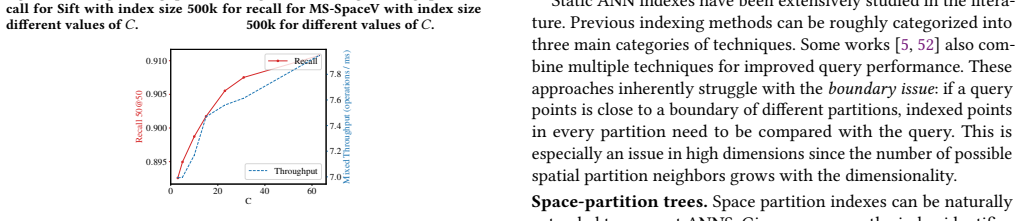
The central object is the search tree T built during each GreedyBeamSearch traversal, together with the bridge-building step GuidedBridgeBuild that connects nodes at selected depths of T (typically Θ(log |D|) layers) subject to a heuristic predicate—in practice, endpoints at the same depth. These bridge edges restore the missing shortcuts that static builds obtain through global passes. For deletions, the key structure is the tombstone counter H(w), which counts how many times a deleted node has been consolidated by a live parent during a traversal; once H(w) exceeds an eagerness threshold C, the node becomes replaceable and can represent a new data point. Consolidation itself is the operation that copies a tombstone's out-neighborhood into the live parent's neighborhood (Algorithm 7). The entire CleANN system combines these on-the-fly repairs with the Vamana graph, using this machinery to avoid global consolidation entirely.
What would settle it
Run the sliding-window benchmark with training queries drawn from an earlier time window or from a separate held-out query set that is not derived from the test queries, and check whether CleANN still matches RebuildVamana recall on distribution-shift datasets such as RedCaps or MS-SpaceV; if the recall gap reappears, a significant part of the bridge-building advantage is an artifact of the training distribution.
Extended reading notes
Core claim
The central discovery is that the robustness problems of dynamic graph-based indexes can be solved locally and lazily rather than globally. During any beam search, the visited nodes form a search tree; adding a few edges between same-depth cousins in that tree—nodes that are nearby but lacked a short connection—dramatically improves navigability under adversarial insertion orderings. For deletions, the index does not need to connect every in-neighbor of a tombstone to every out-neighbor; instead, while traversing, a live node that encounters a tombstone absorbs the tombstone's out-neighborhood on the spot, and after a small number of such consolidations the tombstone is marked replaceable and reused for new data, even if some incoming edges still point at it. The paper argues that these random residual edges do little harm because beam search and pruning naturally ignore them. Together these mechanisms let CleANN match the recall of a freshly rebuilt index while avoiding the costly global scans that make prior dynamic indexes an order of magnitude slower.
Load-bearing premise
The measured recall parity assumes that the in-distribution training queries—generated by randomly sampling the actual test queries and perturbing them by a scale tied to the dataset's average nearest-neighbor distance—are a fair proxy for the query workload rather than a form of test-set adaptation.
Editorial extensions
If this is right
- On sliding-window workloads, a graph-based index using CleANN's insertion and cleaning routines can match the recall of a freshly rebuilt static index without paying the rebuild cost.
- Because cleaning is trigger-driven and local, searches and updates can run concurrently without a global scan, so throughput does not collapse while deletions are being processed.
- The core techniques are portable: guided bridge building and on-the-fly consolidation apply to any graph-based ANNS index that uses beam search plus a pruning routine, not just Vamana.
- On datasets with distribution shift or out-of-distribution queries, query-aware bridge building can push recall above a static rebuild on the same data.
- At a fixed recall target, CleANN's throughput advantage over FreshVamana grows as the write share of the workload increases.
Reading between the lines
- The reported recall parity on distribution-shift datasets depends on the training-query construction, which samples test queries and perturbs them; a cleaner evaluation would train on queries from an earlier time window and would reveal how much of the advantage is genuine adaptivity versus test-set adaptation.
- The fact that a small training batch (2% of test queries) suffices suggests that only a few high-value edges carry most of the navigability; identifying which edges these are could let other indexes add bridges more cheaply.
- The experiments are in-memory, so the benefits may not transfer to out-of-core settings where tombstones and random edges increase I/O; testing under a disk-based index or a memory cap would clarify the boundary of the claim.
- If the bridge-building mechanism is as robust as claimed, it could also improve static index construction under non-uniform insertion orders, which would simplify build pipelines that currently require careful ordering or global passes.
Editorial analysis
A structured set of objections, weighed in public.
Referee Report
Summary. The paper proposes CleANN, a concurrent dynamic graph-based approximate nearest neighbor search (ANNS) system built on Vamana/DiskANN. CleANN combines three techniques: guided bridge building, which adds edges between nodes at similar depths of the beam-search tree during inserts and training searches; on-the-fly neighborhood consolidation, which repairs the graph around tombstones when they are encountered during searches; and semi-lazy cleaning, which recycles tombstone nodes after a tunable number of consolidations without fully removing all dangling edges. The authors claim that CleANN achieves query quality at least as good as a static rebuild on fully dynamic sliding-window workloads, and that at the same recall level it achieves 7-1200x throughput improvements over FreshVamana on million-scale datasets. The evaluation covers 7 datasets, compares against RebuildVamana, FreshVamana, NaiveVamana, and DEG, and includes ablations, hyperparameter sensitivity, memory overhead, and scalability studies.
Significance. If the main claims hold, this would be a significant contribution: CleANN would be the first concurrent graph-based ANNS index that maintains static-build-quality recall under full dynamism without expensive global consolidation, while also supporting concurrent inserts, deletes, and searches. The paper is engineering-heavy but presents a coherent set of mechanisms with a publicly available implementation. Strengths include the breadth of datasets, the ablation studies (especially the no-training and memory-reuse experiments), the sensitivity analysis of the cleaning threshold C, and the direct comparison with the sequential DEG baseline. However, the headline quality and throughput claims are weakened by the evaluation design: training queries are derived from the test queries, and the throughput numbers are reported at approximately matched recall rather than exactly matched recall.
major comments (3)
- [Section 6.1, 'Sliding Window Batched Update'] The recall evidence for the central 'at least as good as static' claim is in-sample. The training queries used to activate GuidedBridgeBuild during searches are generated by 'randomly sampling from test queries and adding a perturbation parameterized by the average nearest neighbor distance'. Since GuidedBridgeBuild modifies the graph during training searches (Section 3.1.2, Algorithm 8, lines 29-30) and only the test queries are marked performance-sensitive, the index is explicitly adapted to a distribution that is deliberately close to the test distribution before recall is measured. On datasets with distribution shift or out-of-distribution queries (RedCaps, Yandex-tti, Adversarial, MS-SpaceV), the reported recall advantage may therefore reflect test-set adaptation rather than robust dynamic maintenance. The no-training variant in Figure 37 provides partial independent evidence, and the ablation in Figure 36 does not use the training phase, but the main benchmark numbers in Table 3 and Figures 6-12 all use this in-sample training regime. Please report the main recall comparisons for a no-training configuration, or with held-out queries that are disjoint from the training queries, and state clearly whether the quality claim applies to the query-adapted setting only.
- [Table 3, rows Sift and MS-SpaceV] The unqualified abstract claim that 'CleANN has query quality at least as good as if the index had been built statically' is contradicted by the paper's own Table 3: CleANN's recall is below RebuildVamana on Sift (98.81% vs. 98.98%) and on MS-SpaceV (89.54% vs. 89.72%), and below FreshVamana on four of the seven datasets (Sift, MS-SpaceV, RedCaps, HuffPost). The gaps are small, but the claim as stated is not supported. Either qualify the claim (e.g., 'competitive with' or 'within measurement noise of') or provide statistical significance or repeated-run variability to justify the 'at least as good' phrasing.
- [Section 6.2 and Table 3, throughput comparison] The throughput claims are reported at 'approximately matched' recall, not at exactly the same recall level. Table 3 states that 'Other parameters are varied to approximately match the recalls of different approaches.' Since the abstract claims 'at the same recall level', the 7-1200x speedup numbers could change if recalls were exactly matched, especially on datasets where CleANN's recall is slightly lower. Please present throughput at several matched recall levels (e.g., by interpolating the recall-throughput tradeoff curves in Figures 22-33) or report the recall values used for each throughput number so the reader can judge the size of the recall gaps.
minor comments (4)
- [Section 6.3.1, Figures 22-33] Several figure captions appear to be duplicated or mismatched with the surrounding text: for example, Figure 23 is captioned 'on RedCaps' while the text refers to GloVe, and Figure 25 says 'RedCaps' in the caption but the text references GloVe. Please re-check the correspondence between figures and captions.
- [Table 3 and Figures 6-19] The index sizes used in the main benchmark are inconsistent between Table 3 and the figure captions: for instance, Table 3 lists Sift at 150k and RedCaps at 1.5M used, while Figures 6 and 9 captions state index sizes of 50k and 500k respectively. Please clarify which index sizes correspond to which experimental round and how the 'Size Used' column relates to the sliding-window initial size.
- [Section 6.2.2] The phrase 'maintains a similar recall as CleANN' for FreshVamana is imprecise; the recall differences in Figures 6-12 are up to several percentage points. Please state numeric recall ranges or use a consistent 'matched recall' protocol for the throughput comparison.
- [Section 6.1] When search throughput is reported for the Sliding Window Mixed Update setting, the text says the weighted average across training and test queries is used. Please state explicitly what fraction of the reported throughput corresponds to training queries and how much the GuidedBridgeBuild overhead in those queries contributes to the reported numbers.
Circularity Check
The headline recall claim is in-sample: training queries are generated by perturbing the test queries, so the 'at least as good as static' comparison is partly self-referential.
-
fitted input called prediction
[Section 6.1 'Sliding Window Batched Update' and Section 6.2.1 (Table 3, Figures 6-12)]
"Since GuidedBridgeBuild learns from queries, to avoid training and testing on the same queries, we issue a separate batch of in-distribution training queries generated by randomly sampling from test queries and adding a perturbation parameterized by the average nearest neighbor distance in the dataset before we issue the test queries. The size of the training query set is 2% of the test set (except for RedCaps, which uses 80 training queries). We designate only test queries as performance sensitive in Algorithm 8."
The paper's central quality claim, that CleANN 'has query quality at least as good as if the index had been built statically,' is established by computing recall on the test queries after GuidedBridgeBuild has already adapted the graph during search queries that are random perturbations of those same test queries. The perturbation is tied to the dataset's average nearest-neighbor distance, so the training distribution is deliberately adjacent to the test distribution. Figure 37 confirms the effect is substantial: in-distribution training gives up to 18% higher recall than no training. Thus the reported recall advantage on distribution-shift and OOD datasets reflects in-sample adaptation to the test distribution rather than an out-of-sample property of the dynamic maintenance scheme.
full rationale
CleANN's algorithmic components are not circular by construction: GuidedBridgeBuild, on-the-fly neighborhood consolidation, and semi-lazy cleaning are defined in terms of search-tree structure, tombstone counts, and consolidation thresholds, not in terms of the target recall values, and the ablations in Figures 35-40 provide some independent evidence for each mechanism. The main circularity concern is experimental. Section 6.1 generates 'in-distribution training queries' by randomly sampling the test queries and adding a perturbation scaled by the average nearest-neighbor distance. Because GuidedBridgeBuild is executed during these training searches (Algorithm 8, lines 29-30) and only test queries are marked performance-sensitive, the graph is adapted to a distribution artificially close to the test queries before the same test queries are scored. The headline claim of static-quality matching is therefore evaluated in-sample for datasets with distribution shift and out-of-distribution queries. Figure 37 quantifies that in-distribution training raises recall by up to 18% over no training, so a large part of the reported advantage is test-set adaptation. The no-training ablation gives partial support for the core mechanism, and the throughput results are less affected because they are measured in the mixed-update setting where recall is not directly measured. Separately, Table 3 shows CleANN recall below RebuildVamana on Sift (98.81% vs 98.98%) and MS-SpaceV (89.54% vs 89.72%), which contradicts the unqualified abstract phrasing but is a correctness issue rather than circularity. Overall, no derivation step reduces to its own inputs by equation; the evaluation of the central quality claim is partially self-referential.
Assumptions & free parameters
free parameters (4)
- Cleaning eagerness threshold C =
7
- Bridge layer set S =
{log2|D|+2, log2|D|+3, log2|D|+4}
- Perturbation scale for training queries =
average nearest neighbor distance of the dataset
- Vamana hyperparameters L, L_I, R, alpha =
L=75, L_I=64, R=64, alpha=1.2 by default; varied to match recall in Table 3
assumptions (4)
- domain assumption Graph-based ANNS with greedy beam search and alpha-RNG pruning behaves as in prior work (Vamana, DiskANN).
- domain assumption A constant number (C=7) of on-the-fly consolidations per tombstone preserves graph navigability as well as global consolidation.
- domain assumption Leftover random edges from reused graph nodes do not materially degrade query quality.
- ad hoc to paper Training queries perturbed from the test set are representative of the test workload.
Cite this review
Pith. "Pith review of CleANN: Efficient Full Dynamism in Graph-based Approximate Nearest Neighbor Search." pith.science (2026). https://pith.science/paper/VTB7U3YP
@misc{pith2026250719802,
  author       = {Pith},
  title        = {Pith review of: CleANN: Efficient Full Dynamism in Graph-based Approximate Nearest Neighbor Search},
  year         = {2026},
  howpublished = {\url{https://pith.science/paper/VTB7U3YP}},
  note         = {Machine review of arXiv:2507.19802}
}
read the original abstract
Approximate nearest neighbor search (ANNS) has become a quintessential algorithmic problem for various other foundational data tasks for AI workloads. Graph-based ANNS indexes have superb empirical trade-offs in indexing cost, query efficiency, and query approximation quality. Most existing graph-based indexes are designed for the static scenario, where there are no updates to the data after the index is constructed. However, full dynamism (insertions, deletions, and searches) is crucial to providing up-to-date responses in applications using vector databases. It is desirable that the index efficiently supports updates and search queries concurrently. Existing dynamic graph-based indexes suffer from at least one of the following problems: (1) the query quality degrades as updates happen; and (2) the graph structure updates used to maintain the index quality upon updates are global and thus expensive. To solve these problems, we propose the CleANN system which consists of three main components: (1) workload-aware linking of diverse search tree descendants to combat distribution shift; (2)query-adaptive on-the-fly neighborhood consolidation to efficiently handle deleted nodes; and (3) semi-lazy memory cleaning to clean up stale information in the data structure and reduce the work spent by the first two components. We evaluate CleANN on 7 diverse datasets on fully dynamic workloads and find that CleANN has query quality at least as good as if the index had been built statically using the corresponding data. In the in-memory setting using 56 hyper-threads, with all types of queries running concurrently, at the same recall level, CleANN achieves 7-1200x throughput improvement on million-scale real-world datasets. To the best of our knowledge, CleANN is the first concurrent ANNS index to achieve such efficiency while maintaining quality under full dynamism.
Figures


Figures from the paper (15 more)


Reference graph
Works this paper leans on
-
[1]
[n. d.]. big-ann-benchmarks/neurips23/streaming at main · harsha-simhadri/big- ann-benchmarks — github.com. https://github.com/harsha-simhadri/big-ann- benchmarks/tree/main/neurips23/streaming. [Accessed 01-10-2024]
work page 2024
-
[2]
[n. d.]. YouTube for Press. https://blog.youtube/press/ Accessed on September 24, 2024
work page 2024
-
[3]
Martin Aumüller, Erik Bernhardsson, and Alexander Faithfull. 2018. ANN- Benchmarks: A Benchmarking Tool for Approximate Nearest Neighbor Algo- rithms. arXiv:1807.05614 [cs.IR] https://arxiv.org/abs/1807.05614
arXiv 2018
-
[4]
Dimitry Baranchuk and Artem Babenko. [n. d.]. Yandex — research.yandex.com. https://research.yandex.com/datasets/text-to-image-dataset-for-billion-scale- similarity-search. [Accessed 30-07-2024]
work page 2024
-
[5]
Qi Chen, Bing Zhao, Haidong Wang, Mingqin Li, Chuanjie Liu, Zengzhong Li, Mao Yang, and Jingdong Wang. 2021. SPANN: Highly-efficient Billion- scale Approximate Nearest Neighbor Search. CoRR abs/2111.08566 (2021). arXiv:2111.08566 https://arxiv.org/abs/2111.08566
arXiv 2021
-
[6]
Yewang Chen, Shengyu Tang, Nizar Bouguila, Cheng Wang, Jixiang Du, and HaiLin Li. 2018. A fast clustering algorithm based on pruning unnecessary dis- tance computations in DBSCAN for high-dimensional data. Pattern Recognition 83 (2018), 375–387
work page 2018
-
[7]
SpaceV Contributors. 2023. SPTAG/datasets/SPACEV1B at main · mi- crosoft/SPTAG — github.com. https://github.com/microsoft/SPTAG/tree/main/ datasets/SPACEV1B. [Accessed 30-07-2024]
work page 2023
-
[8]
Anirban Dasgupta, Ravi Kumar, and Tamas Sarlos. 2011. Fast locality-sensitive hashing. In Proceedings of the 17th ACM SIGKDD International Conference on Knowledge Discovery and Data Mining (San Diego, California, USA) (KDD ’11). Association for Computing Machinery, New York, NY, USA, 1073–1081. https: //doi.org/10.1145/2020408.2020578
arXiv 2011
Show all 54 references
-
[9]
Sanjoy Dasgupta and Kaushik Sinha. 2015. Randomized Partition Trees for Nearest Neighbor Search. Algorithmica 72, 1 (01 May 2015), 237–263. https: //doi.org/10.1007/s00453-014-9885-5
2015 doi
-
[10]
Mirrokni
Mayur Datar, Nicole Immorlica, Piotr Indyk, and Vahab S. Mirrokni. 2004. Locality-sensitive hashing scheme based on p-stable distributions. In Proceedings of the Twentieth Annual Symposium on Computational Geometry (Brooklyn, New York, USA) (SCG ’04). Association for Computing...
2004
-
[11]
Cong Fu, Chao Xiang, Changxu Wang, and Deng Cai. 2019. Fast approximate nearest neighbor search with the navigating spreading-out graph. Proc. VLDB Endow. 12, 5 (jan 2019), 461–474. https://doi.org/10.14778/3303753.3303754
2019
-
[12]
Aristides Gionis, Piotr Indyk, and Rajeev Motwani. 1999. Similarity Search in High Dimensions via Hashing. In Proceedings of the 25th International Conference on Very Large Data Bases (VLDB ’99) . Morgan Kaufmann Publishers Inc., San Francisco, CA, USA, 518–529
1999
-
[13]
Ruiqi Guo, Philip Sun, Erik Lindgren, Quan Geng, David Simcha, Felix Chern, and Sanjiv Kumar. 2020. Accelerating Large-Scale Inference with Anisotropic Vector Quantization. In International Conference on Machine Learning . https: //arxiv.org/abs/1908.10396
2020 arXiv
-
[14]
Ben Harwood and Tom Drummond. 2016. FANNG: Fast Approximate Nearest Neighbour Graphs. In 2016 IEEE Conference on Computer Vision and Pattern Recognition (CVPR). 5713–5722. https://doi.org/10.1109/CVPR.2016.616
2016 doi
-
[15]
Nico Hezel, Uwe Kai Barthel, Konstantin Schall, and Klaus Jung. 2023. Fast Approximate nearest neighbor search with the Dynamic Exploration Graph using continuous refinement. CoRR abs/2307.10479 (2023)
2023 arXiv
-
[16]
Linjia Hu, Saeid Nooshabadi, and Majid Ahmadi. 2015. Massively parallel KD-tree construction and nearest neighbor search algorithms. In 2015 IEEE International Symposium on Circuits and Systems (ISCAS) . 2752–2755. https://doi.org/10.1109/ ISCAS.2015.7169256
2015
-
[17]
HuffPost, Rishabh Misra, and Ziyu Zhang. 2024. Embedded HuffPost New Category Dataset
2024
-
[18]
Piotr Indyk and Rajeev Motwani. 1998. Approximate nearest neighbors: towards removing the curse of dimensionality. InProceedings of the Thirtieth Annual ACM Symposium on Theory of Computing (Dallas, Texas, USA) (STOC ’98). Association for Computing Machinery, New York, NY, USA...
1998
-
[19]
Masajiro Iwasaki and Daisuke Miyazaki. 2018. Optimization of Indexing Based on k-Nearest Neighbor Graph for Proximity Search in High-dimensional Data. arXiv:1810.07355 [cs.DB] https://arxiv.org/abs/1810.07355
2018 arXiv
-
[20]
Suhas Jayaram Subramanya, Fnu Devvrit, Harsha Vardhan Simhadri, Ravishankar Krishnawamy, and Rohan Kadekodi. 2019. DiskANN: Fast Accurate Billion-point Zhang et al. Nearest Neighbor Search on a Single Node. InAdvances in Neural Information Pro- cessing Systems, H. Wallach, H. ...
2019
-
[22]
Mengxu Jiang, Zhi Yang, Fangyuan Zhang, Guanhao Hou, Jieming Shi, Wenchao Zhou, Feifei Li, and Sibo Wang. 2025. DIGRA: A Dynamic Graph Indexing for Approximate Nearest Neighbor Search with Range Filter. Proc. ACM Manag. Data 3, 3, Article 148 (June 2025), 26 pages. https://doi...
2025 doi
-
[23]
Jaemin Jo, Jinwook Seo, and Jean-Daniel Fekete. 2017. A progressive k-d tree for approximate k-nearest neighbors. In 2017 IEEE Workshop on Data Systems for Interactive Analysis (DSIA). 1–5. https://doi.org/10.1109/DSIA.2017.8339084
2017
-
[24]
Herve Jégou, Matthijs Douze, and Cordelia Schmid. 2011. Product Quantization for Nearest Neighbor Search. IEEE Transactions on Pattern Analysis and Machine Intelligence 33, 1 (2011), 117–128. https://doi.org/10.1109/TPAMI.2010.57
2011 doi
-
[25]
Mohammad Kolahdouzan and Cyrus Shahabi. 2004. Voronoi-based K nearest neighbor search for spatial network databases. In Proceedings of the Thirtieth International Conference on Very Large Data Bases - Volume 30 (Toronto, Canada) (VLDB ’04). VLDB Endowment, 840–851
2004
-
[26]
Kuan and P
J. Kuan and P. Lewis. 1997. Fast k nearest neighbour search for R-tree fam- ily. In Proceedings of ICICS, 1997 International Conference on Information, Com- munications and Signal Processing. Theme: Trends in Information Systems Engi- neering and Wireless Multimedia Communicat...
1997
-
[27]
Patrick Lewis, Ethan Perez, Aleksandra Piktus, Fabio Petroni, Vladimir Karpukhin, Naman Goyal, Heinrich Küttler, Mike Lewis, Wen tau Yih, Tim Rocktäschel, Sebastian Riedel, and Douwe Kiela. 2021. Retrieval-Augmented Generation for Knowledge-Intensive NLP Tasks. arXiv:2005.1140...
2021 arXiv
-
[28]
Jie Li, Haifeng Liu, Chuanghua Gui, Jianyu Chen, Zhenyuan Ni, Ning Wang, and Yuan Chen. 2018. The design and implementation of a real time visual search system on JD E-commerce platform. In Proceedings of the 19th International Middleware Conference Industry. 9–16
2018
-
[29]
Sen Li, Fuyu Lv, Taiwei Jin, Guli Lin, Keping Yang, Xiaoyi Zeng, Xiao-Ming Wu, and Qianli Ma. 2021. Embedding-based product retrieval in taobao search. In Proceedings of the 27th ACM SIGKDD Conference on Knowledge Discovery & Data Mining. 3181–3189
2021
-
[30]
Ting Liu, Andrew Moore, Ke Yang, and Alexander Gray. 2004. An Investiga- tion of Practical Approximate Nearest Neighbor Algorithms. In Advances in Neural Information Processing Systems , L. Saul, Y. Weiss, and L. Bottou (Eds.), Vol. 17. MIT Press. https://proceedings.neurips.c...
2004
-
[31]
Kejing Lu, Mineichi Kudo, Chuan Xiao, and Yoshiharu Ishikawa. 2021. HVS: hierarchical graph structure based on voronoi diagrams for solving approximate nearest neighbor search. Proc. VLDB Endow. 15, 2 (oct 2021), 246–258. https: //doi.org/10.14778/3489496.3489506
2021
-
[32]
Yury Malkov, Alexander Ponomarenko, Andrey Logvinov, and Vladimir Krylov
-
[33]
Malkov and D
Yu A. Malkov and D. A. Yashunin. 2020. Efficient and Robust Approximate Nearest Neighbor Search Using Hierarchical Navigable Small World Graphs. IEEE Transactions on Pattern Analysis and Machine Intelligence 42, 4 (2020), 824–
2020
-
[34]
Magdalen Dobson Manohar, Zheqi Shen, Guy Blelloch, Laxman Dhulipala, Yan Gu, Harsha Vardhan Simhadri, and Yihan Sun. 2024. ParlayANN: Scalable and Deterministic Parallel Graph-Based Approximate Nearest Neighbor Search Algorithms. In Proceedings of the 29th ACM SIGPLAN Annual S...
2024
-
[35]
Rajeev Motwani, Assaf Naor, and Rina Panigrahi. 2006. Lower bounds on locality sensitive hashing. In Proceedings of the Twenty-Second Annual Symposium on Computational Geometry (Sedona, Arizona, USA) (SCG ’06) . Association for Computing Machinery, New York, NY, USA, 154–157. ...
2006
-
[36]
Felix Ocker, Daniel Tanneberg, Julian Eggert, and Michael Gienger. 2024. Tulip Agent–Enabling LLM-Based Agents to Solve Tasks Using Large Tool Libraries. arXiv preprint arXiv:2407.21778 (2024)
2024 arXiv
-
[37]
Apostolos Papadopoulos and Yannis Manolopoulos. 1997. Performance of nearest neighbor queries in R-trees. In Database Theory — ICDT ’97 , Foto Afrati and Phokion Kolaitis (Eds.). Springer Berlin Heidelberg, Berlin, Heidelberg, 394–408
1997
-
[38]
Jeffrey Pennington, Richard Socher, and Christopher Manning. 2014. GloVe: Global Vectors for Word Representation. InProceedings of the 2014 Conference on Empirical Methods in Natural Language Processing (EMNLP) , Alessandro Mos- chitti, Bo Pang, and Walter Daelemans (Eds.). As...
2014 doi
-
[39]
Erion Plaku and Lydia E Kavraki. 2008. Quantitative analysis of nearest-neighbors search in high-dimensional sampling-based motion planning. In Algorithmic Foundation of Robotics VII: Selected Contributions of the Seventh International Workshop on the Algorithmic Foundations o...
2008
-
[40]
Parikshit Ram and Kaushik Sinha. 2019. Revisiting kd-tree for Nearest Neigh- bor Search. In Proceedings of the 25th ACM SIGKDD International Conference on Knowledge Discovery & Data Mining (Anchorage, AK, USA) (KDD ’19). As- sociation for Computing Machinery, New York, NY, USA...
2019
-
[41]
Reddit, Karan Desai, Gaurav Kaul, Zubin Aysola, Justin Johnson, Joshua Engels, Ziyu Zhang, and OpenAI (United States). 2024. CLIP-Embedded RedCaps Text- Image Dataset
2024
-
[42]
Aviad Rubinstein. 2018. Hardness of approximate nearest neighbor search. In Proceedings of the 50th Annual ACM SIGACT Symposium on Theory of Computing (Los Angeles, CA, USA) (STOC 2018). Association for Computing Machinery, New York, NY, USA, 1260–1268. https://doi.org/10.1145...
2018
-
[43]
Maying Shen, Xinghao Jiang, and Tanfeng Sun. 2018. Anomaly detection based on nearest neighbor search with locality-sensitive B-tree. Neurocomputing 289 (2018), 55–67
2018
-
[44]
Harsha Vardhan Simhadri, Ravishankar Krishnaswamy, Gopal Srinivasa, Suhas Jayaram Subramanya, Andrija Antonijevic, Dax Pryce, David Kaczynski, Shane Williams, Siddarth Gollapudi, Varun Sivashankar, Neel Karia, Aditi Singh, Shikhar Jaiswal, Neelam Mahapatro, Philip Adams, Bryan...
-
[45]
Aditi Singh, Suhas Jayaram Subramanya, Ravishankar Krishnaswamy, and Har- sha Vardhan Simhadri. 2021. FreshDiskANN: A Fast and Accurate Graph- Based ANN Index for Streaming Similarity Search. arXiv:2105.09613 [cs.IR] https://arxiv.org/abs/2105.09613
2021 arXiv
-
[46]
Ján Suchal and Pavol Návrat. 2010. Full text search engine as scalable k-nearest neighbor recommendation system. In Artificial Intelligence in Theory and Practice III: Third IFIP TC 12 International Conference on Artificial Intelligence, IFIP AI 2010, Held as Part of WCC 2010,...
2010
-
[47]
Philip Sun, David Simcha, Dave Dopson, Ruiqi Guo, and Sanjiv Kumar. 2023. SOAR: Improved Indexing for Approximate Nearest Neighbor Search. In Neural Information Processing Systems. https://arxiv.org/abs/2404.00774
2023 arXiv
-
[48]
Mengzhao Wang, Xiaoliang Xu, Qiang Yue, and Yuxiang Wang. 2021. A com- prehensive survey and experimental comparison of graph-based approximate nearest neighbor search. Proc. VLDB Endow. 14, 11 (jul 2021), 1964–1978. https://doi.org/10.14778/3476249.3476255
2021
-
[49]
Bernstein, Badrish Chan- dramouli, Richard Wen, and Harsha Vardhan Simhadri
Haike Xu, Magdalen Dobson Manohar, Philip A. Bernstein, Badrish Chan- dramouli, Richard Wen, and Harsha Vardhan Simhadri. 2025. In-Place Up- dates of a Graph Index for Streaming Approximate Nearest Neighbor Search. arXiv:2502.13826 [cs.IR] https://arxiv.org/abs/2502.13826
2025 arXiv
-
[50]
Yuming Xu, Hengyu Liang, Jin Li, Shuotao Xu, Qi Chen, Qianxi Zhang, Cheng Li, Ziyue Yang, Fan Yang, Yuqing Yang, Peng Cheng, and Mao Yang. 2023. SPFresh: Incremental In-Place Update for Billion-Scale Vector Search. In Proceedings of the 29th Symposium on Operating Systems Prin...
2023
-
[51]
Fangyuan Zhang, Mengxu Jiang, Guanhao Hou, Jieming Shi, Hua Fan, Wenchao Zhou, Feifei Li, and Sibo Wang. 2025. Efficient Dynamic Indexing for Range Filtered Approximate Nearest Neighbor Search. Proc. ACM Manag. Data 3, 3, Article 152 (June 2025), 26 pages. https://doi.org/10.1...
2025 doi
-
[52]
Xi Zhao, Yao Tian, Kai Huang, Bolong Zheng, and Xiaofang Zhou. 2023. Towards Efficient Index Construction and Approximate Nearest Neighbor Search in High- Dimensional Spaces. Proc. VLDB Endow. 16, 8 (apr 2023), 1979–1991. https: //doi.org/10.14778/3594512.3594527 Received 15 J...
2023
-
[836]
https://doi.org/10.1109/TPAMI.2018.2889473
2018
-
[2014]
Information Systems 45 (2014), 61–68
Approximate nearest neighbor algorithm based on navigable small world graphs. Information Systems 45 (2014), 61–68. https://doi.org/10.1016/j.is.2013. 10.006
2014 doi
-
[2023]
https://github.com/Microsoft/DiskANN
DiskANN: Graph-structured Indices for Scalable, Fast, Fresh and Filtered Approximate Nearest Neighbor Search. https://github.com/Microsoft/DiskANN
Reviewed August 6, 2026 · model on record in the stance chip above.
Discussion (0). Continue with ORCID to comment.