Data-driven method to estimate contamination from light ion beam transmutation at colliders
Pith reviewed 2026-05-18 17:19 UTC · model grok-4.3
The pith
A data-driven method using time dependence and ion size defines control regions to quantify beam contamination effects in light-ion collider data.
A machine-rendered reading of the paper's core claim, the machinery that carries it, and where it could break.
Core claim
Collisions of relativistic light ions such as oxygen, neon, and magnesium have been proposed to study the system-size dependence of quark-gluon plasma dynamics. Electromagnetic dissociation of these ions while circulating in the collider produces beam contamination that is difficult to simulate precisely. A data-driven method exploits the time dependence and smaller size of contaminant ion species to define control regions that quantify potential contamination effects on physics analyses. A simple model illustrates the method and studies its robustness. The method can inform studies of recent LHC and RHIC data and could be useful for future light-ion programs.
What carries the argument
Control regions defined by time dependence and smaller ion size, which isolate and quantify contamination effects in the observed data.
If this is right
- The method provides a practical way to assess contamination in existing proton-oxygen, oxygen-oxygen, and neon-neon datasets from RHIC and the LHC.
- It reduces reliance on detailed simulations for estimating the impact of beam contaminants on physics results.
- The approach can be applied to future light-ion running periods at the LHC and similar programs elsewhere.
- Robustness can be checked by varying the model parameters that describe time dependence and size differences.
Where Pith is reading between the lines
- The technique could be extended by combining the time and size cuts with additional observables such as transverse momentum or particle identification to increase purity of the control regions.
- Similar data-driven control regions might be developed for other accelerator facilities where beam dissociation or fragmentation creates impurities.
- If contamination estimates from this method alter the observed system-size trends, it would motivate re-examination of how light-ion results are compared to heavy-ion baselines.
Load-bearing premise
Control regions selected solely by time dependence and smaller ion size will cleanly separate contamination effects from other backgrounds and beam dynamics without significant overlap.
What would settle it
Applying the defined control regions to recorded light-ion collision data and checking whether the extracted contamination level matches independent estimates obtained from simulation or from other observables such as energy or multiplicity distributions.
Figures





read the original abstract
Collisions of relativistic light ions, such as oxygen, neon, and magnesium, have been proposed as a way to examine the system-size dependence of dynamics typically associated with the quark-gluon plasma produced in collisions of heavier ions such as xenon, gold, or lead. Recent efforts at both the Relativistic Heavy Ion Collider (RHIC) and Large Hadron Collider (LHC) have produced large datasets of proton-oxygen, oxygen-oxygen, and neon-neon collisions, catalyzing intense interest in experimental backgrounds associated with light-ion collisions. In particular, electromagnetic dissociation of light ions while they are circulating in a collider can result in beam contamination that is difficult to simulate precisely. Here we propose a data-driven method for evaluating the potential impact of beam contaminants on physics analyses. The method exploits the time dependence and smaller size of contaminant ion species to define control regions that can be used to quantify potential contamination effects. A simple model is used to illustrate the method and to study its robustness. This method can inform studies of recent LHC and RHIC data and could also be useful for future light-ion programs at the LHC and beyond.
Editorial analysis
A structured set of objections, weighed in public.
Referee Report
Summary. The manuscript proposes a data-driven method to estimate contamination from light ion beam transmutation at colliders such as RHIC and LHC. The method defines control regions by exploiting the time dependence and smaller size of contaminant ion species to quantify potential effects on physics analyses. A simple model is used to illustrate the method and to study its robustness under the stated assumptions.
Significance. If the control regions can be realized with acceptable purity, the method would provide a practical tool for assessing beam-related systematics in light-ion collision data, complementing simulations in studies of system-size dependence of quark-gluon plasma dynamics. The explicit robustness study with the simple model is a strength, as it demonstrates the approach under controlled conditions without introducing free parameters or circular fits.
major comments (1)
- [Section on proposed method] Section describing the control regions: the central claim that time dependence and smaller ion size suffice to isolate contamination effects for quantification rests on the assumption of minimal overlap with other backgrounds or beam dynamics; the simple model illustrates behavior under ideal conditions but does not include a quantitative estimate or test of residual contamination levels in the control region, which is load-bearing for applying the method to real datasets.
minor comments (2)
- [Abstract] The abstract is concise but could briefly note the key assumptions of the simple model (e.g., idealized time profiles or size distributions) to give readers immediate context.
- [Model section] Notation for ion species and time bins is clear in the model section but would benefit from an explicit table summarizing the control-region selection criteria for reproducibility.
Simulated Author's Rebuttal
We thank the referee for their careful reading of the manuscript and for the positive assessment that led to the recommendation of minor revision. We address the single major comment below and will incorporate the suggested clarification in the revised version.
read point-by-point responses
-
Referee: Section describing the control regions: the central claim that time dependence and smaller ion size suffice to isolate contamination effects for quantification rests on the assumption of minimal overlap with other backgrounds or beam dynamics; the simple model illustrates behavior under ideal conditions but does not include a quantitative estimate or test of residual contamination levels in the control region, which is load-bearing for applying the method to real datasets.
Authors: We agree that the utility of the control regions for real datasets hinges on the degree to which time dependence and ion size reduce overlap with other backgrounds. The manuscript presents the method under explicitly stated assumptions and uses the simple model solely to demonstrate the approach and its robustness in the absence of free parameters or circular fits. To address the concern, the revised manuscript will include an additional paragraph that extends the illustrative model with a small residual background component and quantifies its effect on the extracted contamination estimate. This addition will make the load-bearing assumption more transparent without altering the data-driven character of the proposal. revision: yes
Circularity Check
No significant circularity; methodological proposal is self-contained
full rationale
The paper proposes a data-driven method to estimate beam contamination by exploiting time dependence and smaller ion size to define control regions, illustrated via a simple model whose robustness is explicitly studied. No load-bearing derivation, equation, or claim reduces by construction to fitted inputs, self-citations, or prior author results; the central contribution is the suggestion of control-region definitions under stated assumptions, which remains independent and does not rename or smuggle in known results. This is the normal case of a self-contained methodological paper.
Axiom & Free-Parameter Ledger
axioms (1)
- domain assumption Contaminant ions from electromagnetic dissociation exhibit distinct time dependence and smaller effective size compared to primary beam ions.
Lean theorems connected to this paper
-
IndisputableMonolith/Foundation/AbsoluteFloorClosure.leanreality_from_one_distinction unclear?
unclearRelation between the paper passage and the cited Recognition theorem.
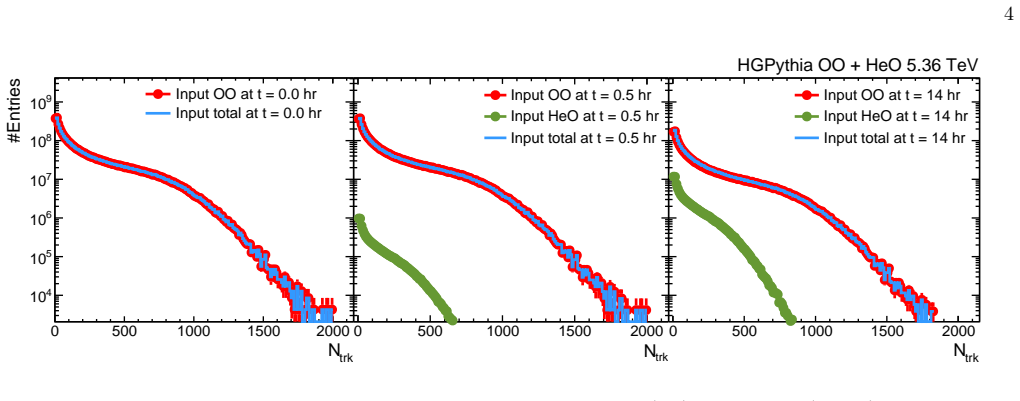
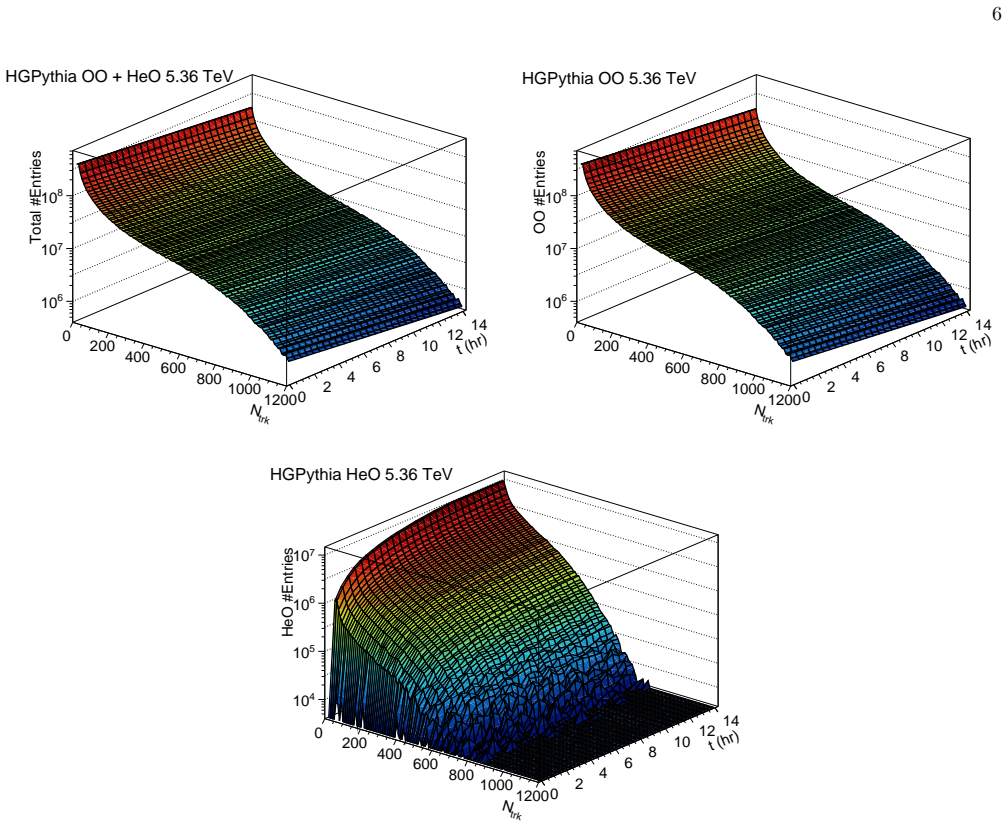
A simple model is used to illustrate the method and to study its robustness... HG-Pythia OO + HeO
What do these tags mean?
- matches
- The paper's claim is directly supported by a theorem in the formal canon.
- supports
- The theorem supports part of the paper's argument, but the paper may add assumptions or extra steps.
- extends
- The paper goes beyond the formal theorem; the theorem is a base layer rather than the whole result.
- uses
- The paper appears to rely on the theorem as machinery.
- contradicts
- The paper's claim conflicts with a theorem or certificate in the canon.
- unclear
- Pith found a possible connection, but the passage is too broad, indirect, or ambiguous to say the theorem truly supports the claim.
Forward citations
Cited by 1 Pith paper
-
Observation of suppressed charged-particle production in ultrarelativistic oxygen-oxygen collisions
First measurement of the nuclear modification factor R_AA in OO collisions at 5.36 TeV shows suppression with a minimum of 0.69 at p_T around 6 GeV, favoring models with parton energy loss.
Reference graph
Works this paper leans on
-
[1]
Heavy Ion Collisions: The Big Picture, and the Big Questions
W. Busza, K. Rajagopal, and W. van der Schee, Ann. Rev. Nucl. Part. Sci.68, 339 (2018), arXiv:1802.04801 [hep-ph]
work page internal anchor Pith review Pith/arXiv arXiv 2018
-
[2]
T. Niida and Y. Miake, AAPPS Bull.31, 12 (2021), arXiv:2104.11406 [nucl-ex]
- [3]
-
[4]
P. Romatschke and U. Romatschke,Relativistic Fluid Dynamics In and Out of Equilibrium, Cambridge Mono- graphs on Mathematical Physics (Cambridge University Press, 2019) arXiv:1712.05815 [nucl-th]
work page internal anchor Pith review Pith/arXiv arXiv 2019
-
[5]
Collective flow and viscosity in relativistic heavy-ion collisions
U. Heinz and R. Snellings, Ann. Rev. Nucl. Part. Sci.63, 123 (2013), arXiv:1301.2826 [nucl-th]
work page internal anchor Pith review Pith/arXiv arXiv 2013
-
[6]
Measurement of inclusive jet cross sections in pp and PbPb collisions at sqrt(s[NN]) = 2.76 TeV
V. Khachatryanet al.(CMS), Phys. Rev. C96, 015202 (2017), arXiv:1609.05383 [nucl-ex]
work page internal anchor Pith review Pith/arXiv arXiv 2017
-
[7]
G. Aadet al.(ATLAS), Phys. Rev. Lett.114, 072302 (2015), arXiv:1411.2357 [hep-ex]
work page internal anchor Pith review Pith/arXiv arXiv 2015
-
[8]
Measurement of charged jet suppression in Pb-Pb collisions at $\sqrt{s_{\rm NN}}=2.76$ TeV
B. Abelevet al.(ALICE), JHEP03, 013 (2014), arXiv:1311.0633 [nucl-ex]
work page internal anchor Pith review Pith/arXiv arXiv 2014
-
[9]
C. Aidalaet al.(PHENIX), Phys. Rev. Lett.120, 062302 (2018), arXiv:1707.06108 [nucl-ex]
-
[10]
M. Aaboudet al.(ATLAS), Phys. Rev. C96, 024908 (2017), arXiv:1609.06213 [nucl-ex]
work page internal anchor Pith review Pith/arXiv arXiv 2017
-
[11]
Evidence for collective multi-particle correlations in pPb collisions
V. Khachatryanet al.(CMS), Phys. Rev. Lett.115, 012301 (2015), arXiv:1502.05382 [nucl-ex]
work page internal anchor Pith review Pith/arXiv arXiv 2015
- [12]
-
[13]
G. Giacaloneet al., Phys. Rev. Lett.134, 082301 (2025), arXiv:2405.20210 [nucl-th]
-
[14]
G. Giacaloneet al., Phys. Rev. Lett.135, 012302 (2025), arXiv:2402.05995 [nucl-th]
-
[15]
Huang (2023) arXiv:2312.12167 [nucl-ex]
S. Huang (2023) arXiv:2312.12167 [nucl-ex]. [16]Measurement of the charged particle nuclear modification factor in oxygen-oxygen collisions with CMS, Tech. Rep. (CERN, Geneva, 2025). [17]Collective flow in OO and NeNe collisions at 5.36 TeV, Tech. Rep. (CERN, Geneva, 2025). [18]Pseudorapidity distributions of charged hadrons in oxygen-oxygen collisions at...
-
[16]
G. Aadet al.(ATLAS), (2025), arXiv:2509.05171 [nucl- ex]
work page internal anchor Pith review Pith/arXiv arXiv 2025
- [17]
-
[18]
E. Waagaard, R. Bruce, R. A. Fernandez, H. Bar- tosik, J. M. Jowett, and N. Triantafyllou, (2025), arXiv:2508.19653 [physics.acc-ph]
-
[19]
Future physics opportunities for high-density QCD at the LHC with heavy-ion and proton beams
Z. Citronet al., CERN Yellow Rep. Monogr.7, 1159 (2019), arXiv:1812.06772 [hep-ph]
work page internal anchor Pith review Pith/arXiv arXiv 2019
-
[20]
R. Bruce, S. Gilardoni, J. M. Jowett, and D. Bo- cian, Phys. Rev. ST Accel. Beams12, 071002 (2009), arXiv:0908.2527 [physics.acc-ph]
work page internal anchor Pith review Pith/arXiv arXiv 2009
-
[21]
A. Svetlichnyi, S. Savenkov, R. Nepeivoda, and I. Pshenichnov, MDPI Physics5, 381 (2023)
work page 2023
-
[22]
I. A. Pshenichnov, I. N. Mishustin, J. P. Bondorf, A. S. Botvina, and A. S. Ilinov, Phys. Rev. C57, 1920 (1998), arXiv:nucl-th/9711030
work page internal anchor Pith review Pith/arXiv arXiv 1920
-
[23]
N. Summerfield, B.-N. Lu, C. Plumberg, D. Lee, J. Noronha-Hostler, and A. Timmins, Phys. Rev. C104, L041901 (2021), arXiv:2103.03345 [nucl-th]
- [24]
-
[25]
S. Choi and H. Oh, Eur. Phys. J. C81, 643 (2021), arXiv:1906.10831 [hep-ph]
-
[26]
G. Kasieczka, B. Nachman, M. D. Schwartz, and D. Shih, Phys. Rev. D103, 035021 (2021), arXiv:2007.14400 [hep- ph]
-
[27]
Jowettet al., LPC Presentation, Indico (2025), ac- cessed: 2025-06-15
J. Jowettet al., LPC Presentation, Indico (2025), ac- cessed: 2025-06-15
work page 2025
-
[28]
C. Loizides and A. Morsch, Phys. Lett. B773, 408 (2017), arXiv:1705.08856 [nucl-ex]
- [29]
discussion (0)
Sign in with ORCID, Apple, or X to comment. Anyone can read and Pith papers without signing in.