An Implementation to Identify the Properties of Multiple Population of Gravitational Wave Sources
Pith reviewed 2026-05-18 17:02 UTC · model grok-4.3
The pith
A JAX-based framework called GWKokab allows separate modeling of rates for different gravitational wave source populations like black hole binaries and neutron star binaries.
A machine-rendered reading of the paper's core claim, the machinery that carries it, and where it could break.
Core claim
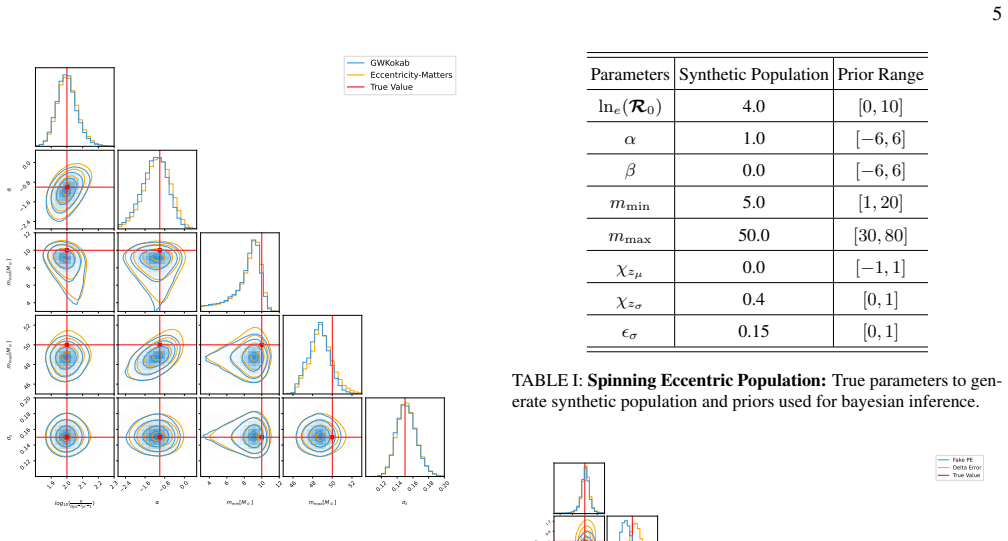
GWKokab is a JAX-based framework that supports modular construction of models with independent rate functions for each subpopulation of compact binary mergers. It incorporates a normalizing flow sampler called flowMC for accelerated Bayesian inference and is compatible with NumPyro. Validation on synthetic spinning eccentric and circular populations demonstrates recovery of injected parameters, including eccentricity distributions, at lower computational cost, and it reproduces known results from non-spinning eccentric models and GWTC-4 mass distributions.
What carries the argument
GWKokab, a modular JAX framework for multi-population rate modeling combined with flowMC normalizing flow sampler for inference.
If this is right
- Researchers can analyze subpopulations like BBH, BNS, and NSBH with independent parameters more easily.
- Computational cost for population inference is significantly reduced.
- Eccentricity distributions can be recovered even in spinning populations.
- More detailed studies of mass, spin, eccentricity, and redshift distributions become feasible.
Where Pith is reading between the lines
- This modular rate setup could be extended to test formation channel models by assigning different priors to each subpopulation.
- Faster sampling might support joint analyses that combine gravitational wave data with electromagnetic observations of the same events.
- The framework's design invites checks on whether independent rate models change inferred merger rates compared to single-population assumptions.
Load-bearing premise
The framework's samplers will reliably produce unbiased results on actual gravitational wave observations without needing case-by-case adjustments or encountering sampling failures in complex models.
What would settle it
Running the framework on real gravitational wave catalog data and comparing the inferred subpopulation properties to those obtained from established slower methods; significant discrepancies would indicate the claim does not hold.
Figures



read the original abstract
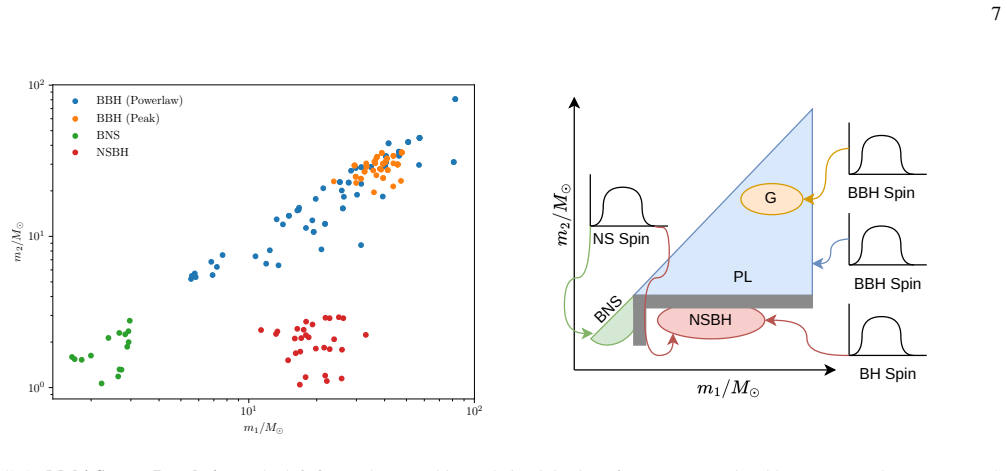
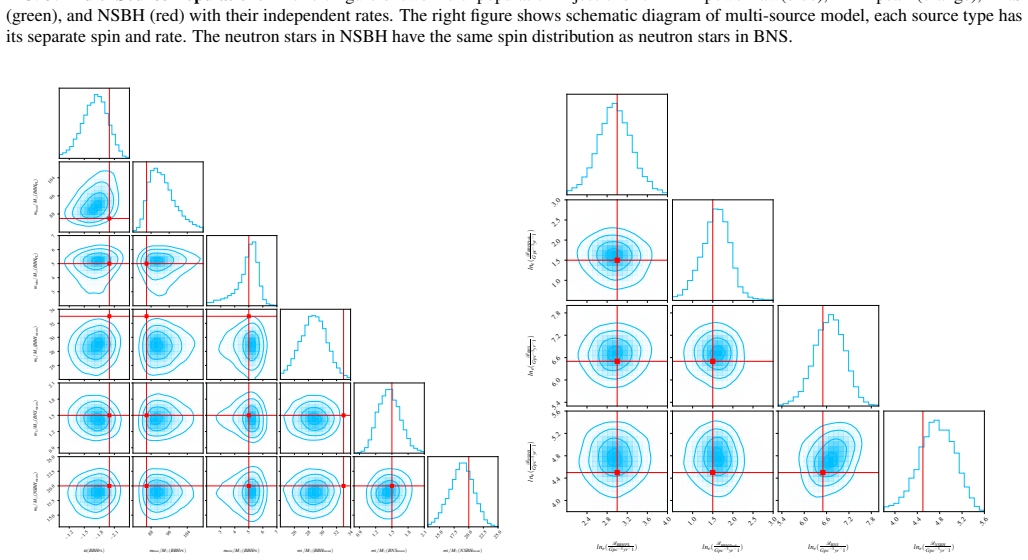
The rapidly increasing sensitivity of gravitational wave detectors is enabling the detection of a growing number of compact binary mergers. These events are crucial for understanding the population properties of compact binaries. However, many previous studies rely on computationally expensive inference frameworks, limiting their scalability. In this work, we present GWKokab, a JAX-based framework that enables modular model building with independent rate for each subpopulation such as BBH, BNS, and NSBH binaries. It provides accelerated inference using the normalizing flow based sampler called flowMC and is also compatible with NumPyro samplers. To validate our framework, we generated two synthetic populations, one comprising spinning eccentric binaries and the other circular binaries using a multi-source model. We then recovered their injected parameters at significantly reduced computational cost and demonstrated that eccentricity distribution can be recovered even in spinning eccentric populations. We also reproduced results from two prior studies: one on non-spinning eccentric populations, and another on the BBH mass distribution using the third Gravitational Wave Transient Catalog (GWTC-4). We anticipate that GWKokab will not only reduce computational costs but also enable more detailed subpopulation analyses such as their mass, spin, eccentricity, and redshift distributions in gravitational wave events, offering deeper insights into compact binary formation and evolution.
Editorial analysis
A structured set of objections, weighed in public.
Referee Report
Summary. The manuscript presents GWKokab, a JAX-based software framework that supports modular construction of hierarchical population models for gravitational-wave sources, with independent rate parameters for distinct subpopulations such as BBH, BNS, and NSBH binaries. Inference is performed with the flowMC normalizing-flow sampler (also compatible with NumPyro), and the framework is validated by recovering injected parameters from two synthetic populations (one spinning-eccentric, one circular) at reduced computational cost, by recovering the eccentricity distribution in the spinning case, and by reproducing selected results from prior studies on non-spinning eccentric populations and the BBH mass distribution in GWTC-4.
Significance. If the central performance claims hold, the modular independent-rate construction combined with flowMC sampling would lower the computational barrier for joint inference over multiple subpopulations, enabling more detailed studies of mass, spin, eccentricity, and redshift distributions that are currently limited by the cost of standard samplers.
major comments (3)
- Validation section (synthetic population recovery): the claim that injected parameters are recovered 'at significantly reduced computational cost' is not supported by any quantitative metrics such as wall-clock times, effective sample sizes, bias or coverage statistics, or direct comparison against baseline samplers; without these, it is impossible to assess whether flowMC delivers unbiased posteriors for the joint multi-subpopulation model.
- Validation section (high-dimensional regime): the reported checks use only low-dimensional injected cases (spinning-eccentric and circular binaries) and do not probe the regime in which subpopulation rates, selection effects, and spin-eccentricity correlations are inferred jointly; this leaves open the possibility of mode collapse or systematic bias when the modular rate construction is applied to realistic GW data.
- Reproduction of prior studies: the manuscript states that results from two earlier analyses were reproduced, but does not specify how the independent-rate modular structure was implemented in those reproductions or whether the recovered posteriors remain consistent with the original publications once the new framework is used.
minor comments (2)
- The abstract would be strengthened by inclusion of at least one concrete recovery metric or speedup factor rather than the qualitative statement 'significantly reduced computational cost'.
- Notation for the subpopulation rate models and the interface to flowMC could be clarified with a short schematic or pseudocode block to make the modularity explicit for readers unfamiliar with JAX-based samplers.
Simulated Author's Rebuttal
We thank the referee for their careful and constructive review of our manuscript on GWKokab. We address each major comment point by point below, providing clarifications and committing to revisions that strengthen the validation and reproducibility sections without overstating current results.
read point-by-point responses
-
Referee: Validation section (synthetic population recovery): the claim that injected parameters are recovered 'at significantly reduced computational cost' is not supported by any quantitative metrics such as wall-clock times, effective sample sizes, bias or coverage statistics, or direct comparison against baseline samplers; without these, it is impossible to assess whether flowMC delivers unbiased posteriors for the joint multi-subpopulation model.
Authors: We agree that quantitative support is required to substantiate the performance claim. In the revised manuscript we will report wall-clock times for the flowMC runs on both synthetic datasets, effective sample sizes, and bias/coverage statistics for the recovered parameters. We will also add a limited comparison against a standard sampler (e.g., NumPyro NUTS) on the same models to demonstrate the computational advantage while confirming that posteriors remain unbiased. revision: yes
-
Referee: Validation section (high-dimensional regime): the reported checks use only low-dimensional injected cases (spinning-eccentric and circular binaries) and do not probe the regime in which subpopulation rates, selection effects, and spin-eccentricity correlations are inferred jointly; this leaves open the possibility of mode collapse or systematic bias when the modular rate construction is applied to realistic GW data.
Authors: The synthetic tests were intentionally low-dimensional to isolate recovery of individual features such as eccentricity in the presence of spin. The GWTC-4 BBH mass-distribution reproduction already incorporates selection effects and a realistic parameter space. We acknowledge that a full joint high-dimensional synthetic test with all subpopulation rates and correlations was not performed. In revision we will expand the discussion to explicitly address the risk of mode collapse, describe how the independent-rate modular construction is intended to mitigate it, and note the current scope of validation as a limitation. revision: partial
-
Referee: Reproduction of prior studies: the manuscript states that results from two earlier analyses were reproduced, but does not specify how the independent-rate modular structure was implemented in those reproductions or whether the recovered posteriors remain consistent with the original publications once the new framework is used.
Authors: We will revise the relevant section to document the exact model configurations, including how independent rates were assigned to subpopulations and how the modular structure was mapped onto the original analyses. We will also include direct posterior comparisons (e.g., median values and credible intervals) with the published results to demonstrate consistency. revision: yes
Circularity Check
Software implementation with independent synthetic validation exhibits no circularity
full rationale
The paper introduces GWKokab as a JAX-based modular framework for subpopulation rate modeling and accelerated inference with flowMC, validated through recovery of parameters from independently generated synthetic populations (spinning-eccentric and circular binaries) plus reproduction of results from prior external studies on GWTC-4 data. No derivation chain exists that reduces predictions or results to fitted inputs by construction, and no self-citations or ansatzes serve as load-bearing justifications for the core claims. The validation benchmarks are external to the framework itself, confirming the implementation is self-contained against independent tests.
Axiom & Free-Parameter Ledger
Lean theorems connected to this paper
-
IndisputableMonolith/Foundation/RealityFromDistinction.leanreality_from_one_distinction unclear?
unclearRelation between the paper passage and the cited Recognition theorem.
GWKOKAB... enables modular model building with independent rate for each subpopulation such as BBH, BNS, and NSBH binaries. It provides accelerated inference using the normalizing flow based sampler called flowMC
What do these tags mean?
- matches
- The paper's claim is directly supported by a theorem in the formal canon.
- supports
- The theorem supports part of the paper's argument, but the paper may add assumptions or extra steps.
- extends
- The paper goes beyond the formal theorem; the theorem is a base layer rather than the whole result.
- uses
- The paper appears to rely on the theorem as machinery.
- contradicts
- The paper's claim conflicts with a theorem or certificate in the canon.
- unclear
- Pith found a possible connection, but the passage is too broad, indirect, or ambiguous to say the theorem truly supports the claim.
Forward citations
Cited by 1 Pith paper
-
Population Properties of Binary Black Holes with Eccentricity
First joint population inference on binary black hole eccentricity from GWTC-4 bounds the eccentric branching ratio below 5% at 90% confidence, with results consistent with quasi-circular models but highly model-dependent.
Reference graph
Works this paper leans on
-
[1]
Expected Rate Estimation The expected number of GW detections can be formulated as an integral over the intrinsic source parameter spaceθand redshiftzmodulated by an appropriate selection (weighting) function. The total expected number of detections summing over all populations is given by µ(Λ) = Z Pdet(θ;z)·ρ(θ|Λ) √gθdθ.(9) HereP det(θ;z)is the detection...
-
[2]
Semi Analytical Approach for Detection Probability We estimate the detection probabilityPdet(θ;z)of a source at redshiftzusing a semi-analytical approach that combines 4 numerical evaluation of signal-to-noise(SNR) over a popula- tion sources with theoretical detector sensitivity, as character- ized through one-sided power spectral density (PSD)S n(f) cur...
work page 2048
-
[3]
Neural Net Estimator for Detection Probability InterpolatingP det values during inference is computation- ally expensive. Therefore, to overcome this, we use a Deep Multi-Layer Perceptron (DMLP) [87] to estimateP det of the sources during inference. The input layer has one neuron [88] perP det parameter (intrinsic and extrinsic), and the output layer has ...
-
[4]
We have also made the injection recovery by generating posteriors with GWKOKAB
and BBH mass distribution using third Gravitational- Wave Transient Catalog (GWTC-3) population [9]. We have also made the injection recovery by generating posteriors with GWKOKAB. We have generated two synthetic populations: first, is the spinning eccentric BBH and second is the circular mixture population of BBHs, BNS, NSBH based on the multi- source mo...
-
[5]
using the 69 BBH events from the LVK’s GWTC-3 popu- 7 101 102 m1/M⊙ 100 101 102 m2/M⊙ BBH (Powerlaw) BBH (Peak) BNS NSBH G NSBHBNS PL NS Spin BH Spin BBH Spin BBH Spin FIG. 3:Multi-Source Population:The left figure shows multi-population injections for BBH power law(blue), BBH peak (orange), BNS (green), and NSBH (red) with their independent rates. The ri...
work page 2015
-
[6]
bounded between0and1. B. Synthetic Population Generation We may want to generate synthetic population for a poten- tial science cases. Therefore, we have provided a flexible ap- plication programming interface (API) in GWKOKABto gen- erate injection for source parameterθand add errors in them to make fake posterior estimates using a previously described s...
-
[7]
Non-Evolving Redshift Models For the non-evolving redshift models, we can use the same equation (8) by puttingκ= 0which will remove the red- shift evolution factor(1 +z) κ. We follow the same procedure as described above to estimate the expected number of detec- tions and posterior distribution of the population parameters. The only difference is that we ...
-
[8]
B. P. Abbott, R. Abbott, T. D. Abbott, M. R. Abernathy, F. Ac- ernese, K. Ackley, C. Adams, T. Adams, P. Addesso, R. X. Ad- hikari, et al., Phys. Rev. Lett116, 061102 (2016), 1602.03837
work page internal anchor Pith review Pith/arXiv arXiv 2016
-
[9]
B. P. Abbott et al. (KAGRA, LIGO Scientific, Virgo), Living Rev. Rel.19, 1 (2016), 1304.0670
work page internal anchor Pith review Pith/arXiv arXiv 2016
-
[11]
Advanced Virgo: a 2nd generation interferometric gravitational wave detector
F. Acernese et al. (VIRGO), Class. Quant. Grav.32, 024001 (2015), 1408.3978
work page internal anchor Pith review Pith/arXiv arXiv 2015
-
[12]
T. Akutsu, M. Ando, K. Arai, Y . Arai, S. Araki, A. Araya, N. Aritomi, Y . Aso, S. Bae, Y . Bae, et al., Progress of Theoretical and Experimental Physics2021, 05A101 (2020), ISSN 2050-3911, https://academic.oup.com/ptep/article- pdf/2021/5/05A101/37974994/ptaa125.pdf, URL https://doi.org/10.1093/ptep/ptaa125
-
[13]
R. Abbott, T. D. Abbott, S. Abraham, F. Acernese, K. Ack- ley, C. Adams, R. X. Adhikari, V . B. Adya, C. Affeldt, M. Agathos, et al., Astrophysical Journal896, L44 (2020), 2006.12611
work page internal anchor Pith review Pith/arXiv arXiv 2020
-
[14]
B. S. Sathyaprakash and B. F. Schutz, Living Reviews in Rel- ativity12, 2 (2009), 0903.0338
work page internal anchor Pith review Pith/arXiv arXiv 2009
-
[15]
K. S. Thorne,The Generation of Gravitational Waves: A Re- view of Computational Tecniques(Springer US, Boston, MA, 1977), pp. 1–61, ISBN 978-1-4684-0853-9, URLhttps: //doi.org/10.1007/978-1-4684-0853-9_1
-
[16]
B. P. Abbott, R. Abbott, T. D. Abbott, S. Abraham, F. Acer- nese, K. Ackley, C. Adams, R. X. Adhikari, V . B. Adya, C. Af- feldt, et al., Physical Review X9, 031040 (2019), 1811.12907
work page internal anchor Pith review Pith/arXiv arXiv 2019
-
[17]
R. Abbott, T. D. Abbott, S. Abraham, F. Acernese, K. Ackley, A. Adams, C. Adams, R. X. Adhikari, V . B. Adya, C. Affeldt, et al., Physical Review X11, 021053 (2021), 2010.14527
work page internal anchor Pith review Pith/arXiv arXiv 2021
-
[18]
R. Abbott, T. D. Abbott, F. Acernese, K. Ackley, C. Adams, N. Adhikari, R. X. Adhikari, V . B. Adya, C. Affeldt, D. Agar- wal, et al., Phys. Rev. D109, 022001 (2024), 2108.01045
work page internal anchor Pith review Pith/arXiv arXiv 2024
- [19]
- [20]
- [21]
-
[22]
The LIGO Scientific Collaboration, the Virgo Collabora- tion, the KAGRA Collaboration, A. G. Abac, I. Abouelfet- touh, F. Acernese, K. Ackley, C. Adamcewicz, S. Adhicary, D. Adhikari, et al., arXiv e-prints arXiv:2508.18079 (2025), 2508.18079
work page internal anchor Pith review Pith/arXiv arXiv 2025
-
[23]
The LIGO Scientific Collaboration, the Virgo Collabora- tion, the KAGRA Collaboration, A. G. Abac, I. Abouelfet- touh, F. Acernese, K. Ackley, S. Adhicary, D. Adhikari, N. Adhikari, et al., arXiv e-prints arXiv:2508.18081 (2025), 2508.18081
work page internal anchor Pith review Pith/arXiv arXiv 2025
-
[24]
LIGO Scientific Collaboration, J. Aasi, B. P. Abbott, R. Ab- bott, T. Abbott, M. R. Abernathy, K. Ackley, C. Adams, T. Adams, P. Addesso, et al., Classical and Quantum Gravity 32, 074001 (2015), 1411.4547
work page internal anchor Pith review Pith/arXiv arXiv 2015
-
[25]
F. Acernese, M. Agathos, K. Agatsuma, D. Aisa, N. Alle- mandou, A. Allocca, J. Amarni, P. Astone, G. Balestri, G. Ballardin, et al., Classical and Quantum Gravity32, 024001 (2014), URLhttps://dx.doi.org/10.1088/ 0264-9381/32/2/024001
work page 2014
-
[26]
Kagra Collaboration, T. Akutsu, M. Ando, K. Arai, Y . Arai, S. Araki, A. Araya, N. Aritomi, H. Asada, Y . Aso, et al., Na- ture Astronomy3, 35 (2019), 1811.08079
-
[27]
T. Akutsu, M. Ando, K. Arai, Y . Arai, S. Araki, A. Araya, N. Aritomi, Y . Aso, S. Bae, Y . Bae, et al., Progress of Theoretical and Experimental Physics2021, 05A101 (2021), 2005.05574
-
[28]
The population of merging compact binaries inferred using gravitational waves through GWTC-3
R. Abbott, T. D. Abbott, F. Acernese, K. Ackley, C. Adams, N. Adhikari, R. X. Adhikari, V . B. Adya, C. Affeldt, D. Agar- 13 wal, et al., Physical Review X13, 011048 (2023), 2111.03634
work page internal anchor Pith review Pith/arXiv arXiv 2023
-
[29]
H. Tong, S. Galaudage, and E. Thrane, Phys. Rev. D106, 103019 (2022), URLhttps://link.aps.org/doi/ 10.1103/PhysRevD.106.103019
-
[30]
W. M. Farr, S. Stevenson, M. C. Miller, I. Mandel, B. Farr, and A. Vecchio, Nature548, 426 (2017), 1706.01385
work page internal anchor Pith review Pith/arXiv arXiv 2017
-
[31]
Constraining black-hole spins with gravitational wave observations
V . Tiwari, S. Fairhurst, and M. Hannam, Astrophysical Journal 868, 140 (2018), 1809.01401
work page internal anchor Pith review Pith/arXiv arXiv 2018
-
[32]
D. Wysocki, J. Lange, and R. O’Shaughnessy, Phys. Rev. D 100, 043012 (2019), 1805.06442
-
[33]
The LIGO Scientific Collaboration, the Virgo Collabo- ration, and the KAGRA Collaboration, arXiv e-prints arXiv:2508.18083 (2025), 2508.18083
work page internal anchor Pith review Pith/arXiv arXiv 2025
-
[34]
The first gravitational-wave source from the isolated evolution of two 40-100 Msun stars
K. Belczynski, D. E. Holz, T. Bulik, and R. O’Shaughnessy, Nature534, 512 (2016), 1602.04531
work page internal anchor Pith review Pith/arXiv arXiv 2016
-
[35]
I. Romero-Shaw, P. D. Lasky, and E. Thrane, Astrophysical Journal940, 171 (2022), 2206.14695
-
[36]
I. Romero-Shaw, P. D. Lasky, E. Thrane, and J. Calder ´on Bustillo, Astrophysical Journal903, L5 (2020), 2009.04771
- [37]
- [38]
- [39]
-
[40]
R. Abbott, T. D. Abbott, S. Abraham, F. Acernese, K. Ackley, A. Adams, C. Adams, R. X. Adhikari, V . B. Adya, C. Affeldt, et al., Phys. Rev. D103, 122002 (2021), 2010.14529
work page internal anchor Pith review Pith/arXiv arXiv 2021
-
[41]
B. P. Abbott, R. Abbott, T. D. Abbott, M. R. Abernathy, F. Ac- ernese, K. Ackley, C. Adams, T. Adams, P. Addesso, R. X. Ad- hikari, et al., Phys. Rev. Lett116, 221101 (2016), 1602.03841
work page internal anchor Pith review Pith/arXiv arXiv 2016
- [42]
-
[43]
C. L. Rodriguez, M. Morscher, B. Pattabiraman, S. Chat- terjee, C.-J. Haster, and F. A. Rasio, Phys. Rev. Lett.116, 029901 (2016), URLhttps://link.aps.org/doi/ 10.1103/PhysRevLett.116.029901
-
[44]
D. Gerosa and E. Berti, Phys. Rev. D95, 124046 (2017), URLhttps://link.aps.org/doi/10.1103/ PhysRevD.95.124046
work page 2017
- [45]
-
[46]
M. Zevin, S. S. Bavera, C. P. L. Berry, V . Kalogera, T. Fra- gos, P. Marchant, C. L. Rodriguez, F. Antonini, D. E. Holz, and C. Pankow, The Astrophysical Journal910, 152 (2021), URLhttps://dx.doi.org/10.3847/1538-4357/ abe40e
-
[47]
S. Galaudage, C. Talbot, T. Nagar, D. Jain, E. Thrane, and I. Mandel, The Astrophysical Journal Letters936, L18 (2022), URLhttps://dx.doi.org/10.3847/2041-8213/ ac85df
-
[48]
Y .-Z. Wang, Y .-J. Li, J. S. Vink, Y .-Z. Fan, S.-P. Tang, Y . Qin, and D.-M. Wei, The Astrophysical Journal Let- ters941, L39 (2022), URLhttps://dx.doi.org/10. 3847/2041-8213/aca89f
work page 2022
- [49]
-
[50]
D. Wysocki and R. O’Shaughnessy,Bayesian parametric population models(2017), URL bayesian-parametric-population-models. readthedocs.io
work page 2017
- [51]
-
[53]
Talbot (2021), URLhttps://git.ligo.org/ RatesAndPopulations/gwpopulation_pipe
C. Talbot (2021), URLhttps://git.ligo.org/ RatesAndPopulations/gwpopulation_pipe
work page 2021
-
[54]
B. Edelman, B. Farr, and Z. Doctor, Astrophysical Journal 946, 16 (2023), 2210.12834
-
[55]
B. Edelman, B. Farr, and Z. Doctor,Gravitational-wave hi- erarchical inference with numpyro(2023), URLhttps:// github.com/FarrOutLab/GWInferno
work page 2023
-
[56]
P. Landry,Tools for neutron star population modeling and inference with gravitational-wave observations(2021), URL https://github.com/landryp/sodapop
work page 2021
-
[57]
S. Mastrogiovanni, G. Pierra, S. Perri `es, D. Laghi, G. C. San- toro, A. Ghosh, R. Gray, C. Karathanasis, and K. Leyde, A&A 682, A167 (2024)
work page 2024
-
[58]
S. Mastrogiovanni, G. Pierra, S. Perri `es, D. Laghi, G. C. San- toro, A. Ghosh, R. Gray, C. Karathanasis, and K. Leyde, Icarogw pure python package to estimate population proper- ties of noisy observations(2023), URLhttps://github. com/simone-mastrogiovanni/icarogw
work page 2023
-
[59]
M. Fishbach, W. M. Farr, and D. E. Holz, Astrophysical Jour- nal891, L31 (2020), 1911.05882
-
[60]
A. Farah,Gwmockcat the gravitational wave mock cata- log generator(2022), URLhttps://git.ligo.org/ amanda.farah/mock-PE
work page 2022
-
[61]
et.al.,gwax: Gravitational-wave astronomy in jax(2024), URLhttps://github.com/mdmould/gwax
W. et.al.,gwax: Gravitational-wave astronomy in jax(2024), URLhttps://github.com/mdmould/gwax
work page 2024
- [63]
- [64]
-
[65]
C. Talbot and E. Thrane, arXiv e-prints arXiv:2012.01317 (2020), 2012.01317
-
[66]
F. Gerardi, S. M. Feeney, and J. Alsing, Phys. Rev. D104, 083531 (2021), 2104.02728
- [67]
- [68]
- [69]
-
[70]
Tiwari, Classical and Quantum Gravity38, 155007 (2021), 2006.15047
V . Tiwari, Classical and Quantum Gravity38, 155007 (2021), 2006.15047
-
[71]
R. O. Meesum Qazalbash, Muhammad Zeeshan,GWKokab: A jax-based gravitational-wave population inference toolkit (2024), URLhttps://github.com/gwkokab/ gwkokab
work page 2024
-
[72]
J. Bradbury, R. Frostig, P. Hawkins, M. J. Johnson, C. Leary, D. Maclaurin, G. Necula, A. Paszke, J. Vander- Plas, S. Wanderman-Milne, et al.,JAX: composable trans- formations of Python+NumPy programs(2018), URLhttp: //github.com/jax-ml/jax
work page 2018
-
[73]
W. et.al.,flowMC: Normalizing-flow enhanced sampling pack- age for probabilistic inference(2022), URLhttps:// github.com/kazewong/flowMC
work page 2022
-
[75]
M. Gabri ´e, G. M. Rotskoff, and E. Vanden-Eijnden, Proc. Nat. Acad. Sci.119, e2109420119 (2022), 2105.12603
-
[76]
Extracting distribution parameters from multiple uncertain observations with selection biases
I. Mandel, W. M. Farr, and J. R. Gair, MNRAS486, 1086 (2019), 1809.02063. 14
work page internal anchor Pith review Pith/arXiv arXiv 2019
-
[77]
J. Wofford, A. Yelikar, H. Gallagher, E. Champion, D. Wysocki, V . Delfavero, J. Lange, C. Rose, V . Valsan, S. Morisaki, et al., arXiv e-prints arXiv:2210.07912 (2022), 2210.07912
-
[78]
M. Zeeshan and R. O’Shaughnessy, Phys. Rev. D110, 063009 (2024), 2404.08185
-
[79]
J. Heinzel, M. Mould, S. ´Alvarez-L´opez, and S. Vitale, Phys. Rev. D111, 063043 (2025), 2406.16813
-
[80]
E. Thrane and C. Talbot, Publications of the Astronomical So- ciety of Australia36, e010 (2019), 1809.02293
-
[81]
T. J. Loredo, inBayesian Inference and Maximum En- tropy Methods in Science and Engineering: 24th Interna- tional Workshop on Bayesian Inference and Maximum Entropy Methods in Science and Engineering, edited by R. Fischer, R. Preuss, and U. V . Toussaint (2004), vol. 735 ofAmeri- can Institute of Physics Conference Series, pp. 195–206, astro- ph/0409387
-
[82]
W. M. Farr, J. R. Gair, I. Mandel, and C. Cutler, Phys. Rev. D91, 023005 (2015), URLhttps://link.aps.org/ doi/10.1103/PhysRevD.91.023005
- [83]
-
[84]
R. Essick and W. Farr, arXiv e-prints arXiv:2204.00461 (2022), 2204.00461
discussion (0)
Sign in with ORCID, Apple, or X to comment. Anyone can read and Pith papers without signing in.