REVIEW 4 major objections 5 minor 6 cited by
Long-context attention must rescale its scores by log n; below that tokens collapse, above it they stop talking.
Reviewed by Pith at T0; open to challenge. T0 means a machine referee read the full paper against a public rubric. the ladder, T0–T4 →
In a simplified attention model with normalized tokens, the phase boundary between token collapse and identity attention occurs when the attention-temperature scaling factor β_n is of order log n, with constant 1/(1−ρ).
T0 review reviewed 2026-08-04 challenge →
load-bearing objection Clean phase-transition theorem for log scaling in a simplified attention model; the bridge to real token geometry is shakier than the abstract claims. the 4 major comments →
Critical attention scaling in long-context transformers
The pith
A machine-rendered reading of the paper's core claim, the machinery that carries it, and where it could break.
The reading
Core claim
Under the idealized simplex configuration—tokens on a sphere with equal pairwise inner product rho—the paper's Theorem 2.1 gives an exact one-step formula for the output inner product when beta = gamma log n. The formula has three limits: subcritical gamma < 1/(1-rho) strictly increases the inner product (contraction), supercritical gamma > 1/(1-rho) leaves it at rho with the attention map tending to identity, and critical gamma = 1/(1-rho) lies between, with a slower contraction. Theorem 2.2 extends the two extreme regimes to an almost-simplex configuration where similarities only need to lie in an interval, and an appendix refines this to exhibit a genuine intermediate phase where each tok
What carries the argument
The object doing the work is the attention partition function Z_i = sum_k exp(beta <y_i,y_k>) with beta = gamma log n. Replacing each exponential by n^{gamma <y_i,y_k>} turns the transition into a comparison of powers of n: the diagonal term n^gamma against the off-diagonal mass n^{1+gamma rho}. The critical gamma solves gamma = 1 + gamma rho, i.e. gamma = 1/(1-rho); whichever power dominates decides whether attention is uniform, identity, or the in-between sparse regime. This exponent comparison appears in the proofs of Theorems 2.1–2.4 and is what pins the log n scaling.
Load-bearing premise
The load-bearing premise is that every pair of normalized tokens has similarity confined to a fixed interval that does not widen as n grows; the paper asserts this for random vectors on a half-sphere, but in fixed dimension the interval does widen as sqrt(log n / d), so the clean threshold at gamma = 1/(1-rho) stands or falls with that premise.
What would settle it
Take normalized token embeddings with fixed dimension d, estimate the range of pairwise inner products at increasing n, and run one attention layer at beta = gamma log n over a grid of gamma. If the pairwise-similarity range grows with n (as it does for random vectors in fixed d), the sharp kink at gamma = 1/(1-rho) predicted under Assumption 2 should blur into a crossover, which would falsify the assumption that sustains the clean phase transition.
If this is right
- If beta grows slower than log n, repeated attention layers contract token directions toward a single cluster, even with residual connections; at the critical rate the contraction slows and content-adaptive sparse patterns survive.
- If beta grows faster than log n, off-diagonal attention vanishes and the layer degenerates to identity, so tokens keep their angles but stop exchanging information.
- The polylogarithmic rescaling used by practical long-context recipes is anchored to a proven critical order: log n, which the paper presents as the explanation for why those recipes work.
- Subcritical scaling also kills gradients through the attention block; supercritical scaling keeps the Jacobian at the normalization-map scale, tying the scaling choice to trainability.
- Because the error terms decay polynomially in n, the phase picture persists across polynomially many layers.
Where Pith is reading between the lines
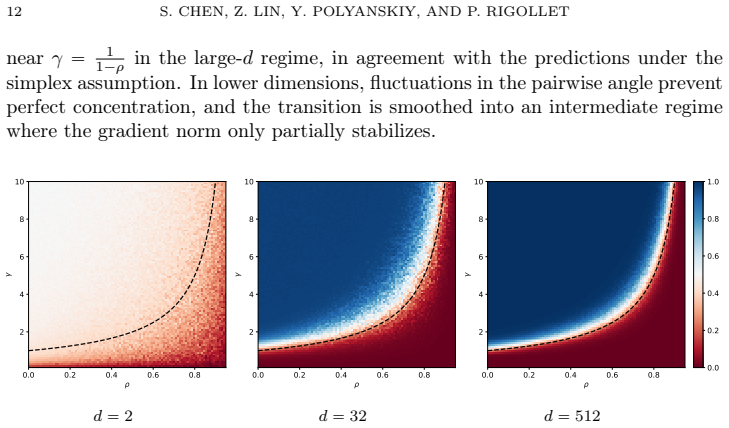
- An implication left implicit: the sharp boundary can only hold when the spread of pairwise similarities is bounded independent of n. For fixed embedding dimension d, that spread grows like sqrt(log n / d), so the transition should broaden into a crossover in the low-dimension regime; the paper's own small-d experiments show exactly this smoothing.
- The paper's deterministic-similarity model predicts beta ~ log n, while the Gaussian-similarity model discussed in the introduction predicts beta ~ sqrt(log n). A reader could distinguish the two by measuring pairwise similarity fluctuations in real pretrained token embeddings: bounded-spread embeddings should follow the log n transition, random-geometry embeddings the sqrt(log n) one.
- A direct extension would be to let the similarity range grow slowly with n, such as fluctuations of order (log n)^{-c}, and derive the resulting width of the critical window; the paper's dichotomy suggests a universal log n center but no sharp constant.
Editorial analysis
A structured set of objections, weighed in public.
Referee Report
Summary. The paper studies a normalized single-head self-attention layer with pre-norm, K=Q=V=I, residual parameter α, and score scaling β_n=γ log n. It proves that under a simplex assumption on token geometry (all pairwise cosines equal to ρ and all squared norms equal to q), the pairwise output cosine tends to ρ for γ>1/(1−ρ), to a value strictly larger than ρ — and to 1 without a residual connection — for γ<1/(1−ρ), and to an intermediate contraction at the critical value γ=1/(1−ρ) (Theorem 2.1, Eq. (2.4)). A relaxed 'almost-simplex' version (Assumption 2) yields contraction for γ<1/(1−ρ1) and identity-like behavior for γ>1/(1−ρ2) (Theorem 2.2). Similar phase statements are given for the normalized Frobenius norm of the input–output Jacobian (Theorems 2.3 and 2.4). Based on this analysis, the abstract claims that β_n≍log n is the critical scaling and that this provides a rigorous justification of the logarithmic attention scaling used in YaRN, Qwen, SSMax, and SWAN-GPT, including the claim that logarithmic scaling maintains sparse, content-adaptive attention at large context lengths.
Significance. The simplex-case algebra is clear, self-contained, and internally consistent: comparing n^γ with n^{1+γρ} correctly identifies the threshold γ=1/(1−ρ), and the calculation does not fit any constants to YaRN/Qwen outcomes. The addition of a backward-gradient phase analysis (Theorems 2.3–2.4) is useful and goes beyond earlier contraction results. However, the advertised practical significance is not established. The extension from the simplex to the d≪n regime rests on Assumption 2, which is asserted to hold for random half-sphere vectors but in fact fails for fixed embedding dimension; the genuinely sparse 'content-adaptive' phase is only proved in Appendix C under a much stronger ad hoc assumption. As a clean phase-transition result for a symmetric toy model, the paper is valuable; as a rigorous justification for actual long-context transformers, it overreaches. With the claims appropriately scoped, or with a correct treatment of dimension-dependent similarity ranges, the paper could be a solid theory contribution.
major comments (4)
- [Section 2.2, Assumption 2 and Lemma A.1] The load-bearing relaxation is not valid in the regime the paper claims to cover. Section 2.2 says that Assumption 2 holds with high probability for independent uniform random vectors on a half-sphere, and motivates d≪n. For fixed d, the maximum pairwise inner product of n i.i.d. points on S^{d-1} grows like sqrt(2 log n/d) and tends to 1, while the minimum on a half-sphere is not bounded below by a positive constant independent of n. Hence no fixed ρ1,ρ2∈(0,1) independent of n exist. Lemma A.1 and the proofs of Theorems 2.2/2.4 explicitly compare n^γ with n^{1+γρ1} and n^{1+γρ2} (Eqs. (A.4)–(A.6)); if ρ1 and ρ2 depend on n, these comparisons no longer give a constant phase boundary, and the threshold 1/(1−ρ) is not defined. The paper's own Figure 1 shows that the d=2 transition is smoothed, consistent with this failure. This is not a cosmetic issue: it affects the central claim of a rig
- [Abstract and Appendix C (Assumption 3, Theorem C.2)] The abstract claims that logarithmic scaling 'maintains sparse, content-adaptive attention.' The main theorems do not establish sparsity. Theorem 2.1 gives uniform attention A_ij≈1/n in the subcritical regime and identity attention in the supercritical regime; at criticality it computes only the output cosine, not the size or support of the attention weights. The only result exhibiting a nontrivial 'few relevant tokens' phase is Theorem C.2 in Appendix C, and it depends on Assumption 3, which postulates per-token relevant sets K_i of size n^τ with separated similarity bands. When τ=1 the relevant set is linear, not sparse; when τ<1, no argument is given that Assumption 3 holds for embeddings arising in practice. Therefore the abstract's sparse-content-adaptive conclusion is not a theorem of the paper's main model.
- [Section 2.2, Theorem 2.2] Even granting Assumption 2, Theorem 2.2 does not establish a sharp phase transition in the almost-simplex case. It proves contraction for γ<1/(1−ρ1) and identity-like behavior for γ>1/(1−ρ2), leaving the entire interval [1/(1−ρ1), 1/(1−ρ2)] uncharacterized. Since ρ1 and ρ2 are arbitrary under Assumption 2, this interval can cover all positive γ. Appendix C narrows the gap but only under the stronger Assumption 3. The title and abstract present 'the critical scaling β_n ≍ log n' as the paper's main result; in the almost-simplex setting the theorem only gives an outer envelope, not a critical curve. This should be stated explicitly, or the criticality claim should be restricted to the simplex model.
- [Section 2.2, final paragraph] The paragraph stating that the results 'extend to transformers with many layers' and that the o_n(1) errors remain negligible under repeated application of the ATT operator 'up to poly(n) iterations' is unsupported. The theorem statements give error bounds of the form |o_n(1)| ≤ C1 n^{-C2} with constants depending on the assumptions but not on the layer number. After n^M iterations, the accumulated error is typically O(n^{M-C2}), which is negligible only when M<C2. No uniform-in-layer bound is stated or proved. Moreover, after one update the token configuration generally leaves the exact simplex or almost-simplex class with the same constants, since norms and angles change; the paper does not prove the invariants needed for multi-layer iteration. This matters because the practical relevance of the result is tied to deep transformers.
minor comments (5)
- [Theorem 2.4, Eq. (2.20)] The subcritical gradient bound is log^2 n / d + o_n(1). This is small only when d ≫ log^2 n. The text says this holds 'for typical values of n and d used in Transformers,' but no formal condition is given; the statement 'gradients do not flow' should be qualified by d≫log^2 n.
- [Figure 1 caption] The caption says the dashed curve γ=1/(1−ρ) 'approximates the actual phase transition with increasing accuracy as d grows.' For d=2 the transition is visibly smoothed and there is no sharp phase boundary; the caption should distinguish between the simplex prediction and the actual smoothed empirical behavior.
- [Section 2.2, Assumption 2] The phrase 'It is easy to see using standard probabilistic tools that Assumption 2 holds with high probability when the y_i's are independent random vectors uniformly distributed on a half-sphere' is not accompanied by a proof or reference. Given that the statement is false for fixed d, this should either be proved with explicit d-dependence or removed.
- [Notation] The notation J1,nK introduced at the start of Appendix A should be replaced by standard notation such as {1,...,n} or [n], since it appears in the main body as well.
- [Minor typographical issues] There are small typos and formatting artifacts, e.g. 'T able 1' in Table 1, and the reference entries for [BBC`23] and [Nak25] are incomplete. These do not affect the substance.
Circularity Check
No significant circularity: the log n phase transition is derived from explicit partition-function algebra, not from fitting or self-citation.
full rationale
The central result is derived from the explicit softmax partition function Z_i = e^β + Σ_{k≠i} e^{a_ik}. Setting β = γ log n reduces the comparison to powers of n: e^β = n^γ versus n e^{ρβ} = n^{1+γρ}. The phase boundary γ = 1/(1−ρ) follows from solving γ = 1+γρ, as shown in Eq. (2.6) and the proof after it. This is a self-contained calculation; no constant is fitted to YaRN, Qwen, SSMax, or SWAN-GPT, and the model does not take their scaling as an input. The abstract's 'rigorous justification' is an interpretive claim about the coincidence of the model's critical scale with the empirical log n scaling, not a circular reduction. Self-citations in the introduction (e.g., [GLPR25], [CLPR25]) are contextual and not load-bearing: the contraction and gradient results are proven in Appendices A and B from explicit Jacobian and inner-product expansions, not imported by citation. The simplex assumption is attributed to the external work [CNQG24]. The unproved assertion in Section 2.2 that Assumption 2 holds with high probability for random vectors on a half-sphere is a correctness/transfer concern, not a circular step, because the theorems do not assume the phase-transition conclusion. Accordingly, no equation reduces to an input by construction and there is no fitted parameter renamed as a prediction.
Axiom & Free-Parameter Ledger
free parameters (5)
- ρ (simplex pairwise cosine similarity) =
∈(0,1), assumed constant independent of n
- q (squared token norm in Assumption 1) =
>0, assumed constant
- ρ1, ρ2 (almost-simplex angle bounds) =
∈(0,1), constants independent of n
- q1, q2 (almost-simplex norm bounds) =
>0, constants independent of n
- τ, ρ3, ρ4, κ3, κ4 (Assumption 3 subset parameters) =
not specified numerically
axioms (5)
- domain assumption K=Q=V=I, so attention scores reduce to scaled dot products of normalized tokens
- domain assumption Pre-layer norm places all tokens on the unit sphere; update includes residual αx_i
- domain assumption Assumption 1: constant norm sqrt(q) and constant pairwise similarity ρ for all i≠j
- domain assumption Assumption 2: norms and pairwise inner products bounded by constants independent of n
- ad hoc to paper Assumption 3: per-token relevant set K_i with size n^τ and similarity ranges, plus technical inequality
Cite this review
Pith. "Pith review of Critical attention scaling in long-context transformers." pith.science (2026). https://pith.science/paper/T3IGRLS3
@misc{pith2026251005554,
  author       = {Pith},
  title        = {Pith review of: Critical attention scaling in long-context transformers},
  year         = {2026},
  howpublished = {\url{https://pith.science/paper/T3IGRLS3}},
  note         = {Machine review of arXiv:2510.05554}
}
read the original abstract
As large language models scale to longer contexts, attention layers suffer from a fundamental pathology: attention scores collapse toward uniformity as context length $n$ increases, causing tokens to cluster excessively, a phenomenon known as rank-collapse. While $\textit{attention scaling}$ effectively addresses this deficiency by rescaling attention scores with a polylogarithmic factor $\beta_n$, theoretical justification for this approach remains lacking. We analyze a simplified yet tractable model that magnifies the effect of attention scaling. In this model, attention exhibits a phase transition governed by the scaling factor $\beta_n$: insufficient scaling collapses all tokens to a single direction, while excessive scaling reduces attention to identity, thereby eliminating meaningful interactions between tokens. Our main result identifies the critical scaling $\beta_n \asymp \log n$ and provides a rigorous justification for attention scaling in YaRN and Qwen, clarifying why logarithmic scaling maintains sparse, content-adaptive attention at large context lengths.
Figures

Forward citations
Cited by 6 Pith papers
-
A Unified Framework for Critical Scaling of Inverse Temperature in Self-Attention
The upper-tail accumulation scale derived from the gap-counting function N_n sets the critical inverse temperature for softmax attention concentration, unifying prior conflicting laws as special cases of different N_n.
-
On the Diverse Dynamical Behaviors Arising in Deep Linear Transformers
Linear self-attention in 2D reduces to a second-harmonic Kuramoto model whose order parameter obeys one ODE; explicit matrix conditions yield clustering, rotating clusters, Hamiltonian oscillations, and bifurcations.
-
FreeSpec: Training-Free Long Video Generation via Singular-Spectrum Reconstruction
FreeSpec uses SVD-based spectral reconstruction to fuse global low-rank and local high-rank features, reducing content drift and preserving temporal dynamics in long video generation.
-
Perceptrons and localization of attention's mean-field landscape
In the mean-field limit of attention with perceptron blocks, critical points of the energy landscape are generically atomic and localized on subsets of the unit sphere.
-
Quantifying Concentration Phenomena of Mean-Field Transformers in the Low-Temperature Regime
In the low-temperature regime, the token distribution in mean-field transformers concentrates onto the push-forward under a key-query-value projection with Wasserstein distance scaling as √(log(β+1)/β) exp(Ct) + exp(-ct).
-
Visual-Language-Guided Task Planning for Horticultural Robots
A vision-language model drives a simulated greenhouse robot through simple crop-inspection tasks with ~87% success, but long multi-target tasks collapse to under 10% success.
Reference graph
Works this paper leans on
-
[4]
[CLPR25] Shi Chen, Zhengjiang Lin, Yury Polyanskiy, and Philippe Rigol- let
arXiv:2501.00762. [CLPR25] Shi Chen, Zhengjiang Lin, Yury Polyanskiy, and Philippe Rigol- let. Quantitative clustering in mean-field transformer models,
-
[5]
[CNQG24] Aditya Cowsik, Tamra Nebabu, Xiao-Liang Qi, and Surya Ganguli
arXiv:2504.14697. [CNQG24] Aditya Cowsik, Tamra Nebabu, Xiao-Liang Qi, and Surya Ganguli. Geometric dynamics of signal propagation predict trainability of trans- formers,
-
[7]
[GKPR24] Borjan Geshkovski, Hugo Koubbi, Yury Polyanskiy, and Philippe Rigollet
arXiv:2505.24333. [GKPR24] Borjan Geshkovski, Hugo Koubbi, Yury Polyanskiy, and Philippe Rigollet. Dynamic metastability in the self-attention model,
-
[8]
arXiv:2410.06833. 28 S. CHEN, Z. LIN, Y. POLYANSKIY, AND P. RIGOLLET [GLPR24] Borjan Geshkovski, Cyril Letrouit, Yury Polyanskiy, and Philippe Rigollet. The emergence of clusters in self-attention dynamics.Ad- vances in Neural Information Processing Systems, 36,
-
[9]
[KGPR25] NikitaKaragodin, ShuGe, YuryPolyanskiy, andPhilippeRigollet
arXiv:2501.12205. [KGPR25] NikitaKaragodin, ShuGe, YuryPolyanskiy, andPhilippeRigollet. Nor- malization in attention dynamics,
-
[10]
arXiv:2411.04990. [Lio71] Jacques Louis Lions.Optimal control of systems governed by partial differential equations, volume
-
[11]
arXiv:2501.19399. [PLS`25] Krishna C Puvvada, Faisal Ladhak, Santiago Akle Serrano, Cheng- Ping Hsieh, Shantanu Acharya, Somshubra Majumdar, Fei Jia, Samuel Kriman, Simeng Sun, Dima Rekesh, et al. Swan-gpt: An effi- cient and scalable approach for long-context language modeling,
-
[12]
[PQFS23] Bowen Peng, Jeffrey Quesnelle, Honglu Fan, and Enrico Shippole
arXiv:2504.08719. [PQFS23] Bowen Peng, Jeffrey Quesnelle, Honglu Fan, and Enrico Shippole. Yarn: Efficient context window extension of large language models,
-
[13]
[PRY25] Yury Polyanskiy, Philippe Rigollet, and Andrew Yao
arXiv:2309.00071. [PRY25] Yury Polyanskiy, Philippe Rigollet, and Andrew Yao. Synchronization of mean-field models on the circle,
-
[14]
[RHW86] David E Rumelhart, Geoffrey E Hinton, and Ronald J Williams
arXiv:2507.22857. [RHW86] David E Rumelhart, Geoffrey E Hinton, and Ronald J Williams. Learn- ing representations by back-propagating errors.nature, 323(6088):533– 536,
-
[2022]
arXiv:2210.12788. [BBC`23] Jinze Bai, Shuai Bai, Yunfei Chu, Zeyu Cui, Kai Dang, Xiaodong Deng, Yang Fan, Wenbin Ge, Yu Han, Fei Huang, et al. Qwen technical report,
-
[2023]
[BPA25a] Giuseppe Bruno, Federico Pasqualotto, and Andrea Agazzi
arXiv:2309.16609. [BPA25a] Giuseppe Bruno, Federico Pasqualotto, and Andrea Agazzi. Emergence of meta-stable clustering in mean-field transformer models. InInterna- tional Conference on Learning Representations,
-
[2024]
[DCL21] Yihe Dong, Jean-Baptiste Cordonnier, and Andreas Loukas
arXiv:2403.02579. [DCL21] Yihe Dong, Jean-Baptiste Cordonnier, and Andreas Loukas. Attention is not all you need: Pure attention loses rank doubly exponentially with depth. InInternational Conference on Machine Learning, pages 2793–2803. PMLR,
-
[2025]
Longformer: The long-document transformer.arXiv preprint arXiv:2004.05150,
[BPC20] Iz Beltagy, Matthew E Peters, and Arman Cohan. Longformer: The long-document transformer.arXiv preprint arXiv:2004.05150,
Pith/arXiv arXiv 2004
This paper was first reviewed by deepseek-v4-flash on August 4, 2026.
discussion (0)
Sign in with ORCID, Apple, or X to comment. Anyone can read and Pith papers without signing in.