Rigorous estimation of error thresholds of transversal Clifford logical circuits
Pith reviewed 2026-05-18 07:19 UTC · model grok-4.3
The pith
Transversal Clifford gates map to classical spin models with local defects, giving decoder-independent circuit thresholds.
A machine-rendered reading of the paper's core claim, the machinery that carries it, and where it could break.
Core claim
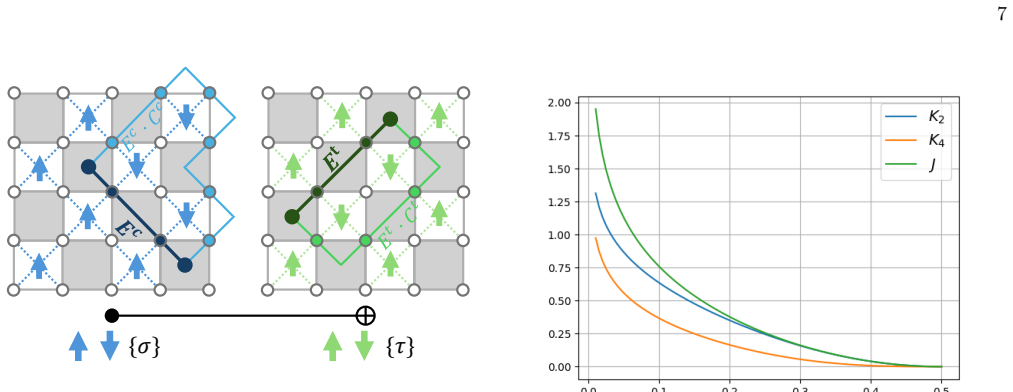
The statistical-mechanical mapping from quantum memories to classical spin models generalizes to logical circuits with transversal gates by adding only local-in-time modifications. For persistent bit-flip noise on a transversal CNOT between toric codes the model is a 2D random Ashkin-Teller model whose threshold is 0.080, a 26 percent drop from the memory value 0.109. When syndrome errors are present the circuit maps to a 3D random 4-body Ising model with a plane defect and yields a conservative threshold of at least 0.028, compared with 0.033 for the memory. The same local modification rule holds for all transversal Clifford gates of the toric code and for arbitrary CSS codes.
What carries the argument
The statistical-mechanical mapping of quantum error thresholds to phase transitions of classical spin models, extended by local-in-time plane defects that represent error propagation through each transversal gate.
If this is right
- The bit-flip threshold for a transversal CNOT on toric codes is 0.080, 26 percent below the static memory threshold.
- When syndrome errors are included the threshold is at least 0.028, a 15 percent reduction from the memory value.
- Every transversal Clifford gate on the toric code produces its own local modification to the spin model.
- The construction applies unchanged to any CSS code because each transversal gate modifies the model only locally in time.
Where Pith is reading between the lines
- The size of the threshold drop quantifies the computational cost of using transversal gates rather than more complex gate implementations.
- The same defect-construction technique could be applied to other noise models or to non-Clifford transversal gates if an analogous local mapping can be derived.
- Classical simulations of the resulting spin models offer a practical route to compare thresholds across different code families and gate sets.
Load-bearing premise
Error propagation through transversal gates can be captured exactly by adding only local-in-time modifications to the underlying classical spin model.
What would settle it
A Monte Carlo simulation of the 2D random Ashkin-Teller model with the parameters fixed by the transversal CNOT that finds a phase boundary at a bit-flip rate other than 0.080 would contradict the reported circuit threshold.
Figures





read the original abstract
The threshold theorem promises a path to fault-tolerant quantum computation, provided the physical error rate is below a critical threshold. While transversal gates efficiently implement logical operations, they propagate errors and can lower this threshold relative to a static quantum memory. In this work, we generalize the statistical-mechanical (stat-mech) mapping from quantum memories to logical circuits with transversal gates, thereby enabling rigorous, decoder-independent thresholds for fault-tolerant logical computation. We first demonstrate the framework for two toric code blocks undergoing a transversal CNOT (tCNOT) gate, quantifying two independent error-spreading mechanisms. For persistent bit-flip errors with perfect syndromes, the stat-mech model is a 2D random Ashkin-Teller model. Monte Carlo simulation and finite-size scaling show that the tCNOT reduces the optimal bit-flip threshold to $p=0.080$, a $26\%$ decrease from the toric code memory threshold $p=0.109$. With syndrome errors included, the circuit maps to a 3D random 4-body Ising model with a plane defect, yielding a conservative estimate $p\geq 0.028$, a modest $15\%$ reduction from the memory threshold $p=0.033$. Beyond the tCNOT gate, we derive stat-mech models for all transversal Clifford gates of the toric code, including the fold-transversal Hadamard and $S$ gates, and generalize the framework to arbitrary CSS codes, proving that each transversal gate modifies the stat-mech model only locally in time. By reducing threshold analysis of fault-tolerant logical circuits to the study of classical spin models with local defects, our framework provides a systematic, decoder-independent benchmark for near-term fault-tolerant architectures.
Editorial analysis
A structured set of objections, weighed in public.
Referee Report
Summary. The manuscript generalizes the statistical-mechanical mapping from quantum error-correcting memories to fault-tolerant logical circuits implementing transversal Clifford gates on CSS codes. For a transversal CNOT between two toric-code blocks it derives an exact 2D random Ashkin-Teller model (perfect syndromes) and a 3D random 4-body Ising model with a plane defect (noisy syndromes), performs Monte Carlo simulations with finite-size scaling to extract thresholds p=0.080 and p≥0.028, and proves that every transversal Clifford gate on an arbitrary CSS code induces only a local-in-time modification to the underlying interaction graph.
Significance. If the mapping is exact, the work supplies a decoder-independent, systematic route to threshold estimation for logical operations by reducing the problem to the phase boundary of a classical spin model with a local defect. Explicit derivations of the dual Hamiltonians, reproducible Monte Carlo estimates showing only modest threshold reductions relative to the static-memory case, and the general locality proof are concrete strengths that extend the stat-mech framework from memories to circuits.
minor comments (3)
- The abstract states the Monte Carlo thresholds but omits lattice sizes, number of disorder realizations, and the precise sampling procedure for the 4-body couplings; these details belong in the main text or a methods paragraph to allow independent verification of the finite-size scaling.
- In the generalization to arbitrary CSS codes, the statement that each transversal gate “modifies the stat-mech model only locally in time” would benefit from an explicit small example (e.g., a weight-4 stabilizer on a [[7,1,3]] code) showing the precise change to the interaction graph.
- The 26 % and 15 % reductions are quoted relative to memory thresholds 0.109 and 0.033; a brief parenthetical reminder of these reference values in the abstract would improve readability.
Simulated Author's Rebuttal
We thank the referee for their positive assessment of our manuscript and for recommending minor revision. The referee's summary correctly captures the core contributions: the exact mapping of transversal CNOT to a 2D random Ashkin-Teller model (perfect syndromes) and a 3D random 4-body Ising model with a plane defect (noisy syndromes), the Monte Carlo thresholds, and the general locality proof for transversal Clifford gates on arbitrary CSS codes. We appreciate the recognition that this supplies a decoder-independent route to threshold estimation via classical spin models with local defects.
Circularity Check
No significant circularity
full rationale
The paper derives explicit dual classical Hamiltonians for transversal gates (e.g., 2D random Ashkin-Teller for perfect-syndrome tCNOT and 3D random 4-body Ising with plane defect for noisy syndromes) and proves that each transversal Clifford gate on CSS codes inserts only local-in-time modifications to the underlying stat-mech model of the toric code. Thresholds are extracted from independent Monte Carlo simulations and finite-size scaling of these mapped classical spin models, not by fitting parameters to quantum-circuit data. The framework extends the known stat-mech mapping for static memories rather than redefining or predicting quantities from its own outputs; any self-citations to prior mapping literature are not load-bearing for the central claims, which remain externally verifiable via classical simulation.
Axiom & Free-Parameter Ledger
axioms (1)
- domain assumption Error propagation through a transversal gate between code blocks can be represented by a local-in-time defect in the corresponding classical spin model.
Reference graph
Works this paper leans on
-
[1]
= 1/ − 1 for the absence/occurrence of a physi- cal error at the data qubit on the link l, and rp = 1/ − 1 for the absence/occurrence of a syndrome error of the Z stabilizer at the plaquette p. In terms of the stat-mech model, the bit-flip error threshold of toric code with O(d) rounds of syndrome ex- traction is mapped to the confinement transition of th...
-
[2]
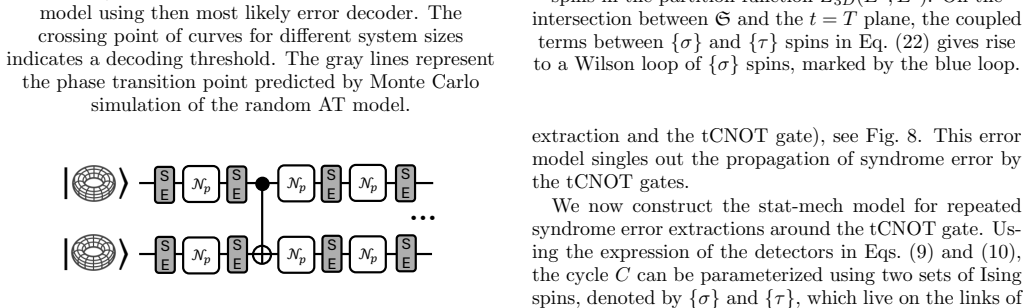
To avoid visual overlap, we sketch the spacetime detectors dc and dt in two adjacent plaquettes that host Z stabilizers. (b) The logical circuit with tCNOT gate, persistent bit-flip noise channels N˜p and two rounds of perfect syndrome extractions (SE), during which the weight-4 Z stabilizers are measured. Denoting the cases where the combined errors will...
-
[3]
4: Coupling constants K2 and K4 in the random AT model Hamiltonian in Eq
Monte Carlo simulation of the disordered AT model With the stat-mech model being constructed, we now conduct a numerical study to quantify the error thresh- FIG. 4: Coupling constants K2 and K4 in the random AT model Hamiltonian in Eq. (17), whose relations with ˜p are given in the Appendix Eq.(A3). Coupling of RBIM, J = 1 2 ln 1−2˜p(1−˜p) 2˜p(1−˜p) , is ...
-
[4]
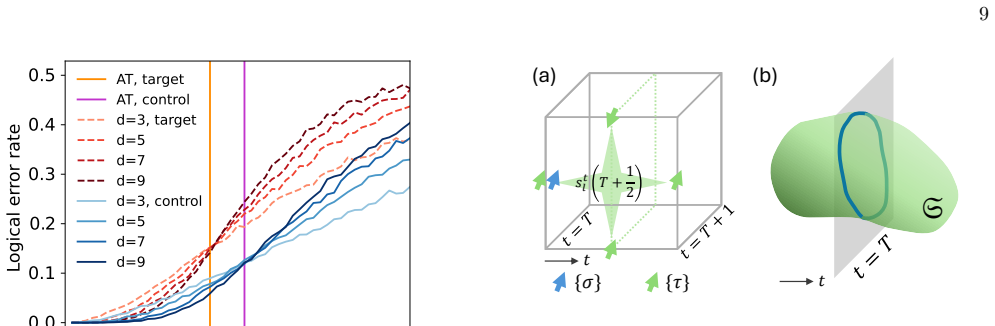
Direct simulation of error correction protocol We cross-check the thresholds predicted by the MC simulation of the AT model with those observed in a prac- tical error correction protocol. Since the error thresholds for a planar surface code and the toric code are expected to be the same [8], we opt to simulate a rotated surface code for convenience. We us...
-
[5]
D. Aharonov and M. Ben-Or, Fault-tolerant quantum computation with constant error, in Proceedings of the Twenty-Ninth Annual ACM Symposium on Theory of Computing - STOC ’97 (ACM Press, El Paso, Texas, United States, 1997) pp. 176–188
work page 1997
-
[6]
A. Y. Kitaev, Quantum computations: Algorithms and error correction, Russian Mathematical Surveys 52, 1191 (1997)
work page 1997
- [7]
-
[8]
Quantum accuracy threshold for concatenated distance-3 codes
P. Aliferis, D. Gottesman, and J. Preskill, Quantum accu- racy threshold for concatenated distance-3 codes (2005), arXiv:quant-ph/0504218
work page internal anchor Pith review Pith/arXiv arXiv 2005
-
[9]
P. W. Shor, Scheme for reducing decoherence in quantum computer memory, Physical Review A 52, R2493 (1995)
work page 1995
-
[10]
Fault-tolerant quantum computation
J. Preskill, Fault-tolerant quantum computation (1997), arXiv:quant-ph/9712048
work page internal anchor Pith review Pith/arXiv arXiv 1997
-
[11]
Stabilizer Codes and Quantum Error Correction
D. Gottesman, Stabilizer Codes and Quantum Error Cor- rection (1997), arXiv:quant-ph/9705052
work page internal anchor Pith review Pith/arXiv arXiv 1997
- [12]
-
[13]
C. Wang, J. Harrington, and J. Preskill, Confinement- Higgs transition in a disordered gauge theory and the ac- curacy threshold for quantum memory, Annals of Physics 303, 31 (2003)
work page 2003
- [14]
-
[15]
R. Acharya, I. Aleiner, R. Allen, T. I. Andersen, M. Ans- mann, F. Arute, K. Arya, A. Asfaw, J. Atalaya, R. Bab- bush, et al. , Suppressing quantum errors by scaling a surface code logical qubit, Nature 614, 676 (2023)
work page 2023
-
[16]
R. Acharya, D. A. Abanin, L. Aghababaie-Beni, I. Aleiner, T. I. Andersen, M. Ansmann, F. Arute, K. Arya, A. Asfaw, N. Astrakhantsev, et al. , Quantum error correction below the surface code threshold, Nature 12 638, 920 (2025)
work page 2025
-
[17]
D. Bluvstein, S. J. Evered, A. A. Geim, S. H. Li, H. Zhou, T. Manovitz, S. Ebadi, M. Cain, M. Kalinowski, D. Hangleiter, et al. , Logical quantum processor based on reconfigurable atom arrays, Nature 626, 58 (2024), arXiv:2312.03982 [quant-ph]
-
[18]
B. W. Reichardt, A. Paetznick, D. Aasen, I. Basov, J. M. Bello-Rivas, P. Bonderson, R. Chao, W. van Dam, M. B. Hastings, R. V. Mishmash, et al. , Fault-tolerant quan- tum computation with a neutral atom processor (2025), arXiv:2411.11822 [quant-ph]
work page internal anchor Pith review Pith/arXiv arXiv 2025
-
[19]
N. Lacroix, A. Bourassa, F. J. H. Heras, L. M. Zhang, J. Bausch, A. W. Senior, T. Edlich, N. Shutty, V. Sivak, A. Bengtsson, et al. , Scaling and logic in the colour code on a superconducting quantum processor, Nature , 1 (2025)
work page 2025
-
[20]
Demonstration of logical qubits and repeated error correction with better-than-physical error rates
A. Paetznick, M. P. da Silva, C. Ryan-Anderson, J. M. Bello-Rivas, J. P. C. III, A. Chernoguzov, J. M. Dreiling, C. Foltz, F. Frachon, J. P. Gaebler, et al. , Demonstra- tion of logical qubits and repeated error correction with better-than-physical error rates (2024), arXiv:2404.02280 [quant-ph]
work page internal anchor Pith review Pith/arXiv arXiv 2024
-
[21]
C. Ryan-Anderson, N. C. Brown, C. H. Baldwin, J. M. Dreiling, C. Foltz, J. P. Gaebler, T. M. Gatterman, N. Hewitt, C. Holliman, C. V. Horst, et al. , High-fidelity teleportation of a logical qubit using transversal gates and lattice surgery, Science 385, 1327 (2024)
work page 2024
-
[22]
A Theory of Fault-Tolerant Quantum Computation
D. Gottesman, A Theory of Fault-Tolerant Quan- tum Computation, Physical Review A 57, 127 (1998), arXiv:quant-ph/9702029
work page internal anchor Pith review Pith/arXiv arXiv 1998
-
[23]
Quantum Computing with Very Noisy Devices
E. Knill, Quantum Computing with Very Noisy Devices, Nature 434, 39 (2005), arXiv:quant-ph/0410199
work page internal anchor Pith review Pith/arXiv arXiv 2005
-
[24]
Topological Quantum Distillation
H. Bombin and M. A. Martin-Delgado, Topological Quantum Distillation, Physical Review Letters 97, 180501 (2006), arXiv:quant-ph/0605138
work page internal anchor Pith review Pith/arXiv arXiv 2006
-
[25]
D. Horsman, A. G. Fowler, S. Devitt, and R. V. Meter, Surface code quantum computing by lattice surgery, New Journal of Physics 14, 123011 (2012)
work page 2012
-
[26]
H. Zhou, C. Zhao, M. Cain, D. Bluvstein, N. Maskara, C. Duckering, H.-Y. Hu, S.-T. Wang, A. Kubica, and M. D. Lukin, Low-overhead transversal fault tolerance for universal quantum computation, Nature , 1 (2025)
work page 2025
-
[27]
M. E. Beverland, A. Kubica, and K. M. Svore, Cost of universality: A comparative study of the overhead of state distillation and code switching with color codes, PRX Quantum 2, 020341 (2021)
work page 2021
-
[28]
M. Cain, C. Zhao, H. Zhou, N. Meister, J. P. B. Ataides, A. Jaffe, D. Bluvstein, and M. D. Lukin, Correlated De- coding of Logical Algorithms with Transversal Gates, Physical Review Letters 133, 240602 (2024)
work page 2024
- [29]
- [30]
- [31]
-
[32]
M. Serra-Peralta, M. H. Shaw, and B. M. Terhal, Decod- ing across transversal Clifford gates in the surface code (2025), arXiv:2505.13599 [quant-ph]
- [33]
- [34]
- [35]
- [36]
-
[37]
J. Behrends and B. B´ eri, Statistical mechanical map- ping and maximum-likelihood thresholds for the surface code under generic single-qubit coherent errors (2024), arXiv:2410.22436 [quant-ph]
-
[38]
J. Behrends and B. B´ eri, The surface code beyond Pauli channels: Logical noise coherence, information-theoretic measures, and errorfield-double phenomenology (2025), arXiv:2412.21055 [quant-ph]
-
[39]
H. Bombin and M. A. Martin-Delgado, Statistical me- chanical models and topological color codes, Physical Re- view A 77, 042322 (2008)
work page 2008
-
[40]
H. G. Katzgraber, H. Bombin, and M. A. Martin- Delgado, Error Threshold for Color Codes and Random Three-Body Ising Models, Physical Review Letters 103, 090501 (2009)
work page 2009
-
[41]
R. S. Andrist, H. G. Katzgraber, H. Bombin, and M. A. Martin-Delgado, Tricolored Lattice Gauge The- ory with Randomness: Fault-Tolerance in Topological Color Codes, New Journal of Physics 13, 083006 (2011), arXiv:1005.0777 [quant-ph]
work page internal anchor Pith review Pith/arXiv arXiv 2011
-
[42]
M. Hasenbusch, F. P. Toldin, A. Pelissetto, and E. Vi- cari, Magnetic-glassy multicritical behavior of the three- dimensional ±J Ising model, Physical Review B 76, 184202 (2007)
work page 2007
- [43]
-
[44]
A. Honecker, M. Picco, and P. Pujol, Universality Class of the Nishimori Point in the 2D ±J Random-Bond Ising Model, Physical Review Letters 87, 047201 (2001)
work page 2001
-
[45]
Gidney, Stim: A fast stabilizer circuit simulator, Quantum 5, 497 (2021)
C. Gidney, Stim: A fast stabilizer circuit simulator, Quantum 5, 497 (2021)
work page 2021
-
[46]
J. Ashkin and E. Teller, Statistics of Two-Dimensional Lattices with Four Components, Physical Review64, 178 (1943)
work page 1943
-
[47]
F. D. Nobre and D. Sherrington, Replica-symmetry breaking for the Ashkin-Teller spin glass, Journal of Physics A: Mathematical and General 26, 4539 (1993)
work page 1993
-
[48]
S. Wiseman and E. Domany, Cluster method for the Ashkin-Teller model, Physical Review E48, 4080 (1993)
work page 1993
-
[49]
S. Wiseman and E. Domany, Critical behavior of the random-bond Ashkin-Teller model: A Monte Carlo study, Physical Review E 51, 3074 (1995)
work page 1995
-
[50]
A. Bellafard, H. G. Katzgraber, M. Troyer, and S. Chakravarty, Bond Disorder Induced Criticality of the Three-Color Ashkin-Teller Model, Physical Review Let- ters 109, 155701 (2012). 13
work page 2012
-
[51]
Q. Zhu, X. Wan, R. Narayanan, J. A. Hoyos, and T. Vojta, Emerging criticality in the disordered three- color Ashkin-Teller model, Physical Review B91, 224201 (2015)
work page 2015
-
[52]
Y.-H. Chen and T. Grover, Unconventional topological mixed-state transition and critical phase induced by self- dual coherent errors, Phys. Rev. B 110, 125152 (2024)
work page 2024
-
[53]
D. Landau and K. Binder, A Guide to Monte Carlo Simulations in Statistical Physics (Cambridge University Press, 2021)
work page 2021
-
[54]
A. J. Landahl, J. T. Anderson, and P. R. Rice, Fault- tolerant quantum computing with color codes (2011), arXiv:1108.5738 [quant-ph]
work page internal anchor Pith review Pith/arXiv arXiv 2011
-
[55]
Savit, Duality in field theory and statistical systems, Reviews of Modern Physics 52, 453 (1980)
R. Savit, Duality in field theory and statistical systems, Reviews of Modern Physics 52, 453 (1980)
work page 1980
-
[56]
H. Kim, Y. Zhou, Y. Xu, K. Varma, A. H. Karamlou, I. T. Rosen, J. C. Hoke, C. Wan, J. P. Zhou, W. D. Oliver, Y. D. Lensky, K. Q. Weinberger, and E.-A. Kim, Attention to quantum complexity, Science Advances 11, eadu0059 (2025). Appendix A: Coupling constants in the Hamiltonian of the random Ashkin-Teller model In this appendix, we derive the coupling const...
work page 2025
-
[57]
Without the tCNOT gate, the values of the spacetime detectors are given by dc(t + 1
= ±1 with probability ps(sc,t l (t + 1 2)) = 1+(1−2p)sc,t l (t+ 1 2 ) 2 . Without the tCNOT gate, the values of the spacetime detectors are given by dc(t + 1
-
[58]
= rc p(T )rc p(t + 1) Y l∈p sc l (t + 1
-
[59]
= rt p(t)rt p(t + 1) Y l∈p st l(t + 1 2). (B1) For a tCNOT gate that happens right after time step T , the values of the spacetime detectors of the control and target blocks become dc(T + 1
-
[60]
= rc p(T )rc p(T + 1) Y l∈p sc l (T + 1
-
[61]
Note that since rc p(T ) is in three spacetime detectors, dc(T − 1 2), dc(T + 1
= rt p(T )rc p(T )rt p(T + 1) Y l∈p st l(T + 1 2), (B2) 14 respectively. Note that since rc p(T ) is in three spacetime detectors, dc(T − 1 2), dc(T + 1
-
[62]
Away from t = T , rc p do not enter the spacetime detector dt(t ̸= T ) of the target block
and dt(T + 1 2), the decoding graph across the tCNOT gate contains weight-3 hyperedges. Away from t = T , rc p do not enter the spacetime detector dt(t ̸= T ) of the target block. To obtain the stat-mech model in this case, we need to parameterize the trivial cycles C that lead to the same set of syndromes {dc, dt}. Based on their forms in Eqs. (B1) and (...
-
[63]
→ sc l (t − 1 2)σl(t − 1)σl(t)σl1(t − 1 2)σl2(t − 1 2), s t l(t − 1
-
[64]
At t > T , to account for rc p(T ) in the detector dt(T ) in Eq
→ st l(t − 1 2)τl(t − 1)τl(t)τl1(t − 1 2)τl2(t − 1 2), rc p(t) → rc p Y l∈p σl(t), r t p(t) → rt p Y l∈p τl(t), (B3) the same as the case without the tCNOT gate. At t > T , to account for rc p(T ) in the detector dt(T ) in Eq. (B2), the reparameterization is changed accordingly: sc l (t − 1
-
[65]
→ sc l (t − 1 2)σl(t − 1)σl(t)σl1(t − 1 2)σl2(t − 1 2), st l(t − 1
-
[66]
In other words, the tCNOT gate induces a domain wall that permutes the Ising spins
→ st l(t − 1 2)σl(t − 1)τl(t − 1)σl(t)τl(t)σl1(t − 1 2)τl1(t − 1 2)σl2(t − 1 2)τl2(t − 1 2), rc p(t) → rc p(t) Y l∈p σl(t), r t p(t) → rt p(t) Y l∈p σl(t)τl(t), (B4) that is, the Ising spin {τ } becomes {τ σ} once we go from t ≤ T to t > T . In other words, the tCNOT gate induces a domain wall that permutes the Ising spins. Putting everything together, th...
-
[67]
− K X l,t rc p(t) Y l∈p σl(t) + rt p(t) Y l∈p τl(t) . (B7) Compared to the Hamiltonian of two decoupled R4bIMs, H3D({σ}|Ec) + H3D({τ }|Et), the difference in the Hamil- tonian above is the terms that involve st l(T + 1 2), which contain the σ spins
discussion (0)
Sign in with ORCID, Apple, or X to comment. Anyone can read and Pith papers without signing in.