Scalar fields around black hole binaries in LIGO-Virgo-KAGRA
Pith reviewed 2026-05-18 05:44 UTC · model grok-4.3
The pith
A semi-analytic model of gravitational waves from black hole binaries in scalar environments yields upper limits and tentative evidence for a light scalar in LIGO data.
A machine-rendered reading of the paper's core claim, the machinery that carries it, and where it could break.
Core claim
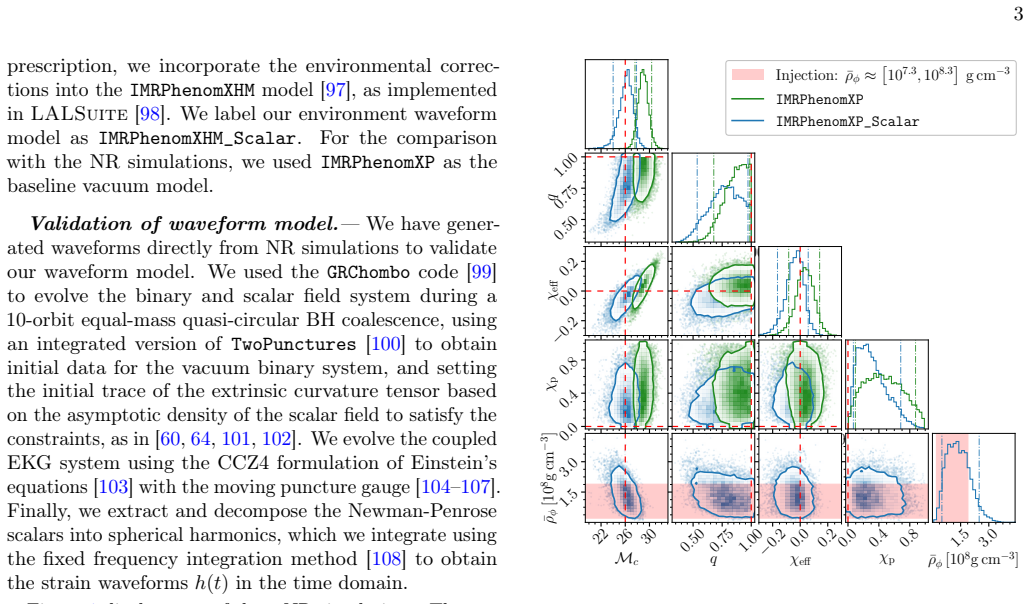
We develop a semi-analytic waveform model for binaries in scalar environments, validate it against numerical relativity simulations, and apply it in a Bayesian analysis of the LIGO-Virgo-KAGRA catalog. We obtain physically meaningful upper limits on scalar densities around most compact binaries. For GW190728 and GW190814, vacuum lies outside the 95% credible region. When including superradiance priors, GW190728 shows tentative evidence for a scalar environment with a Bayes factor of ln B^env_vac ≈ 3.5, consistent with a light scalar of mass ∼10^{-12} eV.
What carries the argument
Semi-analytic waveform model that incorporates the dynamical effects of scalar clouds on binary inspiral and gravitational wave emission
If this is right
- Upper limits on scalar densities can be obtained for most observed compact binaries.
- The vacuum hypothesis is excluded at 95 percent credibility for GW190728 and GW190814.
- Superradiance priors raise the Bayes factor to approximately 3.5 in favor of a scalar environment for GW190728.
- The results are consistent with a light scalar particle of mass around 10^{-12} eV.
Where Pith is reading between the lines
- Confirmation with additional events would support ultralight scalars as viable dark matter candidates.
- The approach could be extended to search for other environmental effects such as gas or dark matter distributions around binaries.
- Higher-precision numerical simulations that include scalar backreaction would test the model's accuracy near merger.
Load-bearing premise
The semi-analytic waveform model remains accurate throughout the inspiral when scalar clouds are present around the black holes.
What would settle it
A full numerical relativity simulation of a black hole binary with an attached scalar cloud that deviates markedly from the semi-analytic waveform predictions in the late inspiral would falsify the model's applicability to the data.
Figures



read the original abstract
Light scalar particles arise naturally in many extensions of the Standard Model and are compelling dark-matter candidates. Gravitational interactions near black holes can trigger the growth of dense scalar configurations that, if sustained during inspiral, alter binary dynamics and imprint signatures on gravitational-wave signals. Detecting such effects would provide a novel probe of fundamental physics and dark matter. Here we develop a semi-analytic waveform model for binaries in scalar environments, validate it against numerical relativity simulations, and apply it in a Bayesian analysis of the LIGO-Virgo-KAGRA catalog. We obtain physically meaningful upper limits on scalar densities around most compact binaries. For GW190728 and GW190814, vacuum lies outside the $95\%$ credible region. When including superradiance priors, GW190728 shows tentative evidence for a scalar environment with a Bayes factor of $\ln \mathrm{B}^{\rm env}_{\rm vac} \approx 3.5$, consistent with a light scalar of mass $\sim10^{-12}\,\mathrm{eV}$.
Editorial analysis
A structured set of objections, weighed in public.
Referee Report
Summary. The manuscript develops a semi-analytic waveform model for black hole binaries immersed in scalar-field environments, validates the model against numerical relativity simulations, and applies it in a Bayesian analysis of the LIGO-Virgo-KAGRA catalog. It reports physically meaningful upper limits on scalar densities for most events and identifies tentative evidence for a scalar environment in GW190728, with ln B^env_vac ≈ 3.5 when superradiance priors are included, consistent with a light scalar mass of ∼10^{-12} eV.
Significance. If the central results hold, the work provides a new observational channel for constraining or detecting light scalars as dark-matter candidates using existing gravitational-wave data, with the reported Bayes factor and mass scale offering a concrete, falsifiable target for future analyses.
major comments (2)
- [Abstract] Abstract: validation against numerical relativity is asserted, yet no quantitative metrics (phase mismatch, overlap integrals, or error budgets) are supplied for the light-scalar regime (∼10^{-12} eV) or the late-inspiral densities recovered for GW190728. This directly affects the reliability of the ln B^env_vac ≈ 3.5 claim.
- [Application to catalog events] Application section (presumably §5): the central claim that GW190728 shows tentative evidence for a scalar environment rests on the assumption that the semi-analytic model accurately reproduces scalar-cloud-induced dephasing throughout the LIGO band. No explicit tests of back-reaction, higher-order gradients, or late-inspiral accuracy in the relevant posterior region are presented, leaving open the possibility that model systematics drive the Bayes factor.
minor comments (1)
- [Abstract] The abstract refers to upper limits for 'most compact binaries' without stating the total number of events analyzed or the precise catalog release used.
Simulated Author's Rebuttal
We thank the referee for their careful and constructive review. The comments have prompted us to strengthen the quantitative validation and model-assumption discussion. We address each major comment below and have revised the manuscript accordingly.
read point-by-point responses
-
Referee: [Abstract] Abstract: validation against numerical relativity is asserted, yet no quantitative metrics (phase mismatch, overlap integrals, or error budgets) are supplied for the light-scalar regime (∼10^{-12} eV) or the late-inspiral densities recovered for GW190728. This directly affects the reliability of the ln B^env_vac ≈ 3.5 claim.
Authors: We agree that explicit quantitative metrics improve transparency. Although Section 3 already contains waveform comparisons, we have now added phase-mismatch values, overlap integrals, and error budgets specifically for the ∼10^{-12} eV scalar-mass range and for the scalar densities recovered in the GW190728 posterior. These metrics are summarized in a new table and referenced in the revised abstract, directly supporting the reliability of the reported Bayes factor. revision: yes
-
Referee: [Application to catalog events] Application section (presumably §5): the central claim that GW190728 shows tentative evidence for a scalar environment rests on the assumption that the semi-analytic model accurately reproduces scalar-cloud-induced dephasing throughout the LIGO band. No explicit tests of back-reaction, higher-order gradients, or late-inspiral accuracy in the relevant posterior region are presented, leaving open the possibility that model systematics drive the Bayes factor.
Authors: We share the concern that model systematics must be quantified. Section 2 derives the leading-order dephasing under the stated approximations and justifies the neglect of back-reaction for the low densities considered. In the revision we have added a new subsection in §5 together with Appendix C that presents explicit checks of back-reaction, higher-order gradient contributions, and late-inspiral accuracy evaluated at posterior samples for GW190728. These tests indicate that the neglected terms remain sub-dominant across the LIGO band for the recovered densities, thereby reducing the likelihood that systematics alone produce the observed Bayes factor. revision: partial
- Full end-to-end numerical-relativity simulations that exactly sample the GW190728 posterior region for direct late-inspiral validation remain computationally prohibitive.
Circularity Check
No circularity: results from direct data comparison after independent model validation
full rationale
The paper develops a semi-analytic waveform model, validates it against NR simulations, then applies it in Bayesian inference on LIGO-Virgo-KAGRA catalog events to obtain upper limits and Bayes factors. The ln B^env_vac ≈ 3.5 for GW190728 and the ~10^{-12} eV mass inference arise from direct model-to-data comparison with no equations reducing outputs to fitted inputs by construction, no self-definitional loops, and no load-bearing self-citations or ansatzes imported from prior author work. The derivation chain remains self-contained against external benchmarks.
Axiom & Free-Parameter Ledger
axioms (1)
- domain assumption Scalar field configurations around black holes remain sustained and affect binary dynamics throughout the inspiral phase.
Lean theorems connected to this paper
-
IndisputableMonolith/Cost/FunctionalEquation.leanwashburn_uniqueness_aczel unclear?
unclearRelation between the paper passage and the cited Recognition theorem.
We develop a semi-analytic waveform model for binaries in scalar environments, validated against numerical relativity simulations... perturbative scheme... non-relativistic limit... Poisson-Schrödinger system... angular momentum exchange ˙Lϕ/M ≈ −4πρ¯ϕM² I(v,α,q)/v⁴
-
IndisputableMonolith/Foundation/RealityFromDistinction.leanreality_from_one_distinction unclear?
unclearRelation between the paper passage and the cited Recognition theorem.
Einstein-Klein-Gordon system... superradiance priors... ln B^env_vac ≈ 3.5 for GW190728
What do these tags mean?
- matches
- The paper's claim is directly supported by a theorem in the formal canon.
- supports
- The theorem supports part of the paper's argument, but the paper may add assumptions or extra steps.
- extends
- The paper goes beyond the formal theorem; the theorem is a base layer rather than the whole result.
- uses
- The paper appears to rely on the theorem as machinery.
- contradicts
- The paper's claim conflicts with a theorem or certificate in the canon.
- unclear
- Pith found a possible connection, but the passage is too broad, indirect, or ambiguous to say the theorem truly supports the claim.
Forward citations
Cited by 2 Pith papers
-
Extracting Properties of Dark Dense Environments around Black Holes from Gravitational Waves
A novel quantity derived from GW signals encodes the density profile of dark dense environments around black holes, allowing characterization of the condensate type and DM properties via multi-wavelength observations.
-
Boson Stars Hosting Black Holes
Numerical and analytic modeling of boson star-black hole systems in the nonrelativistic limit, with Fisher analysis indicating LISA sensitivity to ultralight dark matter mass and self-coupling via gravitational wave d...
Reference graph
Works this paper leans on
-
[1]
E.Barausse, V.Cardoso,andP.Pani,Canenvironmental effects spoil precision gravitational-wave astrophysics?, Phys. Rev. D89, 104059 (2014), arXiv:1404.7149 [gr-qc]
work page internal anchor Pith review Pith/arXiv arXiv 2014
-
[2]
N. Tamanini, A. Klein, C. Bonvin, E. Barausse, and C. Caprini, Peculiar acceleration of stellar-origin black hole binaries: Measurement and biases with LISA, Phys. Rev. D101, 063002 (2020), arXiv:1907.02018 [astro- ph.IM]
-
[3]
V. Cardoso and A. Maselli, Constraints on the as- trophysical environment of binaries with gravitational- wave observations, Astron. Astrophys.644, A147 (2020), arXiv:1909.05870 [astro-ph.HE]
-
[4]
G. Caneva Santoro, S. Roy, R. Vicente, M. Haney, O. J. Piccinni, W. Del Pozzo, and M. Martinez, First Constraints on Compact Binary Environments from LIGO-Virgo Data, Phys. Rev. Lett.132, 251401 (2024), arXiv:2309.05061 [gr-qc]
-
[5]
L. Zwick, J. Takátsy, P. Saini, K. Hendriks, J. Sam- sing, C. Tiede, C. Rowan, and A. A. Trani, Envi- ronmental effects in stellar mass gravitational wave sources I: Expected fraction of signals with significant dephasing in the dynamical and AGN channels, arXiv e-prints , arXiv:2503.24084 (2025), arXiv:2503.24084 [astro-ph.HE]
-
[6]
A. Toubianaet al., Detectable environmental effects in GW190521-like black-hole binaries with LISA, Phys. Rev. Lett.126, 101105 (2021), arXiv:2010.06056 [astro- ph.HE]
-
[7]
A. Derdzinski, D. D’Orazio, P. Duffell, Z. Haiman, and A. MacFadyen, Evolution of gas disc–embedded interme- diate mass ratio inspirals in theLISA band, Mon. Not. Roy. Astron. Soc.501, 3540 (2021), arXiv:2005.11333 [astro-ph.HE]
- [8]
-
[9]
Sbernaet al., Observing GW190521-like binary black holes and their environment with LISA, Phys
L. Sbernaet al., Observing GW190521-like binary black holes and their environment with LISA, Phys. Rev. D 106, 064056 (2022), arXiv:2205.08550 [gr-qc]
-
[10]
A. Vijaykumar, A. Tiwari, S. J. Kapadia, K. G. Arun, and P. Ajith, Waltzing Binaries: Probing the Line-of- sight Acceleration of Merging Compact Objects with Gravitational Waves, Astrophys. J.954, 105 (2023), arXiv:2302.09651 [astro-ph.HE]
- [11]
-
[12]
P. Dutta Roy, P. Mahapatra, A. Samajdar, and K. G. Arun, Identifying intermediate mass binary black hole mergers in AGN disks using LISA, Phys. Rev. D111, 104047 (2025), arXiv:2503.11721 [astro-ph.HE]
- [13]
-
[14]
Black holes, gravitational waves and fundamental physics: a roadmap
L. Baracket al., Black holes, gravitational waves and fundamental physics: a roadmap, Class. Quant. Grav. 36, 143001 (2019), arXiv:1806.05195 [gr-qc]
work page internal anchor Pith review Pith/arXiv arXiv 2019
-
[15]
Bertoneet al., Gravitational wave probes of dark matter: challenges and opportunities, SciPost Phys
G. Bertoneet al., Gravitational wave probes of dark matter: challenges and opportunities, SciPost Phys. Core 3, 007 (2020), arXiv:1907.10610 [astro-ph.CO]
-
[16]
L. Annulli, V. Cardoso, and R. Vicente, Response of ultralight dark matter to supermassive black holes and binaries, Phys. Rev. D102, 063022 (2020), arXiv:2009.00012 [gr-qc]
- [17]
-
[18]
A. Maselli, N. Franchini, L. Gualtieri, T. P. Sotiriou, S. Barsanti, and P. Pani, Detecting fundamental fields with LISA observations of gravitational waves from ex- treme mass-ratio inspirals, Nature Astron.6, 464 (2022), arXiv:2106.11325 [gr-qc]
- [19]
-
[20]
R. Vicente and V. Cardoso, Dynamical friction of black holes in ultralight dark matter, Phys. Rev. D105, 083008 (2022), arXiv:2201.08854 [gr-qc]
-
[21]
D. Traykova, R. Vicente, K. Clough, T. Helfer, E. Berti, P. G. Ferreira, and L. Hui, Relativistic drag forces on black holes from scalar dark matter clouds of all sizes, Phys. Rev. D108, L121502 (2023), arXiv:2305.10492 [gr-qc]
-
[22]
V. Cardoso, K. Destounis, F. Duque, R. P. Macedo, and A. Maselli, Black holes in galaxies: Environmental im- pact on gravitational-wave generation and propagation, Phys. Rev. D105, L061501 (2022), arXiv:2109.00005 [gr-qc]
-
[23]
V. Cardoso, K. Destounis, F. Duque, R. Panosso Macedo, and A. Maselli, Gravitational Waves from Extreme-Mass- RatioSystemsinAstrophysicalEnvironments,Phys.Rev. Lett.129, 241103 (2022), arXiv:2210.01133 [gr-qc]
- [24]
-
[25]
N. Speeney, E. Berti, V. Cardoso, and A. Maselli, Black holes surrounded by generic matter distributions: Polar perturbations and energy flux, Phys. Rev. D109, 084068 (2024), arXiv:2401.00932 [gr-qc]
-
[26]
L. Pezzella, K. Destounis, A. Maselli, and V. Car- 7 doso, Quasinormal modes of black holes embedded in halos of matter, Phys. Rev. D111, 064026 (2025), arXiv:2412.18651 [gr-qc]
-
[27]
S. Gliorio, E. Berti, A. Maselli, and N. Speeney, Extreme mass ratio inspirals in dark matter halos: dynamics and distinguishability of halo models, arXiv e-prints , arXiv:2503.16649 (2025), arXiv:2503.16649 [gr-qc]
- [28]
-
[29]
D. Baumann, G. Bertone, J. Stout, and G. M. Tomaselli, Ionization of gravitational atoms, Phys. Rev. D105, 115036 (2022), arXiv:2112.14777 [gr-qc]
-
[30]
R. Brito and S. Shah, Extreme mass-ratio inspirals into black holes surrounded by scalar clouds, Phys. Rev. D 108, 084019 (2023), [Erratum: Phys.Rev.D 110, 109902 (2024)], arXiv:2307.16093 [gr-qc]
- [31]
- [32]
- [33]
- [34]
-
[35]
M. Bošković, M. Koschnitzke, and R. A. Porto, Signa- tures of Ultralight Bosons in the Orbital Eccentricity of Binary Black Holes, Phys. Rev. Lett.133, 121401 (2024), arXiv:2403.02415 [gr-qc]
- [36]
- [37]
- [38]
- [39]
- [40]
- [41]
-
[42]
Bertone, Dark matter, black holes, and gravita- tional waves, Nucl
G. Bertone, Dark matter, black holes, and gravita- tional waves, Nucl. Phys. B1003, 116487 (2024), arXiv:2404.11513 [astro-ph.CO]
-
[43]
R. Della Monica and R. Brito, Detectability of grav- itational atoms in black hole binaries with the Ein- stein Telescope, arXiv e-prints , arXiv:2503.23419 (2025), arXiv:2503.23419 [gr-qc]
- [44]
-
[45]
R. Vicente, T. K. Karydas, and G. Bertone, A fully relativistic treatment of EMRIs in collisionless envi- ronments, arXiv e-prints , arXiv:2505.09715 (2025), arXiv:2505.09715 [gr-qc]
-
[46]
A. Arvanitaki, S. Dimopoulos, S. Dubovsky, N. Kaloper, and J. March-Russell, String Axiverse, Phys. Rev. D81, 123530 (2010), arXiv:0905.4720 [hep-th]
work page internal anchor Pith review Pith/arXiv arXiv 2010
-
[47]
L. Hui, J. P. Ostriker, S. Tremaine, and E. Witten, Ultralight scalars as cosmological dark matter, Phys. Rev. D95, 043541 (2017), arXiv:1610.08297 [astro-ph.CO]
work page internal anchor Pith review Pith/arXiv arXiv 2017
-
[48]
L. Hui, Wave Dark Matter, Ann. Rev. Astron. Astrophys. 59, 247 (2021), arXiv:2101.11735 [astro-ph.CO]
- [49]
-
[50]
W. H. Press and S. A. Teukolsky, Floating Orbits, Su- perradiant Scattering and the Black-hole Bomb, Nature 238, 211 (1972)
work page 1972
-
[51]
Y. B. Zel’Dovich, Generation of Waves by a Rotating Body, Soviet Journal of Experimental and Theoretical Physics Letters14, 180 (1971)
work page 1971
-
[52]
S. L. Detweiler, KLEIN-GORDON EQUATION AND ROTATING BLACK HOLES, Phys. Rev. D22, 2323 (1980)
work page 1980
-
[53]
T. J. M. Zouros and D. M. Eardley, INSTABILITIES OF MASSIVE SCALAR PERTURBATIONS OF A RO- TATING BLACK HOLE, Annals Phys.118, 139 (1979)
work page 1979
-
[54]
The black hole bomb and superradiant instabilities
V. Cardoso, O. J. C. Dias, J. P. S. Lemos, and S. Yoshida, TheBlackholebombandsuperradiantinstabilities,Phys. Rev. D70, 044039 (2004), [Erratum: Phys.Rev.D 70, 049903 (2004)], arXiv:hep-th/0404096
work page internal anchor Pith review Pith/arXiv arXiv 2004
-
[55]
S. R. Dolan, Instability of the massive Klein-Gordon field on the Kerr spacetime, Phys. Rev. D76, 084001 (2007), arXiv:0705.2880 [gr-qc]
work page internal anchor Pith review Pith/arXiv arXiv 2007
-
[56]
W. E. East and F. Pretorius, Superradiant Instabil- ity and Backreaction of Massive Vector Fields around Kerr Black Holes, Phys. Rev. Lett.119, 041101 (2017), arXiv:1704.04791 [gr-qc]
work page internal anchor Pith review Pith/arXiv arXiv 2017
-
[57]
W. E. East, Massive Boson Superradiant Instability of Black Holes: Nonlinear Growth, Saturation, and Gravi- tational Radiation, Phys. Rev. Lett.121, 131104 (2018), arXiv:1807.00043 [gr-qc]
work page internal anchor Pith review Pith/arXiv arXiv 2018
-
[58]
Superradiance -- the 2020 Edition
R. Brito, V. Cardoso, and P. Pani, Superradiance: New Frontiers in Black Hole Physics, Lect. Notes Phys.906, pp.1 (2015), arXiv:1501.06570 [gr-qc]
work page internal anchor Pith review Pith/arXiv arXiv 2015
- [59]
- [60]
- [61]
- [62]
- [63]
- [64]
-
[65]
L. Hui, D. Kabat, X. Li, L. Santoni, and S. S. C. Wong, Black Hole Hair from Scalar Dark Matter, JCAP06, 038, arXiv:1904.12803 [gr-qc]
work page internal anchor Pith review Pith/arXiv arXiv 1904
- [66]
- [67]
-
[68]
V. Cardoso, T. Ikeda, R. Vicente, and M. Zilhão, Par- asitic black holes: The swallowing of a fuzzy dark matter soliton, Phys. Rev. D106, L121302 (2022), arXiv:2207.09469 [gr-qc]
- [69]
-
[70]
J. Aasiet al.(LIGO Scientific), Advanced LIGO, Class. Quant. Grav.32, 074001 (2015), arXiv:1411.4547 [gr-qc]
work page internal anchor Pith review Pith/arXiv arXiv 2015
-
[71]
Advanced Virgo: a 2nd generation interferometric gravitational wave detector
F. Acerneseet al.(VIRGO), Advanced Virgo: a second- generation interferometric gravitational wave detector, Class. Quant. Grav.32, 024001 (2015), arXiv:1408.3978 [gr-qc]
work page internal anchor Pith review Pith/arXiv arXiv 2015
-
[72]
B. P. Abbottet al.(KAGRA, LIGO Scientific, Virgo), Prospects for observing and localizing gravitational-wave transients with Advanced LIGO, Advanced Virgo and KAGRA, Living Rev. Rel.19, 1 (2016), arXiv:1304.0670 [gr-qc]
work page internal anchor Pith review Pith/arXiv arXiv 2016
-
[73]
F. Acerneseet al.(Virgo), Virgo detector characteriza- tion and data quality: results from the O3 run, Class. Quant. Grav.40, 185006 (2023), arXiv:2210.15633 [gr- qc]
-
[74]
Akutsuet al.(KAGRA), PTEP2021, 05A101 (2020), arXiv:2005.05574 [physics.ins-det]
T. Akutsuet al.(KAGRA), Overview of KAGRA: Detec- tor design and construction history, PTEP2021, 05A101 (2021), arXiv:2005.05574 [physics.ins-det]
-
[75]
A. Buikemaet al.(aLIGO), Sensitivity and performance of the Advanced LIGO detectors in the third observing run, Phys. Rev. D102, 062003 (2020), arXiv:2008.01301 [astro-ph.IM]
-
[76]
A. G. Abacet al.(LIGO Scientific, VIRGO, KAGRA), GWTC-4.0: Population Properties of Merging Com- pact Binaries, arXiv e-prints , arXiv:2508.18083 (2025), arXiv:2508.18083 [astro-ph.HE]
work page internal anchor Pith review Pith/arXiv arXiv 2025
-
[77]
Evolution of the Dark Matter Distribution at the Galactic Center
D. Merritt, Evolution of the dark matter distribution at the galactic center, Phys. Rev. Lett.92, 201304 (2004), arXiv:astro-ph/0311594
work page internal anchor Pith review Pith/arXiv arXiv 2004
-
[78]
Time-Dependent Models for Dark Matter at the Galactic Center
G. Bertone and D. Merritt, Time-dependent models for dark matter at the Galactic Center, Phys. Rev. D72, 103502 (2005), arXiv:astro-ph/0501555
work page internal anchor Pith review Pith/arXiv arXiv 2005
-
[79]
B. J. Kavanagh, D. Gaggero, and G. Bertone, Merger rate of a subdominant population of primordial black holes, Phys. Rev. D98, 023536 (2018), arXiv:1805.09034 [astro-ph.CO]
work page internal anchor Pith review Pith/arXiv arXiv 2018
- [80]
discussion (0)
Sign in with ORCID, Apple, or X to comment. Anyone can read and Pith papers without signing in.