Global time-frequency search for stellar-mass binary black holes in LISA
Pith reviewed 2026-05-25 07:58 UTC · model grok-4.3
The pith
A time-frequency adaptive semi-coherent search detects stellar-mass binary black holes in LISA data at coherent signal-to-noise ratios as low as 11-14.
A machine-rendered reading of the paper's core claim, the machinery that carries it, and where it could break.
Core claim
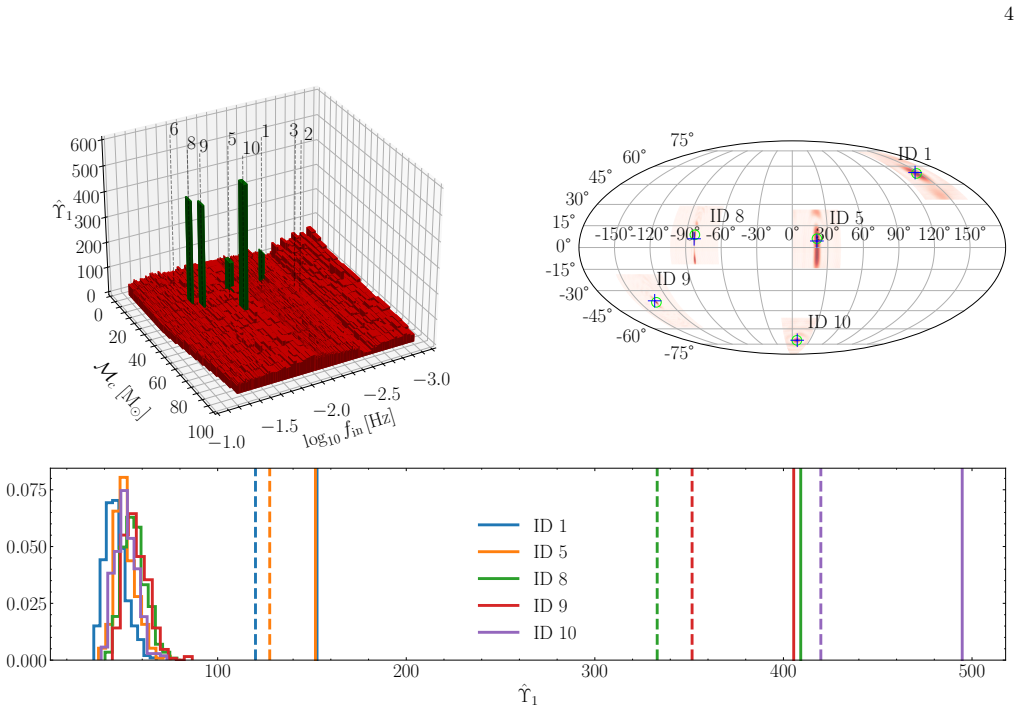
We present a complete pipeline for detecting and characterizing gravitational waves produced by the inspiral of stellar-mass binary black holes in LISA data. The analysis framework relies on an efficient time-frequency implementation of an adaptive semi-coherent detection statistic, which we show to be robust against non-stationary noise and the presence of gaps of varying duration and cadence. The search is able to detect signals with coherent signal-to-noise ratios as low as approximately 11-14 over the full parameter space of binary black holes with spins aligned to the orbital angular momentum and orbital eccentricity at most 0.01 when deployed on the 2-year-long LISA Data Challenge Yors
What carries the argument
An efficient time-frequency implementation of an adaptive semi-coherent detection statistic that scans the data while remaining stable under noise variations and interruptions.
If this is right
- The pipeline recovers signals over the full parameter space for aligned-spin, low-eccentricity binary black holes.
- Performance holds in the presence of non-stationary noise and gaps of varying duration and cadence.
- The entire search completes within one day on approximately 40 GPUs.
- The same techniques extend directly to searches for extreme-mass-ratio inspirals in LISA data.
Where Pith is reading between the lines
- The method could serve as a template for efficient global searches across multiple LISA source classes that share similar signal morphologies.
- If the statistic proves stable under relaxed assumptions on spin and eccentricity, the same pipeline structure could cover a wider fraction of the binary black hole parameter space without major redesign.
- Combining this time-frequency approach with existing matched-filter pipelines might reduce the overall computational load for LISA data analysis by handling the initial detection stage.
Load-bearing premise
The adaptive semi-coherent detection statistic remains effective when restricted to aligned spins and eccentricity at most 0.01 amid the specific non-stationary noise and gap patterns of the Yorsh data challenge.
What would settle it
Inject known signals with coherent signal-to-noise ratios of 11-14 into the Yorsh data challenge and verify whether the pipeline recovers them at the claimed rate.
Figures



read the original abstract
We present a complete pipeline for detecting and characterizing gravitational waves (GWs) produced by the inspiral of stellar-mass binary black holes in data from the Laser Interferometer Space Antenna (LISA). The analysis framework relies on an efficient time-frequency implementation of an adaptive semi-coherent detection statistic, which we show to be robust against non-stationary noise and the presence of gaps of varying duration and cadence. The search is able to detect signals with coherent signal-to-noise ratios as low as $\approx 11-14$ over the full parameter space of binary black holes with spins aligned to the orbital angular momentum and orbital eccentricity $\le 0.01$ when deployed on the 2-year-long LISA Data Challenge Yorsh. The search can be run within a day using $\approx 40$ GPUs. The techniques presented here have wider applications in GW astronomy, in particular the search for extreme-mass-ratio inspirals in LISA data.
Editorial analysis
A structured set of objections, weighed in public.
Referee Report
Summary. The manuscript presents a complete pipeline for detecting and characterizing gravitational waves from the inspiral of stellar-mass binary black holes in LISA data. The framework uses an efficient time-frequency implementation of an adaptive semi-coherent detection statistic, claimed to be robust against non-stationary noise and gaps of varying duration and cadence. It reports successful detection of signals with coherent SNR as low as ≈11-14 over the full parameter space of aligned-spin, eccentricity ≤0.01 binaries when applied to the 2-year Yorsh LISA Data Challenge, with the search completing in a day on ≈40 GPUs, and notes wider applicability to searches for extreme-mass-ratio inspirals.
Significance. If the performance and robustness claims hold under detailed scrutiny, the work would be significant for LISA data analysis by providing a practical, computationally efficient global search method capable of reaching low coherent SNR thresholds for a key source population. Deployment and testing on a public data challenge supports reproducibility and enables direct method comparisons. The extension to other LISA signals such as EMRIs broadens the potential impact.
major comments (2)
- [Abstract] Abstract: the headline claim of detection at coherent SNR ≈11-14 is presented without derivation details, error bars, baseline comparisons to other methods, or quantitative validation metrics on injected signals beyond the headline assertion, leaving the central performance claim only moderately supported.
- [Abstract] Abstract (robustness claim): the assertion that the adaptive semi-coherent statistic remains effective under the exact gap cadence, duration distribution, and non-stationary noise properties of the Yorsh challenge is load-bearing for the uniform low-SNR reach across the aligned-spin, e≤0.01 space, yet no region-specific tests or degradation metrics are referenced to confirm this holds uniformly.
minor comments (1)
- The manuscript would benefit from explicit definitions and notation for the time-frequency implementation of the adaptive statistic and the coherent SNR measure.
Simulated Author's Rebuttal
We thank the referee for their careful review and constructive feedback. We address the two major comments on the abstract below. Where appropriate, we have revised the abstract to improve clarity and cross-referencing while preserving its concise nature.
read point-by-point responses
-
Referee: [Abstract] Abstract: the headline claim of detection at coherent SNR ≈11-14 is presented without derivation details, error bars, baseline comparisons to other methods, or quantitative validation metrics on injected signals beyond the headline assertion, leaving the central performance claim only moderately supported.
Authors: The abstract summarizes the key result; the derivation of the SNR threshold, including the injection campaign, detection statistics, and recovery metrics, is provided in Sections 4 and 5, with quantitative results in Figures 3–6 and Table 1. We have added a brief clause to the abstract directing readers to these sections for the supporting analysis. Error bars are not applicable because the reported range reflects the lowest coherent SNR at which every injected signal in the tested parameter space was recovered. Direct baseline comparisons to other pipelines are outside the scope of this work, which presents and validates our specific time-frequency semi-coherent approach on the Yorsh challenge. revision: partial
-
Referee: [Abstract] Abstract (robustness claim): the assertion that the adaptive semi-coherent statistic remains effective under the exact gap cadence, duration distribution, and non-stationary noise properties of the Yorsh challenge is load-bearing for the uniform low-SNR reach across the aligned-spin, e≤0.01 space, yet no region-specific tests or degradation metrics are referenced to confirm this holds uniformly.
Authors: The robustness claim is supported by the pipeline’s successful recovery of all injected signals across the full aligned-spin, e≤0.01 parameter space when run on the actual Yorsh data set, which incorporates the challenge’s specific gap structure and non-stationary noise. Section 3 details the adaptive statistic’s design for handling gaps and non-stationarity. We have added a cross-reference in the abstract to Section 3 and the relevant figures. While region-by-region degradation metrics are not separately tabulated, the uniform low-SNR performance across the entire space in the presence of the challenge’s exact noise and gap properties provides the primary validation. revision: partial
Circularity Check
No significant circularity; performance validated on external public data challenge
full rationale
The paper presents a pipeline using an adaptive semi-coherent statistic and demonstrates its detection reach (coherent SNR ≈11-14) on the independent LISA Data Challenge Yorsh dataset. The abstract explicitly ties the performance claim to deployment on this external 2-year challenge data with its specific noise and gap properties. No equations, self-citations, or steps in the provided text reduce the central result to a fit, definition, or prior author work by construction. The result is externally falsifiable on public challenge data rather than tautological.
Axiom & Free-Parameter Ledger
Reference graph
Works this paper leans on
-
[1]
A. G. Abacet al.(LIGO Scientific, VIRGO, KA- GRA), arXiv e-prints , arXiv:2508.18081 (2025), arXiv:2508.18081 [gr-qc]
work page internal anchor Pith review Pith/arXiv arXiv 2025
-
[2]
J. Aasiet al.(LIGO Scientific), Class. Quant. Grav.32, 074001 (2015), arXiv:1411.4547 [gr-qc]
work page internal anchor Pith review Pith/arXiv arXiv 2015
-
[3]
Advanced Virgo: a 2nd generation interferometric gravitational wave detector
F. Acerneseet al.(VIRGO), Class. Quant. Grav.32, 024001 (2015), arXiv:1408.3978 [gr-qc]
work page internal anchor Pith review Pith/arXiv arXiv 2015
-
[4]
Akutsuet al.(KAGRA), PTEP2021, 05A101 (2021), arXiv:2005.05574 [physics.ins-det]
T. Akutsuet al.(KAGRA), PTEP2021, 05A101 (2021), arXiv:2005.05574 [physics.ins-det]
-
[5]
Punturoet al., Classical and Quantum Gravity27, 194002 (2010)
M. Punturoet al., Classical and Quantum Gravity27, 194002 (2010)
work page 2010
-
[6]
A Horizon Study for Cosmic Explorer: Science, Observatories, and Community
M. Evanset al., arXiv e-prints , arXiv:2109.09882 (2021), arXiv:2109.09882 [astro-ph.IM]
work page internal anchor Pith review Pith/arXiv arXiv 2021
-
[7]
T. L. Collaboration, Monthly Notices of the Royal Astronomical Society524, 5984 (2023), https://academic.oup.com/mnras/article- pdf/524/4/5984/52633671/stad588.pdf
work page 2023
- [8]
-
[9]
Searching for Gravitational Waves from Compact Binaries with Precessing Spins
I. Harry, S. Privitera, A. Boh´ e, and A. Buonanno, PRD 94, 024012 (2016), arXiv:1603.02444 [gr-qc]
work page internal anchor Pith review Pith/arXiv arXiv 2016
-
[10]
Laser Interferometer Space Antenna
P. Amaro-Seoaneet al., arXiv e-prints , arXiv:1702.00786 (2017), arXiv:1702.00786 [astro-ph.IM]
work page internal anchor Pith review Pith/arXiv arXiv 2017
-
[11]
M. Colpiet al., arXiv e-prints , arXiv:2402.07571 (2024), arXiv:2402.07571 [astro-ph.CO]
work page internal anchor Pith review Pith/arXiv arXiv 2024
-
[12]
The promise of multi-band gravitational wave astronomy
A. Sesana, PRL116, 231102 (2016), arXiv:1602.06951 [gr-qc]
work page internal anchor Pith review Pith/arXiv arXiv 2016
-
[13]
Multiband gravitational-wave event rates and stellar physics
D. Gerosa, S. Ma, K. W. K. Wong, E. Berti, R. O’Shaughnessy, Y. Chen, and K. Belczynski, PRD 99, 103004 (2019), arXiv:1902.00021 [astro-ph.HE]
work page internal anchor Pith review Pith/arXiv arXiv 2019
- [14]
- [15]
-
[16]
P. A. Seoaneet al.(LISA), Living Rev. Rel.26, 2 (2023), arXiv:2203.06016 [gr-qc]
work page internal anchor Pith review arXiv 2023
- [17]
-
[18]
J. R. Gair, L. Barack, T. Creighton, C. Cutler, S. L. Larson, E. S. Phinney, and M. Vallisneri, Class. Quant. Grav.21, S1595 (2004), arXiv:gr-qc/0405137
work page internal anchor Pith review Pith/arXiv arXiv 2004
- [19]
- [20]
-
[21]
J. R. Gair and G. Jones, Class. Quant. Grav.24, 1145 (2007), arXiv:gr-qc/0610046
work page internal anchor Pith review Pith/arXiv arXiv 2007
-
[22]
Detecting extreme mass ratio inspirals with LISA using time-frequency methods
L.-q. Wen and J. R. Gair, Class. Quant. Grav.22, S445 (2005), arXiv:gr-qc/0502100
work page internal anchor Pith review Pith/arXiv arXiv 2005
- [23]
- [24]
- [25]
-
[26]
Y. Wang, Y. Shang, S. Babak, Y. Shang, and S. Babak, Phys. Rev. D86, 104050 (2012), arXiv:1207.4956 [gr-qc]
work page internal anchor Pith review Pith/arXiv arXiv 2012
-
[27]
R. Buscicchio, A. Klein, E. Roebber, C. J. Moore, D. Gerosa, E. Finch, and A. Vecchio, PRD104, 044065 (2021), arXiv:2106.05259 [astro-ph.HE]
- [28]
-
[29]
D. Bandopadhyay and C. J. Moore, Phys. Rev. D108, 084014 (2023), arXiv:2305.18048 [gr-qc]
- [30]
- [31]
-
[32]
H. Wang, M. J. Williams, I. Harry, and Y.-M. Hu, arXiv e- prints , arXiv:2510.07174 (2025), arXiv:2510.07174 [astro- ph.HE]
work page internal anchor Pith review Pith/arXiv arXiv 2025
- [33]
- [34]
-
[35]
A. Toubiana, S. Marsat, E. Barausse, S. Babak, and J. Baker, Phys. Rev. D101, 104038 (2020), arXiv:2004.03626 [gr-qc]
- [36]
-
[37]
B. P. Abbottet al., PRL116, 061102 (2016), arXiv:1602.03837 [gr-qc]
work page internal anchor Pith review Pith/arXiv arXiv 2016
-
[38]
B. P. Abbottet al., Physical Review X6, 041015 (2016), arXiv:1606.04856 [gr-qc]
work page internal anchor Pith review Pith/arXiv arXiv 2016
-
[39]
B. P. Abbottet al., Physical Review X9, 031040 (2019), arXiv:1811.12907 [astro-ph.HE]
work page internal anchor Pith review Pith/arXiv arXiv 2019
-
[40]
Abbottet al., PRL125, 101102 (2020), arXiv:2009.01075 [gr-qc]
R. Abbottet al., PRL125, 101102 (2020), arXiv:2009.01075 [gr-qc]
-
[41]
R. Abbottet al., Physical Review X11, 021053 (2021), arXiv:2010.14527 [gr-qc]
work page internal anchor Pith review Pith/arXiv arXiv 2021
-
[42]
R. Abbottet al., Physical Review X13, 041039 (2023), arXiv:2111.03606 [gr-qc]
work page internal anchor Pith review Pith/arXiv arXiv 2023
-
[43]
A. G. Abacet al., arXiv e-prints , arXiv:2507.08219 (2025), arXiv:2507.08219 [astro-ph.HE]. 7
work page internal anchor Pith review Pith/arXiv arXiv 2025
-
[44]
A. G. Abacet al.(LIGO Scientific, VIRGO, KA- GRA), arXiv e-prints , arXiv:2508.18082 (2025), arXiv:2508.18082 [gr-qc]
work page internal anchor Pith review Pith/arXiv arXiv 2025
-
[45]
A. G. Abacet al.(KAGRA, Virgo, LIGO Scientific), Phys. Rev. Lett.135, 111403 (2025), arXiv:2509.08054 [gr-qc]
work page internal anchor Pith review Pith/arXiv arXiv 2025
-
[46]
R. Buscicchio, J. Torrado, C. Caprini, G. Nardini, N. Kar- nesis, M. Pieroni, and A. Sesana, J. Cosmology Astropart. Phys.2025, 084 (2025), arXiv:2410.18171 [astro-ph.HE]
-
[47]
S. E. de Mink and A. King, ApJ839, L7 (2017), arXiv:1703.07794 [astro-ph.HE]
work page internal anchor Pith review Pith/arXiv arXiv 2017
- [48]
-
[49]
R. Tenorio and D. Gerosa, arXiv e-prints , arXiv:2502.11823 (2025), arXiv:2502.11823 [gr-qc]
-
[50]
T. A. Prince, M. Tinto, S. L. Larson, and J. W. Armstrong, Phys. Rev. D66, 122002 (2002), arXiv:gr-qc/0209039
work page internal anchor Pith review Pith/arXiv arXiv 2002
-
[51]
A. J. K. Chua, C. J. Moore, and J. R. Gair, Phys. Rev. D96, 044005 (2017), arXiv:1705.04259 [gr-qc]
work page internal anchor Pith review Pith/arXiv arXiv 2017
-
[52]
N. J. Cornish and R. W. Hellings, Classical and Quantum Gravity20, 4851 (2003), arXiv:gr-qc/0306096 [gr-qc]
work page internal anchor Pith review Pith/arXiv arXiv 2003
-
[53]
M. Tinto and S. V. Dhurandhar, Living Reviews in Rela- tivity24, 1 (2021), arXiv:gr-qc/0409034 [gr-qc]
-
[54]
J. Valencia and S. Husa, PRD112, 044020 (2025), arXiv:2505.09600 [gr-qc]
-
[55]
Servignat, Yorsh stellar black hole binaries dataset (2025), lDC Technical note
G. Servignat, Yorsh stellar black hole binaries dataset (2025), lDC Technical note
work page 2025
-
[56]
P. Schmidt, M. Hannam, and S. Husa, Phys. Rev. D86, 104063 (2012), arXiv:1207.3088 [gr-qc]
work page internal anchor Pith review Pith/arXiv arXiv 2012
-
[57]
S. Khan, S. Husa, M. Hannam, F. Ohme, M. P¨ urrer, X. J. Forteza, and A. Boh´ e, PRD93, 044007 (2016), arXiv:1508.07253 [gr-qc]
work page internal anchor Pith review Pith/arXiv arXiv 2016
-
[58]
Gravitational-wave phasing for low-eccentricity inspiralling compact binaries to 3PN order
B. Moore, M. Favata, K. G. Arun, and C. K. Mishra, Phys. Rev. D93, 124061 (2016), arXiv:1605.00304 [gr-qc]
work page internal anchor Pith review Pith/arXiv arXiv 2016
- [59]
-
[60]
L. D. C. working group, Lisa data challenge software (2022)
work page 2022
- [61]
- [62]
- [63]
- [64]
- [65]
-
[66]
N. J. Cornish and L. J. Rubbo, Phys. Rev. D67, 022001 (2003), [Erratum: Phys.Rev.D 67, 029905 (2003)], arXiv:gr-qc/0209011
work page internal anchor Pith review Pith/arXiv arXiv 2003
-
[67]
W. Martens and E. Joffre, Journal of the Astronautical Sciences68, 402 (2021), arXiv:2101.03040 [gr-qc]
-
[68]
M. L. Katz, J.-B. Bayle, A. J. K. Chua, and M. Vallisneri, Phys. Rev. D106, 103001 (2022)
work page 2022
- [69]
-
[70]
S. Sakonet al., Phys. Rev. D109, 044066 (2024), arXiv:2211.16674 [gr-qc]
-
[71]
C. Chapman-Bird and D. Bandopadhyay, dig07/yorsh- end-to-end-search: Initial paper release (2025)
work page 2025
-
[72]
M. Abramowitz and I. A. Stegun,Handbook of Mathemat- ical Functions with Formulas, Graphs, and Mathematical Tables(Dover Publications Inc., New York, 1964) p. 300
work page 1964
-
[73]
DLMF,NIST Digital Library of Mathematical Functions, https://dlmf.nist.gov/, Release 1.2.4 of 2025-03-15, equations 7.5.3 and 7.5.4; F. W. J. Olver, A. B. Olde Daalhuis, D. W. Lozier, B. I. Schneider, R. F. Boisvert, C. W. Clark, B. R. Miller, B. V. Saunders, H. S. Cohl, and M. A. McClain, eds
work page 2025
-
[74]
Fourier-domain modulations and delays of gravitational-wave signals
S. Marsat and J. G. Baker, arXiv e-prints , arXiv:1806.10734 (2018), arXiv:1806.10734 [gr-qc]
work page internal anchor Pith review Pith/arXiv arXiv 2018
-
[75]
I. W. Harry, B. Allen, and B. S. Sathyaprakash, PRD80, 104014 (2009), arXiv:0908.2090 [gr-qc]. Supplemental Material Time-frequency search statistic —Here we de- tail our procedure for constructing the detection statis- tic, Eq. (1), in the time-frequency domain by evaluating Eq. (3) instead of the more computationally expensive Eq. (2), and its massively...
work page internal anchor Pith review Pith/arXiv arXiv 2009
discussion (0)
Sign in with ORCID, Apple, or X to comment. Anyone can read and Pith papers without signing in.